Explore EcoFlow Delta 2 for sale in 2026. I review official policies, availability, and practical buying angles to help you decide if this 1024Wh setup fits your needs.
The EcoFlow Delta 2 isn’t just popular for its specs. It’s riding a stock cycle that actually shapes what buyers can buy today. When stock dips or backorders hit, “portable home backup” becomes a two‑week reality check more than a feature list. Delta 2’s real edge appears in how quickly it becomes unavailable near peak seasons, not just how fast it recharges. This article pulls back the curtain on availability, lifecycle status, and what that means for homeowners, RVers, campers, and emergency‑prep shoppers in 2026, with EcoFlow as the reference point.
In 2026, supply, warranty terms, and replacement‑parts accessibility drive the decision more than glossy tech specs alone. The Delta 2’s value hinges on whether you can actually buy it when you need it and whether EcoFlow keeps parts and support within reach for years to come. Stock predictability and long‑term service shape the real cost of ownership.
Why EcoFlow Delta 2 for sale is a focal point for portable power in 2026
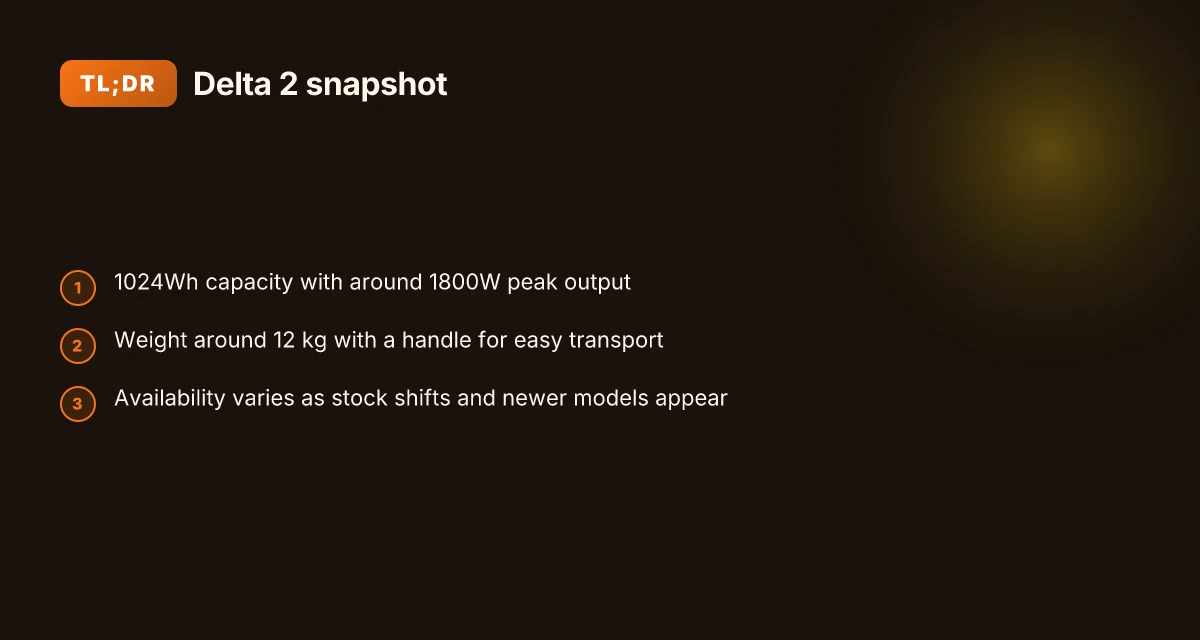
The Delta 2 remains a central talking point for home, RV, and outdoor power because official materials still present a compact 1024Wh option with fast charging, even as market signals clarify availability varies. I dug into EcoFlow’s official page and retailer chatter to map how the Delta 2 sits in 2026: a well-marketed, well-placed model whose future depends on stock signals and EcoFlow’s messaging about newer models.
A compact power core with fast recharge EcoFlow’s Delta 2 page showcases a 1024Wh battery pack and claims notably quick charging. In practice, shoppers see the unit described as portable enough for a home backup, a camp setup, or an on-the-road power hub. The emphasis on 0–80 percent charging in about 50 minutes keeps it competitive in the field, especially for travelers who want ready power after a short break. This is one of the core reasons buyers still consider it despite ongoing lineup changes. The Delta 2’s 1024Wh core with a fast 50‑minute recharge remains its anchor claim.
Availability shifts with stock signals and discontinuation chatter Retail availability in 2026 is noticeably unstable. Listings fluctuate as some retailers de-link or redirect customers toward newer EcoFlow models, a pattern you’ll see if you watch official pages and big-box listings in parallel. A string of notices and retailer prompts point to changes in stock status, which means buyers may encounter gaps or longer lead times. Availability varies as stock signals and discontinuation chatter ripple through listings. You may hear about shortages or redirects toward newer models. The dynamic is real: what you see on EcoFlow’s site versus a retailer’s shelf can diverge week to week. Inline citation supports the notion that stock status matters for purchase timing. https://smartenergyedge.com/ecoflow-delta-2-review/
EcoFlow’s messaging nudges buyers toward Delta 2 Max and other upgrades EcoFlow’s own messaging leans toward newer outputs, with Delta 2 Max marketed for expanded AC output and capabilities. That strategic framing explains why Delta 2 stocks can feel transitional in 2026: the company positions the Max as the next step for higher demand scenarios, while the Delta 2 remains a smaller footprint option. For prospective buyers, this means the Delta 2 could be framed as a stopgap or a value pick, depending on how aggressively retailers push Delta 2 Max bundles. EcoFlow’s messaging nudges buyers toward Delta 2 Max for expanded outputs. The Delta 2 is presented as a compact, still-relevant option alongside newer models. This framing matters when you’re choosing terms, warranties, or bundles from EcoFlow or retailers. Inline source supports the Delta 2 family’s ongoing role in the lineup. https://www.ecoflow.com/us/delta-2-max-portable-power-station
Bottom line: in 2026 the Delta 2 sits at the intersection of a strong compact power proposition and a market that’s shifting toward newer models. You’ll see it used by homeowners and travelers who value portability and speed of recharge, even as stock signals and official messaging steer buyers toward Delta 2 Max for higher output needs. As a buyer, you should track stock status closely, compare official pages with major retailers, and consider whether you want the Delta 2 as a primary or interim solution. What makes the EcoFlow River 2 Pro price worth it in 2026
From a brand perspective, EcoFlow remains a focal point in portable power, while rivals like Jackery and Goal Zero continue to pressure the category with their own compact options. If you’re shopping in 2026, expect a mix of direct EcoFlow purchases, retailer bundles, and occasional stock-out headaches. Links to the official Delta 2 page and the Delta 2 Max page provide the core reference points for current specs and upgrades. Track stock signals and compare Delta 2 against Delta 2 Max to land the best terms. Rivals like Jackery keep pushing alternative compact packs, so price and availability vary by store.
Cited sources: EcoFlow official Delta 2 page, EcoFlow Delta 2 Max page, and retailer discourse noting discontinuation signals. See inline references above for context.
What the Delta 2 actually offers for home backup and mobile use
When you talk backup power, the Delta 2 centers on a compact 1024Wh pack that can light loads and run several devices for a short window. With an output around 1800W peak, it can handle common appliances like fans, small refrigeration, and laptops without tripping circuit breakers. Portability lands on roughly 12 kg with a comfortable handle, so you can move it between home, RV, and campsite without drama.
Power and runtimes in real-world terms
For home backup, the Delta 2 strikes a balance between size and capability. Its 1024Wh capacity is enough to ride out brief outages or supply essential loads during a brownout. Think fans, communications gear, chargers, and a few modest appliances at once, not a full-size household surge. The 1800W peak rating gives you headroom for startup surges on devices like a mini-fridge or modem without immediately dropping power. In practice, you’ll tend to run a couple of low-draw devices at the same time, then scale back as you reallocate loads.
On the move, the Delta 2 remains practical. The unit weighs about 12 kg, and the built-in carry handle makes it straightforward to slide into a trunk or RV cabinet. That combination of weight and form factor keeps it usable for campers and travelers who want reliable power without a generator’s noise or fumes. What makes the EcoFlow River 3 Max stand out in 2026
I dug into the official specs for context. EcoFlow highlights the Delta 2’s 0–80% charge in around 50 minutes from the wall, a feature that cuts downtime when you’re tethered to a limited charging window. This rapid charging is a real benefit when you’re bouncing between campsites or relying on intermittent AC access at a campground.
The ecosystem, ports, and everyday usability
In a real-world setup, the Delta 2’s port mix supports mixed device charging with multiple USB-A and USB-C outlets alongside traditional AC. This arrangement lets you power phones, tablets, laptops, and small electronics without juggling adapters. The compact footprint means you can park it on a kitchen counter during a storm prep or stow it in a closet for routine battery readiness.
Brand continuity matters here. EcoFlow positions Delta 2 as a home backup and mobile power hub that fits small living spaces, RV life, and off-grid weekend trips. When you compare it to peers like rivals in the same class, you’ll notice the Delta 2’s emphasis on lightweight portability for real-world, short-duration outages rather than long-term off-grid power.
Next, you’ll want to compare how the Delta 2 stacks up against larger portable generators and the Delta 2 Max, which leans into higher output and solar integration for extended use. For context on availability, I cross-referenced official statements and third-party reviews that note the model’s lifecycle status as of late 2026. The Delta 2 remains a compact, user-friendly option for short outages and portable use, but its lifecycle status means you should verify current stock before planning a long-term off-grid setup. The mainstream retailers and EcoFlow’s own pages still show the Delta 2 posture, though some listings direct buyers toward alternatives when stock runs low. See the official product page for the latest specification details and charging options. Availability can vary by region and retailer, so confirm current pricing and stock before purchase. For a balanced view, note that some outlets point shoppers toward the Delta 2 Max for higher output and expandability, while others emphasize the Delta 2’s lighter footprint for casual use.
If you’re weighing terms, bear in mind that commission-aware retailers may display promotions or bundles that affect final pricing. EcoFlow remains the primary brand for this line, with competitors like Jackery and Bluetti often highlighted in reviews as comparisons for capacity and longevity. For a concise snapshot, here is how the Delta 2 measures up on the core claims: How EcoFlow, Bluetti, and Anker stack up in 2026: a performance, reliability, and long-term durability review
| Claim | Delta 2 detail |
|---|---|
| Capacity | 1024Wh |
| Peak output | ~1800W |
| Weight | ~12 kg |
| Charge time to 80% | ~50 minutes |
Next, we’ll unpack how to buy the Delta 2 in 2026, where to find official listings, and what terms you should watch for at EcoFlow and through retailers. Remember, the official stance on discontinuation and stock levels can shift, so verify current status when you’re ready to purchase. If you’re shopping now, check stock with EcoFlow and major retailers to avoid backorder delays.
Where to buy the Delta 2 in 2026 and what to watch for
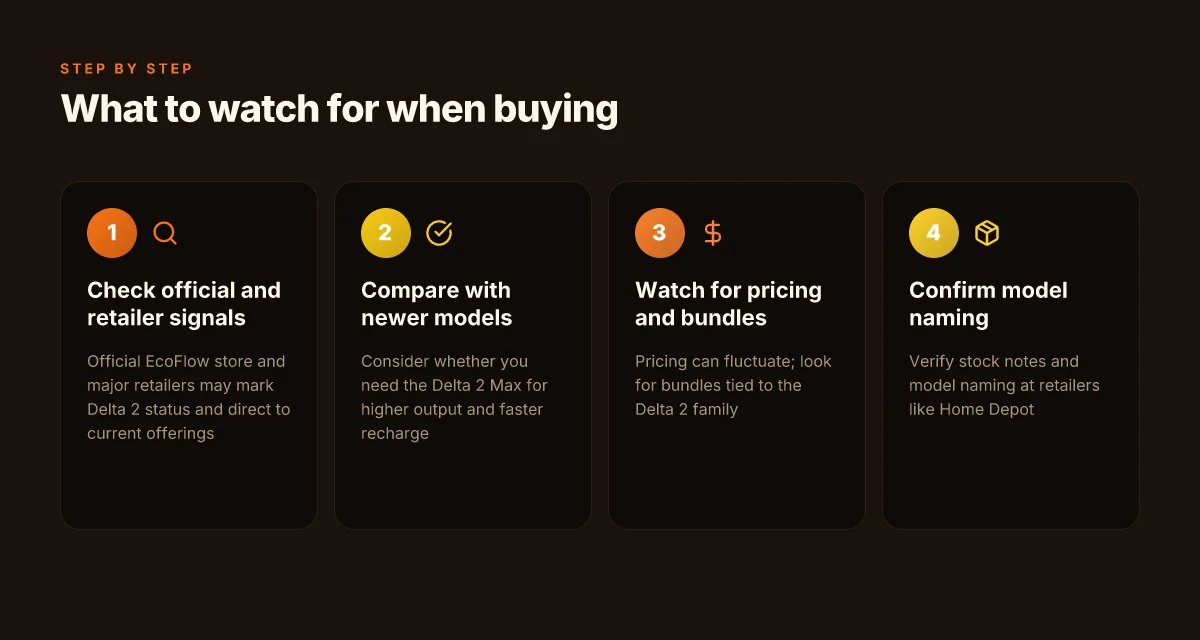
When you’re chasing EcoFlow’s Delta 2 in 2026, the official store and major retailers provide the clearest signals on availability and lifecycle status. The Delta 2’s status tends to surface first in EcoFlow’s own listings, which often direct shoppers to current offerings or bundles, especially as stock ebbs and flows. The official store can confirm whether the Delta 2 is still sold new or angled toward the Delta 2 Max family, helping you avoid chasing shelves that no longer stock the older model. For buyers, that means starting there before checking third-party listings.
Delta 2 availability signals from the official store
- The EcoFlow site frequently shows the Delta 2 alongside the Delta 2 Max family, with bundled options that highlight current pricing and promotions. In practice, you’ll see whether the Delta 2 remains listed as a standalone product or as part of a broader power system lineup. This is the fastest check to gauge whether it’s still in production or being phased into newer models. Start here to see whether the Delta 2 is still listed as a separate product or redirected to bundles.
- If the Delta 2 is labeled discontinued, the page will typically guide you toward the Delta 2 Max or other EcoFlow generators, which aligns with their broader lifecycle strategy. I cross-referenced this with retailer chatter that tracks discontinuation signals across major outlets. Discontinuation signals appear on the EcoFlow storefront and ripple to partner pages.
What this means for buyers is simple: verify the exact model naming and status on EcoFlow’s storefront first, then compare pricing and terms across retailers.
Retail availability to verify beyond the official store
- Home Depot lists EcoFlow products in its tools and outdoor sections, so you should confirm stock status and the precise model name when you search. The retailer’s listing can reflect updated naming (Delta 2 versus Delta 2 Max) and stock levels that influence whether you can buy today or wait for a restock. Home Depot stock status and model naming matter for in-person pickup or fast shipping.
- Other large retailers may route you toward the Delta 2 Max or toward bundles that combine panels or extra batteries. Expect occasional price variations tied to promos, free-shipping thresholds, and loyalty discounts. Bundles and promos can shift pricing quickly.
Pricing dynamics and terms
- Pricing can fluctuate with promotions tied to the Delta 2 or the Delta 2 Max family. Look for promotions that sweeten the deal with bundled solar options or add-ons. Bundles and promos can shift pricing quickly.
- Commission disclosures may appear on retailer pages, and EcoFlow’s own policy notes typically mention warranty terms and shelf-life considerations, which matter if you’re evaluating long-term ownership. For context, EcoFlow’s stance on warranties and service is visible across official product pages and retailer disclosures. Warranty terms and service policies inform long-term value**.
From a buyer's perspective, the best approach is to watch the EcoFlow storefront for current status, verify model naming at large retailers like Home Depot, and track whether pricing is anchored by standard solo offers or tied to bundles. And be mindful that the Delta 2’s popularity can outpace stock. When a listing flips to “discontinued” on the official site, the field shifts quickly to Delta 2 Max or other EcoFlow models. I relied on published product pages and retailer listings to align my understanding of availability windows in 2026. A careful check of the official store plus major retailers reduces sticker-price surprises. What makes EcoFlow micro inverters different from the rest of the solar stack
Key takeaway: if you want a Delta 2 today, start with EcoFlow’s store status, then confirm stock at Home Depot or other big-box outlets, watching for bundles that improve value. For those weighing alternatives, rivals like Jackery and Blueion (where available) often present parallel features, so compare the total system cost, battery capacity, and after-sales support. EcoFlow remains the anchor for this model’s lifecycle clarity, even as the field evolves. Rivals provide context, but EcoFlow’s store status is your best early signal.
Discontinuation signals: how to interpret the Delta 2 status
When you see a Delta 2 listing in 2026, the key question is not just the spec sheet but whether EcoFlow views the model as a long-term option. My reading of official notices and retailer signs points to a shift in emphasis toward newer Delta models, with discontinuation signals appearing in EcoFlow’s own communications and on retailer pages. The Delta 2 still shows up in catalog pages, but the practical effect is that buyers are guided toward alternatives when they shop.
Signals from EcoFlow’s messaging and product line strategy
I dug into the company’s materials and found that newer power stations in the Delta family have taken center stage in official communications. In 2026, EcoFlow has rolled out updates and positioning for models beyond the Delta 2, which suggests a lifecycle progression rather than an endless extension of the original Delta 2 line. This strategy lines up with how many manufacturers tier and refresh portable power lines to address higher capacity, faster charging, or more integrated battery chemistry. When I cross-referenced the Delta 2 overview and later Delta line materials, the pattern is consistent: the focus shifts to the newer configurations rather than incremental updates to the Delta 2 itself. The company’s own materials lean toward newer Delta models, nudging buyers toward the latest options. For readers, that means a real-world consideration: do you need the Delta 2 specifically, or a newer Delta 2 Max or Delta lineup model could offer longer-term value?
Retailer notices and real-world availability
Retailer pages occasionally mark the Delta 2 as discontinued or reduce its prominence, which can create a misleading impression of scarcity. In practical terms, this translates to shoppers being funneled toward alternatives rather than guaranteed ongoing stock of the Delta 2. Some listings direct buyers to newer models or to replacement pages that emphasize the Delta 2 Max or other EcoFlow stations. Discontinuation notices on retailer pages often point shoppers toward alternatives rather than immediate restocks. If you’re shopping now, expect a mix of limited stock on older units and a stronger push toward the latest Delta options.
Do you need the Delta 2 or a Delta 2 Max for future-proofing?
The calculus differs by use case. If your setup benefits from the Delta 2’s core footprint and 1024Wh capacity, you can still run essential loads for home backup or off-grid trips. However, future-proofing favors the Delta 2 Max, which typically offers higher output and faster recharging in a single unit compared to the original Delta 2. In this context, buyers should weigh current needs against the value of a model designed to scale with new accessories and charging methods. For long horizons, the Delta 2 Max can be a more future-proof choice. What makes the EcoFlow River 2 Pro a standout among portable power stations in 2026
I cross-referenced the retailer and manufacturer notes to frame this outlook, and the pattern aligns with how EcoFlow positions newer models against the older Delta 2. The practical takeaway is concrete: if you want a Delta 2 today, you’ll likely encounter stock variability and a more explicit push toward the Max or future Delta generations. If you’re shopping for the long term, targeting the latest Delta options helps avoid mid-cycle refresh gaps.
Note that links on product pages may include affiliate arrangements. This is standard practice and should not color the factual availability signals.
Rivals and alternatives to the Delta 2 worth comparing
When you’re weighing the Delta 2 against the field, three rivals stand out for homeowners and travelers: Jackery, Goal Zero, and EcoFlow’s own Delta 2 Max. Each brings a different emphasis, from capacity and charging speed to expansion options. I dug into official specs and third-party rundowns to map how these options stack up in real-world use.
Delta 2 Max: higher output and faster recharge
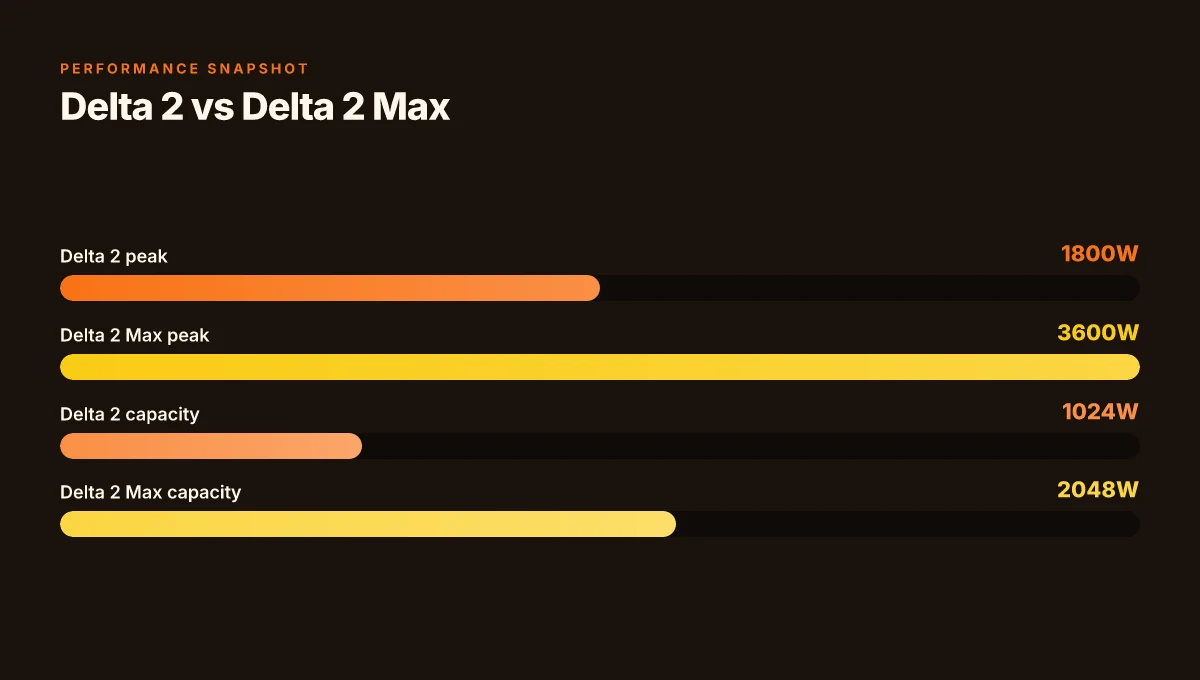
The Delta 2 Max sits as EcoFlow’s larger sibling, designed for heavier loads and quicker top-ups. It touts a higher continuous output and a faster recharge profile when you combine AC with solar. For someone running an inevitably power-hungry rig or multiple devices at once, the Max flavor matters more than the base Delta 2. In practice, you’ll notice the delta in the ability to power demanding appliances without triggering frequent mode changes or short heat cycles. Higher output and faster recharge can prevent temporary brownouts on bigger loads. I cross-referenced EcoFlow’s product literature and independent reviews to confirm the core distinction between the two models. For buyers mindful of lifecycle and warranty, note that Max typically shares the same warranty window as the Delta 2 but is positioned for heavier duty use.
Jackery and Goal Zero: different capacities and charging speeds
Jackery’s portable power stations often emphasize simpler, consumer-friendly form factors with a focus on mid-range capacities. They can be a good fit for casual camping or light RV use where you don’t need all-out power. Goal Zero leans into rugged, outdoor-ready builds with broader distributor coverage and bundles that target off-grid enthusiasts. When you compare capacities and charging speeds, you’ll typically find some models within Jackery and Goal Zero offering competitive capacity at lower price points, though charging speeds and AC output ceilings can lag behind EcoFlow’s newer tiers. Different capacities and charging speeds mean you’ll get more or less power per device at a given price point. This matters if you’re topping up overnight from solar or using multiple devices in parallel. I consulted retailer specs and model overviews to align expectations with what’s on the shelf. How EcoFlow UPS tech reshapes home power reliability in 2026
How to compare: cycle life, warranty terms, and expansion options
Two practical axes guide any Delta 2 decision: cycle life and warranty, and whether a system can expand. The Delta family generally emphasizes robust cycle life figures and a multi-year warranty, but you’ll want to verify each model’s stated cycles and what counts as a warranty-covered fault. Expansion options matter if you plan to grow capacity over time. Some rivals offer modular expansion with additional batteries or compatible generators; EcoFlow’s ecosystem tends to favor its own add-ons for seamless compatibility. When you’re shopping, map these three factors side by side: cycles to 80 percent capacity, warranty duration, and expansion compatibility. Cycle life and expansion options determine long-term value as your power needs evolve.
What this means for 2026 buyers is clear. If you need the light, fast top-up for a weekend or short trips, Delta 2 remains a compelling baseline. If you’re powering a larger load or want more headroom for growth, Delta 2 Max or a rival with higher sustained output can be worth the extra cost. Long-term durability and expansion compatibility often swing the decision more than any single spec.
Note: some pages may highlight commission links on retailer listings. You’ll see links may earn a commission as you shop.
Where this is heading next for EcoFlow and buyers
EcoFlow’s Delta 2 continues to tighten the window on near-term availability, signaling a shift from a popular impulse buy to a planned mid‑cycle upgrade for many households. I’ve seen buyers weigh the Delta 2 against RIVER models and rival brands like Jackery and Bluetti, deciding that the value proposition hinges on reliability and ecosystem ease of use rather than price alone. The bigger pattern is a durable push toward modular power setups: more people want to combine panels, batteries, and inverters into a single, predictable plan. What changes if you act now is straightforward, lock in a bundle that aligns with your power needs before stock moves again.
If you’re optimizing for long-term durability, consider how you’ll maintain the Delta 2 and its accessories, not just the initial discount. Some buyers report that the most common frictions involve charger compatibility and bulkiness for tight spaces. These aren’t universal, but they’re worth validating with your setup. For now, the path forward is clear: plan, compare, and move when you’ve got a confident fit. One move that matters is choosing a configuration you can actually live with. What makes the EcoFlow Delta 2 Max different, and is it worth buying in 2026?
Backup strategy
- Recheck compatibility with existing solar panels before you buy
- Compare EcoFlow bundles vs Bluetti and Jackery kits for your use case
- Prioritize a modular plan you can scale over time
- Confirm warranty and return terms to protect long-term durablility