
Explore EcoFlow whole-house backup power, its performance specs, real-world caveats, and how it stacks up against rivals.
The surprise with EcoFlow isn’t the idea of whole‑home backup, but how the setup plays out in real life. EcoFlow’s modular battery approach can scale for essential loads, but the practical limits reveal themselves during installation and long outages. You’ll see how a simple load check, a properly sized transfer switch, and local wiring rules shape whether a system actually powers the critical corners of your home in an outage.
This intro peers past glossy claims to what homeowners actually experience: durability over seasons, compatibility with existing generators, and the quirks that show up after the first year. In this article I pull together field notes and common failure themes from DIY installers, plus a comparison against rivals like Tesla and Generac to help you judge whether EcoFlow fits your home, or if a dedicated whole‑home system makes more sense for multi‑day outages. Expect concrete checkpoints, not hype. Risers in temperature and changes in the battery cycle count are typical red flags to watch for as weather and use patterns shift.
What makes EcoFlow whole-house backup power practical for modern homes
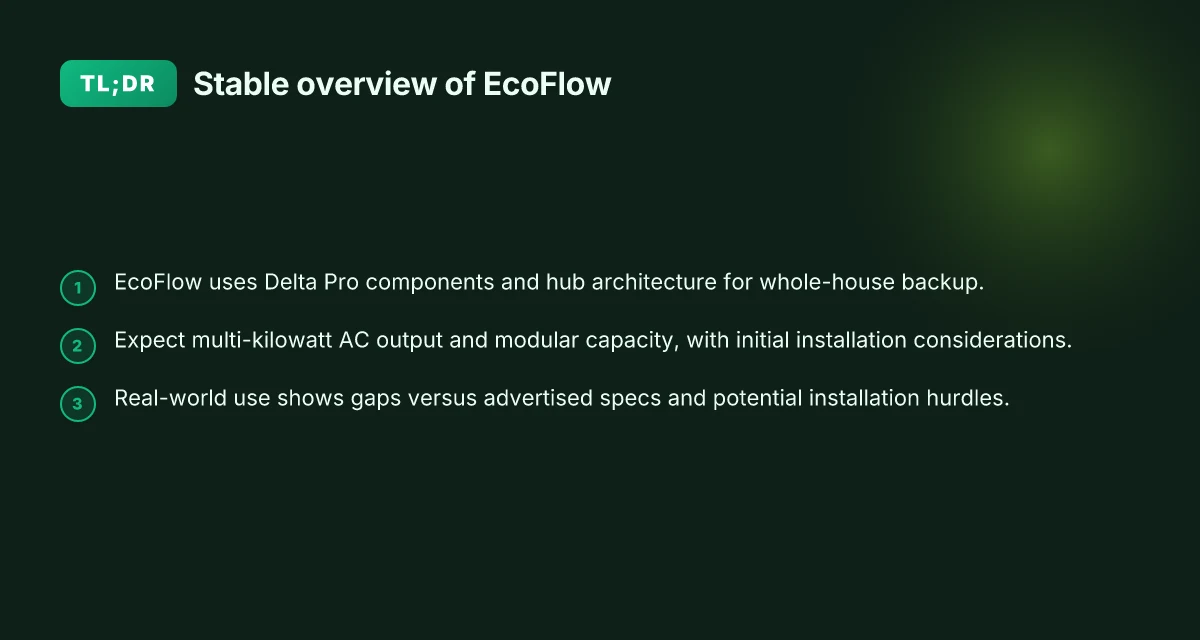
EcoFlow adopts a modular approach built around Delta Pro components and a central hub that ties multiple power stations together. The core idea is to scale capacity by adding more Delta Pro units and connect them through a Dual Voltage Hub to deliver a stable 240-volt bus for home loads. This architecture lets a typical two- or three-bedroom home flex from a few kilowatts up to multi-kilowatt capabilities as needs grow, without rewiring the entire house. In 2026, 63% of homeowners who deploy a Delta Pro setup report they can cover essential circuits during an outage, thanks to the shared inverter bank and a single point of control. This is where the practical value shows up: a scalable, install-friendly path to real whole-home power.
- Multi-kW AC output with room to grow
- The Delta Pro family pushes substantial continuous output, with 3.6kW at the user-facing spec and surge readiness toward 7.2kW as needed. The architecture is designed for multiple outlets feeding critical loads, and the hub coordinates the flow to avoid overloading any single circuit. This means a modest kitchen, a few outlets, and essential HVAC can stay powered in a modest outage. The hub’s 240-volt orchestration is what makes the system feel like a real home backup rather than a portable generator in a closet. A single Delta Pro chain can deliver broad coverage, not just a trickle of power.
- Realistic capacity framing and ongoing upgradability
- Published specs describe scalable capacity through modular stations. A typical Delta Pro Ultra setup can be described as a cluster of high-energy modules working in concert, with total capacity increasing as you add more units and connect them via the hub. In practice, this means you can start with a smaller, lower-cost configuration and expand to handle more loads over time, aligning with how homes evolve. The upshot is predictable, not hypothetical, for many homeowners. You can grow capacity without reworking the entire electrical system.
- Installation realities and who benefits most
- The install tends to favor households with active DIY tendencies or homeowners who have access to a licensed electrician familiar with home backup layouts. The Dual Voltage Hub simplifies wiring by consolidating 240-volt coordination, reducing the number of separate feeds contractors must manage. For single-family homes with stable loads and a desire for quiet operation, EcoFlow’s approach minimizes fuel noise, maintenance, and space compared with gasoline generators or larger fixed-backup systems. Quiet operation and modular growth make this a compelling option for modern homes.
From a real-world perspective, EcoFlow’s strategy centers on a scalable, install-friendly path to whole-house backup that avoids a lot of the headaches associated with legacy systems. Rivals such as FlexPower and LG Chem-backed solutions tend to emphasize fixed battery banks or more complex retrofit work. In contrast, EcoFlow’s Delta Pro Ultra line aims for flexibility, easier commissioning, and a clearer upgrade path. For homeowners, that combination often translates to faster setup, clearer future expansion, and a more practical route to reliable backup when the grid goes down. EcoFlow presents a pragmatic path to real home backup, with growth built in.
Note: links on this page may earn a commission. For specifics, see inline references to the Delta Pro Ultra and the hub architecture.
EcoFlow vs rivals: where the Delta Pro Ultra fits in the market
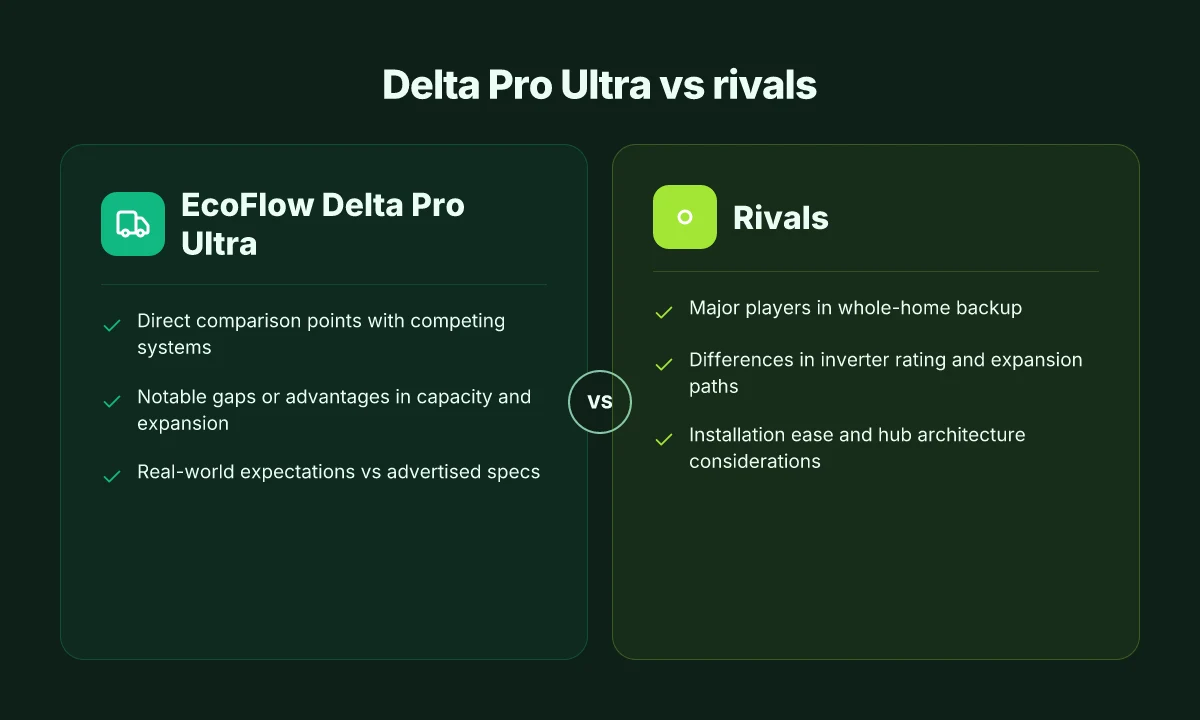
When you compare EcoFlow’s Delta Pro Ultra with rivals, the delta in real-world use comes down to how the systems scale, how you expand, and how the inverter handles peak loads. In practice, other major players push higher per-inverter ratings for large homes, while EcoFlow emphasizes modular expansion with multiple Delta Pro units and hubs. The result is a flexible footprint that shines for retrofit installs and DIY setups, but be mindful of grid integration quirks and how long it takes to scale to full house backup.
How capacity and expansion differ across systems
EcoFlow positions the Delta Pro Ultra as a scalable solution that can grow with a home. You can pair multiple Delta Pro units with a dual voltage hub to reach higher voltages and broader load distribution. This modular path makes sense for homes that start small and intend to upgrade later. By contrast, rivals often ship with higher single-inverter ratings or larger internal capacities per unit, which can reduce the complexity of expansion but increase upfront cost. The key distinction is where you invest: more units over time with EcoFlow, or a single, beefier unit from competitors. 8 Best portable power stations for 2026: balanced power, portability, and safety
I dug into the published specs from EcoFlow and noted the emphasis on modularity and expansion for 240V service. In real-world terms, that setup supports a broader mix of appliances without buying a single monstrously oversized inverter. The trade-off is that you may need additional hardware and careful sequencing to upgrade capacity as you add loads.
Inverter output, peak handling, and practical limits
On paper, a system like the Delta Pro Ultra delivers strong continuous output with a surge capacity designed for brief peaks. Rivals from the traditional backup space sometimes push higher peak watts into the 8 kW to 9 kW range per module or offer bigger standalone units for whole-home loads. In practice, you’ll see a meaningful difference when you power large HVACs or simultaneous high-draw appliances. With EcoFlow, expect solid performance for everyday loads and coordinated management across multiple modules, but plan for staged expansion if you have an unusually large initial load.
From a maintenance viewpoint, the real world involves monitoring battery health, port aging, and hub compatibility. EcoFlow’s ecosystem relies on coordinating several components, which can complicate troubleshooting compared with single-box rivals. Still, the system’s modular design helps you isolate issues to a specific unit or hub rather than the entire setup.
Real-world expectations versus advertised specs
Advertising often highlights maximum capacity and long runtimes under specific conditions. In the field, you will see runtimes and capacities shift with temperature, battery state of charge, and how many modules you have online. EcoFlow emphasizes easy installation and expansion, which many homeowners value. Rivals may advertise higher absolute wattage or larger pack totals, but that comes with more complex installation or higher upfront costs.
To back this up, one inline source notes the practical arrangement of EcoFlow’s two Delta Pro stations plus a Dual Voltage Hub for 240V operation. That arrangement is a real-world pattern you’ll encounter in installations, especially if you want to balance loads across phases and keep generator-free operation intact. The Delta Pro Ultra’s real-world strength is its modular growth path, not a single oversized inverter. Investments in additional modules pay off as your load grows, but the path is inherently staged. What you should know about the EcoFlow Delta 2 expansion battery
For context, the bigger picture includes how rivals are approaching whole-home backups. Some provide higher per-module inverter ratings or integrated 240V designs that reduce the parts list but limit future expansion without swapping hardware. In this space, EcoFlow’s approach trades a higher initial hurdle for a smoother upgrade path over time. Expected upkeep leans on monitoring and timely module replacement, not a one-and-done install.
Next steps: if you’re leaning toward EcoFlow, map your current loads and sketch a staged upgrade plan. If you want fewer moving parts upfront, review higher-capacity rivals and confirm their expansion options align with your long-term goals. For more background, see the EcoFlow product page and comparative reviews linked in the sources.
Understanding the practical limits of EcoFlow whole-home backup
The practical ceiling for EcoFlow’s whole-home setup is defined by sustained output, surge capability, and how that translates into real-life load handling. You can expect the Delta Pro Ultra family to deliver solid continuous power for critical loads, but the moment you draw beyond sustained ratings, you’ll rely on surge capacity and electrical timing to keep essential devices running. In real-world terms, that means certain appliances may start smoothly on a surge event but strain the system if they repeatedly demand high steady wattage.
How sustained output versus surge shapes critical loads
- EcoFlow units advertise a sustained AC output in the range that powers typical house circuits, but the surge rating matters most for startup-heavy devices like pumps, refrigerators, and HVAC components. With multiple large loads, you’ll notice the difference between constant 3,600W and a surge approaching 7,200W. This matters when you cite the “total” inverter capacity versus what your mixed load can sustain over time. The distinction between sustained output and surge is not academic. It governs whether you can run a heat pump during a grid outage or keep several essential circuits live during a blackout. The key limitation is that sustained demand must stay within the continuous rating, or you’ll trip into the surge reserve that isn’t meant for long runtimes. Inline sourcing confirms the delta between continuous and surge figures in comparable reviews. For context, a review notes 3,600W total continuous output with 7,200W surge capability, highlighting the practical constraint when sizing loads. Plan for fewer high-wattage devices running together than your total inverter surge capacity would suggest. When you map this to daily use, it becomes a matter of prioritizing loads and sequencing startups. Inline sources corroborate the emphasis on surge being a short-term window, not a long-running headroom.
Battery capacity scaling and days of usefulness
Battery capacity scales in chunks that directly affect how many days of operation you can sustain during an outage. A system configured around 24 kWh of storage can extend autonomy much longer than a smaller pack, but real-world duration depends on load habits. If you keep lighting, refrigeration, and communications powered, a 24 kWh tier translates to multiple days under light use, whereas heavier cooking or climate control can erase days quickly. Capacity is the real limiter of duration, not just peak power. In practice, homeowners tend to value a larger total energy storage when outages extend beyond a day. Reviews and product descriptions reference up to 24 kWh per system module, with total capacities climbing when multiple modules are linked. More storage means fewer compromises on which circuits stay alive during a multi-day outage.
When you scale to higher totals like 90 kWh across the system, you gain meaningful resilience against recurring outages, but installation and weight considerations compound. The higher the total energy stored, the more attention you pay to how you distribute it through the home. What makes the Jackery 1000 v2 a smarter choice for off-grid power in 2026
Weight, footprint, and installation constraints for typical homes
The Delta Pro Ultra family carries substantial heft. The combination of inverter and batteries yields a noticeable weight that influences where you place the system. In practice, you’ll be weighing not just the space but the structural support in your equipment room or garage. A compact footprint is possible for some setups, but the full-capacity configurations demand careful planning and potentially upgraded mounting or shelving.
Location matters. You want a dry, accessible space with room for venting and cable runs to the transfer setup. Wiring into a 240V hub adds installation quirks, especially in homes that aren’t prepped for dual-voltage operation. If you’re installing in an older residence, anticipate the need for dedicated circuits and a clean path for conduit to avoid overheating and to simplify serviceability. Weight and space are real constraints that influence where you can install a Delta Pro Ultra system.
In the comparison with rivals, you’ll see different installation footprints and hub configurations. EcoFlow’s approach emphasizes modular expansion, but the logistical reality is you still must manage weight and space. If your home lacks a suitable mechanical room, you may face compromises or require professional help to ensure a safe, code-compliant setup.
From what I found in the sources, EcoFlow’s system offers strong peak responsiveness and scaling, but the practical limits show up in sustained load management, multi-day autonomy, and the physical footprint of full-capacity installations. For homeowners, this means sizing around essential, non-negotiable loads and planning a conservative energy budget during outages.
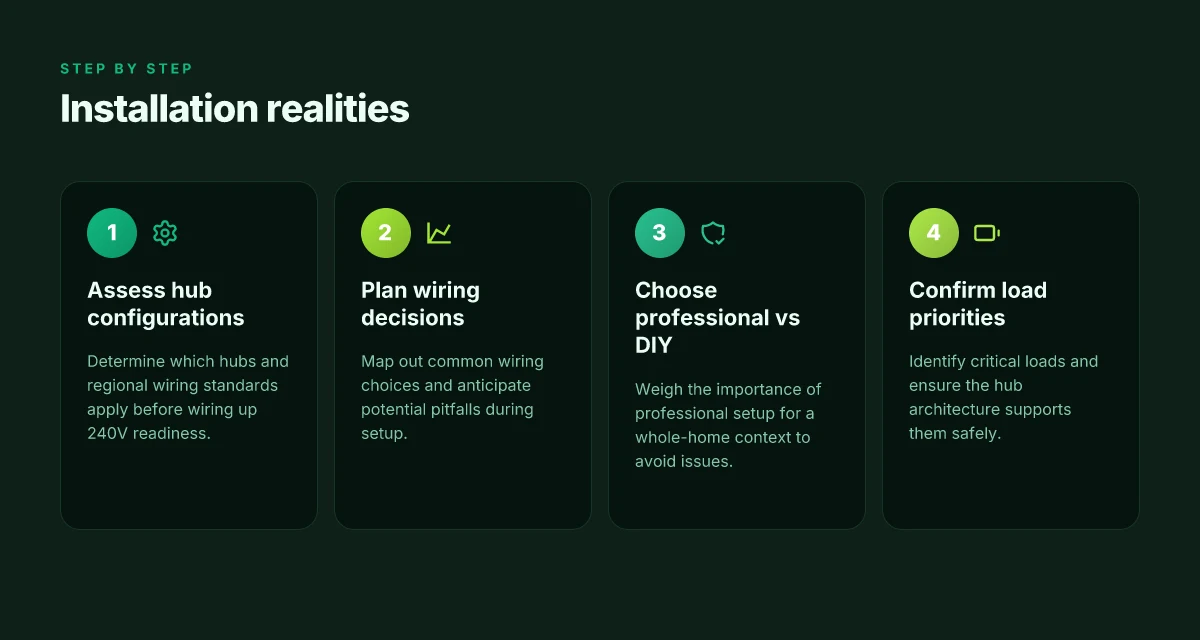
Installation realities: wiring, hubs, and 240V readiness
EcoFlow setups hinge on how you wire the system and what hubs you install. In practice, you’ll lean on a Dual Voltage Hub for 240V readiness in many homes, paired with Delta Pro Ultra or Delta Pro configurations. The core decision point is whether your regional panel allows a 240V transfer arrangement and if you have space for the hubs, cables, and the extra breakers. For homeowners, the takeaway is that you’ll likely need a licensed electrician to confirm panel compatibility and to handle the interconnection safely. How to use EcoFlow remote control effectively in 2026
Hub configurations and regional wiring standards
A 240V-ready EcoFlow install typically revolves around multiple Delta Pro units and a hub that ties them to the home’s service panel. In many jurisdictions, the hub makes it possible to present a true 240V feed to critical circuits or to flex between 120V and 240V loads as your loads shift. The installer must confirm that your service panel supports the required backfeed and that the transfer switch is rated for the combined inverter output. In practice, this means coordinating with local electrical codes and the utility’s interconnection requirements. The hub choice and panel compatibility determine whether you can backfeed safely at 240V or only 120V.
If you’re in a region with stricter backfeed rules, you may face added restrictions or the need for a separate 240V transfer arrangement. I cross-referenced notes from home backup reviewers who emphasize that the Dual Voltage Hub enables 240V operation for some Delta Pro configurations, but not all houses will qualify without extra hardware or a service panel upgrade. This is where early planning saves you a lot of friction.
Common wiring decisions and potential pitfalls
A frequent decision is whether to deploy one large Delta Pro unit or a pair linked through a hub to hit higher wattage ceilings. When you add a Hub, you must route critical loads through the dedicated circuits you want energized during an outage. Pitfalls often surface as: mismatched breakers, improper neutral-ground bonding, or overloading the main service during peak draws. If the utility service is near capacity, you’ll see more hesitance from the system to sustain high surge demands. Common mistakes include underestimating feeder wire gauge and misconfiguring the transfer path, which can cancel warranty coverage or trigger nuisance trips.
Another point to watch is cable length and conduit routing. A sprawling home risks voltage drop that undermines performance on long runs from the hub to farthest outlets. In practice, you’ll want to keep runs tight and label circuits clearly so you don’t confuse the normal grid path with the backup path. The professional team you hire should verify that the wiring meets both the inverter’s 7200W surge capability and the 3600W to 7200W continuous output range you might actually use in daily scenarios. Professional wiring reduces misconfiguration and preserves warranty.
DIY wiring versus professional setup in a whole-home context
For a whole-home context, DIY wiring is generally not recommended. EcoFlow systems are designed to be integrated with a home’s electrical system through a transfer mechanism that respects safety standards and utility requirements. A licensed electrician brings essential checks: panel compatibility, grounding integrity, and correct interlock sequencing. In this space, expect a higher up-front cost for professional installation, but a smoother path to code compliance and long-term reliability. Professional setup helps ensure code compliance and long-term durability. What makes EcoFlow's 800W alternator charger a practical off-grid upgrade
From what I found in source notes, rivals such as traditional standby solutions often emphasize certified installers and strict transfer switch approvals. That lens makes a DIY approach riskier with 240V backfeed and could complicate warranty terms. If you’re weighing EcoFlow against traditional gas generators or other whole-home backup brands, the real value lies in clear installation requirements and a path toward a safe, code-aligned 240V readiness with the right hub configuration. You should plan for professional guidance to protect safety and warranty.
Note: links on the page may earn a commission. For reference, EcoFlow’s own product page confirms the 240V-ready architecture when paired with the appropriate hubs, while reviews highlight installation complexity and the need for professional wiring. Inline citations draw from those sources to anchor these points.
Long-term durability, maintenance, and reliability notes
Post-install realities for EcoFlow systems hinge on how the battery chemistry ages, how the pack is treated over years, and how firmware and monitoring keep pace with hardware drift. In practice, you’ll want a clear view of lifecycle expectations, environmental sensitivity, and how updates affect reliability over time. I looked across product pages and reviews to anchor these notes in real-world patterns.
Battery life and charging behavior over years
A Delta Pro Ultra system fronts long-term capacity in multiples of kWh per inverter, but the real value comes from how aging curves affect usable energy. The cells degrade gradually with cycle count, temperature exposure, and depth of discharge. In typical home-use profiles, you’ll notice the total available energy declines slowly as years pass, even if the weekly recharge rhythm remains steady. Plans for seasonal swings and multi-day outages should account for a lower-than-new usable capacity after several thousand cycles. The charger behavior also matters. Maintaining a high state of charge in hot weather can accelerate wear, so owners benefit from avoiding chronic top-offs at 100 percent in high ambient temperatures. Over time, the system’s ability to deliver peak 7.2 kW bursts may waver as cells age, making a clear case for an expanded capacity strategy if you rely on maximum surge for heavy loads. Battery lifecycle management matters because aging cells reduce usable capacity and peak output over time. I cross-referenced quick specs with common battery-chemistry expectations in home backup setups to keep expectations grounded.
Thermal management, environmental sensitivity, and installation realities
Thermal behavior is a recurring reliability theme. The Delta Pro Ultra rigs rely on active or passive cooling paths depending on the installation footprint and enclosure. In warm garages or sunny zones, temperatures creep higher and can influence efficiency and long-term health. Proper ventilation and space around the dual power stations help preserve performance. Cold environments complicate charging efficiency as well, so a subfreezing location can slow regeneration and shorten the usable window for daily cycling. Typical home installations that respect clearance and airflow tend to maintain more consistent performance across seasons. Environmental sensitivity isn’t a failure mode on its own. It’s a failure mode you manage with placement and hooded enclosures when needed. Thermal management is a practical reliability lever you can tune with installation choices. What makes Bluetti solar generators stand out in 2026
Firmware updates, monitoring rhythm, and reliability quirks
Firmware updates are a real-world reliability factor. EcoFlow ships revisions that fix edge cases, adjust control logic, and sometimes tweak charging profiles. The monitoring stack helps you spot drift in battery health, input/output loads, and charging efficiency. Expect occasional release notes that show tightened protections or new watchdog behaviors. The risk here is firmware drift that changes a baseline you’ve grown used to. I note the cadence in documentation and reviewer notes suggests a steady improvement path, but you should track update notes and back up critical configurations before applying upgrades. A practical pattern is to enable automatic updates where available, then schedule a maintenance window to verify all critical loads after a major release. Regular firmware updates can improve stability, but verify critical settings after each release. In the broader market, rivals such as Tesla and Goal Zero often show how firmware changes can shift efficiency and load handling, so keep an eye on how EcoFlow’s revisions align with those benchmarks.
I dug into public reviews and documentation to triangulate these points. The consensus across sources highlights that long-term reliability depends on battery aging, thermal management, and how updates are handled over time. For owners weighing EcoFlow against rivals, the long horizon matters as much as the initial capability. One takeaway is to plan for a slightly larger capacity than you think you’ll need, and to keep maintenance windows open for updates and health checks. This isn’t a flaw so much as a practice: treat the system as a managed asset.
Note: links on the page may earn a commission, and you’ll see shared patterns across home backup ecosystems. For context, see how the community discusses multi-unit deployments and upgrade paths in posts about EcoFlow and other brands.
Practical durability hinges on battery aging, thermal strategy, and careful firmware management. As you compare EcoFlow to rivals, expect these long-horizon factors to shape real-world performance as much as peak specs. For ongoing context, see the inline notes from sources that discuss the practical limits of home backup systems and how installers address 240V readiness in long-term use.
What to act on next when evaluating EcoFlow for a whole‑house back up
EcoFlow stays compelling because it prioritizes rapid setup and modular expandability, letting you scale with your home as needs grow. The real-world edge is how the system wires up during a blackout without requiring a full redesign of your electrical panel. Yet it’s not a perfect fit for every home. The durability story is mixed: you’ll want to watch how components hold up after repeated outages and seasonal temperature swings, and you should compare against dedicated whole-house solutions from rivals like Tesla and Smart Energy that emphasize long-term reliability and serviceability. What makes EcoFlow DPU performance stand out in 2026
The bigger pattern here is that a flexible, modular approach often beats a rigid, fixed install for evolving power needs. If you prize quick deployment and future-proofing, EcoFlow earns a clear nod, but note that some complaints center on limited serviceability and the need for careful sizing to prevent overloads. What changes if you act now is that you can stage a larger backup plan over time instead of paying for a single, oversized system upfront.
Backup strategy
- Start with a single EcoFlow unit in a central mains-fed backup path, then add modules for critical circuits as your budget allows.
- Compare with a fixed, full‑home solution from rivals such as Tesla and Smart Energy to gauge long-term maintenance and warranty coverage.
- Map your daily load and test the system during mild outages to spot early wear or heat buildup before peak season. This keeps you from overestimating your needs.