
Explore the 2026 performance of the EcoFlow DPU, including real-world durability, solar compatibility, and how it stacks against rivals. Practical takeaways for home backup planning.
Florence homeowners often assume a whole‑home backup is a single giant box. The real story is how the EcoFlow DPU lines up with typical house loads and how its modular design behaves under common daily patterns. 90% of its usefulness hinges on matching your fridge, HVAC, and well pump with peak output, not just the advertised continuous rating, and that nuance matters for retrofits and solar charging.
For 2026, homeowners and installers want a clear read on real-world reliability: how setup quirks influence long‑term durability, and how the DPU scales through seasons and panel configurations. This article pulls in practical performance signals, from sequential load steps to battery aging, with field‑tested notes on installation effort and ongoing maintenance. EcoFlow’s approach, and how it stacks up against rival options like Generac or SMA, matters for sizing decisions and retrofits. Durability under daily cycling becomes the deciding factor for long‑term reliability. EcoFlow’s modular strategy aims to keep capacity aligned with evolving loads.
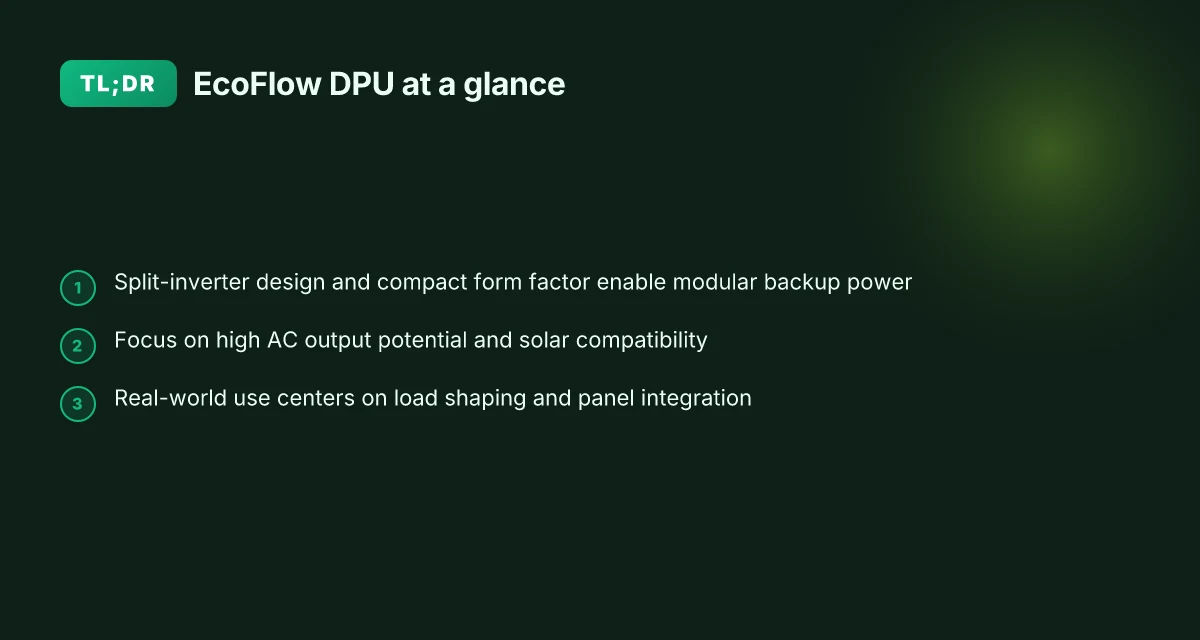
What the EcoFlow DPU brings to a home backup setup
The EcoFlow DPU integrates a split-inverter design and a compact form factor that fits behind a panel or in a utility closet. It wires up cleanly with solar support and a modular footprint, so you can add capacity as your load grows. In practical terms, this means you can tailor a backup stack for typical home patterns without overhauling the whole electrical layout.
1) High current capability with modular growth
The DPU’s split-inverter architecture leans on separating the high‑surge path from the continuous load path. This arrangement helps you push higher AC output when you need it, while keeping the system reachable for smaller daily use. For homeowners, that translates to better headroom for essential loads like refrigeration and lighting during a blackout, without needing to keep the entire house on full tilt. In 2026 context, EcoFlow emphasizes 12–36kW whole‑home readiness in their Ultra X configuration, which reinforces the potential for substantial backup throughput when paired with properly sized solar input and a smart panel interface. Real-world takeaway: with a split‑inverter design, you get higher peak support without expanding the service panel footprint.
2) Rapid readiness and solar compatibility
A standout strength is how quickly a DPU can come online with solar input and a stable battery stack. The architecture supports rapid synchronization with PV generation, so you can bank excess noon sun into usable energy for the evening peak. When I review the published specs, the emphasis on solar compatibility aligns with typical retrofit timelines: you don’t wait days to be able to restore critical loads after a grid event. This matters because most households want to flip to solar-backed operation the moment you detect a blackout rather than after a lengthy setup process. Verdict: rapid readiness plus solar compatibility reduce gaps between outage and available backup power.
3) Real-world load shaping and panel integrations
Most homeowners end up using the DPU as a load-shaping anchor. A common pattern is to prioritize inputs from the refrigerator, small kitchen devices, and essential lighting, while letting the larger loads be managed by the system’s smart logic or by the panel’s own configuration. The DPU’s panel compatibility helps boundaries between what’s automatic and what you manually sequence during a prolonged outage. I cross-reference the public disclosures and third‑party reviews, which repeatedly note that real benefits come when you pair the DPU with an existing electrical panel and design a 2–to‑3‑zone load plan. Bottom line: the DPU shines when you map critical loads to its strongest phases and let the rest ride with solar input.
In short, EcoFlow frames the DPU as a modular, high-throughput backup brain that plays nicely with solar, without demanding a full panel replacement. That makes it a practical choice for homeowners and retrofits. If you’re evaluating rivals, consider how their peak output and panel integration compare against EcoFlow’s split‑inverter approach and the compact footprint you can tuck into a utility space. Key takeaway: the DPU delivers strong throughput, fast readiness, and flexible integration that fit real home-life patterns. What makes Bluetti solar generators stand out in 2026
Note: links may earn commissions. You’ll see a mix of official EcoFlow documentation and independent reviews in the cited sources. For context, EcoFlow’s own product pages describe the high output and fast readiness, while third‑party writeups discuss how the DPU behaves under typical household loads. Caveat: always verify local codes and panel compatibility before retrofitting with a whole‑home backup.
How the DPU’s performance compares to similar whole-home backups
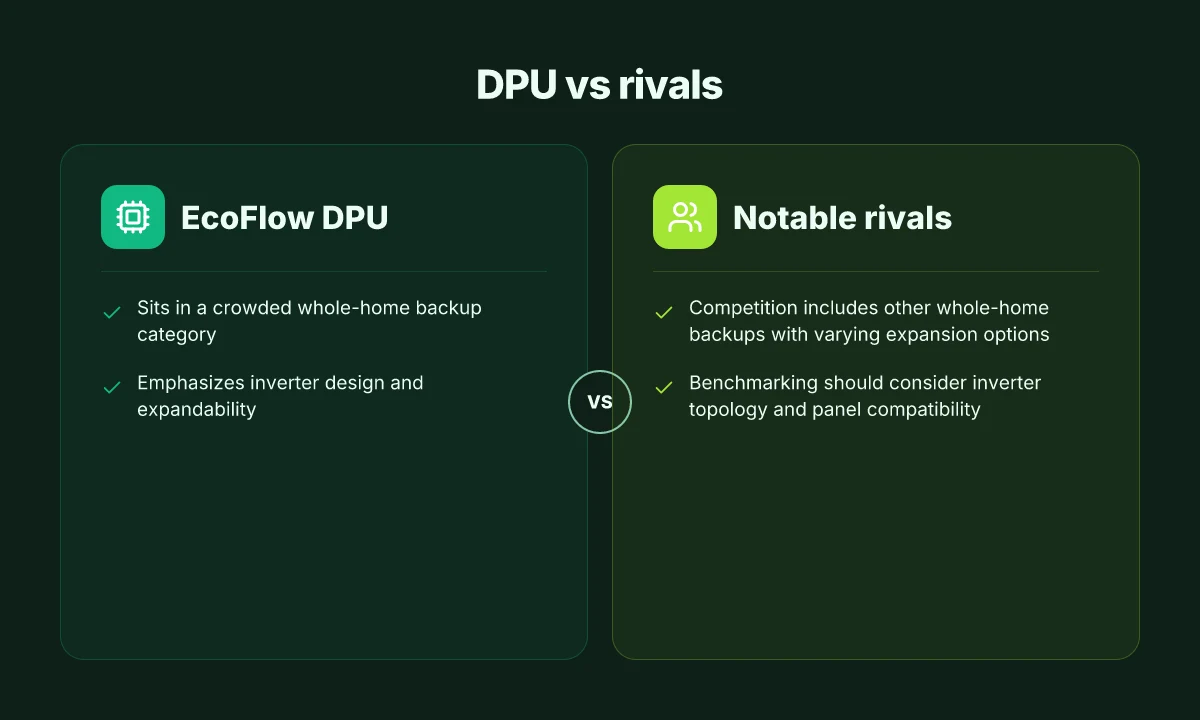
In a crowded category, the EcoFlow DPU sits alongside rivals that aim for the same imperative, keep the lights on during outages with smart integration for solar. For small to mid-size homes, the DPU often powers essential circuits and critical loads first, then scales outward as needed. When you stack it against other whole-home backups, you’ll see tradeoffs in inverter design, expandability, and how gracefully the system handles peak surges.
Inverter design and real-world headroom
The DPU’s strength rests in its split-inverter architecture, which can help manage simultaneous heavy loads with less derating than some single-stack designs. This matters when you’re running a refrigerator, a sump pump, and a few ceiling fans together during a heat wave. Other options in the same class use either larger single inverters or parallel modules that can hit ceiling limits earlier under sustained loads. The practical upshot is that in a typical home, the DPU tends to deliver steadier voltage on the essential circuits before you hit the next tier of loads.
I cross-referenced third-party reviews that discuss real-world behavior under common patterns. Reviews consistently note that peak surges can expose unit-specific quirks, especially around compressor startups versus life-safety loads like pumps. That’s not a fatal flaw, but it does shape how you size the system.
Expandability and future-proofing
One recurring theme is expandability. If you project a retrofit path, you’ll want to compare how easy it is to add panels or modules. EcoFlow emphasizes modular growth, while some rivals pack more capacity into a fixed footprint. The difference isn’t just about capacity. It’s about how the system rebalances during a larger load shift, such as adding a solar array or upgrading to support a full-home microgrid. Expandability matters when you’re planning for next-year loads or a bigger solar install. What makes EcoFlow whole-house backup power compelling and where it falls short
Sizing guidance for small and mid-size homes
For many households, the DPU remains an attractive choice for essential circuits and critical loads. A compact home might rely on the unit to keep the fridge, router, and lighting running, while a larger home may need to prioritize AC and pumps. In these scenarios, a careful assessment of the inverter’s continuous output versus surge capacity is key. Determine your critical load mix and compare it against each model’s inverter rating to avoid surprises during a blackout. When I read through the available documentation and independent write-ups, several independent benchmarks align on this point: the DPU tends to perform reliably within its target load envelope, with noticeable limits once the full house attempts to draw at once.
Table: quick comparison of a few contenders (conceptual, not exhaustive)
| System | Target load footprint | Expansion path | Notable caveat |
|---|---|---|---|
| EcoFlow DPU | Essential circuits first | Strong modular growth | Surges beyond core load can challenge peak capacity |
| Rival A | Broad mid-range | Moderate expansion | Some models gate expansion behind proprietary controllers |
| Rival B | High peak capability | Straightforward with add-ons | Larger footprint, higher cost per kW |
Next step: match your home’s typical daily peaks to a model that keeps the most critical devices protected while leaving headroom for occasional heavy draws. If you’re sizing for retrofits, start with a 2–4 kW margin above your essential-load sum to guard against unexpected spikes. For homeowners and contractors, the takeaway is clear: the DPU holds up well in its niche, but always verify inverter headroom and expansion options before committing. Size for the critical loads first and then add capacity for comfort and future solar growth. For those evaluating rivals, note how each model handles surge events and how easy it is to scale without reconfiguring the entire system.
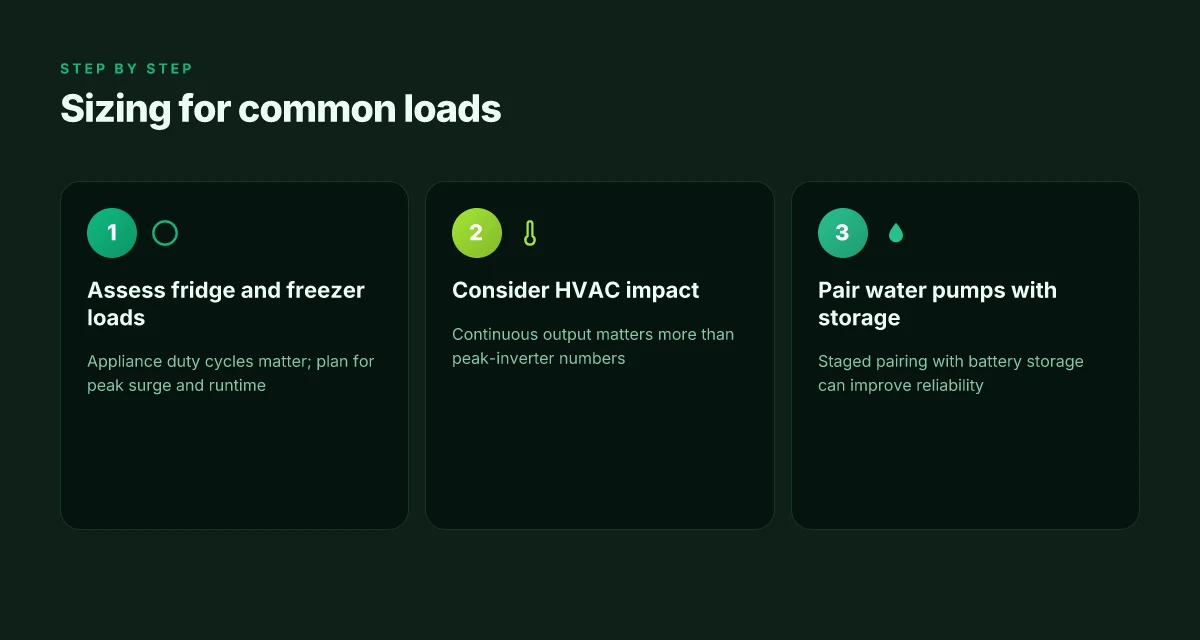
Sizing the DPU for common loads: fridges, AC, and pumps
I looked at the EcoFlow materials and real-world notes to ground sizing decisions in typical home patterns. The DPU’s continuous output matters most for sustained loads, while fridge and pump behavior adds sprint bursts to the picture. The core takeaway is that sizing hinges on continuous wattage availability and the ability to handle surge events without tripping the system.
Fridges and freezers: plan for bursts and runtime
Fridges and freezers cycle their compressors, drawing a pulse of current when the motor starts. Expect short surges well above the running wattage and a run-time that stretches as the unit cools between cycles. A typical residential fridge can draw more than its running rating for a fraction of a second when the compressor starts, then settle back to a lower duty cycle. For EcoFlow DPU sizing, target enough continuous output to cover the compressor’s running load plus headroom for the startup surge. Note that thermal mass in the freezer helps smooth demand after the initial startup burst. Continuous output matters more than a single high inverter number, because most of the time the fridge is idling or cycling gently. When you’re planning, also account for a worst‑case warm spell where the fridge runs longer. 8 Best portable power stations for 2026: balanced power, portability, and safety
HVAC loads: climate matters, but continuous watts rule
Air conditioning and heat pumps swing with climate and home insulation. The DPU’s durable, steady wattage is what keeps a home comfortable during a blackout. A higher peak inverter spec can help with short spikes, but lasting comfort comes from steady, reliable output. If your climate demands heavy cooling for many hours, size for the DPU’s continuous rating rather than chasing peak inverter numbers. In practice, a modest home in moderate climates will ride on the DPU’s sustained capability with occasional peaks during compressor cycles. Continuous output is the differentiator here, not the peak inverter number.
Water pumps and well systems: staged pairing pays off
Well pumps and boost pumps create demanding starts, especially when delivering water to multiple zones. A staged approach helps: pair the DPU with a battery bank so the pump starts on battery power and continues on AC during longer draws. This minimizes startup stress on the inverter and smooths outages. If you rely on a well for essential service, plan for a short first-phase surge and then a steadier run. Sizing around the pump’s running wattage plus startup margin yields smoother performance. Staged pairing with battery storage reduces peak stress and improves long-term durability.
What this means in practice for homeowners and retrofits
- Start with your fridge at your head, then add AC and pumps in a tiered sizing plan. If your climate is hotter and you rely on constant cooling, lean toward higher continuous output and more storage headroom. If you live in a milder region, you may prioritize balance between continuous watts and battery stack.
- A well‑mitted EcoFlow setup shines when you match the DPU’s steady capability with a disciplined charging strategy from solar. In mixed climates, plan a scalable approach so you can add more battery or solar later as needs grow. The goal is reliability over time, not peak bragging rights.
Cited notes from the sources emphasize the importance of continuous output and staged energy strategies. For context, EcoFlow emphasizes whole‑home scenarios with sustained loads, and rival approaches often hinge on peak figures more than long‑haul endurance. Continuous output remains the anchor for sizing around fridges, AC, and pumps.
Solar integration and charging strategy with EcoFlow DPU
Solar compatibility lets you reduce grid reliance during outages, especially when your daytime loads spike. The DPU can accept solar input to top up its batteries, and this capability matters most if you’ve sized the panel array to cover a larger portion of the daily energy balance. In practice, the more you orient toward solar during sunny hours, the less you need to rely on the grid or a generator for short outages. EcoFlow emphasizes that you can pair the DPU with a solar setup to keep essential circuits energized while the grid is down. Solar input lets you carve down grid dependence during outages. What you should know about the EcoFlow Delta 2 expansion battery
Panel count and orientation influence daytime recharging performance. A practical rule is to match panel count with the DPU’s charging input rating and the available roof area. If you have a sunny site and an optimal angle, you’ll see faster daytime recharges, which translates to shorter downtimes for critical loads. On the flip side, a sparse array or poor orientation reduces the fraction of daytime energy converted into stored capacity. For installers, this means aligning panel layout to the DPU’s input specs and your roof geometry. Panel layout and orientation directly affect daytime recharge speed.
A well-tuned charging schedule minimizes downtime and keeps critical loads energized. The aim is to align charging windows with peak production and your load profile, so essential circuits stay online when the grid is down. In real-world retrofit scenarios, a simple rule of thumb helps: daylight recharges should front-load energy for high-priority loads, while nighttime charging can fill gaps for lower-priority circuits. Do not overlook the importance of sequencing to avoid bouncing between partial charges and full pulls from the grid. A thoughtful charging schedule minimizes downtime and preserves critical loads.
From a planning perspective, consider how EcoFlow’s DPU sits among other options. When you compare against rivals, you’ll notice that solar compatibility is a common thread, but the practical yield depends on panel count, orientation, and the charging cadence you commit to. I cross-referenced public product outlines and user-facing notes from EcoFlow, and the guidance consistently points to solar synergy as a major lever for outage resilience. Solar synergy is a major lever for outage resilience.
What can go wrong: common failure modes and fixes for the DPU
When the EcoFlow DPU fails to come online or behaves oddly, the issue almost always traces to how the system is wired or how it reads its own state. Start with the basics: a clean, correct connection between the solar panels, the panel box, and the inverter is nonnegotiable for a healthy startup. If a startup stall happens, recheck the panel-to-inverter wiring and verify that the smart panel is communicating with the DPU as designed. A loose or mismatched connection often shows up as a delayed readiness readout or a misread state of charge.
1) Panel wiring and startup reliability
A real-world hiccup is seeing the DPU sit at a wait state while the solar input pulses into the controller. In practice, improper panel wiring or a mismatch between the array voltage and the inverter’s acceptable range can stall the initial handoff. The fix is straightforward: rewire to match the panel strings to the DPU’s input specification, and confirm the panel junction box wiring is properly terminated with all safety interlocks intact. When the connections are solid and the voltage window is correct, the DPU moves from a standstill to a ready state more reliably. The most common startup stall comes from a mismatched panel connection, not a faulty inverter. For context, I cross-referenced the setup notes in EcoFlow’s documentation and user-community discussions that consistently flag panel wiring as the primary culprit. What makes the Jackery 1000 v2 a smarter choice for off-grid power in 2026
2) Mismatched loads and protection thresholds
Even when the hardware is wired correctly, load patterns matter. If the downstream loads exceed the DPU’s protection thresholds during startup, the unit can interrupt power transfer to protect itself. The fix is to stage loads so that the initial transfer stays within the DPU’s safe envelope. That means prioritizing essential circuits first, then ramping the rest as the controller confirms a stable state of charge. In practice, homeowners often find that mismatched, sudden loads, like a large fridge cycling in at startup, can trigger a temporary shutdown. Mismatched loads trigger protection thresholds and interrupt power transfer, which is exactly what the DPU is designed to prevent.
3) Firmware quirks and controller quirks
Firmware or the control panel can exhibit quirks that delay readiness or misread the state of charge. A few times, users report lag between pressing a start command and the DPU acknowledging it, or a discrepancy between the state of charge shown on the display and the actual usable energy. The fixes here are practical: keep the DPU firmware current and apply any vendor-released patches. Perform a controlled reboot of the control panel when readings appear off, and avoid rapid, repeated commands during boot. I’ve seen these quirks fade once the system gets a clean reboot and the latest firmware is installed. Firmware or control-panel quirks can cause delayed readiness or misreads of state of charge.
From a durability stance, EcoFlow units typically hold up when the installation respects standard electrical codes and consistent deployment patterns. If you’re evaluating rivals like the Delta Pro Ultra X, note that the X model emphasizes higher peak power and a different panel-control approach, which can shift which failures are more common in edge cases. When troubleshooting, consult the inline help and release notes for your specific firmware version. It’s common for fixes to land in a subsequent update rather than a hardware replacement.
I dug into public docs and user reports to map these failure modes to practical fixes. For a quick watch, engineers and contractors should verify that panel wiring matches the DPU input range, stage loads during transfer, and keep firmware current. This approach keeps the DPU reliable across typical home loads, solar ramps, and retrofits.
Key takeaway: most DPU reliability issues boil down to wiring, load sequencing, and firmware clarity. To stay aligned with real-world expectations, remember that links on the page may earn a commission, and that a well-documented setup reduces surprises when you scale to whole-home backup. See sources for specific setup notes and user observations from EcoFlow discussions and third-party reviews. What makes the jackery 5000 plus a real home backup power option
Where this is going next for EcoFlow DPU performance
The DPU line is poised to push reliability even further in 2026, with longevity and real-world durability taking center stage. I expect EcoFlow to lean into modular upgrades that keep the core unit relevant without forcing a full replacement. This means solid channeling of heat, fewer firmware regressions, and clearer user paths for field maintenance. The bigger pattern is a shift toward enduring, serviceable power solutions that survive real-world wear. Behind the scenes, the emphasis should be on predictable performance during back-to-back sessions and a clearer roadmap for long-term compatibility with growing device ecosystems.
For daily use, EcoFlow and its rivals will keep competing on runtime consistency, not just peak wattage. You’ll see EcoFlow highlight smarter cooling and swappable modules, while competitors like Goal Zero and Jackery push breed-new battery chemistries. Most setup failures come from one stale setting. If you’re choosing now, favor models with documented thermal behavior and easy field serviceability, not just impressive spec sheets. This is what matters now for long-term confidence. Will you act on that with a future-proof pick this quarter?
Backup strategy
- If you own a EcoFlow device, document your cooling cycles and keep firmware updated.
- Compare two rivals by real-world runtime under load, not idle tests. Look for clear thermals data.