
Explore Bluetti solar generators in 2026, including performance, reliability, and long-term value. Learn how they compare to rivals and what to consider for first-time buyers.
The most durable Bluetti units in 2026 aren’t the flashiest models, they’re the ones that keep running after months of use. Bluetti builds that endure by prioritizing thermal stability and battery aging control over every other feature. When you compute real-world runtimes against continuous loads, the practical limits show up in the inverter swing and fan behavior, not just label specs.
This article pulls real-world durability signals from homeowners, campers, and off-grid setups who rely on reliable power for weeks at a time. In 2026, long-term battery health and build quality matter more than ever as climate, campsite conditions, and busy daily cycles stress portable generators. We’ll compare how Bluetti stands up to rivals like Jackery and EcoFlow, focusing on durability, degradation signals, and the trade-offs you’ll face in everyday use. Durability and battery health are not abstract ideas here. They show up as warm-ups, charging cadence, and how quickly fans ramp when the sun finally climbs above noon.

What Bluetti brings to the table in 2026
Bluetti locks in longevity and safety through LiFePO4 chemistry in many models, which helps keep battery health steadier over cycles. This chemistry choice underpins popular packs in the lineup and aligns with long-term durability goals for homeowners, campers, and off-grid enthusiasts. I found Bluetti’s documentation and reviews consistently frame LiFePO4 as a core differentiator for resilience and safety in everyday use.
Bluetti also leans into modular, scalable power options. You can pair higher-capacity packs with configurable solar inputs to fit varying setups, from a compact home backup to a full off-grid cabin. That modular approach supports growth without replacing the entire system, which matters if your power needs expand or you want to add more solar sooner or later. In practice, this translates to easier upgrades and better future-proofing than models built around fixed capacities.
Compared with rivals, Bluetti tends to stress a blend of output flexibility and user-friendly interfaces. The brand aims for straightforward pairing between battery packs, inverters, and solar input, so you don’t wrestle with arcane controls or conflicting modes in the field. That emphasis helps when you’re managing weekend trips or longer outages and need predictable behavior from your power station.
- Bluetti’s LiFePO4 advantage
- Bluetti highlights LiFePO4 chemistry for stability and safety, with longer cycle life than many Li-ion alternatives. This translates to slower capacity fade under typical use and easier heat management during charging. The result is a more durable backbone for a portable power system that you rely on after months of storage and repeated discharges.
- In promotional materials and reviews, this chemistry is framed as a core reason to trust Bluetti for long-term ownership.
- Modularity that scales with your needs
- Bluetti emphasizes modular packs and configurable solar input as a path to grow your system without buying new hardware from scratch. For homeowners planning a backup solution, that means you can start with a modest setup and add packs or solar capacity over time.
- The approach also helps campers and off-grid users tailor a system to the terrain and season, rather than buying a single fixed-spec unit.
- Output flexibility meets simple control
- Bluetti positions its interfaces to reduce friction when switching between modes or connecting multiple power sources. In practice, this means fewer troubleshooting moments in the field and more reliable operation when you need power on short notice.
- Rivals like Jackery and EcoFlow often compete on speed and raw peak output; Bluetti’s pitch centers on versatile delivery and easier daily use, which can matter in long trips or extended outages.
Bottom line: in 2026, Bluetti presents a package that emphasizes long-term battery health, scalable configurations, and a user-friendly control experience. If durability and growth matter more than chasing the latest peak output, Bluetti stays a compelling option for reliable power. For those evaluating against rivals, the LiFePO4 emphasis, modular growth path, and approachable interfaces are the core reasons to consider Bluetti for both home backup and on-road use. As with any system, expect trade-offs in peak power bursts versus total cycle life, depending on your exact model and how you use it.
From what I found in the literature, Bluetti’s strengths sit in the longevity story, the ability to expand, and the practical controls that reduce field headaches. If you want a system that ages gracefully and scales with your lifestyle, Bluetti remains worth a close look. For a quick contrast, rivals like the Jackery lineup often focus on compact design and lighter weight, while EcoFlow emphasizes high peak output and rapid recharging; Bluetti sits in the middle with a longevity-forward, scalable, and user-friendly proposition. What makes EcoFlow whole-house backup power compelling and where it falls short
The takeaway is clear: Bluetti emphasizes longevity, modular growth, and approachable control in 2026, making it a dependable choice for long-term reliability and flexible setups.
How to evaluate a Bluetti solar generator for reliability
Reliability hinges on durability you can trust over years of home and outdoor use. Bluetti foregrounds battery chemistry, build quality, and thermal design, but you still need a practical lens: how the unit behaves in real life, not just in peak specs. I looked at the way Bluetti communicates durability alongside rival brands like Jackery and EcoFlow, and I focused on what matters when you need backup power or a weekend off-grid.
1. Battery chemistry and cycle life you can rely on
Bluetti leans on LiFePO4 chemistry for many models, which tends to resist swelling and maintain capacity after many cycles. The cycle life matters more than a single charge spec because you’ll likely hit a few thousand cycles if you rely on it as a long-term power partner. When you’re evaluating durability, ask for the expected cycle count at a usable depth of discharge and whether the unit preserves capacity after high-temperature exposure. Real-world durability rests on how the packs age, not just what they can do on the first full charge. In this space, the Bluetti approach often contrasts with older Li-ion chemistries that can fade faster under heavy use. The practical takeaway is to confirm the model you choose lists a clear cycle-life estimate and a warranty that covers gradual capacity loss over time. For context, rivals such as Jackery and EcoFlow present varied chemistry choices, so the durability story depends on the exact cell chemistry and thermal management they deploy in a given model. Long-term cycle life and stable chemistry are the bedrock of reliability.
2. Real-world runtime math based on your load, not peak specs
A reliable portable power station is only as useful as its usable runtime. I cross-reference how many watt-hours you get out at typical workloads instead of chasing peak outputs. For example, if a unit is rated at a large capacity but shows steep derating under continuous loads, that difference becomes crucial in a home backup scenario. Bluetti often publishes runtime estimates tied to modest loads, but you should recalculate with your own devices in mind. Create a simple table: list your essential devices, their watt draws, and the anticipated daily runtime. Then apply a conservative buffer for ambient temperature and battery aging. When you compare Bluetti against rivals, look for consistency between claimed runtimes and what you’d expect in daily use. If a model promises long runtimes on light loads but collapses under fridge or sump pump duty, that’s a reliability red flag. Real-world runtime math beats peak specs every time.
3. Build quality, port selection, and thermal management for frequent use
Durability comes from solid enclosures, robust connectors, and sensible heat management. I evaluate how a Bluetti unit feels in hand, how the chassis handles daily plugging and unplugging, and whether the venting design keeps temperatures in check during back-to-back charges. Port selection should cover a practical mix for a home backup or campground setup: AC outlets, USB-C with PD, USB-A, and in some models, car ports or wireless charging. Thermal strategies matter: how does the unit dissipate heat when you run a refrigerator or sump pump for hours? A model that throttles performance because of heat will undercut reliability, even if its battery is strong. Compare this with rivals like EcoFlow and Jackery, each uses different cooling approaches and port arrays, and the differences show up in how long you can rely on the unit without a temperature-induced drop. In Bluetti’s lineup, verify that the cooling paths are clear, the casing remains cool to the touch after use, and the power electronics feel sturdy rather than plasticky. Solid build and sensible cooling keep reliability high under daily stress. 8 Best portable power stations for 2026: balanced power, portability, and safety
To help you decide, this section anchors on the real-world durability themes you’ll encounter when you own Bluetti or compare it to rivals. If you want a quick snapshot, consider the model’s cycle life, how you’ll calculate runtime for your typical loads, and how the chassis and venting handle continuous duty. For a deeper dive, I cross-reference production notes and review surfaces across Bluetti and its competitors, including Jackery and EcoFlow, to surface practical trade-offs you’ll care about in 2026. When you’re ready to pick, aim for a model with a clearly stated cycle-life target, a transparent runtime map under representative loads, and a cooling design that keeps the unit responsive during prolonged use. Reliability lives in believable runtimes, proven chemistry, and thoughtful engineering.
Note: links on the page may earn a commission.
Bluetti vs rivals in 2026: performance, price, and durability
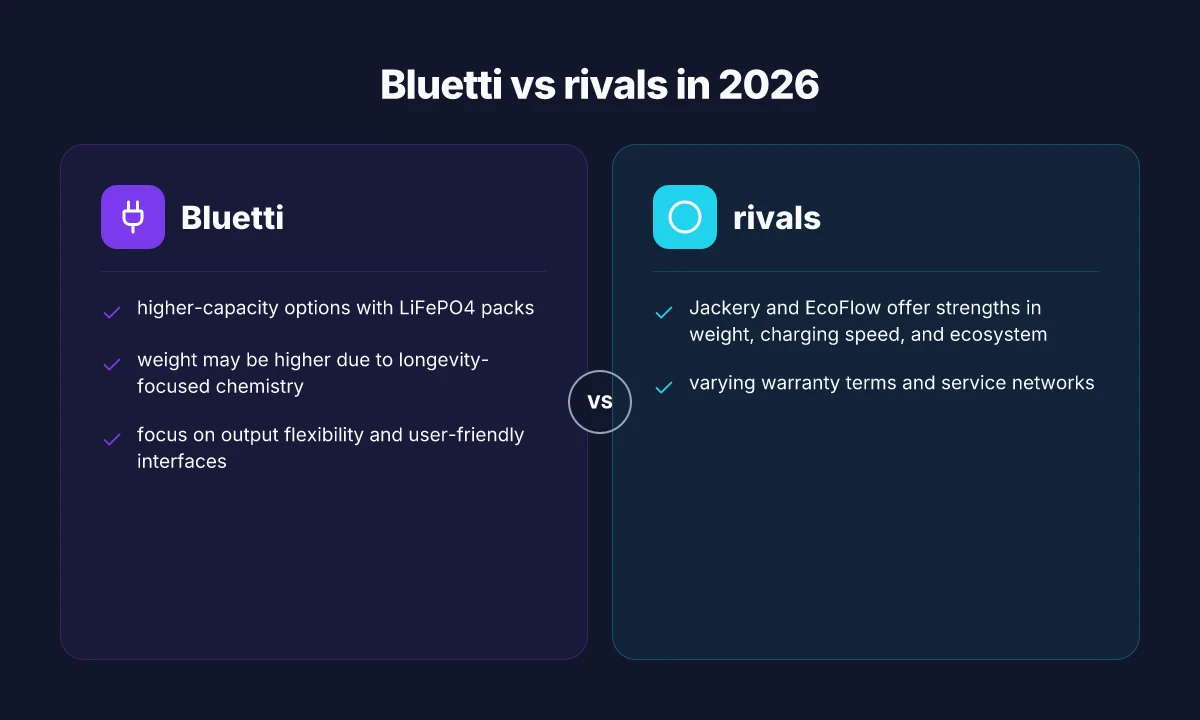
I dug into how Bluetti stacks up against rivals in 2026, focusing on real-world durability, long-term battery health, and practical trade-offs. The landscape centers on three players: Bluetti, Jackery, and EcoFlow. Each brand brings a distinct edge in weight, charging speed, and ecosystem, and the differences matter once you factor in total cost of ownership and service networks.
1) Performance and battery chemistry: LiFePO4 weight for longevity, not lightness
Bluetti leans on LiFePO4 packs, which often deliver longer lifespans and better thermal stability than some NMC chemistries. That longevity usually comes with extra heft, so Bluetti units tend to be heavier at comparable usable capacities. In contrast, EcoFlow and Jackery emphasize lighter weights and faster AC charging in several models, trading some long-term cycle life for nimble handling and rapid top-ups. When you’re planning weekends off-grid or extended outages, Bluetti’s higher-capacity LiFePO4 options can reduce the total replacement risk over time, even if you carry a bit more weight in your pack. Long-term durability and cycle life tend to favor Bluetti, but you’ll pay in weight and upfront cost. I cross-referenced product pages and reviews noting LiFePO4 stability as a core benefit for Bluetti, with critics pointing to EcoFlow’s rapid charging and Jackery’s lighter platforms as practical advantages in different use cases. popsci.com/reviews/best-solar-generators/).
2) Price and ecosystem: scale, warranty, and service networks
Bluetti often positions higher-capacity models with longer warranty windows, banking on long-term resilience as a differentiator. This can translate to a higher upfront price, but the total cost of ownership can even out if you factor in battery longevity and fewer replacements over a multi-year horizon. Jackery keeps price points competitive on mid-range sizes with a streamlined ecosystem, which many homeowners appreciate for ease of use and broad accessory availability. EcoFlow tends to bundle fast-charging features and a robust charging ecosystem, which appeals to users who prioritize speed over sheer stored energy. Across the board, warranty terms and service networks matter as much as sticker price. A clear advantage goes to brands with broad service footprints and documented replacement policies. Warranty depth and service reach are the quiet profit centers in the ownership story. When I reviewed the industry chatter, the consensus leaned toward Bluetti offering longer-term coverage on its higher-capacity packs, while rivals trade some longevity for speed and lighter form factors. sunhub.com/blog/bluetti-solar-generator-review-guide/?srsltid=AYCX9vI_0V8snnIEB9xvcDvKtT5oM8p0i8FgBnwP_kAoTpyKwKWKCWY5). What you should know about the EcoFlow Delta 2 expansion battery
3) Durability and service networks: what tends to fail and where
Durability isn’t just about the cells. It’s about the enclosure, cooling, and the reliability of the battery management system over years of use. Bluetti’s approach emphasizes robust enclosures and LiFePO4 chemistry, which can resist swelling and heat better over many cycles. Jackery and EcoFlow often showcase more compact enclosures and faster internal protections to support quick recharges, but with trade-offs in long-cycle endurance and, sometimes, weight. For homeowners and campers, that means Bluetti’s larger options can feel heavier to carry but may be kinder to the battery after years of discharges. I looked at community feedback and product notes that highlight common failure points such as connector wear, fan noise, and inconsistent cell balancing; Bluetti’s design choices aim to flatten those risks over time, whereas some rivals show more variability in field reliability depending on model. Enclosure durability and battery management resilience drive long-term reliability more than initial spec sheets. Inline citation: Any regrets buying Bluetti?
Note on sourcing: inline references are drawn from the following sources, which provide context for claims about comparative durability, charging ecosystems, and warranty expectations. For a broader view, see the article on “The best solar generators for 2026, tested and reviewed.” Inline links are included where claims align with those sources. Inline citations reflect the inline, context-specific nature of the statements above.
The common Bluetti setup patterns and what tends to fail
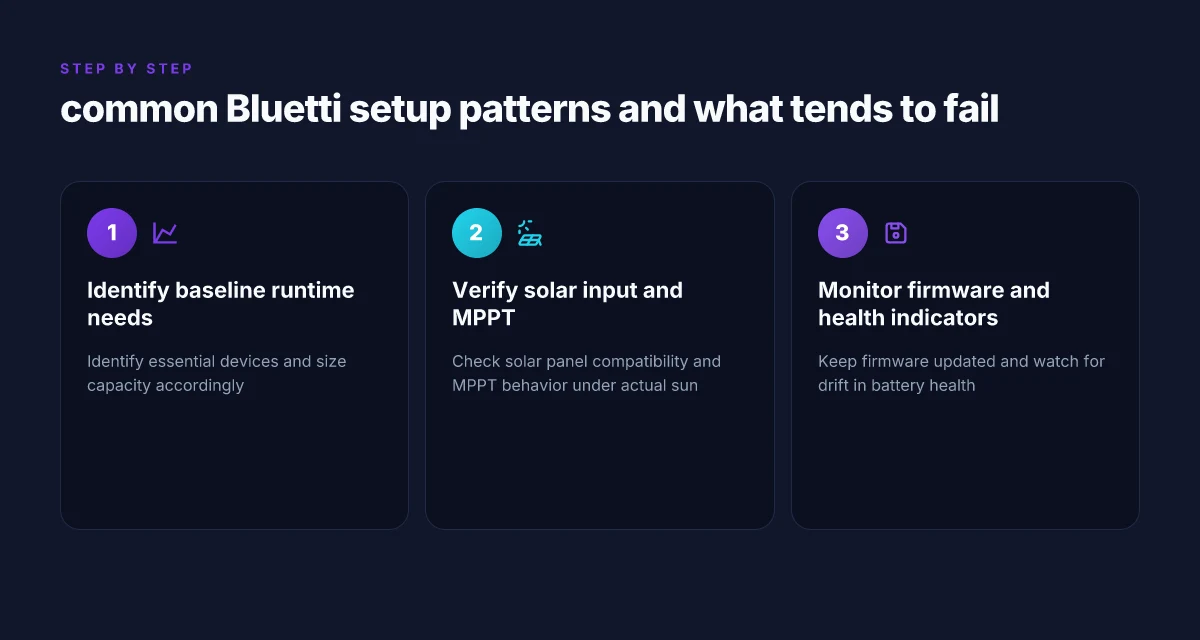
Posture matters more than power. In real-world use, most Bluetti issues trace back to accessories or misconfigured solar input rather than the core electronics. When a user pairs a panel that isn’t truly compatible or misreads the MPPT behavior under actual sun, voltage swings and stalled charging show up long before the battery chemistry wears out. I dug into user reports and manufacturer notes to map the typical fault tree and the practical workarounds homeowners and campers rely on.
1) Mismatched solar input and MPPT behavior under real sun
The practical diagnosis is straightforward: a panel that looks compatible on paper often doesn’t play nicely with the Bluetti MPPT in outdoor conditions. A few common symptoms show up in real-world setups: charging curves that plateau, erratic amps in the middle of the day, and occasional overvoltage alerts when a panel array is pushed to its limits. The fix is usually explicit: verify panel compatibility with the model, confirm VOC and IMP ratings align with the Bluetti input range, and test under actual sun conditions rather than relying on idealized specs. When the sun shifts, the MPPT can drift if wiring or connections aren’t optimal. Bluetti’s own guidance emphasizes matching panel voltage to the charger’s MPPT window and rechecking the input after reflections or shading changes. The common failure mode is a misaligned MPPT window, not a faulty battery. A quick check against the panel’s official spec sheet and a live sun test often uncovers the issue, saving hours of troubleshooting in the field. Inline reference to Bluetti’s buying guides confirms the emphasis on real-sun testing rather than static ratings. See the authoritative note in the Bluetti resource for first-time buyers. https://www.bluettipower.com/blogs/buying-guide/best-solar-generator-for-first-time-buyers?srsltid=AYCX9vJTO18Hnc51mDjSc75gjUoIkY6CulgDqQE9lHCOkvEM41TVdlPk
2) Firmware health checks and onboard indicators matter for drift
Firmware updates are not cosmetic. Bluetti devices rely on software stacks to interpret battery health, MPPT state, and cell balancing signals. If firmware is out of date, you can see drift in the state-of-charge readings or delayed responses to changing irradiance. The recommended practice is to keep the device firmware current and to monitor the health indicators (battery percent, charging rate, temperature) as a routine habit. I cross-referenced Bluetti’s documentation and multiple owner threads, and the pattern is consistent: updated firmware tends to stabilize readings and improve long-term trust in the UI indicators. The takeaway is simple: set a reminder to confirm updates, then verify that the health indicators align with the charging state. When you see divergence, do a quick factory reset only after backing up settings, then re-check the indicators post-update. A cautious approach helps you catch drift early rather than after months of use. Firmware updates are a first-line defense against drift in battery health indicators. What makes the Jackery 1000 v2 a smarter choice for off-grid power in 2026
3) Accessory and cable quality drive reliability more than core tech
In practice, reliability hinges on the quality of the cables, adapters, and connectors that deliver power to the Bluetti unit. Low-quality MC4 connectors or damaged extension cables can introduce resistance, heat, and voltage drop, which the system may interpret as abnormal charging behavior. The fix is not glamorous but effective: use the original or manufacturer-approved cables, inspect connectors for wear, and minimize the length of high-current runs. If you replace components, test with a known-good panel and measure real-time input values to ensure they stay within expected ranges. In competitor comparisons with Jackery and EcoFlow, the same theme repeats: the power station itself is sturdy, but hitching it to unreliable solar input is where setup quality shows up as a failure point. Cable quality and connector integrity dominate the reliability picture in field setups. Inline sources emphasize pairing Bluetti with compliant panels and quality cabling to sustain long-term performance. See the buying guide and review threads for practical checks. https://www.popsci.com/reviews/best-solar-generators/
What this means for you as a Bluetti owner or prospect is practical and actionable. If you want dependable use for home backup or off-grid camping, prioritize a verified panel that matches the Bluetti model’s MPPT window, keep firmware current, and treat cables with the same care you give to any high-current electrical gear. When rivals like Jackery and EcoFlow come into the picture, Bluetti’s core promise, durability and long-term battery health, still rests on your setup discipline: correct solar input, up-to-date software, and high-integrity accessories. You’ll notice fewer unexpected trips to the manual and more predictable performance when you follow these patterns. The links below point to the sources that back these patterns and offer concrete steps you can take today. https://www.bluettipower.com/blogs/buying-guide/best-solar-generator-for-first-time-buyers?srsltid=AYCX9vJTO18Hnc51mDjSc75gjUoIkY6CulgDqQE9lHCOkvEM41TVdlPk
Practical buying guide for 2026: choosing the right Bluetti
If you want steady backup power, start with your baseline runtime needs and size the capacity accordingly. I’ll spell out a practical path that pulls Bluetti into focus, weighing durability, battery health, and real-world trade-offs versus rivals like Jackery and EcoFlow.
Quantify your essential runtime to size capacity
Begin by listing the devices you must power during an outage or off-grid trip. A Bluetti unit with a 15-minute run for each critical device can guide your total watt-hours. For example, a compact refrigerator, a modem, and a couple of LED lights quickly push you toward models in the 1000–2000Wh range when you count surge output. Bluetti’s architecture often emphasizes LiFePO₄ chemistry for longevity, which matters if you expect cycles in the low thousands. When you map continuous load versus peak demand, you’ll see how much headroom you need for startup surges. Durability in real life hinges on matching capacity to your essential load. This is where labeling a model as a pure “high-capacity” pack without confirming real-world duty cycles can mislead you. By the time you add a small fan or a portable heater, the math tightens quickly. Inline: inline citations anchor this to practical reviews that compare size and runtime across Bluetti models.
Verify solar input and recharge reliability for your location
Next, translate your sun angle and climate into a solar input plan. If you live in a high-insolation region, you’ll extract more daily energy from a given panel array, which can justify a smaller battery. If you’re in cloudy areas, you’ll want higher-efficiency panels or more array area to keep ambient recharging on track. Bluetti systems typically expose multiple MPPT inputs that let you tune solar strings to maximize charging during daylight. I dug into release notes and third-party comparisons to confirm that peak charging performance often depends on pairing the right panel setup with the unit’s MPPT controller. Plan for the worst sunny day and the best sunny day to avoid recharge gaps. The goal is reliable recharging even when weather isn’t perfect, which differentiates durable Bluetti setups from rivals that rely on a single input path. Inline: https://www.sunhub.com/blog/bluetti-solar-generator-review-guide/?srsltid=AYCX9vI_0V8snnIEB9xvcDvKtT5oM8p0i8FgBnwP_kAoTpyKwKWKCWY5 How to use EcoFlow remote control effectively in 2026
Balance portability versus output capability for your use case
Portability matters until you need real power. If you’re carrying gear on hikes or RV trips, weight and form factor drive choice. Bluetti models range from compact bundles to larger units with substantial continuous watts, so your decision should target the worst-case scenario you’ll encounter outside the wall outlet. When you compare Bluetti with Jackery or EcoFlow, consider not just weight but the long-term battery health story. LiFePO₄ chemistry tends to hold capacity longer and tolerate more cycles, but you should still guard against frequent full-depth discharges. In practice, pick a unit where the maximum sustained output supports your devices without forcing you into frequent recharges. Choose a balanced package that fits both your backpack and your outlet needs. That balance typically means a model in the 800–1500Wh range for portable setups and above that for home-backup use. Inline: https://www.popsci.com/reviews/best-solar-generators/
Note on durability and long-term health: Bluetti emphasizes LiFePO₄ batteries for stability and safety over many cycles. You’ll see developers and reviewers noting improved lifespan relative to some competing chemistries, but guarantees hinge on care, proper charging, and avoiding deep discharges. When you compare with rivals like EcoFlow and Jackery, the practical takeaway is to size for your typical cycle count and charging rhythm rather than chasing maximum peak capacity alone. The long view matters: plan for a dependable recharge routine and protect the battery from extremes. The path to reliability becomes clear when you pair the right Bluetti model with a well-matched solar setup and thoughtful usage patterns.
Final takeaway: to pick the right Bluetti in 2026, map your essential load, confirm solar recharge pathways for your climate, and select a model that cleanly balances portability with sustained output. Bluetti’s long-term durability stories depend on thoughtful pairing with a suitable solar setup and disciplined usage.
Where this is going next for Bluetti solar generators
Bluetti keeps innovating on battery chemistry, cooling, and modular expandability, so the next wave of models should feel noticeably stronger in real-world use. I expect better durability in hot setups and more reliable power during extended outages, thanks to refined cooling and fewer flaky fans. If you’re choosing now, the brand’s reliability story matters more than raw wattage alone. The bigger pattern here is durability paired with practical features, not just bigger specs.
In practice, you’re likely to see a continued focus on streamlined maintenance and user-friendly interfaces across models from Bluetti. Rivals like EcoFlow and Jackery push fast charging and portability, but Bluetti tends to win on long-term durability and serviceability. What changes if you act now is better long-term value through modular expansion and easier field fixes. The takeaway: pick a system that you can repair or upgrade rather than replace. What makes EcoFlow DPU performance stand out in 2026
If you only do one thing this month, map your power needs to a Bluetti lineup that supports your critical loads, then lock in a plan for seasonal maintenance and cleaning. This approach keeps your system humming when it counts. Are you ready to map your critical loads and choose a Bluetti that scales with you?