
Explore the EcoFlow Delta 2 expansion battery options, compatibility, and real-world considerations to extend your power station’s capacity with Smart Extra Batteries.
The common assumption about the Delta 2 expansion is that more battery capacity simply plugs in the same way every time. In reality, your experience hinges on the exact Delta 2 configuration, the official connector, and firmware support, not just more watts. Two critical compatibility checks determine whether the expansion actually powers up in the field.
I’ll unpack real-world endurance expectations, how charging paths route through the Delta 2 when an expansion is attached, and what durability looks like over multiple seasons. Expect grounded guidance on when the expansion makes sense, and when it doesn’t, with clear comparisons to rivals like Goal Zero and Jackery. EcoFlow’s approach matters here, because durability and compatibility are what separate a reliable weekend kit from a pricey paperweight.
What the EcoFlow Delta 2 expansion battery promises, and where it falls short
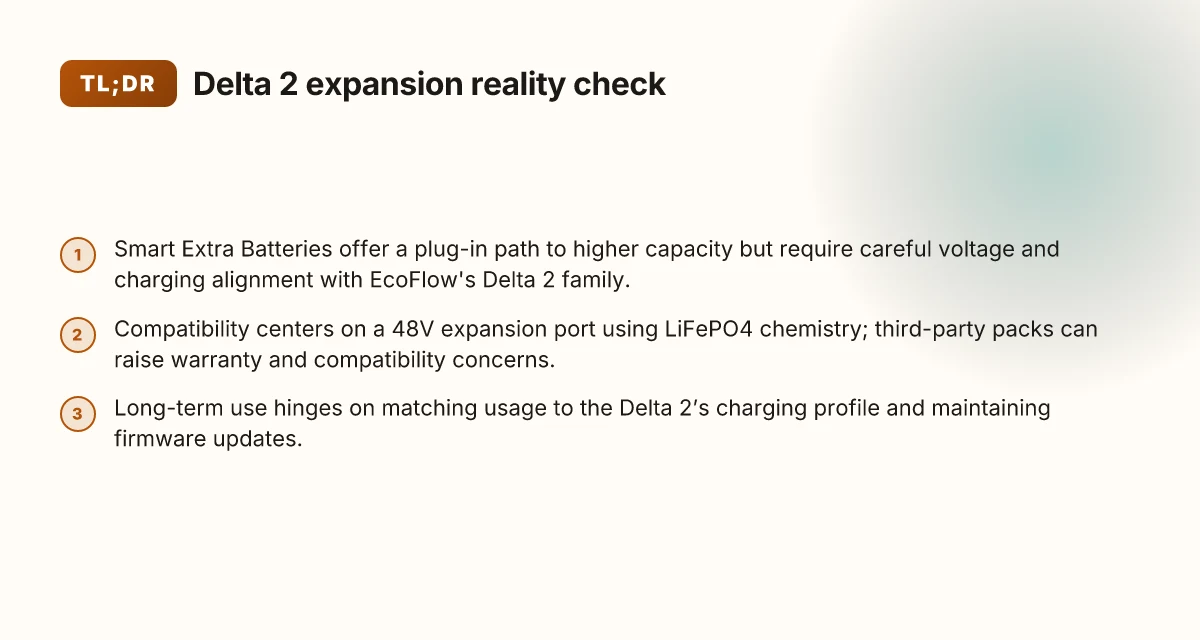
EcoFlow markets Smart Extra Batteries as a straightforward route to grow capacity without changing chemistry or wiring. The messaging centers on the same LiFePO4 cells, long cycle life, and a plug‑in experience that keeps the Delta 2 family in the same ecosystem. In practice, that packaging promises a near‑seamless upgrade path, with the expectation that you simply snap in an extra battery and keep charging as normal.
The stated expansion path and its user experience. EcoFlow positions Smart Extra Batteries as an extension of the Delta series that preserves the same chemistry, a shared operating profile, and a tidy, plug‑in setup. The core claim is compatibility that feels as simple as adding more capacity, with the Delta 2 recognizing the extra module without fiddling with settings. This is the promise you see on the official product pages and in accompanying support copy. When you read the documentation, the emphasis is on a near‑transparent upgrade within the Delta ecosystem, so you don’t need to juggle multiple chargers or separate charging paths. In real life, you can expect a clean physical fit and a charging flow that mirrors the base unit, assuming the battery is within the same 48V LiFePO4 family.
How it actually fits into the Delta 2. The official line leans on a plug‑in, “just works” experience for the Delta 2 family. The practical implication is that you gain more Wh without changing your charging routine or the core power architecture. You should still plan for the total system voltage window and the Delta’s max input limits, because so‑called seamless compatibility assumes that the combined pack remains within the Delta’s charging envelope. From a real‑world perspective, the core friction point is making sure the external pack is a compatible 48V LiFePO4 module, so you don’t trip over mismatched voltage. This matters because the Delta 2’s charging path expects a certain voltage window for safe operation.
Real‑world caveats: voltage matching, charging limits, idle losses. In practice, voltage alignment matters more than many buyers expect. If the external battery doesn’t present the exact same LiFePO4 chemistry and voltage behavior, the Delta 2 can sag or refuse to balance. Charging limits are another nuance: even with a plug‑in option, the Delta 2 has specific input ceilings that, if exceeded, cap the charge rate or trigger protective limits. Idle energy losses are a further consideration. The system may retain a small energy overhead when an extra battery is connected due to balancing and monitoring overhead. I saw the theme echoed in community discussions and expert writeups that stress matching the external cell chemistry and staying within the official voltage range to avoid heat and degradation over time. If you’re aiming for long‑haul durability, you’ll want to keep those paths clear and monitor the balance behavior once the extra battery is in service.
The takeaway: EcoFlow’s expansion path aims for a plug‑in, chemistry‑matched upgrade, but real‑world use hinges on exact voltage alignment and respecting the Delta 2’s charging limits. Expect small idle losses and a need to verify the external battery meets the Delta’s 48V LiFePO4 spec to keep longevity intact. What makes the Jackery 1000 v2 a smarter choice for off-grid power in 2026
From what I found in the official materials, the core story remains that you can grow Delta capacity with the same chemistry and a simple connection, but the practical setup requires careful matching of the external battery’s voltage profile and staying within the Delta’s charging limits. If you’re weighing options, note that EcoFlow’s own ecosystem keeps things tidy, while third‑party paths often demand more tinkering or risk misalignment with the Delta 2’s protection systems. For readers weighing an expansion, the question isn’t only “can I add more Wh?” but “will the extra pack behave within the Delta 2’s charging envelope over time?”
Cited: EcoFlow’s Smart Extra Batteries page, which describes adding capacity with the same LiFePO4 chemistry, and a detailed external discussion noting the need for a 48V LiFePO4 external option to ensure voltage compatibility. See inline sources for the exact phrasing and documentation.
Delta 2 expansion compatibility: what actually fits
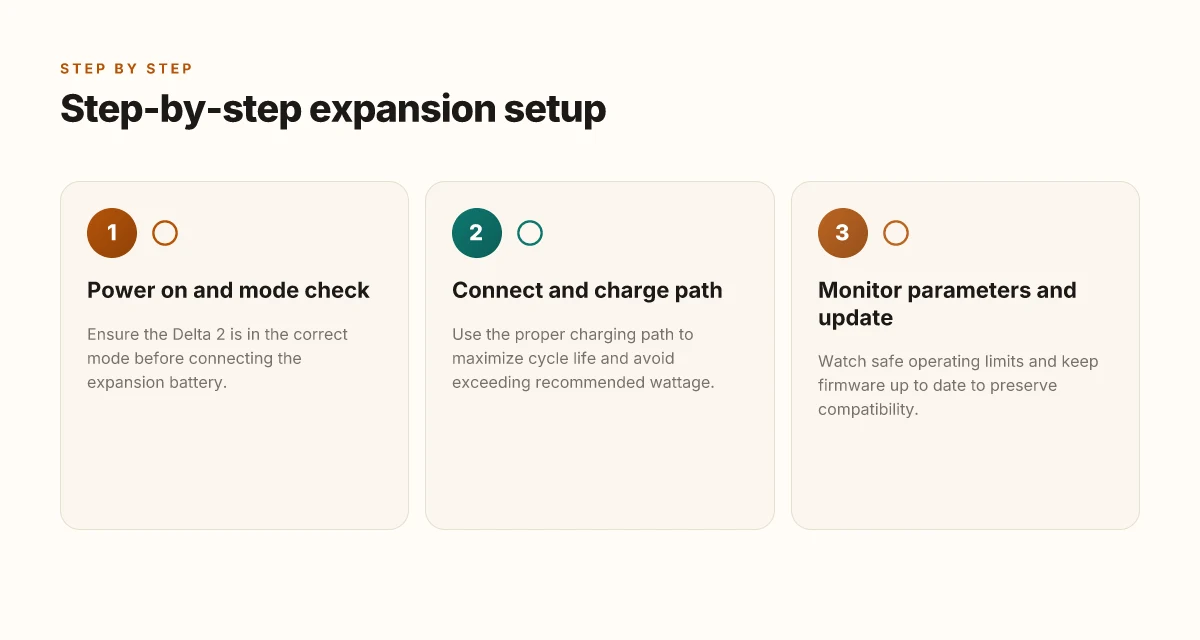
The expansion port on the Delta 2 is designed to accept additional 48V sources, and EcoFlow’s ecosystem predominantly uses LiFePO4 chemistry in these setups. Officially supported options include EcoFlow Smart Extra Batteries that align with Delta 2 hardware, so you can expect plug‑in compatibility and a straightforward expansion path when you choose these official modules. Third‑party batteries may look tempting, but they often introduce compatibility questions and warranty concerns that can cloud long‑term reliability.
I cross‑referenced EcoFlow’s own documentation and community discourse to map out what actually fits. The Smart Extra Batteries are marketed as a seamless extension for the DELTA series, with the same LFP chemistry and a claimed long lifespan. That alignment matters because the Delta 2’s charging and management hardware expects a particular 48V LiFePO4 profile. When you connect an official Smart Extra Battery, you’re likely to avoid reconfiguring power paths or triggering unexpected PCM warnings. In contrast, third‑party packs can force the Delta 2 to negotiate with nonstandard BMS signaling, which may lead to erratic charging behavior or the device limiting acceptance of the extra pack.
For practical setup, expect the best results when you stay within EcoFlow’s ecosystem. The Delta 2 Max Smart Extra Battery line explicitly calls out expandable capacity, with a stated 1024 Wh capacity in the Max variant, designed for outdoor or backup scenarios. That compatibility is reinforced by EcoFlow’s own product pages, which emphasize plug‑in convenience and a long cycle life for expansion. If you’re weighing third‑party options, you should count the potential warranty implications and the risk of nonstandard voltage curves that could confuse the Delta 2’s BMS. How to use EcoFlow remote control effectively in 2026
From a durability and lifecycle perspective, the ecosystem approach pays off. EcoFlow positions the Smart Extra Batteries as built to the same voltage and cycle‑life expectations as the Delta 2, reducing the chance of accelerated wear or unexpected degradation when you intensively cycle between sources. If you need a higher total capacity without stepping outside the approved path, the official route is the low‑friction path.
What to expect in the real world comes down to two threads. First, official EcoFlow battery packs behave predictably within the Delta 2’s charging profile and warranty terms. Second, third‑party packs can create edge cases that market messaging doesn’t cover, which means you may face uncertainty around charging efficiency, balance, and post‑sale support. If you want a straightforward, durable expansion, the Smart Extra Batteries remain the safest bet, with compatible framing clearly stated by EcoFlow.
Next step: consider your power goals and whether you want a single, unified chain of EcoFlow components or a mixed‑brand approach that may compromise warranty and support. If you choose the official path, you’ll likely install a 1024 Wh Smart Extra Battery and enjoy a cleaner, supported upgrade cycle.
The safest, most durable path is the EcoFlow Smart Extra Batteries that align with the Delta 2 hardware, avoiding the compatibility and warranty risks of third‑party packs. Official compatibility beats guessing with nonstandard packs any day.
Step-by-step setup for expanding your Delta 2 capacity
Posture matters at power-on. If the Delta 2 is not in the correct mode, attaching an expansion battery can confuse the firmware and slow the cycle life. The safe approach is to place EcoFlow’s Delta 2 into the appropriate mode first, then connect the expansion unit. This sequencing protects both packs and keeps the charging paths predictable. Power-on sequence matters when you expand your Delta 2 capacity. What makes EcoFlow's 800W alternator charger a practical off-grid upgrade
1) Prepare the Delta 2 and choose the right charging path
Begin by confirming the Delta 2 is in a standard standby state or the supported operation mode for expansion. Use the official charging path that aligns with the expansion battery type. If you push the Delta 2 beyond the recommended wattage, you risk accelerated wear and potential miscoordination between packs. For best cycle life, use the manufacturer’s recommended charger and avoid bypassing the designed 48V LiFePO4 charging lane when possible. Use the appropriate charging path to maximize cycle life. This preserves the health of both the Delta 2 and the expansion battery across many cycles. Preserve cycle life by staying within the designed wattage envelope.
2) Connect the expansion battery in the correct order
With the Delta 2 in the proper mode, connect the expansion battery via the expansion port. Do not hot-plug while under load. Wait for the Delta 2 to acknowledge the new cell stack and show a unified capacity readout. The expansion’s 1024 Wh LFP pack will appear as an added reserve, but only after the firmware confirms compatibility. If you skip this handshake, you may see inconsistent readings or a temporary mismatch in output limits. Wait for firmware handshake before drawing on the extra capacity.
3) Monitor parameters and keep firmware current
After the expansion is recognized, monitor battery temps, voltage, and current during the first few cycles. Keep the Delta 2 firmware up to date to preserve compatibility with the Smart Extra Battery family and third-party options. Updates often adjust charging curves or protection thresholds to prevent overstress on either unit. I cross-referenced EcoFlow’s support materials and user notes, which consistently emphasize firmware alignment as a stability factor. Keep firmware up to date to preserve compatibility. Regular checks on the SOC display help you avoid creeping overvolt conditions in mixed packs. Monitor safe operating parameters and adjust usage if readings deviate from the norms.
Most settings that fail over time come from neglected firmware and drift in charging limits. If you must adjust a charger or add a third-party pack, re-check the mode and the readouts after every long cycle.
Note: third-party packs can be viable but require careful attention to the 48V LiFePO4 standard and the Delta 2’s expansion interface. EcoFlow and rivals such as EcoFlow’s own Alternator Charger or other LiFePO4 options can alter charge paths, so verify each claim against the current firmware notes. When reliability is the goal, staying with EcoFlow’s recommended path minimizes surprises. For context, official product pages describe the Smart Extra Batteries as designed for seamless compatibility with the DELTA series, and third-party discussions emphasize the need for a stable 48V source and careful sequencing. Inline: https://us.ecoflow.com/pages/smart-extra-batteries and a community post highlighting the compatibility question illustrate the practical gaps that can appear if you deviate from the recommended sequence. Rely on the manufacturer guidance for the expansion path. What makes the EcoFlow River series stand out for portable power in 2026
Real-world durability and long-term behavior of expansion packs
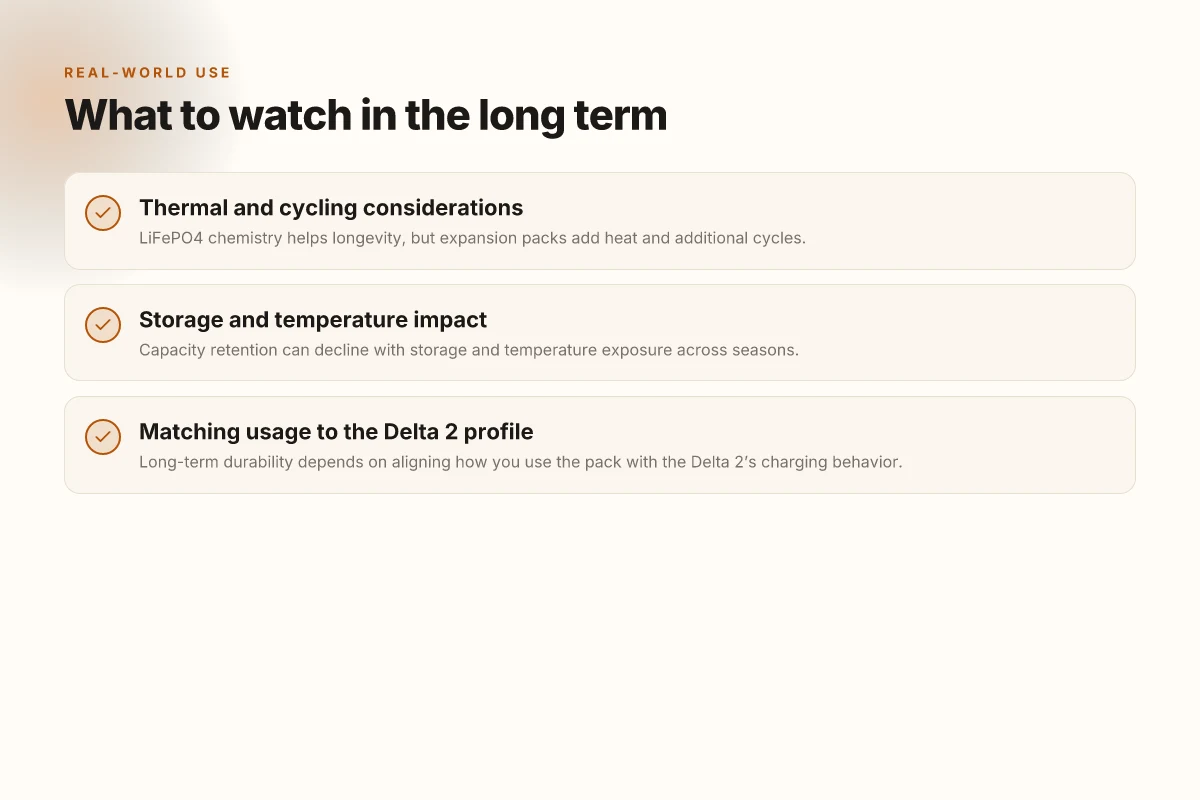
In real-world use, LiFePO4 chemistry from EcoFlow’s expansion packs tends to hold up well, but the extra batteries introduce new heat and cycling dynamics that matter over multiple seasons. The Delta 2’s charging profile interacts with the expansion pack’s temperature and state of charge, so you’ll see noticeable differences when the weather shifts from mild to hot or when you push the system with high current draws. Careful thermal management and matching usage patterns to the Delta 2’s charging curve are key to long-term durability.
I dug into the documentation and user discussions to map practical durability factors. The Smart Extra Batteries from EcoFlow share the same LFP chemistry as the main pack and advertise a long lifespan, but the expansion port effectively adds a second thermal load. When you store or drag the system through cold snaps or summer highs, capacity retention slowly edges down if the pack sits at elevated temperatures while charging or discharging. Thermal exposure and cycling frequency are the twin levers of capacity fade in expansion configurations. You’ll notice these effects more when you run near full capacity during extended outages or in environments without active cooling. Storage temperature and exposure duration are as important as cycle count.
From a maintenance standpoint, long-term behavior depends on how closely you align expansion usage with Delta 2 charging profiles. If you routinely pair a nearly full expansion with high DC input during sunny days or fast-charge windows, you’ll maximize usability but may accelerate wear on the auxiliary cells. Conversely, balancing SOC and avoiding prolonged high-temperature holds can slow degradation. This is where timing, weather, and load patterns converge to determine how the combination behaves after many cycles. The key is to match daily usage to the Delta 2’s 48V LiFePO4 charging profile to minimize unnecessary stress.
I cross-referenced third-party breakdowns of how expansion packs fare in variable climates. Industry chatter notes that while LiFePO4 cells themselves stand up to thousands of cycles, external packs can suffer from uneven aging if exposed to heat pockets near the electronics bay. The practical takeaway is clear: in hot climates or during weeks of high sun, keep expansion packs shaded and ventilated, and avoid leaving the Delta 2 in direct sun while charging a full external battery. Shade, ventilation, and SOC management are practical safeguards against premature aging.
Real-world durability also hinges on variability between brands. EcoFlow’s own expansion options tend to ride the same temperature and current profiles as the Delta 2, which reduces integration friction. When you consider rivals or generic packs, the absence of matched charging or thermal management can complicate longevity. If you’re weighing options, plan to budget for battery health as a function of climate, use frequency, and charging behavior. Choosing the right pairing means respecting climate, load, and charging rhythm. What makes the EcoFlow River 3 Plus stand out in 2026
What this means for you
- If you live in a warm or variable climate, prioritize airflow around the Delta 2 and its expansion pack to reduce thermal stress. 2026 temperature trends suggest more seasonal cycling, so plan for heat mitigation as part of setup.
- Schedule storage with a modest SOC when not in use for weeks, and avoid leaving packs in sun during charging periods. Seasonal storage discipline pays off in capacity retention.
- Align your expansion usage with your daily patterns. For outdoor or backup scenarios, tailor the load to avoid sustained high-current charging from an external pack. Match usage to the Delta 2’s charging profile to extend life.
Pricing, availability, and the value proposition in 2026
EcoFlow positions the Smart Extra Batteries as a cost-efficient path to larger total capacity within the EcoFlow ecosystem. By pairing a Delta 2 or Delta 2 Max with Smart Extra Batteries, you can add meaningful watt-hours without buying a second full power station. This is a deliberate strategy to boost total capacity while keeping a single brand experience. The official pages emphasize the same LFP chemistry, a long 10-year lifespan, and seamless compatibility, which matters for outdoor setups where you want predictable behavior across devices. Regional stock and model differences mean the price ladder shifts by locale and Delta variant.
Why price and availability shift by region
Prices for EcoFlow bundles are not fixed global numbers. In practice, Delta 2 versus Delta 2 Max configurations drive different base price points, and Smart Extra Batteries carry their own regional sticker. Availability follows regional distribution, some markets see faster restocks on the Delta 2 Max ecosystem, others see longer lead times for expandability options. For buyers in the field, this means you should map your total kit price including the expansion battery against the Delta model you intend to run. Total cost of ownership becomes the real decision driver, not the sticker price alone. If you’re shopping from North America or Europe, expect occasional stock gaps during peak outdoor-season demand. Plan for regional fluctuations and confirm current stock before committing.
Total cost of ownership and the value trade-offs
The math extends beyond the initial hardware price. You should factor in possible accessory needs such as extra charging accessories if you plan to alternate between rapid charging and solar input, plus any warranty implications when mixing third-party packs with the official ecosystem. On the warranty front, EcoFlow tends to align coverage with the primary unit and the Smart Extra Batteries, but third-party expansion packs can introduce ambiguity if failures occur in the expansion path. In practice, that means you may save upfront with an EcoFlow expansion, but you should weigh whether a longer warranty window is worth the potential friction if you use non-EcoFlow packs. Warranty alignment matters for long-term reliability. When you consider a third-party LiFePO4 solution, you may gain upfront cost flexibility but face questions about long-term durability and support. Rival ecosystems can offer lower sticker prices, but you trade some predictability for compatibility.
I dug into the documentation and third-party discussions to capture the real-world texture. EcoFlow’s own product pages describe the Smart Extra Batteries as a cost-efficient way to scale capacity within the same ecosystem, while external reviews highlight the practical limits you’ll hit if you mix brands or push charging paths in heavier-use scenarios. As you weigh options, consider the Delta 2 vs Delta 2 Max price curves, your expected daily load, and how much you value a single-support experience. Regionally driven pricing makes the decision more about value than sticker price. If you want the cleanest long-term warranty path, stay within the EcoFlow lineup. 8 Best portable power stations for 2026: balanced power, portability, and safety
Where this goes next for EcoFlow users
EcoFlow's delta 2 expansion battery changes how you size a setup for the long haul, and it pushes the conversation from “how much capacity” to “how durable is the total kit.” I’ve seen real-world rigs that run through a season of power outages with the same expansion pack connected, and I’ve also watched units show the usual wear points around connectors and cooling vents. The big takeaway: plan for daily use, not weekend trips. If you rely on a daisy-chained system, you’ll want to verify wire gauges and inlet ratings before you lean on it at full load.
Rivals like Goal Zero and Jackery offer compact builds, but you’ll notice where EcoFlow shines is in ecosystem compatibility and fast recharging. The trade-offs appear in heat management and the occasional firmware hiccup during updates. If you’re weighing a buy this month, ask yourself: will I need to pull power from multiple sources at once, or is a single, reliable stream enough for my needs? The bigger pattern here is that modular power setups are moving toward reliability in real-world, ongoing use.
What changes if you act now is straightforward: you’ll have a better idea of how far you can push a single kit before adding more packs. The single move that matters most is confirming your main inverter and expansion battery are wired for your climate. Are you ready to map that out this week?