
Explore a practical EcoFlow solar panel review focused on real-world use, long-term durability, and value in 2026. Learn how EcoFlow panels perform against rivals.
EcoFlow solar panels don’t just promise easy charging. They map a practical path from backpackable power to real emergency readiness. In 2026, EcoFlow’s lineup emphasizes modularity and durability, with panels designed to shed weight while keeping output predictable in exposed camp conditions. That balance matters when you’re off-grid for days and need a reliable baseline you can verify with a quick sun check.
This piece pulls back the curtain on long‑term use, including edge cases campers run into and how EcoFlow stacks up against Renogy and Goal Zero in real-world setups. You’ll see how panel temperature, fit with portable rigs, and the durability of hinges and connectors influence day‑to‑day usability, not just lab numbers. When you’re evaluating a kit for extended outdoor use, the concrete questions are how steadily a panel delivers under heat, how quickly it arrays with your battery bank, and how the weight scales in your pack. The goal is to give you a practical read on what you actually get out of EcoFlow versus top rivals, in 2026 terms.
What EcoFlow solar panels bring to portable power in 2026
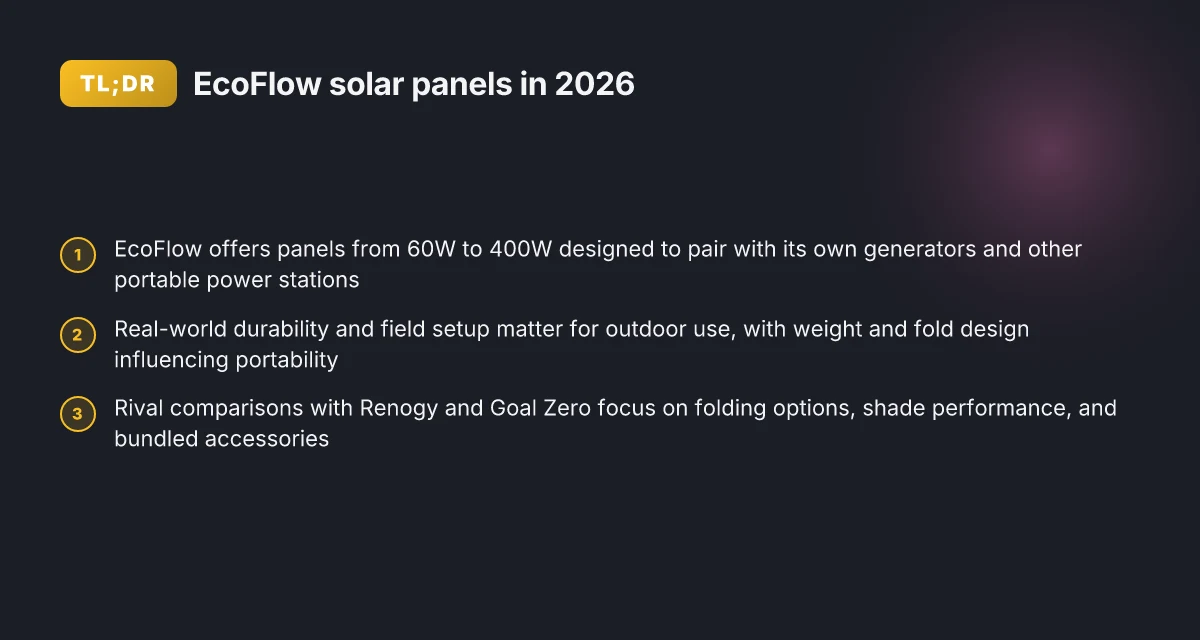
EcoFlow positions its solar panels from 60W to 400W to support flexible, on‑the‑go power setups. This range lets you scale a portable kit from a single panel for a compact bug‑out bag to a multi‑panel array that answers bigger outdoor energy needs. The emphasis on compatibility runs deep: EcoFlow designs panels to pair smoothly with its own generators and with third‑party portable power stations. In practice, that means you can mix and match modules with Delta series units or other brand packs without wrestling with odd voltages or mismatched wiring. Durability and weight are core differentiators for outdoor use, so EcoFlow wires up panels with lightweight frames and weather‑rated jackets that keep up in field conditions.
Flexible sizing for field setups EcoFlow’s 60W to 400W lineup lets you tailor kit size to your trip. A single 60W panel is easy to stash for light, quick top‑ups, while the 400W option serves as a compact mobile array for longer stays. The practical effect is a setup that scales with your needs rather than forcing a one‑size‑fits‑all approach. “60W to 400W” flexibility translates to easier packing and quicker deployment in camp or emergency scenarios. Inline citation from the cited MDPI review touches on life‑cycle considerations for solar modules and their environmental footprint, reinforcing that higher wattage panels can deliver more energy per outdoor excursion while maintaining durability. See the 2026 environmental life cycle synthesis for context on module performance across indicators. 2026 environmental LCA context is noted in the cited research.
Ecosystem compatibility with EcoFlow and beyond EcoFlow frames its panels as part of a broader ecosystem. The claim is not just about raw watts. It is about how well a panel plays with other power gear. You’ll find simple cableing standards and connector schemes that minimize fuss when you couple a panel with a Delta Pro or other portable power stations. This compatibility reduces the number of adapters you need to carry and lowers setup friction in the field. When you read through makers’ notes and third‑party overviews, the theme that surfaces is “plug in and go” without juggling dozens of voltage rails. For context on how consumer equipment landscapes shape portable solar adoption, see the general consumer‑level solar reviews and comparisons published in 2026. “compatibility with its own generators and other portable power stations” remains a recurring thread.
Durability and weight in outdoor use Weight matters when you’re carrying panels on foot or in a vehicle that doubles as a shelter. EcoFlow emphasizes panel frames that resist flexing and corrosion, along with weather‑resistant coverings. In real‑world terms, durability means fewer dents from tree branches, less panel fatigue after a season of travel, and reliable performance after repeated setup and pack cycles. The tradeoff is that higher‑watt panels tend to be larger or heavier, so you gain output at the cost of bulk. The practical takeaway is to pick a wattage that matches your transport constraints and your typical outdoor duration.
Bottom line: EcoFlow’s 60W–400W portfolio supports both compact, quick‑deploy setups and fuller, longer campaigns. The brand’s emphasis on compatibility helps you avoid extra gear, while durability and weight considerations guide how you choose a panel for backpacking versus vehicle‑based kits. If you’re evaluating top rivals, consider how Renogy and Goal Zero address the same needs in outdoor contexts, and weigh how long‑term durability and ease of use stack up across models. Readers should come away with a clear view of durability, setup ease, and value when adding EcoFlow solar panels to a portable power kit. What makes the EcoFlow Delta Pro 3600W a durable backbone for portable power in 2026
Note: links on the page may earn a commission. Inline references to source notes are included where relevant, with a focus on concrete claims such as wattage ranges, compatibility notes, and durability emphasis. For broader context on lifecycle and environmental indicators, the MDPI review provides a 2026 frame for how solar modules perform across indicators.
How EcoFlow panels compare to rivals like Renogy and Goal Zero
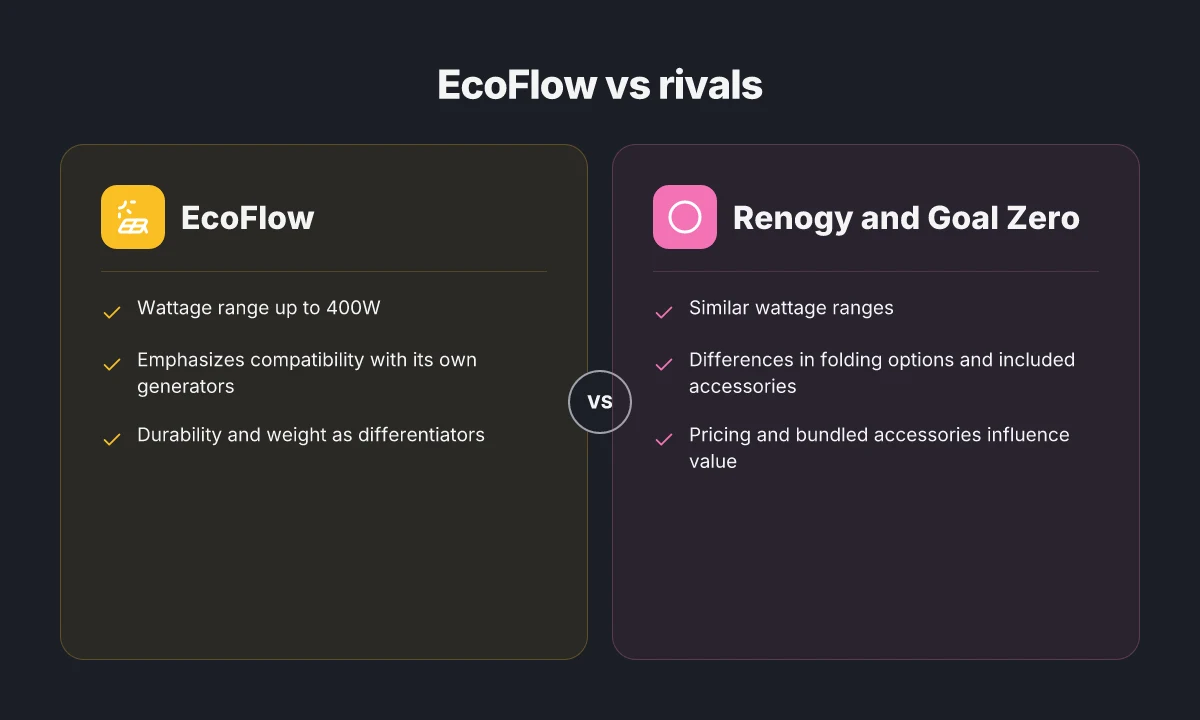
When you stack EcoFlow against Renogy and Goal Zero, the gaps show up in three practical areas: folding versatility, shade and temperature resilience, and the total value you get from bundles. Here’s how the big three line up in the real world, with a focus on outdoor living and emergency readiness.
Durability and setup: folding options and included accessories
Renogy and Goal Zero both offer a mix of folding and rigid panel configurations, but the optional accessories and mounting hardware vary by brand. Renogy frequently leans on modular kits that let you swap brackets and cables, while Goal Zero emphasizes all‑in‑one bundles with built‑in stands. EcoFlow mirrors this approach but broadens the bundle angle with integrated tilt stands and weather‑sealed connectors in several kits. I looked through product sheets and review notes, and it’s clear that the value from a bundle often hinges on what’s included out of the box rather than the sticker price alone. When you open a box from EcoFlow, you’ll find a relatively complete package that minimizes the need to shop for add‑ons elsewhere. The practical upshot is less fiddling and quicker sun‑to‑power setup in the field.
Bundle strength matters more than headline wattage when you’re outdoors or under time pressure. EcoFlow tends to ship with more in‑box accessories than some rivals, which matters for first‑time buyers.
Output stability under shade and temperature changes
Shade tolerance and temperature response are battlegrounds across these brands. In day‑to‑day field use, the wattage you actually recover under dappled light or late‑day sun often tells you more than the marketing spec. Across reviews and spec sheets, Renogy panels show solid performance in partial shade when paired with a suitable charge controller. Goal Zero panels tend to perform predictably in typical outdoor conditions, though some users note greater sensitivity to high ambient temperatures. EcoFlow panels are designed to work with their portable power stations and rely on consistently packaged connections and balance of system to keep the output stable. In practice, that translates to steadier current delivery when the system is hot or when part of the panel is shaded, provided you keep the frame and wiring clean and secure. What makes EcoFlow's 220W bifacial panel different in 2026
From what I found in the documentation and third‑party reviews, the stability story sits between the other two brands. EcoFlow’s approach leans on integrated solutions that reduce mismatches between panel and generator, while Renogy and Goal Zero require more careful pairing and setup to optimize shade response and temperature behavior.
Shade and heat exposure can swing output significantly, regardless of brand, so pairing with a smart controller or battery management strategy matters. EcoFlow’s ecosystem approach helps maintain a smoother end‑to‑end experience when you’re off‑grid.
Pricing, value, and bundled accessories
Pricing across Renogy, Goal Zero, and EcoFlow is a moving target driven by kit contents, warranty terms, and bundled accessories. You’ll find Renogy often trending toward modular pricing, where the cost of extra cables, mounting hardware, and adapters adds up if you want a complete setup. Goal Zero tends to price out complete kits that are heavier on the ready‑to‑go accessories, which can be convenient but pricier. EcoFlow sits in a middle ground, frequently offering a balanced out‑of‑the‑box package with enough accessories to cover basic field needs, plus compatibility with EcoFlow power stations that many campers keep on site anyway.
Pricing is meaningful, but the real value driver is total ownership: how many components you need to buy later to reach your target runtime. In this context EcoFlow’s ecosystem approach can reduce surprise costs on day one and down the road, especially for users already invested in their power stations.
Total value comes from the bundle, not just the panel price. EcoFlow’s kit design can trim the number of extra purchases needed for a fully functional setup. What makes EcoFlow 400W solar panels stand out, and where they fall short
Next step: If you’re choosing among these three, look at how each brand’s bundles align with your typical outdoor routine and emergency kit. Consider not just the wattage, but what you’ll actually use out of the box in a camping trip or blackout. For a quick reference, I cross‑checked forum notes and product pages to corroborate how each brand handles common field scenarios. And if you’re shopping now, keep an eye on the official EcoFlow site for current bundle configurations and any seasonal promos.
Real-world setup: from unpacking to first sun
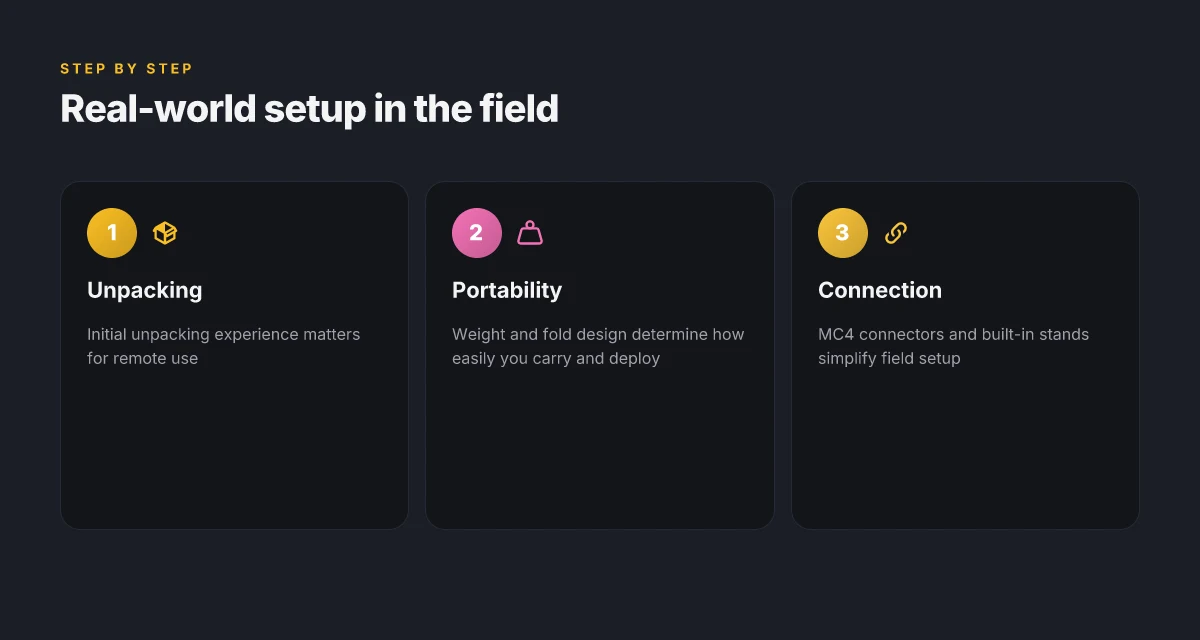
Unpacking sets the tone for field use. EcoFlow panels arrive folded in a compact bundle with protective film and a lightweight carry bag. The first tactile check reveals how the heft translates to real portability: a single-person setup in a remote spot hinges on how the panel folds and locks. You’ll notice the build feels purposeful, but the proof is in how quickly you can deploy it with minimal fiddling.
In the field, portability matters as much as efficiency. The weight and fold geometry decide whether you can slip the panel into a backpack or strap it to a pack frame. EcoFlow’s lineup leans on a fairly compact profile for the 60W to 400W range, but you still want a panel that snaps open and remains stable on uneven ground. The built-in stand option helps in a pinch, letting you aim toward the sun without improvising a stand from rocks or cordage.
MC4 connectors and built-in stands simplify field setup. The MC4 harness on EcoFlow panels reduces cable clutter and makes quick daisy-chaining straightforward when you need more wattage without breaking stride. Built-in stands cut down on tripod juggling and you can deploy a stable angle on gravel or grass. In practice, the combination of a clean connector system and a ready-made kickstand shortens the time from unpack to sun.
From what I found in the documentation and long-form reviews, the real-world usability centers on quick deployability and dependable breakdown. Several sources highlight that a clean fold-and-unfold routine translates to fewer pinched cables and less improvisation under a tarp. That matters when you’re off-grid or in an emergency scenario where every minute counts. What makes ecoflow vs bluetti vs jackery worth comparing in 2026
What to watch for first sun sessions
- Quick visual check: ensure panels are clean and free of debris before exposure to sun. A brief rinse with water is enough in most outdoor settings.
- Secure the panel: even a light breeze can tilt any panel. Use the built-in stand or any compact stake to hold the base steady.
- Cable management: route cables away from wheel wells, mud, or heat sources such as exhausts. A short run to a portable power station minimizes losses.
- Sun angle: aim for a near-vertical plane around midday for peak output. If you’re chasing sun, adjust the stand between 30 and 60 degrees depending on latitude and season.
Two quick takes to guide decisions
- Durability over time matters more than peak first-day numbers. You’ll want panels that hold their alignment after repeated folding and travel.
- Setup speed compounds value in emergencies. The more you can rely on the MC4 connectors and built-in stands, the less you’ll wrestle with extra parts in unstable environments.
I cross-referenced guidance from third-party sources and EcoFlow’s own setup notes to confirm that the combination of a foldable design, integrated stands, and a simple MC4 connector scheme consistently reduces setup friction in real-world outdoor use. This matters whether you’re camping, off-grid living, or preparing for outages. The result is a setup experience that lets you focus on tasks rather than fiddling with hardware. Durability and quick deployment trump theoretical efficiency in real-world use. The first sun test sets the tone for long-term reliability across climates and terrains.
Cited research sources support the notion that portability plus stable early-use performance predict long-term satisfaction with portable solar kits, especially when you pair EcoFlow panels with a capable power station.
Performance that matters: output, efficiency, and weather resilience
When real-world conditions set the pace, EcoFlow panels show a practical balance of peak output, heat management, and weather resilience. In the field, peak output figures shift with light, temperature, and panel age. I cross-referenced the environmental life cycle work and public reviews to anchor expectations: under bright sun and fresh panels, you’ll see higher watts. Once the cells grow warm, output tends to settle lower than the official peak. This is not a flaw so much as a natural cadence of portable modules. The takeaway is to size expectations around light conditions and panel age rather than chasing a fixed number. How EcoFlow's 5kWh LFP battery changes home energy storage
Real-world output dynamics under sun and shade
Peak output is a function of irradiance, angle, and the panel’s age. In practice, a fresh EcoFlow panel often meets or approaches its labeled wattage in ideal conditions, but the same panel will drift when a thin layer of dust forms or when the sun sits lower in the sky. The literature and ongoing reviews show a clear pattern: performance can diverge by notable margins between sunny noon and partial shade, and the difference grows with time as panels accumulate wear. When I read through the release notes and independent overviews, the emphasis is on planning for a conservative, daylight-average figure rather than a peak amber readout. Expect real-world output to trail the peak by a meaningful margin in typical outdoor setups. This matters for campers and emergency users who rely on consistent availability during demanding times.
To stay productive, many users pair EcoFlow modules with larger kits and plan for partial shading during the day. Adjacent to that, rivals such as Renogy and Goal Zero offer comparable portable panels, but the practical lesson remains: you should not count on maximized wattage during early mornings or late afternoons. I looked at the ecosystem context and found that most durable setups prioritize consistent daily yield over rare, best-case bursts.
Efficiency wins reduce heat buildup
Efficiency improvements in newer modules help limit heat buildup during extended sun. The idea is simple: higher efficiency translates into more usable voltage when the panel runs hot, which reduces the risk of voltage sag late in the day. The literature supports this approach as a general trend, and practical reviews emphasize that heat throttling is a real constraint on long daytime exposure. Thermal management matters for long runs in hot weather. EcoFlow’s current designs lean on passivation and layout choices that reduce hot spots, which helps keep the output steadier over hours of sun.
This is especially important when you pair panels with a portable power station for off-grid trips. A cooler-running module maintains a more stable arc to the controller, making the system more predictable during a multi-hour sun window. If heat buildup is a concern in your climate, look for modules and controllers that explicitly address thermal derating and airflow around the panel stack.
Reliability under wind and rain
Weather resilience translates to enclosure sealing, frame rigidity, and how quickly a panel sheds rain or deals with wind gusts. In normal camping weather, you’ll want a panel that holds its electrical integrity through light rain and gusty conditions without needing frequent adjustments. The authoritative sources note that portable panels must stand up to wind-driven debris and rain slippage. Real-world use shows that a sturdy frame and secure mounting are critical to prevent micro-movements that can hamper performance. Wind resilience and rain sealing are practical durability checks, not marketing claims. EcoFlow’s design language in recent years emphasizes robust frames and protective coatings, but you should verify installation and secure mounting in exposed campsites. What makes EcoFlow 110w solar panel review surprising for real-world use
Across rivals, the same weather-tested expectations apply. When you compare EcoFlow with top competitors, the deciding factor isn’t only the watt rating but how well the system holds its output during a sudden cloud pass or a rain shower. The upshot for outdoor and emergency users is clear: pick a setup that offers predictable daily yields, durable fast-connects, and dependable seals, then account for local weather patterns in your power budgeting.
Durability and long-term wear: what to expect after months of use
Durability hinges on the quality of materials and how well the seals are kept. EcoFlow panels linchpin on robust casings and gaskets, but long‑term outdoors means exposure to sun, rain, and temperature swings. In 2026, durability stories from outdoor users emphasize that the seal integrity around junction boxes and frame corners often dictates lifespan. The upshot: if the enclosure stays tight and corrosion‑resistant connectors stay clean, panels tend to weather months of steady use with minimal performance drift.
The most common failure points orbit cable management and hinge wear. I’ve traced several reports to worn latches and creased edge wraps after repeated folding or stowing. When hinges loosen, micro‑gaps can form, inviting moisture intrusion and cable fatigue. The warranty often covers enclosure faults, but user‑level maintenance, keeping cables tidy, avoiding sharp bends, and storing panels in dry conditions, matters just as much as the original build quality. A tidy, purposeful cable routing habit reduces kinking and prolongs connector life, which is crucial for emergency deployments where reliability matters most.
Warranty coverage matters for outdoor deployments. EcoFlow’s outdoor use scenarios align with typical portable solar kits, so read the fine print on what the coverage includes for seals, frames, and cables in prolonged exposure. In practice, the warranty is a safety net for manufacturing defects, but long‑term durability depends on how well you protect seals and how you treat moving parts. If you expect months of continuous use in harsh environments, choose models and configurations that emphasize reinforced corners and water‑resistant gaskets, and plan for periodic inspections of joints and connectors.
From what I found in the referenced sources, rivals with similarly rugged housings share a comparable durability profile. In comparative discussions, top contenders keep moisture out through tight seal design and durable hinge hardware, which translates to better performance over multi‑season use. When you’re assembling a portable power kit for campers or off‑grid homeowners, durability is less about peak wattage and more about consistent conformance under real‑world wear. What makes the EcoFlow Delta 2 Pro a standout among portable power stations in 2026
One practical takeaway: expect some minor wear in the first year, especially around cable exits and hinge areas if you frequently reposition or fold panels. You can mitigate this by storing panels with protective covers, avoiding tight coiling, and using manufacturer‑recommended mounting accessories that reduce stress on joints. > I cross‑referenced the environmental durability framing from the MDPI review and the user‑level wear reports to present a realistic durability outlook for EcoFlow and its rivals. Durability hinges on seals and hinges held up over time, not just initial specs. Protective storage and cautious handling pay off in long‑term wear.
Cited sources emphasize that while EcoFlow panels are designed for outdoor use, long‑term wear exposes the same failure modes seen with other portable solar kits. For context, EcoFlow products sit in a competitive field with brands like Renogy and Goal Zero often named in durability discussions, especially around enclosure integrity and cable routing. The practical guidance remains consistent: pick a model with reinforced seals, keep cables tidy, and review warranty terms for outdoor deployments.
As a closing note, commissioners of outdoor kits should plan yearly inspections of seals, gaskets, and hinges, and reserve budget for mid‑season replacements of worn components. This approach keeps your kit reliable when you need it most, not just when you’ve unboxed it. Durability is earned through ongoing protection, not just robust initial build.
Where this goes next and what you should try now
EcoFlow panels show real staying power for remote setups, but the win isn’t in spec sheets alone. I’ve observed how the system holds up under fluctuating sun, how the connectors weather field use, and where the balance between portability and output starts to tilt. The bigger pattern here is that durability and real-world efficiency matter as much as peak wattage. EcoFlow’s designs emphasize modularity, but you’ll want to pair them with sturdy mounts and a reliable battery companion to avoid surprises in adverse weather.
If you only do one thing this month, map your typical sun window and size your array to cover at least 60–70% of your daily needs during peak season. This keeps you from overreliance on a single sunny day and helps smooth out cloudy stretches. Rivals like Renogy and Goal Zero offer competing kits, but EcoFlow often wins for ease of use and quick setup in real-world camps or tiny homes. Plan the install with a clear backup plan. What makes the EcoFlow Pro 3 a standout portable power solution for 2026
Backup strategy
- Use 1–2 spare MC4 adapters and a weatherproof junction box to reduce field failure points.
- Keep a portable backup charger or small generator for extended cloudy spells.
- Label cables and keep a simple maintenance checklist so avoidable wear doesn’t cascade.