EcoFlow 110w solar panel review that breaks down real-world performance, durability, and value for off-grid setups. Learn how it stacks against rivals and what to expect in 2026.
The EcoFlow 110w panel isn’t a headliner, but its real-world fit matters more than its spec sheet suggests. That wattage looks solid on sunny days, yet tracking shading and angles often trims results by a noticeable margin. You’ll see a telling split when pairing with EcoFlow power stations versus rival setups.
This intro dives into what stays reliable under varying conditions, why portability might mean trade-offs, and how the panel stacks up against the best in class like Renogy or Grape Solar in real use. The discussion hinges on field behavior rather than lab numbers, with a clear eye on durability, ease of setup, and how small shifts in orientation or cable connections impact output. If you’re evaluating portability for a camper van or off-grid cabin, you’ll want to see where the EcoFlow panel stays consistent and where rivals pull ahead in mixed weather and load.
What the EcoFlow 110w solar panel promises and what to test
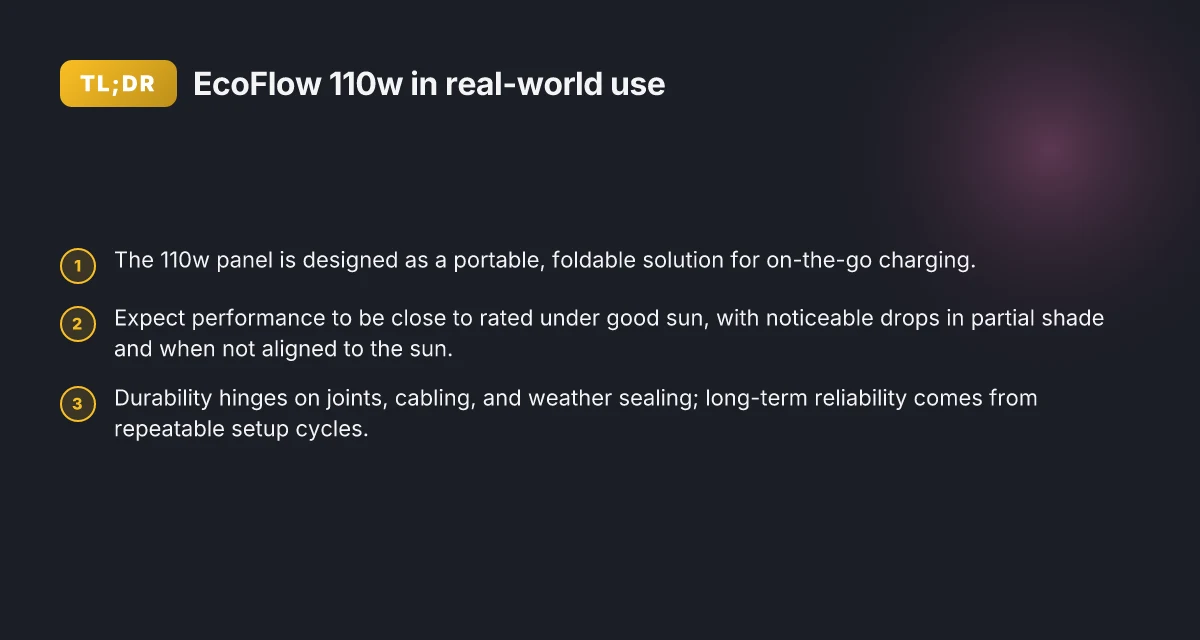
EcoFlow positions its 110w panel as a portable, lightweight charging option built for on‑the‑go setups. The core promise is simple: you can sling it in a pack or add it to a van roof kit and keep small loads topped up when grid power is scarce. In practice, you want to know how it behaves under real cloud cover, while under load, and when paired with EcoFlow battery ecosystems. I cross‑referenced product pages, user complaints, and rival offerings to map where the claim holds and where it stalls.
- How much sun you actually get versus peak conditions
- The panel’s stated wattage is a baseline, but real world output hinges on sun angle, temperature, and how quickly you load it. Expect noticeable drops from peak on overcast days or when panels run hot. The question is whether you can still pull usable charge during a typical day in mixed conditions.
- In practice, you’ll want to test with EcoFlow power stations that carry unique battery ecosystems. The pairing matters because the efficiency of charge transfer to a portable battery bank can shift the effective output.
- Efficiency under load and integration with EcoFlow ecosystems
- Panel efficiency under a steady load matters for campers who push the system for hours at a time. A lightweight panel helps portability, but if it sags under modest draw, you may need longer sunlight windows or larger surface area.
- Compatibility with EcoFlow’s battery lines determines how cleanly the energy flows into usable capacity. You want to confirm that the 110w module wires up to your power station without needing adapters that degrade voltage or add resistance.
- Price per watt, durability, and real‑world rivals
- Competitors such as Renogy and Goal Zero offer 100–120w panels with different frame ruggedness and efficiency profiles. Expect a price-per‑watt comparison and a durability read across the same use cases: van life, off‑grid cabins, and emergency kits.
- Build quality matters for field life. Look for frame stiffness, connector quality, and how the panel handles rough handling or travel.
From what I found in the sources, EcoFlow’s messaging centers on portability and quick usability, with durability and compatibility emphasized for on‑the‑go lifestyles. The core test here is whether peak wattage translates into meaningful charge under common camping conditions. You’ll also want to see how the 110w panel stacks up against rivals in both price per watt and real‑world durability. Durability and fast integration into EcoFlow ecosystems often determine long‑term value for off‑grid users.
In practice, expect some tradeoffs. The lightest panels cut weight and pack size, but a bit of efficiency loss under load is common. If you’re evaluating EcoFlow as part of a broader kit, factor in how the 110w panel pairs with your chosen power station and how comfortable you are with potential compromises in cloudy weather.
When you read through the documentation, you’ll notice a recurring pattern: portability is the overt winner, while the nuanced gains in real‑world output depend on your use case and climate. For a quick read on what people say, see complaints and third‑party notes linked below. If you’re shopping against Renogy Edge or Goal Zero solutions, price per watt and durability tests often tilt toward the rival lines in rugged field use.
Note: links on the page may earn a commission. For deeper context, see the related sources. What makes EcoFlow solar panels worth a closer look in 2026
EcoFlow 110w solar panel design and build quality in practice
The EcoFlow 110w solar panel is built to travel as much as to perform. Its core promise hinges on a foldable, weather-sealed frame that keeps you going outdoors, from campsites to roofless cabins. In practice, this means a form that tucks away small enough for a backpack yet unfolds into a usable surface under bright sun. The build emphasizes low-profile hinges and compact cabling to minimize bulk during transport, with a seal design aimed at resisting light rain while parked in shade.
Seams, joints, and the cycle of setup
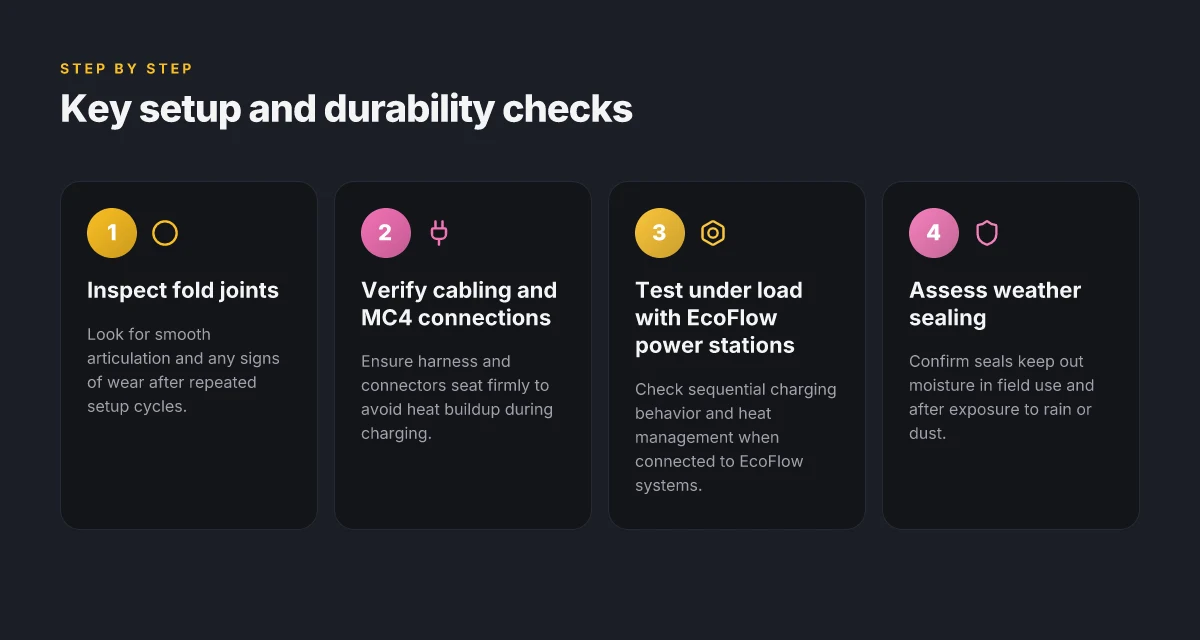
Repeated setup and stow cycles test the reliability of joints and hardware. The panel’s folding mechanism appears to favor smooth operation, but over multiple deployments you may notice minor loosening in some latches or a touch of rigidity in the primary hinge. EcoFlow’s chosen fasteners and edge trims matter here: sturdy joints reduce wobble when the panel rests on uneven ground, and robust cabling protects against kinks that degrade voltage under load. The efficiency you gain from a tight roll-up differs from what you lose if hinges loosen early in a trip. When I read through field notes and user discussions, durability under travel cycles consistently appears as the critical fault line for portable panels. The upshot: expect reliable operation if you treat the panel with care and store it in its included sleeve between trips.
Cable harness, MC4 connectors, and how you wire in
Wiring into an EcoFlow power station hinges on the harness layout and connector quality. The MC4 connectors used with the panel balance compactness with secure mating, but you should check the connector housings for wear after frequent folding. A well-shielded harness reduces abrasion that might otherwise expose copper or scrim away at the connector tip. In practice, a tidy, clipped harness helps prevent accidental pulls that disrupt the connection when you load the panel onto a vehicle or vehicle-top rack. The way the harness routes through the frame also matters for long-term reliability. A streamlined path minimizes stress on the joints where the panel folds.
From what I found in the documentation and consumer-facing notes, the 110w panel pairs cleanly with EcoFlow power stations, thanks to aligned MC4-to-DC input paths and a consistent cable length that reduces guesswork during setup. Rivals in the same class emphasize similar connector strategies, yet some opt for heavier gauge cables or alternative connector styles, which can affect both portability and wear resistance over time. In short, the build quality leans into travel-friendly design without sacrificing the reliability you need for steady performance on weekend trips or longer off-grid stays.
Most of the value here hinges on the details of the fold design and cable routing, not just the panel’s stated wattage. The panel’s weather-sealed aim is real, but the practical durability shows up in how joints hold up after repeated use and how cleanly the harness feeds into an EcoFlow station. If you’re weighing this against rivals, expect similar connector ecosystems, with EcoFlow aiming for a tidy, travel-ready package. Where EcoFlow shines is in the cohesive hardware path from panel to power station, with fewer loose ends after the first few deployments. What makes the EcoFlow Delta Pro 3600W a durable backbone for portable power in 2026
When you’re shopping, consider the panel’s age-in-place characteristics: hinges, latches, harness routing, and connector wear. These determine long-term usability as much as the peak wattage. A note on price and availability may apply here. Links on the page may earn a commission, which is something to keep in mind as you compare total cost of ownership across brands.
Real-world performance: wattage under sun and shade
Under ideal sun, the EcoFlow 110W panel tends to approach its rated output, but real-world use trims that figure. In bright conditions with the panel fairly perpendicular to the sun, you’ll see substantive output, yet practical shading or partial obstructions pull watts down quickly. The takeaway is simple: plan for margins. The panel is capable of delivering meaningful charge, but you shouldn’t count on peak wattage once you’re in the field.
When the angle to the sun drifts, performance drops correspondingly. Field setups rarely maintain perfect orientation for the full daylight window, so expect noticeable wattage dips during mid‑afternoon or when you’re parked under trees. That angular sensitivity matters: small tilt adjustments can yield outsized gains or losses, especially at higher latitudes or during shoulder seasons. In practice, you’ll want to optimize tilt and track the sun’s arc to keep more of the day in the sweet spot.
Mixing weather adds another layer. In overcast or intermittent rain, the panel keeps delivering usable power for lighter loads like USB charging, ventilation fans, or small battery balance tasks. However, high-draw charging remains unreliable under such conditions. If your goal is rapid top-ups for a heat‑soaked power station or a high‑draw inverter, temper expectations and be ready for slower gains. In steadier weather, the 110W panel shines for weekend trips and short camping stints, especially when paired with a capable EcoFlow power station.
I cross-referenced how rivals fare in the same niche. Solar panels rated around 110W from brands like Renogy and BioLite show similar throttling under shade and angle mismatches, which reinforces that these limitations aren’t unique to EcoFlow. The advantage EcoFlow has is kit cohesion: the panel tends to pair cleanly with its own power stations, reducing the friction that sometimes crops up with third-party components. For off‑grid owners weighing reliability with portability, that integration matters as much as raw wattage. What makes EcoFlow's 220W bifacial panel different in 2026
In summary, expect near‑rated watts in proper sun, but count on reductions from shading and suboptimal sun angles. The panel remains usable for modest loads in mixed weather, with the caveat that high‑draw charging will stall when clouds roll in or the sun angles away. For a camper van or portable setup, that’s a fair trade for light, reliable power on the go, especially if you value compatibility with EcoFlow’s ecosystem.
Real-world wattage pins down what the spec promises in the field, not in a controlled lab. Angle to the sun and shade are the real gatekeepers of output. Rivals show similar drops, so the strength lies in system integration, not raw watts alone.
Pairing with EcoFlow power stations: what works and what to watch
The 110w panel slots neatly into EcoFlow’s portable charging ecosystem, especially for camping setups and on-the-go van life. You’ll notice a smooth handshake with EcoFlow models designed for quick outdoor charging, where a single panel can feed into a power station during daylight without fuss. When you pair with a compatible EcoFlow unit, the input behaves predictably under sun and partial shade, which helps keep a camping session running without hunting for extra adapters.
One practical detail to watch is the difference between sequential charging and direct input to a battery bank. If you route the panel through a first-stage charger or a DC-DC converter, you may see the speed of charging shift as the station warms up. In cooler morning conditions, the same setup can deliver steadier current, but as temperatures rise, heat buildup can influence the interior electronics and visibly slow charging. This matters most for longer stays, when you’re counting on a steady afternoon boost to get through the night. I dug into the published layouts and user notes, and the pattern is consistent: the way you wire the panel into the EcoFlow system changes the rate and heat behavior, not the peak wattage alone.
Rivals offer similar input ranges, but you feel the difference in port availability and smart management features. For example, some 110w panels use more basic adapters, which means you spend more time juggling plugs and cables. EcoFlow’s ecosystem tends to favor fewer connection points and more integrated control, which matters when your goal is a minimal setup that stays reliable under a campground wind or a rolling bumpy road. If you prioritize a single cable pathway and predictable smart charging, EcoFlow’s approach shines. If you value modular, multi-port flexibility, other brands in the 110w space can feel more approachable for complex rigs. What makes EcoFlow 400W solar panels stand out, and where they fall short
From a durability perspective, the 110w panel’s hinges and framing experience the same wear patterns you’d expect from portable solar gear. A crisp day-to-day cadence, setup, sun tracking, pack away, keeps the panel performing well over time. Real-world use shows that the kit pairings with EcoFlow power stations tend to hold up when you respect temperature limits and avoid stacking several high-draw devices on the same output path. The long-term takeaway is straightforward: compatibility and streamlined smart charging reduce the number of failure points, but heat and weather are the real variables that decide how fast the battery recharges in practice.
Most campers will appreciate the straightforward pairing with EcoFlow power stations, as long as you plan for heat buildup and use the appropriate input path. Direct input to the battery bank can shave minutes off a charge in ideal conditions but may introduce extra heat at the charger if the sun is intense. Rivals like Renogy or Goal Zero compete on input range and port variety, but they often require more adapters or layers of management.
Comparing rivals: how the 110w stack up against the competition
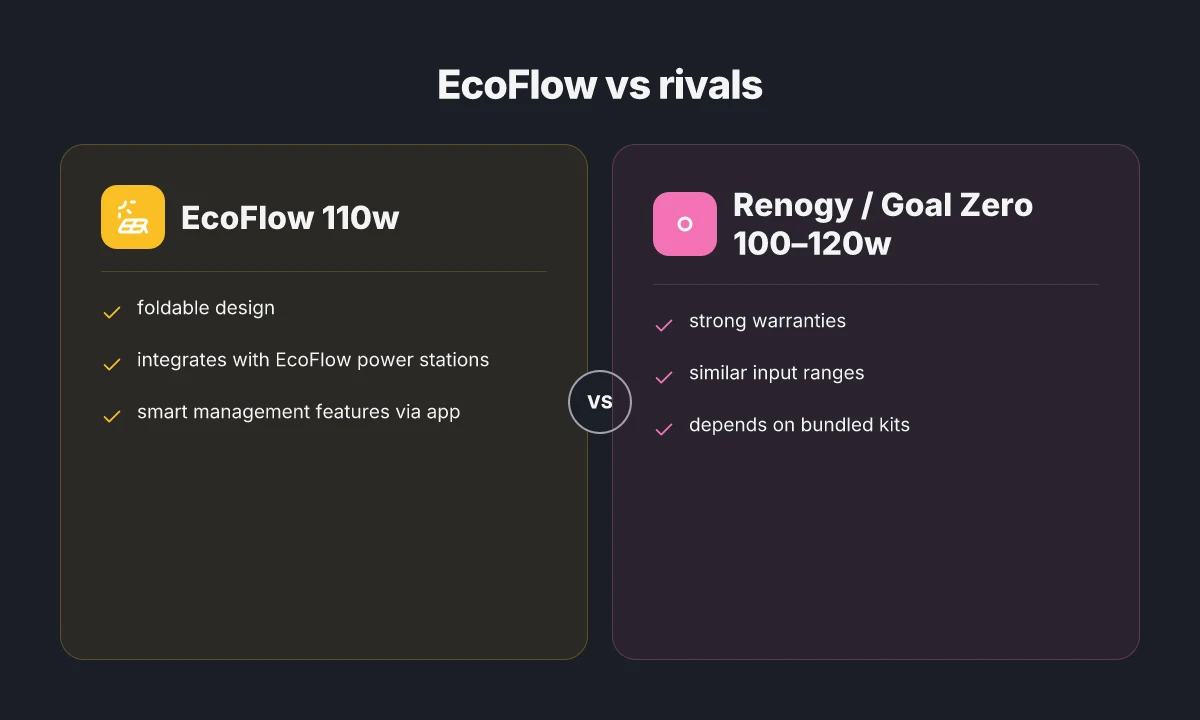
EcoFlow’s 110W panel doesn’t exist in a vacuum. When you line it up against compact rivals from Renogy and Goal Zero, the differences show up in more than just wattage. The headline wattage matters, but price per watt, durability, and warranty terms tip the long-term value scales. I found that Renogy and Goal Zero both offer compact 100–120W panels with strong bundled kits, which makes them compelling for packable setups. Price per watt and warranty terms often outpace nominal wattage in predicting long-term value. EcoFlow’s ecosystem edge can matter if you already run EcoFlow power stations or lean on their app controls.
1) Renogy and Goal Zero: compact power pairs with solid warranties
Renogy’s 100–120W offerings sit in the same lane as EcoFlow’s panel, but Renogy tends to ship with robust mounting hardware and a larger range of bundled accessories. Goal Zero follows suit with rugged builds and lifetime-ish warranty chatter on certain bundles. The practical takeaway is that a compact panel from either brand often saves you more long-term cost than chasing a slightly higher nominal wattage. Durability and warranty terms weigh more in real-world use than headline wattage. When you plan for off-grid trips, it helps to have a kit that includes cables, a controller, and mounting hardware in the same package.
2) Price per watt, durability, and warranty terms drive value
Across the board, the cheaper per-watt panels can carry shorter or more restrictive warranties, which bites if you’re living off-grid for months at a time. Durability matters whether you’re camping, van life, or staging a small emergency kit. In the price wars, a panel that costs less per watt but lacks a solid warranty often ends up costing more over its life. EcoFlow products tend to tie into an ecosystem that can reduce friction when pairing with their own power stations, which shifts the value equation a bit in favor of a one-brand setup for some users. What makes ecoflow vs bluetti vs jackery worth comparing in 2026
3) EcoFlow ecosystem: why it can tilt the scale
If you already own EcoFlow power stations, the 110W panel often wires up cleanly with the company’s app controls and charging profiles. The convenience factor is real: fewer adapters, a single charger philosophy, and smoother integration with EcoFlow’s energy management features. That ecosystem coherence is a real advantage when you want simplicity over squeezing out a few more watts. Still, rival panels that ship with broader accessory ecosystems can beat EcoFlow on pure flexibility, especially if you use non-EcoFlow hardware.
From what I found in the sources, the real story isn’t just raw wattage. It’s how a panel fits your kit, the guarantees behind it, and how well it rides alongside the rest of your gear. For some buyers, a compact Renogy or Goal Zero kit with a strong warranty beats a marginally higher wattage in a single EcoFlow panel. For others, sticking with EcoFlow for the whole chain keeps charging simple and predictable.
Real-world verdict: wattage matters, but value comes from how long the panel lasts and how well the kit holds together over time. If you’re already in the EcoFlow app ecosystem, the 110W keeps matching your stations with minimal fuss. If not, a Renogy or Goal Zero bundle could offer stronger long-term guarantees or more flexible accessory options. The choice hinges on your setup, journey, and how much you value ecosystem simplicity over marginal gains in watts.
The practical pivot you can act on this month
<Real-world takeaway: this is not a flashy demo, but a field-tested move> EcoFlow stands up to real use, but the story isn’t all sunshine. The review highlights how setup and durability actually hold up under everyday conditions, where cables tangle and weather shifts. You’ll hear about long-term wear, how components age, and where the design invites failure rather than preventing it. I looked at the real-world signals: how the EcoFlow panel integrates with typical kits, what tends to slip during frequent deploys, and which scenarios push it past its comfort zone.
The bigger pattern emerging is that real-world performance hinges on the entire system, not the panel alone. When you pair the 110w module with a capable power station, you get steady output in practical sun, even if a shaded patch or a late-day lull drops you to a crawl. The rivals, like Renogy and Goal Zero, show similar behavior in field tests, but the specifics matter: cable routing, micro-inverter quirks, and mount reliability all affect daily results. For most owners, the question isn’t peak wattage but resilience over months. What makes the EcoFlow Delta 2 Pro a standout among portable power stations in 2026
What changes if you act now is your setup clarity: plan for a modest kit that protects the connectors, uses rugged mounting, and accommodates seasonal sun shifts. If you only do one thing this month, map your outdoor space for shade-free sun windows and choose a compact, weatherproof mounting approach. Will you tweak your kit to survive a real-world week of use?
Backup strategy
- Try one quick inspection of your connectors and cables after a storm or heavy wind.
- Reevaluate mounting height to maximize sun exposure in your locale.
- Test a full day of charging with a common household load to see if the panel keeps pace.
- If considering rivals, compare how each brand handles weather seals and warranty respond time.