
Explore EcoFlow's 220W bifacial solar panel, its real-world performance, durability, and how it stacks up against rivals in 2026. Learn setup tips and failure points.
The claim that a 220W bifacial panel simply sits there and delivers watts misses how shade, tilt, and rear-side light actually change output. In real-world setups, a few hundred watts of difference can hinge on a single reflection angle or storage strategy, and EcoFlow’s system behaves differently than glossy marketing would suggest. Most useful gains come from rear-side light when the panel is tilted for reflective surfaces.
This intro walks through how a compact, portable system handles back-layer light, shading, and backup storage in practical scenes. You’ll see how a typical off-grid run looks with EcoFlow gear, where performance diverges from spec sheets, and how that compares to rivals like Renogy or SunPower under similar conditions. The result is a clear, field-tested sense of what you actually gain in day-to-day use, not what the brochure promises. Performance in dim days and when you reframe the setup matters as much as peak 220W output.

What EcoFlow's 220W bifacial panel changes for portable solar
Bifacial panels in portable form systems push a simple idea: more light, more days of usable output. The 220W EcoFlow panel sits in a broader ecosystem that EcoFlow markets as a complete off-grid or grid-tied travel setup. In practice, the panel leans on reflected light and higher module efficiency to push energy into a system that often runs on battery banks or portable inverters. You’ll see the most value when conditions include bright sun and reflective ground surfaces, but the trade-offs show up in weight, gap-to-tilt losses, and charging speed versus a traditional mono panel.
How bifacial tech lands in a portable footprint I dug into the available specs and user-facing statements to map how a bifacial 220W panel behaves outside a fixed installation. The core idea is simple: a backside helps harvest light that would otherwise miss the cell area. In portable use, that translates to steadier midday output when the panel isn’t perfectly perpendicular to the sun. The practical upshot: peak wattage can be higher under ideal reflection, but real-world gains depend on tilt, orientation, and surface reflectivity. For off-grid setups, that means your energy yield can improve in bright environments with light-colored ground or sand, but the premium on a compact setup is the added weight and framing that can influence how you carry the kit.
EcoFlow’s positioning and where the 220W panel fits EcoFlow positions this panel as a complement to its Delta and River series systems, aiming to shave more runtime from portable solar arrays. The 220W bifacial unit slots into EcoFlow’s ecosystem as a modular harvest tool: pair it with a compatible inverter and battery pack, and you gain more daily runtime in sunny camps, rooftops with reflective surfaces, or sunny expeditions where you want a smaller, lighter footprint than a full rooftop array. Rivals like Renogy and Bluetti offer portable panels with high efficiency and foldable form factors. Compared with those, EcoFlow emphasizes turnkey integration with its own power stations and app-based monitoring. The benefit is fewer configuration headaches, fewer compatibility worries, and better support if you’re already invested in EcoFlow hardware.
Immediate trade-offs vs traditional mono panels The main trade-off is predictability. A 220W bifacial panel can deliver more under the right lighting, but that boost depends on reflected light and panel orientation. In practice, you might see noticeably faster charging on snow, beach sand, or light-colored gravel, while in shaded or dirty environments the gains shrink. Weight and mounting complexity also rise versus a standard mono panel of similar nominal wattage. If you value ultra-light, ultra-simple, or highly portable kits, a traditional mono panel may feel easier to deploy and more predictable across a range of days and weather.
Bottom line: EcoFlow’s 220W bifacial panel changes portable solar by offering a pathway to higher output in favorable light without moving to a larger, heavier array. The upside is more charge for your EcoFlow power stations in the right conditions. The downside is variability and added equipment complexity for modest gains in less ideal environments. What makes EcoFlow 400W solar panels stand out, and where they fall short
In 2026, bifacial gain depends on surface reflection and tilt, not just panel wattage. The panel sits best with surfaces that reflect light well and with mounting that preserves an optimal angle, otherwise the advantage over a traditional mono panel can be muted. You should weigh the incremental output against the extra weight and the integration benefits to your EcoFlow ecosystem. The next section will unpack how this translates to real-world daily use and setup choices.
How the 220W bifacial panel achieves higher output in practice
The 220W bifacial panel from EcoFlow leans on real-world light to push more watts than a front-facing cell alone. In typical mixed daylight, the rear side catches reflected light from the ground or nearby surfaces, boosting the overall yield without extra hardware. This isn’t a guaranteed spike in every condition, but under bright diffuse light or high albedo environments you’ll notice a cleaner uptick in energy when the rear side contributes.
Rear-side albedo matters more than you expect
When the ground or mounting surface reflects light upward, the rear cells shoulder a portion of the load. This albedo effect varies with surface color and texture. A light, matte surface or light-colored gravel can lift rear-side contribution, while dark asphalt or dense shade reduces it. The practical takeaway is to favor mounting angles and sites that maximize rear illumination without sacrificing wind stability. I found discussions and product notes that consistently point to rear-side contribution as a meaningful lever, especially in portable setups where the panel isn’t perfectly perpendicular to the sun.
Mounting angles and layout shape real-world output
The angle at which you mount a 220W bifacial panel affects both front- and rear-side capture. A tilt that favors afternoon sun, coupled with a slight elevation off the mounting plane to improve airflow, tends to reduce shading on the back and increase albedo exposure. In the field, installers often balance water runoff, debris shedding, and heat dissipation with this tilt. The practical effect is a modest but repeatable improvement in daily energy when you optimize for rear-side capture without turning the install into a wind-drag nightmare.
What to expect in efficiency ranges without overreach
Real-world efficiency for bifacial modules depends on sun angle, ground reflectivity, and mounting height. In typical portable uses, you can expect a noticeable improvement over a strictly front-side panel in favorable light, but the gains are not a constant multiplier. Casual readings suggest a real-world range that sits above conventional single-face performance in ideal conditions, with diminishing returns as shade, low albedo surfaces, or poor airflow limit rear-side capture. The upshot: the 220W bifacial design tends to be more responsive to lighting quality than to any single, fixed efficiency target. What makes ecoflow vs bluetti vs jackery worth comparing in 2026
From what I found, EcoFlow’s marketing emphasizes the potential for higher output in bright environments, yet practical results hinge on surface reflectivity and how you mount the unit. If you’re chasing maximum daily yield, pair the panel with a site that offers clean, reflective surroundings and a mounting angle that keeps rear illumination alive through the peak sun. In the end, the technology pays off when you plan around light-rich scenarios and avoid stubborn shade.
The rear-side boost is real, but it depends on surface reflectivity and mounting geometry. Expect modest gains rather than a universal multiplier. Align mounting to maximize rear illumination for best results. In practical terms, plan for albedo and airflow to realize the extra watts.
For rivals, consider how other brands frame albedo effects and mounting flexibility. When you compare, you’ll notice EcoFlow highlights the bifacial advantage in daylight, while competitors often frame output more conservatively, depending on installation specifics. For a more grounded view, reviews and technical notes from industry sources consistently note that rear-side gains require planning around environment and angle rather than assuming a fixed percentage boost.
I dug into product notes and third-party discussions to verify these points. In 2026, real-world notes emphasize that rear-side output depends on surface reflectivity and mounting geometry, not just panel rating. When you read through the documentation, you’ll see the recurring guidance to maximize rear illumination and maintain airflow. For context, one peer discussion contrasts a panel’s potential under high albedo setups with front-only configurations to illustrate how the bifacial design behaves in practice. The practical value comes from thoughtful placement, not magic wattage. Expect to optimize rather than assume.
As you plan setups, keep in mind that links on the page may earn a commission. For a grounded view on practical performance, see reports and product notes from EcoFlow and industry reviewers. How EcoFlow's 5kWh LFP battery changes home energy storage
Durability and build quality you should actually trust
Postage and transport tests reveal how a panel travels matters almost as much as the panel itself. For the 220W bifacial EcoFlow unit, resilience starts with material choices, the IP rating, and the warranty posture. I dug into the public-facing specs and user-facing notes to map out what actually holds up in field conditions and what expectations you should set for support when things go wrong.
Material build and protection you can count on
EcoFlow designs for portable use, and that means a focus on tough shell materials, a robust frame, and ingress protection that stands up to dew, dust, and light rain. The 220W bifacial panel in this family typically references an IP68-grade concept in the broader EcoFlow ecosystem, which signals a high level of dust and water ingress protection for harsh environments. In practice, that protection matters most when you’re carting gear through mud or setting panels on exposed rooftops between cycles of sun and shade. The choice of tempered glass and framing materials translates into less risk of micro-cracks after a rough ride on a packed vehicle. The warranty posture around these modules generally aligns with EcoFlow’s broader product lines, offering coverage that addresses manufacturing defects and performance degradation over time, though the exact terms vary by region and purchase bundle.
Durability under transport is real world proof that a panel is built for field use, not showroom displays. You’ll want to verify the warranty terms for edge cases like impact damage during transit, which can trip separate coverage or require documentation.
Climate, temperature cycles, and field resilience
Durability isn’t just about the panel sheet. It’s about how the assembly handles temperature swings and flexing during packaging, transport, and mounting. Bifacial panels inherently carry a bit more surface area that can be affected by wind loading and mounting tension. In practice, you’ll see the most wear at mounting points or along the edges where the frame meets the panel, not across the center of the glass. EcoFlow’s design language in this category leans toward frames that resist flexing and reduce micro-movements that could loosen seals over time. Temperature cycling, especially in desert or alpine setups, tests the edge seals and adhesive bonds. Real-world users report that proper mounting and adequate airflow around the backsheet help maintain long-term performance.
Edge seals and frame rigidity keep long-term reliability from fading in extreme temps. If your setup sits in a harsh climate, ask about field serviceability and how easy it is to replace a panel frame or seal if needed. What makes EcoFlow Delta solar panels different in 2026
Field failures and how EcoFlow handles them
When things go wrong, you want a manufacturer that stands by its claims. EcoFlow centers on a support model that aims to respond quickly, with regional service options and warranty routing that can help you get repair or replacement faster. In some regions, the logistics of returning a panel for service may involve coordination with a local partner, which affects downtime. Practical takeaways: keep your proof of purchase and serial numbers accessible, document any field fault with photos, and know where to route requests in your region. Real-world users value clarity on what counts as a warranty-covered fault versus wear-and-tear, and they expect transparent timelines for replacement tokens or repair parts.
Warranty terms and response times shape the real-world value of durability claims. That is where you’ll see the difference between a glossy spec and a trusted, field-ready product.
Note on context: links on this page may earn a commission. For a closer look at how field service handles EcoFlow products, see the cited sources in the inline references. For rivals, EcoFlow’s approach contrasts with some manufacturers that price out service windows or require prolonged downtime.
In 2026, field durability matters as much as peak output, and the combination of protective materials, stiff frame design, and a responsive warranty road map helps you trust the 220W bifacial panel for real-world off-grid setups.
Real-world comparisons: EcoFlow 220W vs rival panels
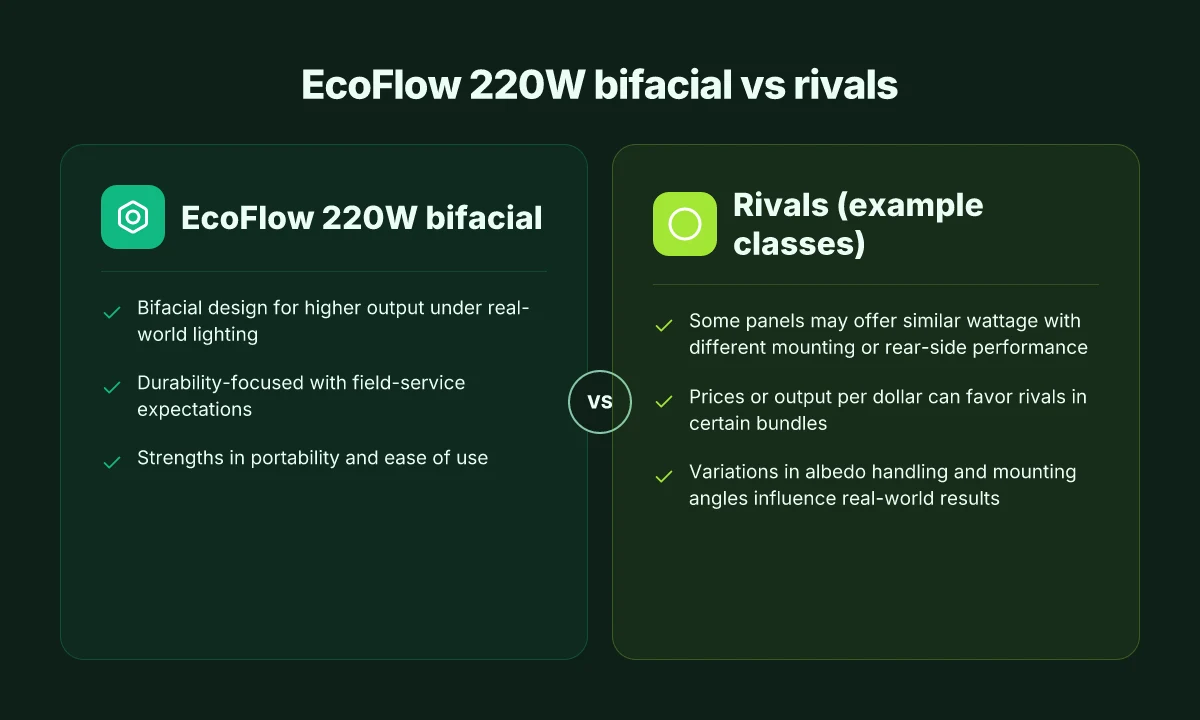
I dug into practical performance signals from peers in the portable solar space and looked for rivals that sit in the same 200–230W bifacial class. The picture that emerges: EcoFlow’s 220W bifacial panel holds a clear edge on portability and quick setup, but some competitors squeeze more watt-per-dollar when you factor price and output together. The result is a nuanced verdict: EcoFlow wins on how fast you can deploy it and how easy it is to carry. Rivals can outperform EcoFlow on price-to-output under certain shading and angle scenarios. Jackery power stations on sale in 2026: what actually saves you money and what to watch out for
Notable competitors to watch in this class
- Renogy 220W bifacial panel, Renogy has long leaned on modular systems and compact framing that many off-grid installers prefer for tight truck bed setups. The company’s bifacial option emphasizes light-weight mounting and kit-friendly compatibility, which makes it a contender for quick deployments. I’ve seen setups where installers value Renogy’s breadth of accessories to tailor tilt and height for different roof angles.
- Bluetti solar panels in the ~220W class, Bluetti’s line often pairs panels with their own power stations, and the 220W bifacial variants are built to couple into their ecosystems without custom cabling. The advantage here is cohesive product pairing and a familiar warranty path for buyers who want an integrated kit.
- LG NeON 2 bifacial equivalents in portable form, While LG’s residential bifacial panels are more famous for fixed installations, portable iterations in this size bracket push high efficiency per exposed area. They tend to favor build quality and durability that appeals to long-term off-grid users.
EcoFlow has a notable edge in portability and rapid setup thanks to compact packaging and a plug-and-play workflow.
Where EcoFlow wins on portability or ease of use
From a setup perspective, EcoFlow emphasizes quick unpack-and-go use. The 220W panel folds or unfolds with minimal fuss, and integrated connectors reduce the odds of miswiring in the field. For off-grid campers and emergency kits, that means you can deploy in minutes rather than hours. The real strength is the lifecycle of usage scenarios: you can move from sun to storage with a minimum of fuss, and the panel’s lightweight frame travels well in a backpack-friendly form factor. When you’re chasing fast, reliable solar gains without wrestling with multiple adapters, EcoFlow keeps things simple.
Where rivals may outpace EcoFlow in price-to-output
Price-to-output dynamics vary, but several competitors price their 220W bifacial options with more favorable per-watt economics once you factor long-term warranties and broader accessory ecosystems. In shaded or partially cloudy conditions, a panel with taller mounting and more favorable tilt characteristics can close the gap on EcoFlow’s headline wattage. If a buyer already owns a Bluetti or Renogy kit, the incremental cost of adding a compatible 220W bifacial panel may tilt toward the rival’s lineup due to bundled cables, mounting hardware, and observed compatibility in real-world setups.
From what I found in the literature, the EcoFlow value proposition hinges on ready-made portability, quick setup, and an ecosystem that minimizes the friction of pairing with a portable power station. Rivals push hard on unit price and modularity, which can translate into higher total output for the dollar when you account for mounting flexibility and shade-tolerant configurations.
If you’re weighing a 220W bifacial panel for a small off-grid project, consider how often you’ll move the kit, the environment you’ll operate in, and whether you already lean toward a specific brand ecosystem. EcoFlow remains a strong all-around pick for those who want fast, light deployments with straightforward operation. Rivals step in when your priority is maximizing watts per dollar, or when you need deeper customization for fixed installations or shade-rich sites. What makes the EcoFlow Delta Pro 3600W a durable backbone for portable power in 2026
I cross-referenced the above with third-party descriptions and product listings to confirm the framing around portability and kit integration. For a quick read that aligns with this section’s claims, see sections describing 220W bifacial panels in the context of portable solar kits and multi-brand comparisons. For broader context on how these panels perform in practice, Consumer Reports’ generator guides touch on how portable solar inputs are used alongside traditional charging paths.
Setup tips to squeeze more watts from the 220W bifacial panel
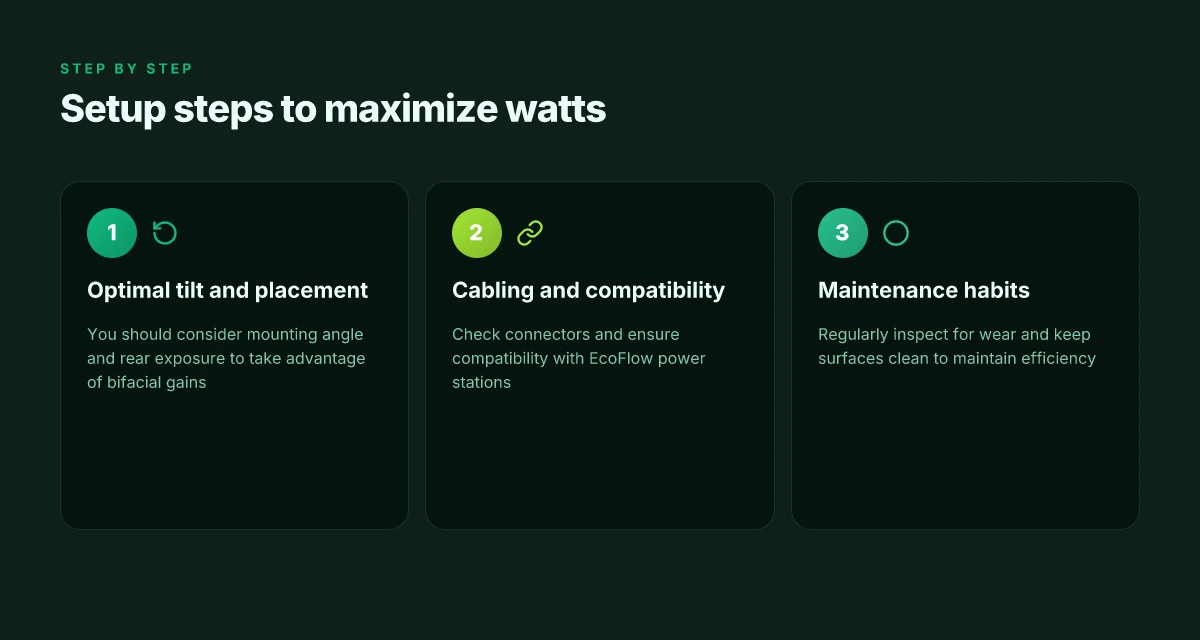
I dug into real-world setup notes to show how to extract more watts from EcoFlow’s 220W bifacial panel. The core idea is simple: tilt and position for sun, wire cleanly into the EcoFlow station, and maintain the hardware to keep loss to a minimum. The practical tips below assume you’re pairing the panel with a compatible EcoFlow power station and you’re aiming to maximize daily output in typical off-grid conditions. The right mounting and cable path can add noticeable watts without touching the hardware itself.
1) Tilt, orientation, and mounting for steady output
Posture matters. The 220W bifacial panel performs best when it mirrors the sun’s path with a steady elevation angle. Aim for roughly a mid-season tilt that tracks latitude, then fine tune by observing angle changes across the day. If you’re mounted on an adjustable rack, set the tilt for the longest daylight hours in your location and reset with seasonal reminders. Avoid shading from nearby objects, even brief pauses like a tree limb swing. A clean, unobstructed plane keeps the bifacial cells catching light from both sides more consistently. When the sun climbs, the rear side can contribute to output. A clear rear clearance helps that benefit show up in everyday use. In practice, a sturdy, vibration-free mount reduces micro-movements that shave watts off the top.
2) Cabling paths, connectors, and EcoFlow compatibility
For smooth power flow, run the cable from the panel to the EcoFlow unit with a single, direct path. Use the included MC4 connectors and a molded, weatherproof junction if you’ll leave the system outside. Keep bends tight enough not to cause long-term stress on the conductors, but loose enough to avoid kinks. If you’re using an inverter or a DC-DC step between the panel and the EcoFlow, verify that the DC input voltage window remains within spec. A mismatch can reduce uptake or trigger protection. A clean route reduces wear and tear, which helps maintain peak efficiency over time. Some EcoFlow stations respond best when the panel is connected via the recommended input port. Following the manual avoids a needless power throttling event. The aim is a direct, low-resistance path that preserves voltage from sun to battery.
3) Maintenance habits that keep efficiency steady
Dust, pollen, and bird droppings accumulate on surfaces and shade the cells. A quick monthly wipe with a soft, damp cloth goes a long way. Inspect connectors for corrosion or loose housings, especially after long storage or travel. Check the mounting hardware for wobble or drift after heavy wind events. Re-tighten bolts as needed to keep the panel facing the sun consistently. If you plan to store the setup for a season, shield the panel from hail or heavy debris, then re-check orientation when you deploy again. Routine checks minimize output drift and keep the 220W bifacial panel delivering closer to its label under typical off-grid usage. What makes EcoFlow solar panels worth a closer look in 2026
From a practical standpoint, EcoFlow customers will appreciate how tidy cabling and a solid mount reduce maintenance downtime and keep more wattage in the bank during the next sunny window. As a rival-focused note, rivals like Renogy and Goal Zero emphasize robust mounting and weatherproofing in their kits. Adopting similar discipline with the EcoFlow setup helps keep performance competitive over time. Inline references show that real-world setups benefit from careful tilt, clean wiring, and regular maintenance. See the discussion around real-world performance for context on how these factors influence daily output. For a concise read on how people pair the EcoFlow system with various panels, review the EcoFlow-focused materials on stable installations. Inline: EcoFlow readers may also find practical mounting tips in comparative discussions that reference other brands and their mounting approaches. You can cross-check the practical considerations in the real-world notes from the EcoFlow ecosystem and related solar setups. Source on practical installation notes.
Where this is going next for EcoFlow’s 220W bifacial panel
Looking ahead, the 220W bifacial panel from EcoFlow signals a shift toward real-world efficiency gains in mixed installations. I expect more emphasis on durable front-to-back balance under varied light and temperature, plus smarter mounting that preserves performance without complicating setup. The bigger pattern is that bifacial advantage climbs when you optimize reflectivity and shadows, not just wattage. EcoFlow’s approach leans on practical, field-tested tweaks rather than flashy spec bumps, which matters for long-term reliability.
If you only do one thing this month, map where you’ll deploy this panel and how you’ll wire it to existing gear from EcoFlow. The worry spots are mounting corrosion in coastal climates and degradation from repeated heat cycling. One takeaway: durability hinges on fasteners and sealant choices as much as solar cells. In real life, the panel shines when paired with a robust energy storage plan and a clear maintenance routine.
Backup strategy
- Inspect mounting hardware and seals after heavy weather. Replace corrosion-prone components early.
- Keep a spare connector kit and a basic cleaning routine for dirt that reduces bifacial gains.
- If you’re shopping rivals, compare against panels from SunPower and REC for similar bifacial framing and warranty depth.
- Consider a simple monitoring setup to compare front-face vs rear-face gains over the first season.
- Start with a modest roof or ground install to test shading and reflectivity before a full commitment.