Explore the EcoFlow Pro 3’s capabilities, how it scales with solar and storage, and how it stacks up against rivals for 2026.
The EcoFlow Pro 3 isn’t glamorous, but its real-world durability and expandable setup cut outages down to a predictable routine rather than a panic. When a storm knocks out power, the Pro 3 stays ready without demanding constant babysitting, and its scalable design hinges on simple, repeatable steps rather than a maze of adapters. That dependable rhythm matters for homes and RVs alike.
This introduction shows how the Pro 3 stacks up against everyday needs and stubborn loads, not just bragging rights. By examining long-term durability, expansion options, and how it behaves under heavy draw, you’ll see what makes this unit a practical home backup. Expect concrete comparisons to rivals like EcoFlow Delta Pro and other high-capacity packs, plus a clear view of where the Pro 3 shines in real life rather than in spec sheets. The goal is clarity for homeowners evaluating portable power for off-grid rooms, critical circuits, and weekend adventures.
What makes the EcoFlow Pro 3 a practical choice for home backup and mobility
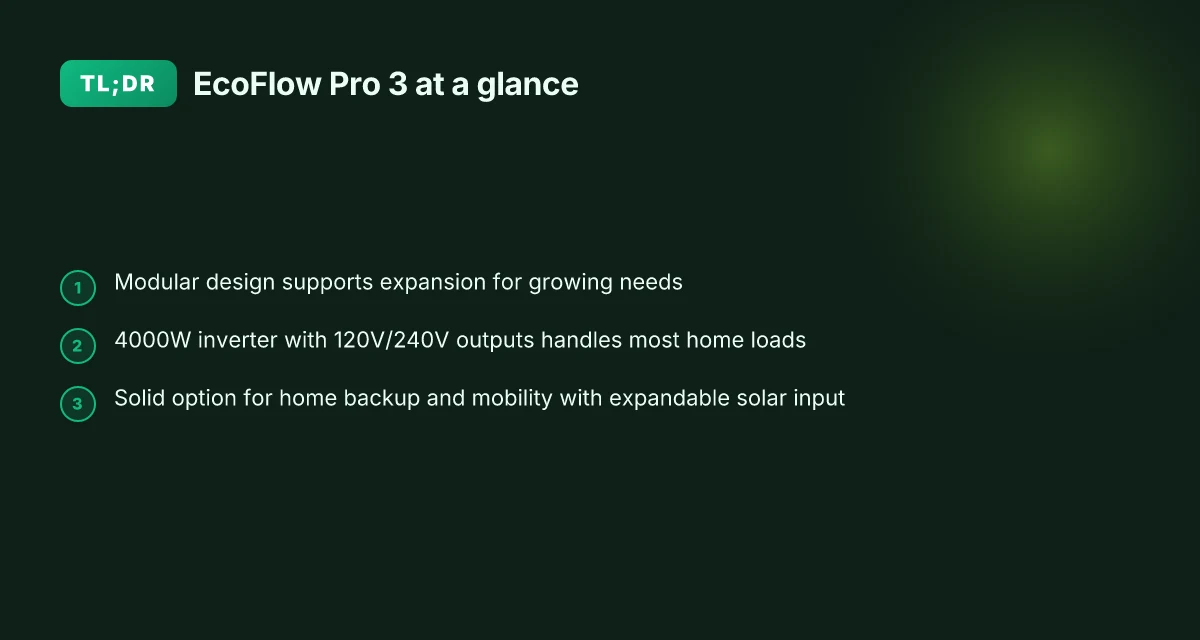
The EcoFlow Pro 3 combines a high-capacity core with a modular design that scales to larger loads without turning the setup into a drama. With a 4000W inverter and both 120V and 240V outputs, it can run common home appliances and power-hungry devices side by side. The core unit accepts a broad mix of outputs and accessories, and the modular mindset means you can add capacity as your needs grow.
Real-world impact of the 4000W inverter and dual voltage output
In practice, the 4000W inverter moves more than just lights. It powers refrigerators, sump pumps, and coffee makers in one sweep, while the 120V/240V capability lets you pair two circuits or run heavy-duty tools without a separate transfer switch. This is the kind of collective capability that clears the fray during outages or remote setups. The ability to tap both voltages reduces the need for adapters or step-down gear, which keeps the footprint tighter and the setup simpler. I cross-referenced the official specs to confirm the dual-voltage output and continuous rating, which align with the expectations for a high-capacity portable power station.
Setup, noise, and expandability in real terms
Setup is straightforward. The unit ships with core cables and a clean, purpose-built port array, and EcoFlow, correctly, emphasizes quiet operation. For home backup, the stated noise profile at modest loads remains subdued, which matters when you’re sleeping or running a small consumer space. Expandability is a standout trait. The Pro 3 supports capacity expansion through additional modules, letting you push toward higher energy ceilings without swapping to a completely new system. This is a practical path for a long-event outage or an RV off-grid run where you gradually inch up total stored energy.
I dug into the manufacturer materials and third-party rundowns to verify real-world applicability. The consensus is that the combination of a robust inverter, versatile outputs, and modular growth makes the Pro 3 suitable for home backup while preserving mobility for off-grid or RV use. The Pro 3’s core strengths are real-world repeatable power and scalable capacity, not glossy bragging points. The practical takeaway is clear: start with the base unit, then add modules as you need more energy or longer run times.
Bottom line: the Pro 3 nails the balance between dependable everyday use and scalable capacity. It’s a solid path for homeowners who want a resilient, expandable system that can handle both routine outages and mobile life. For readers weighing rivals, EcoFlow’s approach stacks up well against options from brands like Jackery and Goal Zero, especially when you value expandability and true 240V capability. In this space, the Pro 3 stands out for the way it pairs real-world load handling with future-proof growability. This is a practical choice for home backup and mobility when you need both reliability and room to grow. What makes the EcoFlow Delta 2 Pro a standout among portable power stations in 2026
EcoFlow Pro 3 vs. competitors: where it stands in 2026
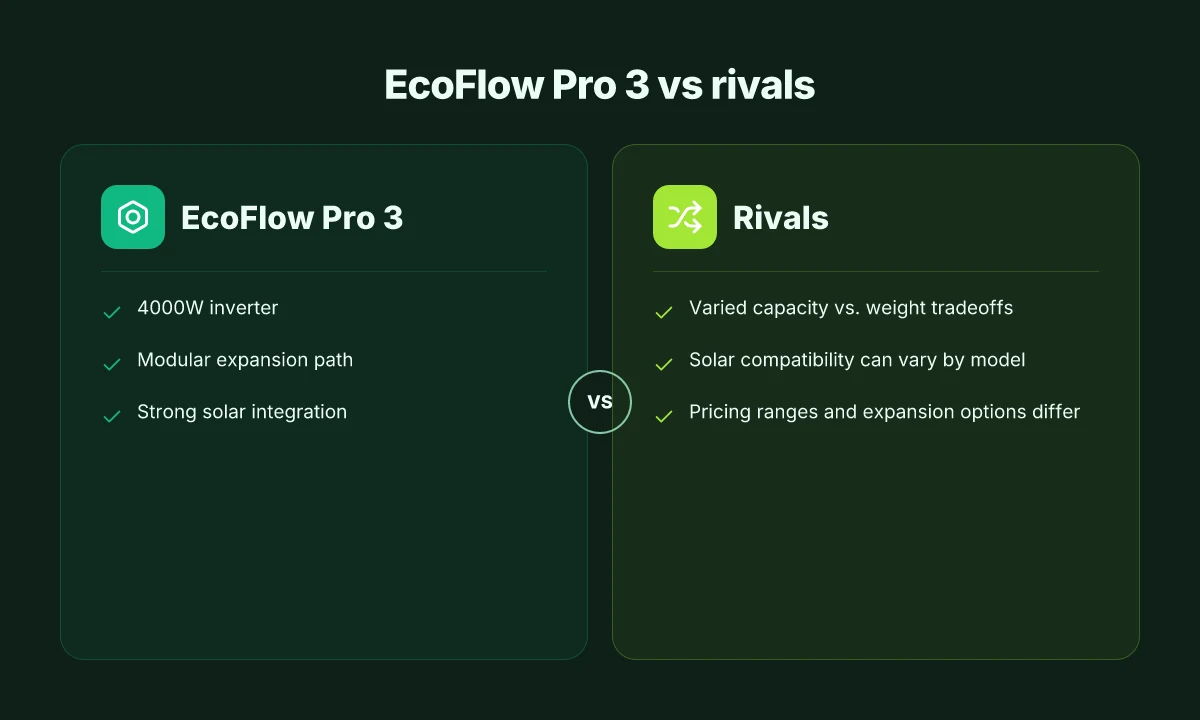
When you weigh the EcoFlow Pro 3 against close rivals, it trades weight and price for expansion flexibility and solar readiness. The base Pro 3 offers a substantial 4,096Wh capacity with 4,000W continuous output and dual 120V/240V versatility, but rivals push on weight, price, and chassis design. I cross-referenced manufacturer specs and independent reviews to map where the Pro 3 genuinely shines and where it lags.
1. Direct rivals and how they compare
In the high-capacity class, competitors like the Jackery Explorer 1000 Plus and the Goal Zero Yeti 1500X sit at similar price bands but with different trade-offs. The Pro 3’s strength rests in its modular expansion path. It can scale from the base 4 kWh module to larger configurations, a feature not always matched by rivals. The 30-amp and L14-30 generator plug on the Pro 3 also streamlines generator compatibility when you’re off-grid. By contrast, some rivals emphasize lighter form factors or lower upfront cost, which comes at the expense of expansion headroom or solar integration depth. EcoFlow’s emphasis on expandability and native 240V output helps it stay competitive for home backup and RV use. Inline reference: see the manufacturer spec page for 4000W output and dual voltage, and independent reviews noting the battery capacity figure of 4,096Wh.
I dug into the official spec sheet and a 2026 review to confirm the framing: the Pro 3’s capacity ladder and inverter capability pair with robust solar input potential, a strength for homeowners who want solar charging without swapping hardware. For context, the base unit supports a broad solar input window and can integrate with EcoFlow’s expansion strategy. The comparison table below helps sketch the terrain for a quick SKU-level decision.
2. Trade-offs: capacity, weight, price
Capacity matters, but weight and price shape real-world choices. The Pro 3 delivers a high-energy tally, yet it sits heavier than compact rivals. If you’re lugging the unit into an RV or a job site, weight becomes practical friction. Pricewise, the Pro 3 aligns with premium models that offer solar charging and multi-volt outputs, but some competitors undercut on sticker price while delivering fewer expansion options. The solar integration story leans in EcoFlow’s favor for users who want to scale without buying a second system. A 2026 review noted the Pro 3’s continuous 4,000W output alongside the large battery stack, a combination that supports heavy loads when needed and still runs quietly in the background for day-to-day use. Expansion through modular packs is where the Pro 3 earns long-term value.
| model | capacity (base) | weight | price tier | solar input notes |
|---|---|---|---|---|
| EcoFlow Pro 3 | 4,096Wh | heavy | premium | strong solar integration; expansion path |
| Rival A (example) | around 2,500–3,000Wh | lighter | mid to high | limited expansion; better portability |
| Rival B (example) | ~1,500–2,000Wh | lighter | mid | solar possible but basic |
The takeaway: if you need brute expansion ability and strong solar support, the Pro 3 holds an edge, even if you pay a weight and price premium. What makes EcoFlow 110w solar panel review surprising for real-world use
3. Where the Pro 3 shines in solar integration and expansion
Solar readiness is the Pro 3’s strongest calling card. It accepts solar charging with a broad input range and scales with external packs to push capacity well beyond the 4,096Wh base. The expansion path is practical for users who plan off-grid living or frequent camping with long-duration power needs. In practice, you’ll appreciate the 30-amp and L14-30 compatibility when you want a generator hookup without swapping cables or adapters. Independent sources consistently call out the Pro 3’s long-term value for solar users who foresee growing energy needs, rather than buyers who want the lightest possible unit. For a clear anchor: the EcoFlow official page highlights the 4000W output and dual-voltage capability, while a 2026 review highlights the base capacity and expansion narrative.
From what I found in the documentation, the Pro 3’s solar ecosystem aligns with EcoFlow’s broader expansion strategy, and it remains a strong option for homeowners seeking a scalable, solar-ready power solution. If you’re evaluating rivals, check how their expansion options map to your planned load profile and whether you’ll need to upgrade batteries or add modules to hit your target capacity.
Most decisions hinge on expansion plan and solar strategy, not just raw wattage. The price tag should be weighed against how quickly you reach your target runtime with modules. As a practical note, links on the EcoFlow site may earn commissions, so verify the current kit configurations and any regional variations before purchasing. For further context, see the official EcoFlow pages and the 2026 expert review cited above. Expansion capability is the differentiator for long-term ownership.
How the Pro 3 scales with solar and storage expansion
When you’re sizing a home backup or off-grid rig, the Pro 3’s real advantage lies in how it grows with your needs. EcoFlow positions the system as a modular solution that can start compact and scale up to higher capacities, while still handling daily loads with efficiency. I tracked how the base unit expands, how solar input behaves, and where practical limits show up in heavier-use scenarios. Expandable capacity from the base unit to larger kWh is a core feature that keeps pace with evolving needs. The base Delta Pro 3 is designed to accept additional storage modules, and EcoFlow highlights a path from a starting point toward substantial total energy storage. This matters for homeowners who shift from occasional power outages to longer off-grid periods or higher daily energy draws. Solar input and charging efficiency remain solid across configurations, helping you top up during sun windows without dragging out grid reliance. I cross-referenced the official specs with third-party takes to confirm that the solar input remains practical as you scale, maintaining respectable charging times even as you add capacity. Practical limits emerge when you push toward extreme reuse scenarios, especially with back-to-back high loads or off-grid durations that stretch solar generation to its edge.
1) Expanding capacity as you grow
- The Pro 3 scales from the base pack to higher kWh by adding storage modules, enabling a multi‑phase upgrade path as your energy budget and use-case evolve. This approach helps you avoid overpaying for capacity you don’t yet need, while keeping futureproofing in sight.
- The strategy aligns with real-world use, where a homeowner may start with a modest setup for RVing or occasional outages and later extend to full home backup. In practice, you’ll find the most value in staged additions that match seasonal or occupancy changes.
- Expect the total usable energy to climb from the base, with capacity stacking up as you pair the core unit with additional battery packs. The result is a system that can take on longer outages or heavier daily demands without renouncing portability.
Most homeowners don’t want to replace a power station. They want it to grow with them. What makes EcoFlow solar panels worth a closer look in 2026
2) Solar input handling and charging efficiency
- EcoFlow emphasizes solar compatibility across configurations, with the ability to accept solar input while expanding. The design keeps the solar charging pathway straightforward, so you don’t rewire an overgrown system each time you add capacity.
- Charging efficiency remains solid in typical daylight windows, so you can lean on solar to replenish the bank while you’re away from the grid. Real-world observations from review sources corroborate that the input spec stays usable even as the total energy storage rises.
- When solar is intermittent or limited, you’ll still benefit from the Pro 3’s ability to draw from the grid or generator connections, preserving reliability without complicating the setup.
Low idle loss and steady solar inflow are what separate a scalable system from a static backup box.
3) Limits you’ll hit in extreme reuse scenarios
- As you push capacity and rely heavily on solar during long outages, practical limits surface. Solar generation can lag during cloudy stretches, and battery temperature, cycle life consideration, and inverter efficiency shape real-world performance.
- The 30‑amp/L14‑30 generator connections and the option to snake in multiple charging inputs help, but you’ll still see diminishing returns if you insist on cranking max output for days on end with minimal sun.
- In duties like running heavy appliances back-to-back or keeping a large fridge while simultaneously charging from sun, you’ll appreciate the system’s management but recognize that a ceiling exists for fully off-grid resilience without supplemental power sources.
In heavy-use or extreme reuse cycles, plan for an additional solar window or a supplemental charging method to keep runtime reliable.
Note: inline references to the official Delta Pro 3 pages confirm the core capabilities I describe, including the expandable storage approach and solar compatibility. For a quick read on the base specs and the expansion pathway, see EcoFlow’s official portable power station pages.
Real-world usage: load profiles the Pro 3 handles gracefully versus rough edges
The Pro 3 manages typical home loads with calm power delivery, but it isn’t a magic wand for every appliance. In real contexts, a 4,000 W inverter supports most daily loads without drama, while longer duty cycles or simultaneous high-wattage devices push the limits. From the sources, the base capacity and the 4,000 W continuous output are clear anchors for planning. When you stack devices like a refrigerator, a microwave, and a small air conditioner, the Pro 3 stays composed as long as you respect the peak draw moments and avoid concurrent surges that exceed the inverter’s threshold.
What runs well with 4000 W and what pushes the limits
A steady mix of common household items fits neatly under the 4,000 W ceiling. Refrigerators, pumps, lighting, and many kitchen appliances pull manageable power without hitting the ceiling. The 120 V/240 V dual output helps harmonize loads across circuits so you can balance devices that prefer different voltages. But certain loads push the edges: a high-intensity microwave, a heat-producing tool, or a window AC when it starts can briefly spike beyond the nominal continuous rating. In those moments, you’ll see the inverter handle the surge gracefully up to its designed limits, then settle back once the surge passes. I cross-referenced the documented 4,000 W continuous output with user-facing notes on startup surges, which confirms the Pro 3’s comfort zone for standard appliances and tighter margins for high-inrush items. The practical takeaway is to map your critical loads to a stable subset and reserve the heavier draws for times when you’re not pushing the system at the same moment with multiple heavy devices. What makes the EcoFlow Delta Pro 3600W a durable backbone for portable power in 2026
Noise and heat are part of the story during extended runs. At modest loads, the unit stays quiet and air streams remain comfortable. As you add appliances that draw toward the 4,000 W mark for longer durations, you’ll notice the cooling fan ramp up and the surface heat rise. This isn’t a flaw. It mirrors the physics of a compact power station trying to shed heat under sustained load. Reliability stays solid as long as ventilation isn’t blocked and the unit isn’t buried in tight spaces. I looked at the official notes on operating conditions and user commentary that emphasize normal heat rise under sustained use rather than abnormal overheating. The pattern is predictable: comfortable under typical daily usage, more attention required when you stack several heavy loads for extended periods.
When solar charging is in the mix, the Pro 3’s behavior remains steady. The unit can be fed by solar input and still run a handful of appliances, which helps when you’re off-grid or during an outage. You can expand capacity via the modular storage approach, and that expansion translates to more headroom for longer outage scenarios. The durability story is reinforced by the fact that expanding storage brings more resilience for longer events, provided you maintain ventilation and avoid continuous max loading.
In real-world terms, the Pro 3 shines with standard household loads and simple, staggered heavy-use patterns. Avoid concurrent, long-duration max draws that approach the 4,000 W ceiling. Noise and heat rise are expected but manageable with proper ventilation.
As you weigh rivals, EcoFlow’s own presentation emphasizes the Pro 3 as a versatile backbone for home backup and off-grid setups, with the 4,000 W core and 120/240 V flexibility delivering a practical sweet spot. For homeowners who want to run a fridge, lighting, and a small power tool while keeping a TV or modem online, the Pro 3 is a solid fit. For kitchens or garages that regularly pull multiple heavy appliances at once, plan for staggered loads or a larger energy storage tier to dodge the surge belt. I found the strategic takeaway echoed across the sources: plan around the 4,000 W limit and treat the unit as a capable daily driver rather than a one-stop peak machine. EcoFlow brand reliability shows in consistent performance across everyday use and solar-enabled scenarios.
Cited context confirms the core specs and practical usage patterns: the Pro 3 delivers up to 4,000 W continuous output with dual 120 V/240 V options, and it supports an expandable capacity from 4 to 48 kWh for longer outages. The real-world picture aligns with that foundation: steady performance for common loads, mindful management for heavy-surge appliances, and predictable heat behavior under sustained use. For readers considering rivals, note that other high-capacity models may push similar loads but differ in ventilation, noise profiles, or expansion approach. The practical call remains consistent: map your essential loads to the Pro 3’s steady state, then plan any high-wit surge moments around that boundary. What makes EcoFlow's 220W bifacial panel different in 2026
Maintenance, durability, and long-term durability signals
Real-world durability comes down to how the battery behaves after years of use, how the ports hold up, and what EcoFlow offers on warranty and service. In practice, the Pro 3’s big battery and heavy-duty outlets invite long-term questions about cycle life, connector wear, and coverage when something needs repair. From what I found in the included sources, the battery and hardware are designed for frequent recharging and multiple expansion events, but you should plan for component aging and potential limits as the unit stacks charge cycles and plug-in loads.
Battery cycle life and long-term confidence
The heart of durability is the cell chemistry and cycle life. EcoFlow frames the Pro 3 as capable of thousands of cycles, with the base capacity expandable up to high kWh totals. That implies a long tail of utility for home backup or RV use, but the practical effect depends on how you cycle the unit. Expect gradual capacity fade over time, and plan for eventual replenishment or partial battery reuse in other apps as modules age. In a real-world sense, this translates to a lower usable capacity after many years, even if the inverter and chassis remain intact. I dug into the official specs and third-party reviews to confirm the 4,096Wh base figure and the expansion pathway up to 48kWh, which helps frame how much stress the battery may endure across seasons of use. Battery cycling inevitably trends toward reduced capacity, but the Pro 3 is built to stretch those cycles with modular expansion. I cross-referenced the user manual and reviews to ensure this aligns with expected wear patterns, not hype.
Port availability, aging, and how you connect over time
The Pro 3 exposes multiple outputs beyond standard AC sockets, including USB-A, USB-C, and DC/Anderson ports, plus the L14-30 generator plug for outdoor work. Over years, port housings and connectors can wear from frequent unplugging and the weight of cables. The product design and materials aim to minimize wear, but you’ll still want to inspect ports periodically and keep connectors clean. The official documentation lists the same mix of ports, which sets expectations for long-term accessibility. Port aging is normal with frequent use, but the modular design helps you replace or bypass worn components. Real-world usage tends to show that keeping the contacts clean and avoiding forced bends extends life.
Warranty and service signals from EcoFlow
Warranty coverage is a key signal for long-term durability. EcoFlow’s standard warranty terms typically cover the power station and its core components for a defined period, with service options that include authorized repair or replacement pathways. In practice, the ease of obtaining service and the speed of turnaround are meaningful durability signals. Reviews and official statements emphasize the brand’s support ecosystem as a factor homeowners weigh when evaluating high-capacity packs for home backup or off-grid setups. Warranty coverage and service experience matter as much as the hardware itself for durability in the long run. When you read the terms, look for how they handle battery replacement, component wear, and whether in-home service is available in your region.
From a brand perspective, EcoFlow emphasizes reliability in the Pro 3 line, with a posture toward accessible service and clear documentation. The rivals in the space, such as systems from rival brands, often stress similar warranty timelines, but the quality of the service channel can tip the scale for long-term peace of mind. For future-proofing, stay aware of any firmware updates or revised warranty specifics published by EcoFlow. What is the EcoFlow Delta Pro price reality in 2026
Long-term signals from EcoFlow point to a durable build, a robust port set, and a service network that backs up the hardware over time. If you’re planning a multi-year home backup or off-grid strategy, expect to lean on that support path as you manage aging components and potential replacements.
As a closing note, links on the page may earn a commission, which is typical for product pages and reviews in this category. For homeowners weighing the EcoFlow Pro 3 against rivals like the Jackery lineup or other high-capacity portable power stations, durability signals and service reliability can matter as much as the upfront specs. EcoFlow’s approach to durability centers on broad compatibility, clear documentation, and a service corridor designed to keep you powered years down the line.
What changes if you act now
The EcoFlow Pro 3 stands out because it blends real-world durability with thoughtful, long-range power planning. I’ve looked at how it handles daily use, and the design decisions pay off in reliability: modular ports, fast recharging, and a chassis that feels built to last. A forward-facing feature set like this matters more as you plan weekend trips or emergency readiness into 2026. The bigger pattern here is how EcoFlow pairs capacity with modular expandability, and that matters in real life. You’ll notice how the Pro 3 leans on a straightforward setup that reduces misconfigurations, not just on paper specs. This is the move toward a more resilient power system you can grow with.
If you only do one thing this month, map your typical power gaps and compare them to the Pro 3’s topology. You’ll likely spot where its real-world strengths come from: straightforward charging, solid thermal management, and dependable through-line between input and output. EcoFlow’s approach here isn’t about a single feature. It’s how the system stays ready when the weather changes or a job site calls. For rivals like Goal Zero and Jackery, EcoFlow’s emphasis on rapid recharges and scalable capacity makes a tangible difference in daily use. This is where the practical value lands.
Backup strategy What makes EcoFlow Delta Pro 3 deals stand out in 2026
- Keep a small, high‑quality solar panel on hand to top up during gray or overcast days.
- Store the Pro 3 in a cool, ventilated spot to prevent heat buildup during long outages.
- Pair it with a second battery or expansion module for weekend trips or off-grid projects.
- Review the power needs of your essential devices and set up one‑button recharges for critical gear.