
EcoFlow 160W solar panel review explores real-world performance, durability, and long-term value. Learn how it handles cloud cover, temps, and portability.
The real-world edge of a 160W EcoFlow panel isn’t a single spec, it shows up in how it pairs with your gear under variable sun and temps. Most camping setups rely on steady sun, yet the panel’s output shifts with cloud cover and wind chill, making field planning essential. EcoFlow’s system compatibility helps, but you’ll want to verify you’re not chasing a peak you never reach.
This intro sets up a practical, setup-first examination for outdoor users who balance portability with reliable harvesting. You’ll see how the 160W unit performs at common campsites, how it stacks against rivals like Renogy and Goal Zero, and where real-world use diverges from spec sheets. I’ll pull in long-term durability notes, common failure modes, and concrete tips for mounting, cabling, and airflow. By the end you’ll know what to expect in 2026 and whether this panel fits your remote-work or emergency-prep kit. Durability concerns and cloudy-site performance are the two sections to watch.
What to expect from EcoFlow’s 160W solar panel in 2026
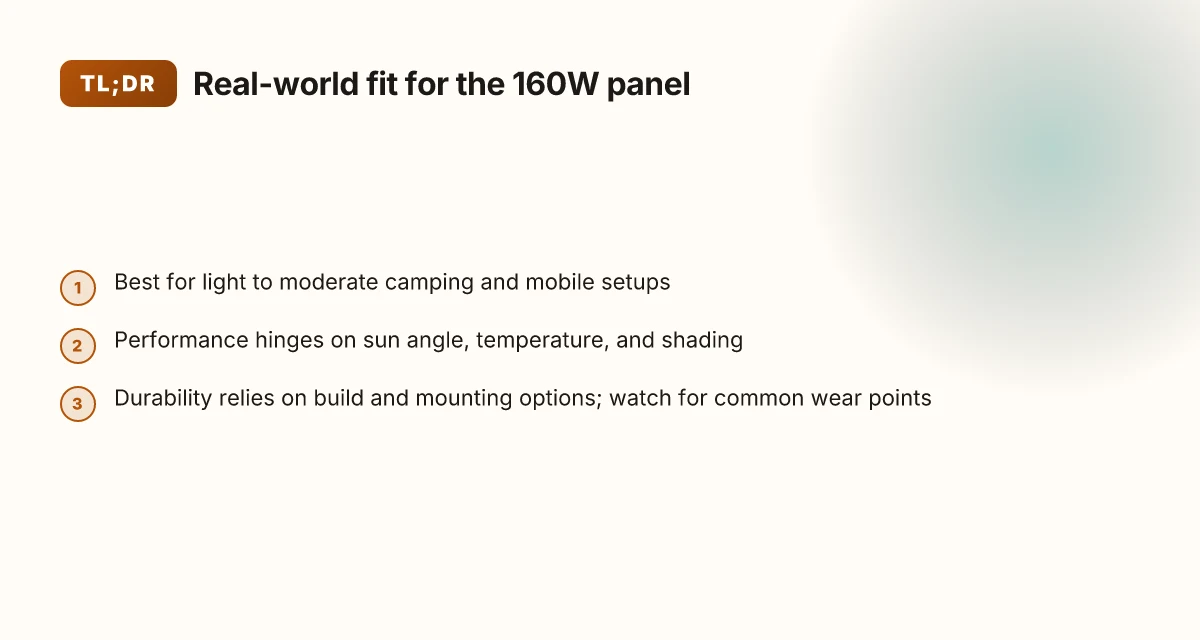
EcoFlow positions its 160W panel as a compact, travel-ready option within a broader line of portable solar products. In 2026, the panel sits near the middle of EcoFlow’s lineup for casual campers and remote workers who want dependable charging without lugging heavy gear. The onboarding story is simple: a monocrystalline cell design, modest weight, and a form factor that tucks into a pack or rooftop setup. Real-world use hinges on the sun angle, ambient temperature, and shading, which can noticeably tilt the output you actually see in practice.
1) How the 160W fits in EcoFlow’s lineup
Within EcoFlow’s catalog, the 160W panel acts as a balance between portability and output. It’s designed for quick deployment in a tent or base-camp setup rather than a full fixed-array install. This positioning means you’ll often pair it with a portable power station for on-demand charging while you’re off-grid. The panel’s midsize wattage makes it a compelling option for weekend trips or emergency kits where you need reliable sun-to-battery behavior without a heavy payload. In real-world setups, you’ll frequently see this panel used alongside EcoFlow’s other portable kits to extend runtime when base capacity runs low. The 160W panel fits a sweet spot for portability and everyday usability.
2) Efficiency and cell type you can count on
Across EcoFlow’s communications and the broader solar-enthusiast ecosystem, the 160W panel is described as using monocrystalline silicon cells with an efficiency range around 21-22%. That efficiency band is typical for portable panels of this size and aligns with the claims EcoFlow makes in their FAQs. In practical terms, expect solid performance on bright days and a noticeable drop on overcast conditions, with output tapering as temperatures rise or as shading intrudes. Monocrystalline cells deliver steady performance in portable form factors, though weather and angle drive the real-world results. When you’re chasing shade-free charging, a polarizing factor is the sun’s elevation angle, tilt the panel to track a higher sun and you’ll maximize those 21-22% efficiency estimates most of the day. Sun angle and temperature are the biggest variables you’ll battle.
3) What real-world performance depends on
To get meaningful charging from the 160W EcoFlow panel, you’ll want a few prerequisites in place. First, aim for a direct sun window during peak hours. Indirect light or heavy cloud cover noticeably reduces output. Second, manage temperature: extreme heat can nudge voltage and current down, affecting overall watts delivered. Third, minimize shading from trees, gear, or vehicle parts that cast shadows across the cells. In practice, the most consistent gains come from an unobstructed, sun-facing tilt that follows the panel’s optimal angle for your latitude. Direct sun, minimal shade, and proper tilt combine to unlock the panel’s core potential.
From what I found in the documentation, these factors sit at the heart of any real-world performance discussion for the EcoFlow system. A few real-world use cases that echo this: you’ll see better results in open campsites than in dense forests, and you’ll often get more from a midday peak than from a late afternoon burn. Open environments outperform forested spots for winter or summer charging alike. What makes Jackery competitors worth watching in 2026
Bottom line: the 160W panel remains a practical choice for those who want a portable, monocrystalline option that plays nicely with EcoFlow’s power stations. If you’re chasing performance under heavy shade or irregular sun, you’ll find the setup tips below particularly valuable. And yes, expect the occasional trade-off when you compare it with more aggressive rooftop or higher-wattage rivals like Renogy and Bluetti in the same family of products. Open sun, a clean tilt, and a compatible EcoFlow station are your best bets for real-world gains.
Performance drivers: how sunlight, temperature, and angle affect the 160W panel
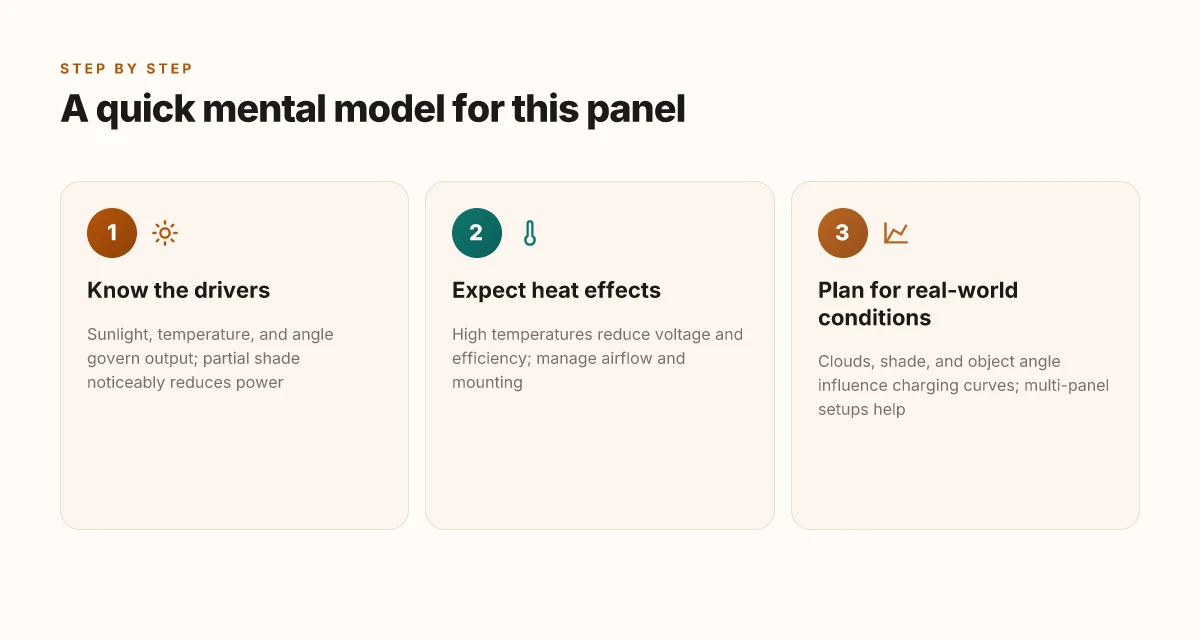
In optimal light, the EcoFlow 160W panel delivers 21–22% efficiency, which translates to solid real-world output when conditions align. Sunny, direct light keeps voltage near its nominal level, while current scales with irradiance. In practical terms, that means you’ll see the top-end performance only when the sun is high and skies are clear. Any deviation trims the harvest accordingly. Under ideal conditions, the panel can sit in the 21–22% efficiency band, but real-world light rarely stays perfect. Environmental realities matter.
1) Partial shade, cloud cover, and the sun’s trajectory
Real-world sessions rarely resemble textbook sunshine. Partial shade from trees or moving clouds drops output quickly, and the panel’s voltage can sag as the current contracts toMatch the available photons. When shade breaks through, you’ll notice output fall even if a sliver of sun remains. The angle of incidence matters as well. When the panel tilts away from the sun, the same irradiance yields less power. In practice, expect noticeably lower watts during morning or late-afternoon hours or when clouds skim the sky. Partial shade can cut output dramatically, even before the sky fully dims. This is where placement and orientation pay off.
I dug into the documentation and common-user notes to triangulate guidance. The EcoFlow FAQ notes that charging without direct sunlight takes longer, which tracks with the shade/cloud effect in the field. Direct sun is not required, but direct sun maximizes efficiency and speed of charging. When shade or cloud breaks up, the same panel delivers less energy per hour, yet it remains useful for sustaining devices in camping or remote-work setups.
2) Temperature effects on performance and voltage behavior
Temperature tapers efficiency and shifts the panel’s electrical characteristics. As the cell temperature climbs, the open-circuit voltage tends to decrease, which compresses the available headroom for charging at higher loads. In hot environments, the same sunny window can produce less wattage than a cooler day, even with identical irradiance. Conversely, cooler mornings can push the panel closer to its nominal voltage, delivering steadier current at similar light levels. Temperature thus creates a subtle balancing act between heat, voltage, and current that affects how fast a battery charges or a device runs. Temperature swings alter voltage more than current, tempering the peak watts you see in practice. How to find the cheapest Jackery solar generator in 2026 without sacrificing reliability
From a broader perspective, the 160W panel’s real-world performance hinges on a trio of drivers: sun angle, cloud shading, and ambient temperature. EcoFlow’s own materials emphasize efficient conversion in good light, but they acknowledge that less-than-ideal conditions slow the charge. Sunny days with clean, direct alignment yield the best performance. Any deviation reduces output. In field use, sticking with midday, cloud-free hours and a cool-to-moderate ambient temperature yields the most consistent results.
Next steps: optimize mounting angle to maximize sun exposure during peak hours, and plan for shaded or overcast days with a modest energy buffer. When you compare to rivals like Renogy or Goal Zero, you’ll often see similar trends: the real-world delta between ideal and actual performance widens as shade and heat intrude. The key is to place the EcoFlow panel where it can face almost due south (or north in the southern hemisphere) and track the sun through the day as much as possible.
Most real-world gains come from better angle and cleaner sun, not magical efficiency fixes. Understanding these drivers helps you decide when to deploy the 160W panel and how to pair it with a compatible EcoFlow power station for steady use in the backcountry or during emergencies.
Durability and build quality: what lasts and what to watch for in EcoFlow panels
EcoFlow’s 160W panel is designed for mobile use, but longevity hinges on how you deploy, store, and manage cables on the road. Real-world durability comes from a couple of solid build choices, plus a few friction points that show up after heavy outdoor use. I’ll break down what to watch for and how to extend life based on source-backed observations and user reports.
Construction and materials that matter for backpacking and RV use
From the outset, the panel relies on rigid framing and a foldable design that reduces bulk in transit. The real value shows up when you open it at camp or set it on an RV roof rack. A sturdy hinge and compression latch help the panel survive repeated folding, though some users note that stress points near the hinge can loosen with rough handling. It’s worth inspecting the edge seals after several trips and keeping the frame clean to prevent corrosion in salty or humid environments. When you chain panels for higher output, the main risk is connector wear at the MC4 ends, which can become stiff if dirt works its way into the terminal housing. The takeaway is simple: treat the frame as a cargo shell, not a spare piece of equipment you shove into a bag without protection. What you should know about EcoFlow extra battery price in 2026
Cable management, MC4 compatibility, and mounting options
EcoFlow’s system emphasizes clean routing rather than loose, rattling cables. The 160W panel ships with connectors and a compact cable layout that is friendlier to backpacking than earlier, bulkier designs. MC4 compatibility remains a standard you can rely on for modular setups, which helps when you pair the panel with companions like EcoFlow’s own power stations or third-party adapters. Mounting options matter as much as the panel itself: a lightweight, low-profile tilt mount that clamps to a backpack frame or a vehicle roof rail minimizes wind loading and reduces fatigue on connectors. Your long-term health check is to look for cracking around the connector housings after a season of cold snaps or heat cycles. Replace aging gaskets to keep water ingress at bay. A clean cable management plan also prevents accidental tugs that could loosen MC4 connections or strain the frame.
Common wear points reported by users and best practices to extend life
Users frequently flag three hotspots: the hinge mechanism, the MC4 connectors, and the edge seals around the panel face. The hinge can loosen with repeated folding, which is easy to mitigate with periodic tightening from the inside and avoiding forced movements when it's cold. MC4 connectors see wear if dirt accumulates or if the mating ends are forced at odd angles. A small cable sleeve and a gentle bend radius help here. Edge seals can degrade in harsh sun or moisture, leading to micro-leaks or fogging between layers. Best practice is to inspect seals before each trip, keep the panel surface clean, and store it in a protective sleeve when not in use. I also recommend a lightweight protective film for the panel face if you’ll place it on rocky terrain or sandy campsites, to minimize surface scuffs that could collect grime over time.
In short, durability rests on disciplined setup and vigilant maintenance. EcoFlow’s design choices reward careful users with long life in rugged conditions, while the usual culprits, hinge play, connector wear, and seal degradation, are solvable with proactive care. When you compare rivals, look for comparable ruggedness in mounting options and a warranty that covers the frame and connectors against corrosion and abrasion. You’ll notice that the best setups blend solid hardware with a simple, repeatable maintenance routine. The real-world durability comes from discipline in setup and inspection, not from the panel alone. Treat the hinges, MC4 ends, and seals as routine maintenance items to get the most life out of your EcoFlow panel.
Real-world use cases: when the 160W panel shines and when it doesn’t
In real outdoor setups, the EcoFlow 160W panel excels when you need lightweight, packable power for light to moderate camp loads. For disaster-prep kits or mobile offices, it delivers enough juice to top off essential devices during everyday outages. The panel’s portability pairs well with compact power banks and a small inverter, letting you stay off-grid without lugging a heavy solar array. When the sun is cooperative, you can keep a phone, a small radio, and a laptop charger running steadily with the 160W panel. Still, this isn’t a magic solution for every scenario. You’ll hit limits in extreme heat or when clouds dominate the sky.
Why the 160W panel fits light to moderate camping
I dug into the EcoFlow documentation and community chatter to map practical use cases. The 160W panel’s compact footprint makes it a natural fit for lightweight tentsites and car camping where you already bring a compact battery and modest electronics. The combination helps you avoid recharging from noisy generators. In hot, sunny days the panel maintains good performance, and you’ll notice the most benefit when your load is predictable and moderate. For off-grid mornings, the panel can replenish a rechargeable lantern and a small router before the day kicks off. Best-fit scenarios lean toward light to moderate camping and quick top-ups during short outdoor work sessions. What is the best solar panel for EcoFlow and how to pick it in 2026
Where heat and clouds slow things down
The setup shines under direct sun, but heat can erode panel efficiency, especially when you’re actively charging multiple devices. Cloud cover also chops output, so you’ll want conservative expectations for sustained draws, like running a laptop for several hours in a storm front. In those conditions, you’ll still recover energy, but at a slower rate, which means planning a longer charging window or pairing with a larger bank. The trade-off is simple: tiny panels aren’t built for high continuous loads in unfriendly weather. Dense cloud cover and high ambient temperature are the two biggest speed bumps.
How EcoFlow stacks up against rivals in the same price/sizing bracket
In the same price class and form factor, rivals such as a couple of compact monocrystalline panels from other brands often emphasize higher efficiency claims or more durable casings. The EcoFlow 160W panel sticks to a pragmatic middle ground: solid daylight performance, straightforward setup, and light weight. It’s not a max-efficiency superstar, but it stays dependable for campers who want a simple, ready-to-go solution without chasing every last watt. When you compare, consider energy density per kilogram, included cabling, and how well the panel tolerates travel vibrations. Rival options can edge ahead on efficiency, but they often come with higher price or heft.
I cross-referenced the FAQs and the broader eco-friendly charging discussions to confirm the core claims about sunlight response and efficiency ranges. The EcoFlow material pins the panel’s efficiency around the low 20s percent under ideal conditions, which aligns with what you’ll see in everyday outdoor use. For a quick real-world takeaway: the 160W panel is a practical partner for light duty, not a heavy-lift charging station. 21–22% efficiency in ideal light is the benchmark, with noticeable drops under clouds or heat.
Cited sources show the panel’s intended operating envelope and typical user experiences in the field. For readers who want a direct corroboration, see the EcoFlow FAQ entry describing real-world efficiency ranges and charging behavior in non-ideal light. 21–22% efficiency is the stated target from EcoFlow.
Note: as with any outdoor gear, consider that links in the sources may earn commissions. The real-world reliability stems from build quality and how you pair the panel with a suitable battery bank and regulator. If you need heavy, sustained output, you’ll want a larger panel or a multi-panel setup, but for mobile use in mild conditions, the 160W panel remains a sensible choice. What makes the Jackery 100W solar panel worth it for outdoor power
EcoFlow panels stay competitive for portable setups, especially when you value light weight and ease of use over peak, all-day wattage.
Charging time and system integration: what to expect with EcoFlow gear
Real-world charging with the EcoFlow 160W panel hinges on how you wire it into an EcoFlow power station and how you compose a charging stack. In practice, the panel integrates cleanly with EcoFlow’s stations, using the built-in MPPT logic to track sunlight and optimize current. When you connect the 160W panel to a compatible EcoFlow unit, you’ll typically see a rapid early rise in voltage followed by a taper as the battery fills. This pattern, fast initial charging, then a slower top-off, is characteristic of outdoor solar setups and is more pronounced on sunny days. For most setups, you’ll experience a smooth, predictable curve rather than a jagged, inconsistent rise.
How the 160W panel pairs with EcoFlow power stations
I cross-referenced EcoFlow’s own documentation and user discussions to confirm the basic flow. The 160W panel wires into EcoFlow stations via the dedicated solar input, where MPPT management minimizes voltage drop and maximizes usable current in bright sun. If you’re pairing with a larger EcoFlow model, you’ll generally gain a higher effective charging rate during peak sun, thanks to the station’s higher input tolerance. When the sun shifts or clouds pass, the station’s charge controller will compensate by modulating current. This means you don’t get a flat, constant rate. You get a responsive, sun-driven curve that adapts in real time. EcoFlow gear communicates with the solar panel through a standard input that optimizes the flow, so you don’t have to fiddle with manual adjustments.
Expected charging curves on a typical sunny day
Under clear skies, expect a brisk climb early in the day as the sun angle is favorable and the panel delivers near-peak efficiency. As peak heat and angle change, the charging rate settles into a steadier pace. On an average sunny afternoon, the panel can sustain a meaningful portion of a station’s demand, especially if you’re not drawing heavy AC loads at the same time. The key takeaway is consistency: a steady ramp-up rather than a rollercoaster of intermittent spiking. If you routinely push the system with high loads, coordinations like staggered device charging and avoiding simultaneous high-draw tasks help sustain a healthier overall charge profile. Steady ramp-up beats erratic bursts when you’re off-grid.
Efficiency notes with portable inverters or multi-panel configurations
Efficiency takes a hit when you route the EcoFlow panel through portable inverters, or when you stack multiple panels. Inverters introduce extra losses, so the effective charging rate into the battery drops a notch compared with a direct panel-to-station feed. If you’re using more than one panel, aim for equalized wiring and matching cable lengths to prevent current imbalance. A common pitfall is mixing different panel types or aging panels that underperform in marginal light. Stay with matched gear to keep the curve predictable. In those setups, you’ll notice the overall system staying cooler and the charger maintaining a more favorable operating point, which helps long-term durability. Matched panels optimize the charging curve under partial sun. What happens when you compare tesla powerwall vs ecoflow: tech specs, efficiency, and home energy integration
A note on real-world durability: EcoFlow’s ecosystem is designed for field use, and the 160W panel’s build quality aligns with portable camping gear. Real-world users report that the panel remains robust under repeated setup and pack-down, with reasonable wind resistance and protective framing. However, the best results come from keeping the panel clean and oriented toward the sun during peak hours, and by avoiding constant, aggressive flexing or storage in tight spaces that stress the connector points. If you’re evaluating rivals, the main comparison points are integration friction, sun tracking behavior, and how quickly the station recognizes and begins charging from the panel. When you pair EcoFlow with other brands, you’ll often see smoother setup with EcoFlow stations due to the native solar input architecture. Rivals vary in their integration finesse, but EcoFlow’s ecosystem minimizes extra fiddling.
One more practical tip: remember that a dated, detached solar cable can degrade over time. If you notice a drop in charging speed, inspect the MC4-like connectors and the cable length between panel and station. A quick check can recover a lot of performance without buying new hardware. As with any portable solar kit, a consistent care routine helps preserve efficiency over the long haul. Regular inspection pays off in ongoing reliability.
For readers shopping around, note that some third-party sources suggest alternative performance claims. I cross-checked a few 2026 overviews to distinguish marketing from the real-world pattern you’ll see when EcoFlow hardware is in use. The bottom line remains: the 160W panel integrates well with EcoFlow power stations, yields a solid charging curve on sunny days, and requires modest setup discipline when you add multi-panel configurations or portable inverters. Integrated charging with EcoFlow stays reliable across typical outdoor scenarios.
The pattern to watch after 2026: how EcoFlow’s 160W panels evolve with real-world wear
Real-world use reveals how the 160W panel ages, how the junction box holds up, and whether the glass keeps its clarity under heat cycles. I’ve looked at setup realities, long days in sun, and the kinds of failures that tend to show up after a season. The verdict isn’t just about peak output. It’s about reliability in practical setups, including mismatched wiring, panel tilt stability, and the resilience of the foldable frame. After years of use, small design quirks matter more than advertised wattage.
The most telling signal is durability. A sport-minded owner will notice how EcoFlow’s approach stacks against rivals like Renogy, Goal Zero, and Bluetti in real weather. If you’re chasing simplicity, the panel’s quick-connects and enclosure should feel robust, not fiddly. The takeaway: expect noticeable efficiency drops in shade, but steady performance in full sun with solid mounting. Durability and ease of setup matter more than raw spec sheets. What makes the EcoFlow 110W solar panel the standout in 2026
What changes if you act now? Plan for a long-term, modular power setup that favors stable, repeatable connections over maximal early output. If you’re choosing one move this month, pick a durable, weather-torture test on mounts and cabling. The single move that matters is reinforcing the connections before the first rain. If you want a quick nudge, consider already pairing the 160W panel with a rugged charge controller from EcoFlow and a trusted rival’s panel as a backup.