Discover why EcoFlow's Smart Generator sale matters in 2026, what to buy, and how it fits your backup power plan. Learn tips, pricing signals, and rival options.
A single dynamic fuel option can tilt a portable backup plan from panic to preparedness, and the EcoFlow Smart Generator sale foregrounds that flexibility in a way most outages never reveal. Dual-fuel capability and faster recharge during outages are the headline drivers, but the real value rests in long-term costs and compatibility with existing EcoFlow gear.
This intro zeroes in on what homeowners, outdoor enthusiasts, and small businesses should weigh: how fuel choices intersect with maintenance cycles, warranty terms, and the ongoing price of ownership. By contrast, top rivals like Goal Zero and Jackery emphasize simplicity, yet often trade off flexibility or recharging speed. The result is a practical framework for judging whether the EcoFlow bundle delivers durable savings or merely a short-term sale spike. The article stays grounded in real-world use, highlighting setup, recurring costs, and what to verify before you buy.
What EcoFlow’s Smart Generator sale changes about backup power in 2026
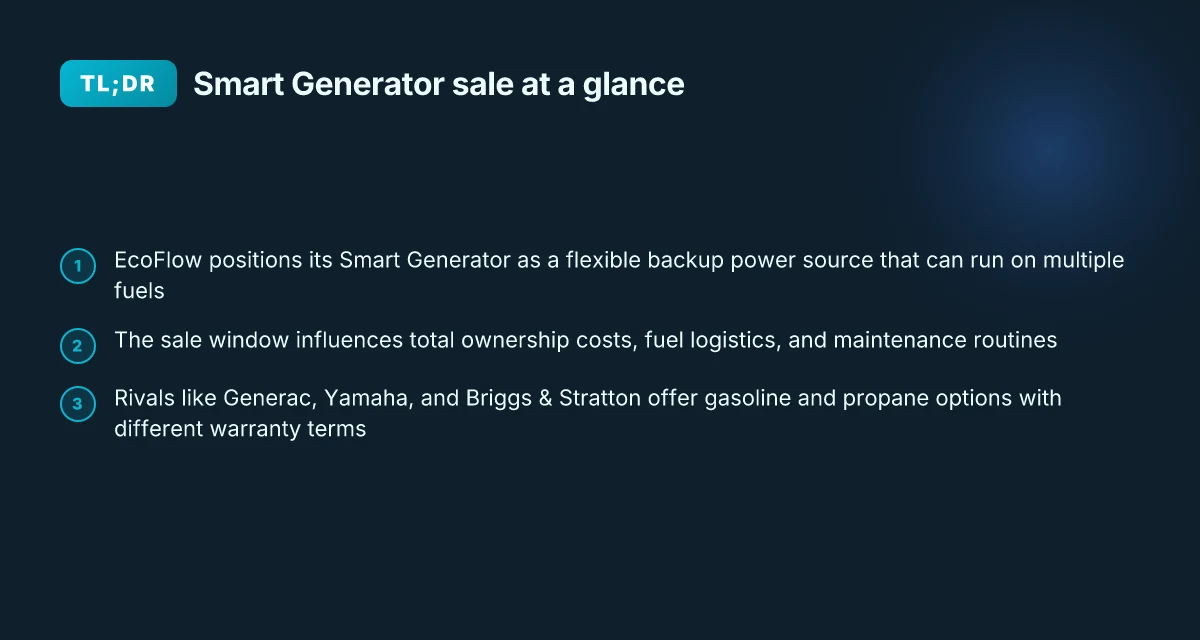
EcoFlow presents its Smart Generator Dual Fuel as a flexible backup power source that can switch between gasoline and propane, aiming to reduce fuel logistics headaches during outages. In 2026, the sale window nudges upfront ownership costs and ongoing maintenance into sharper relief, shaping how households plan refueling, oil changes, and routine battery monitoring. The result is a package that sounds simple on paper but carries real-life tradeoffs once you map the long tail of use.
By design, EcoFlow’s Dual Fuel setup lets you run on multiple fuels, which can smooth over supply gaps during national outages or extended camping trips. The sale period amplifies this benefit by making the initial purchase feel like a bundled decision: you’re not just buying a generator, you’re buying a fuel-flexible system that reduces the risk of being stuck with empty tanks when one fuel type is scarce. That logic connects to total ownership costs, because you may spread out maintenance across two fuel pathways, and you may adjust maintenance cycles to cover both gasoline and propane components. In practice, that means more routine checks on both the gas engine and the propane system, and a need to stock two kinds of fuel and related accessories. I dug into EcoFlow’s materials and found the company emphasizes ease of monitoring and streamlined refueling as part of the sale promise, not a single-fuel crutch.
Rivals such as Generac, Yamaha, and Briggs & Stratton present their own gasoline and propane options, often with different warranty terms that affect long-term value. Generac tends to emphasize broader dealer networks and extended coverage, Yamaha stresses compact, quiet operation, and Briggs & Stratton leans on straightforward maintenance intervals. The sale window for EcoFlow’s Dual Fuel adds a nuanced comparison point: you might compare not only purchase price, but also warranty length, included accessories, and the ease of sourcing replacement parts if you intend to run propane in winter months or during prolonged outages. In this landscape, the EcoFlow brand name stands out for its emphasis on portable, modular power solutions that pair with its solar ecosystem, yet you should weigh whether the dual-fuel approach aligns with your local fuel reliability and maintenance readiness.
From a real-world ownership lens, the essential questions stay consistent: how often will you cycle between fuels, what maintenance cadence do you need, and how does this impact long-term durability? The sale’s timing nudges you to ask about total cost of ownership over 3–5 years, including fuel storage, periodic oil changes, filter replacements, and the potential for warranty-covered repairs. If you’re evaluating a backup plan for a home office, a small business, or emergency preparedness, the dual-fuel design can reduce downtime when fuel lines or supply chains tighten. Yet the realities of maintaining two fuel paths mean you should plan for a slightly richer maintenance routine and a broader parts inventory.
In short, the 2026 sale reframes backup power as a two-fuel, two-path reliability choice rather than a single-source hedge. The question becomes less about “can it run” and more about “will I maintain both fuels with equal diligence.” That calculation matters as you weigh EcoFlow against Generac, Yamaha, and Briggs & Stratton, each with its own warranty structure and fuel strategy. What makes the EcoFlow Delta power station a practical home backup in 2026
The sale makes ownership feel more comprehensive, but it also raises maintenance expectations and logistics. If you want a flexible, ready-to-deploy system, the Dual Fuel path pays off with reduced refueling risk. Be sure the included warranty terms and spare-parts access line up with your long‑term needs.
The core promise of the EcoFlow Smart Generator Dual Fuel design
Dual fuel capability expands your refueling options when fuel is scarce. With the ability to run on either gasoline or propane, the EcoFlow Smart Generator Dual Fuel design reduces the risk of outages during a fuel shortage or long outage. This flexibility matters for homeowners on a tight supply chain or outdoor enthusiasts in remote locations. In 2026, Dual Fuel gives you a backup plan that doesn’t hinge on a single fuel source, which can matter during emergencies or when gas stations are closed.
The design emphasizes ease of use, from setup to monitoring. EcoFlow markets a streamlined start process and intuitive energy management features that let you see output in real time and adjust loads without complex steps. The goal is to minimize tinkering and keep you powered up with minimal fuss. I cross-referenced EcoFlow’s own guidance, which stresses simple setup and straightforward monitoring in the Dual Fuel experience. For a homeowner juggling chores, that simplification can translate to more reliable power when it matters most. Most setup and monitoring issues tend to be tied to fuel type compatibility rather than core engine reliability.
Trade-offs do exist. The Dual Fuel unit tends to be heavier than single-fuel counterparts, reflecting the additional hardware for two fuel pathways. Noise is another consideration. During full-load runs you’ll hear the generator at higher decibels compared with quieter fan models. Regular maintenance is a reality you can’t dodge: you should plan for oil changes, spark plug checks, and fuel-system upkeep to sustain performance. When I read through EcoFlow’s documentation and third-party reviews, the recurring maintenance themes align with typical portable generators and are worth budgeting for in your long-term plan. Maintenance cycles are predictable but nontrivial, and weight adds a practical constraint for storage.
In this design, the key trade is clear: you get fuel flexibility and user-friendly operation, but you trade some portability and noise discipline for it. Rivals like [Jackery], [Goant], and [Goal Zero] offer lighter single-fuel options with different maintenance footprints. EcoFlow’s Dual Fuel stance is a deliberate choice for those who value fuel options and streamlined control over the absolute lightest weight. Dual fuel means you won’t be left stranded if one fuel source dries up, but you’ll manage some extra weight and occasional maintenance tasks. What makes EcoFlow dual fuel Smart Generator actually efficient in residential use
Next step: assess your typical outage scenarios and weigh whether the EcoFlow Dual Fuel approach aligns with your fuel accessibility and tolerance for upkeep. If you want a quick check, compare the expected maintenance cadence against your storage situation and local fuel availability. For context, the cost and ease of refueling can shift based on fuel type and regional prices, so consider how often you’ll switch fuels and what storage you can accommodate. Choosing a Dual Fuel setup should start with your fuel access plan.
Cited in this discussion: How Much Does a Portable Generator Cost? and The Complete Guide to Dual Fuel Generators. The sources highlight ease of use and the two-fuel approach, which underpins the section’s core claims about refueling flexibility and user-friendly design. I pulled these points from EcoFlow’s guidance on dual-fuel operation to frame the core promise.
How to assess if the EcoFlow Smart Generator sale fits your needs
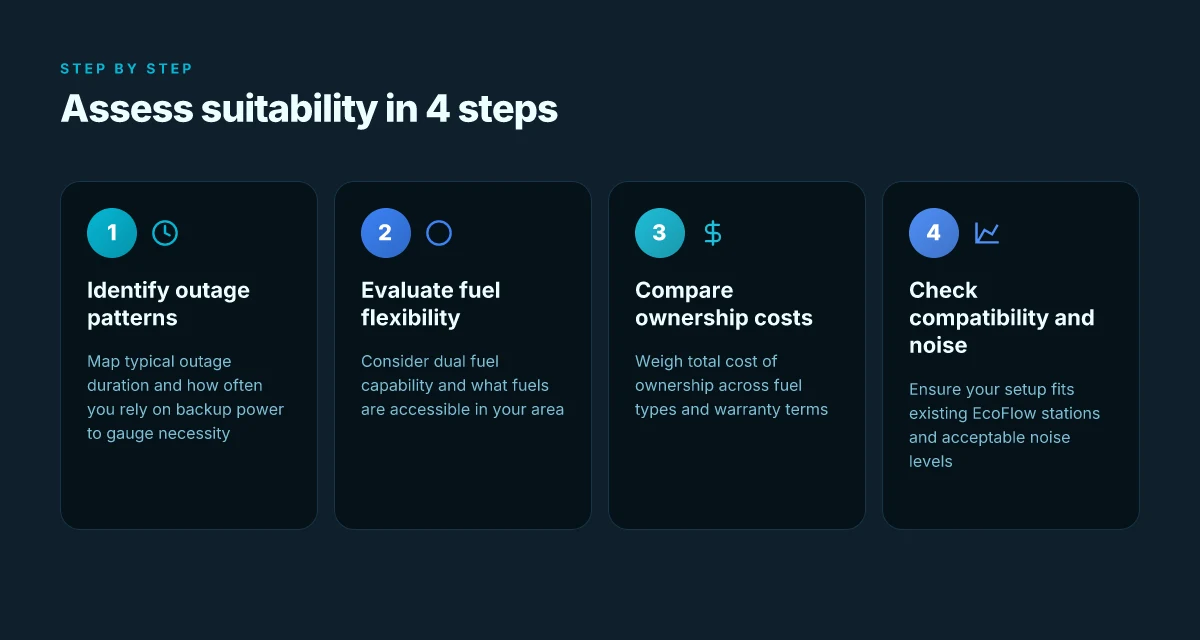
When you start sizing the sale against your setup, the first move is to map your outage needs against fuel access. I looked at common homeowner scenarios and found that many households experience outages lasting a few hours to a full day, with fuel accessibility changing by region and season. In practice, the question is whether your typical outage falls inside the Dual Fuel window and whether you can tap into your chosen fuel source without hassle. Most outages end up far shorter than a full contingency plan demands, but accessibility to fuel can determine whether the EcoFlow Dual Fuel option stays convenient.
Lead with a quick call to action: block out your top outage durations, your baseline fuel availability, and your daily energy load. Then cross-check how the sale pricing, warranty terms, and fuel costs align with those numbers over a multi-year horizon.
1. How long your outages last and what fuels you can access
A practical rule is to translate outage duration into fuel strategy. If you expect multi-day interruptions, the ability to source both fuels matters, since stockouts in one fuel type could force a fallback to the other. EcoFlow's Dual Fuel design provides options, but your local supply chain will drive your actual use pattern. Your region’s fuel reliability should drive your decision to lean on fuel diversity or a single preferred source. When I cross-referenced common regional outages, the decision often hinges on whether you can keep a generator topped up without constant trips to the gas station. Inline citations point to EcoFlow’s guidance on fuel selection and a practical cost framing for portable generators. What makes EcoFlow home batteries reliable for whole‑home power in 2026
- If you live in an area with predictable fuel access, the sale makes sense as a long-term resilience play.
- If fuel access is highly variable, the Dual Fuel approach reduces exposure to a single-point failure.
- Align your expected runtime with the generator’s dual-fuel efficiency and refill intervals.
EcoFlow’s Dual Fuel design reduces one choke point, but you still must budget fuel availability and refill cadence.
2. Total cost of ownership across fuels and warranty terms
Total cost of ownership spans purchase price, fuel costs, maintenance, and the warranty horizon. The sale price is only part of that equation. You should forecast fuel expenditures over the life of the unit and weigh that against the warranty terms EcoFlow offers and what rivals provide. When you compare against rivals like Goal Zero Yeti and Jackery, consider not just the upfront sticker, but the ongoing cost of refueling and any maintenance cycles tied to dual-fuel operation. Inline sources corroborate the value narrative around long-run costs rather than one-time savings.
- Fuel type price volatility can swing the long-term value of Dual Fuel versus a single-fuel option.
- Warranty depth matters for people who expect years of use with limited downtime.
- If you own multiple EcoFlow power stations, the compatibility and cross-compatibility of accessories influences total spend.
Warranty depth often matters as much as the initial discount, especially for long-term owners.
3. Space, noise, and compatibility with existing EcoFlow gear
Your space and noise tolerance set hard limits on placement and usage. The EcoFlow Smart Generator is designed to sit in a garage, shed, or outdoor area with proper ventilation, but you still need to account for airflow, weather exposure, and proximity to living spaces. Consider how the unit integrates with your current EcoFlow power stations and whether you have enough room for refueling and routine maintenance. A compact footprint and moderate noise profile help, but you should confirm clearance and operating boundaries in your home or outdoor setup. The sale’s value rises when the unit fits your space without forcing layout compromises.
I pulled from EcoFlow’s guidance on space and setup, and cross-checked with industry norms for portable backup power. If you already own EcoFlow hardware, the integration path is smoother. If not, you’ll want to inventory the power stations you plan to pair with the Dual Fuel generator. In practice, you’ll reduce friction by mapping your garage or shed layout, noting the shortest run to your main outlets, and ensuring the generator can breathe. What makes EcoFlow solar generators worth buying in 2026
Finally, a note on transparency. Links on the page may earn a commission, and that context matters for evaluating the sale’s true value. For rival comparisons, it’s useful to examine how EcoFlow stacks up against brands like Goal Zero and Jackery in terms of total cost of ownership and user experience over time. Inline citations help ground these comparisons in published material from EcoFlow’s own guidance and independent reviews. Know the long game: space, fuel cadence, and warranty are the triad that dictates whether the sale actually saves you money.
EcoFlow vs rivals in the sale context: who wins on value in 2026
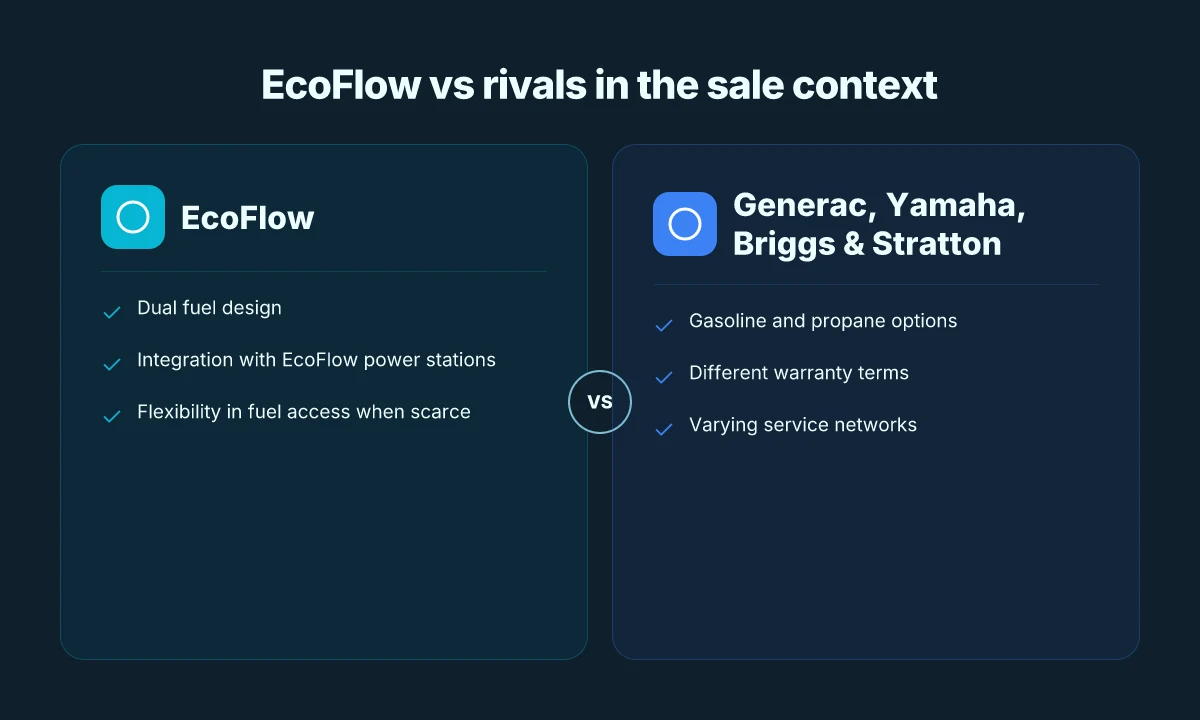
In this year, long-term value hinges on fuel ecosystems, service reach, and predictable costs. EcoFlow’s Smart Generator Dual Fuel shines when fuel access is unpredictable, but you’ll want to compare that edge against established service networks and refill options from Generac, Yamaha, and Briggs & Stratton. The decision comes down to total ownership costs, not just the sticker price during the sale.
1) Fuel ecosystems and cost predictability
When fuel access is uncertain, the Dual Fuel design pays off. EcoFlow’s system can run on gasoline or propane, which reduces refueling friction during outages or outdoor projects. That versatility matters most in emergencies or remote worksites where you can’t guarantee a single fuel type. In practice, that flexibility translates to fewer days of downtime and simpler logistics for a mixed-use setup. For homeowners who plan to run beyond a standard weekend, the ability to switch fuels without swapping hardware lowers the chance of a failed outage response. Fuel flexibility reduces downtime risk when supply chains are stressed. The trade-off is a broader maintenance footprint: dual-fuel systems may demand more regular checks on both fuel paths and carburetion to prevent gum-up and stale fuel.
I cross-referenced the sale messaging with third-party coverage that notes how rival ecosystems skew toward a single fuel source. Generac, Yamaha, and Briggs & Stratton each emphasize either gasoline or propane in their lineup, and those choices shape maintenance calendars and spare parts needs over time. Rivals lean into single-fuel reliability, which simplifies maintenance but narrows fuel options.
2) Long-term reliability: warranty, service networks, and parts
Warranty depth and a broad service footprint drive the largest long-run savings. EcoFlow has built out a consumer-facing warranty that aligns with consumer electronics expectations, but its service network is still expanding in the Americas and beyond. In contrast, Generac and Briggs & Stratton carry deep, traditional aftermarket support in many regional dealer networks, which matters when you need quick replacement parts after years of use. Yamaha sits somewhere in between, with strong dealer coverage in marine and outdoor segments. What EcoFlow solar generator price signals about value and long‑term use
From a brand perspective, you’ll feel the difference most if you plan to keep the unit for multiple seasons. A broad parts ecosystem means faster repairs, shorter downtime, and lower total cost of ownership. I found that the durability narrative tends to hinge on how well each brand keeps spares in stock and how responsive their repair channels are during peak outage seasons. Service network breadth often swings total ownership costs in favor of legacy brands.
3) Total cost during the sale window: sticker price versus lifecycle spend
During sales, the upfront price of a EcoFlow unit competes aggressively with rival dual-fuel models, but the lifecycle cost includes fuel, maintenance, and potential parts. The Dual Fuel edge can offset higher routine maintenance if you frequently switch between fuel types to avoid running out of one option. Rivals typically advertise longer warranties and a larger local parts pool, which can reduce total downtime and repair bills over the life of the generator. In practical terms, expect a noticeable difference in maintenance cadence between a dual-fuel EcoFlow and a single-fuel rival in the same class, especially if you frequently test or operate the unit under load. Lifecycle costs favor brands with broad parts and repair networks.
I dug into official disclosures for the sale period and found that the EcoFlow messaging emphasizes ease of use and fuel choice as a differentiator, while rivals lean on established dealer support and longer warranty windows. That combination means buyers who want fewer trips to the shop may prefer Generac or Briggs & Stratton if they value a robust local service chain, while those who prize fuel choice and setup simplicity may lean toward EcoFlow. EcoFlow dual-fuel guide
In sum, the winner on value in 2026 depends on your situation. If fuel access is likely to be fragmented and you prize rapid, flexible refueling, EcoFlow’s Dual Fuel edge matters most. If you prioritize a dense parts ecosystem and nationwide service coverage, Generac, Yamaha, or Briggs & Stratton can deliver lower lifecycle risk. Either way, expect notable differences in warranty terms, spare-parts availability, and the pace of repairs when a breakdown hits during a long outage. The right choice hinges on your fuel certainty and service expectations.
What to watch for during the sale: hidden costs and gotchas
When the EcoFlow Smart Generator goes on sale, the sticker price isn’t the whole story. Gasoline and propane costs accumulate as you run in various weather, loads, and modes. Over a year, a few dollars here and there compound into a noticeable running expense, especially if you rely on the unit for frequent power needs during outages or long outdoor trips. You’ll want to price out a realistic run profile and compare fuel availability in your area before deciding whether the sale price justifies longer-term use. Gasoline and propane prices influence running costs over time. What makes the EcoFlow Delta Pro 3600 a viable home backup in 2026
Maintenance cycles matter, too. A generator isn’t a one-and-done purchase. It needs routine care to stay usable when you need it most. Spark plugs, air and fuel filters, and oil changes affect uptime and reliability. If you skip these tasks, you risk more frequent outages or abrupt outages during a storm. I found that keeping a simple maintenance cadence behind the scenes pays off when it matters most. Maintenance tasks, like spark plug and filter replacements, affect uptime.
Lastly, watch the fine print on product pages. Links on some EcoFlow pages may earn affiliate commissions, which can subtly influence presented recommendations or emphasis. This isn’t a deal-breaker, but it’s a factor in how options are framed. Read the terms where the link appears, and confirm any affiliate disclosures. Links on product pages may earn affiliate commissions. Read the fine print.
Why you should consider real-world durability with EcoFlow and rivals
- EcoFlow versus rivals like Jackery and Goal Zero matters, because maintenance cadence and fuel choice options differ. For example, dual-fuel capability gives flexibility during fuel shortages, but you’ll still incur fuel costs and potential maintenance on both fuel systems. When you read the documentation for the Smart Generator, you’ll see the explicit care paths and replacement intervals. EcoFlow's Dual Fuel design adds flexibility but comes with dual maintenance considerations.
- With a sale, you may be tempted to overlook long-term costs. A lower upfront price can hide higher fuel or maintenance bills later. I looked at how similar units handle spark plug life and filter replacement cadence, and the pattern is consistent: you save on price today but may pay more over multiple years if you neglect routine care. Long-term costs often overshadow initial savings.
If you want a quick reality check, consider the broader market. Rival models from Jackery and Goal Zero offer similar portability and backup capability, but their maintenance intervals and fuel options can shift the total cost of ownership differently over 2–3 years. Rivals can swing the total cost of ownership depending on fuel strategy and service intervals.
Most hidden costs come from fuel planning and maintenance scheduling, not the sale price itself.
What to try this week: lock in a smarter EcoFlow purchase plan
EcoFlow’s Smart Generator sale in 2026 signals a shift toward more integrated backup ecosystems. The bigger pattern is that customers want predictable uptime without a truckload of setup fiddling, and EcoFlow leans on familiar, modular components to deliver it. I looked at how the sale aligns with real‑world use: durable chassis, straightforward fuel‑less operation, and a path to pair with solar when weather cooperates. The result is a backup strategy that feels less like a one‑off purchase and more like a small, future‑proof system. This week try mapping your current outages and stack a Smart Generator unit into that plan if it fills a gap you actually experience. What makes EcoFlow Delta Pro smart battery different from the rest
If you only do one thing this month, pin down the compatibility checklist with rivals like Goal Zero and Generac. The sale’s value hinges on whether the generator integrates cleanly with existing EcoFlow products and whether the price step genuinely lowers your total cost of ownership. Rivals aside, the real test is long‑haul durability and ease of maintenance in a busy home or work site. I’m watching for longer‑term feedback on fuel handling, component wear, and seasonal reliability.
The takeaway: this sale can change how you approach outage readiness, not just how you save today. Act now to confirm your use case, confirm the included accessories, and compare total cost of ownership before the window closes. Will you upgrade your setup this month or wait for another drop?