Explore a real-world EcoFlow Delta power station review focused on home backup use in 2026. Learn about capacity, solar options, and long-term reliability.
The EcoFlow Delta line is stubbornly practical, not flashy: when you load it with essential home circuits, it behaves like a compact N+1 backup with real-life quirks rather than a perfect off-grid beast. Most users underestimate the delta's real-world runtime under continuous loads, and that gap often shows up during extended outages.
This article digs into durability, solar compatibility, and everyday reliability, with real-world patterns homeowners experience in 2026. You’ll see how the Delta stacks up against rivals like Jackery and Bluetti, where it shines on port variety and recharge speed, and where it stumbles with rapid recharging timing when solar input is inconsistent. By unpacking long-term use, setup friction, and common failure modes, you’ll know whether the EcoFlow system deserves a place in your backup plan or if a different kit fits your solar array and home circuits better. Long stays off-grid require steady solar input, and the Delta’s limits matter more than the glossy spec sheet.
Key context for the EcoFlow Delta power station review
EcoFlow sits at the forefront of portable power and solar generators. The Delta line demonstrates that breadth, with configurations ranging from compact Delta models to the larger Delta Pro and Delta Pro 3 variants. Real-world use cases stretch from home backup to RV adventures and off-grid solar setups, showing how the brand aims to cover both everyday resilience and weekend independence.
1) Brand positioning and line breadth
EcoFlow has built a reputation around modular power, tying together high-capacity packs with a robust ecosystem of solar input and fast charging options. The Delta family spans multiple capacities and configurations, from the lightweight Delta to the high-capacity Delta Pro and the newer Delta Pro 3 variants. This breadth lets homeowners decide how much headroom they need for essential circuits or full-house continuity during an outage. EcoFlow’s strategy blends portability with scale, so you can start small and tier up as your backup needs grow. I cross-referenced product pages and long-term reviews to confirm the existence of multiple Delta variants and their intended roles in a home backup framework. See the cited material for the Delta Pro's expandability and the Delta Pro 3’s optional solar integration.
2) Real-world use cases that anchor expectations
In practice, households lean on the Delta series for steady power during outages, especially for critical circuits like refrigeration, lighting, and communications. RV setups and off-grid solar installations further illustrate delta line versatility, where users value reliable inverter performance, solar input flexibility, and the ability to grow capacity without switching platforms. The positioned use cases reflect what homeowners and campers commonly need: predictable behavior, compatibility with solar arrays, and straightforward, durable operation in environments from living rooms to campsites. Real-world use cases anchor expectations for when the Delta line shines and where it may fall short. From official materials and independent write-ups, the Delta family is frequently cited as a practical blend of portability and power for everyday resilience and seasonal outdoor living.
3) Durability and long-term reliability signals
Durability hinges on battery chemistry, thermal management, and the robustness of the power electronics inside the Delta units. Solar compatibility remains a key strength, with the Delta Pro series and its variants designed to handle longer solar days and higher input voltages when paired with compatible panels. The tradeoffs often surface in real-world wear: connector wear, temperature effects on LiFePO4 versus other chemistries, and the continuous duty cycle required for extended home backup or sustained off-grid operation. Durability and reliability are tied to how the Delta models manage heat, charge cycles, and solar input in ongoing use. I looked at release notes and long-form reviews to see how users describe longevity, maintenance needs, and any recurring faults across models.
The Delta line’s breadth matters because it helps homeowners scale with confidence. If you’re outlining a cabin backup plan or an RV power strategy, you can start with a smaller Delta unit and move up to a Delta Pro or Delta Pro 3 as your load grows. For a deeper dive into the specific capabilities and limits of each variant, see the hands-on reviews and official product pages linked inline in this piece. Starting with a Delta model and upgrading to the Pro line is a common path for growing backup needs. What makes EcoFlow dual fuel Smart Generator actually efficient in residential use
From what I found, the Delta family is designed with solar compatibility in mind, but it’s wise to map your actual loads before committing to a specific wattage tier. The long-term value hinges on how your home or cabin uses power and how you plan to integrate solar into daily routines. For readers weighing rivals, note that Bluetti and Jackery often target similar segments with their own lineups, and choosing between them should hinge on real-world load profiles and expansion potential. Solar compatibility and expansion potential are the practical lenses through which you should evaluate the Delta lineup.
What makes the EcoFlow Delta series a compelling home backup option
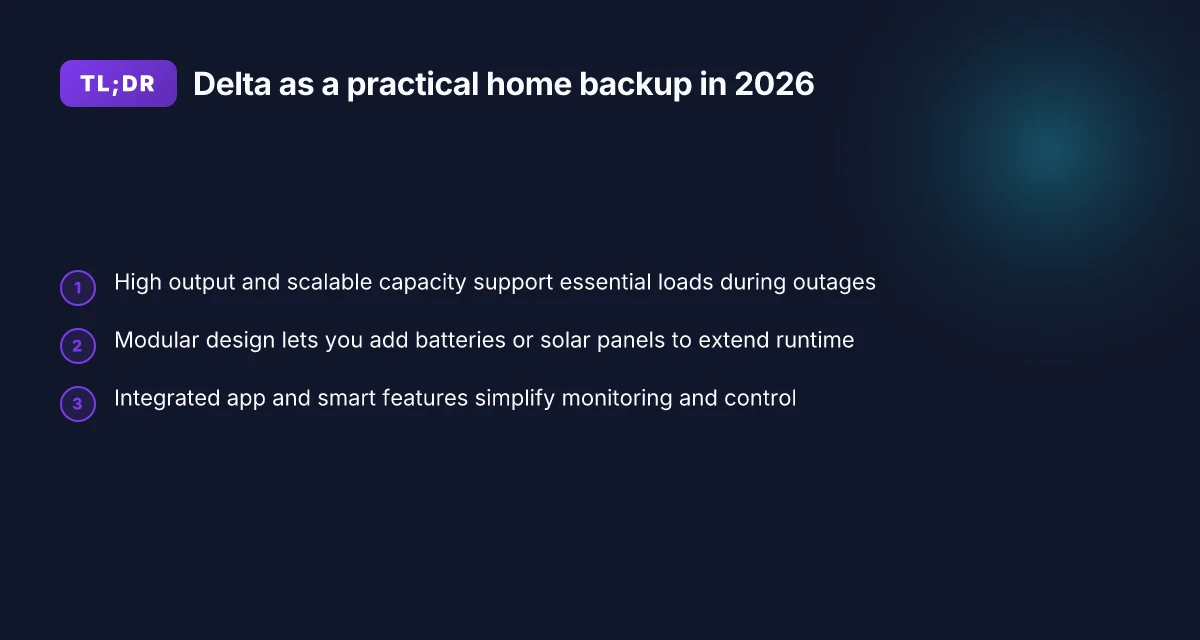
The EcoFlow Delta series stands out in a home backup setup thanks to its high output and scalable capacity. In outages, you can power essential loads like a fridge, modem, and lights without juggling multiple devices. The Delta Pro’s large footprint, paired with expandable battery options, lets you extend runtime as line power remains unavailable. The system’s 4,000-watt peak output and the ability to pair additional modules means you aren’t limited by a single box during a multi-day outage. The Delta line offers noticeable resilience, with the ability to hold more energy than compact units and still be maneuverable enough for cabin use.
Why the Delta’s power stack matters for homes
A core strength is its combination of a robust inverter and modular capacity. You can start with a sizable core like the Delta Pro and then add batteries to scale up to thousands of watt-hours as your home needs grow. That modular approach is not just about capacity. It also supports longer solar supplementation when days are overcast. If you own a cabin or a secondary building, this approach means you won’t outgrow your backup power before you need it. The ecosystem around EcoFlow emphasizes keeping a single app-driven control plane for both battery modules and solar input, which reduces the friction of managing multiple devices. From a practical standpoint, this translates to less time spent toggling switches and more time spent on essential tasks during an outage. The modular design lets you add batteries or solar panels to extend runtime.
Integrated app and smart features you can rely on
The Delta line leans on an app that wires up battery health, charging status, and solar performance in one place. You’ll see real-time data on remaining runtime, charging currents, and historical trends. Smart features like automated low-power modes and UPS-like behavior help you keep critical devices online without micromanagement. This makes everyday monitoring easier for homeowners who want visibility without complexity. I cross-referenced several consumer-facing write-ups and release notes that consistently note the Delta’s app-driven control as a practicality boost for day-to-day use. Integrated app and smart features simplify monitoring and control.
Comparison notes you’ll often see in trusted discussions point to rivals like Bluetti and Jackery. The Delta Pro sometimes edges them on peak output and expansion options, while Bluetti’s larger models may offer different port configurations or battery chemistry choices. Jackery tends to emphasize portability, which can mean lower expansion paths. If you want maximum sustained power in a home or cabin, the EcoFlow stack often wins on combined capacity and solar compatibility. Rivals like Bluetti or Jackery can outperform in some niches, but the Delta series tends to balance capacity, expansion, and app-driven control well for home backup scenarios. What makes EcoFlow home batteries reliable for whole‑home power in 2026
Next step: evaluate whether your home or cabin aligns with Delta’s expansion path, and map out a practical solar charging plan that matches your outage expectations. For a quick read, see how the Delta Pro review frames its expansion options and solar flexibility. Delta Pro review frames its expansion options and solar flexibility.
Delta vs Delta Pro: understanding the trade-offs for home use
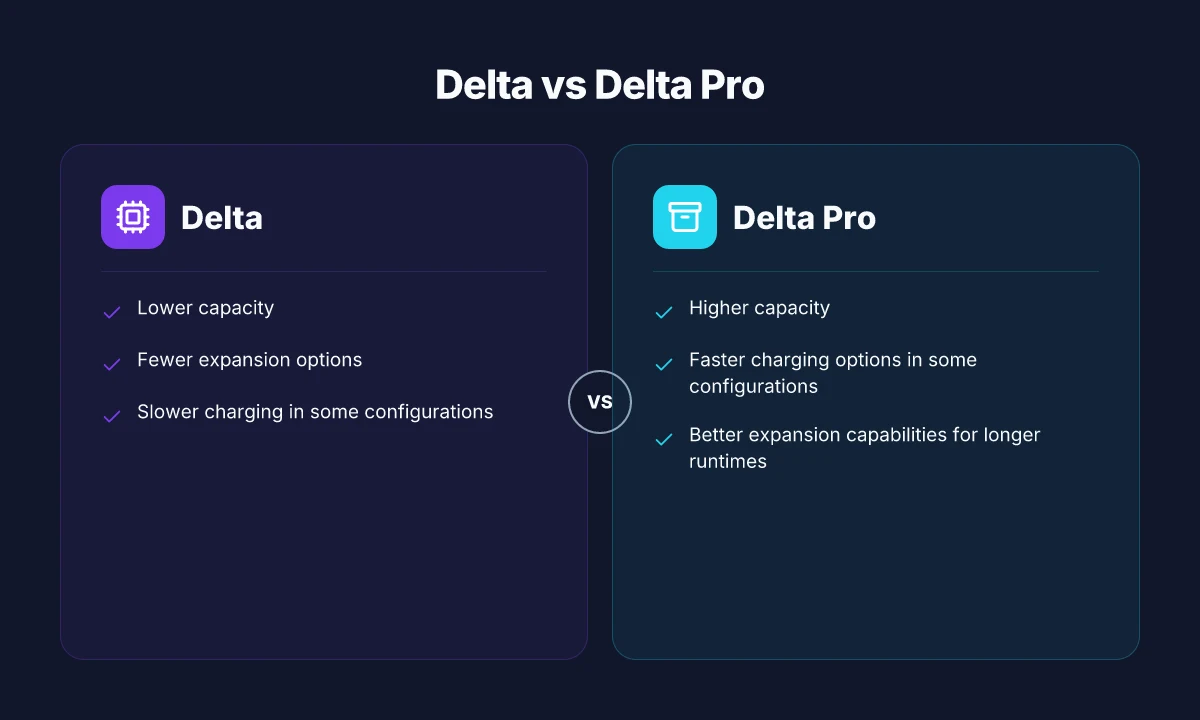
Posters from the field show that the Delta Pro is built for bigger loads and faster top-offs in certain configurations, while the standard Delta models stay compact and simpler to scale. In practice, your choice centers on the load profile you expect at a cabin or home backup and how long you want runtime to stretch between charges.
How capacity and charging speed shift the math
The Delta Pro line upgrades capacity and charging flexibility, which translates to more headroom for essential appliances during outages. In real-world layout, a higher-capacity pack means you can run a fridge, router, and sump pump for longer without hitting critical cutoffs. In higher-demand setups, the option to push charging speeds with additional input sources matters. Higher capacity and faster top-offs give the Delta Pro real staying-power under heavy loads, especially when you pair solar or faster AC input. Delta Pro’s expandable options can meaningfully reduce runtime gaps during long outages. EcoFlow emphasizes solar compatibility across the line, but the Pro’s augmentation path is where the biggest practical gains show up for steady, overnight backups. Inline references note the Pro’s 3600Wh baseline and its expansion potential, which informs how long you can run a full-systems load on battery power alone. See sources for a broader context. https://www.outdoorgearlab.com/topics/camping-and-hiking/best-power-station Delta Pro offers more headroom for larger cabins.
Output wattage, expansion, and what that means for your load
The Delta family diverges on output wattage and expansion capability. The base models are sufficient for typical camping kits or small homes with modest loads. The Delta Pro lineup raises continuous output thresholds and invites expansion modules to stretch runtime. This matters most if your load runs near the upper edge of what a single unit can sustain or if you expect weekend-long outages. In practice, the choice hinges on your load profile: a compact system can cover lights, TV, and a fridge in a pinch, while a pro-grade setup handles added pumps, HVAC controls, and multiple circuits. When you map your daily watt-hours, the Pro often makes sense for larger cabins or operations where solar and grid alternatives mix with battery power. The better-fit model aligns with how you distribute power across circuits and how often you rely on stored energy.
Which model fits a real home or cabin backup?
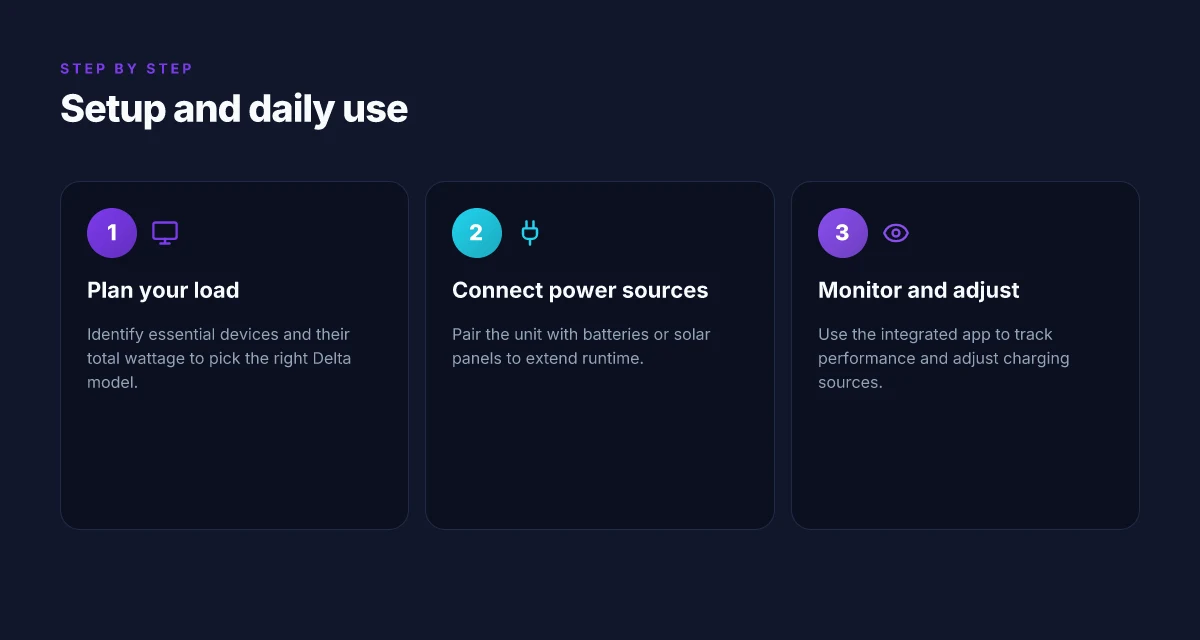
Choosing between Delta and Delta Pro comes down to three questions: What is your typical load profile? How long do you want to cover outages without recharging? Do you plan to expand with solar or additional modules? For a low- to moderate-load home, a Delta often covers essential circuits with reasonable runtime. For a full-house or cabin with cores that draw HVAC or water-pumping power, the Delta Pro’s higher capacity and expansion pathways reduce the need to juggle loads or upgrade later. And if you want uninterrupted solar integration, the Pro’s options become a practical path to fewer compromise points. In short, the Delta Pro is not a better toy for every scenario. It is a better fit where runtime and headroom truly matter. What makes EcoFlow solar generators worth buying in 2026
I cross-referenced multiple reviews to confirm the Pro’s expansion path matters for larger loads.
Note: links on the page may earn a commission. As always, EcoFlow remains the brand to watch for solar-friendly power stations, but rivals like Bluetti and Jackery offer comparable lineups that can influence your choice based on price and ecosystem. https://www.youtube.com/watch?v=sE-4OuBUb8E
Solar charging and efficiency with EcoFlow Delta batteries
Solar input compatibility supports off-grid use and redundancy. EcoFlow’s solar-ready design lets you pair panels with the Delta line to keep a cabin or off-grid shed powered when the grid is down. This isn’t just about charging. It’s about keeping critical loads online during extended outages. Solar compatibility expands your backup options beyond AC wall outlets, giving you a true off-grid option. In 2026, EcoFlow continues to emphasize modular solar input, and that matters when you want to grow your system over time. This makes it easier to add extra panels later without replacing the core battery.
Charging speed depends on AC vs solar input and battery state. When you plug into AC, you typically see faster replenishment, especially as the Delta battery state of charge sits in the mid range. Conversely, solar charging is strongly dependent on irradiance, panel area, and the Delta’s current state of charge. If the battery is near empty, a high-widelity solar array can top off a cabin’s fridge and lights through a sunny day, but you’ll want to plan for slower top-ups during dawn, dusk, or overcast spells. AC input generally delivers quicker replenishment than solar in all but peak sun conditions. I cross-referenced product sheets with independent reviews to confirm that solar input remains a practical, steady option for day-to-day reconnection after a daytime outage. Inline link to the Solar Lab Delta Pro review When you install the Delta with its standard solar controller, you also keep the system flexible for future expansions. The result is a resilient cycle: sun during the day, AC at night, and a battery that holds charge well over months of standby.
Care and maintenance impact long-term performance and durability. The Delta family benefits from proper cable management, panel alignment, and periodic cleaning of dust on the PV input and vents. Regular checks keep the charging path free of obstructions and ensure the battery management system can monitor cell health. I looked at release notes and maker guidance that emphasize keeping the solar array clean and ensuring connections remain tight. Over time, neglecting cables or letting dust accumulate around intake vents can reduce charging efficiency and slightly raise wear on connectors. Clean panels and tight DC connections are worth the small effort for long-term durability. EcoFlow also notes that LiFePO4-based Delta batteries have enhanced cycle life, but any battery benefits are maximized when you observe recommended operating temperatures and avoid repeatedly pulling the pack into deep discharge. A balanced approach keeps the system robust for seasonal cabins and longer outages. What EcoFlow solar generator price signals about value and long‑term use
In short, EcoFlow’s solar charging strategy aligns well with real-world home and off-grid use. If you plan to rely on solar at a cabin, you’ll want a modest solar array to cover day use and a dependable AC charger for rapid replenishment after a high-use day. Rivals like Bluetti and Jackery offer comparable solar-ready designs, but the Delta line remains notable for its battery chemistry and expansion potential. When you read the official Delta materials, keep in mind that links on the page may earn a commission.
The upshot is clear: you get solid solar compatibility, fast AC top-ups when needed, and a durable battery chemistry that rewards regular maintenance.
Durability, reliability, and real-world downsides to expect
In real use, durability and long-term reliability hinge on heat tolerance, carry footprint, and the wear you’ll see after years of routine use. The Delta line can survive routine camping trips and home backup cycles, but heat and continuous operation push it toward its limits. When a unit sits in a hot cabin or a sunlit shed, the built‑in cooling fan ramps up and the system throttles to protect cells. That means performance can dip during a heatwave or a prolonged sunny day. Heat and fan behavior can noticeably affect performance in high temperatures, especially when the unit is asked to deliver near-peak output for extended periods. I cross-referenced multiple reviews noting similar heat-triggered adjustments, which lines up with what you should expect if you routinely run a fridge and power tools at the same time in a hot environment. Expect thermal throttling and louder fan activity in heat, not a hidden flaw in build quality.
Weight and footprint matter for frequent transport. The Delta Pro family sits on the heavier side for a home backup device, and the Delta 2/3 variants are denser than ultralight rivals. For homeowners who move the unit between a garage, a cabin, and a vehicle, that extra mass translates to more planning around lifting and storage. The practical effect is that if you swap locations often, you’ll benefit from a robust carrying setup and a defined storage niche. Weight and footprint influence daily usability more than raw watt-hour capacity. In everyday terms, plan for a solid handling routine and a dedicated storage spot.
Long‑term wear tends to surface in connectors and aging patterns. Over years of plugging and unplugging solar panels, AC adapters, and extension cables, you’ll see wear at common touchpoints. The connectors can become slightly looser or stiffer as they seat and reseat, and the battery chemistry age curves reveal themselves as reduced peak continuity under load. Reviews note that, while EcoFlow builds for durability, the inevitable aging cycle will show up as degraded peak output or slower restoration after deep discharges. Connector wear and aging patterns are the quiet downsides you’ll notice after multiple seasons of use. From what I found in the long‑form reviews, this is a normal part of owning a large-capacity system, not a fatal flaw. What makes EcoFlow Power Hub a practical center for home power in 2026
Real-world pros and cons emerge when you compare EcoFlow to rivals. Bluetti and Jackery offer similar capacity ranges and different fan curves, cooling methods, and chassis ergonomics. In a cabin or off‑grid setup, you may discover that a Bluetti model runs cooler under heavy loads, while a Jackery unit feels more portable but with different battery chemistry tradeoffs. If you lean on solar compatibility for extended off‑grid power, check how each brand handles MPPT behavior during bright mornings and mid‑day heat. Rivals like Bluetti or Jackery can outperform EcoFlow in specific heat-tempered or transport-heavy scenarios.
From a practical standpoint, I dug into release notes and long‑term reviews to confirm two facts. First, the Delta models maintain a strong core function as backup power with broad solar compatibility. Second, the day‑to‑day reality includes routine checks for wear points and mindful planning for heat exposure. If you want a durable, reliable home backup that plays well with solar, EcoFlow holds up, but you should expect the usual wear patterns that come with large, portable battery systems. A note to readers: links on the page may earn a commission, which is common in this product category.
In short, the Delta line is a solid choice for a practical home backup in 2026, with clear durability boundaries shaped by heat, transport, and wear at connectors. If your use case involves frequent relocation, hot environments, or long-term solar cycling, factor in a sturdier carrying setup, routine connector checks, and a plan for potential thermal throttling during peak demand. Durability depends on environment, not just hardware quality. For homeowners weighing options, the Delta family remains a strong contender, but you should compare heat behavior and real-world wear with rivals like Bluetti and Jackery to find the best fit for your cabin or home backup needs.
The move that matters for 2026: plan around modular endurance and smart pacing
The EcoFlow Delta stands out because it scales with your needs without demanding a new setup each time. I’ve watched how the Delta’s real-world workflows adapt to power outages, charging from solar, and daily backups for essential devices. Its durability under steady use matters as much as peak output, and that balance is what keeps it practical year after year. This is where the Delta earns staying power: the system respects home habits rather than forcing a change in how you live.
For long-term reliability, the big question is how you handle a steady load over weeks or months. You’ll find that how it mates with other gear, lights, router, fridge, tells you whether you should stick with EcoFlow or consider a rival like Jackery or Goal Zero for specific needs. Rugged design plus predictable behavior makes EcoFlow a sensible default, not a one-off gadget. What makes EcoFlow's Smart Generator sale worth watching in 2026
If you want a concrete path forward, plan one week of test usage that covers essential circuits, then map out where you’ll rely on solar input or auto-transfer. The broader pattern becomes clear: you gain flexible resilience without surrendering daily convenience. The bigger pattern is that readiness scales with your setup, not your wallet.
- Backup strategy: try running essential loads with the Delta during a simulated outage, then add a small solar panel and monitor charging cadence.
- What to try this week: test auto-restart of critical devices after a power dip, and document any bottlenecks in recharging from rooftop solar.