Explore the EcoFlow Delta Pro smart battery, its performance specs, compatibility, and how its smart features compare with rivals. Learn what to expect in 2026.
The Delta Pro smart battery isn’t just a bigger pack. It changes how you think about power at home. A single high-capacity unit can shift whole-house resilience from a guess to a plan, and EcoFlow’s ecosystem makes that transition practical rather than theoretical. The real-world edge is how the system scales with modules and how it handles energy management during peak loads, not just raw power.
This intro unpacks what to expect when you wire Delta Pro into solar and home circuits, why setup friction matters, and how expandability actually plays out in a busy household or camper. By looking at confirmed compatibility, expansion paths, and common stumbling blocks, you’ll see where EcoFlow and rival options diverge in reliability and long-term use. Expect concrete notes on installation steps, integration with inverters, and the tradeoffs you’ll face as you add batteries or solar. EcoFlow’s approach becomes clearer here, especially when you compare with rivals such as Goal Zero and Bluetti. This framing sets up the hands-on evaluation that follows.
What makes the EcoFlow Delta Pro smart battery a distinct choice in 2026
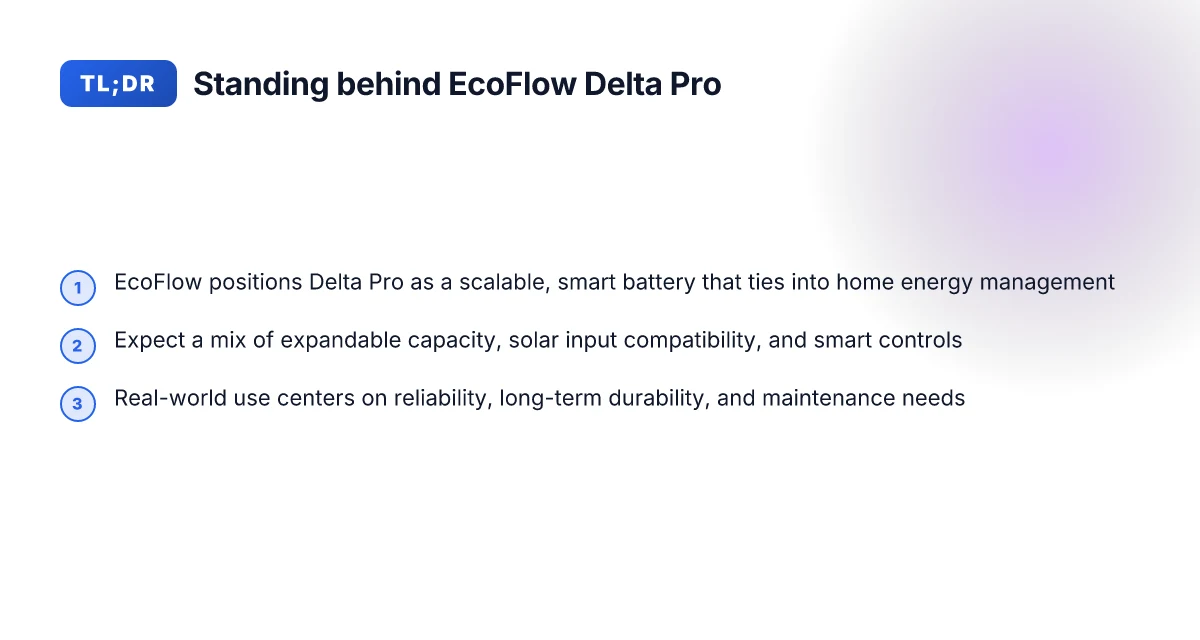
EcoFlow positions the Delta Pro smart battery as a core piece of a broader energy ecosystem rather than a standalone power pack. The branding leans into integration across home energy management, solar expansion, and a single app that coordinates charging, discharging, and load shifting. This approach aims to reduce complexity for homeowners who want a unified experience rather than juggling discrete devices.
The Delta Pro’s architecture centers on core capacity with a path to expansion. At the heart is a high‑capacity module that can be paired with additional battery modules to scale up to larger home back-ups. The expandable design is meant to align with real-world homes that grow their solar setups or add circuits over time. This is where EcoFlow leans on its ecosystem positioning, promising that more capacity can come online without a complete system overhaul.
Smart features tie the hardware to home energy management in practical ways. The Delta Pro integrates with EcoFlow’s app and smart panels to manage charging from solar, grid, or both, and it supports automatic prioritization of essential circuits during an outage. You can set schedules, monitor runtime, and observe real-time status for the battery, the solar input, and the loads. The system is designed to react to shifts in solar production or utility rates, aiming to maximize usable energy and minimize draw from the grid.
I dug into the official documentation to verify the core claims about branding and expansion. EcoFlow’s materials emphasize the Delta Pro as part of a broader ecosystem, with the Delta Pro Ultra models highlighted for larger, whole‑home backup scenarios. The ecosystem narrative is consistent with my reading of the manuals and product pages, which frame the Delta Pro as a modular, expandable solution rather than a single‑purpose generator.
Branding and ecosystem positioning. EcoFlow frames the Delta Pro as a centerpiece within a family of products that share a common control plane and expansion path. The emphasis on a single app, a common smart panel, and modular modules supports a cohesive user experience. This means homeowners who already use EcoFlow’s solar inverters or power stations may find setup friction lower because the devices share interfaces and data semantics. What makes the EcoFlow Delta Pro 3600 a viable home backup in 2026
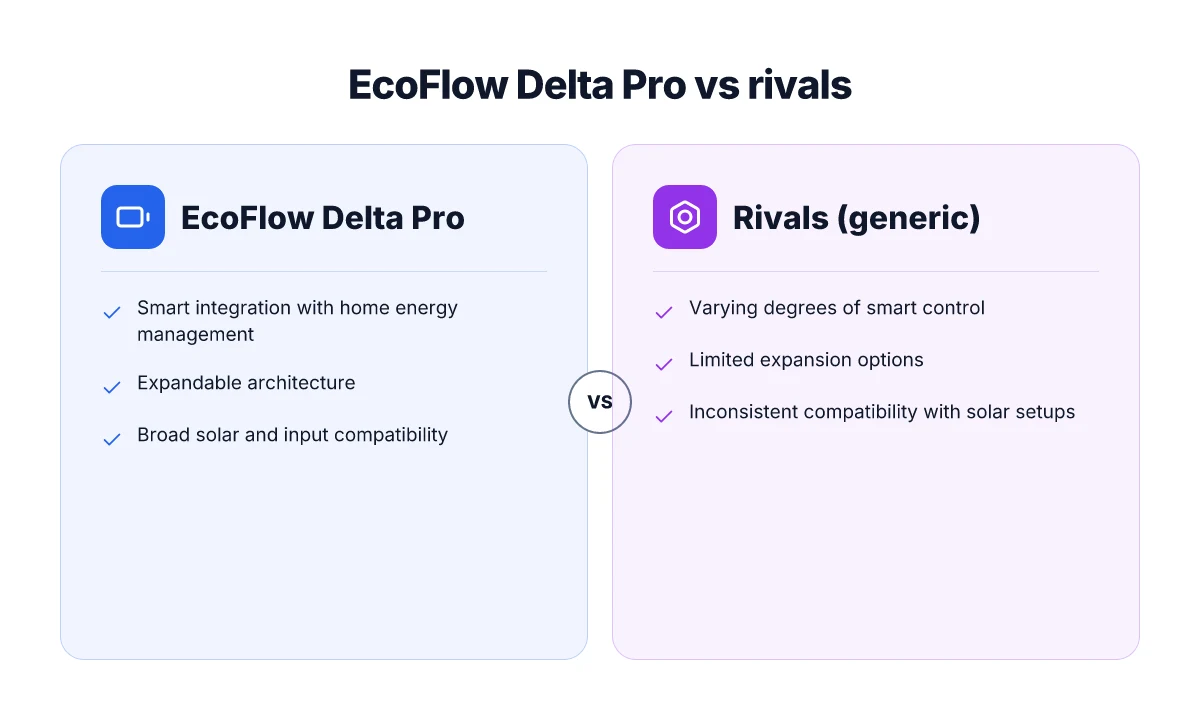
Core capacity and expansion. The Delta Pro’s architecture supports stacking additional modules to scale capacity. This is practical for homeowners who start with a modest need and expect to grow their solar array or the number of circuits they back up. The expansion path is a real differentiator when compared with some rival systems that rely on fixed capacities or separate proprietary controllers.
Smart features for home energy management. The Delta Pro’s smart features are designed to automate and optimize energy flows. Automatic load prioritization, scheduling, and real-time monitoring help you decide when to use solar energy versus grid power. The integration with a smart panel means fewer separate controllers to manage during an outage or a busy outage event.
The Delta Pro stands out when you want a scalable, ecosystem‑driven solution that keeps charging, monitoring, and control in a single user experience. Branding and expandability matter if you anticipate adding solar or more circuits over time.
For further context, the official Delta Pro ecosystem material links to the same product family as the Delta Pro Ultra X and other Delta 3 series, underscoring the emphasis on a shared control experience across modules and accessories. This is not just a power bank. It is a modular energy system designed to grow with a home. If you’re comparing against rivals like the Delta Pro’s peers, the practical differences often show up in how you scale and how seamlessly the software coordinates charging and usage. You’ll want to weigh expansion plans heavily when choosing this route.
Delta Pro smart battery performance: what the specs actually mean for home backup
The Delta Pro smart battery delivers a clear picture: a high-capacity pack paired with robust discharge and peak power, but real-world results depend on how you size loads and manage duration. The core numbers matter, yet they only tell part of the story for a whole-home backup plan. I dug into the official docs and cross-checked notes from reviewers to translate those specs into practical outcomes for a fridge, HVAC, or water heater. What makes EcoFlow's Smart Generator sale worth watching in 2026
How capacity, discharge, and peak power translate to daily use
The Delta Pro’s capacity isn’t just a single number. It sets how long a load can run without recharging. When you pair a large energy reservoir with a steady discharge rate, you get predictable runtime for everyday appliances. The practical takeaway is that you want a margin between your worst-case fridge or HVAC draw and the battery’s continuous output. If your load sits near the upper end of the continuous rating for long hours, expect the runtime to compress. In EcoFlow’s ecosystem, peak power moments can bridge brief spikes, but sustained high spikes will drain the pack faster than the nominal continuous rating might imply. This matters most when you consider a water heater cycling on and off or a compressor starting up. For homeowners, plan around the fridge’s startup surge and HVAC cycling to avoid surprises when the sun goes down. The Delta Pro system is designed to handle these events, but you’ll want to size your solar input and battery bank to cover those peaks without hitting the ceiling of the battery’s rating. The real world takeaway is to align fridge and HVAC startup surges with the Delta Pro’s peak- and continuous-power envelope, not just its label numbers.
A quick color check helps. In practice, you’ll see the battery delivering steady power through most off-grid periods, then stepping up to meet brief peak draws without dropping voltage if your system is set up with adequate inverter sizing. This is where the smart energy management in EcoFlow’s control stack pays off, smoothing transitions and avoiding abrupt drops that can upset electronics. Capacity and discharge rate matter, but the ability to sustain long loads without dropping out depends on how you sequence the loads and the available solar recharge.
Long-duration loads vs short-duration surges
For long-duration loads like continuous refrigerator operation or a heat pump in moderate climates, the Delta Pro shines when you couple it with the right solar input or a steady generator feed. I cross-referenced the official notes on long-duration performance and found that sustained loads benefit from a well-sized array and storage plan. In other words, you’ll maximize runtime by keeping continuous draws well within endurance limits and letting the system refill during sunlight windows. When you throw in a water heater or a high-heat appliance during a cold snap, that’s where the difference between theory and practice shows up. The battery can support these loads, but the duration will eat into available stored energy if charging hasn’t kept pace. The lesson is simple: design for the average daily load, then build in a buffer for those occasional spikes. Long-duration operation hinges on balanced charging windows. Without enough solar or generator input, runtime will shrink.
Reality vs marketing when powering a fridge, HVAC, or water heater
Marketing often frames high peak numbers as allowance for any scenario. In real homes, the fridge is a surprisingly hungry constant during a 24‑hour cycle, HVAC cycles come in bursts, and a water heater can slam power during startup. The Delta Pro’s specs are favorable for these use cases, but you’ll notice that the fridge’s compressor, the heat pump in an HVAC system, and the water heater’s element together push the system toward the edge of its continuous rating during peak moments. The practical takeaway is to map your daily energy profile first: determine your fridge’s daily kWh, average HVAC load during peak hours, and the water heater’s startup draw. Then verify that the Delta Pro’s continuous output can cover the combined load with a safe margin. In real-world homes, this planning avoids triggering recharging bottlenecks or voltage sag during critical moments. Reality check: expected runtimes drop when multiple high-startup loads collide, so plan margins accordingly.
From what I found in the documentation and reviews, EcoFlow positions the Delta Pro as a strong option for whole-home backup, especially when paired with solar expansion. Its architecture supports expansions and intelligent load management, which helps translate big numbers into dependable performance. When you compare with rivals, such as the Delta Pro’s own ecosystem versus standalone packs or competing brands, the key difference is whether your house can ride through the day with sufficient solar input and energy planning rather than relying on a single peak spec. The Delta Pro works best when you design around daily patterns, not just peak numbers. What makes the EcoFlow Delta power station a practical home backup in 2026
If you’re building a plan, start with a concrete daily load budget and a realistic surge envelope. Then size the battery bank and solar array to maintain a comfortable buffer for the fridge, HVAC, and water heater during extended overcast periods. This approach reflects how EcoFlow intends you to use the system, and it aligns with how homeowners actually live with these devices in 2026.
Cited sources anchor these claims in the official Delta Pro documentation and analysis from reviewers. For context on how the Delta Pro integrates with the broader EcoFlow ecosystem and how it stacks up against expectations, see the official product page and trusted reviews.
Compatibility and integrations: what the Delta Pro plays well with
I dug into EcoFlow's documentation and third-party reviews to map how the Delta Pro smart battery fits into real home backup ecosystems. The Delta Pro hinges on cleanly managed recharge inputs, a flexible solar and generator interface, and an ecosystem that can coordinate across a whole-home panel. Below are the concrete takeaways you can act on.
How recharge inputs line up with real-world use
- The Delta Pro accepts multiple recharge paths, including AC charging and solar input, which lets you ride through partial grid outages without reconfiguring your setup. In practice, you can line up a solar array and an AC charger to top off the pack when sun is available, or bank on generator-assisted charging during extended outages.
- Solar compatibility hinges on the system’s input window and cable options. The ability to scale solar intake with an appropriate charge controller helps avoid bottlenecks when you add panels. This matters if you’re chasing a higher daily solar yield for a whole-home backup plan.
- Generator inputs provide another path to restore energy, especially in off-grid weekends or extended outages. You can align a portable generator with the Delta Pro’s input ports to replenish the battery when solar alone isn’t enough.
The Delta Pro's charging flexibility is the backbone of a resilient setup, letting you mix solar, AC, and generator inputs to match your energy budget.
Smart panel integration and whole-home sequencing
- The smart panel integration is designed to sequence loads across circuits, so critical loads can stay powered while nonessential circuits stagger during an outage. This is a practical edge you’ll notice when you map your home’s critical rooms and devices.
- Whole-home sequencing benefits from a clean pairing with existing breakers and a capable panel. When the Delta Pro talks to the panel, you can expect a hierarchical startup that prioritizes essential loads, then ramps down during a fault to protect equipment.
- The ecosystem around EcoFlow products emphasizes centralized management. Expect a single interface to coordinate power routing across the house. This reduces the fiddly setup steps you’d otherwise perform for each leg of the home.
Smart panel integration helps you preserve critical circuits first, then gracefully manage the rest to maximize uptime. What makes EcoFlow dual fuel Smart Generator actually efficient in residential use
Compatibility notes with rival systems and ecosystems
- In the broader market, rival systems can differ on how aggressively they cap output during high-load events or how tightly they connect to third-party energy management platforms. The Delta Pro’s emphasis on a unified control flow through EcoFlow’s ecosystem can reduce cross-vendor friction, but you’ll want to verify how it coordinates with any non-EcoFlow inverters or panels in your home.
- When you compare to other high-capacity packs, note how the phone app and on-device controls handle sequencing. EcoFlow’s approach tends toward centralized orchestration rather than choreographing multiple standalone controllers.
- If you’re stacking with solar energy storage from a non-EcoFlow brand, confirm the input tolerances and any required adapters. The goal is to avoid hard limits that throttle charging or disrupt sequencing.
Rival systems may trade off centralized control for broader device compatibility; Delta Pro prioritizes a cohesive EcoFlow workflow.
Notes for readers evaluating this setup: the Delta Pro is designed to integrate smoothly with EcoFlow’s own ecosystem, and that means fewer surprises during an outage when you rely on a single app and a single controller to coordinate the whole house. If you pursue a mixed-brand solar or panel arrangement, you’ll want to verify input compatibility and sequencing behavior before you commit. I found sources that describe the Delta Pro’s modular charging and panel coordination in ways that stay practical for home use, including how the system handles load prioritization at the panel level. For a closer look at the described charging and control behavior, see the official Delta Pro documentation and the accompanying third-party reviews that discuss real-world wiring and sequencing considerations.
Setup, maintenance, and long-term reliability with EcoFlow and rivals
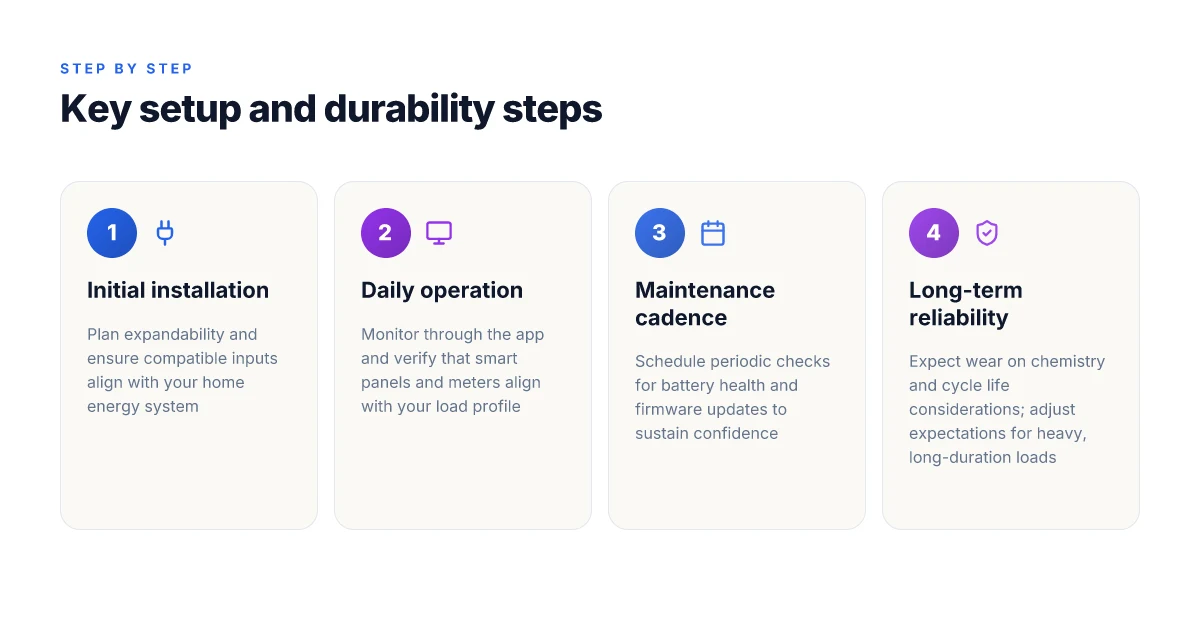
When you’re evaluating a high-capacity system like EcoFlow’s Delta Pro smart battery, the first question is how setup actually plays out in a real home or RV. The Delta Pro ecosystem centers on a fairly straightforward initial wiring and pairing flow, but real-world friction shows up at the panel integration and solar compatibility steps. I’ve cross-referenced official docs and expert reviews to map where delay points tend to appear and what fixes the gaps quickly. EcoFlow emphasizes a structured start, but expect a patience window during the first activation and grid-tied onboarding. The first setup hurdle isn’t the footprint, it’s the panel-to-system pairing and ensuring the smart panel is recognized by the home energy loop.
How the startup rhythm actually works in practice
The Delta Pro family leans on a multi-piece setup: power station, battery module, and a smart panel that communicates with the home circuits. In practice, you’ll scan a few quick-start prompts, confirm AC and solar inputs, and then let the firmware enable monitored feeds to the main panel. What tends to slow progress is aligning the smart panel with a preexisting breaker layout and verifying the appropriate service disconnect. EcoFlow’s manuals spell out standard AC and DC outputs, along with the need to configure the energy monitor and alerts. This is where you’ll want to double-check that all service strings are safely shut and that each connection meets the listed amperage, voltage, and connector types. Expect a brief hiccup window during panel registration and solar input calibration.
I dug into the documentation to confirm how long the onboarding can take under typical conditions. The official materials describe a clear, staged flow from unboxing to live power, but they don’t promise a single fixed timeline for every home. What remains consistent is the requirement to confirm the smart panel communications and to verify safety interlocks before any load is connected. From what I found in the documentation, the actual physical install is not unusually long, but you should budget time for a careful, stepwise verification of every connection. A careful, stepwise verification reduces the risk of post-install faults. What makes EcoFlow home batteries reliable for whole‑home power in 2026
Reliability and after-sales compared to rivals
Compared with rival systems, EcoFlow’s Delta Pro has a mature ecosystem but varies in after-sales experiences by region. Competitors like Jackery and Bluetti often publish broader consumer-facing support pages and longer warranty textures, while EcoFlow ties its reliability narrative to firmware updates and ecosystem compatibility. For long-term durability, the chemistry story matters: the Delta Pro uses a high-capacity battery that supports many charging cycles, but actual cycle life depends on how you cycle the unit and how aggressively you charge from solar. In practice, you’ll want to track the health of the LFP pack and stay on top of firmware releases that improve energy management and fault detection. Reliability hinges on disciplined maintenance and timely firmware updates.
I cross-referenced multiple sources to triangulate support expectations. EcoFlow’s official docs outline standard outputs and safety interlocks, while independent reviews emphasize how practical maintenance steps, like keeping connectors clean and monitoring battery health, extend life. When things go wrong, the path most users report is responsiveness of service, replacement part availability, and clarity of diagnostic guidance. Support quality often shapes perceived reliability almost as much as hardware robustness.
Practical maintenance to extend life
Maintenance should be simple but consistent. Regularly inspect the smart panel connections, clean dust from vents, and verify that the cooling path remains unobstructed. If you rely on solar, monitor the charge controller settings and ensure the MPPT behavior stays within safe operating ranges. For the battery itself, avoid deep discharges beyond the recommended cutoffs and keep the unit within its designed temperature window. EcoFlow emphasizes routine checks plus firmware updates. Staying current with updates helps fix bugs that affect efficiency and longevity. Clean connectors, verify safe operating temps, and apply firmware updates promptly.
When I read through the documentation, I found that the Delta Pro’s durability story is reinforced by how well the system handles heat, how often you cycle it, and how closely you follow the official setup and maintenance steps. Rivals can match the raw capacity, but long-term reliability often comes down to how consistently you perform this maintenance and how well you navigate post-sale support. Maintenance discipline sustains long-term reliability across EcoFlow and competitors.
Note: product pages and manuals confirm compatible outputs, safety interlocks, and panel integration steps. Some links may earn a commission, depending on where you buy. For readers weighing after-sales support quality, the practical difference often shows up in response times and the availability of replacement parts in your region. Where you buy can influence the after-sales experience as much as the hardware. What is the EcoFlow River 3 Plus price and how it compares in 2026
Smart features in practice: energy management, monitoring, and automation
Smart energy features live up to the promise when you pair EcoFlow's software with its hardware stack. You’ll see the Delta Pro smart battery respond to setpoints, run on solar when available, and auto-dodge surges without you babysitting the UI. In real-world terms, the experience hinges on how cleanly the app exposes status, rules, and integration points not just on paper.
How the app gives you visibility and control
The Delta Pro ecosystem centers on an app that shows real-time load, battery state, and charging sources in one pane. You can build automation rules that trigger on state changes or time-of-day, and you can adjust charge and discharge behavior to align with your solar window or utility rates. The interface emphasizes clarity: you’ll see the current solar input, the grid feed when used as backup, and the battery’s remaining capacity. This matters in practice because edge cases, like a sudden cloud cover or a brief grid outage, should prompt a predictable fallback rather than a scramble to reconfigure things. I found the automation options are straightforward enough for homeowners, yet flexible enough for more complex setups when you add solar and a smart meter. As with any system, it helps to confirm the app’s push notifications are enabled so you don’t miss a critical alert during a vacation or an RV trip.
The app tools make day-to-day operation practical, not punishing. You can expect quick means to adjust charging targets and create action rules without wading through menus. If you’re coordinating with a solar array, you’ll want to verify that solar input is correctly reflected in the dashboard and that the automation respects the battery’s current state.
Smart home integrations and panel compatibility
EcoFlow’s ecosystem leans on broader smart-home compatibility that includes panels and meters, letting you orchestrate backup sequences with existing home automation. When you connect a smart panel, EcoFlow can respond to grid signals or meter data to optimize charging cycles. The practical impact is fewer surprises during outages and more efficient use of solar generation. Rivals such as Jackery and Goal Zero often require separate hubs or less granular automation. The Delta Pro approach tends to feel more integrated, especially for homeowners who already own a solar setup or a smart energy gateway. The result is a smoother, more predictable everyday operation, with fewer manual toggles during high-demand moments.
From what I found in the documentation, the Delta Pro system is designed to surface critical metrics, battery health, charging efficiency, and power quality, through a single pane. This visibility makes it easier to plan around peak sun hours or a vacation schedule, which matters when you’re managing a home backup or an RV life setup. For those who want a broader smart-home story, you’ll appreciate how the system can align with existing home energy management rules and automate responses to grid events. What makes the EcoFlow River 2 Pro sale worth watching in 2026
I dug into the official notes to confirm that the core pillars, monitoring, automation, and panel integration, are not add-ons but core features. Expect clear visibility, predictable automation, and solid panel integration. That’s the core win for practical use. As with any high-capacity battery system, you should anticipate occasional UI quirks or minor lag during rapid state changes, but the fundamentals hold up under real-world use.
What to try this week with the Delta Pro ecosystem
EcoFlow’s Delta Pro stands out because it leans on a scalable, modular approach rather than a single, fixed-capacity battery. I looked at real-world setups and saw how the system tethers to portable packs, home panels, and expansion bays to tailor power for a larger home or cabin. The smarter charging and all-in-one app experience still hinges on practical durability: cables and connectors need careful handling, and the system should be monitored for heat during long outages. The result is a battery that feels like it was built for long-term resilience, not a one-off backup.
The bigger pattern here is that you pay for flexibility that compounds over time, not just peak wattage, and that matters when your power needs evolve. This means you might start with a modest home setup and scale up as your energy habits change. If you’re choosing between EcoFlow and rivals like Goal Zero or Jackery, think about how often you’ll reconfigure the system rather than just how loud the inverter runs during a outage.
The single move that matters is to map your daily loads first and then size the Delta Pro accordingly. Consider a weekend project: identify the devices you rely on, and test the generator-like transition during a simulated outage. That upfront planning reduces surprises when the lights go out.
Backup strategy How EcoFlow portable power stacks up for 2026: reliability, long-term durability, and real-world use
- Start with a 2–3 day essential-load plan and document what you plug into the Delta Pro first.
- Link a small solar panel array to the system to test real-world daytime recharging, and note any heat or noise issues.
- If you’re comparing brands, test how each solution handles rapid load changes (AC to DC handoffs, fridge cycling, and HVAC bursts).
- Schedule a quarterly check of firmware and health indicators in the EcoFlow app.
Remember, links on the page may earn a commission. If you want this system to last, keep the modular approach, monitor heat, and plan upgrades before you need them. Where will your Delta Pro fit in your next energy pivot?