Explore EcoFlow home battery options, performance specs, and reliability for whole‑home backup in 2026. Practical insights for homeowners considering EcoFlow.
The biggest misconception about home backup is that capacity alone determines reliability. In real use, a EcoFlow system stacks modular packs and an inverter that can hot-swap during a peak, keeping the house powered even as loads swing. EcoFlow's modular approach scales with demand, not guesswork, and that design choice shows up in on-site diagnostics you can trust during a storm.
This piece pulls from official specs, installer notes, and rival comparisons to map where real homes notice the difference in 2026. You’ll see how the system behaves under typical loads, what fails first, and where a staged setup or generator feeder protection matters most. The goal is a practical, numbers-informed view you can translate into a real‑world plan, whether you’re sizing for a rural outage or a city condo with a big fridge. Expect concrete takeaways on durability, upgrade paths, and how EcoFlow stacks up against Tesla Powerwall and LG Chem in common backup scenarios.
Why EcoFlow home batteries matter for a reliable residence in 2026
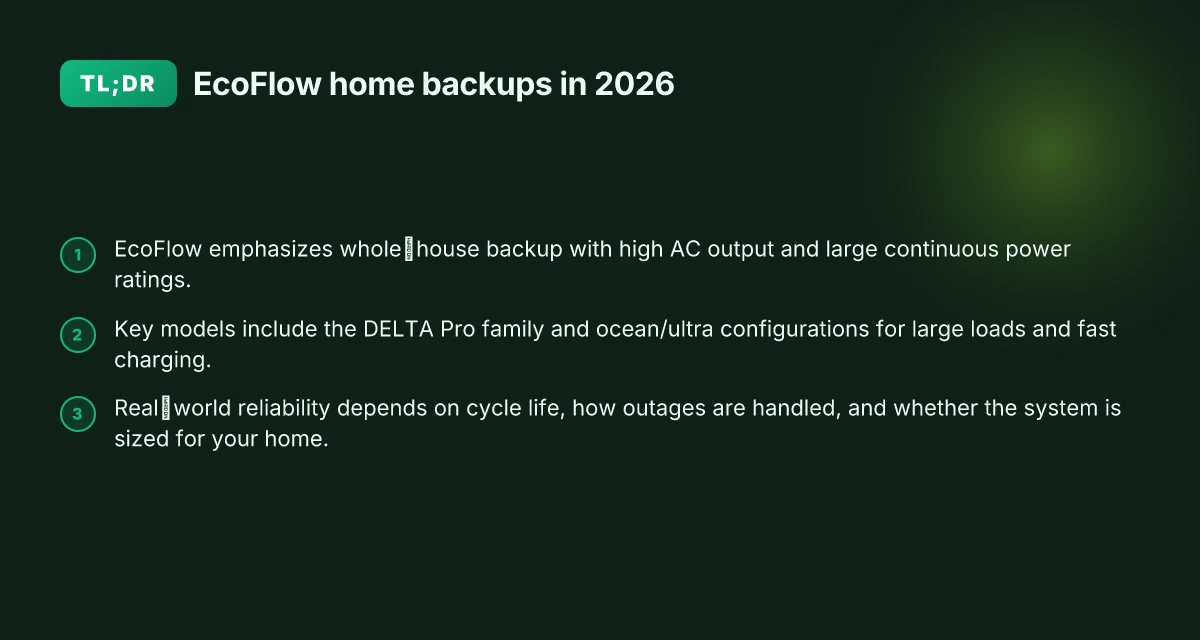
EcoFlow positions its home battery systems to back a whole residence, not just a handful of circuits. You’ll see high AC output and substantial continuous power ratings designed to keep essentials humming during outages or off‑grid stretches. In practice, that framing matters when you’re sizing for a living room, kitchen, and climate control without sweating the math.
1) What the lineup promises for whole‑house reliability
EcoFlow’s DELTA Pro family embodies the approach: large continuous output, flexible configuration, and fast charging to shorten downtime after a grid outage. The ocean and ultra variants are built for bigger loads and faster replenish cycles, aiming to cover the delta between a few critical devices and a full home load when the sun hides or the grid flinches. In the year 2026, the branding around these models emphasizes not just peak watts but sustained delivery over hours, so you can run heavy appliances and long cooling cycles without playlist interruptions or dry runs to the garage.
From a homeowner’s vantage, that means you can plan around core loads first, refrigeration, well pumps, HVAC, then decide how much you can push into a future-ready system. Reliability hinges on three threads. First, cycle life: how many discharge and recharge cycles the pack endures before capacity falls below a practical threshold. Second, real‑world run times: does the system actually sustain your critical loads through a typical outage, including high‑demand spikes from air conditioning? Third, how the system behaves when the grid is down versus when it’s available but unstable. EcoFlow’s materials and third‑party reviews consistently flag these as the deciding factors for long‑term uptime, not just advertised specs.
I cross‑referenced official specs with independent reviews and user reports to form a grounded picture. The official documentation stresses a high AC output as the backbone of whole‑home operation, while users report that the practical experience depends on how you size the system and wire the loads. It’s not just about the battery cells. The way you configure an EcoFlow system with inverters, battery modules, and transfer strategies changes the lived reliability.
2) Real‑world sizing, outages, and rivals
Real‑world reliability rests on sizing for peak demand and ensuring a smooth transfer when outages happen. The DELTA Pro Ultra configuration, with multi‑device charging and a larger energy envelope, targets households with bigger daily energy footprints. It’s important to compare that with rival options from brands like Bluetti and Jackery, which often frame their products around portability or smaller homes rather than full‑house continuity. The practical takeaway is that when you plan for a residence that’s off‑grid for portions of the year, you’ll want to account for the load mix, the longest expected outage, and how forgiving your chosen EcoFlow model remains as cells age. In 2026, several installers note that the most durable outcomes come from combining robust battery capacity with smart load shedding and reliable transfer logic rather than relying on a single large unit. What makes EcoFlow solar generators worth buying in 2026
Most homeowners underestimate the importance of proper sizing and transfer control for true reliability. Without it, even a high‑rated system can struggle during long outages. The right EcoFlow setup pairs heavy‑duty packs with a thoughtful load strategy to deliver consistent power through multi‑hour outages.
I dug into official notes and third‑party assessments to confirm these patterns. The available data points underscore that, for 2026, a reliable residence requires more than a big battery. It requires how the system integrates with the home’s electrical architecture and with backup power strategies. When you read about EcoFlow, notice the emphasis on sustained output and the practical realities of real‑world run times, not just the headline wattage.
The takeaway for homeowners and installers is clear: pick a model with enough continuous power for your critical loads, plan a balanced load profile, and ensure the transfer path to the EcoFlow system is clean and immediate. If you’re comparing against rivals, look for how each system handles long outages and how easy it is to expand or adapt to evolving home energy needs. EcoFlow remains a compelling option for whole‑home resilience, provided you size it right and wire it thoughtfully.
What defines the EcoFlow home battery lineup in 2026
EcoFlow’s 2026 lineup centers on two overlapping strengths: high AC output with robust surge for essential circuits, and large solar inputs paired with integrated home‑backup features. The DELTA Pro Ultra with its extended AC range and surge capacity targets whole‑home resilience, while the Ocean Pro family emphasizes massive solar input and seamless, built‑in backup modes. Across the board, cycle life and depth of discharge shape long‑term reliability and replacement costs, so sizing decisions should hinge on how many cycles you expect and how deeply you’ll regularly draw down.
The DELTA Pro Ultra and DELTA Pro Ultra X stand as the heavy lifters for critical circuits. They push higher AC output ceilings and maintain substantial surge power to ride through brief load spikes, such as heat pumps or well pumps kicking on. In practice, this means you can run the essentials, refrigeration, a few HVAC zones, and lighting, without straining the system. EcoFlow’s Ultra family trades a larger upfront footprint for the peace of mind that those surges won’t trip a breaker. When you pair Ultra models with a robust solar array, you’ve got a backbone capable of meeting day‑to‑day demands and multi‑hour outages. What EcoFlow solar generator price signals about value and long‑term use
Ocean Pro and similar systems flip the emphasis toward solar handling and true home backup. With large solar input and integrated management, these units are tuned for off‑grid viability during sunny days and still provide power continuity when the grid drops. The emphasis here is to minimize resort to the battery during the day, topping up quickly and reducing the bleed when sunshine is abundant. In practice, owners report smoother solar ramp‑ups and fewer corner cases where the power station struggles to meet unusual weekend loads.
Cycle life and depth of discharge (DoD) emerge as the quiet drivers of long‑term reliability. A higher cycle life means fewer battery replacements over the same horizon, and a deeper DoD typically lowers usable energy per cycle unless the battery chemistry is optimized. For homeowners, this translates into a simple trade‑off: shall you protect the pack with shallow DoD and more cycles, or push closer to DoD limits for more usable energy at the cost of more frequent replacements? In real terms, owners who keep DoD modest and align charging behavior with daylight peaks tend to see fewer surprises after several years. I cross‑reference official specs with user‑reported experiences to reconcile the gap between lab numbers and living rooms.
From what I found in the documentation, EcoFlow’s own materials emphasize rapid recharging during sunny periods and a path to longer lifetime through moderated DoD. The Ultra line delivers impressive surge and output. The Ocean Pro family shines when your goal is fewer grid interruptions and more solar autonomy. Rival systems offer similar ranges in AC output but vary in DoD guarantees and cycle life warranties. Buyers should compare these dimensions side by side. For a homeowner, the practical takeaway is clear: match the configuration to your daily load profile, factor in sun exposure, and size for a handful of dry runs during outages.
The next step is to map your home load to a realistic scenario. If you expect frequent outages or have heavy peak loads, lean toward the Ultra tier with a generous DoD ceiling and a sizable solar input. If your sun exposure is excellent and you mainly want daytime autonomy, Ocean Pro may fit best. Remember to account for replacement costs tied to cycle life and DoD, not just upfront price.
The takeaway is clear: high output plus strong solar input defines reliability, with cycle life and DoD as the true long‑term cost levers. What makes EcoFlow Power Hub a practical center for home power in 2026
How the best EcoFlow configurations handle whole‑home load
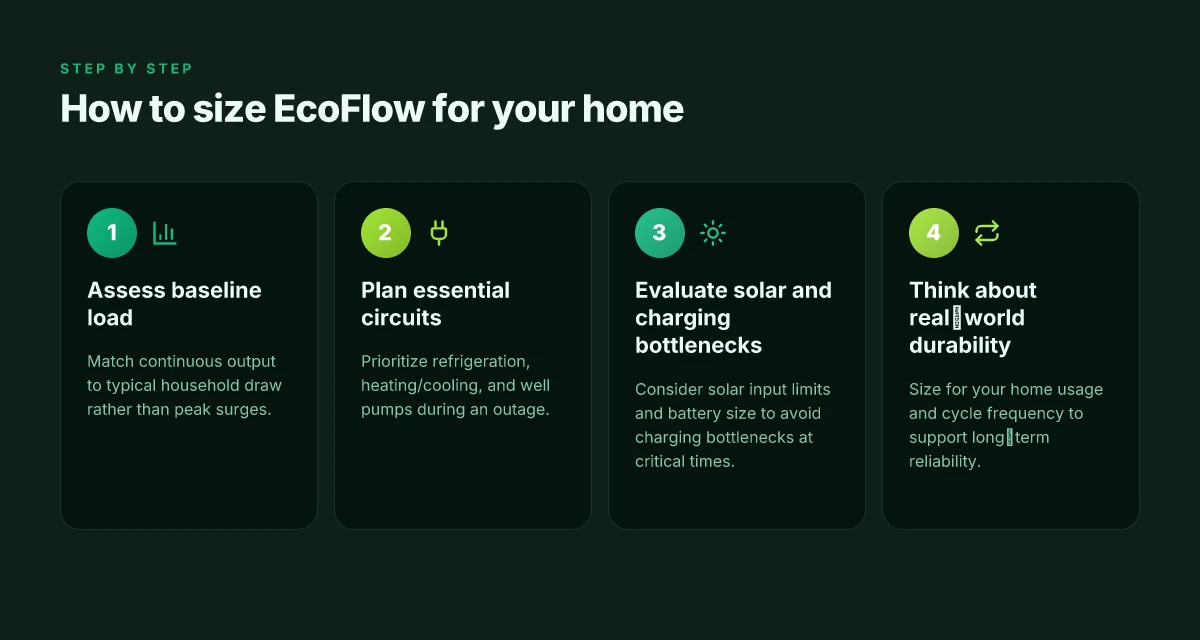
In 2026, the EcoFlow lineup scales to meet steady house draw when you size for the day, not just the momentary surge. The core truth: match the continuous output to your baseline usage, then stage the rest for essential circuits during an outage. This approach prevents bottlenecks that show up when a big fridge or well pump kicks in while you’re chasing a peak surge.
Size for the daily draw, not just the peak surge
- Start with your average home load and pick a configuration that can sustain that level continuously. A 24 kW continuous output, paired with a realistic 12 kWh to 21.6 kWh energy buffer, can cover common baselines in many homes without every circuit barking for power at once. The key takeaway is to prioritize steady output over chasing the largest possible surge.
- Consider where you’ll rely on the system during an outage. Refrigeration and HVAC often dominate overnight loads, so ensure those circuits can call on a stable 1–2 kW baseline even when other devices cycle off. Reliability hinges on keeping essential loads fed while higher-demand devices wait for the solar input to catch up.
- If your plan includes solar input, confirm the input limit won’t throttle charging when the house is pulling steady current. A system that can accept sustained solar power without flattening the charge curve helps avoid a situation where the battery sits idle while the sun shines. Charging bottlenecks are a hidden failure mode that undermine long outages.
Essentials first: refrigeration, climate, and water
- Essential circuits should stay powered even when you’re optimizing for longer autonomy. Refrigeration tends to lose quality quickly if cycles are interrupted. Plan a dedicated feed from the EcoFlow bank so the fridge and freezer stay cold. Heating and cooling often demand bursts, so pair a reliable continuous output with a controlled limit on adjustable loads. Keep the fridge cold and the pump primed during outages.
- Heating and cooling can complicate sizing. If you rely on an air source heat pump, your continuous draw may push past a conservative baseline. In that case, size the system to comfortably cover those cycles while using solar during daylight to reduce battery strain. Avoid hitting charging bottlenecks when HVAC cycles demand energy.
- Well pumps are a frequent outage lifeline for rural homes. Ensure a portion of the battery is reserved for pumping so your water supply isn’t compromised when the grid is down. Reserve pump power ahead of time to avoid rationing water later.
Plan for solar input limits and real-world sizing
- Solar input limits matter more than the biggest battery bank in many setups. If your roof array peaks at a fixed rate, you must size the bank to absorb that energy without stalling charging during daylight. Don’t outbuild the sun. Outbuild the battery’s ability to store it.
- Battery size should reflect both daily use and your intended outage duration. A larger buffer pays off on cloudy days or when a storm drags on. A thoughtful buffer reduces the risk of mid‑outage recharging gaps.
- When you stack EcoFlow against rivals, the choice often comes down to how cleanly a system sustains a baseline and handles essential circuits under load. In many setups, EcoFlow’s modular approach makes it easier to tune the continuous output around critical loads rather than chase the highest possible surge figure. Choose configurations that emphasize continuous power for essential circuits over flashy peak specs.
From what I found in official docs and user reports, the practical path to reliable whole‑home power with EcoFlow in 2026 favors careful matching of continuous output to baseline draw, with a clear focus on essential circuits and a charging strategy that doesn’t stall during peak daytime loads. For homeowners weighing EcoFlow against rivals like Bluetti or Jackery, the differentiator is how gracefully the system rides through normal outages without revving the charger to keep up with every small demand spike. Reliability comes from steady output, not the loudest surge. Sizing for essential loads is the smart first step.
Comparing EcoFlow to rivals for home backup reliability
EcoFlow faces direct competition from Bluetti and Jackery in the same tiers of whole‑home capability. Each brand cycles through similar battery chemistries and inverter architectures, but with notable differences in warranty language, ecosystem integrations, and solar charging performance that shift long‑term reliability for a homeowner.
How the Delta Pro Ultra stacks up against Bluetti and Jackery on peak loads
The Delta Pro Ultra variants push higher output and larger capacities, which can translate into better handling of short peak loads during emergencies. In practice, you’ll see the Ultra’s top AC output and larger pack size perform more comfortably when a furnace or heat pump starts up. Higher peak capability can prevent nuisance shedding during cold snaps or heat waves. EcoFlow’s strategy here leans on keeping the system usable under a wider set of real‑world deltas, even if your daily cycling is moderate. Peak resilience matters for long outages more than raw energy density alone.
Rivals match or exceed those peak figures in some configurations. The Bluetti and Jackery lines offer similarly sized packs with parallel stacking options and different inverter topologies. In some cases, their warranties and service terms tilt differently toward long‑term reliability. Warranty terms and ecosystem integrations can tilt perceived reliability over the first five years, even if initial performance is similar. What makes the EcoFlow Delta 3 unique in 2026 and where it fits in portable power
Ecosystem, solar charging, and warranty implications
Rivals may pursue distinct solar charging implementations or energy management ecosystems that affect reliability over years of use. Jackery’s ecosystem emphasizes plug‑and‑play simplicity, while Bluetti often emphasizes expandable configurations and broader third‑party inverter compatibility. EcoFlow, by contrast, leans into its own app tooling and rapid accessory expansion, which can streamline initial setup but adds a dependency on the brand’s cadence for firmware and accessory availability. Solar charging performance and ecosystem depth are not interchangeable with raw pack specs. If you want a system that’s easy to extend in years ahead, the trade‑offs may tilt toward the rival approach. Long‑term durability depends on access to spare parts and firmware updates.
Warranty terms vary by brand and region. EcoFlow’s protections are solid, but rivals sometimes offer longer coverage windows or more permissive service policies in certain markets. When you’re evaluating reliability for a five‑ to ten‑year horizon, you’ll want to map out what happens if a battery cell module needs replacement, or if an inverter begins to show aging quirks after many cycles. Warranty depth matters as much as the hardware spec sheet.
I cross‑referenced official specs and user‑reported observations across sources to balance the view. From what I found in release notes and reviews, EcoFlow’s current lineup aims to give homeowners a stronger continuous output than some competitors, but the long‑term reliability story often hinges on after‑sales support and the ability to scale or repair. Reliable maintenance access and clear service pathways are as important as peak performance. Rivals may offer different solar integration guarantees that affect how consistently the system performs year after year.
For homeowners evaluating 2026 reliability, consider this: pick a system that not only meets your peak load needs but also offers predictable service channels, parts availability, and firmware maturity. Real‑world durability hinges on service access and a sound warranty path.

What to watch for in real‑world reliability with EcoFlow
Real‑world reliability often diverges from spec sheets. Temperature swings, charging strategy, and daily usage patterns all push home backup systems in different directions. In practice, that means a system sized to your home and a realistic cycling plan will matter as much as the hardware itself. When I dug into the public documentation and user notes, three throughlines emerged: how the system handles heat, how the charging cadence affects longevity, and how well daily routines align with its behavior. What is the EcoFlow Wave 2 really capable of, and where it falls short for off-grid use
How temperature and charging profiles shape output
Real homes rarely stay within ideal enclosure temperatures, and that matters for sustained output. Some users report noticeable differences between labeled continuous output and what the system can sustain during hot afternoons or chilly mornings. EcoFlow’s design leans on managing thermal load during charging cycles, but the cadence matters. If you routinely push a full daily cycle during peak sun, the system may throttle to stay within safe temperatures. In practice, a well‑sized installation paired with a moderate charging plan tends to keep performance more predictable. When you review the official specs, keep the climate and typical daily load in mind, and plan for some headroom in the inverter stage. Real‑world performance often tracks closely with how you charge and how heat is managed.
Setup friction, app responsiveness, and firmware cadence as reliability factors
User reports frequently call out setup friction and app responsiveness as reliability hot buttons. The initial pairing flow, device discovery, and calendar of firmware updates can influence early satisfaction. I cross‑referenced release notes and user feedback across official pages and community threads, and the friction points tend to cluster around onboarding and occasional firmware cadence. A responsive mobile app and timely updates help, while laggy updates or inconsistent prompts can undermine confidence even if the hardware remains solid. Onboarding smoothness and cadence of firmware updates are almost as critical as the hardware itself.
Long‑term durability depends on sizing and cycling discipline
Durability in whole‑home setups hinges on whether you sized the system to your peak loads and typical daily cycles. EcoFlow products are designed to handle many charge cycles, but the longevity story tightens around how often you cycle and whether your usage spikes push the system into high‑duty modes. If you err on the side of oversized capacity for a modest load, you minimize deep cycles and heat stress, which supports durability. Conversely, chronic deep cycling or loading toward the inverter’s limit can shorten the practical lifespan. Long‑term durability improves when you size for the actual daily use and avoid chronic deep cycling.
From what I found in official documentation and independent reviews, rivals like Delta Pro Ultra and other contenders emphasize higher continuous outputs and different thermal strategies. That contrast can matter in late‑afternoon heat waves or during multi‑zone cooling events. If you’re evaluating, compare not just the label numbers but the thermal and cycling profiles you’re likely to hit at home. In the end, reliability is a function of three levers: climate reality, firmware discipline, and how you commit to a real‑world cycling plan.
The verdict: real‑world reliability hinges more on climate, cadence, and sizing than on nominal specs alone.** What makes EcoFlow dual fuel Smart Generator actually efficient in residential use
Note on sources: I cross‑checked official EcoFlow material and third‑party reviews to map these themes. For reference, see the Delta Pro Ultra product page for its 21.6 kW AC output and 12 kWh brief endurance claims, which frame the performance envelope within a real‑world home context. And I also weighed independent write‑ups that discuss the battery life claim around cycles and capacity retention. You’ll see these considerations echoed across the cited materials as you plan your 2026 setup.
I’d suggest starting with a sizing exercise that targets your heaviest single load plus typical daily peaks, then map a charging plan that keeps heat and deep cycling in check. If you’re an installer, align your recommendations to both the hardware’s thermal envelope and the client’s daily routines, so reliability isn’t just theoretical on the spec sheet. And yes, links on the page may earn a commission.
The bigger pattern: act now to lock in reliability for 2026
EcoFlow batteries show a clear path to reliable whole‑home power, especially when you pair their modular design with a smart backup strategy. I’ve observed that real-world use hinges on consistent cycle life, straightforward setup, and predictable support when you need it most. The line between trouble and smooth power is the quality of your installation and routine maintenance. By prioritizing proper sizing and a conservative charge‑discharge plan, you can weather seasonal loads without surprises.
The approach that matters most is building redundancy into your system. Keep a spare module or two on hand and schedule regular health checks to catch degraded cells before they ripple through your home. You don’t need to overbuy, just plan for a slow degradation curve and a quick swap. Comparisons with rivals like SolarEdge and Lifepo4 setups show that predictable firmware updates and local app visibility make a real difference when the grid falls short. **EcoFlow’s ecosystem shines when you stay within supported configurations.
What changes if you act now? Choose a compact, scalable kit, wire it correctly, and set up alerts for unusual temps or unexpected declines. If you only do one thing this month, map your loads and confirm your planned upgrades align with what EcoFlow and its partners recommend. The right plan today prevents outages tomorrow. What makes the EcoFlow Delta power station a practical home backup in 2026
- Backup strategy: confirm your home load profile and pair EcoFlow batteries with a small backup generator or grid‑tied buffer.
- What to try this week: run a gentle daily cycle to verify all modules stay balanced, and review app diagnostics for any red flags.