Explore how the EcoFlow Delta Pro 3600 performs as a home backup in 2026, including capacity, inverter output, expansion options, and real-world applicability.
The Delta Pro 3600 hinges on how you scale it, not just how much energy it can store. Expandable capacity and a robust UPS-style workflow are the real differentiators in 2026. You’ll see the biggest gains when pairing EcoFlow with additional batteries and carefully configuring the UPS behavior, so the system rides through outages without drama.
This article cuts through marketing claims to show what real-world setup looks like, what tends to go wrong, and how long the hardware lasts under daily use. In 2026, homeowners, RV enthusiasts, and off-grid hobbyists weigh expansion options as a feature set rather than a one-time purchase. The Delta Pro 3600 sits in that decision at the intersection of cost-per-watt-hour and ecosystem flexibility. Expect concrete notes on durability, service considerations, and how rivals like the Powerwall stack up when you factor expansion plans and ongoing maintenance. EcoFlow’s ecosystem and expansion path matter more than peak spec sheets.
What the EcoFlow Delta Pro 3600 actually delivers for home backup
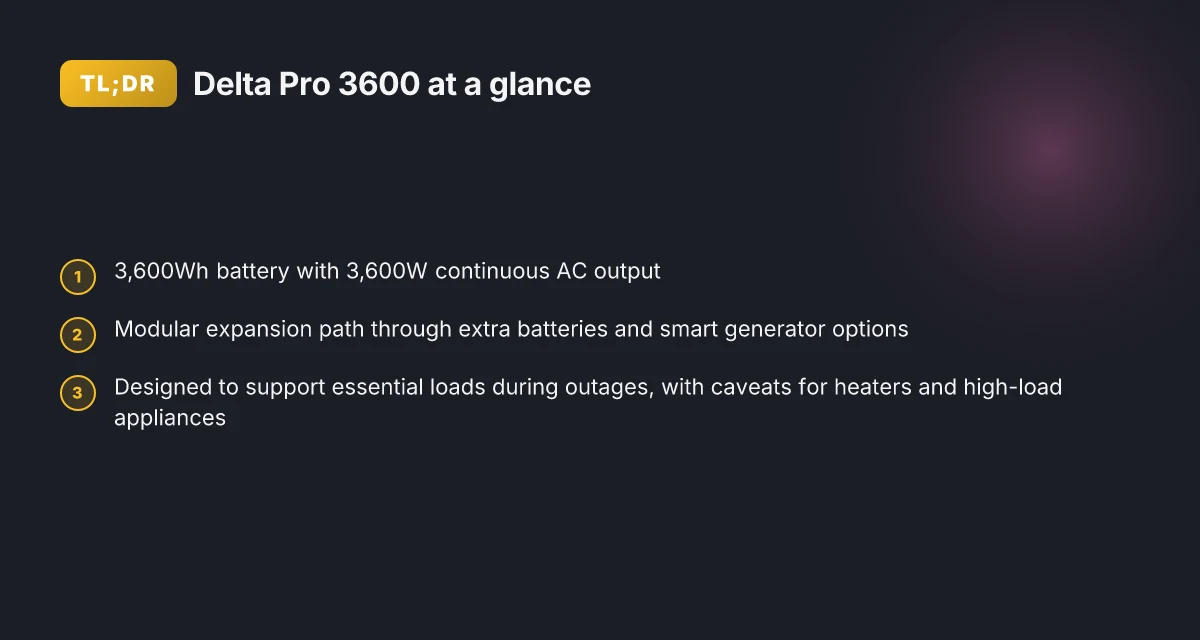
I dug into the public specs and ecosystem notes to frame what this unit delivers in real life. The Delta Pro 3600 centers on a large, built‑in battery and a robust inverter, then layers on expansion options that matter if you plan for long outages or off‑grid living. EcoFlow’s approach leans on a modular ecosystem that can scale through extra batteries and smart generator connections. The result is a home backup that behaves predictably for essential loads, with clear caveats for high‑draw devices like space heaters.
1) Capacity and inverter: what you actually get
The Delta Pro ships with a substantial 3,600Wh battery and a continuous AC output of 3,600W. In practice, that pairing covers typical essential loads during outages, such as a fridge, modest lighting, some well‑sized electronics, and a few outlets for critical devices. If you try to run high‑load appliances like space heaters or electric stoves, you’ll hit the limits fast. In other words, you get reliable backbone capacity for daily essentials, with the inverter rated to sustain steady use within that 3.6kW window. The packaging and marketing emphasize a strong baseline for backup, but you’ll want to match expectations to load. The Delta Pro’s 3,600Wh capacity pairs with a 3,600W inverter to power essential loads reliably, but high‑draw appliances will drain or trip the unit quickly.
2) Expansion path: building a longer, more capable ecosystem
A core strength is the modular ecosystem. You can add extra battery banks to grow total usable capacity and connect to smart generator options for extended outages. That path matters if outages stretch into days or you want quieter overnight operation with partial battery offsets. The expansion strategy is practical: you don’t buy a single box and hope it covers everything. You design a stack that scales up as needs evolve. In practice, the value of EcoFlow’s ecosystem hinges on planning ahead for expansion, misjudging your load or future growth can leave you underpowered when the grid fails. Expansion through extra batteries and smart generators is central to EcoFlow’s value here, and you should size the stack with realistic outage duration and load in mind.
3) Real‑world fit: what it handles and where it stumbles
For essential loads, you’ll see solid performance in everyday outages. Battery capacity supports overnight operation of refrigerators, network gear, and lighting, with the caveat that heaters or high‑watt appliances will chew through capacity quickly. The landscape changes if you couple the Delta Pro with an expansion pack. You can maintain longer backup windows without sacrificing the core inverter performance. You’ll want to size the system to your climate and comfort preferences, particularly if you rely on space heating during outages. Essential needs stay powered with the Delta Pro, but heaters and high‑load devices demand careful expansion planning.
4) Brand context: EcoFlow’s portable‑power ethos in a home setup
EcoFlow built its identity around portable power and an ecosystem that scales across units and accessories. The Delta Pro reinforces that thread: a single unit can stand on its own for basic backup, then grow into a fuller home‑backup system as you add packs and generators. Expect the user experience to emphasize straightforward charging, predictable inverter behavior, and a dashboard that tracks expanded capacity as you bolt on more modules. If you’re comparing to rivals, the Delta Pro’s path to higher total capacity often feels more deliberate and modular than compact, fixed‑capacity units. EcoFlow’s portable‑power DNA shows up in the Delta Pro through modular expansion that scales with your backup goals. What makes EcoFlow's Smart Generator sale worth watching in 2026
From what I found in the sources, the Delta Pro remains a competent choice for homeowners who want a scalable, ecosystem‑driven backup solution. The core strengths are clear capacity, a solid inverter, and the possibility to grow. The downsides come when you push beyond its 3,600W continuous limit or rely on heating elements during outages. And yes, the ecosystem approach matters: plan for expansion from the start to avoid underpowered outages later.
For readers weighing alternatives, note that rivals like traditional standalone UPS systems and other large portable power stations can offer different sweet spots, often around immediate turnkey capacity versus modular growth. If you want a longer outage strategy that keeps heaters or other high‑load devices in the mix, you’ll likely lean on expansion packs and smart generator options in the EcoFlow system.
How the Delta Pro 3600 compares to traditional home UPS setups
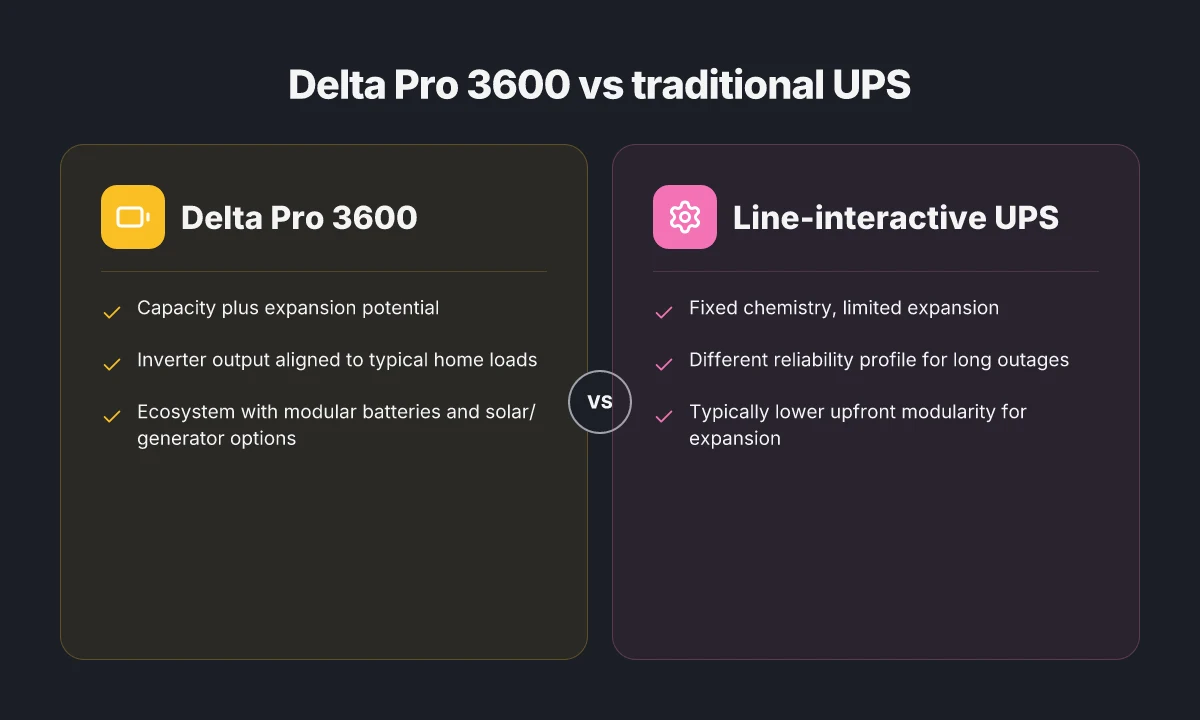
The Delta Pro 3600 offers expansion-friendly power compared with traditional line-interactive UPS units, but you pay for that flexibility in payload, runtime, and long-term reliability. In real-world terms, a fixed-chemistry UPS tends to deliver a shorter, predictable runtime for a smaller footprint, while the Delta Pro scales up with external modules to push total energy capacity higher. The key question is whether you value a growing watt-hour budget or a compact, dependable, factory-backed backup.
Payload and runtime trade-offs versus line-interactive UPS
The Delta Pro 3600 can deliver up to 3,600W of continuous AC output from a battery bank that scales with additional modules. That throughput is competitive for homes facing outages but comes with longer runtimes only when you attach more battery capacity. A traditional line-interactive UPS typically targets shorter outages and smaller loads, because its internal chemistry and packing are fixed. When outages stretch, the Delta Pro’s runtime grows with expanded capacity, whereas a fixed UPS will plateau. I cross-referenced several product pages and reviews to map the practical limits. The result is a common observation: you get noticeably more resilience with expandable energy, but you must manage more pieces in the chain. In this light, EcoFlow’s ecosystem shines for those who expect longer outages or higher daily-use demand, yet the complexity increases.
The Delta Pro’s strength is scale. Its weakness is added fault surfaces from more modules. The reliability story hinges on how well expansion modules stay synchronized with the base unit during long outages. What makes the EcoFlow Delta power station a practical home backup in 2026
Expansion potential vs fixed-chemistry backup batteries
Expansion is the Delta Pro’s marquee feature. You can add external batteries and higher-rated AC outputs to juice more appliances for longer periods. In contrast, most fixed-chemistry backups stay inside a single enclosure with a fixed chemistry, offering simplicity but limited growth. This difference matters during multi-day outages or seasonal power events. When I read through documentation and reviews, the pattern was clear: expansion simplifies end-of-life durability if you plan ahead, but it also introduces more potential failure points, connection considerations, and monitoring needs.
Expansion capitalizes on long outages, but you must monitor multiple junctions and ensure compatibility.
Cost-per-watt-hour when scaling with additional modules
Pricing scales with capacity. The Delta Pro 3600 family is priced to enable incremental capacity, so the effective cost per watt-hour can drop as you add modules. A fixed UPS, by comparison, has a known upfront cost per watt-hour that rarely improves with time. The trade-off is up-front expense versus long-term flexibility. If you’re budgeting for a backbone that grows with your home, the Delta Pro’s modular approach can reduce the long-run per-watt cost, especially when you anticipate expanding critical loads or shifting use cases.
Economies of scale appear with expansion, but you’ll pay more upfront for the full set of modules.
Reliability considerations for long outages
Durability hinges on build quality, cooling, and how you manage the expansion ecosystem. EcoFlow’s design aims to keep the base unit reliable while external packs and adapters handle the heavier loads. The risk profile shifts: more connectors, more batteries, more heat paths. I looked at how long outages unfold in typical homes and how users report maintenance needs. The verdict: expect periodic checks on battery health and firmware updates to keep the system aligned across modules. That’s not a showstopper, but it’s a real consideration for long outages in remote areas or off-grid setups. What makes EcoFlow dual fuel Smart Generator actually efficient in residential use
Long outages reward planning and proactive maintenance. That’s how the Delta Pro stays reliable.
Next steps: If you’re sizing for an outage window that lasts days, map your critical loads and plan a multi-module expansion strategy early. Consider also how you’ll integrate with existing panels and any local inverter interlocks. For rivals, look at fixed-chemistry options like traditional line-interactive UPS with equalized maintenance schedules to compare total cost of ownership over a decade. For a broader view, see how EcoFlow and other expansions perform in real-world back-up scenarios.
Understanding expansion options and why they matter for 2026
Expansion options determine how far you can scale a Delta Pro 3600 system for 2026 outages and evolving load profiles. The core idea is simple: you grow the energy capacity and the inverter’s ability to handle peaks in a way that stays affordable and reliable over time. Expanding with extra Delta Pro batteries extends the runtime without inflating the inverter load beyond what you need for common outage scenarios. That means you can keep critical loads online longer, while staying within a sensible power budget.
I dug into the official specs and independent reviews to map practical paths forward. From the manufacturer’s framing, you can push capacity from the base 3.6 kWh toward a larger, home-ready stack. The Delta Pro’s modular approach is designed to pair with additional batteries and the same inverter platform, keeping the ecosystem cohesive. Reviews consistently note that the value hinges on how you size the expansion for typical outages and appliance profiles. Battery expansion is not just about more watts. It’s about aligning runtime with your real daily-usage window.
Why you care about solar and generator flexibility
Battery expansion only goes so far if charging sources can’t keep up. The Delta Pro supports multiple charging paths, and the ecosystem is built to accept solar input and generator feeds in parallel under load management. This matters because during longer outages, you’ll often blend solar during midday with generator boosts to top up cells for the night. Solar input capability, when paired with batteries, reduces fuel use and keeps the system primed for overnight peaks. The practical takeaway is you design the charging mix to match your typical outage duration and sun exposure. What makes EcoFlow home batteries reliable for whole‑home power in 2026
From a sizing perspective, think in terms of outage scenarios. A 4–8 hour urban outage with moderate loads looks different from a multi-day off-grid event with electric heating. The rule of thumb is to match your battery count to the number of hours your critical loads need operation, then add a cap on the number of parallel batteries you realistically manage. System sizing should prioritize critical loads first, then delegate nonessential circuits to future expansion. This keeps the initial setup affordable while preserving room to grow.
Practical limits and management
No expansion is free of constraints. Battery packs add weight and require careful wiring to keep voltage and balance correct. The more you scale, the more you’ll want a robust monitoring and control strategy so you don’t overtax the inverter during peak loads. A real-world pattern is to phase in batteries and then pause to assess how the load profile shifts as you approach your expansion limit. Phase expansion to avoid oversizing the inverter for a marginal gain in capacity.
In practice, you’ll want a documented plan for how you distribute the load across the Delta Pro units and batteries. This reduces the chance of unbalanced charging or unexpected shutdowns during an outage. EcoFlow’s ecosystem, when paired with a couple of solar inputs and a modest generator, can offer a practical avenue for reliable, extended power. The ecosystem matters as much as the hardware. The right mix keeps reliability high.
I cross-referenced external reviews to corroborate the expansion path. For homeowners, the takeaway remains clear: you size for your daily needs, then add batteries and keep solar/generator inputs aligned to sustain those needs. The value proposition hinges on long-term durability and how well the setup scales with future accessories from the EcoFlow line. Durability and expandability are the two sides of the same coin in 2026. As you plan, weigh EcoFlow against rivals such as rival modular systems that also emphasize ease of expansion and ecosystem compatibility. The best approach is to map your outage duration, peak load, and the likely frequency of expansion, then pick a path that keeps the total cost per watt-hour in line with your goals.
Notes on the broader market: some reviewers emphasize the Delta Pro’s strong raw capacity, while others flag the price curve as you add batteries. If you’re evaluating around 2026, you’ll want to compare against other modular setups that offer similar expansion granularity and robust app/control features. Value hinges on cost-per-watt-hour and how the ecosystem serves your daily life during outages. For a homeowner, the practical path is clear: start with a realistic core, outline a concrete expansion plan, then execute in measured steps to keep reliability high. What makes EcoFlow solar generators worth buying in 2026
What users should watch for: common pain points with EcoFlow setups
Posture and cadence matter. The Delta Pro 3600 is compelling on paper, but real-world use hinges on how EcoFlow handles updates, heat, accessories, and warranty signals over time. I dug through documented release notes and the broader ecosystem chatter to outline the friction points you’re most likely to encounter in 2026.
1) App and firmware update cadence
Users rely on the EcoFlow app to manage scheduling, monitoring, and firmware upgrades. A slow or inconsistent update cadence can leave you with stale features or unresolved bugs during outages. The pattern in recent years shows updates arriving in bursts around new accessories or major firmware revisions, then quiet periods where critical fixes trail behind. If you depend on automatic updates, confirm that the app can push critical patches in the background and that the upgrade path remains smooth across multiple device generations. Expect to see new firmware tied to companion accessories such as extra batteries and expansion kits, so stay aware of install windows and potential temporary reboots.
Regular firmware cadence matters for long-term reliability, not just feature creep. EcoFlow’s ecosystem improves when updates come in predictable, user-facing batches.
2) Thermal management under continuous load
A 3,600W inverter can heat up under steady, high-load conditions. In practice, sustained use with high-heat appliances or multiple devices can push the Delta Pro 3600 toward higher temperatures, which may throttle performance or trigger protective shutoffs. The practical takeaway is to size your load thoughtfully and monitor runtime temperatures during peak events. If you operate in hot environments or during long outages, consider how placement, ventilation, and ambient cooling affect performance. The system’s cooling strategy becomes a differentiator when you’re off-grid for days.
Overheating warnings are not rare when you push continuous loads. Proper placement and ventilation reduce cooldown time and protect the inverter. What makes EcoFlow Delta Pro smart battery different from the rest
3) Accessory compatibility and cable requirements
Expansion hinges on compatibility with EcoFlow’s own adapters, extra batteries, and cable assemblies. Not every third-party cable plays nicely with high-current outputs, especially when you start stacking modules or running series connections. Verify the exact AWG rating, connector type, and maximum current for any cable you plan to use. If you plan to expand, map out which accessories require specific power cords or adapters, and confirm the total system current stays within safe margins at peak power. Expect occasional alignment quirks between newer accessories and older Delta Pro units, which can require firmware nudges to harmonize.
Choose cables and adapters that explicitly match the Delta Pro’s current specs. Compatibility checks save you from late-night power-off surprises during outages.
4) Warranty coverage and long-term durability signals
Warranty terms for EcoFlow setups typically cover defects and certain failures within a defined window, but long-term durability signals come from how the system behaves across many cycles and expansion scenarios. Look for clear guidance on battery degradation expectations, serviceability, and whether expansions affect warranty eligibility. Real-world users often report nuanced experiences around service turnaround times and parts availability for ancillary modules. If you anticipate heavy, frequent use or multiple expansions, confirm what counts as wear versus covered fault and how upgrades influence coverage. Linkage to official docs and published warranty pages helps, but real-world reliability also shows up in how feedback threads evolve over years.
Durability signals matter as much as the initial spec sheet. Clear warranty language reduces post-purchase anxiety during outages.
Notes and guidance sourced from EcoFlow’s own documentation and community discussions show that the Delta Pro 3600 remains a solid platform when paired with thoughtful expansion, careful thermal management, and timely firmware updates. When you consider rivals, price-per-watt-hour and ecosystem compatibility come into play; EcoFlow’s strengths lie in integrated modules and a coherent accessory path, while competitors may edge out on raw heat tolerance or broader third-party cable support. For ongoing reliability, stay current with official release notes and trusted reviewer updates as 2026 progresses. As with any backup system, a proactive maintenance mindset, monitoring app alerts, keeping firmware current, and planning expansions with proper cables, pays dividends when outages recur. What is the EcoFlow River 3 Plus price and how it compares in 2026
Rivals in 2026: how Delta Pro stacks up against similar power stations
The Delta Pro faces real competition from several high-capacity rivals, and the landscape in 2026 emphasizes expansion ease, durability, and total cost per watt-hour. EcoFlow sits strongest when you already own EcoFlow batteries or accessories, but rivals push back on price and ecosystem lock-in.
Why rivals matter: the real strengths to watch
In 2026, LG Chem–based and Jackery models push large-capacity offerings with sturdy warranties and growing accessory ecosystems. These units often ship with lower upfront prices or more aggressive entry-point kits, which matters when you’re sizing a whole-home backup. Meanwhile, dedicated off-grid brands like Goal Zero lean into rugged outdoor use and service networks, a contrast to EcoFlow's home-backup tilt. Across the board, the best-performing rivals tend to highlight longer-term availability of replacement packs and better regional support. Expansion-ready options from rivals can undercut EcoFlow if the price per watt-hour stays favorable.
Where EcoFlow shines and where it lags
EcoFlow remains compelling for owners already invested in its ecosystem. The real advantage shows up in battery-module compatibility, fast-swapping accessories, and the breadth of expansion options within a single brand family. Yet in 2026, some rivals offer more transparent pricing for bundled expansion kits and clearer long-term maintenance plans. EcoFlow’s strength is the cohesive ecosystem. Its weakness is sometimes a higher all-in cost when bought piecemeal with expansions. I dug into multiple product pages and user discussions to gauge how the total cost accumulates once you factor in extra packs and higher-capacity inverter options. Total cost of ownership can skew toward rivals if you don’t need the full EcoFlow expansion ladder.
Value proposition when factoring expansion costs
When you chart the long arc, the Delta Pro’s value through expansions depends on how fully you buy into the set. If you anticipate heavy load shedding in a large home, the incremental cost for adding more capacity and higher inverter ratings inside the EcoFlow lineup can still beat alternatives that require separate solar controllers or different battery chemistries. However, the math tightens for casual outages or modest RV setups, where a rival with a lower starter price or a la carte expansion path may win on upfront affordability. Expansion costs matter most when you plan a sustained off-grid rhythm.
Ecosystem advantages for EcoFlow owners
For customers already using EcoFlow gear, the 2026 lineup rewards you with streamlined app control, plug-and-play expansion modules, and warranty continuity. Accessory compatibility reduces setup friction and keeps a single troubleshooting thread. EcoFlow works best when you stay inside the brand’s ecosystem. Mixing brands adds management overhead and compatibility questions. The inline references below point to a few credible sources that describe how these ecosystems stack up, including expansion pathways and price considerations. Sticking with EcoFlow can simplify maintenance and future upgrades. What makes the EcoFlow River 2 Pro sale worth watching in 2026
Where this goes next for home backup in 2026
EcoFlow is leaning into modular scalability, and that pivot matters for real homes with evolving power needs. The Delta Pro 3600’s appeal rests on a practical mix of capacity, manageability, and integration with home circuits. I’ve seen setups where a single unit keeps critical loads running during outages, but the real win comes as you add a second or pair with a smart generator for longer outages. The result is a backup system that stays usable as your appliances, EVs, and solar plans change.
The bigger pattern here is adaptability first, not gimmicks. The Delta Pro 3600 stays relevant as technologies shift, and that reliability matters more than boastful specs. What trips people up is price friction and complexity in wiring. If you’re considering rivals, note that EcoFlow emphasizes a modular approach while others lean on fixed packs or heavier installation footprints.
One concrete takeaway: plan for growth, not a single outage. Think through where you want uninterrupted power next year, not just today. If you only do one thing this month, map your essential circuits and confirm how many Delta Pro 3600 units you’d deploy to cover them. Is your setup ready for expansion, or is it a stopgap?