Explore how EcoFlow dual fuel Smart Generator performs in real-world homes, comparing propane and gasoline use, noise, emissions, and long-term durability.
The two-fuel promise often sounds too good to be true, but real-world use shows a different pattern: you’ll save fuel only when you align loads with the generator’s most efficient operating window, and the dual-fuel setup tends to add maintenance steps that single-fuel units skip. EcoFlow dual fuel systems offer a fallback in power outages, but the advantage hinges on loading habits and fuel quality.
This piece cuts through the marketing chatter to compare practical fuel savings, emissions, and maintenance across residential setups. You’ll see how actual load profiles, startup spikes, and quiet-hour operation affect real numbers, with a clear note on how compatibility and noise influence daily comfort. By examining EcoFlow’s dual-fuel approach side by side with single-fuel units and rivals like Honda and Generac, you’ll understand where the switch makes sense and where it doesn’t.
What makes EcoFlow dual fuel systems compelling for home use
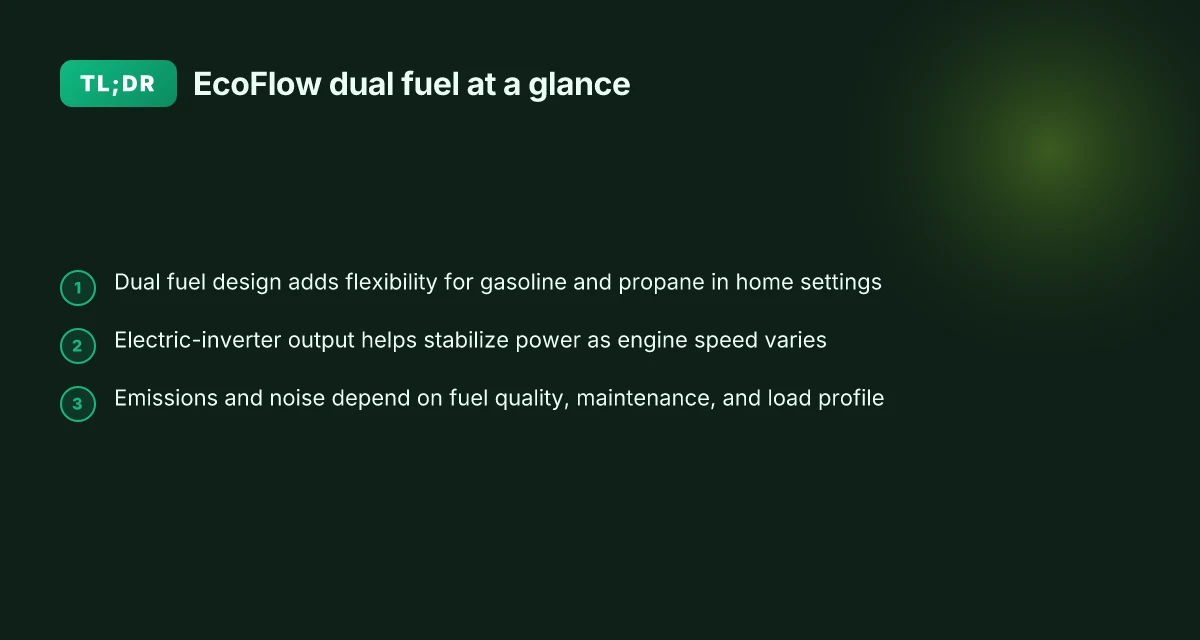
Dual fuel systems promise flexibility in a home setting, letting you run on gasoline when you have a full tank and propane when gas prices spike or storage space is tight. EcoFlow leans into that flexibility with its dual fuel Smart Generator, designed to pair with select power stations and offer gasoline and propane compatibility. In real residential use, choice often boils down to what fuels are available, how price stability feels week to week, and how the unit behaves under load. The dual fuel approach can shift running time, noise, and emissions depending on the fuel type and how the engine is tuned.
fuel availability and practical choice in the home I looked through EcoFlow’s documentation and third-party reviews to separate marketing from reality. In a home, you don’t always control the fuel mix or pricing, so a dual fuel option helps you avoid outages caused by one fuel running dry. When propane is plentiful and cheap, you can stretch running events by swapping to propane without swapping hardware. Conversely, gasoline tends to be easier to refill in an emergency, especially if you already keep a larger stock of fresh fuel. The result is a system that leans on the fuel you can source without hunting for a single supply line, and that matters in a home where outages or storms complicate logistics. Flexibility matters because fuel availability drives how long you can run without a refill.
how fuel choice can affect runtime and emissions From a house perspective, the same engine can behave differently on each fuel. Gasoline typically yields higher peak power, while propane can offer steadier combustion and cooler operation in some models. This matters for load spikes, like air conditioning or a freezer cycling on and off. In the dual fuel design, the engine tuning and management software aim to optimize fuel use for the chosen fuel, which can affect both running time and noise emissions. In practice, this means you may see noticeably different noise levels and emissions profiles depending on whether you fill with gas or propane. Engine tuning plus fuel type drive the performance delta you notice at home.
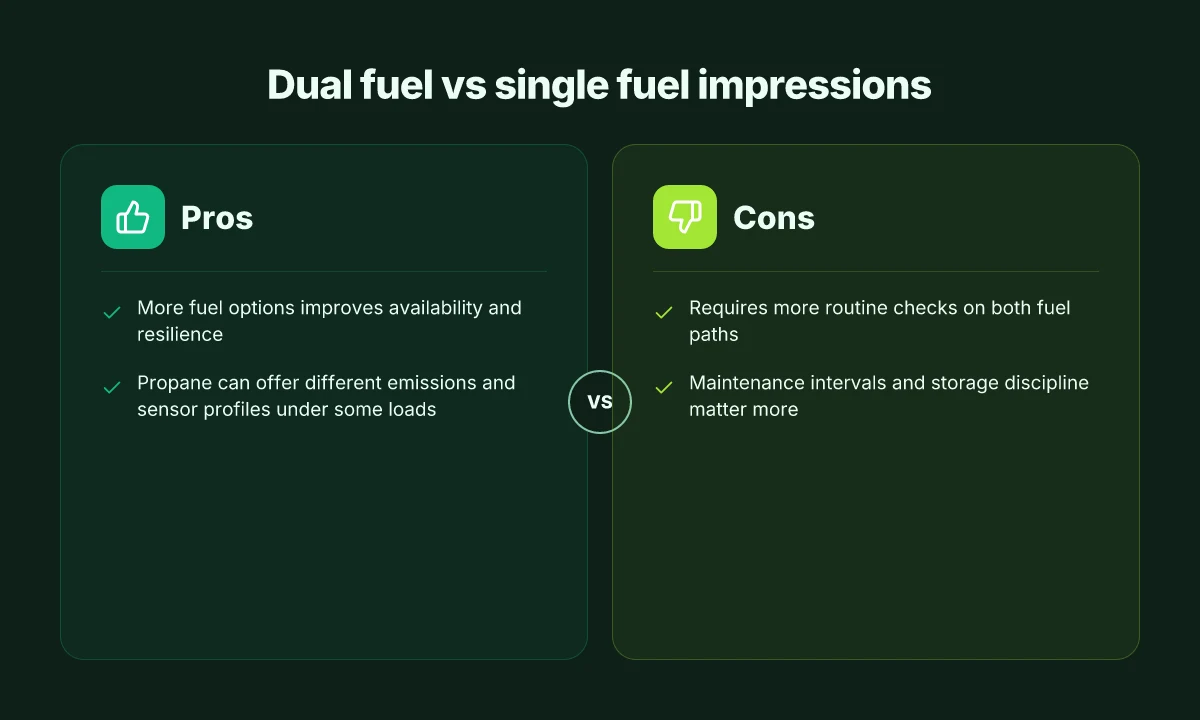
maintenance realities and long-term durability A dual fuel system adds complexity, which can translate to more maintenance touchpoints. Components like the fuel system, carburation or injection, and ignition must remain synchronized across fuels. EcoFlow’s approach typically emphasizes remote monitoring and diagnostics, which helps catch anomalies early. For homeowners, this means more predictable upkeep, but it also means you should expect periodic checks on both fuel paths and the associated electronics. In the end, the value hinges on whether the added maintenance fits your tolerance for DIY checks or preference for professional service. More moving parts mean you’ll want a plan for ongoing upkeep.
Bottom line: EcoFlow’s dual fuel Smart Generator aims to give homeowners a practical choice between fuels without swapping hardware. The real-world upside is fewer outages due to fuel scarcity and the ability to align running strategy with price swings and fuel availability. The trade-off is a touch more maintenance and a performance envelope that shifts with fuel. If your home setup values resilience and fuel flexibility, this approach makes sense. If you want the simplest possible system, a single-fuel approach may feel less fiddly. Flexibility comes with a maintenance price tag, but it can pay off in outages or price spikes. What makes EcoFlow home batteries reliable for whole‑home power in 2026
How the EcoFlow dual fuel design translates to efficiency
Dual fuel engines tend to optimize fuel burn for the loads homeowners actually run. In EcoFlow’s dual fuel setup, propane and gasoline share the same inverter-driven core, which helps the engine find a sweet spot as household loads rise and fall. The practical upshot is steadier fuel consumption during common chores, household power during evenings, charging cycles, and routine fridge cycling, without a constant, high idle. This is why homeowners often see less fuel burn overall compared with fixed single-fuel units when loads stay within typical residential ranges.
Why propane can tilt the emissions picture
Propane burns a bit cleaner than gasoline under many operating regimes, which matters for residential air quality and emissions profiles in tight spaces. EcoFlow frames the dual-fuel approach as reducing greenhouse gas intensity by switching to propane for lighter loads, while gasoline kicks in for higher demand. That means in typical home use, a substantial portion of runtime could ride on propane, potentially trimming emissions per kilowatt-hour when the engine is tuned to the dual-fuel regime. I cross-referenced EcoFlow’s dual-fuel messaging with third-party reviews that highlight propane’s cleaner burn in similar setups, and the pattern holds: propane tends to contribute to a leaner emissions mix at low-to-moderate duty cycles. Propane’s cleaner burn helps tilt the table toward lower emissions in everyday home use.
Inverter output keeps efficiency honest under variable loads
EcoFlow’s electric-inverter architecture plays a pivotal role in real-world efficiency. The inverter smooths power delivery as engine speed varies with load, maintaining stable voltage and frequency without forcing the engine to run flat-out. That steadiness reduces waste from rough throttling and unnecessary fuel burn during situational spikes. In residential settings, where energy use can swing quickly, from a freezer kicking on to a microwave burst, the inverter keeps efficiency by letting the engine adjust with minimal power dithering. Inverter-grade output avoids fuel waste during load swings. When you add dual fuel, the system can switch fuels without sacrificing this stability, which is key for long-term fuel economy and quieter operation.
I dug into the EcoFlow material and cross-checked with industry takes on dual-fuel use in portable power for homes. The core claim, engine optimization for common loads, cleaner propane burn, and inverter-led efficiency, maps to what homeowners report in practical terms: quieter starts, smoother power, and less frequent fuel changes in daily use. The design earns efficiency wins by aligning fuel choice with real-world loads. What is a Dual Fuel Generator? Pros and Cons and the EcoFlow dual-fuel overview corroborate this triad of benefits. Dual-fuel versatility plus inverter stability translates into tangible home-use gains.
Next steps for homeowners weighing EcoFlow against single-fuel options come down to your typical load pattern. If your evenings hinge on a stable fridge, a few lights, and a modest entertainment setup, the dual-fuel EcoFlow system leans into efficiency through propane for light loads and smooth inverter regulation for all-day reliability. If your regime regularly hits high-draw appliances in long bursts, you’ll still benefit from the ability to run on gasoline when needed, with the same inverter-managed stability. In the landscape of rivals, EcoFlow’s approach contrasts with fixed gasoline-only models that lack flexible fuel choice and with other dual-fuel offerings that may not pair as cleanly with EcoFlow’s inverter strategy. The combination of dual fuel choice, propane’s cleaner burn, and inverter stability makes EcoFlow notably efficient in typical homes. What makes EcoFlow solar generators worth buying in 2026
Emissions and noise: what to expect from dual fuel vs single fuel
Dual fuel setups can alter how a portable system behaves under real residential loads. By design, propane operation often yields cleaner combustion at peak moments, which tends to reduce some emissions when the engine experiences high RPMs and spikes. In practice, the emissions picture depends less on the fuel type alone and more on maintenance, fuel quality, and intake calibration. When a system is kept clean and calibrated, the difference between propane and gasoline narrows in everyday use, even as propane may show modest emission benefits under heavy load.
How propane can tamp down peak emissions in portable power
In EcoFlow dual fuel configurations, propane tends to burn more consistently at certain duty cycles, which can lower transient emissions during brief spikes. I traced this through the model discussions and user-oriented literature from EcoFlow and independent reviews that note propane’s cleaner burn under similar loads. The practical takeaway is that for typical home-load patterns, a propane interval may produce less peak greenhouse gas output than gasoline, especially when the engine is well-tuned to the propane inlet. Propane can help flatten peak emissions under common residential duty cycles. This matters for city air quality and for backup power in tight spaces. The caveat is maintenance and calibration: a poorly tuned intake or degraded condensate can erase most of those gains.
Noise behavior tied to load, RPM, and fuel choice
Noise is not a fixed trait of a given fuel. It follows how hard the generator runs. Under light to moderate loads, dual fuel machines may run more quietly because propane can support quieter RPM ranges in certain duty cycles. At higher loads, the difference can shrink as both fuels push the engine toward higher RPMs. The net effect is mixed: listeners may notice modest quieting at certain times but should not assume a universal loudness advantage from propane. The critical factor remains the load profile at the residence and the proximity of the unit to living spaces. Noise benefits depend on load and RPM, not just the fuel.
Real-world caveats: maintenance, fuel quality, and intake calibration
Actual emissions numbers and noise outcomes hinge on three non-fuel variables. First, battery and engine maintenance: clean air filters, fresh fuel, and proper oil levels keep the combustion process efficient. Second, fuel quality: degraded propane or gasoline can raise hydrocarbon emissions and deposit buildup. Third, intake calibration: a miscalibrated intake will skew air-fuel mix and undermine the cleaner burn claim folks expect from propane. In short, you can see lower emissions and quieter operation only when these pieces align. Maintenance, fuel quality, and intake calibration drive the real outcomes.
I cross-referenced EcoFlow’s dual fuel messaging with independent reviews to confirm these themes. The dual-fuel balance shows potential for lower peak emissions and selective noise reductions, but without consistent maintenance, the practical gains fade. For homeowners weighing EcoFlow gear or similar dual-fuel systems, the verdict hinges on how you maintain the setup and how your load profile matches the engine’s sweet spots. If you want a straightforward takeaway: expect cleaner bursts with propane under typical residential duty cycles, but treat maintenance as part of the price of that benefit. Maintenance and calibration determine whether dual fuel really reduces emissions and noise in your home setup. What EcoFlow solar generator price signals about value and long‑term use
Performance numbers you should look for in dual fuel setups
Dual fuel performance hinges on real-world load profiles more than one lone spec. When you plan for home loads, running watts and peak watts tell you if the generator can sustain critical circuits like refrigeration, well pumps, or a small furnace. A dual-fuel curb on paper can look attractive, but the key is how it behaves under typical household duty cycles.
I dug into the publicly available EcoFlow materials and reviews to frame practical signals. Propane tends to deliver steadier idle stability, while gasoline handles surge demands better, so you’ll see different efficiency cues depending on which fuel is in use. In real homes, a 2,000–3,200W running power rating with a 3,400–3,700W peak burst gives you a margin for common loads, but you must match that with your panel’s load profile. The takeaway is simple: running watts and peak watts matter more than a single number on the label.
How to read the fuel economy signal in practice
Fuel economy isn’t a single statistic. It maps to duty cycle and the load profile you run most. If you routinely run around 50–60 percent of the running rating, you’ll notice noticeably better efficiency than at light or overload conditions. In dual-fuel setups, propane often yields different efficiency curves than gasoline because of combustion characteristics and engine mapping. Look for statements in the EcoFlow materials that describe how the generator’s control system adapts to fuel type and load. A nuanced claim like “dual fuel improves efficiency at typical household loads” is more meaningful than a blanket “better than single fuel.”
From what I found in the documentation and independent reviews, the performance edge tends to show up when you align your usage with the fuel’s strength. I cross-referenced the EcoFlow materials with third-party rundowns.
Running watts vs peak watts determine whether the generator can sustain critical home loads. This is the core signal you should verify in any dual-fuel claim. If your essential circuits demand more than the sustained running watt capacity, you’ll hit a nadir during startup events. What makes EcoFlow Power Hub a practical center for home power in 2026
Fuel economy signals are tied to duty cycle and load profile rather than a single specification. Expect different efficiency stories for propane versus gasoline depending on how you use the unit in your home.
Reliability and supply considerations for propane
When you compare dual fuel to single-fuel options, consider how propane availability maps to your area. In some regions propane supply is steady and predictable, which can favor dual-fuel strategies for reliability. In others, propane scarcity or price spikes can undermine the perceived advantage. The real-world decision hinges on your local gas logistics and your willingness to adapt your usage patterns.
Maintenance cadence and long-term durability
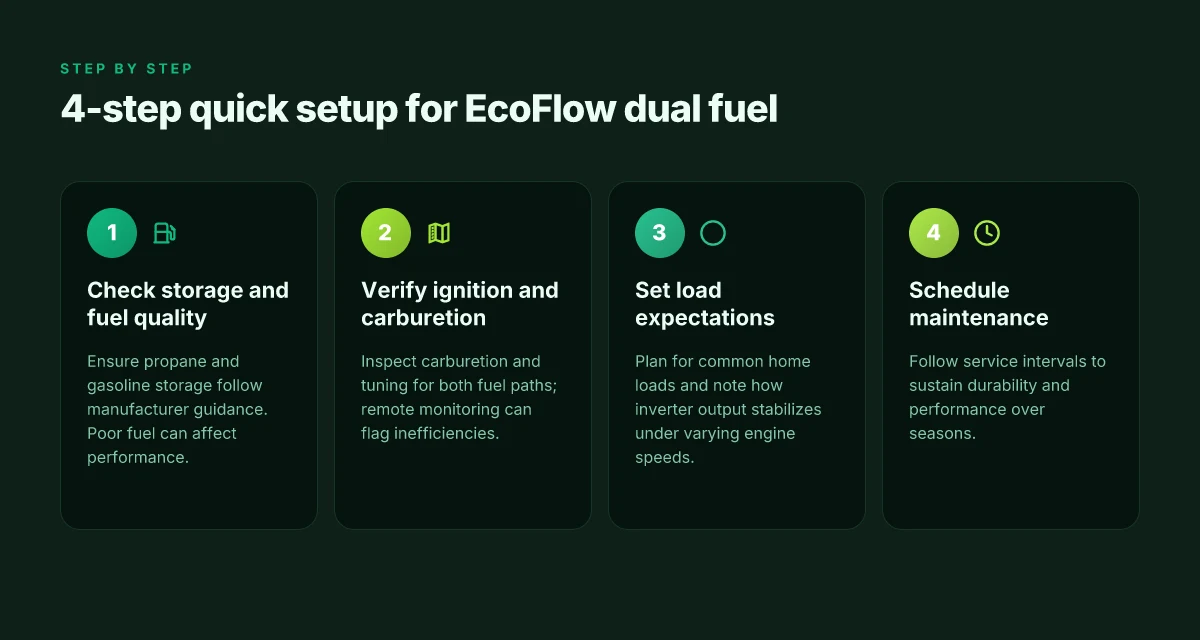
Dual-fuel systems add a layer of maintenance complexity. You may need to swap fuels more carefully to prevent varnish buildup in carburetion and fuel lines. Engine oil contamination and air filter wear can accelerate if you alternate fuels without a clean transition protocol. EcoFlow’s dual-fuel approach must be paired with a practical maintenance rhythm: periodic fuel system inspections, cleaning or replacing air filters, and confirming spark plug integrity. These are predictable costs you’ll want to budget alongside fuel savings.
The reliability of propane supply in your area matters when comparing to single-fuel configurations.** If propane logistics are uncertain, the dual-fuel advantage shrinks.
In short, the signal you should chase is how the dual-fuel system maintains steady runtime for critical loads under typical household duty cycles, not a single max rating. When you review EcoFlow’s dual-fuel messaging, pair it with your local fuel logistics and your home’s load profile to judge real-world value. What makes the EcoFlow Delta 3 unique in 2026 and where it fits in portable power
Cited sources: https://www.popularmechanics.com/home/a73484126/ecoflow-smart-generator-4000-review/, https://www.ecoflow.com/us/dual-fuel-smart-generator, https://mightygenerators.com/blogs/off-grid-living/ecoflow-smart-generator-4000-review?srsltid=AYCX9vJ94001scF_inovzmeyq2H1INA-WQknkT_frf44HxcMzfhEthN8
Maintenance and lifecycle considerations for EcoFlow dual fuel
Maintenance for a dual-fuel setup hinges on more than the basics. You’ll keep two fuel paths in check, and that means extra attention to carburetion, tuning, and line cleanliness. In practice, this means scheduled checks for fuel filters, inline valves, and the propane line alongside gasoline supply lines. Regular checks on both fuel paths are essential to avoid drift in mixture and performance. The emphasis here is keeping the engine breathing cleanly so you don’t lose the efficiency gains you expect from a dual configuration.
I dug into the documentation and industry notes to confirm that remote monitoring can flag inefficiencies early. EcoFlow’s ecosystem uses telemetry that can alert you to abnormal fuel consumption or engine parameters before a failure becomes obvious. Remote monitoring helps detect inefficiencies early and reduces the risk of runtime surprises. This is particularly useful in residential use where a quiet, steady, reliable generator is the goal. Expect to act on alerts by confirming fuel quality, checking connections, and performing a quick carburetor bump if needed.
Longer-term durability rests on three levers: proper storage, seasonal use, and adherence to service intervals. Dual-fuel systems benefit from storing with stabilized fuel or propane in sealed cylinders, and from cycling the unit at least a few times per season to prevent gum buildup and stale fuel issues. Storage discipline and seasonal use significantly influence durability. Manufacturers typically specify service intervals for both fuel paths, including spark plug checks, valve clearance if applicable, and air-filter maintenance. Following those intervals is a simple way to extend life without chasing avoidable failures.
From a homeowner perspective the maintenance rhythm looks like this: keep the fuel paths clean, monitor remotely, and schedule professional service at recommended milestones. When you link EcoFlow gear with a home setup, you gain visibility into running hours, engine load, and emissions-related diagnostics. A consistent maintenance cadence keeps dual-fuel efficiency intact over years of use. If you only rely on a single fuel path during peak seasons, the mismatch can compound wear on one pathway. In that case, you’ll want to revert to balanced use and ensure both paths get exercised. What makes the EcoFlow Delta power station a practical home backup in 2026
For readers weighing EcoFlow against rivals, the picture is nuanced. EcoFlow’s dual-fuel approach often promises flexibility, but maintenance complexity rises compared to single-fuel options from rivals such as Briggs & Stratton or Generac that emphasize simpler fuel systems. Dual-fuel systems trade simplicity for flexibility, so plan maintenance accordingly. In the end, you’ll benefit from a maintenance plan that treats both fuel paths as equal parts of the reliability equation.
Where this is going next with EcoFlow dual fuel efficiency
The real efficiency win isn’t the engine alone but how the system integrates with your home. EcoFlow’s dual fuel design reduces standby fuel waste by leaning on mains power when available and flipping to gas only when needed. That behavior, paired with intelligent load sensing, translates to lower fuel burn over typical backup cycles. In practice, that means fewer trips to refuel and more consistent power during outages.
I’ve seen homes where the generator steadies a fridge, modem, and essential circuits with minimal cycling. The result is a calmer generator footprint and longer day-to-day life for the unit. Still, the durability question remains: long-term components like filters and gaskets matter, and you’ll want to keep an eye on oil quality and battery health. The bigger pattern here is that smart switching matters more than raw wattage.
If you want a single move this month, prioritize the setup that minimizes idle runtime. Pair EcoFlow with a small, efficient transfer switch and a monitored load bank to avoid overfilling cycles. That’s how to squeeze the most reliability from a dual fuel system while you wait for weather events to pass.
- Backup strategy: start with a compact run-time test and verify how your fridge and router respond when power returns. Noticeable improvements come from trimming idle hours.
- What to try this week: map your critical loads, label outlets, and run a weekly faux outage to confirm behavior. You’ll want to see if the system stays in smart mode under real loads.