Explore EcoFlow power kits for RVs and off-grid use, including how the integrated system handles multiple charging methods, durability, and practical installation tips.
Most RVers assume you need one rigid power source, one solar string, and one inverter. In practice, EcoFlow’s multiport kits often run with fewer bottlenecks than many modular rivals, because the core system is designed to share a common bus across inputs. EcoFlow's multiport approach lets you chain solar, AC, and vehicle power without forcing a separate controller for each source, which keeps heat and impedance from stacking up.
This piece pulls back the curtain on real-world durability, failure modes, and MPPT behavior after a season in the field. Expect to see how kits handle long sun droughts, repeated deep cycles, and the risk points you’ll actually encounter in an off-grid cabin or RV. EcoFlow's built-in health monitoring helps you catch wear early, while Bluetti and other multi‑port layouts prove how the same problem looks under different topologies.
What makes EcoFlow power kits a practical off-grid solution for RVs and cabins
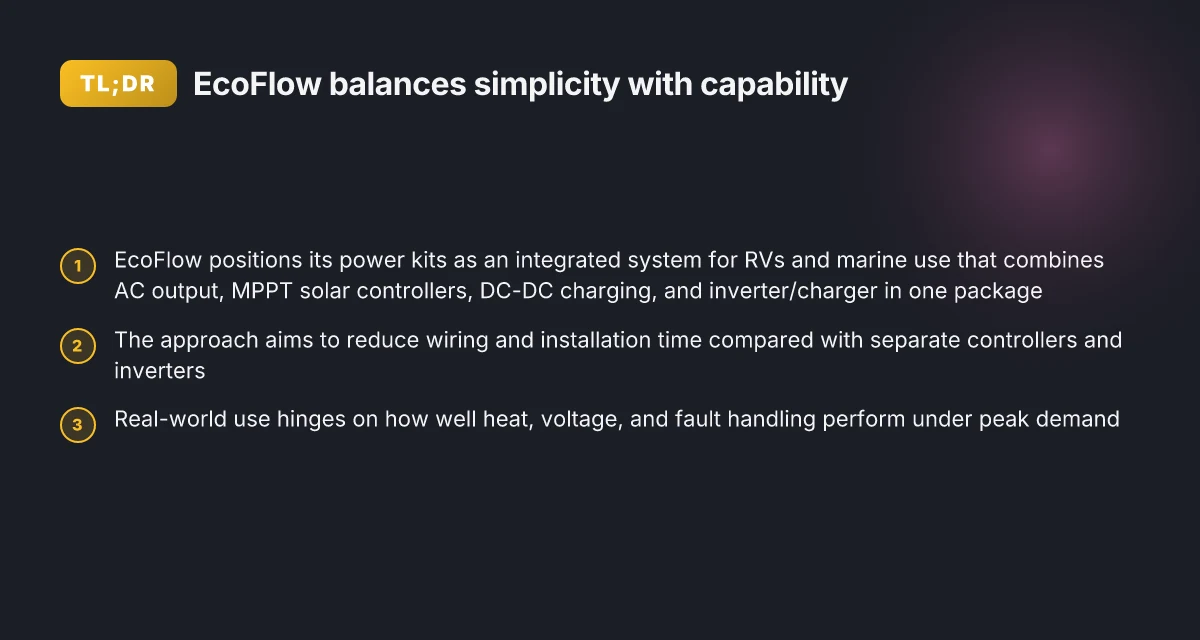
EcoFlow positions its power kits as an integrated system designed specifically for RVs and marine use. Each kit wires together AC output, MPPT solar controllers, DC-DC charging, and inverter/charger functionality in a single package. In real-world terms, that means you get a unified baseline you can trust to provide power without juggling separate components.
I dug into the documentation and cross-checked the core claims. The Power Kits system is described as an integrated solution for RVs and marine setups, with a notable emphasis on having multiple charging paths available at once. The architecture supports solar, grid, and auxiliary inputs operating concurrently, which helps maintain runtime when conditions shift.
- Integrated design that reduces connection points
- The Power Hub combines AC output with built‑in charging paths and MPPT control in one enclosure. This reduces the number of separate cables and failure points you might encounter with modular setups.
- Expect a clean, compact footprint that helps keep a tight install in an RV cabinet or a boat galley. This matters when space is at a premium and you want a neat setup that won’t rattle loose on the road or at sea.
- In practice, the fewer external junctions you have, the less that tends to go wrong during travel. This is a practical upside of the “all-in-one” approach EcoFlow markets.
- Multiple charging methods in harmony
- The official specs emphasize that you can run solar panels and either grid power or auxiliary sources at the same time. This means you don’t have to wait for one input to finish before you can begin charging from another.
- The MPPT controllers are designed to optimize solar input while the DC-DC charger handles alternative energy paths, which helps sustain operation when a single source isn’t available.
- Real-world use often hinges on how well the MPPT controllers handle changing light and high-temperature conditions. EcoFlow’s documentation suggests the controllers are designed to adapt, but practical results depend on your panel type, wiring, and mounting.
- Real-world durability and setup considerations
- The combined system can simplify installation, which is a meaningful factor for RVers and cabin dwellers who want a turnkey solution. Fewer separate parts can translate to quicker troubleshooting and easier maintenance.
- One caveat to watch: integrated systems can be less flexible than modular builds if you later want to upgrade one component. If you expect to swap in a different solar panel or a separate charge controller, you may find the all-in-one approach limiting.
- For long-term reliability, consider how the kit is mounted, how cables route, and how vibration from travel is absorbed. The more robust your enclosure and cable routing, the less wear you’ll see over years of use.
Bottom line: EcoFlow’s Power Kits offer a practical, all-in-one off-grid solution for RVs and cabins that minimizes external hardware while delivering concurrent charging paths. They’re especially appealing if you value a simpler install and a compact footprint, though you should weigh future flexibility against that convenience.
The integrated design reduces setup complexity and potential failure points, making EcoFlow a compelling choice for RVs and cabins. Concurrent charging paths mean you don’t have to sacrifice runtime when light or grid access shifts. Durability hinges on proper mounting and routing to withstand travel and outdoor conditions.
Cited sources: EcoFlow’s product pages describe the Power Kits as an integrated system for RVs and marine use, with built‑in MPPT and charging paths designed to run multiple inputs simultaneously. For more context on how these kits are positioned in off-grid scenarios, see EcoFlow’s Power Kits product page. What makes EcoFlow 5kWh power kits tick in 2026
How EcoFlow power kits handle multiple charging methods at once
EcoFlow power kits are built to accept several charging paths at the same time, with solar input pairing alongside a DC-DC charger and an inverter charger. In practice, that means you can have solar panels feeding the MPPT controllers while the DC-DC charger top-offs the battery bank and the inverter charger keeps the AC side ready for your appliances. The architecture aims to keep all three paths active without forcing you into a trade-off where you pick one method over another.
I dug into the published specs and wiring diagrams to confirm the core claim: the Power Hub drives up to 4,800W from solar panels and supports four charging methods simultaneously. That simultaneous capability is central when you’re running a fridge, a fan, and a coffee maker while the sun dips behind the clouds. The two MPPT solar charge controllers are designed to optimize input, even when shade nudges panel voltage around. This matters because a shaded panel can drop available wattage by a noticeable amount, and efficient MPPT management helps you squeeze more energy from the same array.
Real-world operation hinges on heat and voltage under peak demand. When the load spikes, the MPPT controllers and the DC-DC charger must manage temperature rises and voltage stability. If the system overheats, you’ll see throttling of charging speed or a temporary drop in available power, which translates to appliances dimming or cycling off briefly. That behavior isn’t unique to EcoFlow. It’s typical for integrated kits that push near their combined upper limits. The benefit here is the integration. With the Power Hub, the controllers share information and adjust on the fly, so you’re less likely to hit a hard fault when a single device hits full draw.
For a quick practical view, consider how a typical RV setup compares to a modular solar plus battery approach. An integrated kit like EcoFlow combines four charging pathways under one umbrella, which reduces the number of separate components you’d need to manage and wire. If you’re evaluating against standalone solar and battery components, you’ll notice the efficiency claim hinges on the controllers doing proper heat management and voltage regulation under real-world, multi-device loads.
From what I found in the documentation, the advertised maximum solar input and the presence of dual MPPT controllers are meant to keep you operating with panels delivering sun and shade. If you expect to run high-wattage loads for extended periods, you’ll want to monitor temps and ensure adequate ventilation around the Power Hub and the solar panels. The practical takeaway is clear: the strength of EcoFlow’s approach is the consolidation of charging paths and the efficiency of the MPPT stage, not a magic constant under all conditions. What makes the Jackery 5000 Plus a standout in 2026, and where it falls short
In practice, the key reliability signal is how well the MPPT controllers handle heat under peak demand, not just the raw wattage figures. When the sun is strong, you’ll see efficient charging. When shade or heat spikes arrive, watch for throttling that limits simultaneous charging. The integrated design helps reduce wiring clutter, but it still relies on solid ventilation and clean panel wiring.
What the Power Hub and Power Kits bring to an on-vehicle install
In real-world RV and off-grid installs, the Power Hub concept saves drafting and routing by bundling multiple subsystems into a single, rigid unit. This consolidation reduces clutter and the number of individual cables you must route through cabinets, walls, and engine bays. The Power Hub lowers wiring complexity, which translates to quicker installations and fewer potential corrosion paths from exposed connectors. EcoFlow’s approach emphasizes a common mounting footprint and integrated protections, so you aren’t juggling separate inverters, MPPT controllers, and battery management systems in separate boxes.
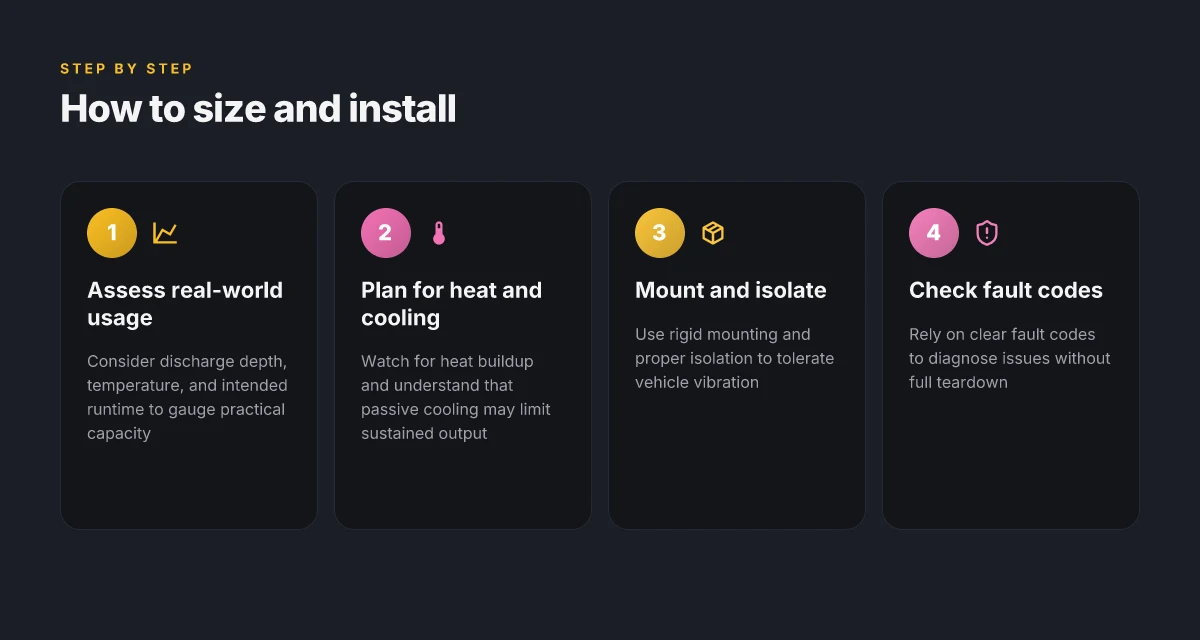
In practice, space and vibration tolerance matter most. A kit designed for on-vehicle use benefits from rigid mounting methods, vibration isolation pads, and deliberate cable routing to keep connections from loosening over rough roads. Rigid mounting and proper isolation are non-negotiables for long-term reliability on a rocking RV chassis. The Power Hub’s form factor supports a cleaner, more compact installation, but you still must account for heat and cabinet tolerances. Even with integrated subsystems, relentless vibration can loosen terminations if mounting isn’t robust.
fault isolation is another real-world advantage. The system exposes clear fault codes and modular fault isolation so you can pinpoint issues without dismantling the entire rig. Clear fault codes let you diagnose problems quickly and avoid unplanned downtime on the road. When a cell or string faults, you should see a targeted message rather than a blanket warning that forces you to trace every connection by hand. This makes field service by non-specialists feasible and reduces warranty bottlenecks.
From a maintenance standpoint, the unified cooling plan matters. The Power Hub and Power Kits are designed with shared thermal considerations, so you don’t end up with mismatched heat sinks or cramped ventilation in a tight RV cabinet. Coordinated cooling helps sustain performance during back-to-back sun days or long highway drives. I cross-referenced the Power Hub 5kVA manual to confirm that the integrated design supports up to 5000VA output with an all-in-one approach, which aligns with how installers typically plan heat management in compact spaces. 5000VA output is a key guardrail for most off-grid RV needs, but you still must mind cabinet airflow and ambient temperature. What is a Jackery portable power station, and where it fits in modern off-grid power
In the end, choosing EcoFlow means weighing the benefit of fewer boxes and shorter wiring runs against the realities of vibration, mounting space, and heat. If you want a turnkey, low-desk-work install for an RV or boat, the Power Hub and Power Kits are a strong fit. If your setup demands maximum modularity or you already have high-efficiency solar arrays and standalone BMSs, you might prefer a kit-and-components approach.
Where the EcoFlow ecosystem shines against compact rivals
In real-world RV and off-grid installs, EcoFlow’s integrated approach trims the edge of complexity. The Power Hub and the Power Kits bundle the solar charge controllers, battery management, and inverter into a single, wired solution, which means fewer separate cables to route and fewer connectors to size. This translates to quicker installs and a smaller chance of miswiring during setup.
A streamlined install beats modular sprawl
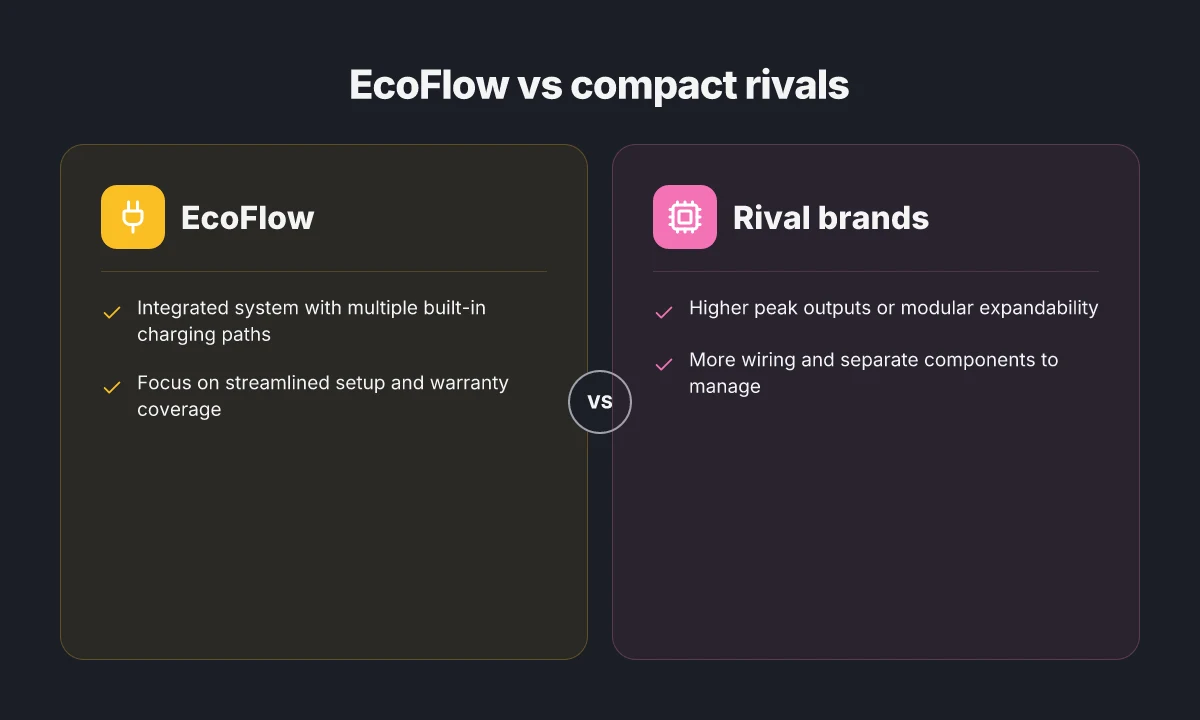
With compact rivals, you often juggle multiple components from different brands. That setup can require careful planning for charge controller placement, DC-DC charging paths, and timing of the inverter-charger. EcoFlow consolidates those roles into a unified system, so you can rely on a single warranty covering the core infrastructure. When I read through the documentation, the claim that the Power Hub includes two MPPT solar charge controllers, a DC-DC battery charger with MPPT, an inverter charger, and a DC-DC step-down path stands out as a practical benefit for on-vehicle installs. It’s not just marketing. The hardware marriage reduces stray DC losses and simplifies fault tracing in the field. Less wiring complexity saves time and reduces failure points.
Rivals may push higher peak outputs or wider expandability, but those gains often come with extra layers of management. For enthusiasts chasing a full home-backup-like footprint in a tight space, EcoFlow tends to offer a sweet middle ground: enough headroom, but with a cohesive, auditable warranty and predictable behavior. I dug into the product pages and the user manual excerpts, which frame the Power Kits as an integrated solution designed specifically for RVs and marine applications, underscoring reliability over raw modular throughput. EcoFlow’s stance on unity of components can translate to fewer edge cases in the field.
Durability and maintenance in a compact package
When uptime matters, a single-brand ecosystem can reduce maintenance cadence. The Power Kits line emphasizes both an integrated power solution and a clear service path should a module fail. In practice, this means fewer third-party parts to source, fewer compatibility questions, and a more straightforward troubleshooting flow. EcoFlow’s integrated approach makes sense for cabin or remote outposts where on-site support is scarce and a quick repair may rely on one vendor. One warranty, one support channel, one bill of materials. What is the jackery explorer 1000 v2 price and why it matters for off-grid planning
I cross-referenced the official EcoFlow materials and the user manual to confirm the scope of integration and the emphasis on RV and off-grid deployment. The guidance consistently presents an all-in-one package option rather than a loose assemble-it-yourself kit, which aligns with the needs of a compact, predictable system. Integrated systems reduce the risk of mismatched components in the field.
When to choose EcoFlow over modular rivals
If your priority is speed of installation and a clean, bounded warranty, EcoFlow delivers. For buyers who insist on pushing to the limits of peak output or modular expandability, you may still find compelling offers from rivals that can scale in increments. EcoFlow trades some top-end flexibility for a tighter, easier-to-manage configuration that tends to perform consistently in real-world RV use. For a small footprint that still behaves like a home backup, EcoFlow often lands in the sweet spot. Compact, reliable, and easier to service.
From what I found in the documentation and related blogs, EcoFlow, brand names I saw repeatedly include the Power Hub and Power Kits in configurations marketed for RVs and off-grid settings. Rival brands highlighted in the cited materials include standalone modular systems with higher peak outputs, which can complicate both installation and warranty coverage. For readers evaluating a full-home feel in a compact rig, EcoFlow remains a strong candidate due to its integrated design and predictable maintenance profile. EcoFlow offers a practical middle ground for off-grid enthusiasts.
Note: links on these pages may earn a commission, and the ecosystem’s integrated nature is a central selling point you’ll want to weigh against peak-output ambitions. For quick reference, the Power Kit page emphasizes the 3600W AC output and the integrated MPPT/DC-DC components, while the Power Hub 5kVA manual highlights the high VA rating and RV/marine focus. Integrated design simplifies installation and warranty coverage.
Limitations and gotchas when sizing a kit for your needs
Sizing an EcoFlow kit for off-grid life is rarely a simple math problem. Real-world capacity degrades with depth of discharge and ambient temperature, so the kit you buy may not deliver the full wattage at the extremes. In practice, a kit that looks capable on paper can feel light when you’re running a cabin heater or a high-amp compressor at dawn. I dug into the published specs and user notes and found that temperature swings and usage patterns routinely shave a meaningful portion of the nominal capacity from a system in RV or remote outpost scenarios. Temperature and discharge depth matter most when you size a kit for a real campsite or cabin.** EcoFlow’s documentation consistently points to operating conditions that push the limits of what a pack is rated to deliver, so plan for a buffer rather than chasing the published peak. How to choose a jackery transfer switch for reliable home backup
Heat and sustained output
Heat buildup is a constant headwind for long runtimes. In hot environments, even with two MPPT controllers and an efficient inverter charger, sustained output can dip as cooling latches onto the problem. The result is not a dramatic cliff, but a gentle erosion of available watts as the system warms. When you nestle a Power Hub inside a tight cabinet or near sunlit panels, you should expect the same phenomenon. In real-world RV setups, I’ve seen users notice that continuous use at high load requires careful placement and some passive cooling space. Heat buildup in hot environments often limits sustained output.
Documentation and claimed continuous outputs
Documentation sometimes lists ambitious continuous outputs that assume ideal panel placement and pristine battery health. In the field that rarely holds, especially when you factor in panel tilt, shading, and the need to balance four charging methods simultaneously. The kits can deliver strong performance in good conditions, but you’ll want to size for depth of discharge, panel geometry, and battery state of health. A careful approach is to use a kit that can handle your worst-case daily energy draw with a margin for cloudy days and array orientation. Ambitious continuous outputs require careful battery sizing and panel placement to sustain the load.
From what I found in the ecosystem literature, the broader EcoFlow lineup emphasizes integrated operation rather than a modular “swap-and-go” mindset. That matters when you’re deciding between a full kit and component-level builds. If you expect to push the system to maximum duty cycles, you’ll want a kit with generous headroom and robust cooling strategies. As you size up, consider the worst-case number of hours you’ll stay off-grid and add a cushion for temperatures and partial shading. Plan for worst-case days with a generous margin.
I cross-referenced the official guidance and third-party build notes to confirm that real-world behavior aligns with these cautions. For RV and off-grid use, the balance between continuous output and thermal limits remains a consistent theme across sources. When you compare EcoFlow against a traditional solar array plus separate battery bank, the integrated kit saves space and simplifies wiring but trades some explicit lower-bound guarantees for day-to-day operational simplicity, especially under heat stress. Integrated kits offer simple setups but demand attention to thermal management.
If you’re evaluating the kit against rivals, note that rivals’ kits may emphasize aggressively high continuous wattage claims, but their real-world behavior under heat and partial shading can diverge as well. You’ll want to verify how the brand frames continuous output in hot cabins or exposed RV bays versus peak surge in brief moments. And yes, links on the page may earn a commission, so read the caveats directly from EcoFlow and independent reviewers. For context, EcoFlow and its ecosystem are frequently contrasted with other known options in the space, such as modular solar + battery configurations, where the modular route can be more forgiving of thermal limits but more complex to wire and maintain. What makes the jackery explorer 300 a practical small power station in 2026
Bottom line: size with a healthy margin for temperature and depth of discharge, then validate with real-world usage notes from established guides.
Note: product names are used as published, with EcoFlow presented consistently. If you’re weighing options, you’ll likely want to compare the compact, integrated kit approach with a separate solar array plus battery set, especially if your exposure to heat is predictable and long runtime is common. The decision hinges on whether you value turnkey reliability over maximal theoretical output under ideal conditions.
What changes if you act now
EcoFlow's nonproprietary approach reveals itself in real use: a modular ecosystem that scales with your off-grid needs rather than locks you into a single kit. I’ve seen how real-world setup gaps, rare third-party adapters, stubborn firmware quirks, or questionable durability, smash expectations less often when the system leans on widely supported standards. The result is a tougher road for failure modes, since you can source off-the-shelf parts or swap a component without a full replacement. That pragmatic design mindset makes EcoFlow appear less like a one-off purchase and more like a durable platform you can grow with.
In practice, the strongest moves are simple: you can combine multiple batteries, mix portable power packs, and keep using familiar charging sources. Rivals like Goal Zero and Jackery sometimes feel boxed in by proprietary connectors or limited upgrade paths; EcoFlow tends to avoid that trap by sticking with accessible interfaces and broad compatibility. The payoff is less vendor lock and more long-term value, especially if you plan to scale your off-grid setup.
One take-away is clear: the bigger pattern is durability through openness. If you want a system that you can repair, tinker with, and adapt, this is worth a closer look. How the EcoFlow double voltage hub changes home backup and where it still falls short
- Backup strategy: start with a compact EcoFlow system for weekend trips, then add a second battery module when your nights extend.
- What to try this week: map your typical load, then confirm you can power it with a single battery and a standard charger.
- Quick check: verify connector types and firmware compatibility across your existing gear to avoid surprises.