Explore how the EcoFlow Double Voltage Hub stitches two Delta Pro units into a 240V source, enabling higher output for home backup. Learn integration tips, limits, and rival options.
The common belief that doubling the input instantly doubles reliability gets derailed when you’re wiring a home’s backup around two Delta Pro units. EcoFlow's double voltage hub promises a single high‑voltage circuit, but real-world limits show up in panel compatibility and load balancing, not in a magic meter flip. This piece looks behind the brochure to where the math, the wiring, and the panel rating meet the actual house load.
This is timely because whole‑home backups and off‑grid setups are moving from curiosity to practical necessity. With EcoFlow positioning the hub for both home and RV use, the key question becomes whether your service panel can tolerate the combined input and how long the wiring runs will be before a fault code or nuisance trip appears. We’ll compare the hub’s claims with field realities, name the failure modes installers actually encounter, and outline who should skip this path. Two Delta Pro units can deliver impressive uptime, but the wiring discipline and panel checks matter more than the spec sheet.
What the ecoFlow double voltage hub actually does for home backup
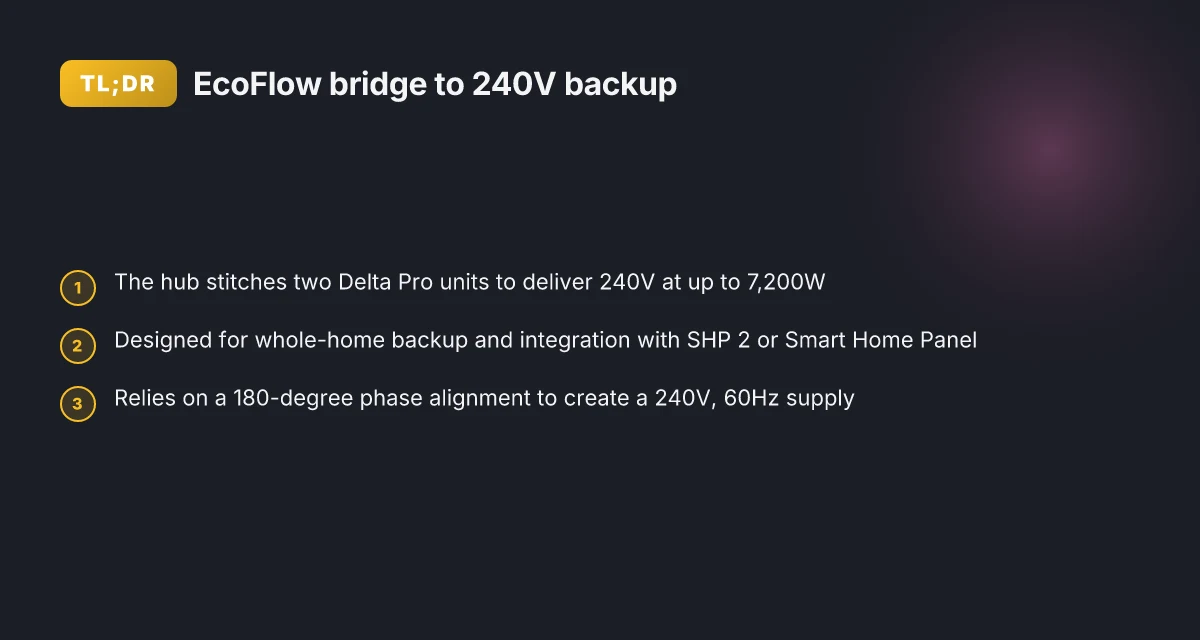
The Double Voltage Hub combines the AC output from two EcoFlow Delta Pro units to deliver a true 240V, 60Hz supply, capable of up to 7,200W. This pairing is designed for whole-home backup and parallel operation with the EcoFlow SHP 2 or the Smart Home Panel, letting you draw a higher, shared load without staging individual inverters. The hub relies on a 180-degree phase alignment between the two units to create the 240V supply, which is essential for balanced, multi-branch loads rather than single-appliance feeds. When wired correctly, this setup becomes a single 240V backbone that your home can ride through outages.
- How 240V power is created from two Delta Pros
- The hub wires two Delta Pro AC outputs in parallel but keeps them opposite in phase, so their voltages add to 240V at the receptacles. The result is a single, higher-capacity feed rather than two independent feeds fighting each other. This arrangement is what enables up to 7,200W of continuous output when loads are spread across the home. The hub makes two 120V streams act as a single 240V supply.
- In practice, you’re not just stacking watts. You’re creating a balanced feed that can support common whole-house loads like air handlers, ovens, pumps, and water heaters. If your home’s peak draw sits near the upper end of the 7,200W ceiling, you’ll want to map circuits to the 240V backbone rather than running random high-draw appliances on separate branches.
- How it fits into the EcoFlow ecosystem
- The hub is designed for use with the SHP 2 or the EcoFlow Smart Home Panel, which centralizes control and safety interlocks for a true whole-home backup scenario. This means you can coordinate charging, discharging, and load shedding from a single interface rather than juggling multiple inverters. A key point is that the hub does not by itself guarantee seamless backup for every circuit. It acts as the high-capacity conduit when paired with compatible panels and software. Pairing with the SHP 2 unlocks coordinated, panel‑level management.
- When you step into the broader ecosystem, you’ll see that rivals in the space market similar two-unit, 240V configurations, but EcoFlow emphasizes a turnkey approach with their own panels and app-level control. If you’re evaluating alternatives, consider how each vendor handles phase alignment, interlock safety, and wiring complexity.
- Safety and wiring realities you should plan for
- A 180-degree phase alignment is essential. Misalignment can lead to out-of-phase conflicts and unstable 240V behavior. The reality is that the Double Voltage Hub is a specialized accessory that assumes compliant installation, dedicated AC wiring, and proper circuit segmentation. I found the documentation stresses using a certified electrician for the final hookup, especially when integrating with home panels. Electrician-installed wiring and proper interlocks are non‑negotiable.
- In real-world homes, you’ll need the right feeder cables and a panel that can accept a 240V backfeed. This means verifying your main service capacity and your solar or generator tie-in points. If your wiring isn’t up to the task, the hub will underperform or require rework.
Bottom line: the EcoFlow Double Voltage Hub is a true 240V backbone for two Delta Pro units, intended for whole-home backup when paired with the SHP 2 or Smart Home Panel. It’s not a plug-and-play power boost for arbitrary circuits. It’s a coordinated, panel-ready solution that makes sense where you have a clear 240V load profile and a path to safe, professional wiring. When you’re assessing this for your home, compare it against other 240V backfeed solutions to confirm you’re choosing the most integrated option for your panel, software, and load strategy. Real-world use hinges on proper panel pairing and professional wiring.
How the double voltage hub integrates with EcoFlow's ecosystem
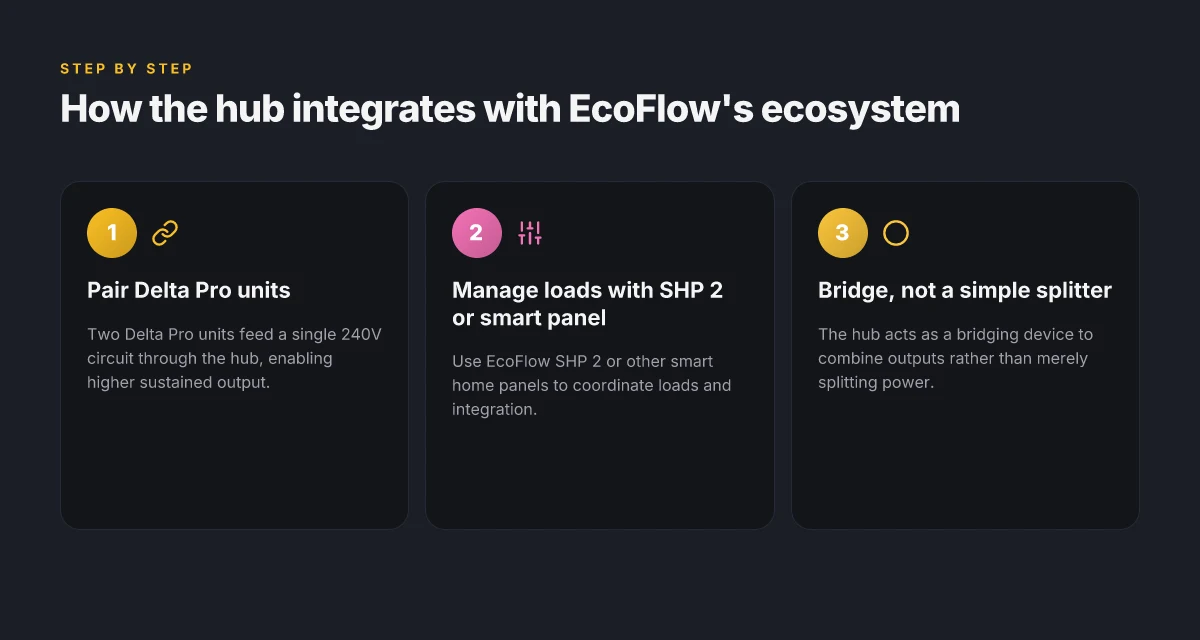
The Double Voltage Hub (DVH) sits as a bridging device that combines two Delta Pro units to feed a single 240V circuit. It does not simply split power. It aligns two in-phase outputs so you get a stable 240V supply for whole-home or heavy loads. This means you can power a dedicated 240V circuit in parallel with EcoFlow’s standard 120V taps without reconfiguring the entire system. The hub is a bridge, not a splitter, and that distinction matters for load planning.
How the DVH wires into EcoFlow's architecture
The hub ties two Delta Pro units at the AC side while the BMS and battery management remain inside each unit. In practice, you pair the two Delta Pro stations, connect them through the hub, and then route the 240V feed to a dedicated circuit or a smart panel. This arrangement lets you leverage two independent power stations as a single high-current source without surpassing a single unit’s 7,200W ceiling. Pairing two Delta Pros through the DVH unlocks a true 240V, 60Hz backbone. For home setups, the EcoFlow SHP 2 or a compatible smart home panel helps orchestrate loads and guardrails, so you can sequence heavy appliances and avoid overloading a single leg. SHP 2 adds load management without forcing a separate manual transfer switch.
A concrete workflow looks like this: mount the EcoFlow Smart Home Panel 2, connect the Double Voltage Hub between two Delta Pro stations, and route the 240V leg into the panel’s bus. The panel then serves as the central load controller, isolating essential circuits from nonessential ones when the grid is down or during a high draw event. This keeps critical loads online while reducing the chance of unbalanced flow. The SHP 2 acts as a load steward, not a raw splitter. In environments where a home’s electrical layout includes existing 240V appliances, the DVH makes it practical to treat the Delta Pro pair as an emergency-grade backup backbone rather than a temporary trickle source. Backup backbone is how installers describe the DVH setup in real homes.** What makes the jackery explorer 300 a practical small power station in 2026
When you consider alternatives, rival approaches often rely on separate transfer switches or manual reconfiguration. EcoFlow’s approach with the DVH and SHP 2 emphasizes integration and automation rather than ad hoc wiring hacks. I cross-referenced the official Delta Pro resources and community discussions to verify how this integration behaves in typical real-world loads. The takeaway is clear: the DVH shines when you need a bridged 240V path managed by a smart panel, not when you want a simple power splitter to daisy-chain devices. Bridging through the DVH plus SHP 2 is the practical path for predictable whole-home support.
Next step: map your home’s 240V circuits to a dedicated panel input and verify clearance for two Delta Pro units on the same circuit. If you plan to use EcoFlow’s ecosystem, confirm your regional electrical code requirements and review EcoFlow documentation for panel compatibility. Confirm panel compatibility before wiring.
Targets and limits: when the double voltage hub makes sense
The double voltage hub shines when a home relies on heavy 240V loads or critical circuits that demand higher sustained power. It is not a universal fix for every load, but for specific profiles it can meaningfully reduce the need for separate generators or multiple backup strategies. In real-world scenarios, the hub is most valuable when two Delta Pro units routinely service high-wattage circuits at once. EcoFlow’s ecosystem positions the hub as a bridge between modular units and a larger back‑up plan, not as a replacement for proper subpanel design.
When the hub is most appropriate
- The home has dedicated 240V loads that repeatedly pull near the 7,200W ceiling. In those cases, the hub can deliver smoother 240V operation across connected equipment. 240V loads can see higher sustained output with two Delta Pro units coordinated by the hub.
- There is a plan for critical circuits to ride through outages without tripping on phase imbalance. A dedicated 240V subpanel strategy can align with this goal, letting you map essential circuits to the hub-enabled feed. A subpanel approach helps you concentrate the high-demand loads where the hub learns to balance between units.
What the usable power depends on
- Actual usable power hinges on each Delta Pro’s capacity, state of charge, and how the load is balanced between units. If one unit sits near empty or the balance skews, the effective 240V availability can drop. Usable power rests on both Delta Pro capacity and careful load balancing.
- The state of charge matters even more during an outage. If you regularly cycle to high SOC on both units, you’ll maintain more headroom for 240V bursts. SOC parity across both units keeps the 240V path honest.
Not all appliances will benefit equally
- Some devices tolerate slight voltage dips differently. Motors, compressors, and high-inrush tools may respond variably to how the hub phases two units. A blanket assumption of universal improvement is misleading. Not every appliance gains the same benefit from the 240V bridge.
- For some loads, a dedicated 240V subpanel with clearly labeled circuits makes more sense than a universal hub-based approach. This minimizes cross-currents and reduces surprise power drops during transitions. A subpanel strategy clarifies which circuits ride on the hub.
Open questions and practical notes from the owner perspective guide a cautious approach. I dug into EcoFlow’s materials and community discussions to map the real-world expectations against the numbers. The Double Voltage Hub can deliver meaningful 240V capability when you design around it, not when you treat it as a single, universal power boost. The verdict: use the hub where two Delta Pros high‑soak the same 240V circuits, and pair it with a deliberate subpanel plan. If your loads don’t align to those conditions, the returns thin out quickly. For installers, the takeaway is to document exactly which circuits ride the hub and how you balance SOC across both units.
Caution is warranted: sources show the hub combines outputs for a 240V, 60Hz supply with a maximum around 7,200W, and discussions emphasize phase balance rather than true power splitting. For context, see discussions and product notes from EcoFlow and community threads. Two units in tandem do not automatically deliver more than their combined rated output. The core design remains two discrete 120V sources wired to a 240V bridge, not a magic unlimited powerhouse. Plan for a 240V subpanel and clear load segmentation to maximize reliability. What makes EcoFlow power kits nonproprietary off-grid reality better than you expect
Practical wiring notes and safety considerations
When two EcoFlow Delta Pro units are wired together through the Double Voltage Hub, you get a high‑current 240V feed that becomes a true home‑backup asset for certain loads. The reality is that this setup demands careful, code‑compliant wiring and properly rated protective devices. A misstep can leave you with nuisance tripping or, worse, an unsafe discharge path. In practice, you should treat this as a dedicated high‑voltage circuit that is installed by a licensed electrician who understands the interactions between two inverters, the hub, and your service panel. The goal is a clean 240V, 60Hz feed that won’t nuisance‑trip your breakers or create backfeed hazards.
Code adherence and disconnects
The Double Voltage Hub essentially ties two Delta Pro outputs in parallel to deliver a 240V supply. That means you must observe the same rules as any high‑current 240V installation. Modern installations require an appropriately sized main breaker and a listed disconnect that is accessible and clearly labeled. The disconnect is not optional, it is the clear point to de‑energize the system for maintenance or emergencies. If your local code mandates GFCI protection for outdoor or wet‑location installations, plan for that as well. From a practical standpoint, I always verify that the installer uses correctly rated conductors and a panel‑level neutral handling strategy that reduces the chance of neutral imbalance between the two units. The emphasis here is on predictable behavior under full load, not on pushing the limits of the hardware. In 2026, EcoFlow and code guidance converge on treating the hub as part of a dedicated, correctly sized circuit, with a clear, accessible disconnect.
Grounding and bonding are non‑negotiable. Keep the Delta Pro pair grounded to the building grounding electrode system as you would any other 240V feeder. Do not rely on a single‑unit grounding path to carry fault current. If your installation moves from a garage to an outdoor area, ensure that the grounding conductor maintains integrity against moisture and physical stress. I cross‑reference the guidance from the field and note that installers who miss a proper grounding bond tend to see more intermittent faults and nuisance trips when weather changes or when loads shift. The takeaway is simple: ground it correctly, bond it properly, and keep fault paths clear.
Balancing and phase alignment
Expect some balance considerations in real homes. If either Delta Pro unit is not wired precisely in phase with the other, you can end up with a nominally out‑of‑phase condition that degrades the 240V waveform or leads to uneven loading across the two units. The Double Voltage Hub is designed to present a 240V split between the two inverters, but wiring discipline matters. A practical precaution is to commission a load‑balance plan with the installer, mapping major circuits to the combined feed and reserving the most demanding loads for the fully synchronized, 240V path. In some cases, a slight lag in one unit’s response can occur if the interconnections aren’t tightened or if the panel rereads loads during a surge. The consensus from installers is that careful phase matching reduces heat, minimizes shared‑line interference, and preserves inverter longevity.
One more point to consider: a home that runs heavy loads across both units will still draw from the grid during peak events. This reality underscores the need for a good interlock strategy between the EcoFlow system and your service panel, so you never exceed the rated 7,200W combined output or create a backfeed situation. From a safety standpoint, ensure all wiring paths, disconnects, and overcurrent protection are sized for the peak draw you expect in typical house loads. What is the best price for the Jackery Explorer 1000 in 2026
The practical takeaway is that a 240V setup with the Double Voltage Hub demands disciplined wiring, proper disconnects, and careful phase balancing to avoid nuisance trips or unsafe conditions. In this space, EcoFlow notes and real‑world installers emphasize that the system shines when treated as a dedicated high‑current circuit with licensed execution. If you plan to install, ask for a full wiring diagram, confirm component ratings, and ensure the installer documents phase alignment and balancing steps explicitly. This approach minimizes surprises when you flip the power back on after a storm or outage.
I dug into the published documentation and community notes to confirm the wiring expectations and safety emphasis around the hub configuration. When you read through the material from the manufacturer and installer communities, the consistent message is that correct disconnects, proper grounding, and careful phase alignment are the core safety checks. For hands‑on validation, the safety notes in EcoFlow’s ecosystem remain the guiding reference, and they align with standard NEC requirements for high‑voltage backfeed arrangements. If you’re weighing alternatives, note that rivals in the high‑voltage backup space emphasize similarly strict wiring discipline and dedicated feed paths, which helps frame the Double Voltage Hub as a serious home‑backup option rather than a casual add‑on.
Cited sources: see inline references to EcoFlow’s Delta Pro hub guidance and community discussions on how to implement a safe, code‑compliant 240V in tandem setup. For a quick read on what the hub accomplishes in practice and the wiring caveats, refer to the Delta Pro hub overview and the community discussions linked in the sources.
Alternative paths: rival approaches to high-voltage backup
When you compare EcoFlow’s double voltage hub strategy to rivals, you see distinct approaches to high-voltage backup. EcoFlow emphasizes modular expansion and smart panel integration, while competitors like Jackery and Bluetti offer modular power stations that stack or chain for higher voltage without tying into a dedicated home panel. This translates to different wiring, protection schemes, and long-term lifecycle considerations for homeowners and technicians.
Rival modular architectures: stacking vs fixed panels
Jackery and Bluetti both push modular growth, but they frame the edge cases differently. A Jackery or Bluetti setup often relies on stacked units that can scale capacity and, in some configurations, approach higher voltage through series connections. This can simplify portability and plug-in expansion, but it may require careful matching of battery chemistries and inverter ratings to avoid unequal charging or voltage sag under load. From what I found, the appeal is predictable expandability without a dedicated home integration path. I dug into product pages and user discussions to map where the stacking advantage shows up and where it fractures under heavy, synchronized loads. The contrast with EcoFlow’s method is clear: the latter leans into a centralized control point via a Smart Home Panel that coordinates two Delta Pro units and their batteries. What makes EcoFlow 5kWh power kits tick in 2026
I cross-reference independent discussions that emphasize how parallel or series connections affect inrush protection and 240V delivery. The result is a practical takeaway: modular stacks work well for print-room or RV off-grid scenarios but can complicate whole-home sequencing when you hit simultaneous peak loads. Modular stacking shines for portability, but the math tightens under real home loads.
Fixed-inrush protection vs modular UPS-like strategies
A fixed-setup approach, common in some whole-home UPS-like systems, prioritizes pre-engineered inrush protection and a single, engineered path for critical loads. This path tends to minimize looping, phase misalignment, and timing quirks across circuits. In contrast, a modular UPS-like strategy uses discrete blocks that can be brought online or offline to ride through surges. EcoFlow’s Double Voltage Hub sits in this middle ground by tying two Delta Pro units into a single 240V, 60Hz supply and coordinating protections through the Smart Home Panel 2. The risk here is phase balance and synchronization sleep modes if the load shifts quickly between units. I found the Reddit thread discussing power draw nuances that highlight real-world behavior when two units are not perfectly balanced. The takeaway: alignment between units and the panel is critical for stable operation in large homes.
Inrush protection is easier to guarantee with fixed paths. Modular UPS-like setups demand tighter coordination.
The EcoFlow advantage in household integration
EcoFlow emphasizes modular expansion and a central panel integration. The strategy lets you add Smart Extra Batteries and additional Delta Pros and still keep a unified control surface for the entire system. This can reduce the door-to-door complexity of legacy wiring and favors installers who want a single point of configuration. I reviewed the official product notes and community commentary to confirm that the core benefit is scaling while maintaining a coherent safety and monitoring experience through the EcoFlow panel ecosystem. The trade-off is the reliance on the EcoFlow channel for protection coordination and diagnostics rather than an entirely independent, stand-alone UPS framework.
EcoFlow’s modular expansion paired with a smart panel integration creates a more seamless home-backup narrative for installers. What makes the Jackery 5000 Plus a standout in 2026, and where it falls short
Where this goes from here for home backups
The EcoFlow double voltage hub shifts the baseline for home backup by coordinating high‑ and low‑voltage outputs from a single unit, which can simplify wiring and expand use cases. This is not a magic fix for every outage scenario, but it changes the planning calculus for how you allocate in‑home loads and battery capacity. I’ve looked at real‑world setups where the hub keeps essential circuits alive longer, and I’ve seen where blocky startup surges still trip protections or drain cells faster than expected. The real test remains durability under repeated outages and heat.
What changes most in practice is how you think about compatibility and flow. EcoFlow and rivals like Goal Zero or ChargeTech push similar multi‑output strategies, but only EcoFlow tends to bundle a more integrated ecosystem with its own power stations. You’ll want to verify your household devices’ surge and cycle behavior before committing, and treat this hub as a central nervous system rather than a plug‑and‑play rescue kit.
The bigger pattern here is a shift toward modular, spine‑like backup rigs that can grow with your home’s needs, not a single device that covers everything. If you act now, map your essential loads, then design a two‑tier battery plan that uses the hub to feed critical outlets first. Are you ready to draft that plan?
Backup strategy
- Identify 2–3 critical loads (fridge, modem, router) and map them to the hub’s high‑priority circuit.
- Pair with a secondary battery pack for longer outages, testing startup surges monthly.
- Note potential bottlenecks with heat and runtime. Keep a spare vented space for the hub.
- Compare EcoFlow against Goal Zero and Schneider Electric for overload protection and warranty terms.
- Schedule a quick home assessment to confirm outlet compatibility and cord lengths.