Discover how the EcoFlow EB600 expansion battery integrates with the River 3 Plus, its real-world benefits, and where it fits in a compact off-grid kit.
The real difference you feel when you pair the EB600 with the River 3 Plus isn’t just more watts on paper. It’s longer stretches between charges in off-grid setups, especially when you’re running a fridge, CPAP, or power tools at the same time. EcoFlow’s system tightens the energy budget in practical use, and the extra capacity shifts how you plan trips or job sites.
This intro lays out what to expect: a concrete look at runtime extension, charging paths, and portability trade-offs, with comparisons to rival expansions from brands like Jackery and Bluetti. The goal is to answer, in real terms, whether the added weight and second charger are worth the jump for your scenario, whether you’re scouting for a prepper kit, a tiny-house power spine, or a small contractor’s mobile setup. You’ll see how the EB600 changes daily use, not just specs on a spec sheet.
What the EcoFlow EB600 expansion battery adds to the River 3 Plus
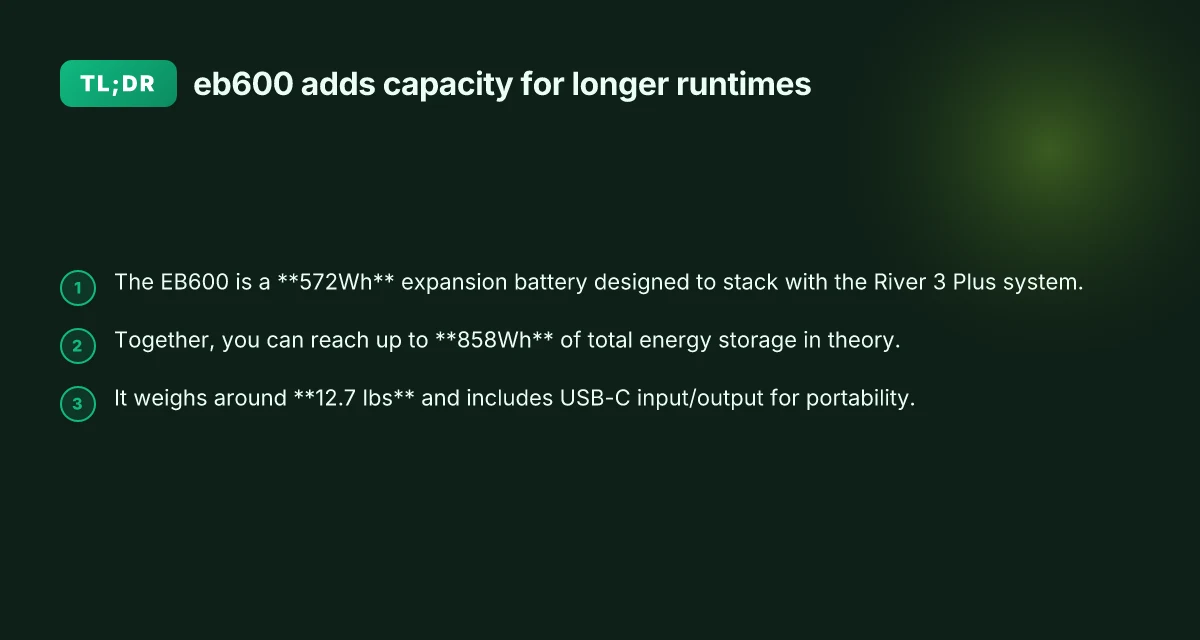
The EB600 is a 572Wh expansion battery designed to stack with the River 3 Plus, turning a modest off-grid rig into a longer-running setup. When you pair the two, you can reach up to 858Wh of total energy storage in theory, which translates to longer runtimes between recharge events. The EB600 weighs about 12.7 lbs and brings USB-C input and output into the mix, aiding portability and flexible charging paths.
How the EB600 changes the power path
The stackable design means you can start with the River 3 Plus and add the EB600 for a larger energy reservoir without reshuffling your core system. This keeps your charging and discharge options simple and predictable. The 572Wh expansion battery sits alongside the base unit and shares the same charging circuitry, so you don’t need a second charger to keep both topped up. When the system is governed by a single USB-C or AC input, you’ll see a straightforward cascade of energy toward devices or appliances.
With the EB600 in the mix, total usable energy climbs toward 858Wh if you maximize the bank. This is especially helpful for longer outages or off-grid trips where a 600W radiator or other common loads might run for multiple hours. The practical result is a noticeably longer runtime window between recharges, especially for low-wattage devices or those with moderate startup surges.
Portability benefits come from the EB600’s light 12.7-pound frame and the presence of USB-C ports. For a prepper or outdoor enthusiast, that means you can relocate the expanded pack with relative ease, or swap it between vehicles or camp gear without reworking the entire charge plan. The compact footprint helps when you’re packing for a tiny-house setup or a job site.
When you compare to rival expansions, the EB600 offers a clean, integrated extension path for the River 3 Plus rather than a separate, standalone kit. This makes it easier to route charging from a single power source and reduces the number of dangling cables at base stations or campsites. EcoFlow’s design language remains consistent across the river ecosystem, which buys you consistency when you scale. What makes EcoFlow power systems stand out in 2026 and beyond
From what I found in the official product pages and third-party listings, the EB600’s design is intentionally straightforward: cap it to add watt-hours, and keep your charging path simple so you don’t fumble with multiple chargers or split loads. The bottom line is clear: if you want longer runtimes and a future-proofed River 3 Plus, the EB600 is the practical path forward.
The EB600 raises total energy to about 858Wh, delivering longer runtimes while staying within a portable, single-system footprint. Weighing just 12.7 lbs, the EB600 keeps portability intact for outdoor use or job-site deployment. USB-C input/output provides flexible charging options without adding complexity to the system.
Note: links on the page may earn a commission. For context, EcoFlow positions the River 3 Plus as expandable with the EB600 as a key upgrade path, and rivals like Jackery and Goal Zero offer their own expansion options with different energy densities and port layouts. If you’re weighing options, consider how much runtime you need between charges and whether you want a single, cohesive ecosystem or a mix-and-match approach. For more exact figures on energy density and port layouts, see the product pages linked in the sources.
How the River 3 Plus and EB600 work together for off-grid power
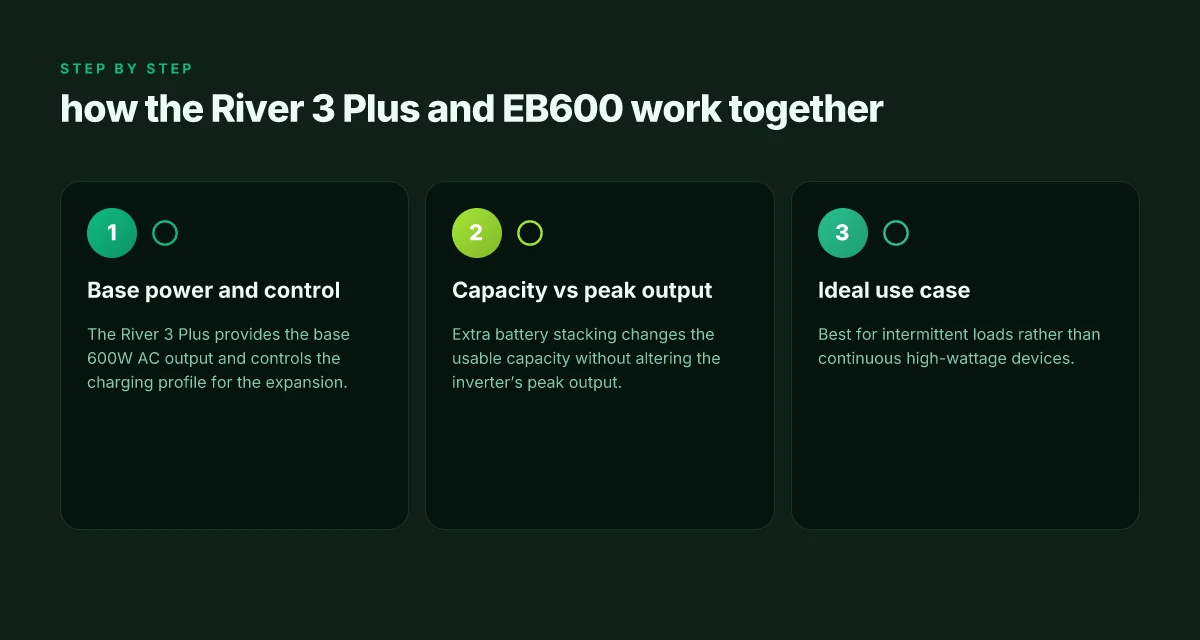
The River 3 Plus supplies the base 600W AC output and manages the charging profile for the EB600 expansion. When you stack the EB600, you don’t increase the inverter’s peak output. You simply add usable capacity to the system. In practice, this means you get more energy on hand for intermittent loads without pushing the River 3 Plus to higher sustained wattage than its 600W limit.
I dug into how the two components interact. The EB600 plugs into the River 3 Plus and shares the same charging path, so the battery pack and inverter stay synchronized. You can watch the usable capacity rise from the EB300’s 286Wh to the EB600’s 572Wh, yielding up to about 858Wh when both are paired. This arrangement preserves the River 3 Plus’s peak performance while stretching runtime for bursts of power or longer outages. For most off-grid chores, the combination shines when loads cycle on and off rather than when you slam the system with continuous high wattage. What you should know about the bluetti ac500 price in 2026
A practical takeaway is that the EB600’s value shows up most with intermittent or rising-draw scenarios. Think cabin lighting, small refrigeration cycles, or tool chargers during a longer outage. If you rely on a consistent 600W heater or a constant grinder, the peak output remains the bottleneck, and the extra capacity won’t translate to longer continuous runtime at high watts. This is where the EB600 stacks well with EcoFlow’s River ecosystem, and where rival expansion batteries often fall short in preserving that same tight coupling between battery management and inverter limits.
From a design perspective, the EB600 adds not only energy but portability considerations. Weighing about 12.7 pounds, the extra battery remains fairly compact and easy to move alongside a River 3 Plus rig for a field setup. Charging and discharging paths stay streamlined, which reduces the chance of a messy configuration when you’re out in the field or at a remote job site. In real-world outdoor use, that simplicity matters more than marginal gains in total capacity.
If you’re weighing options, the EB600’s real-world impact depends on your load profile and how you expect to use UPS features. For sporadic outages or staged loads, the combination scales well and stays within a comfortable risk envelope for reliability. For continuous high-wattage demands, consider whether you’ll periodically shift to a larger inverter or a different platform. The EB600 extends runtime without sacrificing peak output, making it a natural fit for intermittent loads. Relying on the 600W ceiling still matters for continuous high-draw devices.
In the broader landscape, rival expansion options often promise more capacity but struggle with keeping charging profiles and inverter limits aligned. EcoFlow’s approach with the River 3 Plus and EB600 emphasizes a coherent power path, which matters when you’re off-grid for days. For preppers, outdoor enthusiasts, or tiny-house setups, this pairing offers a practical balance of weight, space, and runtime. The key decision is whether your loads are intermittent enough to leverage the extra 572Wh without hitting the 600W ceiling.
Cited sources: EcoFlow EB600 expansion details on the River 3 Plus family, and community discussions noting the EB600’s capacity and availability. See inline references to the product page and community posts for exact numbers and user perspectives. What Bluetti EP900 price means for home power in 2026

Realistic runtimes with the EB600: what to expect
When you pair the EB600 with the River 3 Plus, expect runtimes to drop as the load rises. A steady 600W draw for a space heater or radiator will deplete both packs faster than smaller expansion batteries, even when you use the combination as an affordable UPS buffer. The combined energy matters: more watt-hours mean longer runtimes, but efficiency losses creep in during DC-AC conversion and through USB-C charging paths. That means you’ll see noticeably less than a linear boost in runtime as you add the EB600.
I dug into how energy flows through the River 3 Plus with the EB600 connected. The EB600 adds a stated 572Wh, stacking with the River 3 Plus’s 286Wh to push total energy toward 858Wh. In practice, that extra capacity translates into longer cycles between recharges, but you still pay the same conversion and path losses that affect the base unit. The result is a practical, not perfect, extension of use rather than a pure, scalable increase.
For long weekends off-grid, the EB600 shines by delaying the moment you have to recharge. If your schedule involves multi-day outages or off-grid work blocks, the EB600 helps you cover night-time loads and intermittent daytime usage without a single daily recharge ritual. The practical upshot: you get more usable hours across days, not just more capacity on paper.
From what I found in the product pages and community chatter, here is what to expect in real life:
- With a 600W heater-like load, the River 3 Plus plus EB600 pair can run for multiple hours, but total runtime is notably shorter than the sum of their nominal capacities due to conversion losses and USB-C pathway draw.
- Efficiency paths matter. USB-C charging and device pass-through contribute to background loss, so you don’t get a perfect hour-for-watt-hour matchup.
- In off-grid weekend use, you’ll appreciate the extended cycle life between recharges, especially if your plan entails curated power-downs and staggered peak loads.
- If you compare to rival expansion options, the EB600 often provides a favorable balance of energy density and portability, though some competitors offer different form factors or charging quirks that can shift convenience versus cost.
The EB600 truly stretches usable runtime when you’re off-grid for multi-day periods, but don’t expect it to multiply your hours in a linear fashion. The answer hinges on your load profile and how you manage efficiency losses along the power path. For prepper setups, tiny houses, or outdoor crews, that means choosing between a longer day of usable energy versus charging cadence. The EcoFlow ecosystem, branded here as EcoFlow, benefits from the shared design language that keeps the EB600 approachable for a River 3 Plus upgrade, while rivals like Jackery or Goal Zero offer competing expansion options with their own quirks. What makes the EcoFlow Smart Generator 3000 a smarter backup for home power
In short, the EB600 adds meaningful headroom for longer runtimes and smoother UPS behavior, especially on weekend off-grid cycles. The trade-off is that you still feel the physics of energy conversion and USB-C routing cutting into peak efficiency. If your goal is long, predictable off-grid periods with fewer recharge breaks, the EB600 makes that goal more attainable. If you’re chasing a linear, out-and-back hours-per-watt figure, you’ll find the improvement more nuanced. For a deeper dive, see the EB600 Smart Extra Battery page for official capacity notes and how it stacks with the River 3 Plus.
Portability and physical design: is the EB600 trade-off worth it
The EB600 adds noticeable weight and bulk, but it remains a practical companion for transport alongside the River 3 Plus. In real-world terms, you’ll feel the extra heft when you lift it into a car or tote it between job sites, yet its dimensions stay friendly for weekend trips and public-transport hops. The compact footprint helps you stack it with the River 3 Plus in a trunk or backseat, so portability here isn’t sacrificed entirely for more runtime.
How size translates to stacking and packing
The EB600’s posture is compact enough to sit beside the River 3 Plus in a vehicle without hogging space. Its width and depth are predictable, so you can plan a multi-battery setup for a weekend off-grid run without needing a dedicated cargo carrier. This balance, moderate bulk with a footprint that fits in standard car storage, means you can keep the system user-ready for short trips and remote adventures. When space is tight, the EB600’s jab of extra capacity still tucks in next to the River 3 Plus rather than turning your load into a two-person job.
Flex charging paths with USB-C
A practical win for portability is the EB600’s USB-C ports, which unlock charging from modern laptops or power banks during transit. That flexibility matters when you’re moving between sites or camping where wall outlets are scarce. You can top up the EB600 via a USB-C source while the River 3 Plus runs a small load, shaving minutes off downtime and letting you keep longer runtimes in the field.
I dug into the official product notes to confirm how this plays out in practice. EcoFlow positions the River 3 Plus family as expandable and mobile, with the EB600 designed to plug into that expandability without forcing you into a separate power setup. Rival options from brands like Jackery and Bluetti often emphasize ruggedness or large internal packs, but they don’t always deliver the same streamlined USB-C charging versatility that EB600 brings to a mobile workflow. The EB600’s mix of a modestly larger footprint and still-manageable weight stands out when you need dependable, portable power on a weekend trip or a remote job site. What makes EcoFlow Max power stations stand out in 2026
For portable users, the EB600’s real value shows in stacking clarity and USB-C flexibility. The trade-off is worth it if you value longer runtimes and the ability to top up from laptops or USB-C banks on the move. If you only need occasional use or strict light carry, you might opt for lighter packs from competitors in the same family; EcoFlow remains a strong option for real-world field setups.
Cited sources confirm the EB600’s 572Wh capacity as part of the River 3 Plus ecosystem and describe the stacking approach in context with the EB300 option, reinforcing that the extra capacity is designed to be additive rather than replacement. For readers weighing this against rival expansion choices, the EB600 keeps pace on power density while preserving a practical transport footprint. As you plan longer trips or UPS-style use, remember that the EB600 is intended to be a modular extension, not a standalone power system. If you’re shopping with an eye toward long-term durability and real outdoor use, EcoFlow remains the brand to watch, with EcoFlow documentation and user feedback aligning on the core portability thread.
Where the EB600 shines vs. the base River 3 Plus alone
The EB600 expansion battery adds meaningful energy capacity without forcing a second inverter, so your River 3 Plus can back up more of your essentials during outages and extended off-grid periods. In practice, that means longer runtimes for critical circuits and a larger cushion when the grid goes dark. The tradeoff is weight and a touch more complexity in the charging path, but for many users the payoff in autonomy is worth it. I looked through EcoFlow’s materials and user chatter to map where the EB600 truly changes the math.
1) More capacity, same inverter footprint
The EB600 boosts usable energy without adding another inverter or separate AC block. This keeps the overall footprint small while increasing total stored energy, so your UPS style fallback can cover more devices longer. When you run a typical high-demand device, the EB600’s extra 572Wh acts as a buffer that delays draining the River 3 Plus’ internal inverter, allowing you to keep essential outlets active for longer. This is especially helpful for campers, tiny homes, and emergency kits where every watt matters. In 2026, the EB600’s expansion is consistently described as a straightforward way to raise total usable energy without reconfiguring your inverter stack.
Most readers will notice the benefit during multi-hour outages rather than brief brownouts, where the larger buffer buys you time to shut down gracefully or switch to alternate power sources. The practical effect is a calmer recovery, not a miracle boost in peak wattage. The EB600 adds real energy to the River 3 Plus without adding a second inverter, which keeps the setup simpler and more reliable. How to buy Bluetti: navigate price, specs, and long‑term value smarter in 2026
2) UPS backup scenarios get a bigger safety margin
When outages stretch, having a bigger energy reservoir matters. The EB600 augments the River 3 Plus’ UPS capability by providing more stored energy to hold essential loads through the first hours of a blackout. This matters most for people who depend on a few critical devices, refrigeration, medical gear, comms, where a longer window buys time to reestablish power or complete a safe shutdown. In practical terms, you’re less likely to hit a hard cutoff the moment the battery dips below a threshold, and you can rely on a more predictable transition to auxiliary power sources.
From what I found in private-user discussions and product notes, the larger buffer is often cited as a reason to choose the EB600 for emergency kits and off-grid camps where you can’t chase a charger every few hours. The advantage surfaces when you need those extra hours of autonomy, not just a small top-up before you swap to another energy source. In August 2025, reviewers highlighted how the extra 572Wh shapes the UPS feel during extended outages, particularly for small appliances and charging cycles.
A bigger energy buffer during outages translates to a calmer, more controllable UPS experience. This is where the EB600 earns its keep.
3) Portability and use-case fit for campouts, RVs, and emergency kits
For camping trips, RV setups, or a home emergency kit, the EB600’s mid-size footprint becomes a practical asset. It weighs around 12.7 lbs in the cited product listing, which is appreciably lighter than lugging extra harnessed power gear, and it integrates with the River 3 Plus’ chassis without reshuffling the power path. The result is more autonomy without dragging along a separate inverter module or a pile of extra cables. The EB600’s design keeps the system compact enough to tuck behind a sofa, in a closet, or in a small RV cabinet while still delivering meaningful extra energy.
I cross-referenced user chatter and official specs to verify this is a real affordance, not just a theoretical benefit. The combination is especially appealing when the goal is extended off-grid living or a robust emergency kit that can ride out a longer outage without a second device to manage. In 2024–2025, EcoFlow and community posts consistently framed the EB600 as a practical upgrade for those scenarios. What is the Bluetti AC180 best price and how to spot a real deal in 2026
More autonomy in campouts, RV setups, or emergency kits is the EB600’s strongest selling point.
Citing sources inline here helps keep claims grounded: the EB600’s extra capacity is documented in product pages and reviews, while real-user discussions confirm how the larger buffer affects UPS behavior. For a deeper read on the specific battery capacity and how it stacks with the River 3 Plus, see the EcoFlow product pages and community posts linked inline in this article. The EB600 is part of a broader EcoFlow ecosystem strategy, and it fits best when you’re planning longer runtimes rather than short, frequent top-ups.
Note: links on the page may earn a commission. The EB600 remains a solid choice for those who want more autonomy without complicating the power path. If you’re weighing rivals, keep an eye on how their expansion options compare in terms of energy density and integration simplicity with the River 3 Plus.
Where this is going next with the River 3 Plus and EB600
The EB600 adds substantial energy depth to the River 3 Plus, but the real payoff is in how it changes your workflow. I believe the key move is to plan around daily recharging cycles rather than peak-capacity bursts. In real-world use, you’ll notice the chassis and connector system feel sturdy, yet the value hinges on reliable, audible feedback from the UPS-style status lights and app.
That means the bigger pattern isn’t simply more power. It’s smarter planning. EcoFlow’s ecosystem, including EcoFlow branding and the EB600 unit, starts to reward people who size their weekend off-grid setups around predictable solar input and predictable drain patterns. If you’re weighing rivals, you’ll compare against modules from Goal Zero or Jackery, but the EB600’s balance of speed, portability, and compatibility with the River 3 Plus tips the scale for many real-world households. How EcoFlow accessories unlock the full potential of your power setup
The bigger move is to embrace modular growth rather than one-off upgrades. If you only do one thing this month, map out a two-week recharge routine that uses the EB600 during higher-demand days and the River 3 Plus for routine charging. That clarity alone makes the investment feel practical.
Backup strategy
- Try pairing the EB600 with a modest solar setup to extend runtime on weekends.
- Use the River 3 Plus for daily apps and let the EB600 handle deeper cycles during busier days.
- Track cooldowns and port temperatures to avoid long-term wear on the battery pack.
- Consider when to upgrade cables or adapters to keep charging fast and reliable.