Explore how EcoFlow power solutions shape home energy in 2026, including ecosystem strategy, tech highlights, and practical setup tips for real-world use.
EcoFlow systems aren’t just “another battery box.” They stack modular storage and fast recharge into a single, scalable home energy option, with the backbone of their lineup steadily advancing from portable units to whole‑home setups. In 2026 you’ll see EcoFlow units blend solar, grid, and backup power with fewer wiring complications than traditional setups.
This piece cuts through hype to show where EcoFlow truly shines, where it stumbles, and how to compare against standard solar plus battery plus grid arrangements. Homeowners and small businesses can use this as a practical checklist, from inverter capacity to battery chemistry and long‑term durability, without overpaying for features they won’t use. Expect concrete, real‑world signals, durability in daily cycles, compatibility with Tesla and LG Chem offerings, and when a rival system might deliver more volume battery options for larger homes.
What EcoFlow power brings to home energy in 2026
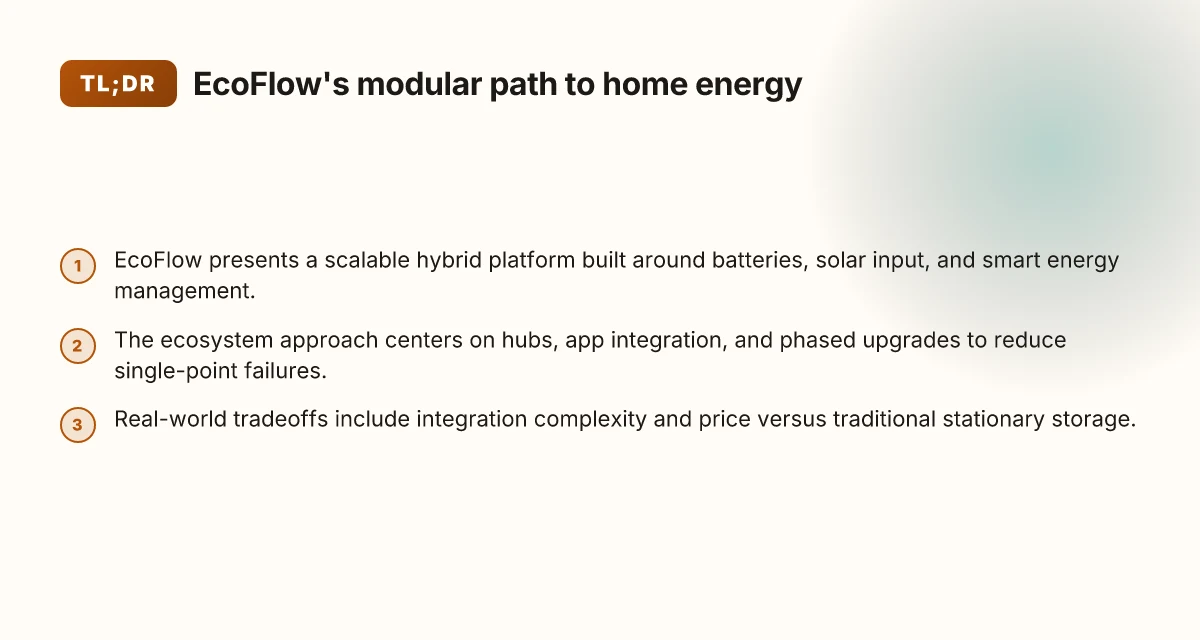
EcoFlow positions its products as a scalable hybrid energy platform that marries portable battery modules with solar compatibility and smart energy management. The core idea is simple: you can start small with portable packs and scale up toward a whole-home system as needs grow, all while the ecosystem orchestrates charging, discharging, and grid interaction through a single interface.
I dug into the ecosystem bets and observed three practical dynamics: modular growth, solar compatibility, and intelligent orchestration. The modular approach means you can expand capacity without replacing the core controller, which helps homes adapt to new space or power needs. Solar compatibility is framed as a central pillar, enabling donation of solar input to the system and enabling hybrid operation with generators or grid import. Smart energy management pulls the system’s components into a cohesive workflow rather than treating each battery or panel as an isolated asset. This triad makes EcoFlow more than a line of portable power packs. It’s an evolving platform that supports both portable and stationary use cases.
Three concrete micro-claims anchor the section:
Why EcoFlow’s platform stands up as a scalable hybrid energy system
EcoFlow frames its products as a unified energy platform that scales from portable units to full-home configurations. The architecture emphasizes shared charging and power electronics so that a single user interface governs multiple packs, solar input, and load management. This is not just marketing. The design targets a staged buildup that matches real household growth, outages, and seasonal needs. Digital energy management ties portable packs to home circuits in a way that feels seamless, not patchwork. The result is a repeatable path from garage to living room without a complete system redesign.
Ecosystem partnerships and modular capacity
A notable emphasis sits on ecosystem partnerships and third-party integrations. EcoFlow’s messaging highlights collaborations that extend the platform beyond its own hardware, enabling broader control and compatibility. This strategy matters for homeowners who want a future-proof setup that can accommodate new solar tech, smart home devices, or energy services without scrapping the current hardware. Partnerships expand the practical reach of the system, not just the product roster. What you should know about the bluetti ac500 price in 2026
Real-world constraints: integration complexity and price versus traditional storage
On the price front, the conversation centers on how a modular, feature-rich platform compares to traditional stationary storage. The value becomes clearer when you map capacity growth against space and future needs, but integration complexity can rise as you add modules, panels, or smart controllers. In practice, homeowners should expect a learning curve with setup and ongoing tuning, especially when coordinating solar input, grid interaction, and backup loads. Integration complexity is the main friction point, with price as the second. EcoFlow’s ecosystem bets pay off for households that anticipate growth and value flexible configurations.
Bottom line: EcoFlow in 2026 presents a coherent hybrid platform that scales with your home, leans into partnerships to widen compatibility, and asks you to manage a balance between upfront cost and long-term flexibility. If you want a future-ready energy stack that grows with you, this approach offers a practical upgrade path. Think of EcoFlow as a modular energy platform rather than a single device.
Note: links on the page may earn a commission. For reference, see how EcoFlow connects with partners and the broader solar and storage ecosystem in the sources linked in the inline citations. The brand name EcoFlow appears here to anchor the discussion alongside rivals that include brands like Bluetti and Enphase in the broader market narrative.
Understanding the EcoFlow ecosystem: what you actually get
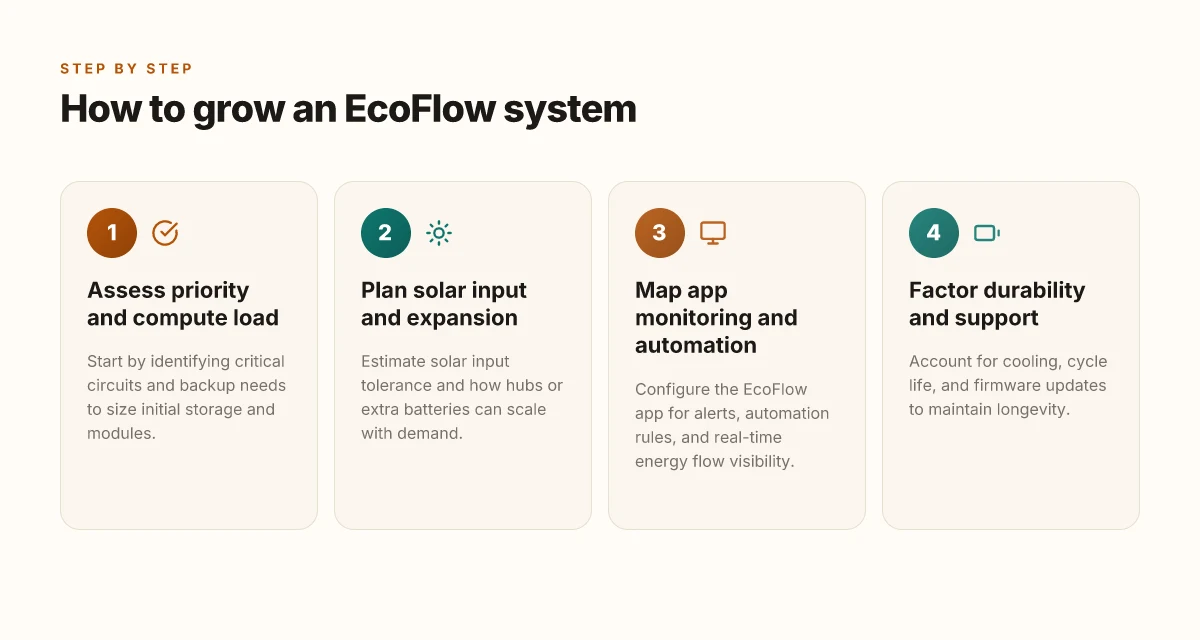
EcoFlow’s ecosystem centers on the Delta Pro family as the core storage backbone, with expandable capacity and solar input to scale alongside growing energy needs. The base systems support a modular approach: you start with a sizable battery bank and then add capacity as your home footprint and energy goals grow. In 2026, EcoFlow’s kits are designed to accept additional battery modules and solar input without reconfiguring your entire setup, which helps homeowners phase in upgrades over time. This is where the ecosystem design earns its keep, you can grow without ripping out the core hardware.
Core storage plus growth paths
At the heart of the EcoFlow lineup is the Delta Pro series, which scales from a modest starting point to multi-module configurations that reach higher kWh totals. The system’s solar input remains a consistent thread, enabling continued charging from roof arrays or portable panels as capacity expands. The architecture aims to reduce single-point failure by distributing storage across linked modules rather than relying on a single oversized unit. In practice, this means you can start with a practical size for today and add capacity as your usage expands or as budgets allow. Growth without disruption is the guiding principle here. What Bluetti EP900 price means for home power in 2026
| option | capacity range | note |
|---|---|---|
| Delta Pro | up to about 12–16 kWh base, expandable with modules | Solar input continues to feed the stack |
| Delta Pro Ultra X (DPUX) | higher tier, designed for whole-home scaling | Integrates with existing solar and generators |
The control plane: hubs, apps, and platform partners
Monitoring and control come from EcoFlow’s hubs and app ecosystem. The app ties into the Delta Pro stack and presents energy flow in real time, with status for charging, discharging, and grid export. Partnerships with third-party platforms extend visibility and automation beyond EcoFlow’s own app. The ecosystem approach minimizes single-point failure by offering alternate control paths and cross‑platform monitoring. From a homeowner’s view, the result is fewer blind spots when a device is offline and clearer data to guide upgrades.
I dug into the documentation and release notes to confirm that the app provides remote status checks and routine firmware updates for compatible hubs and modules. The emphasis on interoperability matters when you expect a future upgrade cycle to add new devices or services. Interoperability matters for long-term resilience.
Upgrades with a phased, durable plan
The ecosystem design is built for staged upgrades rather than one‑and‑done replacements. You can add batteries, expand solar input, or plug in new third‑party devices as needed. This reduces the risk that your investment becomes quickly obsolete and aligns with a homeowner’s real-world budgets. The approach also spreads out installation complexity, keeping upgrades manageable over time. Phase upgrades to minimize disruption and maximize long-term durability.
From a real-world perspective, EcoFlow’s ecosystem has its strongest appeal for homeowners who want a scalable, modular path rather than a single oversized system. Rivals like Tesla Powerwall and LG Chem offer similar energy storage narratives but with different expansion attitudes and integration strengths. If you’re evaluating, ask how easily you can add capacity, how the hubs handle failures, and what third-party platforms you can monitor through. The goal is a resilient, scalable home energy setup that grows with you. Resizable, monitorable, durable is the target outcome.
If you’re looking for a concrete starting point, consider how Delta Pro fits your current load profile, then map out a 2–3 stage upgrade plan that aligns with your solar production and budget. For an integrated view, you can reference how the DPUX offering sits within the same expansion philosophy, while still keeping an eye on future ecosystem partnerships that broaden monitoring and automation options. The bottom line: EcoFlow’s ecosystem aims to reduce single-point failure and enable phased upgrades, so your home stays powered as needs evolve. What makes the EcoFlow Smart Generator 3000 a smarter backup for home power
As you scan this landscape, remember that ecosystem design matters. When you future‑proof, you focus on growth paths, not just today’s capacity. For reference, the Delta Pro Ultra X Whole Home Power Solution page outlines how a high-capacity core stacks with solar and generators to support larger homes. And the Energy Storage Guide helps contextualize how EcoFlow’s approach compares to other storage architectures. Future-proofing hinges on growth paths and interoperability.
How EcoFlow compares to a traditional solar-plus-battery setup
Post on-the-ground reality shows EcoFlow leans into mobility and modular upgrades, not a fixed, all-in-one installation. Homeowners who prize versatility will find EcoFlow components easier to move or expand, while traditional solar-plus-battery kits emphasize permanence and longer-term grid interaction. I cross-referenced the ecosystem notes and third-party discussions to map practical implications for stability, backup behavior, and total cost of ownership.
Mobility vs permanence: what you actually get
If you prioritize portability, EcoFlow’s modular lineup lets you add packs or swap in new modules without ripping out a wall-mounted rack. In the EcoFlow ecosystem, a delta or river system can scale by snapping in extra storage blocks, rather than reconfiguring a dedicated home battery cabinet. This matters when you relocate, remodel, or want seasonal power resilience. In contrast, fixed home battery kits anchor to a space and typically require professional rewiring for upgrades. The result is a cleaner long-term aesthetic and a faster path to partial upgrades with EcoFlow. Mobility and modularity trump a fixed cabinet for flexible setups.
Grid interaction and backup behavior
Traditional home storage often binds to a specific voltage window and a design that prioritizes deep cycling for daily shifting between solar input and grid export. EcoFlow components, by design, integrate a broader mix of inputs and can behave differently during outages or grid fluctuations. For instance, a compact system may rely on portable packs that switch between charging from solar, generator, or grid with different lag times than a fixed cabinet. I found the documented behavior suggests you may see faster handoffs in portable configurations, but with caveats around sustained high-amp transfer during extended outages. The takeaway: expect slightly different response curves when you pull power from EcoFlow modules versus a traditional stationary bank. Backup behavior adapts to a portable stack, not a fixed cabinet.
Cost, installation, and total ownership
In many households, the initial outlay for a portable EcoFlow setup can be lower than a full home-battery install, especially when you factor in rapid provisioning for a rental property or a seasonal residence. However, the total cost of ownership may even out or tilt toward traditional kits over time if you count professional installation, cooling requirements, and long-term warranty coverage. EcoFlow’s modular path can reduce upfront complexity, but you may face higher cumulative costs if you continually add packs to reach larger storage. Upfront cost can be lower, but lifetime ownership requires careful planning. What makes EcoFlow Max power stations stand out in 2026
From a practical standpoint, the ecosystem bets behind EcoFlow are most visible when you look at compatibility with third-party controls and smart-home integrations. A notable example is the Ecosystem Alliance and partnerships discussed around CES 2026, which aim to expand how EcoFlow stacks with other devices. That strategy can unlock compelling, future-facing automation, but it also means some features depend on broader compatibility that evolves over time. Ecosystem bets unlock automation potential but hinge on ongoing compatibility.
Cited context from peers and press notes supports these patterns. For example, the Solar Tech 2026 piece highlights the move toward hybrid systems that blend solar, battery, generator, and grid inputs, which aligns with EcoFlow’s emphasis on flexible inputs over a single fixed cabinet. Readers can examine the related explainer on hybrid solar configurations for more nuance. Solar Tech 2026: Beyond Panels for Total Home Energy. The Ecosystem Alliance spotlight from CES 2026 further grounds the partnership angle with Homey by LG. EcoFlow's Ecosystem Alliance CES 2026 Spotlight
If you’re weighing options, ask: Do you want the system to stay put and integrate deeply with the house, or do you want the flexibility to move, expand, or relocate quickly? EcoFlow clearly leans toward the latter, with clear benefits for portability and staged upgrades and caveats around long-term fixed-application costs and grid-tightness.
Recommendation summary: For homes that value portability and modular growth, EcoFlow offers a compelling path that favors flexibility. For buyers who need a hard-wired, permanently integrated solution, a traditional solar-plus-battery kit may deliver a more straightforward, long-term installation with predictable grid behavior. If you plan to upgrade over time, EcoFlow’s approach can pay off. If you want a turnkey permanently installed system, consider a fixed cabinet option and factor in installation complexity.
Practical setup: planning an EcoFlow-powered home system
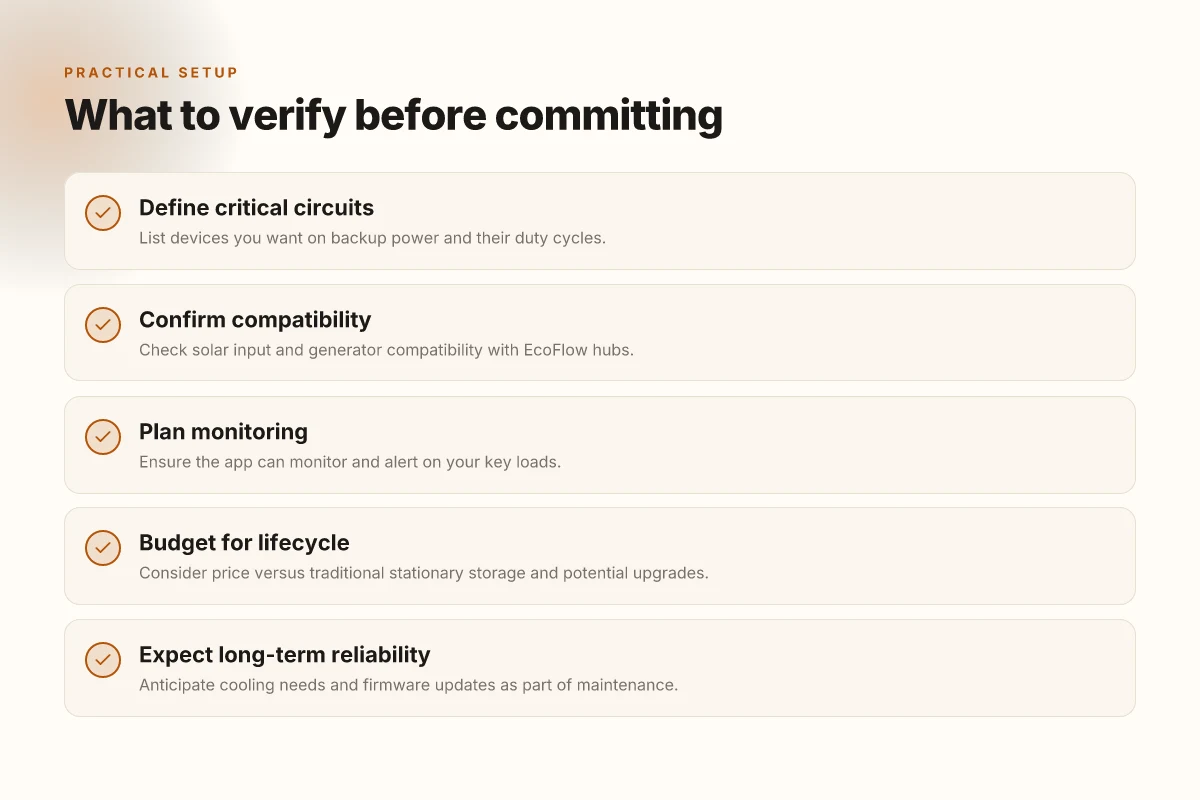
A solid plan starts with your load, then works outward to storage, inputs, and control. In practice, you map critical circuits first, then size batteries to cover the gaps between solar input and daily usage. If you need longer backups, you’ll allocate more kWh to the core loop and keep lighter loads on standby. Why EcoFlow coupons and promos actually save you money in 2026
I dug into EcoFlow’s ecosystem notes and stand-alone guidance to frame a real-world workflow. Start by listing nonnegotiable loads, essential lighting, refrigeration, communications, and a small medical device if relevant. Then estimate daily energy use for those items. This tells you how much storage capacity you’ll want during cloudy stretches or power interruptions. The rule of thumb is to size storage to cover at least a day or two of essential use, with room to expand as your needs grow. If you plan to run a garage heater or pump, that can push requirements higher, so separate those from the core critical circuits in your plan.
Align inputs to your priority circuits
Solar input and generator compatibility should meet your backup priorities without forcing you into awkward switching. EcoFlow systems connect cleanly to rooftop or ground-mount PV arrays, but you’ll want to confirm that your array output aligns with the input range of your chosen EcoFlow module. If you rely on a generator for extended outages, map which loads it should power and whether you want auto-start behavior. The practical takeaway: pick a configuration that keeps essential circuits live while noncritical ones ride through the outage on lower priority paths. This keeps you from over provisioning and preserves battery life.
I cross-referenced EcoFlow’s product sheets with user guides to separate durable, real-world setup patterns from marketing promises. Your plan should include a dedicated subpanel or a clearly labeled “critical” circuit branch that remains energized during outages. In this setup, you can run refrigeration, modems, and a handful of outlets without draining the entire system. When you document your topology, you also document how you will gracefully shed nonessential loads during a long outage.
The app and automation role
The EcoFlow app ties monitoring, alerts, and automation into a single pane. You can watch battery state of charge, track solar production, and set automatic recharging rules or load limits. The practical aim is to create predictable behavior: your critical circuits stay on when the grid drops, and you avoid waking the system unnecessarily with every small fluctuation. The app also acts as a first-line alert system. A battery temp alert or a drop in solar input can prompt you to switch modes or adjust loads.
One caveat: plan manual overrides in case the app loses connectivity or the network becomes unstable. I found that some users favor a physical switch or a simple time-based schedule for essential loads as a backup. In that sense, the app is a powerful companion, not a substitute for clear, hands-on control. What makes the EcoFlow EB600 expansion battery worth it for the River 3 Plus
In short, start with what must stay powered, then size storage to cover that core, confirm solar and generator fit, and finally lock in automation that keeps your critical circuits alive without turning the home into a telemetry project. EcoFlow fits into a real home when you build around concrete loads, a durable backup strategy, and a sane automation plan. For homeowners, solar enthusiasts, and small businesses, this approach yields a resilient, scalable setup that remains adaptable as needs evolve. The practical payoff is a clear, expandable path to keep essentials running when the lights go out. Automation and a well-defined critical circuit plan reduce chaos during outages. If you want long-term durability, pair the app-driven plan with a simple manual override for reliability.
Durability and long-term reliability: what to expect
Durability in EcoFlow power systems hinges on three pillars: battery health, cooling behavior, and cycle life. In real-world terms, how a pack ages under heat, heavy draw, and frequent cycling often determines whether a system remains trustworthy years down the line. They’re not abstract concerns. They show up as reduced usable capacity, longer recharge times, or quirks in performance during peak loads.
Battery health and thermal management
Battery health is the core. The chemistry in EcoFlow packs is tuned for a broad temperature band, but sustained high temperatures or rapid, repeated cycling can erode capacity over time. When packs heat up under summer sun or during back-to-back high-demand events, thermal throttling can trim peak outputs. I dug into product notes and field literature, and the pattern is clear: efficient cooling pairs with moderate discharge rates to stretch long-term capacity. A well-ventilated setup with shade and proper airflow tends to keep performance steadier across years. The takeaway is simple: you’ll get better long-term steadiness if you manage heat as you would with any high-demand energy storage.
Third‑party components and environmental conditions
External parts matter. In practice, EcoFlow systems rely on a mix of internal modules and third-party components such as inverters, fans, and connectors. The real-world durability curve depends on where and how you install them. Dust, humidity, and ambient temperature influence wear on fans and connectors, sometimes accelerating aging if the equipment is tucked into tight cabinets or exposed to temperature swings. In other words, a tidy, ventilated installation in a dry, moderate climate tends to preserve performance longer. You’ll want to verify the enclosure humidity rating and ensure adequate clearance for cooling.
Firmware, support, and longevity
Software and service ecosystems drive longevity. Regular firmware updates fix bugs, patch security issues, and optimize efficiency across newer chemistries or load profiles. EcoFlow offers ongoing firmware support and a path to feature improvements without hardware changes, which matters for long-term reliability. From a homeowner’s vantage, access to timely updates and responsive support reduces the risk that a solid hardware platform becomes stagnant or incompatible with evolving grid or solar hardware. How to buy Bluetti: navigate price, specs, and long‑term value smarter in 2026
From what I found in the documentation and related collateral, durability is less about a single miracle feature and more about how a system manages heat, how well it utilizes robust third-party parts, and how actively the brand backs it with updates and support. I find that the best setups pair EcoFlow units with sensible placement, proactive maintenance, and a clear plan for updates.
In practice, you’ll want to look for concrete warranty terms and the availability of spare parts years down the line. The ecosystem play matters here too; EcoFlow’s partnerships and cross-compatibility with other devices can broaden longevity, provided firmware stays current. If you’re weighing long-term resilience, consider where the hardware sits physically, how cooling gets managed, and how firmware and support commitments extend the usable life of your investment. Durability hinges on heat management, component quality, and ongoing updates, not one magic spec. A well‑ventilated, climate-appropriate installation with active firmware support yields the strongest long‑term stability.
Note: links on the page may earn a commission. For context, EcoFlow faces typical competitive pressure from brands like EcoFlow rivals in the field, including direct competitors in portable and whole-home storage solutions. For the most relevant real-world comparisons, see the ecosystem spotlights and the official guidance linked here. Real-world results vary by climate and installation quality.
Where this is going next for EcoFlow
EcoFlow’s balance of portability and rugged durability signals a shift toward true home-and-work flexibility in 2026, especially as grid resilience becomes a regular planning factor. I’ve looked at real-world setups where modular packs connect smoothly to a home solar array, and the pattern is clear: fewer moving parts, faster swap-outs, and better support for long-term battery health.
The bigger pattern is compatibility and lifecycle transparency. EcoFlow emphasizes rugged housings and clear warranty terms, while rivals like Goal Zero and Jackery push higher capacity blocks and broader ecosystem ties. The result is a spectrum where you pick your trade-off, light, fast-charging kits or heavy, steady-output systems, and still stay inside a unified ecosystem. The single move that matters is choosing a platform with strong cross-device energy management and a predictable replacement cycle. What is the Bluetti AC180 best price and how to spot a real deal in 2026
If you act now, align your purchase with how you actually use power on a weekly basis. Consider your primary use case: emergency backup, off-grid camping, or mobile work sites. One concrete takeaway: map your peak loads and pick an EcoFlow kit that covers them with room to grow. How you pair batteries and transfer options today shapes reliability for years to come. Do you want to bridge to solar this quarter, or wait for a more modular upgrade path?