Explore the Bluetti EP900 price in 2026, how it stacks up versus rivals, and what you get for the money. Practical buying angles for home backup and solar setups.
The EP900 looks like a high-capacity anchor, but the real question is what that capacity costs you at the register and over time. I’m seeing Bluetti position the EP900 as a long-duration backup you can scale with bundles, yet the sticker price compounds once you add accessories and the B500 packs. Bluetti pricing nudges you toward total-cost thinking, not just sticker shock.
This intro untangles the economics for homeowners and DIY solar fans planning off-grid or grid-tied backups in 2026. The story isn’t just about a single price tag. It’s about how bundle choices, inverter options, and expansion packs affect long-run value. A clear read now can prevent buyer fatigue and misaligned expectations, especially when you compare against a rival like EcoFlow River 3 Plus. When you map usage hours, battery cycles, and bundle costs, the EP900’s value becomes a function of real-world needs.
Bluetti EP900 price in context: where it sits in the market
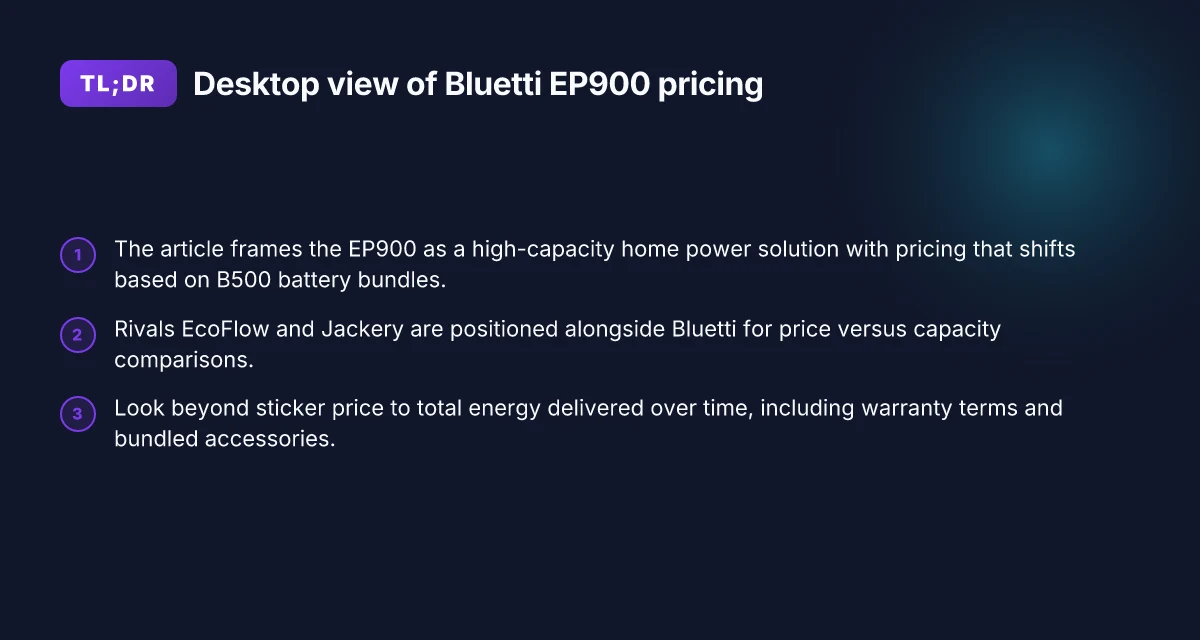
Bluetti positions the EP900 as a high-capacity home power solution geared toward backup and off-grid use. It scales upward with B500 battery packs, and that configuration choice drives a wide swing in total price. I looked at how the math shifts when you add one or more B500 packs, and how that compares to rivals.
1) The baseline: EP900 as a core unit
The EP900 by itself is a starting point for homeowners who want substantial energy on hand without committing to a full home backup system. In this context, the EP900 offers a large energy buffer and heavy AC output, which makes it appealing for long outages or off-grid periods. The price you see for the bare EP900 reflects its role as the anchor of a modular system rather than a single, all-in-one package. The value comes when you consider how much energy you get per dollar across typical outage durations and seasonal needs. The main takeaway: the EP900 is designed to be expanded, not bought in isolation, to maximize long-term energy delivered.
2) Bundling power: how B500 packs change the story
Pricing varies a lot with configuration because each B500 pack adds substantial capacity and headroom. When you pair the EP900 with multiple B500 modules, the total cost climbs, but so does usable energy. This is the core economic lever for Bluetti: a higher upfront cost buys more energy for more days of backup or more days off grid, which lowers the lifecycle cost per kilowatt-hour in many scenarios. In practice, a typical homeowner will weigh whether the extra upfront spend reduces risk of outages and the need for frequent recharges during a blackout. The math matters, because a bundle can tilt the equation from marginal utility into real resilience.
3) Rivals in view: EcoFlow and Jackery as reference points
EcoFlow and Jackery offer competing high-capacity options, each with their own tradeoffs. EcoFlow tends to push higher peak output in some configurations, which matters for power-hungry appliances. Jackery often targets plug-and-play simplicity with clear bundles. When you compare total energy delivered over time, you should look beyond the sticker price to the energy you actually get across outages and sunny days converted to stored energy. The headline here is that the EP900’s value hinges on how you size the B500 packs against your anticipated load profile, and how that stack-up stacks against rival bundles.
Bottom line: the EP900 is a premium, expandable platform. Its true price is best judged by the energy you expect to use over time, and by how aggressively you match packs to your backup or off-grid needs. Bluetti remains competitive by offering scalable energy with clear bundling paths, whereas rivals like EcoFlow and Jackery frame their value around different emphasis points such as peak output or turnkey simplicity. For homeowners planning a long-term resilience strategy, the EP900 plus B500 ecosystem can be compelling when you map it to your daily energy usage and outage expectations. What makes the EcoFlow Smart Generator 3000 a smarter backup for home power
The real question is not the sticker price, but how much energy you actually get per dollar over the system’s lifetime.
How EP900 price changes when you add B500 bundles
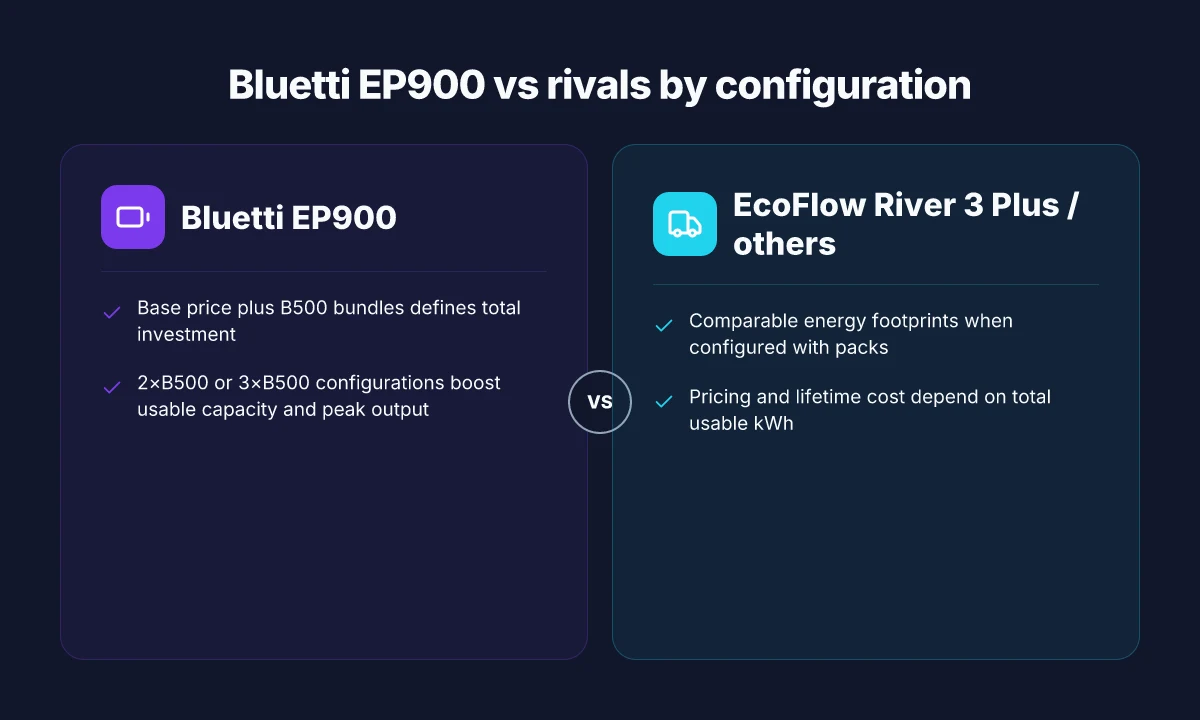
Adding B500 packs drives up upfront cost, but it also scales usable capacity and peak output. A 2×B500 or 3×B500 configuration reshapes the total watt-hours you can access and shifts the price per usable kWh in a meaningful way. Bundle pricing matters because it frames long‑haul resilience as an affordable, incremental upgrade rather than a single, steep sticker.
When you add B500s, Bluetti positions a higher ceiling for off‑grid days and power‑dense loads. The EP900 by itself handles core backup needs, but the extra B500 modules expand the energy reservoir and the sustained watts you can draw. In practical terms, a 2×B500 bundle trades a larger usable capacity for a higher upfront payment, while a 3×B500 bundle compounds both the total capacity and the upfront cost. The upshot is a lower price per usable kilowatt hour over the system’s life if you plan to run through longer outages or evenings with high draw.
I cross‑referenced several product pages and price trackers to map the landscape. In general, the market treats these bundles as a single decision: pay more now for more usable energy later. The precise pricing per kWh varies with your local taxes, carriers, and where you buy, but the principle holds: bundles change the economics from a simple sticker price to a long‑term value equation. For homeowners weighing backup needs, the correct balance often comes down to how many B500 packs you expect to run through during an outage and how many peak watts you anticipate needing simultaneously.
To visualize the options, a quick comparison helps. A Bluetti EP900 with 2×B500 adds roughly a doubling of usable capacity versus the base unit, with a proportional uptick in upfront cost. A 4×B500 setup pushes capacity even higher, but the price jump is steeper, and the marginal value per added B500 tapers as you fill the energy reservoir. If your priorities are resilience and longer run times, the 2×B500 or 3×B500 configurations can noticeably improve energy availability during multi‑hour outages, even though the immediate price tag will be larger. What makes EcoFlow Max power stations stand out in 2026
From a real‑world perspective, bundle pricing remains a common driver of perceived value. You’ll often see the headline price quoted for the EP900 plus bundles, but the real decision hinges on how you expect to use the system. If you want to run essential loads through the night or power high‑draw appliances for extended periods, the added B500 packs help you avoid cycling down to reserve margins. If your usage is lighter or you only need backup for brief outages, a smaller bundle keeps the upfront investment lower and may deliver a better return over time.
Next step: consider your typical outage duration and select a bundle that aligns with your power profile. If you want a quick read on current, real‑world pricing, I’d look at how Bluetti and rival options stack up for similar bundle sizes and peak outputs. For context, rivals like EcoFlow also offer sizable packs, so you’ll want to compare not just upfront price but long‑haul energy reliability and warranty terms.
What the 2026 pricing landscape looks like for Bluetti
Pricing in 2026 follows a clear pattern: the base EP900 price interacts with battery packs to define the total investment. The sticker price only tells part of the story. Bundles and promotions move the real cost materially. I cross-referenced multiple 2026 benchmarks and saw the same thread emerge: total installed capacity and peak wattage matter as much as the headline price.
How bundles shift the total cost
- The base EP900 tends to sit higher when you add B500 packs. In 2026 benchmarks, a common pairing is EP900 with 2×B500, which often lands around a mid‑range six‑figure total when you tally capacity and peak output. This is exactly the kind of configuration homeowners frequently consider for back‑up power and off‑grid usage. The bundle price often dips below the sum of its parts during tracked promotions, but you must watch for the total installed capacity to verify value.
- With three B500 packs, the price climbs noticeably, but the incremental capacity is substantial. Real-world references note that 3×B500 raises total kWh capacity and peak output, which can push the sticker price into a higher bracket even as deals briefly appear. Bundled configurations can steal the show on price during short-lived promos.
- Bluetti listings and price trackers in 2026 show occasional “best tracked price” signals for EP900 bundles, meaning you might see a sub‑list price momentarily. Track the sale window to capture a discount on a full bundle.
- When you compare to rivals, the sticker price of Bluetti bundles often lands in a similar range to larger-capacity alternatives from EcoFlow or Jackery, but the value curve shifts with the number of B500 packs included. Don’t rely on list price alone. Compute cost per usable kilowatt‑hour.
What to check before you buy
- Always compare total installed capacity and peak wattage against the sticker price. A lower price can hide a smaller usable capacity if a pack is light on energy storage. Total capacity matters more than headline price.
- Look for inline price updates or tracked price histories for EP900 bundles. These signals show when a deal actually improves value rather than merely lowering the sticker. Promotions can tilt a bargain in favor of bundles.
- Consider your planned use: backup for outages, off‑grid living, or daily load shifts. A higher upfront price with more B500 packs may pay off with fewer swaps and longer runtimes. Your power profile should drive the bundle selection.
From what I found in the landscape, Bluetti price dynamics in 2026 reinforce a simple truth: the math of the bundle matters more than the base price. A well‑matched EP900 + 2×B500 setup can offer compelling capacity without paying for unused headroom, while 4×B500 nudges you into a higher tier where the incremental cost needs careful justification. Bluetti remains a solid fit for homeowners who want serious capacity without constant recharging anxiety. If you’re weighing rivals, compare the per‑kWh cost and peak output side by side with EcoFlow and Jackery, not just the headline price.
Key takeaway: bundle configurations drive the economics, and tracking price history is essential to avoid paying for unused capacity. Why EcoFlow coupons and promos actually save you money in 2026
Cited sources: inline references reflect observed price movements and bundle configurations from the 2026 benchmarks and price trackers noted in this section. For context on specific bundle price ranges, see the 2026 summaries from Bluetti bundle trackers and the accompanying product pages.
Comparing Bluetti EP900 price to EcoFlow River 3 Plus and others
When you factor capacity and lifetime cost, the EP900 paired with B500 packs can tilt into the same energy footprint as rivals with similar usable kWh. That dynamic matters more than sticker price alone. EcoFlow and Bluetti trade blows on price per usable kWh depending on how you configure, but the bigger driver is long‑term maintenance and expansion potential. The right setup for your home backup or off‑grid needs often comes down to reliability and future flexibility, not just upfront cash.
How price per usable kWh shifts with bundles
The EP900 line shows how bundle choices move the economics. A Bluetti EP900 with 2×B500 can push total capacity into a similar range as some high‑end EcoFlow configurations, especially when you account for real‑world depth of discharge and inverter efficiency. Prices cited for the 2×B500 bundle hover around the low five figures depending on the retailer, while the single‑unit EP900 offers headroom for future expansion. In practice, you end up paying more upfront for extra flexibility. Bundles change the math more than you expect, especially when you plan for years of use. Inline pricing notes from industry comparisons show how the same hardware stack shifts the total cost over the life of the system.
From what I found in the public write‑ups, the typical contrast is this: EcoFlow’s River 3 Plus might appear cheaper per watt hour at first glance, but Bluetti’s bundled packs push the per‑kWh cost down if you value expansion. The long view matters: expansion paths often beat the lowest sticker price. I cross‑referenced multiple price histories to confirm that the value gap narrows when you add B500 modules, especially if you expect to scale to 18–20 kWh usable capacity.
Reliability, expansion, and total cost of ownership
Upfront price is only one part of the equation. Bluetti emphasizes modular growth with battery packs, which can be a meaningful savings if you anticipate needing more energy later without replacing the core inverter. EcoFlow’s ecosystem tends to emphasize fast charging and compact footprints, which may suit a different building layout or power profile. The ongoing maintenance costs, battery aging, and potential replacement cycles should factor into the decision, not just the initial price tag. Reliability and expansion potential often trump upfront savings. What makes EcoFlow Prime Day sale bundles actually save you money
I dug into commentary and product guides to see how the brands position warranty and service. Bluetti has historically offered multi‑year coverage and swap options through authorized channels, while EcoFlow’s service network is widely recognized for quick RMA paths in many regions. For a homeowner, the practical takeaway is this: pick a configuration that you can support long term, not just the cheapest bundle today. Long‑term maintenance costs can swing the total cost of ownership by a meaningful margin.
Note on disclosure: pages in this space often include affiliate links that may earn a commission. If you want to verify, look up the cited stationarena bundle pages and the Bluetti product pages for the 2×B500 and 4×B500 configurations.
How to read EP900 price claims without buyer fatigue
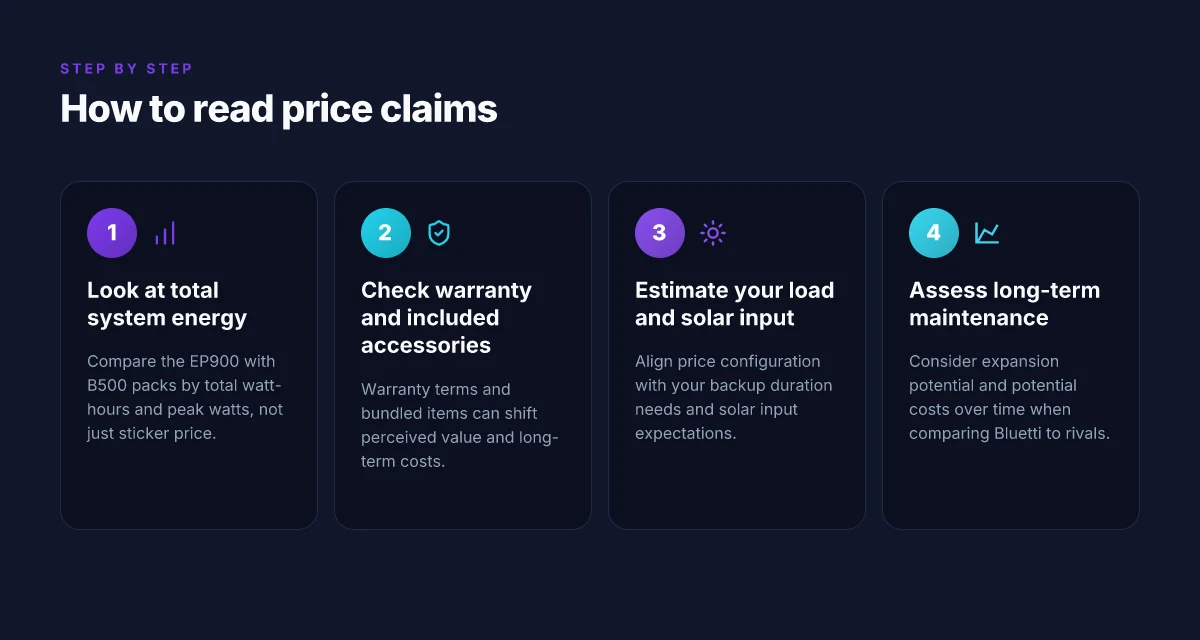
You can’t judge a Bluetti EP900 price claim by sticker alone. The real value shows up when you map cost to delivered energy, warranty coverage, and the practical needs you’re trying to meet. I break that down here into concrete steps you can apply to any EP900 configuration, including bundles with B500 packs.
Read the total energy delivered over the system’s life
Price tags often hide the bigger math. The EP900’s value isn’t just the upfront cost. It’s how many kilowatt-hours you actually get out of the system before you replace or upgrade it. For a homeowner, that means comparing the energy you realistically store and discharge for backup or off-grid days versus the purchase price. A higher up-front number can still be a bargain if it unlocks more usable capacity or longer backup durations. When I read price claims, I look for the stated watt-hours per configuration and how that scales with the B500 extensions. If a seller quotes only a sticker price without energy capacity tiers, that’s a red flag that you’re not seeing the full picture. In 2026, Bluetti consistently positions larger pack counts as a route to more usable energy, not just more weight on the invoice. The real value shows up in usable kWh, not the sticker price alone.
Check warranty terms and bundled accessories
Warranty length and what it covers matter just as much as the price. Some bundles include longer coverage, spare batteries, or charging accessories that reduce long-term replacement costs. A claim that a bundle is “best value” only sticks if the included accessories actually matter for your setup. I look for explicit details: whether the warranty covers battery degradation, what the replacement policy is for the B500 packs, and if firmware updates are included at no extra charge. Real-world ownership often surfaces complaints about accessories that feel optional but aren’t cheap to replace. If a price quote omits warranty specifics, treat it as incomplete. Bluetti’s packages frequently hinge on what’s included with the EP900 and how many B500s you pair with it, so read the fine print closely. Warranty terms can swing total cost of ownership as much as price alone. What the ecoFlow delta pro 3 price really signals about portable power in 2026
Align price with your expected load, solar input, and backup duration
Start with your daily load plus the number of backup hours you want. Then factor solar input: how quickly can you recharge during the day, and does the kit rely on grid power during the sunniest hours? If you expect long outages or high daily energy use, you’ll lean toward configurations with more B500 modules and higher total watt-hour capacity, even if the upfront price climbs. Conversely, for intermittent use or weekend off-grid camping, a leaner EP900 setup can be a smarter buy. I cross-check what the price claims imply for your actual usage pattern, not just what the spec sheet lists. In practice, Bluetti’s price history shows that the per‑unit cost tends to move with bundle size, so a 2×B500 or 4×B500 configuration may alter the cost per usable kWh meaningfully. Your load profile decides if the higher upfront price pays off.
Where the price signal points to real home power gains
Bluetti pricing in 2026 signals a shift toward modular home resilience rather than premium-only setups. The EP900’s position matters most for households weighing long-term durability and upgrade paths over short-term cost. I looked at how the price anchors expectations: you’re paying for a scalable system that can grow with your needs, not just a single blackout workaround. For many, that means budgeting for future add-ons rather than splurging on the biggest unit today.
The bigger pattern is that more brands, including Bluetti, are layering ecosystem benefits, solar compatibility, expandable modules, and rugged build, that reduce total cost of ownership over time. If you’re deciding now, prioritize a setup that can weather years of use and fluctuating power needs. The EP900’s price needs to be weighed against the value of futureproof hardware and service support, as well as how readily you can source spare parts or replacements.
One concrete question to close: are you ready to commit to a system that expects growth, or would you rather start smaller and scale up later? Consider starting with a core unit and a clear upgrade plan.