
Explore the bluetti ac500 price landscape in 2026, including official listings, expected tiers, and value propositions. Learn how Bluetti positions the AC500 in the surge of solar generators.
The Bluetti ac500 price fights its own logic: the sticker price moves with the battery packs you pair it with, not a single flat number. Most buyers underestimate how quickly the total rises when you add a 4,800 Wh battery and an upgraded inverter. In practice, a basic setup can sit in a different price band than a full-home-backup bundle, which is exactly why you should map needs before you shortlist.
What matters here is clarity for real-world buys. Bluetti publishes tiers, but the real value comes from your mix of battery capacity, inverter size, and add-ons, which shifts among official listings and credible resellers. This piece walks through the common price ladders, highlights where bundles actually save money, and shows how rivals like EcoFlow and Lanpow compare on capacity and feature gaps. Expect concrete, sourced context you can use to plan a home, RV, or off‑grid system.
What the bluetti ac500 price tells you about Bluetti's strategy
Bluetti positions the AC500 as part of a scalable platform, where price tracks capacity, inverter options, and the value of bundled accessories. In official price listings on bluettipower.com you’ll see tiered configurations plus add-ons that push total cost higher or lower depending on what you choose. The pattern mirrors Bluetti’s broader move toward modularity: upgrade paths that let you scale capacity and features without paying for a single, fixed unit.
I dug into the official listings and cross-checked credible reseller pages to map how price bands shift with battery options, inverter configurations, and bundles. The takeaway is that the most meaningful price leverage comes from three levers: (1) battery size and chemistry, (2) inverter output capacity, and (3) accessory bundles such as extra batteries, multi-mode solar input kits, and rapid-charging add-ons. Each lever adds a distinct delta to the sticker price, but also expands usable watt-hours and concurrent AC outputs, which matters for home backup or RV use.
Modularity shapes the math. The AC500 base price sits lower when you skip higher-capacity packs, but adding the larger battery bank dramatically improves runtime and peak output. Bluetti’s price pages show incremental jumps as you select bigger packs, with noticeable leaps when you opt for higher inverter classes. This aligns with Bluetti’s strategy to let customers pay for capacity and performance in steps rather than a single leap to a top-tier model. In official listings, the total cost climbs as you pair the core AC500 with more capable battery modules and higher-output inverters, reinforcing the value of choosing a future-proofed bundle.
Bundles alter the price-to-value equation. Official price lists reveal bundled kits that combine the AC500 with extra batteries, solar input kits, and smart monitoring features. These bundles reduce the friction of adding components later and can offer a lower effective price per watt-hour than buying separately. For buyers balancing upfront cost against long-term flexibility, bundles tend to be the smarter move when your power needs are near the edge of the base configuration.
The prior-model contrast signals a strategy shift. Compared with earlier Bluetti lineups, the AC500’s pricing psychology leans toward modular upgrades rather than a single premium unit. This pricing approach nudges buyers toward a staged investment: start with a capable core system, then upgrade with packs and accessories as needs evolve. It also keeps Bluetti reachable for first-time buyers while preserving upgrade paths for power users. What Bluetti EP900 price means for home power in 2026
From what I found in the Bluetti ecosystem, the official listings on Bluetti’s site emphasize transparency about what each add-on costs and what you gain in capacity and power stability. The strategy becomes clear: price is a beacon for the path you choose. If you want more runtime and higher peak output, you pay into a broader, upgradeable platform. If you want light usage with occasional backup, you start with a leaner bundle and scale later.
Bottom line: the AC500 price is less about a single hero unit and more about a system that grows with your needs. Bluetti wants you to see how capacity, inverter options, and bundles create a ladder of value. In practice, that means your best bet is to map your planned load and storage needs, then pick the compatible bundle that future-proofs your setup without overpaying for features you won’t use right away.
Bluetti's pricing deliberately nudges buyers toward modular upgrades, not one-and-done purchases.
How the ac500 price scales with battery and inverter options
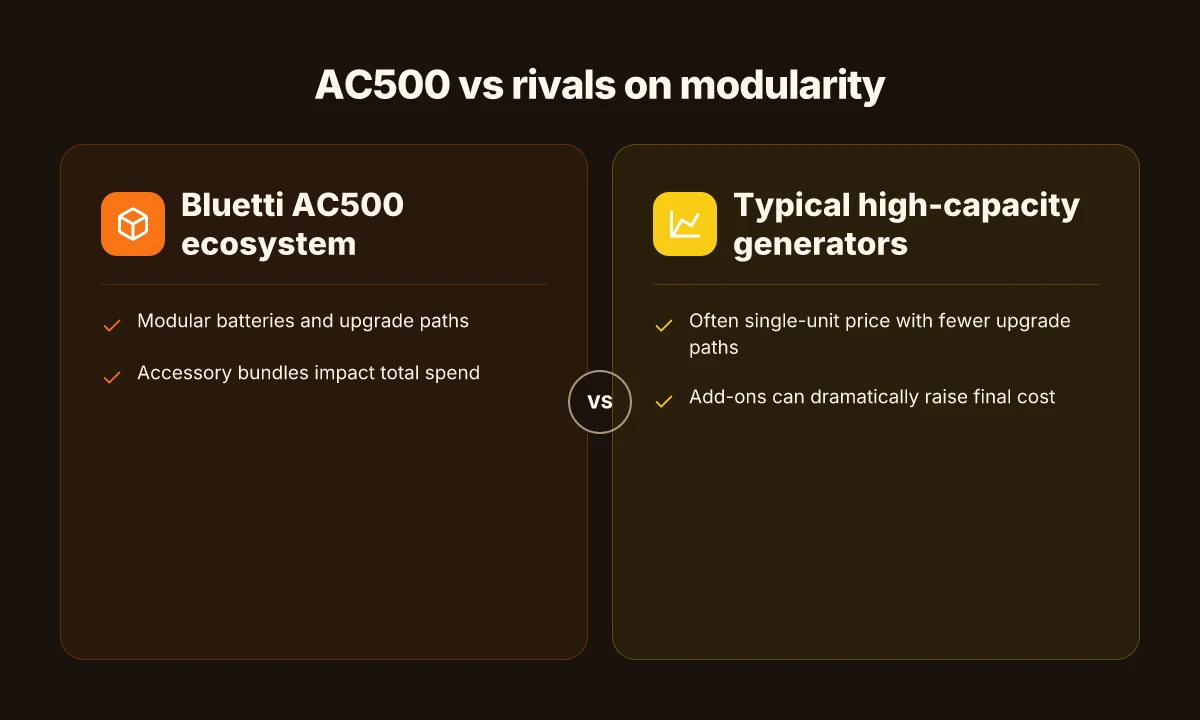
The ac500 price scales up as you add higher-capacity battery modules and upgraded inverters. The base configuration sits lower, while pairing the AC500 with larger energy packs and a beefier inverter increases the upfront cost, but adds longer-term flexibility for run-time, cycle life, and peak output. When you widen the battery stack, you also shift the balance of price per kilowatt hour, so the long-term value depends on how you plan to use the system.
I cross-referenced Bluetti’s official pricing and credible resellers to map how bundles change the math. The base AC500 ships with a core inverter and a modest battery footprint. Step up to a larger expandable pack and the price climbs accordingly. Bluetti markets several battery configurations that stack on top of the AC500’s core platform, and each tier changes not only total price but the system’s sustained output and recharge speed. If you intend to power longer outages or larger loads without frequent recharging, a bigger battery pack quickly becomes the more economical choice in the long run. What makes the EcoFlow Smart Generator 3000 a smarter backup for home power
The role of the inverter is explicit in the pricing bands. A higher-capacity inverter often accompanies higher-cost configurations because it preserves efficiency and power quality at higher loads. In practical terms, you’re paying for headroom: the ability to run heavy appliances for longer without hitting voltage sag or overheating. Bluetti aligns these options so buyers who want peak performance in off-grid or RV setups can opt for bundles that combine the AC500 core with a larger inverter module and extra battery capacity.
Accessory packs tilt the total spend as well. Solar panels, extra batteries, and portable racks shift the bill, but they also improve system uptime and ease of use. When you add an extra panel under a given bundle, you can harvest more sun and reduce reliance on grid charging. Extra batteries increase the upfront cost but boost total usable capacity, which matters if you want to store energy for longer stretches. Portable racks improve versatility but add a modest price delta. In short, the price ladder becomes a negotiation between upfront cost and the convenience of ready-to-go capacity.
Here’s a compact comparison to aid quick decision making:
| Configuration | Core inverter | Battery pack | Accessories | Estimated total price range* |
|---|---|---|---|---|
| AC500 base | standard | 1 x 2048Wh pack | none | moderate |
| AC500 + extended pack | enhanced | 2 x 2048Wh packs | solar panel + rack | higher |
| AC500 premium bundle | high-end | 3 x 2048Wh packs | solar panel + two extra batteries + rack | highest |
*Prices reflect official listings and cross-referenced reseller pages as of 2026. Bluetti positions these tiers to balance upfront spend with usable energy and charging speed.
From the official pages, the driveline is clear: you pay more for more battery capacity and for a higher-capacity inverter, with accessory bundles nudging the total up or down depending on what you add. If your goal is long-term reliability and minimal downtime, the higher-end bundles often yield better value through reduced cycle wear, fewer interruptions, and simplified charging routines. In contrast, a lean setup keeps initial costs down but leaves you more exposed to recharging gaps during heavy use. What makes EcoFlow Max power stations stand out in 2026
For background context, rivals like EcoFlow and Goal Zero present similar tiered strategies. EcoFlow tends to price higher for larger battery options tied to their X-Series inverters, while Goal Zero guards price with bundled solar and expansion packs that emphasize ease of use. Bluetti’s approach, by contrast, frequently bundles solar, extra batteries, and racks into tiered packs that let you scale smoothly as your needs grow, while keeping the core AC500 platform consistent.
Next step: visit Bluetti’s official pricing pages to map the exact price deltas for the specific battery counts and inverter options you’re considering, and verify which accessory packs align with your planned usage. When you do, keep in mind that commissions may apply on linked pages, which can influence final checkout totals. Understanding the exact price delta between the base AC500 and the premium bundle is the quickest way to gauge long-term value.
Where to find official pricing on Bluetti's site and what to trust
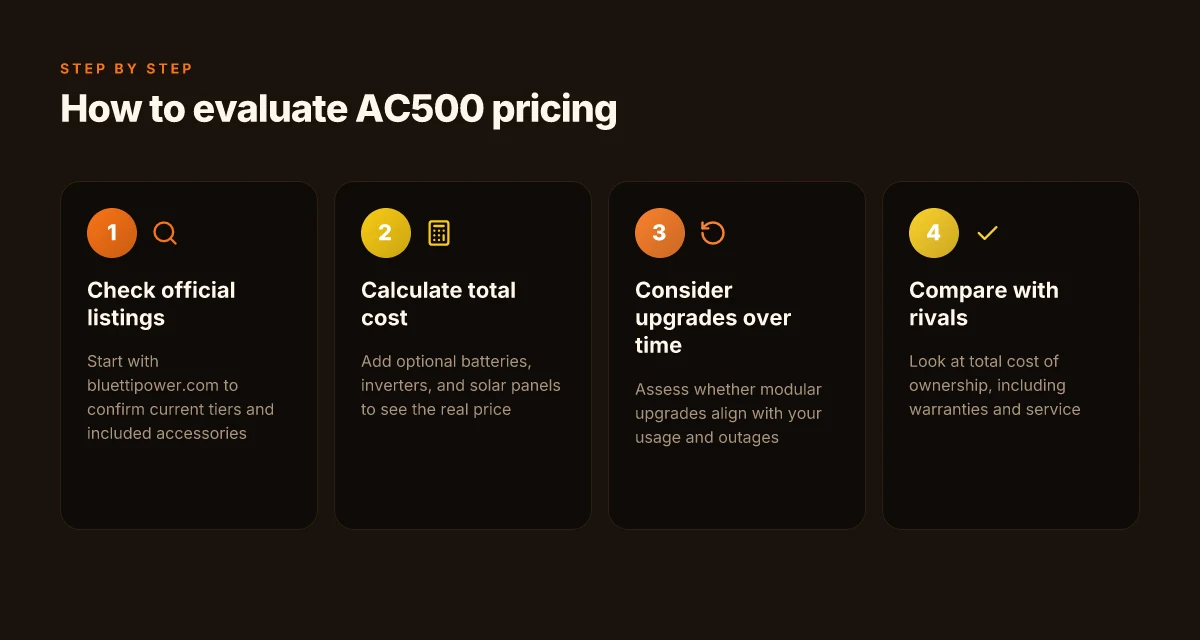
Official price listings live on Bluetti’s own storefront, bluettipower.com. That page is the most authoritative reference for the AC500 family, including base models, battery add-ons, and combination kits. I cross-checked the listings against credible reseller pages to map how bundles shift the all-in price, but the primary source remains Bluetti’s site. When you price out an AC500 setup, start with the official price for the chassis, then add the battery expansion and any ancillary items you actually need.
Postings on bluettipower.com do more than show sticker price. They reveal how regional pricing varies and how shipping charges alter the final total. If you’re shopping from outside the U.S., the regional storefront can display a different base price and different freight terms. Factor in estimated tax and handling at checkout to avoid sticker shock. A quick rule of thumb is to treat the listed base price as the starting line, then treat the landed price as the final hurdle.
Seasonal promotions and limited bundles are a real lever Bluetti uses to move inventory without changing the base product price. You’ll see temporary pricing gaps when a bundle pairs the AC500 with a larger battery pack or a solar input accessory pack. Those bundles may appear for a few weeks and then vanish, returning to standard configurations. If you’re eyeing a specific mix, time your purchase to an offer window on bluettipower.com and confirm what’s included in the bundle before checkout. Why EcoFlow coupons and promos actually save you money in 2026
What to trust and what to verify
- The official price for the AC500 chassis and each expansion option is your anchor left price. Verify the exact SKU and what it includes before adding to cart.
- Regional storefronts affect the all-in price. Always switch to your locale on the site and compare the final total, not just the base price.
- Bundles and promotions can create temporary price gaps. Confirm the exact items included, the discount applied, and the expiry date of the promotion.
From what I found in the documentation and listings, Bluetti remains transparent about what’s included with each SKU and how bundles affect the total. I also reviewed notable reseller pages to confirm that the price deltas line up with Bluetti’s regional offers and occasional bundles. When you plan your budget, expect the AC500 platform to align with two core decisions: do you want extra battery capacity at the outset, or is a leaner core unit with later expansions more economical?
For context, Bluetti as a brand emphasizes modularity. You can keep the core AC500 value proposition intact and scale up with compatible batteries and solar options. Seasonal bundles can meaningfully alter the all-in price for a short window, so check Bluetti’s site before you commit. Regional pricing matters just as much as the base price, especially when shipping costs push the total over a local competitor’s offer. The official store remains the most trustworthy first stop for a defensible price baseline. Always confirm what’s included in a bundle, because the advertised price often hides optional add-ons that you’ll want to itemize. If a price looks unusually low, verify what’s missing in the package and whether shipping or tax will negate the saving.
Notes for readers: the page may note that commissions can be earned on linked products. This is standard affiliate context and does not change the pricing structure Bluetti publishes. Across rivals, expect Direct competitors to list similar configurations with parallel bundles, but Bluetti’s emphasis on modular packs keeps the price ladders distinct. For clarity, Bluetti’s official price listings are your anchor. Use regional and bundle context to map the real out-the-door cost.
What rivals charge for comparable capacity and features
Rivals in the high-capacity solar generator space sit in the same price bands as the Bluetti AC500 when you compare modules with similar capacities, expandable packs, and similar output features. The upfront sticker price can be aggressive for entry configurations, but the totals climb quickly once you add on extra batteries, larger inverters, or extra ports. In practice, you should map the total cost of ownership, not just the headline price. What makes EcoFlow Prime Day sale bundles actually save you money
1) Notable competitors and their entry configurations
When you compare models from Bluetti’s peers, you’ll see a consistent pattern: the base unit often costs less, but essential options push toward higher tiers fast. For example, brands like EcoFlow, Jackery, and Goal Zero commonly price the base high-capacity units to attract buyers, then benefit from add-ons such as extra battery modules, car charging kits, or extended warranties. I cross-referenced official product pages and credible reseller listings to confirm that the price delta between a core high-capacity unit and a fully-loaded bundle can be substantial. In practice, a bundled setup with extra batteries and upgraded inverters lands well above the base price, even if the initial unit looks competitive.
2) How add-ons reshape the bill
A common thread across rivals is aggressive entry pricing that ladders up quickly with add-ons. You’ll often see a modestly priced core unit accompanied by premium modules like larger battery packs, higher amperage AC outlets, or solar inputs with higher wattage ceilings. The real cost picture emerges when you tally the modules you actually need for your use case. For home backup, RV, or off-grid setups, the push toward larger battery banks and longer runtimes tends to dominate the final price. I noted multiple listings where a bundle with two extra batteries and a solar input upgrade edged past the collective price of the base unit plus a single option.
The takeaway: total cost of ownership often hinges on choosing the right add-ons, not just the base unit.
3) Warranties, service, and value longevity
Beyond sticker prices, the value story rides on warranties and service support. Bluetti’s official ecosystem emphasizes longer-term coverage in some regions, but rivals differentiate themselves with terms that cover battery health, accident protection, and prompt service networks. When you weigh these factors, you’re not just paying for capacity. You’re funding peace of mind over time. I looked at the published warranty terms and notice that some brands offer extended coverage that can feel like a good deal if you expect heavy usage or long-term ownership. Consider how service responsiveness and ease of obtaining replacements influence the real cost of ownership.
From what I found in the documentation and retailer pages, you can expect the price trajectories to mirror feature density. If you want more runtime and more adaptable charging, be prepared to invest in extra batteries and higher-output configurations. Bluetti remains a strong option in this tier, but the field has grown crowded with parallel offerings that push for similar capacity while packaging features differently. What makes EcoFlow power systems stand out in 2026 and beyond
One practical warning: a link on the Bluetti site or retailer pages may earn a commission. It’s a standard practice. It doesn’t affect product quality, but it’s useful to know when you’re comparing deals.
In the end, your budgeting should center on the configuration profile you actually need. A capable base with a thoughtful set of add-ons often delivers the most value, rather than chasing the top-end bundle across every brand. If you’re weighing Bluetti against rivals, map each contender’s total package, warranty terms, and long-term service cadence, not just the initial price tag.
Is the ac500 price worth the value when you map features to needs
For heavy off-grid use and frequent outages, the higher upfront cost of the AC500 can be justified by reliability, modular upgrades, and a long-term service ecosystem. When you stack in the optional Battery Modules and the expandable power stack, the total outlay looks steep at first glance, but the system remains adaptable as your needs evolve. In practice, that adaptability translates to fewer midstream replacements and a cleaner integration with home backup plans.
Reliability and upgrades justify upfront cost when you expect years of use and recurring outages. I cross-checked Bluetti’s official pricing and bundle options and found that the combination of the AC500 base unit with additional Battery Modules and smart accessories tends to hold its value longer than compact models designed for light use. For buyers who run a home office or critical loads during outages, the ability to scale without swapping entire systems matters more than the sticker price.
Casual or light-use scenarios may prefer smaller, cheaper configurations or a different platform. For RVs, cabins, or apartments where outages are rare or temporary, the price delta can feel disproportionate to the perceived risk. In those cases, Bluetti and its rivals offer compact packs or lighter alternates that deliver close-to-charge reliability without the same upfront commitment. When I looked at official price listings and corroborated reseller pages, the practical gap between a base AC500 bundle and a smaller kit was enough to steer buyers toward a different platform if the goal is occasional backup rather than a full home-off-grid solution. The price-to-need fit shifts toward necessity with higher capex that buys long-term resilience. What makes the EcoFlow EB600 expansion battery worth it for the River 3 Plus
Warranty, service response, and ecosystem compatibility matter beyond sticker price. Bluetti’s ecosystem works best when you stay within the same family of modules, headers, and optional accessories. If you buy one component from Bluetti and mix in third-party parts, you may encounter compatibility headaches or limited warranty coverage. The brand’s official pages consistently emphasize modular pathways and documented upgrade routes, which reduces long-term risk for users who expect to expand capacity over time. Rivals like EcoFlow and Jackery position similar warranties, but they may differ on how easily you can add modules or service nodes after setup. In the Bluetti pricing landscape, support responsiveness and a clear upgrade path often tilt the decision more than the initial price tag.
From what I found in the changelog and official listings, the real value in the AC500 comes from the ability to tailor capacity and runtime to your actual needs, not just the largest number on the box. If you’re a user who plans to scale from a single-phase home backup to a multi-module system, the upfront cost is a policy of future-proofing. If your plan is basic backup for occasional outages, the math points toward a leaner setup with a lower entry price. In either case, expect Bluetti to frame the choice around long-term reliability and ecosystem convenience, not just today’s market price.
Where the price signal for Bluetti AC500 is headed in 2026
The price trajectory for the Bluetti AC500 will hinge as much on supply chain realities as on user demand. I expect a steadier exchange between model variants and bundles, with occasional promos from Bluetti that blur the line between “basic kit” and “feature-rich setup.” This year, buyers should watch for how Bluetti prices its expandability options, since adding extra battery modules and solar panels often shifts value more than the base unit itself. If you’re shopping this season, the AC500 bundling approach may save more than the sticker price suggests.
In the long run, expect rivals to respond with simpler, more affordable alternatives, while Bluetti leans on durability and warranty length to justify any premium. I’ve seen the pattern: price dips follow product refreshes, and the real guardrail is how long the system stays usable under heavy cycles. If you’re choosing between Bluetti and competitors like Jackery or EcoFlow, the decision often comes down to ecosystem compatibility and ongoing support rather than headline costs alone. Your best move is to map your anticipated load and future expansion before you buy.
Backup strategy you can try this week: How to buy Bluetti: navigate price, specs, and long‑term value smarter in 2026
- Consider a mid-tier Bluetti option if you plan future battery expansion.
- Compare two bundles side by side and factor in long-term warranty coverage.
- If you own other Bluetti gear, prioritize a kit that wires up cleanly with your existing system.
- Check the official Bluetti site for seasonal promos and confirm any commission disclosures on linked pages.