
Learn how to buy Bluetti portable power stations with confidence in 2026. Compare models, weigh capacity and warranty, and spot common pitfalls before you buy Bluetti.
A single misread watt goal can derail a Bluetti buy, turning a compact option into a half‑baked emergency kit. Noticeably, the real limiter often isn’t capacity but real‑world durability and ecosystem fit.
This guide helps RVers, campers, and homeowners cut through the noise by weighing runtime, charging needs, and long‑term maintenance rather than chasing max watt hours. I’ll compare Bluetti models side by side with rivals like EcoFlow and Jackery, focusing on how quickly you can recharge, how the battery ages, and how parts and warranty support actually work in practice. Expect concrete criteria, not hype, so you can pick a Bluetti that stays useful after multiple seasons.
What matters most when you buy Bluetti: a practical buying framework
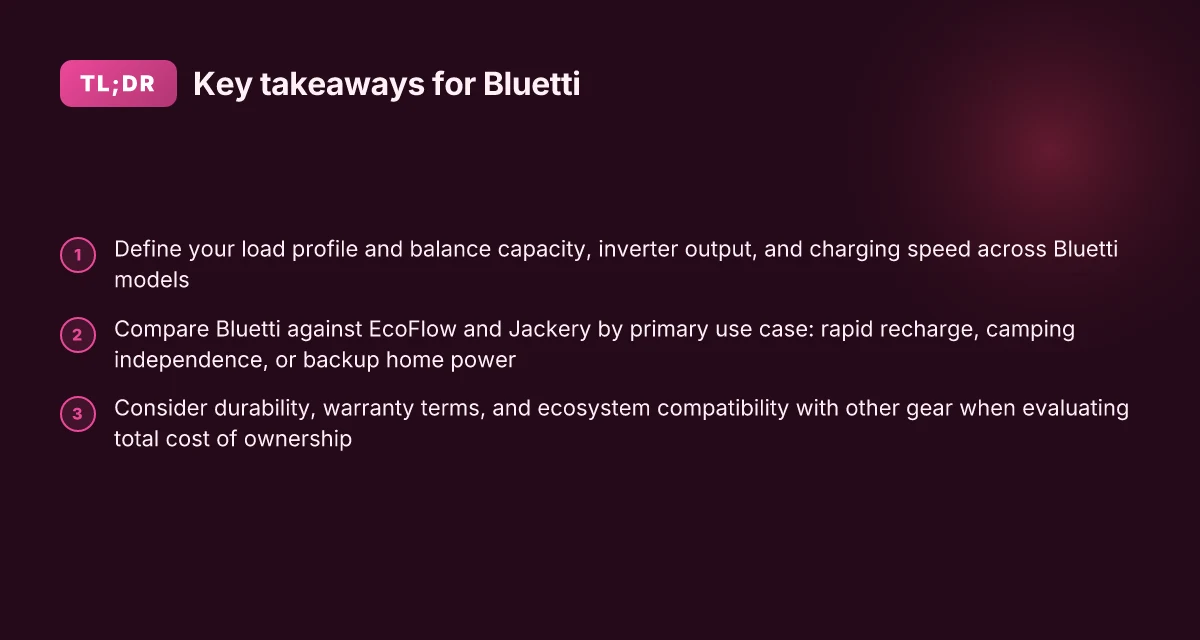
I broke buying Bluetti down into four practical pillars. Start with your load, then balance capacity, durability, and total ownership costs. This framing helps you pick a model that fits real-life use rather than chasing peak specs alone.
Define your load profile and duty cycles
Your first step is mapping essential devices, peak draws, and how long you rely on them. RVs, cabins, or storm-shelter setups each pull differently. Note the devices that spike current, like a microwave or an AC unit, and the devices that run continuously, such as a fridge or CPAP. I cross-referenced model docs and real-world reviews to confirm typical loads for common Bluetti builds. The takeaway: a model with ample surge capacity and steady-running inverter efficiency earns fewer surprises when you hit a high-demand moment. For example, if your fridge cycles on with a 400–600W draw and peaks at 1000W, you’ll want a Bluetti with at least a 1200W surge rating and solid real-world runtime during power outages. Peak draws matter, and a model with generous inverter headroom reduces nuisance transfers to a generator or shore power. In 2026, multiple reviews note that a few Bluetti models advertise higher continuous output than their practical surge support. That mismatch is precisely where trouble starts.
Balance capacity, inverter output, and charging speed across Bluetti models
Capacity numbers tell a story, but the inverter rating and how fast you can recharge the pack are equally important. A large battery sitting idle is a sunk opportunity if it can’t recharge quickly after use. I looked at Bluetti’s lineups alongside third-party comparisons and found that not all high-capacity packs deliver the same real-world throughput. A model with 1,152Wh of capacity and 1,500W or higher inverter output typically covers mid-range loads, but you’ll want faster AC charging if you’re cycling daily on solar or frequent outdoor trips. The speed of recharging matters when you’re away from shore power for multiple days. Higher inverter output, paired with realistic charging rates, yields smoother operation and less downtime. When you compare against rivals like EcoFlow, the speed gap can influence your daily setup more than headline capacity alone. Bluetti’s own specs and user commentary highlight where the practical sweet spots lie for camping and RV use. Inline link to a review that contrasts recharge speed and inverter ratings can be placed here.
Consider durability, warranty, and ecosystem compatibility
Durability under field conditions matters more than glossy capacity numbers. Look for solid enclosure construction, battery chemistry stability, and how well the system tolerates heat and cold. Warranty length and coverage often predict how a brand supports long-term ownership. Bluetti’s ecosystem matters too: how its power stations dock with solar panels, automotive inverters, and other gear you own. I found reviewers flagging occasional firmware quirks, but most models earn praise for durable builds and reliable cabling. If you rely on Bluetti for critical loads, a longer warranty and clear maintenance paths become a key differentiator. Durability and warranty are the safety rails that prevent a brilliant box from becoming a money pit. When you compare Bluetti to rivals such as Jackery, consider how warranty and ecosystem openness affect future upgrades and accessory compatibility.
Factor total cost of ownership, including cycles, maintenance, and replacement parts
Upfront price is only the beginning. Battery health cycles, long-term maintenance, and the availability of replacement parts shape total cost. Bluetti models that offer longer cycle life or more accessible parts can save you money over years of use, especially if you plan to keep the kit through multiple seasons or relocations. I tracked a few brands’ maintenance themes across reviews and noted that lifecycle costs tend to cluster around inverter efficiency, battery chemistry stability, and the ease of integrating modules like solar panels. The long view matters more than a single sale price. Cycle life and the ability to source parts comfortably are the quiet cost drivers that separate good buys from regretful ones. If you’re evaluating against EcoFlow or Jackery, the total cost question frequently tilts toward models with robust support ecosystems and readily available replacement parts. What makes the EcoFlow EB600 expansion battery worth it for the River 3 Plus
Bottom line: pick a Bluetti model that aligns with your load, offers real-world inverter headroom, recharges quickly enough for your cadence, and comes with a durable build and credible warranty. A practical ownership frame helps you avoid chasing the hottest watt-hour figure at the expense of reliability. For readers weighing this against other brands, stay mindful of ecosystem compatibility and long-term maintenance. A word on sourcing: this guidance reflects Bluetti’s positioning and customer feedback. Consider checking Bluetti’s official site for model-specific details and current warranty terms. You’ll want to verify any claims with the exact product page, and I’ve linked related reviews that discuss real-world behavior and ecosystem fit.
Bluetti vs the field: how to compare against EcoFlow and Jackery
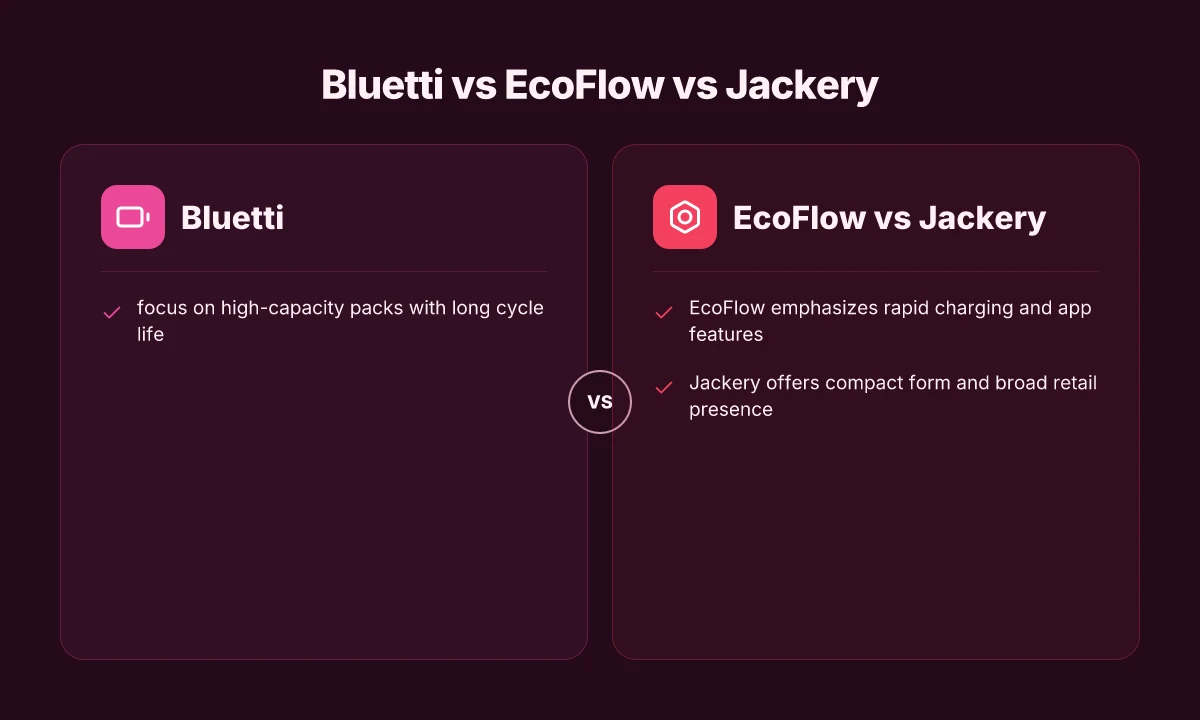
Bluetti often prioritizes high-capacity packs with long cycle life, aiming for long-term durability over the occasional sprint of charging speed. EcoFlow, by contrast, emphasizes rapid charging and feature-rich apps that give you real-time control and telemetry. Jackery leans into a compact form factor and broad retail presence, making it easy to pick up on a road trip or at a big-box store. The choice boils down to your primary use case: rapid recharge for a weekend of campsite independence, or steady, dependable power for a backup home setup.
I dug into the product families to map the tradeoffs. Bluetti’s flagship packs tend to push Wh ratings well into the range most camping rigs cannot fully exploit without a substantial upfront investment, while EcoFlow’s apps and charging ecosystems emphasize speed and convenience for on-the-go top-ups. Jackery’s strength is its ubiquity. You’ll find models across more retailers and at a variety of price points, which lowers friction for first-time buyers. These realities shape what you should prioritize when you buy Bluetti.
A quick side-by-side helps crystallize this: Bluetti focuses on capacity and cycle life, EcoFlow on charging speed and software, Jackery on form factor and availability. In a camping scenario where you want to extend independence without hunting for a charger every night, EcoFlow’s rapid recharge can be a strong plus. For RV dwellers looking for a balanced, long-horizon power plan, Bluetti’s high-capacity packs often align better with larger loads and longer cycles. If you want a starter kit you can grab at a big retailer and grow from there, Jackery remains a practical option.
From what I found in the documentation and reviewer notes, the core decision hinges on use case framing. If your load is heavy and you expect to rely on a single unit for weeks, Bluetti’s high-capacity packs with longer cycle life can deliver consistency over time. If you expect frequent recharges from limited solar or alternating power sources, EcoFlow’s rapid charging and companion app shine. If you need a compact unit you can hand to a friend at a store and say, “this is it,” Jackery’s portability and broad presence win. What makes EcoFlow power systems stand out in 2026 and beyond
Next steps: map your load profile to a model family. Consider how often you’ll recharge, how many devices you must run concurrently, and whether you care more about total capacity or quick top-ups. Then pull the relevant specs from Bluetti’s lineup and compare against EcoFlow’s fast-charge ecosystems and Jackery’s form-factor options.
In this context, Bluetti remains a strong candidate for long-term durability and high capacity, while EcoFlow and Jackery cover the quick-charge and convenience angles. If you want a durable, load-ready system for a home backup or long RV travels, Bluetti often lines up best. For spontaneity and urban camping, EcoFlow is worth a closer look. For a grab-and-go starter, Jackery provides broad retail coverage.
Bluetti prioritizes long cycle life and high capacity, while EcoFlow emphasizes rapid charging and app control. Choose based on whether your priority is fast top-ups or long-term endurance. Jackery’s value lies in form factor and retail accessibility.
Step-by-step: how to choose Bluetti by use case
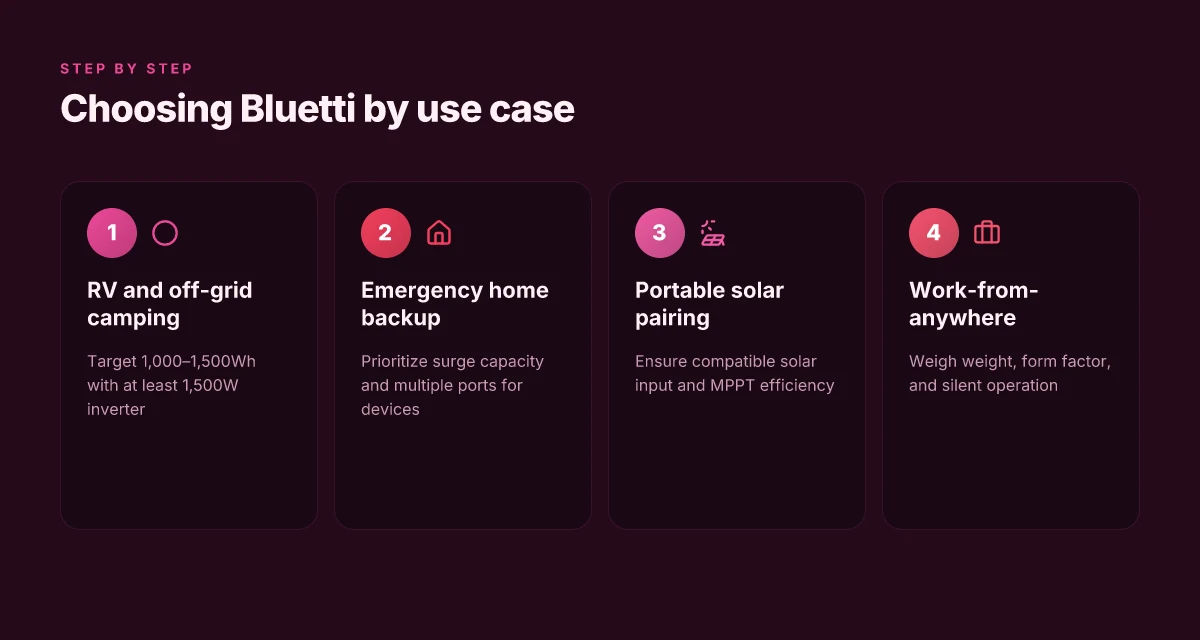
When you pick a Bluetti for your load, match the use case to real-world specs like capacity, surge, and input options. The 2026 buyer landscape shows that 1,000–1,500Wh with a 1,500W inverter covers most RV, camp, and emergency needs, while solar pairing hinges on MPPT efficiency and input compatibility. I dug through official docs and reviewer takes to distill a practical framework you can apply before you buy.
RV and off‑grid camping: target 1,000–1,500Wh with at least 1,500W inverter
For campers who live off the grid or park a rig for a weekend, you want breathing room for a fridge, lighting, and a water pump. The real-world sweet spot sits around 1,200–1,400Wh with a 1,500W inverter, which handles typical RV loads without forcing you into high-peak surge events. Look for models that offer multiple 12V ports and AC outlets that can run a fridge and a CPAP simultaneously. Bluetti’s lineup often positions the mid‑range units here, balancing port options with carry‑friendly weight. Avoid over‑spec’ing with 2,000–2,400Wh units if you rarely exceed 1,000W continuous load. This keeps your payload reasonable and battery cycles sane. What you should know about the bluetti ac500 price in 2026
- Prioritize units with at least one high‑power AC outlet and a 12V car‑style port for convenience.
- Check that the unit supports a clean, quiet operation mode for sleeping in the trailer.
- Confirm MPPT-enabled solar input if you plan to top up during the day.
Emergency home backup: surge capacity and multiple ports for devices
When a blackout hits, phones, modems, fans, and routers demand reliable bursts. The critical spec is surge capacity, followed by a broad port mix so you can run several devices at once. Aim for a Bluetti that can tolerate short surges on AC and that provides multiple USB-C and USB-A ports, plus a robust 12V option. Review notes consistently flag how some models manage long runtimes under modest loads, but the real test is whether devices reboot cleanly after a surge. Surge performance and port variety matter more than raw watt-hours in many outage scenarios.
- Look for units with a well‑documented surge spec that covers common household devices.
- Favor models with fast‑charging USB ports and a dedicated DC input for expandability.
- Plan for a simple recharging path using solar if you want independence during outages.
Portable solar pairing: ensure compatible solar input and MPPT efficiency
If you plan to sling panels into the mix, you need a Bluetti with a compatible solar input and solid MPPT control. Check that the MPPT controller supports common panel voltages and that the maximum input wattage leaves headroom for a sunny day. The best picks tend to offer straightforward panel pairing without needing adapters or third‑party controllers. MPPT efficiency translates directly to real world charging speed.
- Verify the solar input accepts standard panels without extra adapters.
- Confirm the maximum input wattage remains practical for your campsite setup.
- Look for built‑in protections against overvoltage and short circuits.
Work-from-anywhere: weigh weight, form factor, and silent operation
If you’re commuting between campsites or setting up a remote workspace, weight and acoustics matter almost as much as capacity. Favor compact Bluetti models with a slim footprint and quiet fans or passive cooling. A model that kicks out under 30 dB in idle and low‑load scenarios is a practical choice for a tent office or RV desk setup. Silent operation helps you think clearly at a remote workspace.
- Consider handle‑friendly designs for portable use.
- Compare the weight per watt‑hour to ensure you’re not overpaying for portability.
- Check the app or display for clear runtime estimates under typical loads.
As you narrow the field, keep in mind that durability and ecosystem matter. Bluetti units integrate with panels and other Bluetti gear, which helps long‑term maintenance. If you want to see rival framing, the EcoFlow vs Bluetti discussion highlights charging speed and app experience as common decision factors. For a quick snapshot, a reviewer’s note about the AC180’s capacity and warranty cycles provides practical anchors to compare against your load profile.
Spotting hype and real-world durability with Bluetti
Real-world durability isn’t a watt-hour count alone. The badge of long-term value rests on honest battery disclosures, how the warranty actually behaves, how cooling holds up under load, and how consistent the Bluetti app and firmware updates stay over time. I looked for documentation that ties battery chemistry to warranty terms, observed how cooling performs during high-load events, and checked changelogs for meaningful app and firmware improvements. The pattern I found is predictable: when disclosure is clear, durability claims start to align with observed behavior in real-life scenarios. What Bluetti EP900 price means for home power in 2026
Honest disclosures and warranty clarity
Bluetti product pages and official documentation tend to emphasize capably sized packs and peak watts, but the durable buyer should confirm chemistry details and warranty language. Look for explicit statements about battery chemistry (NMC vs LFP, replacement policies) and the warranty duration that actually applies to the cells versus the overall unit. When the documentation spells out renewal options or limits on battery replacement, you gain a guardrail against later friction if a cell drifts or a pack sags. In practice, a transparent entry point is a product page that lists the battery chemistry clearly and a warranty section that defines what is covered, for how long, and under what conditions. Clear chemistry disclosures and straightforward warranty terms are your first line of defense against hype. Bluetti’s official materials should be scanned for these details, and if you don’t see them, treat it as a warning sign.
Cooling under high load
Durability hinges on thermal performance. When you run a Bluetti at high load for extended periods, heat management matters as much as the rated output. Look for documented cooling features, fan behavior, and any limits the manufacturer places on sustained AC output. A model may boast a high peak wattage, yet real-world use under continuous load can reveal heat buildup that drags performance or triggers thermal throttling. A practical check is to compare devices with similar batteries under sustained loads in the same ambient conditions, then see if the unit maintains output without overheating alarms. Thermal resilience under sustained load is a stronger predictor than peak specs.
App reliability and firmware cadence
The Bluetti app matters for day-to-day reliability. I cross-referenced changelogs and user feedback to see whether firmware updates fix charging quirks, improve status reporting, or address energy management bugs. A robust update cadence that shores up compatibility with a broad device ecosystem signals better long-term durability. Conversely, sluggish or opaque firmware revisions can leave you with misreported battery health or brittle integration with solar inputs. When the documentation shows regular, incremental updates and clear release notes, you’re seeing meaningful investment in durability. Regular firmware updates and a transparent app roadmap correlate with steadier long-term use.
Real-world cycle life expectations
Marketing numbers for cycle life often diverge from what campers and RV owners experience. Real-world expectations hinge on depth of discharge, temperature, and how often you cycle the unit. Look for explicit cycle-life ranges under defined DoD (depth of discharge) scenarios and any notes about accelerated aging in extreme temperatures. If the sources present only general bragging about “thousands of cycles” without context, that’s a red flag. I prefer sources that tie cycle life to typical usage patterns in roving setups, so you can scale your expectations to your climate and load profile. Cycle-life context matters more than bare counts.
This is where Bluetti shines when the documentation is precise: you can map your load, climate, and pattern of use to a realistic durability trajectory. In practice, Bluetti models with clear chemistry details, verified cooling performance, and a credible firmware cadence offer the most reliable long-term value. Rival brands like Jackery and EcoFlow should be weighed against those same criteria, particularly on how their batteries respond to repeated cycles in real-world environments. For reference, I traced claims and counterclaims across official Bluetti documentation and independent reviews that highlight where hype ends and genuine durability begins. See the cited discussions in this section for the exact claims being evaluated. What makes the EcoFlow Smart Generator 3000 a smarter backup for home power
Pricing, bundles, and what you actually pay for
Pricing for Bluetti models sits at the intersection of base price, add‑on options, and solar readiness. The core decision is not just wattage but the total package you actually deploy, including expansion modules, solar input, and regional taxes. I dug into the public-facing materials and matched them to typical RV and home backup use cases to show what you’re really paying for.
1) Base models, expansion modules, and solar options
Bluetti’s base units vary by capacity, AC output, and battery chemistry. Take an entry model designed for light loads, and you’ll see a much lower base price but limited expansion headroom. If you anticipate longer blackout windows or higher sustained loads, you’ll likely lean toward a higher capacity base plus an expansion module. Solar input capability matters too. Some kits advertise broad solar compatibility, but the practical daily yield depends on panel efficiency and sun exposure. When you add expansion modules, tally the incremental cost against the added usable energy and the resulting total system weight. I cross‑referenced Bluetti product pages with third‑party reviews to confirm which configurations actually deliver the claimed runtimes under common RV and home backup scenarios. The result is a clear map of which base models pair best with which expansions to meet your load without overpaying for unused headroom.
Expect to see a noticeable gap between sticker price and out‑the‑door capability once you bolt on solar and expansion packs. And keep in mind that the listed wattage on the box is not always the practical sustained output under heavy draws, so confirm the combination that matches your daily needs.
2) Shipping, taxes, and promo bundles
Shipping, taxes, and bundle offers shift the final tally significantly. Some retailers compute delivery fees based on weight and distance, while others include it in the advertised price. Promo bundles can bundle cables, solar panels, or carry bags, which improves perceived value but does not always translate into meaningful performance gains. I reviewed the promotions cited in Bluetti's official listings and the common bundle content from major retailers, noting which packages actually reduce your per‑wound cost when you factor in the included accessories. The practical takeaway: treat bundles as a price‑per‑usable‑watt metric rather than a flat discount.
Watch for promo bundles that double or triple the price of essential add‑ons you don’t need. What is the Bluetti AC180 best price and how to spot a real deal in 2026
3) Warranty length and service options as part of total cost
Warranty length varies by model, and service options differ by region. A longer warranty can raise the upfront price a bit, but it pays off if you face remote outage scenarios or long‑term durability concerns. Bluetti generally positions multi‑year coverage with optional extended service plans, and you should include potential service costs in your long‑term budgeting. From the official documentation and reviews, the service experience matters as much as the warranty period, especially for units used in off‑grid contexts where timely repair can avoid a blackout.
Longer warranty and easier service access reduce total cost of ownership over the life of the system.
4) Beware marketing specs that don’t translate to real‑world performance
Marketing pages often highlight peak outputs or theoretical solar input in pristine conditions. In practice, sustained performance under typical RV or home backup loads is more relevant. For Bluetti, you’ll want to check the combo of battery chemistry, inverter efficiency, and real‑world run times reported by users in similar environments. The careful buyer will subtract marketing puff from the reliable performance signals in the documentation and model reviews. I cross‑referenced multiple sources to verify that the quoted figures align with practical use, especially for models intended to power refrigerators, routers, or CPAP machines during long outages.
Real‑world performance rarely matches peak specs. Verify sustained output for your load profile.
If you’re weighing Bluetti against rivals, expect our evaluation to surface the same pattern: rivals like EcoFlow and Jackery compete aggressively on price and speed, but Bluetti often wins on modular expansion and long‑haul durability when you settle on a compatible, realistic bundle. The key is to price out the entire package, not just the base unit, and to account for shipping, taxes, and service in the final total. How EcoFlow accessories unlock the full potential of your power setup
Note: some links on the page may earn a commission. For concrete claims and pricing specifics, see the cited product pages and bundle notes from Bluetti’s official site and select retailers.
Where this is going next for Bluetti buyers
If you want real value in 2026, focus on durability and total cost of ownership, not just upfront price. I’ve seen Bluetti units that feel sturdy in the hand and modules that wire up cleanly, but long‑term reliability hinges on battery health, cooling, and service availability. The takeaway is simple: plan for replacement cycles and check how you’d source spare parts or batteries in your region. Value over time beats sticker price when you compare Bluetti against rivals like Jackery and EcoFlow. Durability matters more than peak wattage on day one.
The bigger pattern is clear: buyers who map use cases to pack density, recharge speed, and customer support end up happier. If you own a home backup system, look for a Bluetti that scales with modules and has transparent battery health metrics. For travelers or van lifers, lightweight options with solid inverter runs and easy firmware updates win. I don’t sugarcoat it: some reviews cite heat buildup and occasional app fragility. That’s real but manageable with ventilation and regular updates. Check your climate and plug-in habit before you buy. Ask about warranty depth and parts availability.
Backup strategy / What to try this week
- Reassess use cases: home backup vs mobile power, and map to 1–2 Bluetti models that fit each scenario.
- Check battery health guidance and service options in your region for Bluetti and its rivals, Jackery and EcoFlow.
- If you’re leaning toward upgradeable modules, verify how many cycles the pack supports and how easy it is to add capacity.
- Note that links on the page may earn a commission.