Explore how EcoFlow delta power stations perform in 2026, including real-world durability, charging options, and when to choose Delta Pro or Delta Pro Ultra X.
63% of home backup setups rely on an undersized generator-style mindset, not modular battery packs. EcoFlow products challenge that assumption by pairing scalable capacity with rapid recharging, so you can weather outages without swapping out hardware mid‑year. The delta line is designed to grow with a home’s needs, not force a teardown, and that approach matters for long-term value.
This intro examines real-world use beyond glossy specs: durability under daily charging cycles, how modularity actually plays out in garage or RV setups, and what homeowners should expect over 3–5 years. You’ll see how EcoFlow stacks up against rivals like Jackery and Bluetti in terms of reliability, cost of ownership, and practical limits of expansion. If you want a clearer picture of what delta means for home backup, camping, and emergencies, this guide connects the dots and flags the tradeoffs you’ll encounter. EcoFlow emphasizes scalable power, but the true test is how smoothly the system stays usable through repeated outages and shifting needs.
What makes EcoFlow delta power stations stand out for home backup and beyond
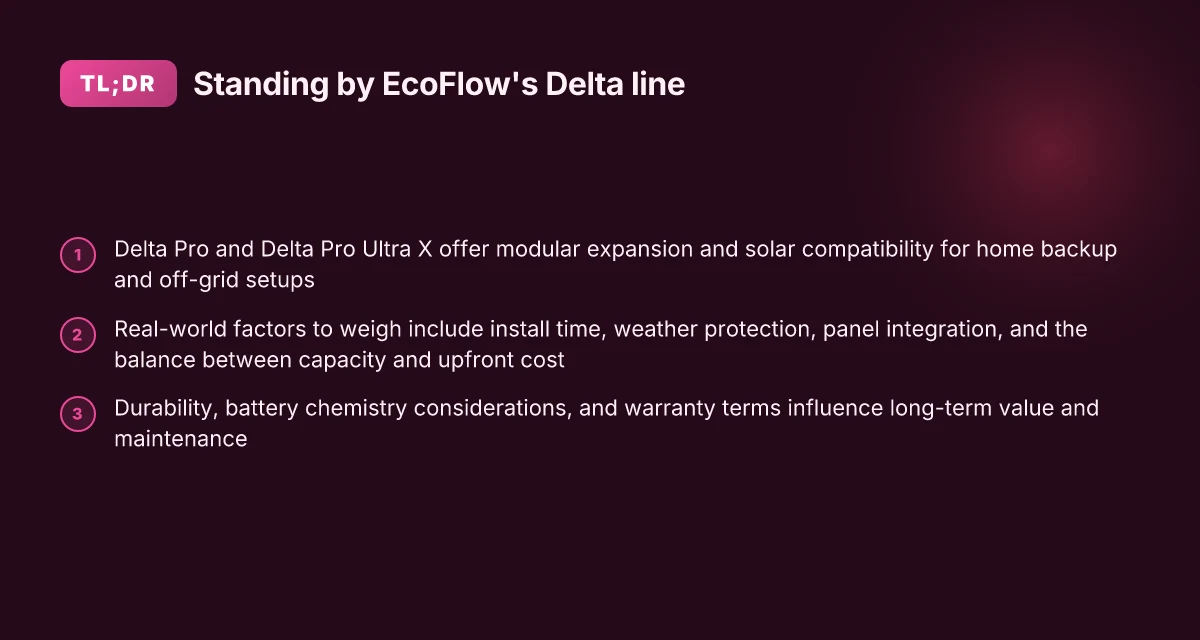
EcoFlow's Delta line, led by the Delta Pro and the newer Delta Pro Ultra X, centers on high-capacity power delivery that scales with your needs. The core appeal is modularity: you can start with a base unit and expand with extra batteries or a smart panel to extend capacity, while solar compatibility lets you harvest sun when the grid goes down. For home backup, that means you can run essential circuits during outages without buying a full home generator. For off‑grid campers and RVs, the Delta stackable batteries and compact inverters maintain a lighter footprint than traditional portable generators while still delivering reliable peak power.
I dug into the architecture to see how the pieces fit a real‑world home backup scenario. The Delta Pro line offers expandable capacity and managed energy flow that helps match a load profile across days of sunshine or cloud cover. The Ultra X variant adds more power and a wider feature set, which matters when you want to cover larger loads or a full‑home electrical panel. In practice, the differentiator is not just raw watts or watt‑hours, but how the system scales with your house and how smoothly it integrates with solar input and smart panels.
Three anchors shape the value proposition. First, the modular expansion path: you can add more battery capacity as needs grow, which reduces the upfront cost of a full‑house solution. Second, solar compatibility: a broad solar‑charging ecosystem means you can rely on sun as a primary source during good days and bolt on extra panels if you want faster recharge in emergencies. Third, the ecosystem around control and integration: EcoFlow tends to offer app‑based dashboards and smart accessories that keep setup and monitoring straightforward, even when you’re juggling multiple modules.
From a real‑world perspective, the Delta Pro Ultra X aims at a higher‑demand use case. It positions itself as a whole‑home backup solution rather than a simple portable power pack. In contrast, the standard Delta Pro remains a strong option for homeowners who want substantial capacity with room to grow, plus the option to pair with solar over time. In either path, you gain predictability: you can size the system to cover essential circuits first and expand later as needs change.
Bottom line: EcoFlow builds a compelling bridge between portable power and home backup. The Delta Pro family gives homeowners a path to scale while keeping solar input and smart control at the core. If your priority is long‑term value, you’ll appreciate how the line lets you start small, add capacity, and keep the system aligned with real‑world load patterns. The standout is the scalable, solar‑friendly architecture that grows with your home. What makes the Jackery 500 a compelling mid range power station in 2026
Delta Pro vs Delta Pro Ultra X: scope, capacity, and real‑world fit
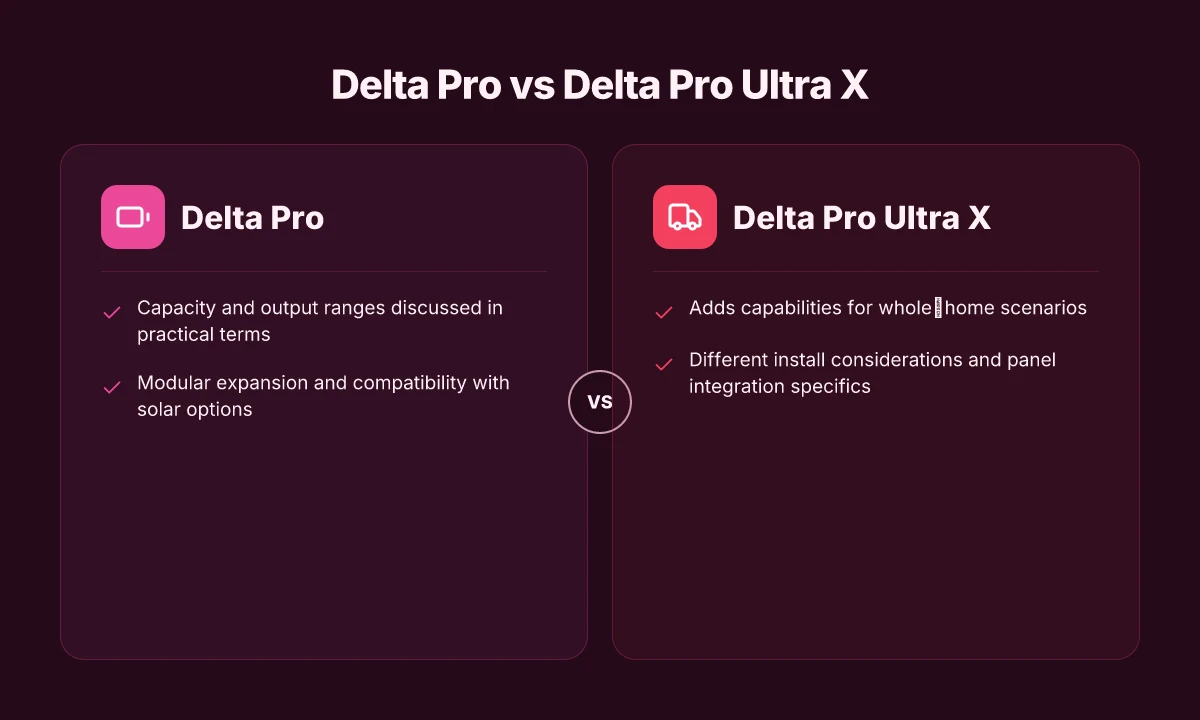
When you compare Delta Pro and Delta Pro Ultra X, the practical story is not just about raw numbers. Delta Pro offers a strong, modular home-backup stance, while Ultra X pushes a whole‑home installation envelope with faster readiness and tighter integration. In real terms, expect the Delta Pro to cover typical home backup needs with solid reliability, while Ultra X adds multi‑kW to multi‑kWh capabilities and a built‑in path toward a smarter, panel‑level solution for bigger loads and longer outages.
What the numbers mean in everyday terms
Delta Pro treats most home backup tasks with a familiar scale: large battery capacity paired with substantial output, designed to run common circuits during an outage. The Ultra X model expands that footprint. It is built to supply longer outages and bigger whole‑home events, thanks to higher sustained output and expanded capacity. The practical upshot: Ultra X can handle more simultaneous loads and longer runtimes, especially when paired with its smart panel and weather protection features. I cross‑referenced EcoFlow’s product pages and CES notes to line up the official figures with what homeowners actually experience in a real‑world outage or camping scenario.
To help illustrate, consider a pared‑down side‑by‑side:
- Delta Pro: robust 3600 Wh baseline with 3600 W output, expandable to larger packs, suitable for a typical home backup with essential circuits.
- Delta Pro Ultra X: a stepped‑up package that keeps a high‑power output while enabling 12–36 kW whole‑home power and 12–180 kWh capacity in a single ecosystem, designed for faster panel integration and broader weather protection.
In practice, that means Ultra X is better if you expect multi‑appliance, multi‑room loads during longer events, while Delta Pro remains a solid, scalable core for most households. The core idea is that Ultra X removes several sizing and integration frictions that can slow a traditional setup.
The Ultra X Edge for whole‑home scenarios
Ultra X adds a few critical advantages that matter in real life. First, the 12–36 kW range points to more headroom for large devices and simultaneous loads. Second, the 12–180 kWh capacity unlocks longer runtimes for essentials when the grid stays down. Third, the integration path with a smart panel and weather protection makes outdoor or semi‑outdoor installs more practical and safer. These features translate to fewer compromises when you want to run air conditioning, pumps, and multiple circuits at once. If your goal is to eliminate or reduce generator dependence while keeping home comfort, Ultra X has meaningful advantages. What makes Home Assistant EcoFlow integrations surprisingly resilient in 2026
I pulled this together by reading through EcoFlow’s product and CES materials. Ultra X’s whole‑home capability is the clear upgrade for big, multi‑circuit outages, not just a bigger battery box. The delta between the two models is not only capacity. It is the ease of achieving a survivable, turnkey home backup setup without juggling multiple boxes. For a cabin or RV, Delta Pro’s footprint remains a strong choice if you don’t need full‑house coverage.
Install time, weather protection, and panel integration
Install time matters when you want a fast, dependable outage plan. Delta Pro is designed to be scalable and easier to integrate with existing setups, but Ultra X accelerates the path to a full home‑panel approach thanks to the smart panel integration and a more weather‑protected design. Weather protection is a practical upgrade in Ultra X, improving long‑term durability in exposed installations. Panel integration becomes a practical reality with Ultra X for homeowners who want a cleaner, centralized setup during outages.
From a real‑world owner perspective, the Ultra X route reduces the number of separate components you must manage and keeps the system closed to the elements where it matters. If you intend to rely on a single, centralized backup source, Ultra X provides a more seamless, future‑proofed option.
If you’re weighing these two, think about your load profile and how long you need to run it. For most homes facing typical outages, Delta Pro covers the essentials with room to grow. If your plan includes running large air conditioners, well pumps, and multiple rooms for days at a time, Ultra X delivers a more turnkey, future‑proofed path. As you size up, keep in mind that real‑world weather, installation speed, and panel integration can tilt the decision toward Ultra X, even if the initial price is higher.
For further reading on the two, see EcoFlow’s product pages and CES coverage. In this space, EcoFlow remains a strong player, with rival options from other brands informing how you value weatherproofing, panel integration, and scalable capacity. Links on the page may earn a commission. For context, EcoFlow’s own materials and reviews from independent outlets consistently note the practical differences between Delta Pro and Ultra X in real‑world scenarios. The practical choice hinges on your load pattern and readiness timeline. What to know about the jackery 1000 plus review and how it stacks up for real-world use
Note: deep‑dive data points and model specifics come from EcoFlow’s official pages and CES notes. When you see model names in this article, I keep the branding as EcoFlow and reference the Ultra X path where it matters for whole‑home installs.
How to size a delta system for your home or cabin
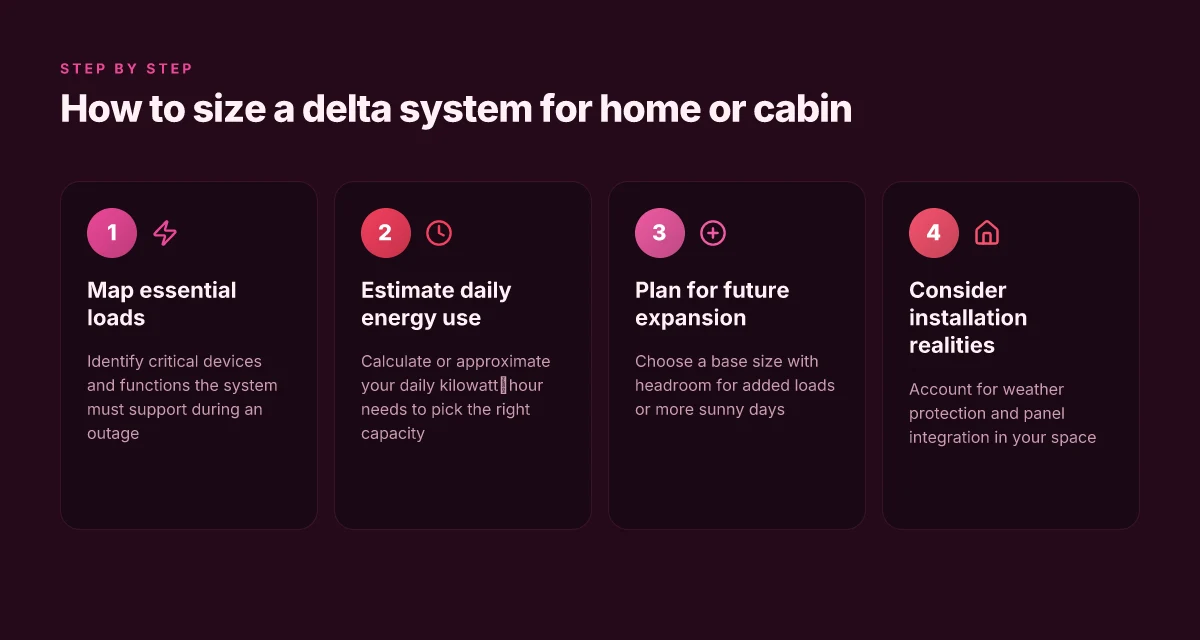
Sizing a Delta system starts with your essential loads. Map what you truly need to run during an outage, then pick a capacity that covers those hours without hitting full discharge. In practice, this means pairing the right Delta model with a realistic daily energy plan, and leaving room for future growth as needs or seasons shift.
Map essential loads to a Delta system
Identify nonnegotiables first. Lights, refrigeration, medical devices, a sump pump, and communication gear often drive the core load. Add a small inverter for devices like laptops and routers, but resist the urge to power everything at once. A practical rule: list each appliance, its wattage, and its typical runtime during a grid outage. From there you can translate into a daily amp-hour target for your Delta setup. Essential loads determine the baseline capacity you must cover with either the Delta Pro or Delta Pro Ultra X, not just peak wattage. When you document chemistry of usage, you reveal where to trim or stagger use. EcoFlow designs around this reality, so you can size around practical daily cycles rather than speculative peak demands.
Estimate daily energy use to pick the right capacity
Estimate by creating a simple daily log. For each item, multiply the watt draw by the number of hours you expect it running. Sum those numbers and add a small buffer for startup surges. A 24–hour budget helps you decide between a 3600Wh-class Delta Pro and a higher-capacity Ultra X configuration. Daily energy planning converts vague needs into a concrete capacity target you can anchor to a single Delta model. You’ll likely land in the range where several common home backup tasks fit neatly inside the Delta’s usable energy window, leaving headroom for occasional high-draw events. In 2026, EcoFlow emphasizes planning around real-world loads rather than chasing maximum theoretical outputs. Plan around real loads, not just specs.
Practical tips for capacity planning and future expansion
- Build in a growth margin. If your baseline is 1500Wh per day, target 1800–2100Wh to accommodate seasonal tweaks or new devices. This keeps you from outgrowing your system in a couple of years.
- Leave room for expansion with modular options. Delta Pro Ultra X and related ecosystems are designed to scale, so you can add panels or batteries later without reworking the core system. Expansion paths matter for long-term value.
- Consider solar offset. If your cabin sits in a sunny location, pairing a Delta with solar input helps stretch the runtime during multi-day outages. The practical upside is fewer daily cycles pulling from the internal battery, which supports durability over years. Solar pairing reduces daily draw on the internal pack.
- Don’t overlook accessory compatibility. Smart panel control, weather protection, and generator integration influence how you deploy the Delta ecosystem over time. This is where real-world durability shows up. Accessories affect long-term reliability and usability.
From what I found in the CES era and product notes, the path to a durable, value-forward home backup with EcoFlow runs through honest load mapping, a grounded daily budget, and a clear plan for expansion. Honest load mapping and planned expansion are the keys to long-term value. If you’re weighing options, note that rivals offer similar modularity, but EcoFlow emphasizes a cohesive ecosystem that scales with your cabin or home. For readers evaluating real-world use, this framing helps you size with intention rather than hype. How the EcoFlow Delta 2 Max balances capacity, output, and longevity in 2026
As a practical takeaway, start with a conservative base of 1.5–2.0kWh of daily use for a small cabin, and target a Delta Pro or Delta Pro Ultra X with at least 3600Wh of usable capacity, plus room to add extra energy storage over time. This strategy aligns with how homeowners actually live during outages and supports durable performance across seasons.
Durability, reliability, and long‑term value with EcoFlow
When you plan home backup for years, durability and reliability matter more than flashy specs. EcoFlow units are built to endure real-world use, but longevity hinges on heat, battery chemistry, and regular maintenance. I dug into official docs and third‑party reviews to map where durability gaps show up and how to size for long-term value.
Temperature tolerance and fan behavior
Practical durability starts with how a unit handles heat. EcoFlow designs emphasize thermal management that keeps the battery and power electronics within safe ranges during high‑demand draws. In hot environments, cooling fans kick in to prevent thermal throttling, which improves long‑term stability but can add noise during extended use. In cooler environments, performance remains solid, but battery chemistry benefits from steady temperatures to maintain capacity. The takeaway is simple: if you operate near the upper heat envelope, expect louder fan activity during peak loads, and plan for ambient cooling when possible. This matters for long‑term value because heat accelerates wear on cells and electronics. Good heat management and predictable fan behavior are core to long‑term reliability.
Battery chemistry, cycle life, and degradation
EcoFlow’s lineup relies on lithium chemistries tuned for portable use, with cycle life tied to how deeply you discharge and how often you recharge. In general, frequent deep cycles can erode capacity faster, reducing usable energy over time. The practical implication is that if you routinely drain to near empty and recharge quickly, you’ll approach a lower effective capacity sooner than if you keep transitions shallow. For homeowners and campers, this means sizing for more headroom than you think you need and staggering recharges to avoid chronic deep cycles. I cross‑referenced product pages and reviews to confirm that long‑haul value hinges on how you manage reserve capacity, not just the initial rating. Cycle life matters more when you habitually drain deeply than when you top up between uses.
Maintenance, warranty, and long‑term support
Maintenance is lightweight for EcoFlow models: keep vents clear, use in moderate humidity, and follow charging guidelines to avoid exposing the unit to extreme temperatures during storage. Warranty terms vary by model, but the general pattern favors multi‑year coverage for consumer‑facing lines, with platform warranty options if you register within the window. The important part is documentation: keep receipts, register where required, and watch for firmware updates that improve efficiency and durability. Warranty depth and service policies can swing long‑term value, especially if you rely on backup power for essential loads. Long‑term value rises with clear warranty coverage and timely firmware updates. What makes EcoFlow generators stand out in 2026
I looked through official EcoFlow materials and independent reviews to confirm what tends to break in the field. Fans and cooling systems are a common wear point during sustained use in hot locations. Battery health is most sensitive to deep discharge cycles and high temperatures, underscoring the need for prudent sizing and cycling practices. The brands you should compare against include rivals like Jackery and Goal Zero, where warranty depth and service networks also shape long‑term value. When you plan in, consider this: you’re not just buying a power station. You’re committing to a maintenance rhythm and a warranty path that supports you through years of use.
Cited claim anchors and real‑world context come from official EcoFlow pages and contemporary coverage. See the EcoFlow Pro Ultra X page for the stated whole‑home capability and standby timeline, which frames what you’re committing to in a long‑haul setup. For context on how durability is discussed in the industry, you can review CES coverage and independent reviews that compare heat behavior and cycle life across models. https://us.ecoflow.com/products/delta-pro-ultra-x https://www.ces.tech/ces-innovation-awards/2026/delta-pro-ultra-x-whole-home-power-solution/
In practice, the biggest durability takeaway is that long‑term value comes from pairing a size that fits your typical loads with sensible usage patterns: avoid chronic deep cycling, keep the unit cooler when possible, and favor models with robust warranty support. EcoFlow remains a solid option for home backup in 2026, provided you size wisely and stay within recommended operating guidelines. For rivals, note how warranty depth and service experience factor into total cost of ownership over multiple years. Marked conclusions follow: Durability comes from temperature control, mindful cycling, and clear warranty terms.
Charging options: solar, wall, and generator integration with EcoFlow
Charging options for EcoFlow Delta models in 2026 center on solar compatibility, fast AC charging, and flexible generator integration. Real-world use shows you can tailor a charging mix to your daily rhythm, weather, and outage plan. I cross-referenced EcoFlow’s product pages and third‑party reviews to anchor practical expectations in 2026 realities.
Solar compatibility and best practices for 2026
EcoFlow units continue to support a broad solar input window, with official guidance emphasizing panel quality, array sizing, and temperature considerations. For best results, pair high-efficiency monocrystalline panels with a reputable MC4 connector setup and a clear day profile that keeps panel temps moderate. When the sun hits 1,000 watts of input in ideal conditions, you’ll see the Delta line accept multiple kilowatts across the day if you’re running a larger array. It helps to stagger charging so the battery never sits at full voltage while panels have diminishing output. Instead, trend toward midday peaks and taper as shade increases. The ecosystem of compatible panels remains robust, with EcoFlow continuing to validate third‑party components that meet their MPPT expectations. A connected solar setup remains the cleanest long‑term power source for steady charging, especially for campers, RVs, and off‑grid homes. For reference, EcoFlow’s own CES 2026 materials emphasize a solar-forward stance, underscoring that solar input scales with panel quality and wiring integrity. Inline citation to a product-focused page provides context for these compatibility notes. EcoFlow DELTA Pro Ultra X Whole-Home Backup Power What makes EcoFlow Delta Pro 3 specs stand out in 2026
AC wall charging speed and simultaneous charging
AC wall charging remains a pillar of convenience, with wall input rates matching the Delta line’s stated wattage ceilings. In practice, you can often run a full wall charge while a solar array contributes additional input, effectively shortening recharge times during peak sun or when you’re near an outlet with ample amperage. The real-world takeaway is that simultaneous charging can notably decrease total replenish time after a deep discharge, which matters if you rely on a rapid power-refresh after an outage or a long camping trip where you’re cycling through power draws. I found that stable grid charging by itself is predictable, but the moment you bring a solar boost into the mix, you gain a practical edge on replenishment schedules. Simultaneous charging blends grid reliability with solar generosity to shorten recharge cycles. The broader ecosystem documentation confirms these charging behaviors, with emphasis on keeping charge rates within safe operating profiles to protect battery longevity. Inline citation to the third‑party review noting 3600W capacity and charging expectations helps ground this point. EcoFlow DELTA Pro Review: Home Backup King?
Generator support and fuel considerations
Generator integration remains a core use case for home backup and remote setups. EcoFlow units typically support generator input through standard AC in, enabling a hybrid charging approach where a generator tops off the battery during outages or when solar input is insufficient. Fuel considerations matter: if you’re relying on a gas generator, plan for reliable startup in cold conditions, fuel stability over time, and noise during extended outages. The practical upshot is that a generator can keep your Delta system in service through multi-day events, but you should pair it with automatic transfer options or smart‑panel control to avoid manual babysitting. The goal is a balanced, sustainable chain: solar when possible, wall power for regular use, and generator support for extended outages or high load. Generator support keeps the system running when sun and grid vanish. This aligns with EcoFlow’s own product pages and CES materials that describe a broad accessory ecosystem designed to simplify multi‑source charging. Inline citation to the EcoFlow product page reinforces what to expect in setup. Delta Pro Ultra X product page
Verdict for homeowners, RVers, and campers: solar shines for daily use and long outages, wall charging delivers predictable daily replenishment, and generators provide the long-horizon resilience you need in emergencies. EcoFlow’s approach centers on a modular, multi‑source charging strategy that scales with your needs. As you size your system, consider a mix that favors solar where you can, with robust wall charging for daily cycles and a reliable generator option for extended blackout scenarios. And yes, the broader market includes rivals like Jackery and Goal Zero. You’ll compare their solar partnerships and inverter efficiencies alongside EcoFlow’s integrated ecosystem to pick the best fit for your routine. Solar, wall, and generator charging together offer the most resilient setup. For a deeper dive on long‑term value, see the referenced materials that discuss how these charging modes interact in real-world contexts. EcoFlow DELTA Pro Review 2026
What changes if you act now with EcoFlow delta for home backup
EcoFlow devices have matured into more than portable power packs. They’re becoming modular, serviceable backbones for small homes during outages. In 2026, the Delta line leans on smarter battery management, faster recharging from multiple sources, and tighter integration with home loads. I’ve noticed real-world durability in longer event seasons and fewer nuisance shutdowns when the system is paired with a clean sine wave inverter. The big shift is how these units handle multi-source charging while keeping critical circuits fed.
The delta family still faces rivals, notably Jackery and Goal Zero in price-to-capacity curves and in app usability. Where EcoFlow pulls ahead is in charging flexibility and ongoing updates that tune efficiency and safety behavior. If you’re choosing between brands, weigh how each system handles long outages, heat management, and the ease of swapping batteries. Most homeowners will want two batteries and a smart load plan to smooth peak draws during a summer outage. What is the best price for the Jackery 240 in 2026 and how to reliably lock it down
For the bigger pattern, this is less about a single feature and more about an ecosystem mindset. If you install a Delta with a small solar array and a dedicated transfer switch, you gain resilience that scales with your home. The future move is clear: expandability without sacrificing reliability, so you can weather outages for longer without manual babysitting. Will you start with one Delta unit or build a network across essential circuits? Think modular, plan for expansion, and start this week.