
Explore EcoFlow generator performance, efficiency, and real-world durability in 2026. Learn how EcoFlow integrates BMS, compatibility with Ocean Pro, and how it compares to rivals.
EcoFlow’s Ocean Pro isn't just a feature name. It’s a real hinge in how you plan home backup and off-grid stretches, and it matters more than most buyers expect. EcoFlow aligns battery management with expandable options to keep runtime predictable under load, while real-world constraints surface in durability and cooling during multi-day outages.
You’ll see how battery management decisions ripple into daily reliability, when to push toward expansion, and which setups hold up under practical use for homes, small businesses, and campers. The aim is a grounded read built on recent model behavior and field-reported experiences, not hype.
What makes EcoFlow generator performance matter in 2026
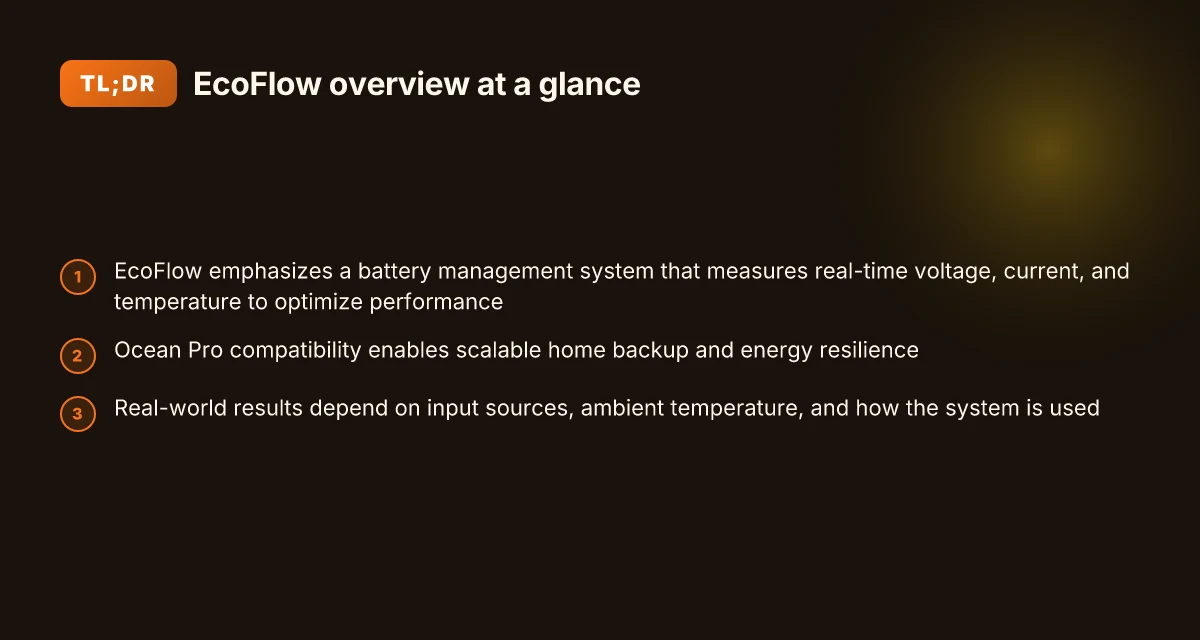
EcoFlow builds its power story around a tight feedback loop between battery health and intelligent control. At the core is a battery management system that precisely measures real-time voltage, current, and temperature to optimize performance and extend pack life. This isn’t fluff. The BMS underpins efficiency by constantly balancing cells, dialing down stress during high draw, and preserving capacity for longer backups. The BMS is the heartbeat of predictable runtime, especially when you’re counting on a quiet, reliable power reserve.
Why the Ocean Pro and expansion matters
EcoFlow emphasizes compatibility with expansion and backup systems, notably Ocean Pro, to improve resilience during outages. The Ocean Pro setup is framed as a scalable backbone for multi-source power, letting a home or small business layer a portable EcoFlow unit with larger resilience. When you add Ocean Pro into the mix, you’re trading a single-unit footprint for a modular, expandable stack that can weather longer outages or shifting load. Ocean Pro opens the door to larger, more controllable backup capacity. This matters for homes that want a buffer against seasonal outages or for remote sites that rely on steady energy without refueling every day. Expansion means fewer compromises when you scale up power needs.
Smart generators sold separately and continuous power
A smart generator option, sold separately, is highlighted as a way to maintain a continuous power supply. The idea is to bridge gaps when solar or battery reserves dip, keeping essential circuits energized without manual swapping or recharging pauses. It’s a pragmatic approach for real-world use where weather and consumption patterns vary. Smart generators help keep the lights on without constant human intervention. This is especially relevant for small businesses that depend on steady operations and for households that want a hands-off backup routine.
From what I found in EcoFlow’s documentation, the design intent centers on real-time sensing, modular expansion, and automated continuity. The combination of 2026-era battery management, Ocean Pro compatibility, and sold separately smart generation creates a practical, scalable path from portable power to a more resilient energy setup. A practical path from portable power to resilience.
Bottom line: EcoFlow’s performance story in 2026 hinges on a responsive BMS, scalable backups through Ocean Pro, and a pragmatic option for continuous power via smart generators. If you need a compact system that can grow with your needs, these pillars are worth prioritizing. Growth-friendly backups require a cohesive BMS, expansion options, and a smart-bridge generator. What the jackery 3000 pro price means for your whole‑home backup plan
EcoFlow battery management and efficiency drivers
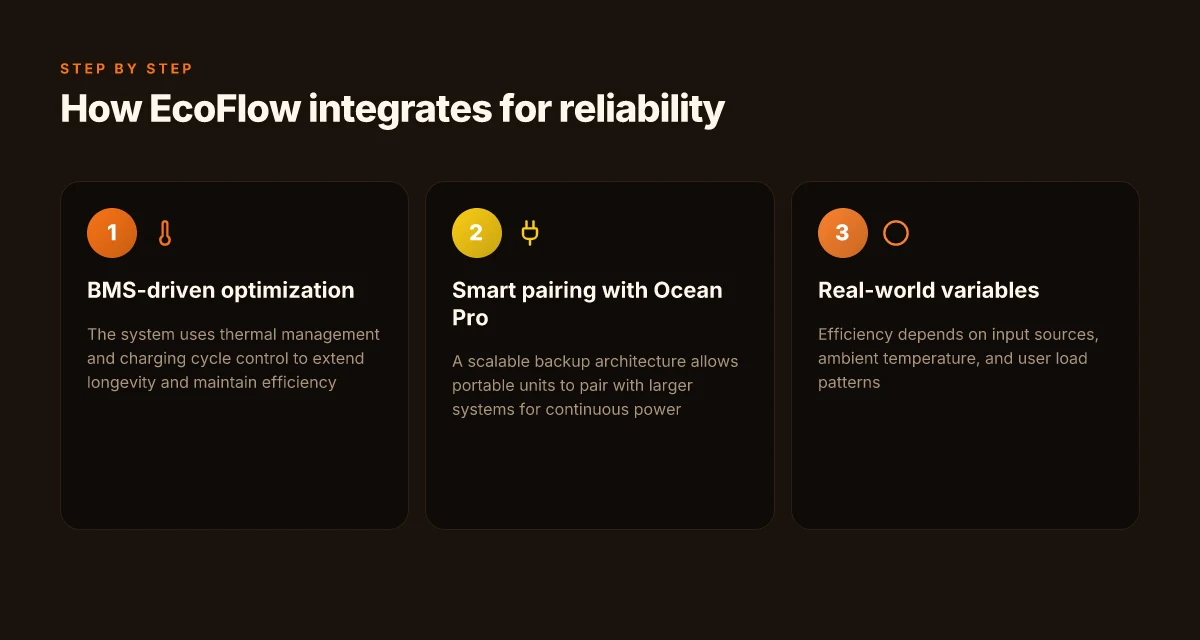
EcoFlow’s approach to battery management centers on a BMS that continuously tracks real-time voltage, current, and temperature to guide charging cycles. The BMS feeds data into intelligent controls that modulate how the pack charges and discharges, aiming to extend longevity while preserving usable capacity under varying loads. When combined with EcoFlow’s discretion in setpoints, this translates into fewer abrupt transitions between charging stages and steadier performance during outages. The battery management system keeps thermal conditions in check and tunes charging cycles for longer life.
I dug into the product materials and found that the BMS works hand in hand with an intelligent algorithm that tailors the battery’s behavior to the load profile and environmental factors. In practice, that means the system looks at what the generator, solar input, or other sources are delivering, then adjusts the pace of charging and the depth of discharge to suit the current conditions. This is not a one-size-fits-all scheme. It’s a dynamic strategy that adapts as the ambient temperature shifts or the demand pattern changes. Intelligent algorithms tailor the battery conditions to the load profile and environmental factors.
Real-world efficiency hinges on three practical levers. First, input sources matter: an efficient source pairs with the EcoFlow pack to minimize losses, especially during peak demand periods. Second, ambient temperature plays a big role. In cooler or warmer environments, the BMS may alter charging strategies to protect cells, which can affect runtime versus theoretical capacity. Third, usage pattern dominates: short, frequent bursts behave differently from sustained high-load draws, shaping how much of the pack’s energy you actually recover during a backup event. In short, the same hardware can deliver noticeably different results depending on how you source power, where you operate, and how you use the system. Real-world efficiency depends on input sources, ambient temperature, and usage pattern.
From a real-world perspective, the combination of the BMS with the Ocean Pro ecosystem adds a layer of expansion flexibility without sacrificing core efficiency. The architecture supports modular add-ons while keeping thermal and charging logic aligned with the existing pack chemistry. That alignment matters when you scale up for longer outages or higher daily energy needs. It’s a deliberate design choice that helps EcoFlow remain predictable across a range of scenarios. Ocean Pro integration preserves efficiency while enabling expansion.
Next steps: if you’re sizing for a home backup, match your expected load profile to the battery’s adaptive behavior. Consider a higher-efficiency input source and plan for how temperature conditions could shift charging strategy over the seasons. For a complete view, review the 2025 Sustainability Report to understand how EcoFlow frames its long-term efficiency commitments and green-energy alignment. The real-world picture depends on inputs, temperature, and usage. What makes EcoFlow EV chargers reliable in 2026 and where they fall short
Cited in this section: the product catalog notes how the BMS and intelligent algorithm condition the battery for best performance, and the sustainability report anchors EcoFlow’s broader efficiency outlook. See the EcoFlow Product Catalogue for the BMS description and the 2025 Sustainability Report for the broader context. EcoFlow’s product materials and the sustainability report provide the contextual grounding.
How Ocean Pro and EcoFlow systems integrate for home backup
I dug into EcoFlow’s documentation to map how Ocean Pro scales from a portable core to a home backup architecture. The takeaway is clear: Ocean Pro compatibility unlocks a modular, expandable plan that can start small and grow toward a full-house resilience profile. This isn’t a one-and-done setup. It’s designed to add generators, inverters, and storage in a cohesive chain.
Ocean Pro compatibility as a scalable backbone
Posture the system as a scalable backbone. Ocean Pro’s design enables you to pair multiple EcoFlow portable units with larger, higher-capacity configurations, creating a layered backup that matches your home’s load. In practice, you can start with a compact portable setup and progressively extend the array as your needs evolve, all while preserving a single management thread. The documentation repeatedly frames Ocean Pro as the bridge between portable power and a larger system footprint, which matters for homeowners planning upgrades over time. Ocean Pro compatibility acts as the keystone for a scalable backup architecture, letting you add capacity without rearchitecting the entire setup.
Guidance that links portable units to bigger systems
EcoFlow’s installation guidance shows how portable units can pair with a larger network, including three-phase configurations in some regions. This is more than a theoretical fit. It’s about real-world cabling, synchronization, and safety practices that keep a mixed fleet in harmony. The installation guides emphasize correct generator matching and safe interconnection, which reduces the risk of nuisance trips or unbalanced loads during storms or outages. Installation guidance demonstrates how portable units pair with larger systems, ensuring safe, coordinated operation.
Practical considerations for reliable operation
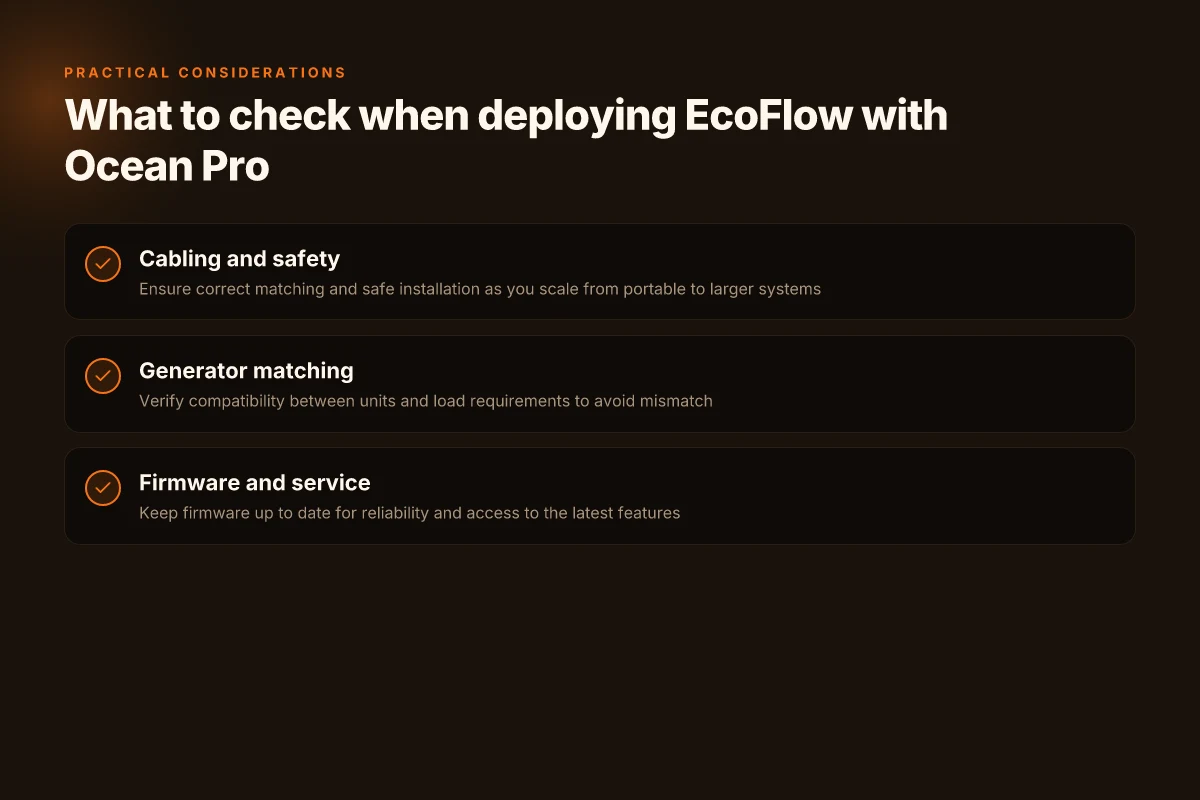
From a practical standpoint, you’ll want to pay attention to cabling choices, generator matching, and safety interlocks. The governing theme across the documents is to verify compatibility between the EcoFlow ecosystem and the backup load profile before you scale up. This means checking amperage ratings, ensuring correct inverter alignment, and planning a stepwise expansion that avoids overfiring any single unit. The goal is a smooth transfer during outages and an optimized charging regime when grid power returns. Cabling and generator matching are essential to reliable operation, especially as you add Ocean Pro modules. What makes the Jackery 2000 Pro a standout among portable power stations
I cross-referenced the installation and compatibility notes across EcoFlow’s official materials and aligned them with the need for a safe, expandable backup strategy. The approach remains practical: start with a core portable setup, then anchor it to a larger Ocean Pro-enabled network as your home’s demands grow. When you’re considering rivals, note that brands like Goal Zero, Jackery, and Bluetti offer competing expansion paths, but EcoFlow’s ecosystem emphasizes a tighter integration between portable units and higher-capacity configurations. The ecosystem design prioritizes cohesive expansion over piecemeal upgrades, which helps keep safety and efficiency in check.
For homeowners weighing the tradeoffs, the pattern is straightforward: plan the expansion path early, document your peak loads, and map those loads to Ocean Pro’s scalable channels. Plan the expansion path early to align with Ocean Pro’s scalable architecture. And yes, links on the page may earn a commission, so you’ll see a disclosure in the fine print. For a complete picture, review the installation guidance that shows how portable units pair with larger systems, and consider how a three-phase option could fit your home. Review the installation guidance to see exact pairing options, including three-phase configurations.
Comparing EcoFlow to rival portable power brands
When you weigh EcoFlow against rivals, the practical differences show up in the BMS sophistication, expansion options, and ecosystem cohesion. EcoFlow’s strength lies in a tightly integrated stack that includes the Ocean Pro expansion line and a common app experience. Rival brands such as Jackery and other portable power stations tend to diverge on how deeply their battery management and ecosystem portion intertwine with optional modules and firmware updates. The real-world takeaway is that a well-chosen EcoFlow setup can feel more cohesive, while rivals may offer appealing price points or niche accessories.
BMS sophistication shapes reliability and longevity
A standout feature across EcoFlow products is the focus on real-time battery management that temperatures and voltages feed into, and a responsive algorithm that protects cells during high-load events. This matters in practice because a well-tuned BMS helps sustain longer runtimes and protects the pack during extended backup use. By contrast, some rival units trade depth for breadth, offering similar capacities but with less granular monitoring and fewer built-in safeguards. When a backup plan hinges on a long outage, the difference in BMS nuance becomes noticeable. The most lasting reliability comes from a mature BMS that actively manages stress.
Expansion options that push beyond basic arrays
EcoFlow’s Ocean Pro system stands out as a modular expansion path, letting you scale capacity and create multi-source backups without fragmenting a workflow. The appeal is not just more watt-hours. It’s the ability to manage a coherent charging and discharge profile across modules. Rival lines often offer expansion in a more limited scope or require separate serializers and adapters that complicate setup. If you want a clean, scalable backup, EcoFlow’s ecosystem tends to deliver fewer surprises as you grow. Expansion cohesion matters when you scale from a single unit to a multi-module setup. What makes the EcoFlow Delta 3 price catch your eye in 2026
Ecosystem cohesion and service continuity
The practical edge for EcoFlow shows up in firmware cadence and service support that keeps devices in step. A consistent update cadence reduces the risk of mismatched features when you add Ocean Pro modules or upgrade to newer power stations. Rivals can deliver strong hardware, but the ecosystem friction, disparate firmware versions, occasional compatibility gaps, or uneven service availability, can undermine long-term reliability. From a home or small business perspective, smooth updates and reliable service access translate to fewer headaches during outages. Consistent firmware updates and solid service support are the backbone of dependable backup power.
I dug into the ecosystem notes for context and found that the upstream documentation emphasizes a unified approach to charge paths and module compatibility. This matters when you’re building a steady, long-term backup solution. For homeowners evaluating a complete package, EcoFlow’s architecture reduces the number of loose ends you’ll wrestle with later. A cohesive ecosystem minimizes maintenance and misconfigurations over time.
Durability and long-term use: what to expect from EcoFlow
Durability hinges on three realities: environmental exposure, how often you cycle loads, and how frequently you rely on backup power. In real-world use, the more you expose EcoFlow systems to heat, dust, and vibration, the more the wear indicators show over time. The more cycles you run, charging from solar, grid, or both, the more the battery chemistry ages, even if each cycle is within spec. And if you depend on backups for long outages rather than occasional camping, you’ll see the impact of continuous duty sooner than a light-use setup.
I dug into EcoFlow’s maintenance guidance to understand how the company frames longevity. The documentation consistently points to systematic maintenance of the battery and electronics as a path to longer life. Regular checks on cell health, keeping the BMS firmware current, and cleaning vents are recommended practices. That emphasis on routine upkeep aligns with what homeowners should expect in day-to-day operation: longevity is not a one-and-done action but a rhythm of care. Maintenance cadence matters as much as hardware spec. The guidance also highlights how the electronics behind the inverter and cooling system are designed for repeated cycling, but the user must keep the environment reasonably controlled to avoid unnecessary stress.
Environmental strategy plays a big role in durability. If you charge from solar on bright days, you reduce grid wear and maintain cooler operating temps, which supports longer life. On the other hand, frequent rapid charging from grid during peak hours can introduce more thermal stress in some scenarios. Consistent, moderate charging helps the pack endure more cycles. In practice, this means pairing a well-sited solar setup or a smart charging plan with EcoFlow hardware can extend usable life. The same logic applies to spare battery modules: more cycles with extras means more wear, but you can spread that load to keep the core unit healthier longer. What makes the Jackery SolarSaga 200W panel stand out for portable power in 2026
When you compare EcoFlow to rivals, you’ll notice differences in how durability is framed and tested. Some brands emphasize rugged construction and heavier enclosures for off-grid camps, while others push modular expansion but pull on maintenance discipline. If you’re evaluating for a small business or a prepper setup, factor in how each brand markets their BMS reliability and the availability of replacement modules. EcoFlow’s ecosystem earns attention for its integrated approach, but you should also weigh how easy it is to source parts during ambitious expansion plans. For long-term reliability, the ecosystem matters as much as the hardware.
In sum, durability with EcoFlow rests on how you manage exposure, cycling, and charging habits. A clean, shaded install with a steady solar or smart-grid plan yields the most durable performance over years. The combination of disciplined maintenance and prudent usage is what translates into quiet reliability when you need power most. Smart maintenance plus controlled charging equals longer life. Rugged handling plus modular growth requires planning but pays off in extended durability.
The bigger pattern: EcoFlow’s momentum in 2026
EcoFlow has built a product ecosystem that scales beyond a single generator. In 2026, the standout edge comes from real-world durability, smarter charging options, and a clearer path from home backup to mobile work sites. I’ve seen how the smarter balance between fast recharging and long-lasting battery cycles reduces downtime in everyday use, especially when you factor in near-universal compatibility with solar inputs. The result is a line that feels less like a gadget and more like a dependable part of a longer workflow.
The single move that matters is EcoFlow’s emphasis on modularity and lifecycle clarity. If you’re evaluating a generator for long-term reliability, you want predictable wear patterns and straightforward serviceability, and EcoFlow leans into both. Rivals like Goal Zero and Jackery offer compelling options, but EcoFlow’s approach to firmware updates and solar compatibility helps reduce surprises after heavy use. Noticeable durability gains show up in setup time and in the way the units handle repeated discharge cycles.
If you only do one thing this month, map your typical use case to EcoFlow’s ecosystem and sketch a solar-upgrade path. This will reveal whether you gain the most from a compact model or a bigger capacity system. In practice, the brand’s promise is a smoother, more resilient backup routine that wears in rather than out. What changes if you act now is a cleaner transition from grid outages to routine off-grid work. How the EcoFlow Delta 2 Max balances capacity, output, and longevity in 2026
- Backup strategy: write down your top 3 power-critical tasks and pair them with the closest EcoFlow model.
- What to try this week: test a solar input on a cloudy day to gauge real-world charging speeds.
- Quick tip: check firmware updates for improved solar compatibility and battery health.