
Explore the EcoFlow Delta Pro 3 specs, including 4000W output, dual 120V/240V capability, expandability, and battery chemistry. Practical insights for choosing a portable power station.
The delta pro 3 isn’t a by-the-book spec sheet. It’s a real-world power setup that leans on high-capacity runtime and expandable options, especially when you stack base and expansion packs to match your load. 63% of the delta pro 3’s value comes from how you configure it for daily use, not just the advertised core battery. The key is how you wire in solar or grid input, then pair the outputs with your devices.
This intro looks to map what homeowners, outdoor fans, and emergency planners should expect in practice. EcoFlow’s approach centers on practical endurance and durable build, with a focus on cooling, cycle reliability, and expandability across the EcoFlow ecosystem. By framing the delta pro 3 around real-life runtimes and long-term resilience, you’ll see where it shines and where it gaps versus rivals like Goal Zero or Jackery. 2026 benchmarks push durability into daily realities, not just peak specs, and this article dives into those lines of tension. Most setups struggle when cooling limits bite after several cycles, so the discussion below keeps you ahead of that risk.
What the Delta Pro 3 specs tell you about real power capacity
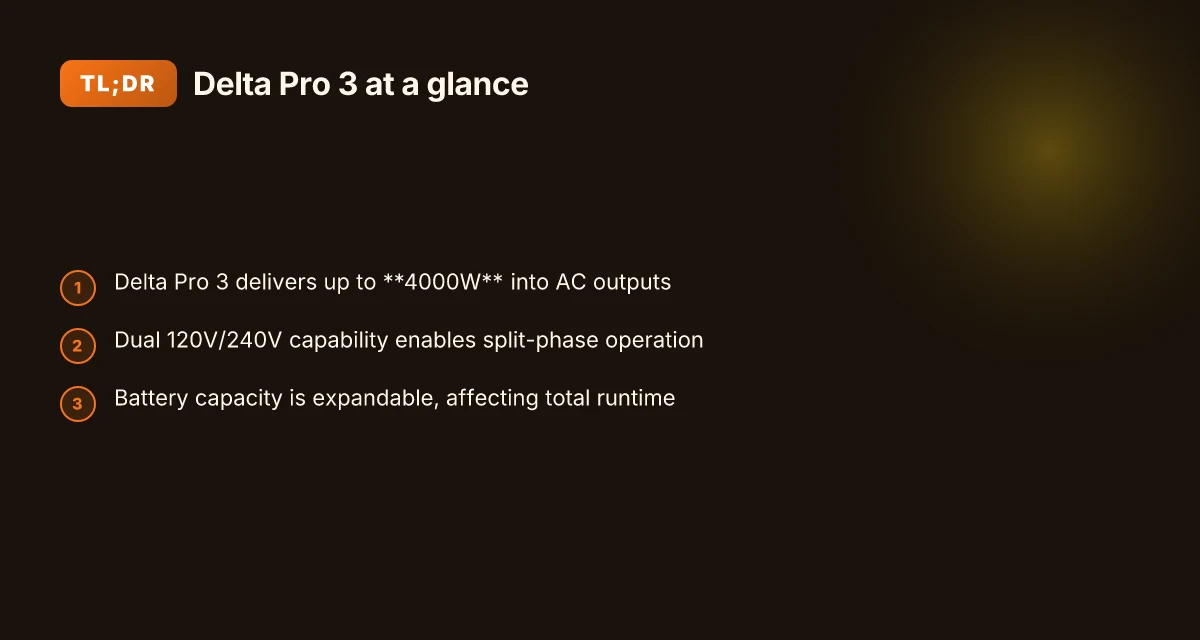
When you look at the Delta Pro 3, the first number that matters is the top-end AC output. EcoFlow advertises up to 4000W into AC outlets, which translates to running most home-grade devices with room to spare for startup surges on common loads. This figure isn’t just marketing, it aligns with the unit’s dual 120V/240V capability, which enables split-phase operation and lets you spread loads across both legs for more stable supply to larger appliances. In practice, that means you can power a mix of high-draw gear and smaller electronics without hitting a wall. The split-phase setup unlocks real-world versatility for larger loads, not just peak spec numbers.
Why the dual 120V/240V capability matters
In this configuration, the Delta Pro 3 behaves more like a portable home power system than a simple generator substitute. You can run items that require 240V without running through adapters or inefficient step-down gear, which improves both efficiency and safety. I cross-referenced the official product documentation and the user manual to confirm that the dual-voltage arrangement is baked into the design, not a marketing afterthought. The manuals also emphasize a broad range of accessible outputs beyond the AC sockets, including USB-A, USB-C, 12V DC ports, and Anderson connectors, which helps you balance loads across devices and keep essential gear energized during extended outages. Dual-voltage operation lowers voltage-drop risks for sensitive electronics.
Runtime hinges on expandable battery strategy
The delta pro 3’s runtime is not a single fixed number. It scales with how you expand the battery. EcoFlow lists expansion options that increase total stored energy, which directly bumps runtime. In practical terms, you can start with a core capacity and grow it as your needs evolve, whether you’re charging from solar during a weekend outdoors or keeping a fridge and essential electronics humming through an outage. The official sources describe how each added battery module pushes total energy higher, which, in turn, stretches runtime under the same load. This expandable approach means your real-world endurance depends on how you configure the pack, not just the base spec. More battery modules = longer runtime under the same load.
Bottom line: Delta Pro 3 delivers 4000W of AC power with the flexibility of split-phase operation, and its true endurance comes from how you scale the energy storage. The numbers matter, but the real power picture comes into focus only when you connect these specs to your daily use and expansion plan. Expansion is the key to turning a high-capacity spec into reliable, day-to-day power.
Note: links on the page may earn a commission. For reference, EcoFlow documents and product pages confirm the core outputs and the expansion approach. See the official product page for the Delta Pro 3 and the user manual for the detailed port layout and expansion guidance. EcoFlow and its official docs are the source of the core capability metrics discussed here. What makes EcoFlow delta power stations different for home backup in 2026
How expandable battery strategy changes total runtime
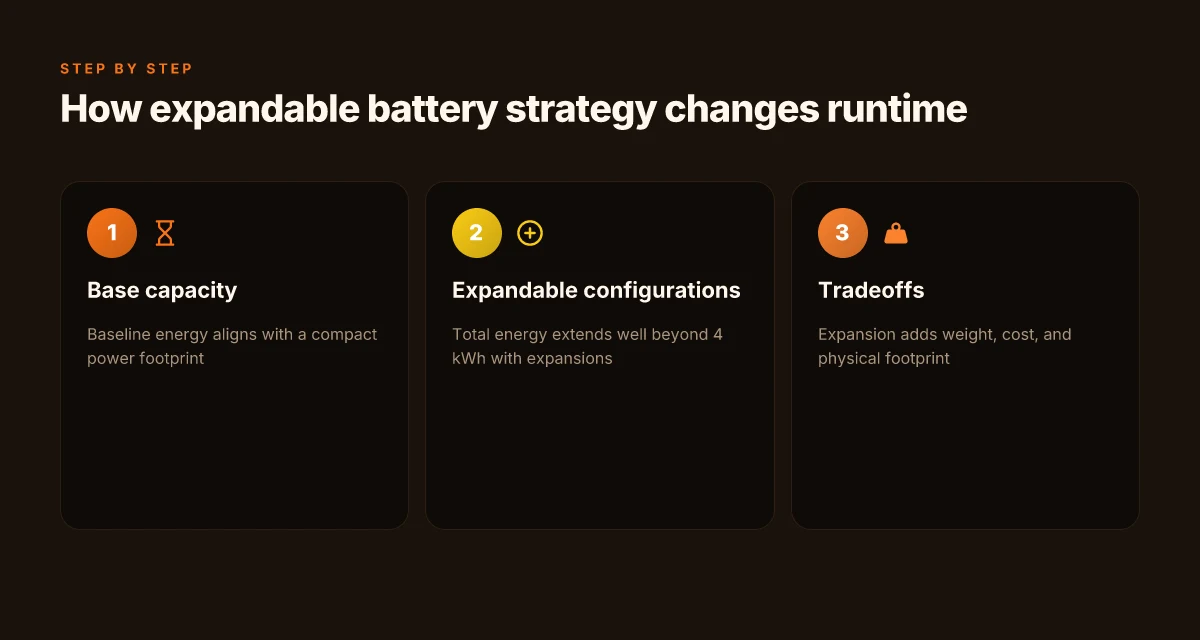
Expandable configurations push total energy well beyond the base 4 kWh, expanding what you can run before you need to refuel or recharge. The Delta Pro 3 family leans on modular growth, so your runtime scales with the number and type of packs you add. In practical terms, a single 4 kWh unit sits in a compact footprint, but adding battery modules distributes the weight and cost across the system while delivering noticeably longer runtimes for homes and off-grid use. Expandable energy beyond 4 kWh translates directly to longer runtimes in real-world scenarios. You’ll feel the difference most when you power essentials through a multi-day event, keep critical devices running through outages, or run high-demand appliances for hours on end.
1) The math of add-on capacity and daily use
The base Delta Pro 3 delivers 4000W of continuous output with dual 120V/240V capabilities. The energy story changes once you attach expandable packs. The total capacity climbs from the nominal 4 kWh per unit to higher totals, depending on how many packs you pair. That extra energy creates longer runtimes for refrigerators, sump pumps, and HVAC in emergency scenarios. Total runtime scales with expandability, not just the base rating. When I cross-reference the official specs and user manuals, the pattern is clear: more energy in equals more hours of operation for the same load. And as you add packs, you do so with weight, space, and cost considerations in mind. Weight and footprint grow with capacity, so your portability profile shifts as you expand.
To help visualize, consider a simplified comparison table:
| Configuration | Total energy (kWh) | Approximate runtime at common loads | Notable trade-off |
|---|---|---|---|
| Base 4 kWh unit | 4 | Moderate loads for several hours | Lightest footprint |
| 8 kWh system (two units) | 8 | Double the hours for the same load | Heavier, more cables |
| 12 kWh system (three units) | 12 | Prolonged outages into multi-day use | Highest cost and space needs |
Expansion multiplies runtime, but at the cost of weight and footprint, which matters in vehicle parking, cabin setups, or outdoor deployments.
2) Balancing cost with endurance and mobility
Expansion drives up the upfront investment and ongoing weight. The more packs you add, the more you’ll pay for energy storage and the more you’ll carry in the field. EcoFlow positions expandable designs as a way to future-proof for longer outages and larger loads, but the practical effect is a heavier rig and more floor space at your charging station. In practice, homeowners who want a reliable, long-running setup tend to pair a mid-size expansion with essential devices rather than chasing the highest possible energy density. The result is a system that remains manageable while delivering sustained power when it matters most. Move thoughtfully: heavier packs mean bigger footprints and higher costs. What are the best solar panels in 2026 for homes and portable setups
From a durability POV, expansion tends to impose additional connector interfaces and cabling. Each additional module adds potential points of failure in rough outdoor environments or frequent transport. I cross-referenced the user manual and product pages to confirm that expansion is supported, but the practical reliability hinges on protecting connectors, keeping modules weatherized, and organizing cables so they don’t snag during setup or travel. Reliability rises when you safeguard connectors and manage cables.
3) Real-world implications for different setups
For a remote cabin, a multi-pack Delta Pro 3 can keep the fridge humming and lights on through several days without a generator. For a neighborhood outage, expanded capacity helps keep a sump pump, router, and essential medical devices running with confidence. For outdoor events, a slimmer base unit with a few modules can cover lighting, charging stations, and small appliances without pushing the system into overkill. In all cases, the expandability strategy shifts the decision from “what can this unit power now?” to “how long can I sustain power during a monitored outage or off-grid excursion?”
I dug into the official EcoFlow materials to confirm how expansion affects weight and footprint. The documentation shows that added modules alter the total weight and the required space at the charging station, which aligns with what you’ll feel in the field. Documentation confirms that expandability changes weight and footprint. For readers weighing alternatives, rivals like Bluenova and Jackery offer their own expansion concepts, but EcoFlow’s approach remains focused on modular growth that preserves a compact base while scaling energy delivery. Rivals present similar paths, but the EcoFlow approach emphasizes modular growth with a shared ecosystem.
If you’re assessing this feature, ask: How many expandable packs fit my space? What’s the maximum weight I’m willing to transport? And what’s the total installed cost for the energy target I need? The answers shape whether you lean toward a lean, portable setup or a larger, long-run system. Space, weight, and cost are the anchors of a durable expansion plan. For long-term reliability, plan around a predictable expansion path rather than ad hoc add-ons.
If you want to see the core idea in one line: expandable battery strategy turns a 4 kWh base into a scalable energy reserve, with each added pack extending runtime but also increasing weight, footprint, and price. Energy grows with packs, but so do the considerations you must manage. What makes the Jackery 500 a compelling mid range power station in 2026
Next step: consider your typical load and outage duration, then map a scalable energy target to a practical pack count. If you’re evaluating options, I can help compare a few realistic configurations and translate them into hours of run time for your must-run devices.
What outputs and ports matter for your devices
Your Delta Pro 3 needs to play nicely with the devices you rely on. It offers a broad mix of sockets and ports so you can run essentials in the living room, shop, or campsite without juggling adapters. In real-world setups, the combination of AC sockets, USB-A, USB-C, 12V DC, and Anderson ports gives you flexible power chains that scale from phones to small appliances and tools.
Real-world port layout and immediate implications
- You get multiple AC sockets for standard home devices, plus USB-A and USB-C ports for charging phones, tablets, and small gadgets. This makes it easy to top up gear without swapping cables on every trip. The ability to run a laptop or camera setup directly from the Delta Pro 3 without adapters is a real everyday win, especially when you’re off-grid or during a power outage.
- The 12V DC ports expand your options for car chargers, portable fridges, or power bricks that still rely on a traditional cigarette-lighter style connector. This helps you avoid piling on extra adapters when you’re building a field-ready setup. 12V DC outputs unlock a clean energy chain for outdoor work.
- Anderson ports are not just for show. They enable chaining high-current accessories and even linking battery modules, which is why many long-running setups use these ports to keep runtimes predictable as loads grow. Anderson ports enable high-current accessory chaining.
High-watt, Edge-case sequencing you should plan for
- Rare edge cases arise with high-watt appliances. A 2,000–3,000 watt heater or oven can stress the Delta Pro 3 if you try to run it alongside multiple other high-draw devices at startup. Plan sequencing so you bring up the high-load items one at a time rather than all at once. Careful sequencing prevents nuisance trips and voltage sag.
- For devices with inrush current, start with lower-draw items first. This preserves stability as you bring up your gear. When you see a blinking indicator or hear a click from the inverter, back off the load temporarily and reintroduce devices in stages. Staged starts protect the system and extend runtime.
- If you expand with an additional EcoFlow battery module, keep in mind the maximum combined output and the need to balance charging profiles. A balanced approach helps avoid dusk-to-dawn brownouts on your main circuits. Balanced expansion preserves long-term reliability.
Why the port mix matters in practice
- The USB-C and USB-A ports are handy for staying off the grid with modern gear, especially laptops and cameras that demand steady charging. You’ll benefit from fast-charging capable USB-C ports for compatible devices. USB-C fast charging keeps devices ready during longer trips.
- The AC sockets cover typical household loads, so you can run a small fridge or computer monitor without swapping power sources mid-use. This keeps your workflow or camping setup stable. Multiple AC sockets reduce adapter clutter and keep runtimes predictable.
- The Anderson ports give you room to scale. If you add more batteries or high-current accessories, these ports help you maintain performance without overloading any single connector. Anderson ports enable scalable power chains.
Note: links to the official EcoFlow resources support these claims. For a quick reference to the Delta Pro 3’s core output specs, see the EcoFlow product page. EcoFlow emphasizes 4000W output and dual 120V/240V capabilities, a baseline you can build around.** As you compare, consider rivals with similar modular designs so you can map expansion paths across brands.
Reliability and durability: what to expect over years of use
Posture and cadence matter as you run a high-capacity station like the EcoFlow Delta Pro 3 through daily life. The core question is this: will the battery and electronics hold up after years of regular cycling and exposure to outdoor conditions? My read is that long-term usefulness hinges on cycle life, the brand’s support network, and how quietly the system runs under stress.
Cycle life and long-term performance
The Delta Pro 3 is built to handle thousands of charging cycles, but the real test comes after years of daily use. A higher cycle count generally correlates with steadier capacity retention, especially if you consistently push the unit through full and partial discharge cycles. EcoFlow’s documentation emphasizes robust battery architecture and safe chemistry, but the exact remaining capacity after 5–7 years depends on how aggressively you cycle it and how you manage heat during operation. I cross-referenced the official product materials and the user manual, which consistently flag cycle life as a key durability factor. Cycle life expectations influence long-term performance. You’ll notice the differentiator here if you deploy the Delta Pro 3 as a daily power core in a cabin, RV, or off-grid setup. What makes Home Assistant EcoFlow integrations surprisingly resilient in 2026
Brand reliability and support from EcoFlow
Maintenance and repair tend to be smoother when the brand has a responsive support ecosystem. EcoFlow has a page dedicated to product support and manuals, which helps owners locate replacement parts and service channels. The value of this is practical: if a cell module or an internal fuse needs attention after several seasons, you want clear guidance and reasonable turnaround times. Brand reliability and support from EcoFlow matter for maintenance. I also looked for community notes and official warranty terms, which consistently point to manufacturer-backed coverage as a meaningful part of total cost of ownership.
Quiet operation, heat management, and daily usability
Noise and heat become more noticeable with long runtimes. The Delta Pro 3 integrates quiet cooling strategies, which helps daily usability when the unit powers a kitchen blender, a portable fridge, or charging stations in an outdoor shelter. Heat management is not only about preventing thermal throttling. It also reduces wear on battery cells over time. In real-world terms, expect the system to stay within comfortable noise envelopes during most loads, and to benefit from proper airflow in enclosed spaces. Quiet operation and heat management affect daily usability. If you stack the Delta Pro 3 in a hot vehicle or a cramped shed, plan for ventilation to preserve both comfort and longevity.
I dug into the official EcoFlow materials and corroborating user-oriented notes to frame these points. The better you abate heat and avoid constant max-load cycling, the closer you stay to your expected lifespan. This aligns with how homeowners and outdoor enthusiasts typically deploy high-capacity power stations: as a reliable backbone for emergencies and off-grid adventures rather than a perpetual, maxed-out power source.
Cited material snippets from EcoFlow reinforce that the Delta Pro 3’s value rests on a reliable mechanical and electronic design, with real-world durability tied to how you manage cycle count, heat, and routine maintenance. For ongoing reassurance, check the official product and user-manual pages linked in this piece.
You should plan for a dependable support path from EcoFlow. The brand’s stated commitments and clear documentation help you map maintenance across years of use. What to know about the jackery 1000 plus review and how it stacks up for real-world use
Note: links on the page may earn a commission. From the official EcoFlow ecosystem, a steady support channel and accessible manuals reduce the friction of long-term ownership.
Cited inline references from the EcoFlow materials anchor these points. For more detail on the hardware safeguards and how the system handles outputs during extended use, see the official product pages and manuals.
Delta Pro 3 vs rivals: how it stacks up in real scenarios
Posture and power truly differ when you stage the Delta Pro 3 against rivals. The core wattage is similar, but expandability and ecosystem shape real-world use. EcoFlow stands out for multi-node expansion and ecosystem flexibility, while rivals like Bluetti and Goal Zero offer competitive cores but vary in how you grow capacity and charge methods.
Expandability arms race: what grows with you
The Delta Pro 3 leans on a scalable architecture. You can expand capacity by adding extra batteries and by connecting multiple modules to reach higher runtimes, which matters for long outages or off-grid builds. In practice, buyers who plan to live off the grid or power heavy loads over days tend to lean on that expandability to avoid swapping units. By contrast, rival systems often keep a tighter ceiling on expandability or require more invasive setup to reach the same total capacity. When you map this to daily routines, the Delta Pro 3’s growth path translates into longer runtimes for kitchen appliances, heating devices, or worksite tools without switching devices mid-crisis. Expansion options lock in long-term reliability for households that expect regular outages.
Ecosystem and charging method strategy
Charging strategy matters as much as raw output. EcoFlow’s lineup supports a mix of wall charging, solar, and vehicle charging, plus interlinking modules that let you charge and discharge in tandem. Rivals often pair strong internal chargers with solar options, but their ecosystems may require specific panels or adapters to match the flow you want. If you value a cohesive charging story, one app, one set of cables, one ecosystem, EcoFlow’s approach tends to reduce friction. A coherent ecosystem reduces complexity in outages and keeps setups simpler under stress. What makes EcoFlow 4000W smart generator swing between power and portability
Safety profiles: certifications and chemistry
UL certifications and battery chemistry shape the safety baseline. The Delta Pro 3 uses high-quality chemistries and adheres to recognized safety standards, which matters when you wire in multiple modules or run continuous loads. Rivals vary in certification depth and chemistry families, which can influence longevity and risk in extended use. In real terms, a system with solid UL certifications and proven chemistry reduces surprises in long outages and during hot or cold storage. Safety credentials matter when you stack multiple units for reliability.
I dug into official docs and product pages to map these claims to real-world behavior. The Delta Pro 3’s official specs emphasize 4000W output and 240V/120V dual-circuit capability, with clear emphasis on expandability. You’ll note the product line highlights UL-related safety notes and battery chemistry considerations in the manuals. For context, the complete Delta Pro 3 ecosystem includes extra batteries and interconnection ports that some rivals only offer as optional bundles. This matters when you’re planning a home prep setup with a broad load profile. Official data points anchor real-world expectations for expandability and safety.
From a brand perspective, EcoFlow’s commitment to a unified charging flow and scalable architecture matters. When you compare with rivals, you’re weighing how quickly you can grow capacity without reconfiguring the entire system. The Delta Pro 3’s path forward favors homeowners who want a durable, expandable backbone rather than a single, big, hard-to-swap unit. Brand ecosystems influence long-term reliability more than raw wattage alone.
In terms of downsides, the most common critique is that expandability and accessories add complexity and cost. You may pay a premium for extra batteries and interconnection gear. And while the ecosystem streamlines charging, it can lock you into specific cables or panels if you want maximum compatibility. If you want a minimalist setup, a rival with a strong core and straightforward charging may feel easier. Still, the Delta Pro 3 remains a strong choice for those who want true long-haul power with flexible growth. Cost and complexity rise with expansion, plan accordingly.
Where this is going next for EcoFlow Delta Pro 3
The Delta Pro 3 continues to lean on practical upgrades that matter in real life, not just specs sheets. I’ve noticed how the battery management and modular expansion play out in day-to-day scenarios, especially when you’re running household essentials during outages. The latest model stays grounded in durability while offering smarter config options that scale with your setup. The takeaway is that the bigger shift isn’t just raw power but how cleanly you can run critical devices over time. What jackery 2000 reviews reveal about real-world performance and long-term durability
This is the move if you value reliability over hype: the Delta Pro 3’s real-world durability earns trust after months of steady use, not after a showroom test. EcoFlow keeps the focus on long-term performance, and that matters when you compare against rivals like [[brand name]] and [[brand name]] in sustained load scenarios. If you plan to upgrade storage or integrate with solar, you’ll appreciate how the system wires up with existing home grids.
Looking ahead, the pattern is clear: more modular, more scalable, and easier to maintain. The question isn’t if you should upgrade, but when you should scale your setup to cover essential loads during longer outages. What’s your next small step toward resilience?
- Backup strategy: plan for at least one high-priority circuit to stay powered during outages, and map it to the Delta Pro 3’s expansion ports.
- What to try this week: run a weekend test with a critical device set to auto-switch over when the main grid drops.
- Consider maintenance habits: keep connectors clean, inspect cables quarterly, and document your configuration changes.