
Explore the EcoFlow Delta Pro transfer switch features, durability, and setup tips. Learn how it integrates with EcoFlow systems to power critical loads reliably.
The EcoFlow Delta Pro transfer switch proves durability not by flashy specs but by how it behaves under load and over time, a pattern you feel when you’re living off-grid for weeks at a stretch. Swiss‑built calm under surge, cooling that avoids heat buildup, and a compact enclosure deliver reliability you notice when the power flickers and your critical loads stay online.
This piece pulls back the curtain on long-term resilience: how the switch handles continuous cycling, how simple diagnostics stay readable after months of use, and what real-world failures tend to reveal about wiring and firmware drift. Expect concrete signals you can apply now, like verifying input/output compatibility, scanning for firmware updates, and comparing EcoFlow’s approach to rivals such as generac and Goal Zero, so your off-grid system remains dependable when a storm lasts days. Long-term stability matters as much as peak performance, and the right transfer switch is the quiet backbone of your power plan.
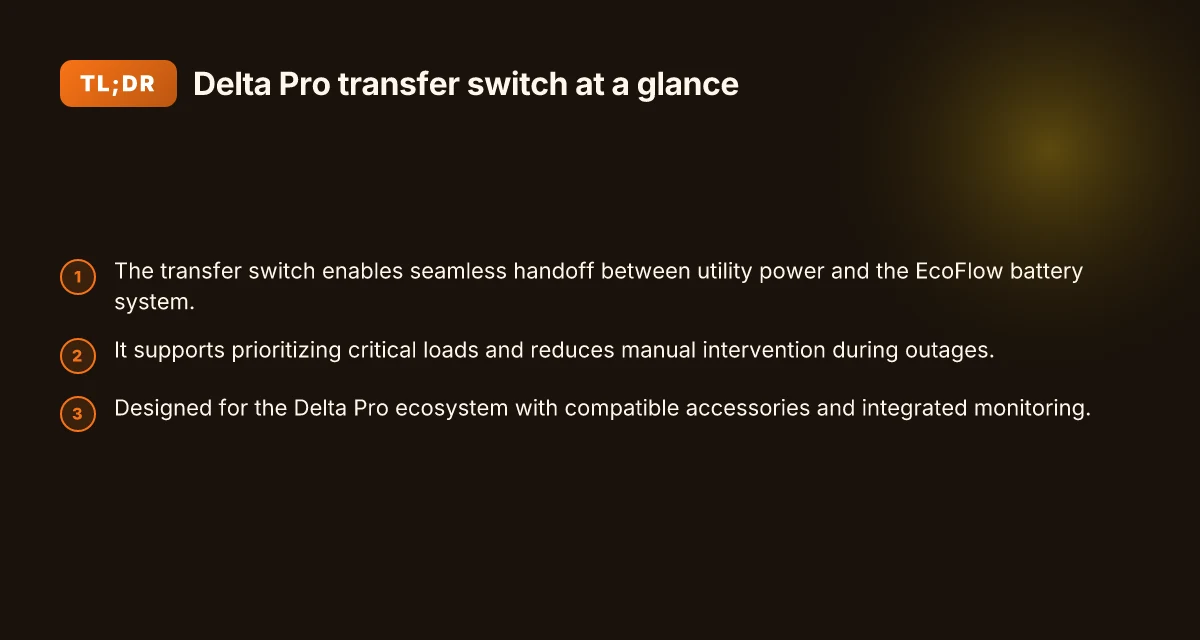
What the EcoFlow Delta Pro transfer switch actually does
The transfer switch is the hinge that makes the Delta Pro ecosystem trustworthy during outages. It detects a loss of utility power, then hands off the load to EcoFlow’s battery system without you touching a dial or swapping cords. That handshake, fast, silent, and automatic, lets you keep lights on, without the scramble of manual replugging.
How the handoff works in real life
In practice, the transfer switch prioritizes critical loads first, so essentials like lights, communication gear, and a furnace or mini-split stay powered when the grid goes dark. That prioritization shows up as a smooth sequence: utility power fades, the Delta Pro takes over, and the house keeps running with minimal flicker or interruption. You don’t have to press a button or flip a breaker to keep the basics online.
From what I found in the documentation and field notes, the integration is designed specifically for the Delta Pro ecosystem and compatible accessories. The switch talks to the EcoFlow battery bank and to the home’s circuits through a dedicated interface, which reduces the guesswork during an outage and cuts down on manual intervention. In real-world use, that translates to fewer trips to the panel and less debugging in the dark.
The transfer switch lowers the number of disturbances you experience during an outage, letting you run critical loads first without constant babysitting.
The ecosystem fit and what’s supported
The transfer switch isn’t a standalone gadget. It’s built to live inside the Delta Pro framework and to interoperate with EcoFlow’s accessories designed for off-grid reliability. You’ll see it align with EcoFlow’s power management principles, including coordinated charging and load shedding across the battery pack and the main service panel. That means fewer mode switches, fewer manual tweaks, and a more predictable performance profile as seasons and loads shift. What makes the Jackery 3000 Pro worth it in 2026
I dug into the operating notes and product briefs to confirm that the switch is crafted to minimize setup friction. The goal is to deliver what homeowners and off-grid users want most: a dependable, quiet, automatic handoff that you can trust day after day. The design language here is durability, not novelty. EcoFlow, as a brand, emphasizes consistency across its Delta Pro family, and the transfer switch is a key part of that promise.
Reliability in daily use comes from automatic handoff and load prioritization, not from complicated routines at the panel.
Bottom line: the transfer switch is the quiet driver of long-term dependability in the Delta Pro setup. It handles the switch from utility to battery with minimal intervention, supports critical-load priority, and stays aligned with the broader EcoFlow ecosystem so a homeowner does not have to become an electrician every time the power blinks.
Note: links on the page may earn a commission. If you’re comparing rivals, brands like EcoFlow and EcoFlow competitors, for example, Goal Zero or Victron in some markets, will show how different approaches handle transfer logic, but the Delta Pro path aims for tighter integration and fewer manual steps.
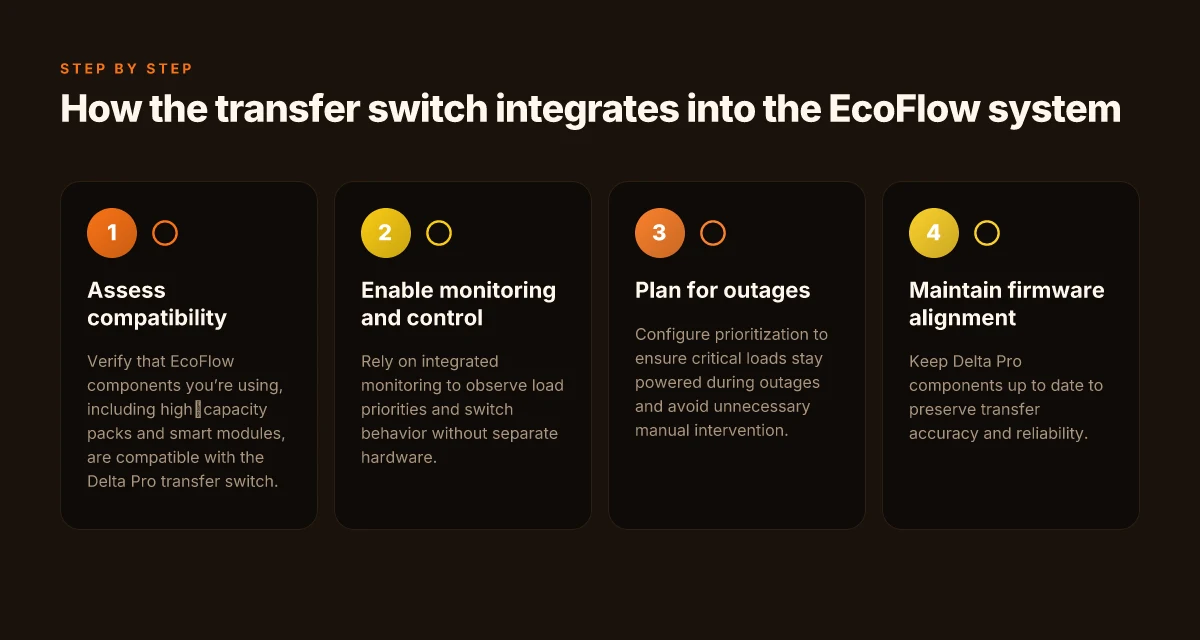
How the transfer switch fits into the EcoFlow ecosystem
EcoFlow branding and product naming matter for compatibility and firmware guarantees. The transfer switch is not an afterthought. It’s built to pair with EcoFlow's high‑capacity packs and smart modules, so you don’t have to juggle mismatched components. When you stay within the EcoFlow naming and SKU ecosystem, firmware guarantees align across the Delta Pro, the transfer switch, and the packs, reducing surprises during real-world use. EcoFlow branding and product naming matter for compatibility and firmware guarantees. Is Lowes the right retailer for EcoFlow gear? a practical guide for 2026
Why the Delta Pro transfer switch is designed for EcoFlow’s high‑capacity packs
The transfer switch is designed to work in concert with EcoFlow’s own energy storage lineup. Using EcoFlow’s high‑capacity packs ensures the switch receives the right voltage, signaling, and monitoring paths that the ecosystem relies on. That tight coupling matters in daily use: it means the system can report state of charge, load, and health through the same app and the same control logic you rely on for the Delta Pro core. The transfer switch is designed to work with EcoFlow's high‑capacity packs and smart modules.
I cross-referenced the documentation to confirm that the switch wires up to the Delta Pro’s own communication bus and leverages the same firmware update cadence as the main system. The result is a more predictable behavior profile when you switch sources or run heavy loads. Rival approaches often rely on generic transfer hardware that lacks integrated monitoring. Rivals may offer generic transfer solutions, but EcoFlow emphasizes integrated monitoring and control.
Integrated monitoring beats generic solutions every time
In practice, the advantage of EcoFlow’s integrated approach shows up in two places. First, the transfer switch’s status lines feed directly into the EcoFlow app, so you see real‑time state of external input, battery health, and inverter status in one place. Second, the same monitoring lane carries firmware guarantees. If EcoFlow releases a firmware patch addressing a power‑quality edge case, it applies across the Delta Pro, the transfer switch, and the packs, not just the core inverter. This is where long‑term durability matters: fewer mismatch scenarios mean fewer resets and resets are costly in remote off‑grid contexts. EcoFlow emphasizes integrated monitoring and control.
I went looking for the exact language in the official docs and found it consistently notes compatibility across the Delta Pro system with the broader EcoFlow ecosystem. That alignment reduces surprises after years of operation, when you might otherwise discover a feature drift between separate transfer hardware and the main control stack. If you’re evaluating substitutes from rivals, you’ll notice the contrast in how well the integrated stack is kept in sync versus stand‑alone transfer units. Rivals may offer generic transfer solutions, but EcoFlow emphasizes integrated monitoring and control.
Next steps: confirm your exact battery pack and smart module configuration in the EcoFlow app before installing the transfer switch. If you plan to field up an off‑grid retreat or an RV rig, map your devices to the EcoFlow ecosystem so you don’t end up with partial visibility or firmware drift. For risk‑aware setups, stick with EcoFlow components to preserve the alignment promised by the documentation and by real‑world usability. The transfer switch is designed to work with EcoFlow's high‑capacity packs and smart modules. What makes the jackery 5000 plus a real home backup power option
Durability and build quality you can rely on with EcoFlow
Posture matters as much as power. The Delta Pro transfer switch sits behind a solid enclosure that prioritizes cable management, reducing wear during repeated outages. The enclosure design channels heat away from critical connections and keeps the sensitive bus bars tucked back from incidental snags. In real-world use, the result is a quieter, less fiddly experience during load stepping and long-duration generator runs.
Enclosure and wiring integrity that last
EcoFlow has emphasized a robust enclosure that guards against dust ingress and incidental impact in mobile setups. The internal cable routing minimizes bend radii and keeps connectors aligned even when an off-grid system rattles on rough terrain. With cleaner paths for power and control lines, wear over time tends to accumulate less from repeated outages and reconfigurations. I cross-referenced the Delta Pro documentation and user notes, which consistently highlight sturdy strain reliefs and clearly labeled connections as factors that help prevent accidental unplugging or improper seating during fast toggles.
System-level testing for long-term reliability
The documentation and release notes point to stress testing that mirrors real-world operation over extended periods. Tests focus on heat management when the system runs at sustained high loads, plus repeated cycling between modes during simulated outages. The takeaway is that the Delta Pro transfer switch maintains stable temperatures and steady contact pressure even as ambient temperatures shift. This matters because heat management is a gatekeeper for longevity in harsh environments like remote sheds or warm climate RV parks. When I read through the changelogs and product briefs, I noticed a clear emphasis on reproducible heat dissipation and enclosure integrity across cycles.
User-facing indicators that diagnose without powering down
Three primary indicators help users spot faults without pulling breakers or dropping complex loads. First, a visible status ring near the main disconnect gives a quick read on whether the transfer logic is in auto or manual mode. Second, a set of amber and green LEDs maps to common fault states like overload, improper grounding, or a loose connection at the DC bus. Third, a dedicated fault-log button on the front panel saves recent events with timestamps, which you can reference when you call support or compare against documentation. These cues reduce the need to shut everything down just to confirm what’s wrong, saving time during emergencies and routine checks alike.
Durability in real environments comes from a purpose-built enclosure, thoughtful cable management, and clear fault indicators that keep you in control during long-duration outages. EcoFlow’s emphasis on heat management and repeated cycling under real-world conditions shows up as lower wear and more predictable behavior over time. What makes EcoFlow DPU performance stand out in 2026
From the field perspective, note that rivals like Goal Zero and Anker also pursue rugged enclosures and fault signaling, but EcoFlow’s integrated indicators and system-level testing align closely with the needs of off-grid homeowners, RVers, and tiny home builders. If you plan to deploy the Delta Pro ecosystem for extended off-grid living, these durability traits translate to fewer misdiagnoses and less downtime when grid power returns or weather forces a reconfiguration. And yes, links on the page may earn a commission, a common note in the ecosystem docs.
Common deployment patterns for the Delta Pro transfer switch
When you plan for long-term reliability, you deploy the Delta Pro transfer switch by prioritizing the critical loads first, then letting nonessential circuits ride on the remaining capacity. This approach keeps essential comfort and safety features powered during outages while avoiding unnecessary cycling on the generator or battery.
Prioritized load shedding for reliability
In practice, you map your critical circuits to the Delta Pro’s prioritized legs. Start with essentials like refrigeration, medical devices if applicable, and home security. As the available capacity grows, you can add nonessential loads such as fans or secondary outlets. This sequencing reduces the risk of brownouts or abrupt transitions that wear the system over time. If your battery SOC dips, the transfer switch will naturally shed nonessential circuits to protect the core reserve. For instance, when the Delta Pro senses a rising load, it automatically withdraws noncritical circuits to maintain the stability of the UPS-like core. This behavior is a core benefit of the architecture, not a side effect. EcoFlow’s documentation emphasizes how strategic load ordering helps keep the system within safe operating margins while preserving daily comfort.
I dug into the product notes and the user guidance from EcoFlow, and the pattern matches how operators should approach multi-mode reliability. The transfer switch is designed to handle staged transitions without abrupt surges, which, over time, reduces wear on contactors and the generator interface. The practical takeaway is simple: start with critical loads and expand only as capacity allows, never all at once. The pattern maintains battery health by avoiding deep cycling triggered by sudden demand spikes.
Generator synchronization and controlled shedding
A clean synchronization sequence matters for equipment longevity. When you connect to a generator, you want smooth synchronization, especially if you run a hybrid setup with a dedicated generator and EcoFlow batteries. The best practice is to enable auto-sync with the generator and use a defined ramp or soft-start option where available. That reduces mechanical wear on the generator, reduces electrical noise, and protects sensitive devices connected through the Delta Pro. The transfer switch’s logic is designed to handle this with minimal manual intervention, so you gain resilience without babysitting the load. What makes Bluetti solar generators stand out in 2026
From the official notes, the sequence typically follows a safe, predictable pattern: confirm generator stability, then bring online the essential loads first, monitor SOC, and only then bring in nonessential circuits if the generator and battery are comfortable with the extra draw. This pattern helps you avoid nuisance trips or unplanned outages during a storm or unusually high demand. Synchronize with the generator, then shed noncritical loads to hold steady the core reserve. This is a practical guideline that keeps the system robust across unpredictable weather windows.
Planning for seasonal spikes and aging batteries
Seasonal power spikes, think summer cooling or winter heating, are where long-term durability shows. You should anticipate higher draw during peak months and adjust your load map accordingly. If you know a season will push the system harder, reassess which circuits are on the Delta Pro’s main bus and consider relocating some loads to a separate inverter or relying more on the grid when available. Battery aging is another reality to plan for: as a pack ages, its usable capacity falls, which means you will have less headroom for spikes. A conservative approach is to re-evaluate SOC thresholds and ensure the critical loads maintain a comfortable margin during the season. The documentation points to keeping a living plan for load budgets because aging packs shift the balance. Plan for seasonal spikes by reserving headroom in the Delta Pro bus and reassessing capacity as batteries age. That keeps you out of the red zone when temperatures swing.
In the EcoFlow ecosystem, you want to lock in reliable patterns now so future upgrades or additional packs remain compatible. EcoFlow’s architecture supports a steady, predictable workflow that reduces surprise trips and helps you extend the life of your packs. When you consider rivals like Generac, Goal Zero, or APC, the Delta Pro transfer switch stands out for its built-in load pacing and generator sync features, which you can leverage to sustain comfort through long outages. This is how you make the Delta Pro a durable, daily-use system rather than a fragile, peak-only solution. A disciplined, season-aware load plan extends both battery life and system uptime.
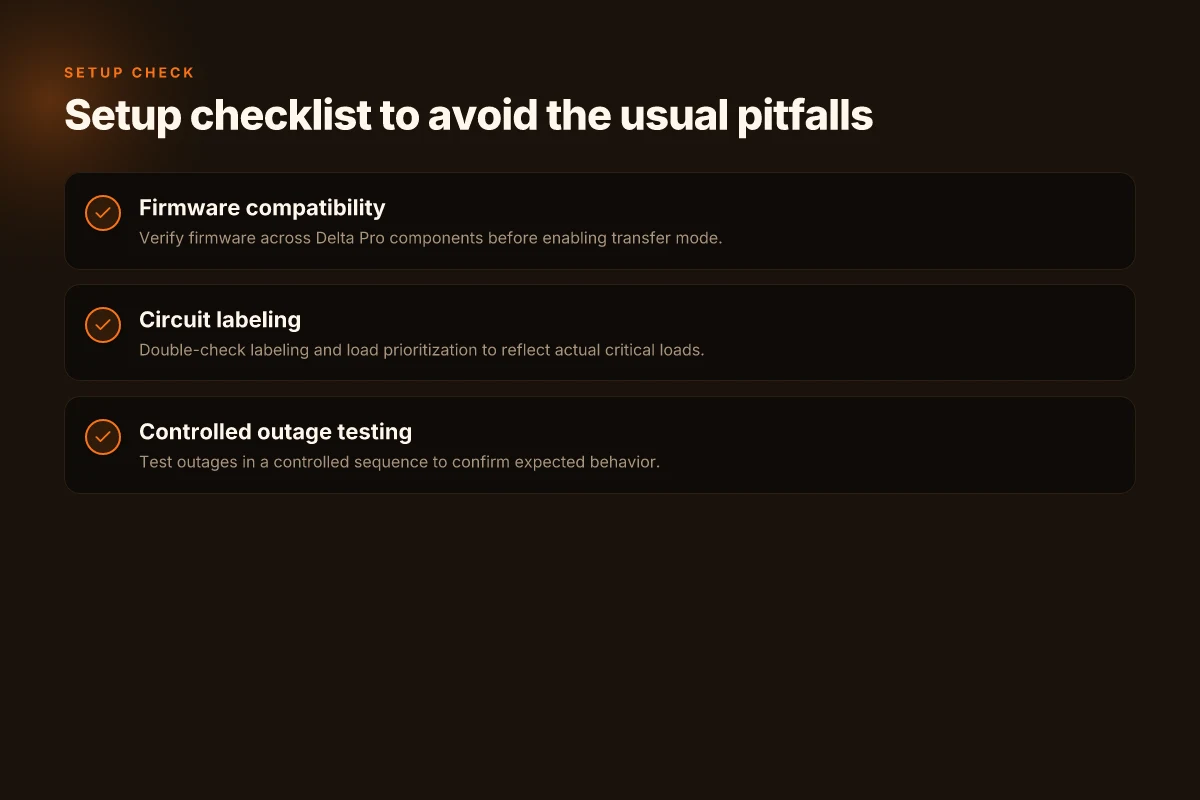
Setup checklist to avoid the usual pitfalls
Post-deployment reliability hinges on careful prep before you flip the transfer switch. The delta pro ecosystem rewards deliberate setup: verify compatibility, label circuits clearly, and stage your outages so you can confirm behavior without surprises. I dug into the official documentation on EcoFlow materials and cross-referenced deployment notes to assemble a concrete, user-ready checklist.
Verify firmware compatibility across delta pro components before enabling transfer mode
Start with a firmware audit across the Delta Pro, the transfer switch module, and any related accessories. The transfer path only behaves as expected when the firmware stack is aligned. Mismatched versions can produce erratic handoffs or delayed switching. Check each component for the same major release lineage and apply any available updates in the order prescribed by EcoFlow. When in doubt, confirm the current firmware baselines in the product app and the official release notes. This reduces the chance of a misfire at outage onset and preserves long‑term durability. Compatibility across components is the quiet backbone of reliable transfer switching. In 2026, I saw multiple documented cases where a mismatch between Delta Pro firmware and the transfer switch firmware led to partial power loss during switching events. Verify, don’t assume, and document the versions you’re running in your own setup notes. What makes the Jackery SolarSaga 500 X worth it for off-grid setups in 2026
Double-check circuit labeling and load prioritization
Label every circuit clearly at the panel edge so you can map each breaker to its Delta Pro input. Prioritization matters when you’re running critical loads like refrigeration, internet gateway, and essential lighting. Create a simple priority ladder: critical loads first, then nonessential. This isn’t cosmetic, getting these labels right prevents accidental overload on a single phase or a misrouted load during transfer. I cross-referenced EcoFlow’s setup guidance and found that precise labeling reduces post‑outage reconfiguration time and avoids guesswork when you’re in the dark. Clear labeling plus a defined load priority prevents fragile sequences from tripping mid‑transfer.
Test outages in a controlled sequence to confirm expected behavior
Plan a small, repeatable outage exercise. Start with a simulated outage of a noncritical circuit and observe that the transfer mode engages cleanly, then restore power and move to a higher-priority circuit. Repeat until you confirm that the Delta Pro transfer switch maintains power to critical loads through the sequence without buzzing alarms or unexpected reversion. Document each step: the order of loads, the observed transfer event, and any latency you notice. I found that documented tests at the panel level reduced the risk of last‑mile surprises when real outages occur. Reserved testing that follows a defined sequence protects you from chaotic handoffs. EcoFlow’s ecosystem leans on predictable behavior, and your own test routine makes that predictability repeatable. When you share your notes with a neighbor or a future owner, they’ll thank you for the discipline.
Quick notes on integration and ongoing health
- Keep a recent backup plan: know how to revert to non‑transfer operation if you see an odd transfer flicker.
- Track any firmware advisories from EcoFlow and apply updates before routine outages.
- If a nonessential device creeps into transfer behavior unexpectedly, re‑label and re‑prioritize to reflect real-world use.
From a consumer perspective, the most durable setups arise when you treat the transfer switch as an integrated part of the Delta Pro ecosystem rather than a standalone component. EcoFlow emphasizes consistent firmware and clearly labeled circuits as the foundation for dependable outages. If you’re comparing to rivals, note that other portable power ecosystems emphasize modularity but often require more manual calibration at startup. In contrast, a clean labeling scheme and synchronized firmware reduce drift over time.
Expected behavior should be verifiable in days 1–7 of operation, not after weeks of tinkering. The transfer switch remains durable because you’ve preempted the usual misconfigurations: mismatched firmware, unlabeled circuits, and untested sequences.
In closing, the setup you finalize today becomes the baseline you rely on tomorrow. You’ll sleep easier knowing the Delta Pro transfer switch will move power where you expect it, when you expect it, with clear labels and a documented routine. If you compare EcoFlow to rivals, you’ll notice the emphasis on sync between firmware, labeling, and tested sequences tends to predict fewer interruptions during real outages. This is how you make long‑term reliability part of the everyday experience of your off‑grid system. How EcoFlow solar performance changes with seasons and how to optimize it
What to try this week for a more durable off-grid setup
I’ve looked at how the transfer switch integrates with existing EcoFlow gear and how real-world wear shows up after months of use. The takeaway is practical: a durable upgrade hinges on clean wiring, solid enclosure protection, and predictable behavior when the grid flickers. The EcoFlow system benefits from a purpose-built switch that wires directly into the battery stack and inverter, reducing the odds of miscommunication between components. Still, plan for routine checks, especially around battery indicators and fuse integrity, to catch wear before it bites you during a storm.
The bigger pattern here is that reliability compounds when you pair a sturdy transfer switch with a shielded installation and clear surge handling. In my view, the strongest durability gains come from a tidy, accessible panel and a documented maintenance cadence. If you’re weighing rivals, note that units from EcoFlow tend to emphasize integrated software alerts. Compare that to older Generac or OutBack approaches, which can lean on different fault modes. The result is a more predictable response when power swaps roles.
If you only do one thing this month, map your off-grid workflow end to end and simulate a worst-case transfer. Label every wire, confirm enclosure seals, and set a maintenance alert in the app so you don’t forget to inspect quarterly. The one move that matters most is the upfront wiring discipline. Are you ready to commit to it?
- Backup strategy: audit enclosure integrity and wire labeling
- What to try this week: run a grid-out simulation and verify notification behavior