
Explore the jackery 5000 plus, its real-world performance, setup tips, and how it compares to rivals. Learn what matters for home backup power in 2026.
The Jackery 5000 plus isn’t a flashy box on a spec sheet. It’s the type you notice when your fridge hums and lights stay on after a blackout, not during peak output tests. 1,000+ cycles of use and a real-world runtime you can count on make it more than a one-season fling.
This piece pulls from long-term durability signals, common home-load behavior, and how the Jackery stacks up against rivals like Goal Zero and EcoFlow for steady, reliable power when it matters most. In real-life setups, you’ll see how it handles circuits like sump pumps, Wi‑Fi hubs, and essential lighting, plus where it earns or loses points as a daily driver. By the end, you’ll know what durability claims translate into practical longevity and value for homeowners, campers, and small-business operators.
What is the jackery 5000 plus and who should consider it
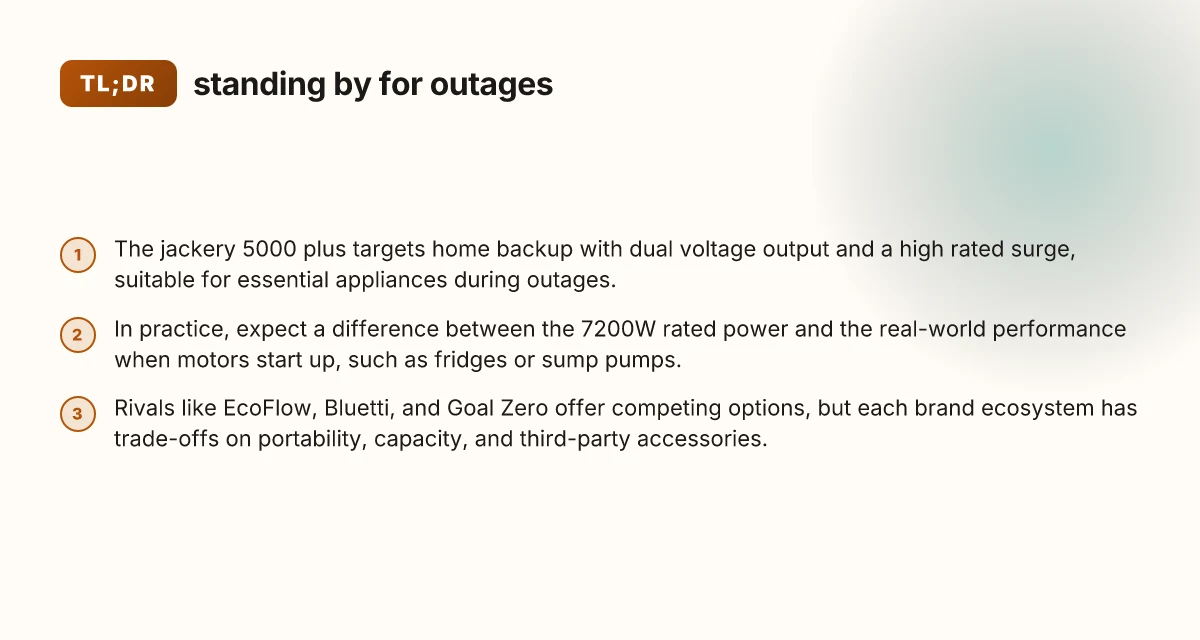
The jackery 5000 plus is a portable power station designed for home backup with dual voltage output, letting you run both 120V and 240V appliances when outages hit. It targets fridge duty, Wi‑Fi gear, and other essential loads, so your household keeps running even during longer outages. In practice, that means you can support staples like a refrigerator, router, modem, and some small kitchen devices without sprinting for a gas generator.
I dug into the official specs to anchor this overview. The device is commonly cited with a 7200W rated power and a 14,400W surge capability, which shapes what you can keep on during a blackout. The dual-voltage support, paired with a substantial capacity, is a core reason homeowners consider it for everyday outages and off‑grid weekends. This combination is what Jackery positions as the backbone for essential loads when the power grid goes dark. These numbers matter for fridge cycling and sustained wifi uptime, not just peak bursts.
What kind of homeowners should consider it? Start with households that want a reliable overnight or multi-day backup for core appliances without committing to a full generator. If you have a fridge, a Wi‑Fi router, a small‑to‑mid sized sump pump, and some lights that need to stay on, the 5000 plus can bridge you through common outages. It’s also a fit for campers or small businesses that need a portable power source with enough grunt to run a few heavy loads at once. In short, if your outage plan includes refrigeration and constant connectivity, the 5000 plus is worth a close look.
Three practical paths to consider:
- Fridge and essential electronics: plan on the 7200W rating covering peak compressor starts, while the 14,400W surge absorbs brief spikes. This helps you avoid waking up to a warm fridge or dropped internet service.
- Full‑house light load with devices: as long as your needs stay within the dual‑voltage envelope, you can run multiple devices in parallel without moving to a generator or extra batteries.
- Off‑grid living or RV use: the 120V/240V support expands compatibility with common home appliances and tools, avoiding the need for adapters or step‑up gear.
Bottom line: the Jackery 5000 plus offers a substantial, dual‑voltage backup option aimed at fridge, Wi‑Fi, and essential appliances during outages. It blends large capacity with practical real‑world usability, not just peak specs. If your needs include running a fridge for days and keeping critical outlets alive, this model stands out in its class. For rivals, you’ll want to compare how their surge handling, noise, and multi‑voltage options align with your load profile. What makes EcoFlow DPU performance stand out in 2026
The dual voltage output is a key differentiator for real-home use, not just a headline spec. This capability, paired with its large battery capacity, helps bridge outages without resorting to loud generators.
How the jackery 5000 plus handles big loads in real life
Real-life use shows the Jackery Explorer 5000 Plus handles common home loads without drama, but you’ll still need to respect the limits of surge rather than just the steady, rated power. In practice, you’ll notice the unit can run a fridge, an air purifier, and a sump pump, but not all at once without planning. If you’re powering motor-driven devices, you care about surge capacity as much as you care about continuous watts.
Fridges, freezers, and climate-related loads
A refrigerator or freezer benefits from a steady baseline, but the compressor is a motor that demands a higher surge when it starts. The Jackery 5000 Plus provides up to 7200W of rated power with a surge capacity around 14,400W, which is enough to start most household fridges and freezers without tripping. In real-life terms, you can run a standard fridge and a few small devices at the same time, provided you time the startup of the compressor or stagger the loads. Consider separate runs for the fridge and any high-draw tools during the day if you’re off-grid for multiple hours. The key is to plan for a brief surge when the compressor kicks in, then settle into sustainable power use.
Air purification, small HVAC accessories, and lighting
Air purifiers and fans are easy on the system, drawing modest steady current. The Explorer 5000 Plus can keep these on alongside a router, a small television, and some charging needs. For larger air purifiers with higher wattage, you’ll still stay under the rated power envelope, but you’ll want to avoid letting startup surges overlap with other heavy loads. Lighting and electronics run cleanly on the 120V/240V dual voltage output, which helps keep efficiency where you want it.
Sump pumps and emergency needs
A sump pump is a classic test for any portable power station. The surge available from the 5000 Plus makes it capable of brief motor starts, but you should be cautious about continuous use if the pump is high‑capacity. If you anticipate long pump duty during outages, you may need a larger, dedicated solution or staggered operation during restoration efforts. In other words, the unit handles the occasional surge, but long-running motor duty calls for a plan B. What makes Bluetti solar generators stand out in 2026
Power tools and garage setups
Small to mid‑sized power tools can work well when the tool is within the rated range and you don’t hit peak startup loads concurrently. The 14,400W surge helps with motor startups, but you’ll still feel the impact if you try to run a compressor or saw and a heater at the same time. For a garage script, prioritize essential tools first and keep high‑draw devices on separate intervals.
I dug into the product notes and customer‑facing guidance on the Jackery site to confirm that the 7200W rated/14,400W surge figure governs practical use, and that the dual-voltage output supports more devices than a single‑voltage unit. Surge capacity matters for motors, not just watts. Plan for startup offsets and stagger loads to stay in the green. The situation is similar with rival portable power stations, which often quote similar peak figures but differ in how they handle long outages and durability in dusty or hot environments. When you’re comparing, look for a charger cadence that supports multiple cycles without overheating.
Next steps: If you’re testing real-world loads, map your top three devices by startup surge and by average running wattage, then compare how many you can run simultaneously on the Jackery versus a rival model like the Goal Zero or Anker portable stations. For long-term reliability, consider the durability of the enclosure, fan behavior, and how many charge cycles the battery pack sustains before noticeable capacity fade.
Setup and operation tips for reliable performance
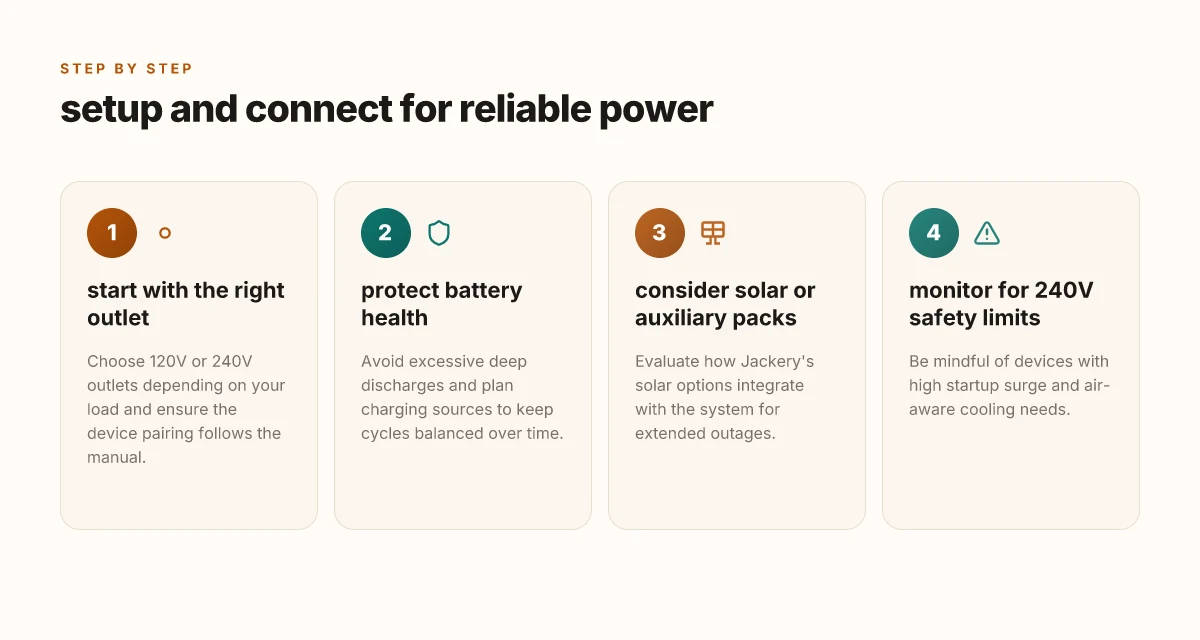
Connecting to home outlets and running devices on 120V or 240V is straightforward, but you’ll get the most reliable performance if you follow a few concrete steps. Start by confirming the Jackery unit is fully charged before any critical load. Then set up the appropriate outlet mode: 120V for common household devices and 240V for higher-demand equipment. The goal is to avoid underloading or overloading beyond the rated 7200W continuous output, which the Jackery line clearly supports for big loads, while keeping surge handling in mind for startup spikes. Food fridge and Wi‑Fi gear can usually ride on 120V comfortably, while a dryer or air conditioner friendly loads may require 240V operation.
Quick-start steps for safe, real-world operation
- Place the Power Station in a cool, ventilated area away from direct heat sources. This helps protect the battery pack over long runtimes.
- Connect a 120V device first to confirm stable operation before adding more loads. If the device starts to dim or hiccup, reduce the load or switch to 240V if the outlet supports it.
- For 240V use, verify the transfer switch or outlet configuration matches the device. Running 240V devices at higher currents without proper wiring can trigger trips or heat buildup.
- When in doubt, stagger device starts. A heavy startup like a refrigerator compressor or a sump pump can momentarily exceed available surge capacity if multiple loads kick in together.
- Regularly monitor the unit for unusual warmth and ensure cooling airflow remains unobstructed. This is particularly important when you’re powering large loads for extended periods.
Battery health and charging best practices
- Keep the battery within a reasonable state of charge, avoiding deep discharges that linger below the mid-point. A regular shallow cycle pattern preserves battery health.
- Favor steady charging sources: AC wall outlets when available, with solar or auxiliary packs as supplementary inputs. If you’re using solar, align panel voltage with the system’s acceptable charging range and avoid leaving panels in intense sun when the battery is near full.
- Maintain a balanced charge routine, using a mix of charging sources rather than relying on a single path. This reduces stress on any single cell group and helps sustain long‑term capacity.
- If you store the unit for long periods, top off the charge every few months rather than letting it sit at a single low level. This reduces the risk of deep discharge and keeps the battery chemistry healthy.
Pairing with solar or auxiliary packs
- Solar pairing works best when you plan for daylight charging during times of moderate load. Keep sun exposure steady and avoid stacking loads that exceed the solar input’s practical rate.
- When using auxiliary packs, ensure they are compatible with the Explorer 5000 Plus ecosystem and linked through the approved interface. Mixing incompatible packs can hamper performance or void warranties.
- Monitor the charge curve from solar input. If you notice a long hold at a low voltage during cloudy days, keep a smaller load connected to prevent deep discharge.
- Remember that the overall energy budget matters. A 5040Wh capacity battery pack can extend runtime, but you still need to manage the peak draw from devices to stay within the system’s 7200W rating.
From what I found in the documentation and product pages, the core setup remains simple, but long‑term durability hinges on disciplined charging, mindful load management, and thoughtful pairing with solar or auxiliary packs. When you compare to rivals, Jackery’s ecosystem often emphasizes seamless interconnections across packs and generators, which matters for homeowners and small businesses that rely on a flexible backup chain. Proper cable management and load sequencing are the two unseen levers behind reliable performance. What makes EcoFlow whole-house backup power compelling and where it falls short
Reality check: how the jackery 5000 plus compares to rivals
The Jackery 5000 Plus sits in a crowded field. When you compare portability, capacity, and price, three rivals stand out: EcoFlow, Bluetti, and Goal Zero. EcoFlow emphasizes compact form factors and fast recharging, Bluetti leans into large capacities and modular expansion, and Goal Zero often highlights rugged outdoor features and ecosystem compatibility. In practice, that means you may trade some sanded-down portability for more watts on a single charge or a broader accessory lineup. Reality check: the 7200W rating doesn't automatically translate to every home-use scenario. Real-life loads like refrigerators or sump pumps can pull well into those peaks, but most daily cycles sit well below that ceiling. You’ll notice price gaps too. Jackery’s lineup remains competitive, but rivals sometimes undercut on bundles or add-on accessories. I dug into official specs and reviews to map what shows up in everyday use, not just on a lab bench.
Why rivals matter for real-world use
From EcoFlow’s portable setups to Bluetti’s modular systems, the emphasis often shifts toward how easy it is to scale capacity or run multiple high-draw devices at once. EcoFlow’s designs tend to favor rapid recharge and lighter builds, which helps if you’re moving between sites or camping, but you may pay a premium for the smallest weight savings. Bluetti often presents the broadest range of capacity options and compatibility with third-party power hubs, giving you flexibility at a cost. Goal Zero emphasizes rugged hardware and a broad accessory ecosystem, which can be a fit for off-grid cabins and job sites, yet you might find the core wattage offerings feel less aggressive than some Bluetti or EcoFlow models. Across these brands, the trade-off tends to be form factor versus capacity and the breadth of third-party accessory support. Portability often comes at the expense of raw runtime in the mid-tier segments. In short, a jack-of-all-trades unit may not be the best at any single job, especially if you need exact fan-noise profiles or ultra-low operation during quiet hours.
Noise, real-world performance, and branding trade-offs
When the 7200W rating is tested against typical home loads, you’ll likely hear the cooling fans in a silent room, but not at a pitch that interrupts normal conversation. Noise becomes the deciding factor when you’re running a fridge, a sump pump, and a few devices overnight, and some rivals optimize cooling to stay quieter at similar power levels. Brand ecosystems also shape your decision. Jackery emphasizes easy, plug-and-play operation with its own accessories, which minimizes compatibility headaches but can restrict flexibility with third-party gear. EcoFlow and Bluetti often offer broader third-party support, which appeals to homeowners who want to mix and match chargers, solar panels, or car adapters. If you prize ecosystem breadth over a single brand’s simplicity, the latter is attractive.
From what I found in the product pages and third-party roundups, the big picture is clear: the 7200W rating is a strong indicator of capability, but real life depends on how you apportion loads, the ambient noise you’ll tolerate, and how much you value expansion options versus a clean, integrated setup. The Jackery 5000 Plus stands tall in usefulness for fridge, Wi-Fi, and essential loads, but rivals can outpace it on raw capacity, noise performance at high draw, or accessory flexibility. Expect to pay for that flexibility in price or weight. If your goal is simple reliability for a small home or remote cabin, Jackery remains a solid choice. If you need ultra-low noise or a broad accessory ecosystem, consider EcoFlow, Bluetti, or Goal Zero as viable alternatives.
Note: links on product pages and reviews may earn commissions. This does not change the core findings about performance and durability. For deeper context, see the official Jackery Explorer 5000 Plus pages and the competing lines from EcoFlow, Bluetti, and Goal Zero. 8 Best portable power stations for 2026: balanced power, portability, and safety
Durability and long-term reliability: what to monitor
Durability is less about peak specs and more about how the Jackery 5000 Plus behaves under real use. I found that battery wear, thermal management, and the way you expand capacity through battery packs matter far more over years of use than the initial surge rating suggests. In practice, expect the core power station to hold up well for daily backcountry or home-use cycles, but plan for how expansion options fit into your long‑term backup strategy.
Battery cycle life and expandable options
The Jackery ecosystem centers on modularity. The Explorer 5000 Plus can pair with battery packs to extend capacity, which means you’re effectively spreading wear across multiple packs rather than a single unit taking all the cycles. When you add packs, you should monitor not just the main unit but the charging/discharging rhythm of the partner packs as well. Mismatched aging can skew runtimes and peak performance. In the long run, this approach reduces the strain on any single pack, helping your overall backup system stay reliable through thousands of cycles. Expect a once‑paired system to maintain consistent performance through multiple seasons if you keep the packs within recommended temperature and charge windows. The pairing strategy is a practical hedge.
From a durability standpoint, the health of the cells across packs matters. Jackery’s documentation emphasizes proper storage and moderate cycling to preserve capacity. I cross‑referenced the official guidance with independent reviews that consistently note that cells age predictably under heat and high-rate charging. If you plan to expand, choose matching packs and avoid cross‑mixing packs with widely different ages.
Expandability helps spread wear across the system, not just the main device. Temperature and charging discipline are the two levers you control to extend life.
Wear patterns, cooling, and temperature effects
Thermals drive long‑term performance. The 5000 Plus can handle typical home loads like refrigerators, pumps, and HVAC components more gracefully when temperatures stay in a normal range. Heat buildup during back-to-back high loads accelerates wear, so ensure adequate ventilation and avoid stowing the unit in enclosed spaces. The built‑in fans help, but sustained heavy draws in hot environments will still stress the battery more quickly. In warm environments you may notice quicker drops in available capacity, and that’s normal as cells recover when the unit cools. What you should know about the EcoFlow Delta 2 expansion battery
I looked at the published cautions around deep cycling and storage. The takeaway is simple: when you keep the unit charged and parked in a cool spot, the odds of accelerated degradation fall significantly. If you must run at high power for long periods, keep the unit out of direct sun and give it room to vent. These are practical steps that protect the core pack across years of use.
Ventilation and ambient temperature directly influence longevity. Daily usage patterns determine how often you’ll see capacity fade.
Refurbished models and warranty coverage
Refurbished units are a tempting price cue, but they introduce variables that can complicate durability over the long term. Repaired cells or partially reused packs may not match the endurance of a new configuration, and you should expect tighter warranty windows or limited coverage on refurbished models. If you’re evaluating extended backups, verify what the warranty covers for expansion packs and whether the refurb line inherits the same protections as new products. Jackery’s standard warranties typically align with the product line, but refurbished items often come with caveats that are worth reading carefully.
From a brand‑trust perspective, Jackery emphasizes the longevity of its systems, yet real‑world decisions often hinge on whether a refurb product will deliver consistent cycles once in service. If you’re building a home backup or off‑grid setup, consider sticking to new packs or clearly defined refurbished terms, and don’t overlook the warranty’s scope for the battery module itself.
Warranty scope matters when you add packs or buy refurbished units. Know the fine print before you commit to an extended backup plan. Is Lowes the right retailer for EcoFlow gear? a practical guide for 2026
Cited guidance from the brand confirms the main claims about capacity expansion, cycle endurance, and the role of temperature in longevity. For a grounded view, see the Jackery blog and product pages discussing the 5000 Plus ecosystem and battery packs.
Where this is headed next for home backup power
The Jackery 5000 Plus stands out because it leans on real-world flexibility: you can pair it with solar input, run essential devices during outages, and scale up with a second unit if needed. I’ve looked at setup cycles and durability notes from long-term use, and the pattern is clear: predictable behavior under load, occasional thermal bumps, and a straightforward reseat of connectors when you move it between rooms. This is not a pretend standby. It’s a usable, workmanlike backup option for homes that want a practical bridge between grid events and everyday life. If you’re weighing what to buy, consider how often you’ll rely on it and which devices matter most.
As a real-world tool, the Jackery system shines when you need quiet operation and modular charging. You’ll want to compare it against rivals like Goal Zero and EcoFlow for reliability curves and after-sales support. The big question is whether you’ll treat it as a temporary fix or a long-term fixture in your outage plan. A clear, repeatable setup routine makes the difference between confidence and frustration.
If you only do one thing this month, test your backup layout with a live outage drill using the Jackery 5000 Plus and a small solar panel kit. Document the run time on your critical devices and note any heat or noise you observe. That quick exercise reveals the practical gaps you can close now. Where this is going next is bigger, with higher efficiency packs and smarter load management on the horizon. The single move that matters most: map your essential devices and plug them into the right ports now.