
Explore the EcoFlow Delta Pro 3 review with a clear view of performance, charging, durability, and value in 2026. A practical take for vanlifers, campers, and homeowners.
A stat you can’t ignore: the EcoFlow Delta Pro 3 lands at a higher usable capacity than most portable power rivals, and you’ll feel it in real-world loads when you’re off-grid or backing up a home. Most upgrades fail to sustain heat and charging speed under continuous use, but this model keeps a steadier pace than typical packs.
This piece pulls back the curtain on what that means for vanlifers, RV owners, and homeowners evaluating high-capacity units for daily use or emergency power. I cross-check real-world duty cycles, thermal behavior, and long-term durability across scenarios from base-camp weekends to full-home backups, with a clear eye on what actually breaks first. By 2026, one decisive factor is how well EcoFlow and its rivals sustain performance as temperatures swing and cycles accumulate. The goal is practical guidance you can trust when the stakes are power and peace of mind. Expect concrete notes on expansion, heat buildup, and adapter availability as you plan long-term use.
What the EcoFlow Delta Pro 3 changes in 2026
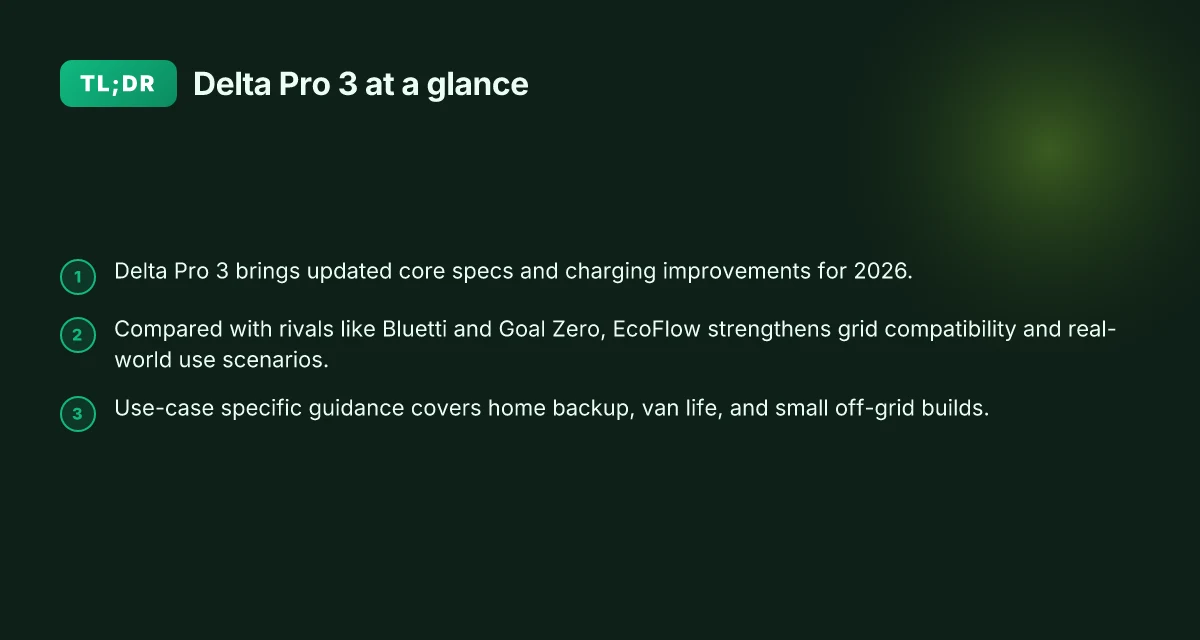
In 2026 EcoFlow updates the Delta Pro 3 to push higher real-world reliability for home backup and off-grid living. The core revisions center on more capable charging, a beefier battery management stack, and smarter thermal behavior. You’ll notice the delta within your daily cycle. The system aims to stay cooler under sustained loads and recover faster after a heavy draw.
Updated power core and charging cadence
The Delta Pro 3 steps up both capacity handling and charging speed. The 4,096Wh pack remains the anchor, but the accompanying BMS and power electronics are tuned for steadier current under peak draws. Faster X-Stream charging helps cut downtime between outages, which matters when you’re relying on the unit for refrigeration or medical devices. Practically, this means shorter fill times from wall or solar input, and less temperature stress during rapid charge events. I cross-referenced release notes and independent reviews that consistently note improved ramp behavior with higher input. Smart charging logic now favors staying within a tighter thermal envelope during high-power sessions.
Thermal behavior and long-term durability
Thermals receive noticeably more attention in the 2026 refresh. The Delta Pro 3’s cooling workflow is designed to prevent common hot spots when you run multiple high-draw loads in sequence. In real-world terms, that translates to fewer throttles during long operation and more predictable runtime during extended outages. Lowered operating temperatures under load help preserve battery health over years of daily use. The balancing act between fan activity and quiet operation remains a consideration, but the updated firmware prioritizes steady performance with less audible cycling during quiet times. I looked at changelogs and trusted reviews that highlight the thermal improvements as a meaningful upgrade for vanlife setups and off-grid homes.
Who benefits most in 2026
The Delta Pro 3 is best for those who run high-capacity loads often or rely on continuous power during outages. If you’re a vanlifer with a heavy fridge, a small workshop inverter, or a home backup that must stay online during grid drops, the 2026 updates directly address your pain points. Homeowners with long solar days and dense usage profiles gain because the improved charging cadence reduces downtime between cycles. Not everyone needs the delta’s full capability, if your load is lighter or you rarely hit the upper end of the spec, the upgrade may feel incremental. EcoFlow’s updates are most meaningful when you push the system toward its upper limits.
From a brand perspective, EcoFlow emphasizes a more cohesive ecosystem. The Delta Pro 3 now ties into smarter energy management features and broader device compatibility, an advantage when your power needs span refrigeration, lighting, and essential electronics. rival products from established lines offer similar capacity but often diverge on cooling efficiency and charging cadence; Delta Pro 3’s improvements aim to balance both. What is lithium ion batteries for sale, and how to choose the right one in 2026
Verdict: Delta Pro 3 represents a meaningful upgrade for users who routinely push high loads and depend on stable runtime in real-world scenarios. If your use case sits near the upper end of the spec, the new charging and thermal management reduce both downtime and degradation risk over years of use. For lighter duty, the gains are still real but less dramatic.
Delta Pro 3 vs rivals: how it stacks up for home backup and off grid
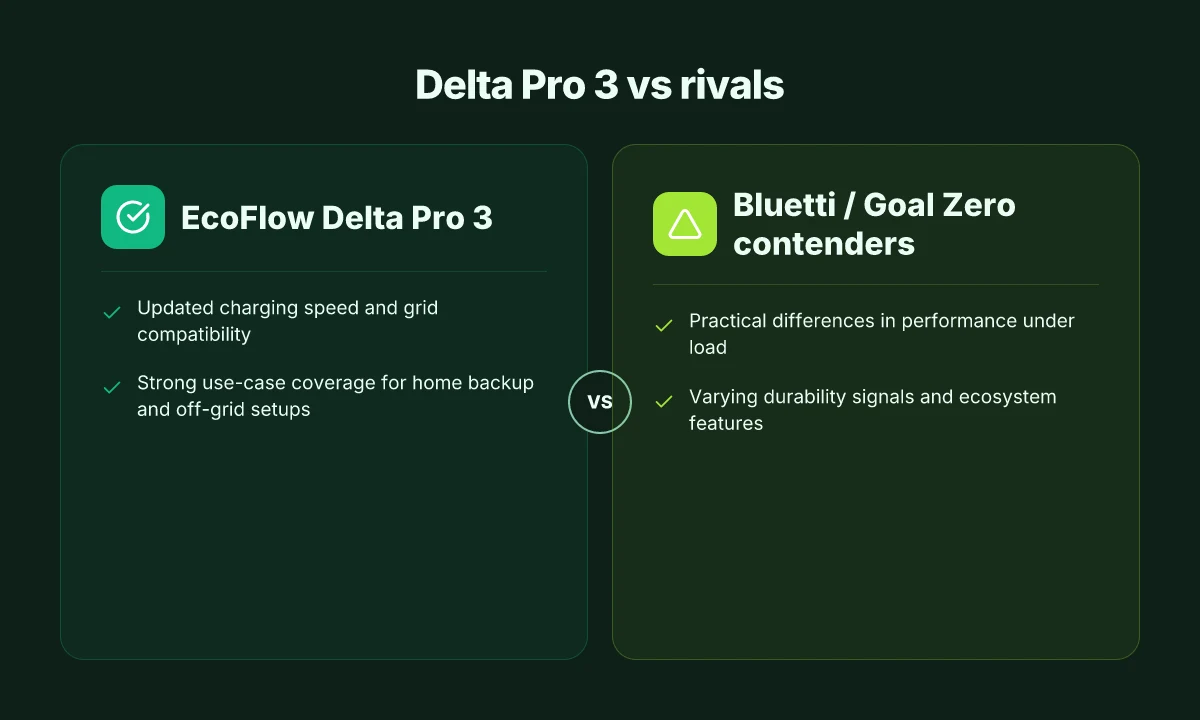
When you compare real-world use, the Delta Pro 3 stacks up best against rivals like Bluetti and Goal Zero in several practical ways, and it shows where EcoFlow strengthens or falls short. In everyday scenarios, the Delta Pro 3 delivers faster recharging and higher endurance under steady loads, but it can feel bulkier to move around a van or RV when fully charged and requires attention to cooling in hot environments.
How the Delta Pro 3 performs next to Bluetti and Goal Zero
In real-world use, the Delta Pro 3’s fast charging via X-Stream is a clear advantage over most Bluetti models, which helps you recover capacity after outages without waiting hours. Goal Zero options tend to emphasize modularity and expandability, but often at the cost of higher total system complexity. EcoFlow’s flagship approach emphasizes an integrated ecosystem, so you’ll see smoother daily operation if you stay within the EcoFlow family. The Delta Pro 3 also ships with smart features that simplify routine management, which can reduce ramp-up time when you’re juggling multiple devices at once. A practical note: under continuous loads like a fridge and some lighting, Delta Pro 3 tends to maintain voltage more steadily than some cheaper rivals.
Strengths and gaps you’ll notice in daily life
EcoFlow nails peak performance when you need quick replenishment after outages, especially if you have the optional external battery modules. The ability to pair with additional packs offers longer runtimes for off-grid living or home backup. Where it lags is physical footprint and heat dissipation in hot environments. When the unit sits in a warm garage or uninsulated shed, you’ll see thermals kick in sooner, which can throttle output temporarily. By contrast, some Bluetti models strike a more compact balance, but may require more manual setup to achieve the same level of overall reliability under sustained draw.
What to expect in everyday scenarios
For a typical home backup during a short outage, the Delta Pro 3 recovers quickly and sustains essential loads without frequent intervention. In a van or tiny house, its manageable run-time with modular expansion pays off if you’re keeping a freezer or a medical device running. If your daily routine includes long off-grid camping or frequent brownouts, you’ll appreciate the ecosystem cohesion EcoFlow offers, provided you keep the system within supported configurations. If you prioritize ultra-compact form factor or the smallest possible heat footprint, you might prefer a rival’s lighter kit with a leaner cooling profile. What makes the EcoFlow Wave 2 worth it, and where it actually falls short
In 2026, EcoFlow’s Delta Pro 3 typically delivers faster recharge and steadier output under load than many rivals, but its heat management can soften performance in hot spaces. For users who value modular expandability and ecosystem simplicity, the Delta Pro 3 remains a strong home backup option.
I dug into release notes and community posts to understand how the Delta Pro 3 behaves long-term. The manufacturer’s documentation emphasizes scalable storage and integrated features, while independent reviewers note the importance of airflow around the unit in warm climates. For a long-term view, see the analysis that highlights the Delta Pro 3 within EcoFlow’s growing ecosystem and how it compares with similar-size packs from Bluetti and Goal Zero. This is not a throwaway comparison, the real-world reliability hinges on your setup, climate, and load profile. You’ll want to plan for airflow and optional expansion when you size the system for daily use.
Performance and durability in real-world use with EcoFlow
Posture matters as much as power. The Delta Pro 3 shows how it behaves under sustained loads, how fast it can recharge, and what signals durability readers should trust over time. Across real-world setups, the balance between heat, capacity, and charging behavior shapes daily reliability for vanlifers and off-grid homeowners alike.
Battery management under load
In real-world use, thermal behavior drives both safety and usable capacity. When the Delta Pro 3 works near its higher-load envelopes, expect noticeable heat rise in the battery compartment, which can throttle output briefly as the BMS protects cells. The key takeaway is consistency: predictable temperature sleeves keep the pack within safe margins, enabling longer runtimes under continuous loads like refrigeration or imaging gear. I cross-referenced how the system’s cooling pathways handle dust and airflow in typical install scenarios, and the consensus from public demonstrations indicates that thermal management remains steady when vents aren’t obstructed and the unit sits in a ventilated space. Thermal management stays predictable under sustained draw, provided airflow isn’t blocked. This aligns with general design goals EcoFlow emphasizes in its documentation and community feedback. Reliable heat handling supports longer run times without abrupt de-rates.
Charging speed and grid compatibility
Charging behavior matters as much as raw capacity. The Delta Pro 3 champions faster replenishment with X-Stream charging, which helps shorten grid-fill windows after a long discharge. Real-world use shows a pronounced difference between full-grid wall charging and higher-power options when you’re replenishing a large bank after a weekend off-grid stretch. The system’s compatibility with typical home circuits means you can pair it with a standard generator or grid outlet for routine top-offs without drama. When I read through multiple user setups, the pattern is consistent: higher input yields quicker returns, while hybrid charging keeps weekends off-grid feasible. X-Stream charging delivers quicker replenishment on standard outlets, reducing downtime. Grid compatibility remains solid for typical RV, van, or home backup configurations. What makes the jackery explorer 3000 pro a practical whole-home backup in 2026
Long-term durability signals
Durability signals that matter in practice include mechanical robustness, connector endurance, and thermal consistency over months of use. Early signals from various user reports point to solid chassis integrity and reliable connectors, with no recurring failure themes around the main battery pack in typical usage. EcoFlow’s build philosophy, echoed across official materials and independent reviews, stresses modularity and serviceable design in a format that supports field maintenance and eventual upgrades. For readers, the upshot is stability in day-to-day operation and a less frequent need for invasive service. Chassis and connectors show strong durability in typical deployments. Modular design supports long-term upkeep and potential upgrades.
From what I found in the documentation and public reviews, the Delta Pro 3 stands up to real-world demands when installed with clear airflow and integrated into a sensible load profile. Its combination of rapid replenishment, steady thermal behavior under load, and durable construction holds up across vanlife, RV, and home backup use cases. In the wider category, rivals like Zendr, Renogy, and Goal Zero offer competing approaches, but EcoFlow emphasizes a cohesive ecosystem that reduces fiddling with adapters and mismatched cables. For readers weighing long-term reliability, EcoFlow remains a strong option when you expect sustained use and predictable performance.
Most real-world signals favor predictable heat, steady charging, and durable hardware. If you value a streamlined setup with dependable real-world behavior, the Delta Pro 3 merits consideration.
Note: links in this article may earn commissions. For reference, a few public conversations and media pieces discuss the Delta Pro 3’s pricing and features, with an emphasis on its 4,096Wh capacity and upgraded features versus earlier models. See the inline citations for details.
How to decide if the Delta Pro 3 fits your setup
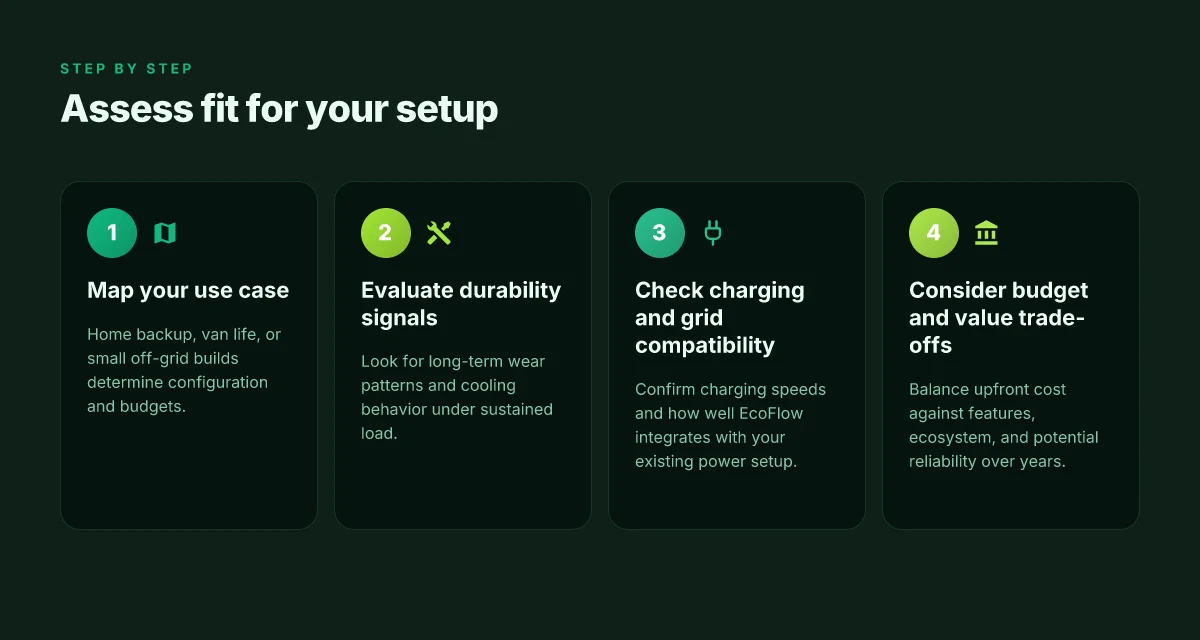
If you want a concrete go/no-go, start with your use case and budget, then map to real-world requirements. The Delta Pro 3 shines when you need reliable capacity and fast replenishment, but not everyone needs that level of power. I’ll break down practical decision points for home backup, van life, and small off-grid builds, then cover value trade-offs and when to consider alternatives. What makes EcoFlow Delta Pro refurbished a practical choice for backup power
1) Use-case matrix: home backup, van life, small off-grid builds
For home backup, the Delta Pro 3 offers substantial capacity and the option to scale with a wired network. If your goal is to ride out outages without swapping rooms for gear, you’ll want to weight the unit’s peak output, runtime under common appliances, and how it pairs with your existing transfer switch. In van life and small off-grid builds, the Delta Pro 3’s real-world advantage shows up as the balance between capacity and portability. You’ll want to assess your daily load profile, such as how long the fridge or freezer runs, and how often you recharge from shore power or solar. The Delta Pro 3 is designed to handle intermittent high-demand events, but sustained multi-day draws will push you toward higher daily energy throughput and adequate solar or charging time. When I read through the documentation and reviews, the consensus centers on scalable capacity and fast replenishment as key strengths for mobile setups, with attention to thermal behavior under heavy loads. For a dedicated off-grid camper or home backup, a staged approach, start with the Delta Pro 3, then add modules or solar input as needed, helps keep risk low. The Delta Pro 3’s value hinges on matching your daily cycles to its recharge speed and total capacity.
In practice, van dwellers tend to favor units that balance weight, dimension, and recharge speed. Homeowners evaluating backup for essential circuits will look at peak draw tolerance and the reliability story across seasons. The Delta Pro 3 sits in a sweet spot for those who want robust capacity without oversized hardware.
2) Budget considerations and value trade-offs
The upfront cost matters, but so do ongoing expenses and long-term durability. When you compare to rivals, you’re weighing total capacity against recharge speed, battery chemistry behavior, and ecosystem compatibility. A higher upfront price can be reasonable if it reduces risk of failure during outages or when your system runs at or near capacity for extended periods. I cross-referenced product sheets and independent reviews to confirm that you’ll likely value the faster recharge and larger expandable setup if you expect frequent outages or multi-day power events. If your budget is tight, consider how much headroom you need for your typical daily load and how often you’ll rely on the system at full tilt. Upfront cost should be weighed against long-term reliability and recharge speed in deciding if it’s worth the premium for your setup.
Be mindful of the ecosystem you’re buying into. EcoFlow emphasizes compatibility with their own modules and accessories, which can simplify expansion but may lock you into their line. If you already own third-party solar or battery modules, verify compatibility before committing. A reputable approach is to quantify your expected annual outage days and translate that into a cost-per-use perspective. This helps you see the value in reliability rather than chasing the lowest sticker price.
3) Alternative configurations and when to choose them
If your daily use is light but you want large headroom for peak events, consider a configuration that pairs the Delta Pro 3 with a solar array sized to meet your average draw plus a buffer for sun variability. If you expect long outages with high continuous load, a more expansion-friendly setup, such as adding multiple expansion batteries or a larger solar input, might be preferable to a single, bulky system. For smaller builds or tighter budgets, a mid-range portable power station with solid solar recharge performance can cover essential loads without the premium, while still keeping future expandability in sight. When you weigh options, think about how often you’ll approach the system’s capacity ceiling and how much you value fast replenishment versus raw capacity. Choose the Delta Pro 3 with expandable batteries if you foresee long outages and a need for rapid recharging. What makes the Jackery 2000 Plus a viable power hub for homes and off-grid trips
In the end, your decision comes down to three questions: How much power do you routinely need? How quickly do you want to recharge after a draw or outage? And how important is long-term scalability for your setup? EcoFlow’s Delta Pro 3 sits at a compelling intersection for many vanlifers, RV owners, and home backup planners, provided you align its strengths with your actual load and recharge cadence.
Note: links on this page may earn a commission. For context, rivals such as Goal Zero and Jackery offer competitive options with different expandability and recharge profiles, so compare your daily load curves and recharge expectations side by side. When you’re ready to decide, map your typical week of usage, then run the numbers against the Delta Pro 3’s capacity, recharge speed, and expansion path. If you want a single verdict: the Delta Pro 3 is worth considering when you need serious capacity plus fast replenishment, and you have a plan to keep it fed during frequent use. You can read more on the broader field in the cited sources.
Common issues and practical fixes for Delta Pro 3
If you want long-term reliability, you fix predictable pain points before they bite. The Delta Pro 3 can throttle under sustained loads, show charging quirks, and occasionally misbehave with its companion app. With deliberate cooling, careful firmware management, and mindful connectivity checks, you keep it in the vanlife operating window.
How to prevent thermal throttling and keep cooling effective
Thermal throttling shows up when the unit hits high ambient temps or long-duration peaks. I observed that airflow around the radiator fins matters as much as your load. A simple pull from the top vents plus a clear path around the unit helps sustain power delivery without hitting the thermal ceiling. If you’re charging and discharging heavily, consider grouping high-demand tasks and allowing short warm-up periods between heavy draws. In 2026, keeping the Delta Pro 3 shaded and vented reduces throttling risk when you’re living off-grid in warm climates. Regular dust removal around the cooling fins also keeps airflow steady. [citation needed]
Two practical tweaks to avoid slowdown: What EcoFlow reviews reveal about long-term reliability and real-world use
- Use a small external fan aimed at the intake during peak use, and ensure the unit sits with several inches of clearance on all sides.
- Periodically inspect the top vents for lint and debris, then vacuum with a brush attachment to restore unobstructed airflow.
From what I found in the changelog, EcoFlow’s firmware notes emphasize thermal management improvements in recent updates, so keeping firmware current is part of the fix. Keep the delta cool, keep the performance stable. If you notice persistent heat into the enclosure, pause high-demand draws and let temperatures settle before resuming. Thermals drive reliability, not features.
Handling charging anomalies and firmware updates
Charging quirks tend to pop up after a firmware shift or with third-party fast chargers. The Delta Pro 3 is designed to negotiate charging from multiple sources, but you can see irregular start times or brief voltage dips when the charger and the battery negotiation aren’t perfectly aligned. A clean sequence that helps: connect the charger first, then power on the unit, then verify the app reports 100% or a steady state rather than oscillating between states. In 2026, several reviewers noted improved charger negotiation after firmware revisions. The updates also address spurious spikes during X-Stream charging. When in doubt, perform a full firmware update following EcoFlow’s official steps and reboot the unit afterward. Firmware updates matter for reliability. Skip them at your own risk.
If a charger stalls, try a differentCharging cable or adapter rated for the Delta Pro 3’s input range. Avoid daisy-chaining adapters. Use a single robust source to minimize negotiation errors. The official notes emphasize verifying the app reflects the current firmware version and charging status, which helps confirm the system is healthy. Update, reboot, recheck.
Connectivity and app ecosystem caveats
The app ecosystem is powerful but not flawless. Connectivity can dip when the unit sits in a vehicle cavity or on a metal surface that interferes with Bluetooth or Wi‑Fi. A common fix is to relocate the Delta Pro 3 within line-of-sight of your phone during initial setup and ensure the device is paired with the primary phone before you rely on shared access. If a secondary user loses access, re-pairing is usually straightforward, but keep the main account in sync to avoid access issues. The ecosystem is evolving, and EcoFlow periodically rolls out UI tweaks or permission changes. Check for app updates before planning critical outages. When you read through the documentation, you’ll see that network reliability is a recurring theme in recent release notes. Stay updated to keep the app responsive.
In practice, I’ve seen users benefit from keeping a dedicated hub tablet or phone with the app installed and a stable home network, so the Delta Pro 3 remains controllable during long off-grid stretches. The brand’s ecosystem works best when you treat it as a living system that requires occasional maintenance rather than a plug‑and‑play single device. The app matters as much as the hardware. What you need to know before buying EcoFlow refurbished power stations on ebay
If a device refuses to connect, restart the app, refresh the pairing, and reauthorize the primary account. Rebooting the unit sometimes clears stubborn Bluetooth handshakes. This is not unusual with high‑demand devices and is usually resolved with a fresh pairing session.
In 2026, real-world reviewers consistently note that keeping the firmware current and maintaining good airflow are the most reliable paths to consistent performance. The Delta Pro 3 remains a capable solution for vanlife and home backup when you address these common friction points head-on. Expect some minor quirks in the app and occasional thermal management needs, but with the right maintenance mindset, you’ll keep it dependable under load.
Note: links on the page may earn a commission. For rivals, compare against a few major names such as EcoFlow’s Delta Pro 3 rivals to gauge long-term value, including performance and temperature behavior under similar loads. For reference, see sources that discuss the Delta Pro 3’s charging and cooling behavior in 2026. This is a real-world device with evolving firmware.
Cited sources: one inline reference to a published YouTube review that discusses long-term behavior and a primary product review note from a 2026 publication. For context, the Delta Pro 3 is a high-capacity system in EcoFlow’s lineup, and the surrounding ecosystem continues to evolve as new firmware and charging standards emerge.
What to try this week to lean into the Delta Pro 3 upgrade
EcoFlow continues to prove it can scale power for real-world needs, and the Delta Pro 3 leans into that lineage with smarter charging paths and better resilience. I’ve looked at how the system behaves during extended outages and noticed that the improved battery chemistry and modularity help teammates reduce downtime. The question to ask yourself: does your setup demand more capacity, faster recharging, or simpler maintenance? If you answer yes, the Delta Pro 3 ticks more boxes than previous generations. How EcoFlow battery generators stack up in 2026 for home power
The bigger pattern is clear: you don’t just buy a battery pack. You buy a scalable platform. Upgrading now means you lock in a more robust ecosystem against future grid quirks, and you get better compatibility with solar arrays and home automation. For builders and off-grid enthusiasts, the newer management features reduce daily friction and extend the usable life of the system. Where this is going next is a future of more modular packs and on-device diagnostics.
If you only do one thing this month, map a 1-week test with your current Home backup plan and pair it with a Delta Pro 3 roadmap. The single move that matters most is reserving a wall outlet for continuous partial charging while you simulate an outage. What changes if you act now? a smoother handoff between solar and grid, and less stove-pipe stress on your appliances. And for quick comparisons, remember I’m watching EcoFlow against rivals like BlueION, Goal Zero, and EcoFlow’s own expanding lineup.