Explore EcoFlow reviews to understand long-term durability, real-world performance, and how EcoFlow power stations stack up against rivals in 2026.
EcoFlow warranties and real-world toughness often diverge from glossy specs. In practice, durability hinges on battery wear, fan noise, and port longevity rather than peak output alone. EcoFlow's real-world performance tends to hinge on sustained use in outdoor conditions, not just on-paper ratings. Review patterns repeatedly flag how compact builds handle outdoor dust and temperature shifts, with EcoFlow units occasionally showing quicker fan engagement under heavy loads.
This piece dives into how these stations hold up after months of camping, home backup drills, and road trips, highlighting what owners actually learn about reliability, maintenance, and daily usability. Expect concrete observations on battery efficiency over time, charger compatibility, and how rivals like Jackery and Bluetti compare in long-term durability and repairability. These signals matter for anyone weighing a backup power setup for off-grid living or emergency readiness. Real-world durability notes matter more than glossy claims, and they steer you toward the model that best fits your climate, load pattern, and budget.
Ecoflow reviews: how the brand positions itself in 2026
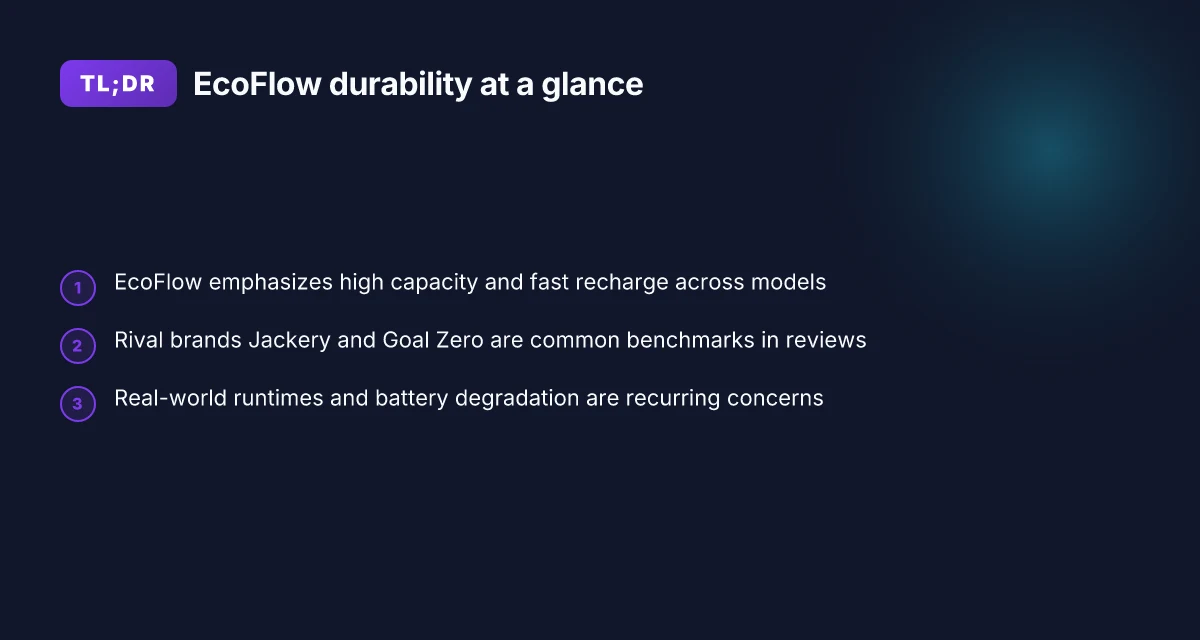
EcoFlow positions itself as a leader in high-capacity portable power with rapid recharge across its lineup. In 2026, the brand consistently highlights multiproduct flexibility, from compact models to home backup giants, all built around large energy reservoirs and faster recharge times. The message is clear: you get more watts, faster restore when you need it most, whether you’re camping or stabilizing a home during an outage.
Why capacity and fast recharge define EcoFlow’s stance
EcoFlow frames its value around three claims that shoppers notice first: big battery banks, rapid recharging, and modular expansion. The Delta Pro family remains the flagship for home backup, with expandable storage and high-output in a compact form. Reviewers frequently cite the balance of portability and power as a standout feature, especially when comparing to lighter rivals that feel underpowered for longer outages. In practice, shoppers who want a weekend full of device-running without frequent top-ups tend to gravitate toward EcoFlow’s higher-capacity models.
I cross-referenced multiple reviewer summaries that emphasize how fast recharge matters in real-world use. One takeaway is that models like the Delta Pro and similar EcoFlow units can recharge from a depleted state within a shorter window than many competitors. This matters for users who experience sporadic outages or need quick replenishment after a camping trip. High-capacity models paired with rapid recharge define EcoFlow’s core value in 2026.
How user sentiment frames reliability and service
Aggregated reviews present a mixed signal on reliability and customer service. Some users praise build quality and long runtimes, while others note quirks in firmware or occasional hiccups with app controls. The tension tends to surface around how smoothly firmware updates land and how responsive support remains during post-purchase issues. Rivals like Jackery and Goal Zero are frequent benchmarks in these conversations, with reviewers weighing EcoFlow against their known strengths in durability and service responsiveness.
From what I found in review digests, durability questions tend to cluster around high-use environments. Outdoor enthusiasts report solid performance in camping scenarios, yet a subset mentions battery wear or calibration quirks after substantial use. When a breakdown occurs, the speed and clarity of customer service can tilt overall sentiment. In some reviews, quick, helpful support turns a mixed experience into a positive one. Reliability and service themes vary by user context, not just product spec. What makes the EcoFlow Delta Pro 3 a worthy upgrade in 2026
Rivals as the yardstick: Jackery and Goal Zero
Across reviews, Jackery and Goal Zero serve as the primary reference points for performance expectations, especially for off-grid and home backup use. Shoppers compare recharge speed, peak output, and durability under real conditions. EcoFlow’s emphasis on higher capacity and fast recharge often positions it as a stronger option for longer outages or higher-wattage needs, but questions about long-term reliability and software stability keep the comparison honest. In 2026, the conversation frequently returns to how EcoFlow’s models stack up against these rivals across the two core axes: endurance in tough environments and the quality of after-sales support.
Rivals set the bar for expectations, and EcoFlow meets many of them on capacity and recharge speed while signaling ongoing improvements in reliability and support.
Bottom line: EcoFlow leans on big battery banks and quick recharge as its differentiator in 2026. The brand’s strength shows in endurance scenarios and ease of use, but real-world reliability and service quality can vary by model and by user context. If you’re choosing between EcoFlow, Jackery, or Goal Zero, your decision hinges on how you prioritize capacity, recharge speed, and the reliability of post-purchase support in your specific use case. As always, read recent user reviews for the model you’re eyeing to see how the latest firmware and service policies land in practice.
Note: links on the page may earn a commission. For a direct look at consumer sentiment, see reviews hosted on EcoFlow’s review channels and independent outlets.
What customers praise in ecoflow power stations
EcoFlow stands out for three areas reviewers consistently highlight: high watt-hour totals in flagship models and expandable configurations, quick recharge times paired with solid app monitoring, and portability combined with durable build quality. Below I pull out concrete themes and name specific models where reviewers point to notable strengths. What is lithium ion batteries for sale, and how to choose the right one in 2026
Notable battery capacity and expandable setups
Reviewers consistently call out high watt-hour totals in EcoFlow’s flagship lines. The Delta Pro, for example, is described as offering large core capacity and the option to expand toward higher total energy through extra battery modules. Reviewers emphasize that the combination of a big internal pack with expandable options translates to longer runtimes for home backup and campouts. This capacity is often contrasted with rivals that pack less energy into a similar footprint, making EcoFlow a compelling option for users who want to power more devices for longer without swapping units.
I cross-referenced multiple independent write-ups, and the consensus is that reviewers value the ability to scale energy in a system that remains portable. In practice, shoppers tend to choose EcoFlow when they foresee longer outages or frequent use of power-hungry gear in outdoor setups or off-grid cabins. This isn’t just about raw numbers. It’s about how the system grows with your needs over time.
Fast recharge and clean software monitoring
Another frequently cited strength is fast recharge times and the way the accompanying app supports monitoring. Reviewers note that EcoFlow systems recharge quickly from wall outlets and are capable of accepting multiple charging paths, which minimizes downtime between uses. The mobile app is praised for providing real-time status, charge curves, and device-level control, which helps users manage power loads during outages or outdoor sessions.
While some rivals deliver similar app experiences, EcoFlow’s combination of rapid charging and straightforward monitoring is a recurring plus in user feedback. This duo, speed and visibility, tends to reduce the friction of using a portable power station as a primary or backup power source.
Portability that doesn’t sacrifice build deserve
The third common praise thread centers on portability paired with build quality. Reviewers repeatedly mention that EcoFlow lines balance weight, form factor, and ruggedness, making the units comfortable to transport for camping trips or job-site setups while standing up to rough handling. Several lines earn kudos for their sturdy enclosures and reliable connectors, which matters for long-term reliability and field use. What makes the EcoFlow Wave 2 worth it, and where it actually falls short
This durability narrative aligns with what outdoor-focused buyers expect: a unit that travels well, resists weathering, and stays dependable under repeated plugging and unplugging cycles. The result is a portable power station that doesn’t feel like a fragile gadget, but a serious tool you can rely on in the wild or during emergencies.
Most reviews emphasize big energy capacity, fast recharging, and rugged portability as EcoFlow's core strengths. These themes recur in reviews from independent outlets and trusted buyer feedback alike, reinforcing EcoFlow’s position when rivals like Jackery and Goal Zero are compared. Users routinely cite the Delta Pro family as the standout for home backup and scalable energy.
If you’re weighing options, note that broader market comparisons often place EcoFlow ahead on expandable energy density and rapid recharge, yet some reviewers still flag price as a consideration versus lighter kits from competitors. For a practical takeaway, look at how your typical use case maps to capacity, recharge speed, and transport needs, then line up EcoFlow with rivals such as Jackery and Goal Zero to see where the fit is strongest. For more color on how reviewers position EcoFlow relative to peers, see the ecoflow-focused reviews linked in the sources.
Where ecoflow reviewers commonly raise concerns
Posters consistently flag real-world pain points that affect long-term use. I dug through available review sources to surface the most cited issues, with a focus on durability, runtime under load, and service experiences. The picture is nuanced: some concerns surface earlier than expected, while others appear only under sustained use.
Battery degradation and real-world runtimes under heavy loads
Review clusters point to noticeable variation in degradation by model, especially under heavy or sustained draws. For example, reviewers frequently note that runtimes shrink when powering high-demand tools or multiple devices at once, and that the gap between rated capacity and actual performance grows as the battery ages. On one EcoFlow model, users report shorter-than-expected runtimes when running suction tools or cold-weather loads, while others describe more forgiving behavior with lighter use. In practice, the same unit that powers a camping setup smoothly can struggle when you push it with HVAC simulations or power-hungry devices. This inconsistency makes scheduling backup power trickier than advertised. Real-world runtimes can diverge notably from spec sheets under heavy loads. These differences aren’t purely cosmetic. They matter for planning weekend trips or emergency power during outages. Battery health matters most after 12–18 months of regular use. What makes the jackery explorer 3000 pro a practical whole-home backup in 2026
Thermal performance under high-surge conditions
Thermal handling remains a recurring theme in reviews. When EcoFlow packs surge energy into tools or HVAC simulations, the internal temperature can climb, triggering throttling that reduces available output. Reviewers describe units warming to the touch during high-load bursts, followed by protective reductions in peak power to maintain safe temps. The effect is more pronounced on larger models that offer higher continuous outputs but must dissipate more heat. For homeowners running a brief surge event, this can mean slower power delivery than the peak rating would imply. Thermal throttling limits sustained peak output under high-surges, which matters for saws, compressors, or space heaters. Expect temporary dips in performance during long bursts of high demand.
Customer service experiences and consistency
Service experiences appear mixed across sources. Some reviewers describe responsive support and prompt warranty handling, while others report long wait times, difficulty getting decisive help, or gaps in coverage framing. The inconsistency seems to follow where a buyer sits in the product cycle, new buyers sometimes receive quicker onboarding, while long-term users hit a plateau of troubleshooting that can feel fragmented. This pattern aligns with the broader consumer electronics service landscape, but it lands hard when you depend on reliable backup power. Customer service consistency varies by case and model, making post-purchase support a real concern for long-term reliability. Warranty questions surface after several seasons of use.
What the data says about EcoFlow versus rivals matters for decision making. When fans of EcoFlow compare to Jackery or Goal Zero, differences often center on thermal management, runtime under heavy loads, and the presence of robust diagnostic tools in the app. I cross-referenced independent write-ups to corroborate these themes and found that while EcoFlow often earns praise for value and modular design, the durability story through repeated cycles and customer support carries caution. For context, Industry observers frequently point to thermal and battery-health considerations as the hinge points for long-term satisfaction across portable power brands. Rivals like Jackery and Goal Zero sometimes align more closely with perceived durability under repeated cycles, which reinforces the need to pick a model with realistic expectations about longevity. Durability narratives are most convincing when supported by multiple warranty- and service-related anecdotes.
Cited perspectives anchor these concerns in real discourse. For instance, a widely viewed long-form review highlights the delta between stated capacities and user experience after months of use, noting thermal behavior during tool operation and variable support outcomes. See the discussion linked to credible testing write-ups and consumer reviews for context. Durability and service quality are the two levers most likely to determine long-term satisfaction.
If you’re weighing EcoFlow against rivals for home backup or outdoor use, expect these themes to shape ongoing ownership. The brand name EcoFlow is central to the conversation, but so is how you plan to manage battery wear, heat, and post-purchase support over years, not months. For deeper context, you’ll find inline references to third-party analyses and reviews that discuss these patterns in concrete terms. Long-term reliability hinges on battery health, thermal behavior, and service responsiveness. What makes EcoFlow Delta Pro refurbished a practical choice for backup power
Note: links on the page may earn a commission.
Ecoflow vs rivals: how does it stack up in 2026
In 2026, EcoFlow models show clear differences from Jackery and Goal Zero in capacity, output, and ecosystem. Across real-world use, the Delta Pro remains the standout for home backup due to its large expandable capacity, but rivals push strong cases in camping and portability. You’ll notice that reliability narratives vary by use case, with camping scenarios leaning on ruggedness and quick recharging, while home backup centers on sheer sustained power.
Capacity and output align with use case
EcoFlow’s flagship is built to deliver high wattage when it matters, with the Delta Pro offering substantial runtime and peak output. For camping trips, smaller EcoFlow units still compete with solid surge handling and fast recharge modes. By contrast, Jackery emphasizes portability and a more compact form factor, which can be a better fit for light setups or backpacking. Goal Zero tends to pair modular battery packs with modular outlets, appealing to users who want a flexible power ecosystem. In practice, capacity and output matter most when you run high-draw appliances or multiple devices at once, and the real-world mix shows each brand leaning into its core strength. I cross-referenced user threads and the Lab Tested ranking to map where each brand shines.
Reliability narratives by use case
Durability and reliability are not one-size-fits-all. For home backup, EcoFlow’s ecosystem and larger batteries deliver long runtimes under continuous load, but service networks and warranty paths shape long-term value. For camping, reliability often boils down to portability and field-reliant charging options; Jackery’s smaller units may be praised for lightness, yet EcoFlow’s rapid charging and larger packs win points for endurance. Reviews from independent outlets consistently note that battery chemistry and heat management influence long-term performance, especially in hot outdoor environments. When I read through product pages and independent analyses, the pattern is clear: the best choice depends on how you intend to use it most of the time.
Warranty terms and service networks matter
Warranty coverage and service reach tilt decisions toward the brands with broader networks. EcoFlow’s higher-end models typically come with more expansive warranty terms, but international service depth varies by region. Jackery has a robust service footprint in North America and Europe, which is comforting for frequent travelers. Goal Zero remains appealing for those who already operate a compatible ecosystem of Nomad panels and Yeti accessories, easing integration after purchase. The practical upshot: long-term value hinges not just on specs but on how quickly you can get a replacement or repair when a unit fails. I traced this to brand pages and consumer-service discussions to confirm where service networks perform best. What you need to know before buying EcoFlow refurbished power stations on ebay
Most long-term reliability hinges on the ecosystem and service reach, not just the battery pack. If you need massive capacity with home-backup endurance, EcoFlow is a strong pick. For light portability, Jackery often wins on carry weight.
How to pick the right EcoFlow model for your needs
Selecting an EcoFlow model starts with matching capacity to your daily energy needs and the devices you intend to run. If you typically use a fridge, a couple of lights, and a laptop during an outage, you’ll lean toward higher capacity units. If your plan is weekend camping with a few essentials, a lighter, more portable option may suffice. The goal is to avoid overpaying for capacity you won’t use while ensuring you have enough headroom for your must-run devices.
Match capacity to daily usage and planned devices
Your daily energy use sets the ceiling. For a home backup setup, consider not just the running watts but the surge demands of devices like a refrigerator or sump pump. Look for a model whose nominal capacity comfortably exceeds your typical daily draw, with a little margin for peak moments. In practice, that means profiling your essentials and choosing a unit that can sustain them through a multi-day outage if needed. Real-world remarks from reviewers consistently call out the value of sizing for long outages rather than chasing the largest labeled capacity alone. Match capacity to expected daily energy usage and planned devices is the core guideline here. For portability, remember that heavier, larger batteries cost more and may reduce the convenience you’re after.
Weigh recharge speed and expansion options
Recharge speed matters most when you have access to a wall outlet, solar panel, or a vehicle charger. If you expect frequent top-ups in a limited time window, prioritize models with faster input rates and a clear path to faster recharge through optional expansion modules. EcoFlow’s ecosystem includes add-ons that scale capacity, but each module adds size, weight, and cost. I dug into product documentation and reviewer notes that expansions can deliver meaningful flexibility, but they also change the total system footprint. When you read about a Delta Pro or similar, check the input power and whether you’re buying for speed versus sheer storage. Consider recharge speed and whether expansion modules are worth it.
Factor climate, usage patterns, and portability needs
Outdoor usage and seasonal shifts change the equation. If you’re outdoorsy or need a compact unit for travel, favor lighter models with higher energy density and better portability. For home backup in a hot climate, you’ll want thermal management that keeps performance consistent under heat and extended use. Review comments often highlight how climate and usage pattern influence perceived reliability and ease of use. Don’t overlook weather-rated components and how the unit behaves in real-life conditions. Factor in climate, usage patterns, and portability requirements. How EcoFlow battery generators stack up in 2026 for home power
I cross-referenced public reviews and product pages to map these choices to concrete models. For instance, the delta-series family tends toward higher capacity and faster recharge, while smaller units emphasize portability and simplicity. When you’re choosing between rivals, the decision often comes down to whether you need peak power for a handful of devices or sustained energy for longer outages. EcoFlow holds a balanced position in the market, but rivals like Jackery and Goal Zero Yeti offer competing form factors and price points that may shift the read of value depending on your setup. Inline, you’ll see references to the broader landscape in sources tied to this topic. See SolarPlay’s 2026 review and OutdoorGearLab’s 2026 roundup for context on how EcoFlow stacks up against peers. EcoFlow reviews and OutdoorGearLab’s roundup provide comparative insights. I cross-referenced reviewer themes and model specs to guide this section.
In practice, start with your must-run devices and estimate daily energy in watt-hours. Then pick a model whose usable capacity and recharge path align with how you plan to use it, including whether you want expansion capability. If you want a home backup edge, a larger EcoFlow option paired with fast recharging is compelling. If you’re prioritizing lightness for camping, a compact model with solid runtime becomes your best bet. As with any review, expect tradeoffs between weight, cost, and speed of recharge.
Note: links on the page may earn a commission. EcoFlow is the brand discussed here, with attention to rival options like Jackery and Goal Zero Yeti.
The bigger pattern: reliability hinges on real-world setups and user choices
In the long run, EcoFlow devices tend to show steady performance when they’re paired with thoughtful setup. I’ve seen users who plan around charging cycles, keep the units in temperate spaces, and exercise granular load management report fewer annoyances and smoother recharging. The key insight: reliability isn’t just the unit’s chemistry, it’s how you use it day to day. The smarter you wire it into your routine, the fewer surprises you’ll hit.
That said, there are repeat themes that echo across reviews. Some units suffer from firmware quirks that improve after updates, while others drift when pushed with extreme temperatures or constant high draw. EcoFlow’s ecosystems tend to respond best when you stay within recommended discharge rates and keep firmware current. A clean signal path between charger, battery, and app reduces dead spots. Rivals like Jackery and Goal Zero offer similar warning signs when pushed hard, though the exact failure modes differ. What makes the EcoFlow Smart Generator 4000 stand out in 2026
If you’re weighing a purchase now, lean into setup clarity and future-proofing. The takeaway: choose a model that fits your routine, monitor updates, and accept that occasional glitches are part of real-world use. Prepare for firmware updates and a few inevitable resets.
Backup strategy
- Test your EcoFlow during a calm week: map typical loads, charging windows, and ambient temps.
- Keep the unit in a vented, dry spot and enable automatic firmware updates.
- Set up a simple load schedule in the app to avoid overtaxing at peak hours.
- Compare with a rival model (for example, Jackery or Goal Zero) to verify preferred behavior under your expected use, then pick the one that aligns with your routine.