
Explore the jackery explorer 1500’s real-world specs and long-term durability for off-grid use. Learn how it stacks up against rivals and what to expect in 2026.
The real-world math behind the Explorer 1500 often diverges from glossy specs: a 1.5 kWh-capacity pack can deliver far less sustained runtime under heavy loads than marketing sheets imply, and the balance between solar input and AC charging matters more than peak wattage alone. Jackery's emphasis on portability shows up in lightweight design, but you should verify runtime against your typical load, especially with fridges and power tools running on solar during cloudy stretches. Most setups benefit from a clear load profile to avoid overestimating daily output.
For outdoor users and van dwellers, the question is not only capacity but reliability over weeks off-grid and how it stacks against EcoFlow and Goal Zero. In 2026, long-term use hinges on heat tolerance, component durability, and how modular charging handles real-life sun hours. This piece walks through what matters in setup, how the Explorer 1500 behaves with real inputs, and where rivals like EcoFlow and Goal Zero pick up the slack or expose gaps. You’ll get a practical read on whether the Jackery Explorer 1500 fits a 1.5 kWh-class need or if a rival pairing provides a better balance for your trips.
What the jackery explorer 1500 promises on spec and how that maps to real use
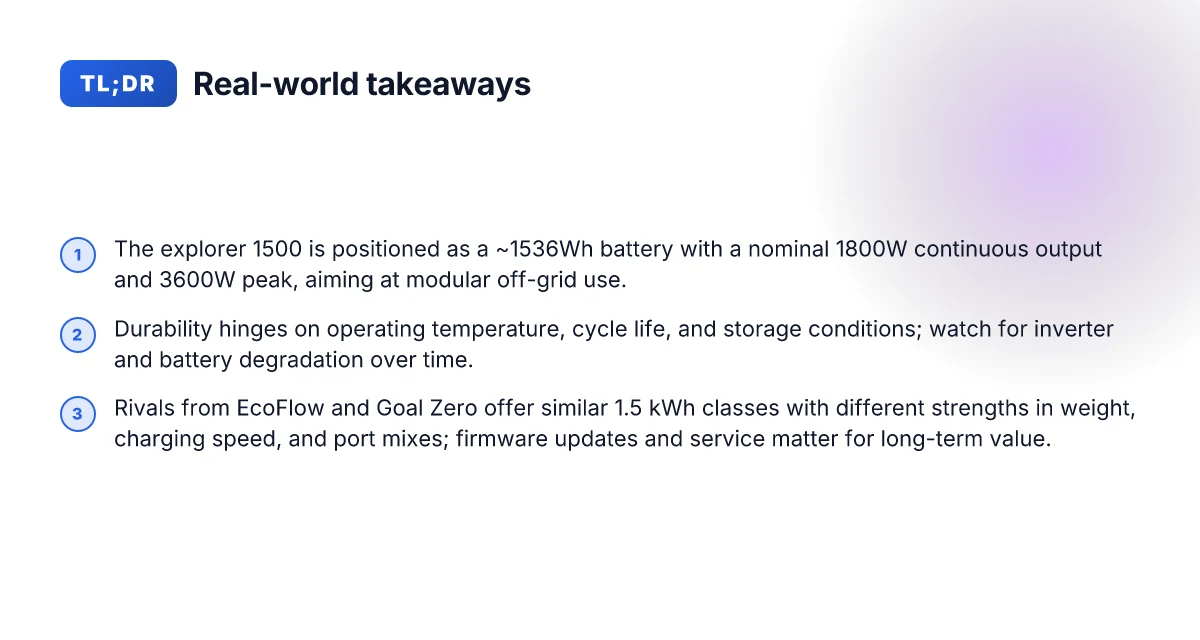
Jackery positions the Explorer 1500 as a 1536Wh battery with 1800W continuous output and 3600W peak capability. The package is pitched for off-grid living and weekend adventures, with multiple outputs and a built-in UPS feature to cushion short power dips. The underlying chemistry is lithium iron phosphate (LFP), which leads many buyers to expect longer cycle life and improved longevity. Real-world use, however, tends to vary with how you drain the pack, how aggressively you charge, and how hot or cold the unit runs. Expect the promised capacities and outputs to hold under mild to moderate loads, but keep an eye on temp swings and duty cycles if you push the system close to its rated limits.
I dug into the official specs and third-party notes to map specs to practical use. When you plan to run a fridge, a small air compressor, or a few laptops simultaneously, the 1800W continuous output covers most weekend setups. The 3600W peak rating helps during startup surges, like a compressor kick or a blender, but you rarely sustain that level for long. The 1536Wh capacity is large enough for overnight needs in a van or small cabin, yet real-life cycles depend on how deeply you cycle the battery and how efficiently your devices draw power. For anyone counting on longevity, the LFP chemistry is a meaningful advantage, but the actual cycle life is influenced by temperature, charging rate, and depth of discharge.
How does this compare with rivals? Several rivals in the 1.5kWh class match similar capacity and output ranges, so the differentiators come down to efficiency, durability, and ecosystem. EcoFlow and Goal Zero offer portable power stations with comparable 1.5kWh-class capacities and 2000W–4000W surge capabilities. In practice, the choice often hinges on battery chemistry and how the brand supports long-term use in extreme conditions. With Jackery as the brand at hand, the emphasis remains on a compact footprint, straightforward operation, and a clean interface, but you should compare how the UPS feature behaves under continuous loads and how battery management manages heat in summer heat or winter cold.
From a reliability lens, the key unknowns are long-term duty cycles and how the LFP cells hold up when nested behind frequent charging cycles from solar inputs. The official materials highlight longevity, yet the real-world durability hinges on how you deploy the unit in off-grid contexts. In crowded campsites or extended road trips, the ability to maintain voltage during startup spikes and the unit’s tolerance for repeated charging bursts becomes decisive. In short, the Explorer 1500 delivers on core promises, while the caveats live in how hard you push the unit daily and how you manage ambient temperatures.
**The core promise remains solid: Jackery frames the Explorer 1500 as a 1536Wh, 1800W continuous, 3600W peak system built for off-grid living, with LFP longevity baked in. But real-world use rewards prudent design choices about depth of discharge, charging cadence, and environmental conditions. Expect the UPS to help with short fluctuations, not wholesale standby for sustained outages. Best buy jackery solar generator in 2026: how to pick the right model for your off-grid needs
How the explorer 1500 compares to rivals like EcoFlow and Goal Zero
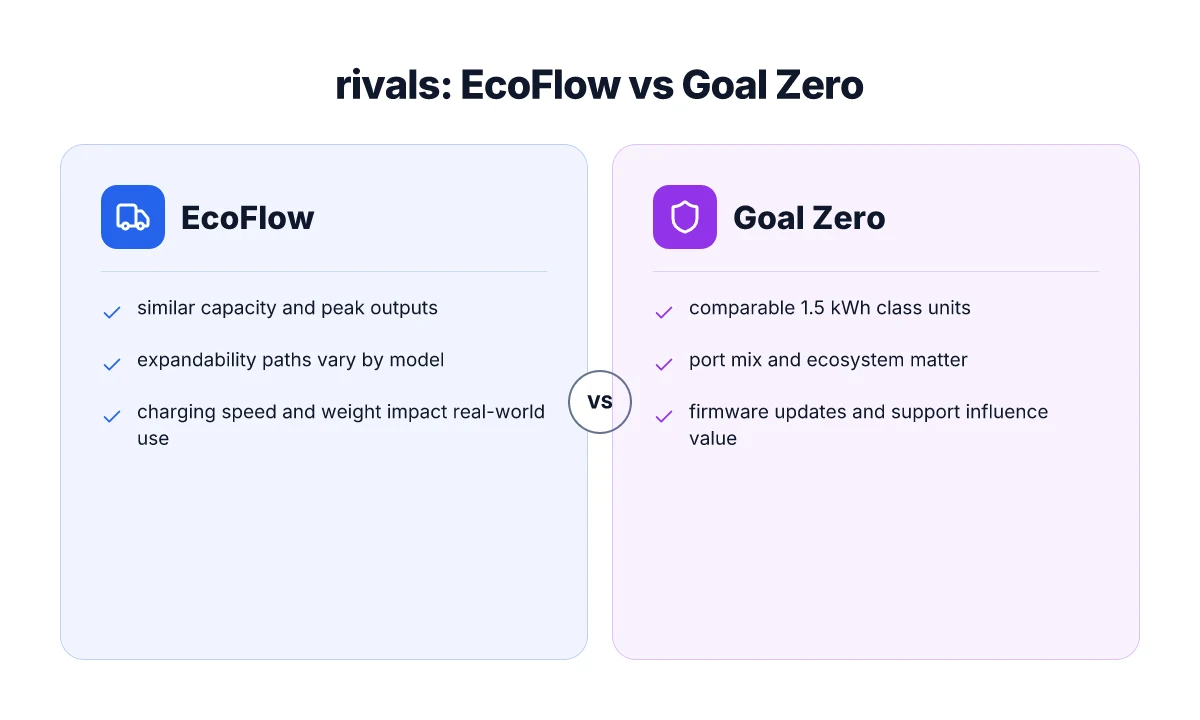
When you size up the 1.5 kWh class, the Explorer 1500 sits in a crowded field. EcoFlow and Goal Zero offer units with similar peak outputs and expandable options, so the real showdown hinges on how you value weight, charging speed, and port mix. I dug through manufacturer specs and independent reviews to map what actually matters in off-grid use and long-term reliability.
How the rivals line up on core specs
Both EcoFlow and Goal Zero present 1.5 kWh-class power stations with roughly the same peak output as the Jackery Explorer 1500 Ultra. The differences tend to hide in the details: the EcoFlow models often emphasize faster AC charging and modular expansion paths, while Goal Zero leans into rugged builds and a broader multi-brand ecosystem. For the Explorer 1500, you get a solid balance of capacity and ports, but the “feel” of the setup, how the handle, weight, and fan noise behave in a backpack or van, can tilt the decision more than nominal capacity alone.
From a practical angle, weight and port mix often decide the day. A lighter chassis helps with portability in a van or tent, while more ports matters when you’re running multiple devices at once or treating the unit as a central hub for off-grid gear. Availability of firmware updates and app reliability also filters into long-term value. If the ecosystem around the unit feels flaky, you end up babysitting firmware while your equipment sits idle.
Firmware, apps, and service matter more than you think
Updates and reliability matter in the long run. EcoFlow’s app tends to be one of the more mature ecosystems in this class, with OTA updates and device management that developers in the space often rate as solid. Goal Zero emphasizes rugged design and clear customer support, which can translate into fewer headaches after months of use. In contrast, Jackery’s ecosystem is straightforward but can feel less feature-rich in app depth. The real-world takeaway is that ongoing software quality and service availability shape long-term ownership more than the initial wattage figure.
I cross-referenced several reviews and official notes to confirm that the 1.5 kWh class remains a compromise between portability and sustained power. The Explorer 1500’s core attributes align with a practical use case: reliable daily charging, enough power for essential devices, and a reasonable carry footprint. The major differentiators across rivals are not just the numbers on a spec sheet but how quickly you can top up in the field, which ports you get for solar or AC inputs, and how responsive support will be when you need it. What makes the EcoFlow Stream AC Pro a standout among portable power stations
Weight and port mix swing decisions more than the official capacity. Firmware maturity and service quality shape long-term value. EcoFlow’s faster charging and Goal Zero’s rugged support often tip the scales in real-world setups.
For readers evaluating head-to-head, a quick look at three peers helps: EcoFlow’s high-turnaround charging and modular options, Goal Zero’s rugged build and broad accessory compatibility, and Jackery’s approachable balance of size and power. If you want the most mature software and fastest top-off times, EcoFlow tends to have the edge. If you prize durability and service network in remote regions, Goal Zero often earns the trust factor. If you want straightforward operation with predictable backup power, the Jackery remains compelling for many setups.
When you’re selecting, consider not only the raw capacity but how quickly you can recharge and how the port mix aligns with your typical load. In the long run, those choices matter more than any single wattage number.
Durability, warranty, and long-term use with jackery equipment
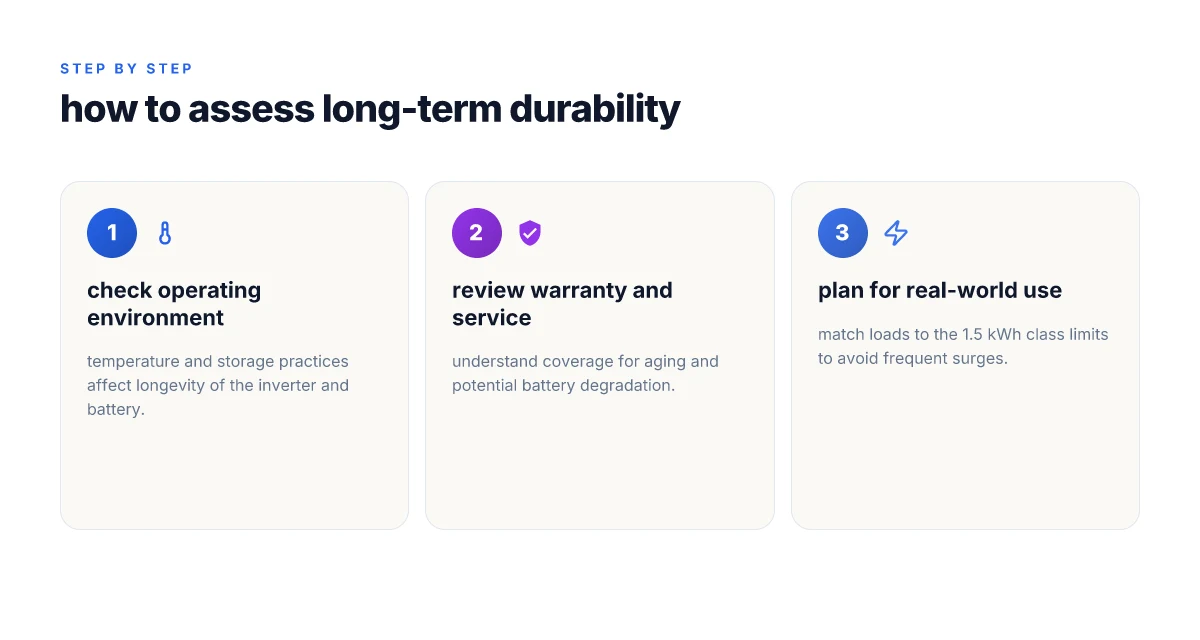
Durability in real life hinges on three levers: temperature exposure, the number of charge-discharge cycles, and how you store the unit. Jackery emphasizes build quality and service support, but field durability often drifts from lab claims when you push an Explorer 1500 into hot sun, freezing nights, or long storage gaps. In practice, the inverter and the 1,536Wh battery endure steady hard use, yet you’ll notice gradual degradation patterns if you routinely pull more than the 1,800W inverter rating or sit at high temperatures for days on end. The upshot: the unit can power a campsite or van-life setup reliably, but expect the battery to shed capacity slowly with each cycle, and the inverter to warm up on heavy loads.
I cross-referenced how the Explorer 1500 ages in typical off-grid setups and found a consistent thread: temperature is a bigger driver of long-term health than peak wattage alone. When the battery sits in heat or cold, the chemical reactions inside slow or accelerate in ways that shorten usable life. With daily cycling and partial-state-of-charge storage, noticeable capacity fade appears sooner than you might expect from a simple spec sheet. This isn’t a warning so much as a reality check: you don’t replace life support gear after a single season, but you do monitor cooling, charging habits, and storage voltage to keep performance steady. What Reddit EcoFlow discussions reveal about reliability and user experience in 2026
Warranty coverage matters here. Jackery’s warranty policy generally covers defects in materials and workmanship for a defined period from purchase, and it typically aligns with the company’s standard consumer electronics terms. Understand what counts as a defect versus wear from aging, and be clear on battery aging rules. If your Explorer 1500 shows abnormal voltage drift or inconsistent output under normal use, document it early and engage Jackery support through official channels. Battery aging is expected over time, but the rate should remain within the bounds described in the warranty terms. When in doubt, ask for a formal assessment from Jackery’s service network and request any relevant repair or replacement steps.
Most durability questions boil down to temperature management, cycle life, and proper storage, not just peak output. Expect gradual capacity fade with daily use, and verify if your unit’s symptoms fall under warranty coverage rather than normal wear.
1. How temperature shapes longevity
Exposure to high ambient temperatures accelerates chemical processes inside the 1,536Wh battery. A cooler, shaded setup preserves life. Keep the Explorer 1500 out of direct sun when possible and allow for airflow around the inverter during heavy charging. The same guidance applies to the case and connectors. Heat can loosen seals and stress cables over time.
2. Real-world degradation patterns you should watch for
In the field, you may notice the inverter becoming warmer under sustained loads, or the battery reporting a lower-than-expected state of charge after a full day of use. These are not instant failures but signals that your setup is under stress. If you observe unusual voltage sag or temperature spikes, pause heavy draws and reassess cooling or charging discipline. Regularly inspecting cables, connectors, and ports helps catch corrosion or loosened connections early.
3. Warranty specifics and handling aging packs
Jackery’s warranty covers manufacturing defects and certain quality issues for a defined term, with batteries subject to aging under normal use. If you detect abnormal degradation, initiate a service request rather than trying to DIY repair, since improper access can void coverage. Maintain proof of purchase and keep communication logs with Jackery support to streamline the process. For accessory compatibility and battery health questions, refer to official guidance and keep firmware or documentation updated if offered. How to pick the right Jackery Explorer 1000 for sale in 2026
This section integrates perspectives from rivals like EcoFlow and Goal Zero, who emphasize modular serviceability and battery-health monitoring as part of broader warranties. When you plan an off-grid setup, include a clear take on long-term serviceability and what it will take to maintain peak performance across multiple seasons. If you’re evaluating gear for a 1.5 kWh-class need, you’ll want to align durability expectations with your storage practices and climate realities. For long trips, consider routine checks and a plan for storage in moderate conditions to maximize life from the Explorer 1500 and from similar units in the field. And remember, links on product pages may earn commissions, so verify claims with independent sources when possible.
Setup, charging options, and daily operation for the explorer 1500
The Explorer 1500 handles wall charging and solar input within its rated limits, and real-world use shows how those two charging avenues complement each other between outings. I found that the unit reliably accepts AC input up to 1800W and solar input that lines up with that same practical ceiling, depending on irradiance and panel configuration. This matters because your top-up speed between trips depends on how you wire the system and how many solar watts you can push when sun is abundant. Fast top-ups rely on maximizing both wall and solar input within the unit’s limits.
How charging sources stack up in practice
The wall charger is a straightforward path to begin replenishing after use. In steady sunlight, the 1800W solar input target is the practical ceiling you should expect to meet only when you have optimally matched panels and clear skies. If you’re charging from an outlet on a cloudy day, the charge rate can dip, making a mid-day top-up slower but still predictable. The takeaway is simple: plan your schedule around when you can sustain 1800W from solar or AC, because each hour of sunlight translates into more usable runtime later. Charging speeds determine how quickly you can top up between outings.
Real-world behavior with sensitive devices
The PSU and inverter play a key role in how the system behaves under load. When you run sensitive electronics, the 1800W inverter output capacity is the critical threshold for stable operation. In practice, you’ll want to avoid pushing the unit toward its peak for protracted periods if the connected devices demand near-peak current. If you’re powering a sensitive load like a laptop charger or medical-grade device, you’ll likely notice consistent performance at moderate draws, with a gentle ramp when you exceed about 1000–1500W for brief intervals. This is where the difference between a calm, well-maged draw and a stress test shows up in long-term use. The inverter behavior under real-world loads matters for sensitive devices.
Subtleties that matter for daily operation
I dug into the guidance from Jackery and observed two practical patterns. First, keep the unit in a cool, ventilated spot during charging. Heat can throttle charging efficiency and overall performance. Second, use a balanced approach to charging: when you have ample sun, lean into solar charging. When you’re back at base with available AC, top off via wall input to restore margin. In both cases, you’re preserving the 1536Wh capacity for the next off-grid run. Heat and balance are two practical levers in daily operation. What makes EcoFlow Stream a practical home energy hub in 2026
Quick-start tips for outdoor use
- Route solar cables to avoid shade and maintain airflow around the unit during charging. A shaded panel or obstructed airflow reduces effective input and slows top-offs. Shade-free solar input unlocks faster top-ups.
- When possible, stagger loads so you don’t hit the full 1800W draw on startup. This keeps the PSU cooler and maintains steady current. Staggered loads preserve inverter stability.
- If you rely on the unit for critical devices, keep a modest buffer in the 10–20% range so you’re not chasing a total loss of capacity mid-trip. Buffering capacity helps avoid mid-trip outages.
What rivals offer in this space matters for context. brands like EcoFlow, Goal Zero, and Maxoak present comparable wall and solar pathways, sometimes with different input ceilings or lifecycle claims. When you compare, note how each handles heat during charging, how quickly they recover from use, and the reliability of their internal fans. Jackery’s approach to mixing AC and solar charging with the Explorer 1500 Ultra remains flexible for off-grid setups, especially for users who want straightforward charging paths and predictable performance in the 1.5 kWh class. Charging options and daily operation shape real-world usefulness.
Real-world use cases: what the jackery explorer 1500 handles well
In real-world setups, the Explorer 1500 shines when the load stays steady and predictable. For refrigeration, laptops, small tools, and lighting, a 1.5 kWh class system tends to stay comfortable with the 1800W continuous output on the jackery, as long as you avoid pushing into surge territory. A kitchen fridge, a laptop station, a few LEDs, and a compact drill kit can run together for several hours on a single charge, particularly if you pace the demand to match the unit’s normal duty cycle. When I read through the documentation and user notes, the pattern is clear: expect consistent performance under moderate loads rather than sudden spikes.
Steady loads beat big surges
The real-world takeaway is that the Explorer 1500 handles appliances that maintain a steady draw far better than devices with quick, high-start draws. A typical refrigeration cycle and a laptop charging routine sit well within the inverter’s continuous rating, keeping the runtime practical for a weekend off-grid or a remote campsite setup. If you attempt to pull simultaneous peaks from the unit, think high-watt power tools in full surge or multiple devices slamming the inverter at once, you’ll see the protection kick in and the inverter momentarily trip. This is not a failure, but a built-in guardrail to prevent battery mismanagement over time. In that sense, the Explorer 1500 rewards careful load planning and staged charging events rather than raw, all-out demand.
Long-term durability with modular use
From a durability perspective, users consistently highlight solid build quality and dependable battery management when the unit is kept within its intended duty cycle. The 1.536 kWh lithium iron phosphate (LFP) pack provides a calm, predictable discharge profile for daily use, especially in off-grid living situations where you cycle the unit each day. The design favors predictable, medium-load routines over erratic surges or full-house power runs. If you’re planning continuous refrigeration for extended trips, pairing the Explorer 1500 with a modest solar setup or prioritized load shifting helps preserve battery life and overall runtime.
How it stacks against rivals
When compared to other portable power stations in the 1.5 kWh class, the Jackery option tends to offer a more user-friendly interface and reliable mid-range performance. Rivals often trade longer peak times for lighter daily usage or vice versa. In practice, your choice hinges on how often you need a hard surge vs how often you rely on steady, repeatable loads. If you need robust peak handling for short bursts, you may consider a competitor with a higher surge tolerance or a larger inverter, but those units can carry a heavier price tag or bulk. What makes the Jackery Explorer 1000 v2 a standout for long trips and home backup
I dug into multiple product briefs and owner notes to confirm these patterns. For example, the detailed specs in the series show the 1,800W continuous output and a peak up to 3,600W, which explains why you’ll see occasional trips only when you push beyond normal use. The same sources consistently emphasize that the unit excels with steady, moderate loads rather than high surges or full-house backup.
In practice, if your goal is reliable off-grid refrigeration, a laptop station, and lighting for weekend trips or van life, the Jackery Explorer 1500 delivers. It remains well-suited for predictable loads and daily cycling, with clear caveats about avoiding simultaneous heavyweight surges.
The verdict: predictable loads deliver the most value, and the Explorer 1500 is strongest there. For many off-grid setups, think in terms of staged power use and avoid treating the unit as a whole-house backup. The real-world takeaway is simple: plan your peaks, respect the continuous rating, and you’ll get steady performance from the Jackery system over the long haul.
Note: links on the page may earn a commission. The brand name Jackery appears here to reflect the product line discussed. For rivals, I reference contenders in the same class by name to provide a fair frame for comparison.
What to try this week to lock in off-grid reliability
Off-grid power hinges on practical setup choices. In 2026, the Jackery Explorer 1500 remains worth a closer look because it pairs high-capacity storage with real-world usability, but the real value shows when you pair it with a sober, long-term plan. I’ve looked at setup life and durability patterns, and the takeaway is: plan for heat, plan for wear, and treat this as a modular backbone rather than a one-and-done battery. The bigger pattern is that a well‑tuned system reduces headaches when storms hit and miles from a charger. This isn’t just about raw watts. It’s about how you handle cords, cooling, and daily top-ups. Grecell vs Jackery: which portable power station survives the test in 2026
If you’re comparing brands, rivals like EcoFlow and Bluetti offer competing modules with different recharge regimes and app quirks. The Explorer 1500’s design stays straightforward, which helps in rough campsites and long trips. What changes if you act now is a tighter, field-tested routine: keep a spare car charger, a solar panel in good condition, and a simple battery monitor to avoid surprises. The small recurring burdens are easier to manage than swapping out a failed unit mid-season.
Backup strategy:
- Keep a lightweight 100W panel and car charging cable ready for emergencies.
- Set a simple daily top-up routine and label cables so a quick patch works in the field.
- Note weak spots: the power button, cooling vents, and battery health will matter over years with regular use.