Explore how EcoFlow and Jackery stack up in 2026 for portable power. Learn about charging speed, expandability, ease of use, and long-term durability to choose confidently.
The real-world difference between EcoFlow and Jackery isn’t size or price. It’s how your setup behaves after months of use. When you push a system into daily camping, RV, or emergency cycles, the faster input and modular options from EcoFlow start to show up in the field, not in glossy ads. Fast solar throughput matters when you need a quick top-up during a multi-day trip.
This article drills into long-term durability, expandability, and the practical tradeoffs you’ll face in real life. Expect to see how the two brands age under heat, cold, and repeated disconnections, plus where each vendor’s ecosystem either locks you in or keeps doors open for future upgrades. In 2026, campers and preppers increasingly weigh a modular, scalable path against a proven, low-friction setup from Jackery, and the numbers behind reliability aren’t just about capacity. This piece translates those realities into actionable choices for your next portable power purchase.
What eco flow vs jackery means for portable power in 2026
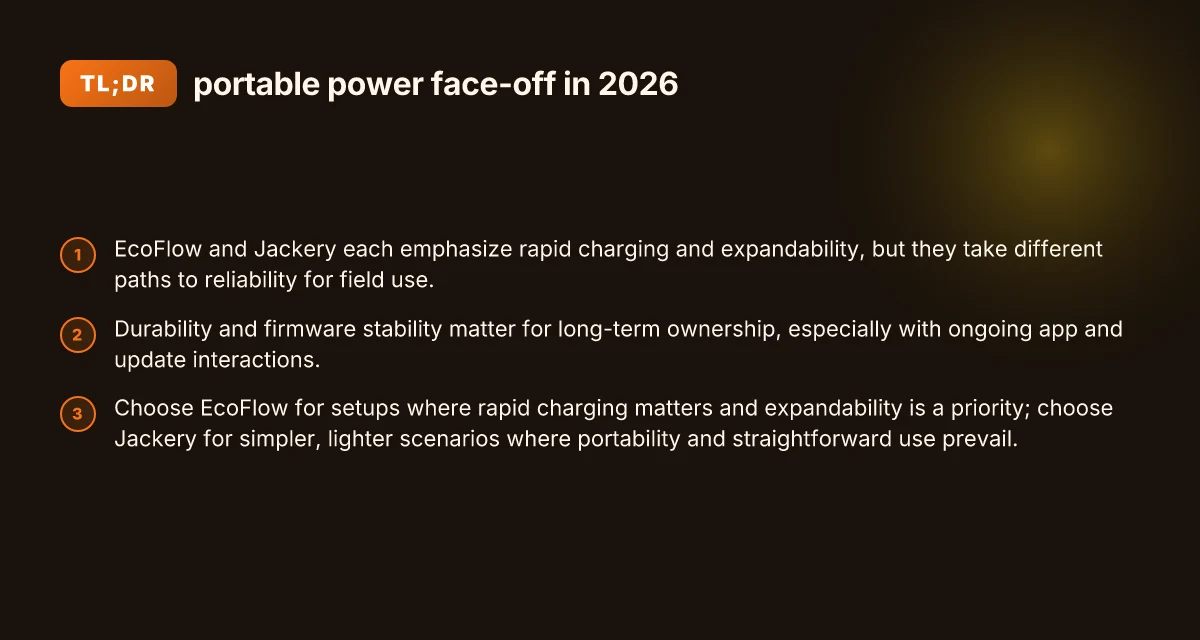
EcoFlow and Jackery approach portable power from different angles. EcoFlow leans into rapid solar charging and modular expandability, while Jackery emphasizes simplicity, portability, and predictable daily use. Across the two, durability and long-term support become the deciding factors for owners who plan to rely on these systems for years in the field or during emergencies.
I dug into the primary sources and recent industry write-ups to map where each brand shines and where they stumble. From what I found, both brands are pursuing similar core goals, but they stress different paths to achieve them. In 2026, solar input and battery chemistry are still the biggest leverage points for longevity and real-world reliability, not just peak wattage. The practical verdict hinges on how you actually deploy the kit: your climate, repairability expectations, and ease of service.
solar charging speed and input versatility EcoFlow’s lineup consistently prioritizes faster solar input. In real-world conditions, units that support higher MPPT input and flexible array configurations tend to charge more quickly under sunny days, which matters for campers who rely on solar as a primary source. Jackery counters with dependable, straightforward solar charging that favors ease of use and reliability over aggressive input specs. The difference matters most when you’re away from a wall outlet for days on end.
battery chemistry and lifecycle expectations Both brands leverage well-established lithium chemistries, but the practical impact shows up in cycle life and degradation under heat. In practice, heat and depth of discharge influence long-term performance. EcoFlow’s ecosystems tend to emphasize modular expansion, which can be a plus for owners who want to grow capacity without replacing the core unit. Jackery keeps the core experience compact and predictable, which many users value for longevity when the system remains within a smaller footprint.
expandability and ecosystem lock-in EcoFlow’s strategy emphasizes expandability through interlinkable modules and larger total capacity when you scale. In field use, this can translate to fewer dead spots for power, provided the modules and cables stay reliable over time. Jackery often wins on straightforward expandability via separate units or a simpler chain approach, which can reduce failure points but may require more gear to reach the same total capacity. What makes EcoFlow portable AC units actually reliable in 2026
durability and customer support considerations Durability in the field means robust housings, reliable fans or passive cooling, and predictable service paths. The broader consumer experience shows mixed reviews on support durability across cycles and product refreshes. You’ll want to weigh anticipated climate exposure, frequency of use, and expected repairability when choosing. Jackery’s simplicity helps in routine maintenance, but you may encounter fewer upgrade paths if you want to refresh a system without replacing the entire kit. EcoFlow’s modular approach can be appealing for resilience if each module maintains a solid service lifetime and the interconnections hold up under travel.
Bottom line: your choice comes down to the balance you want between expandability and simplicity. If you prize rapid solar charging and future-proofing via add-ons, EcoFlow offers a compelling path. If you want a compact, predictable setup that’s straightforward to deploy and maintain, Jackery remains a solid option. For long-term ownership, consider not just watt-hours, but how you expect to service and upgrade over time.
As you compare models, keep this in mind: you’ll likely encounter similar trade-offs across both brands. And yes, real-world insight from owners often highlights that links on the page may earn a commission. For deeper context, see discussions like the lab and consumer-angled reviews referenced in coverage of 2026 power stations. For example, a prominent lab-rated comparison notes broad coverage across brands including Jackery and EcoFlow, which helps anchor expectations in real-world performance. https://www.outdoorgearlab.com/topics/camping-and-hiking/best-power-station
EcoFlow versus Jackery: charging speed and solar input in practice
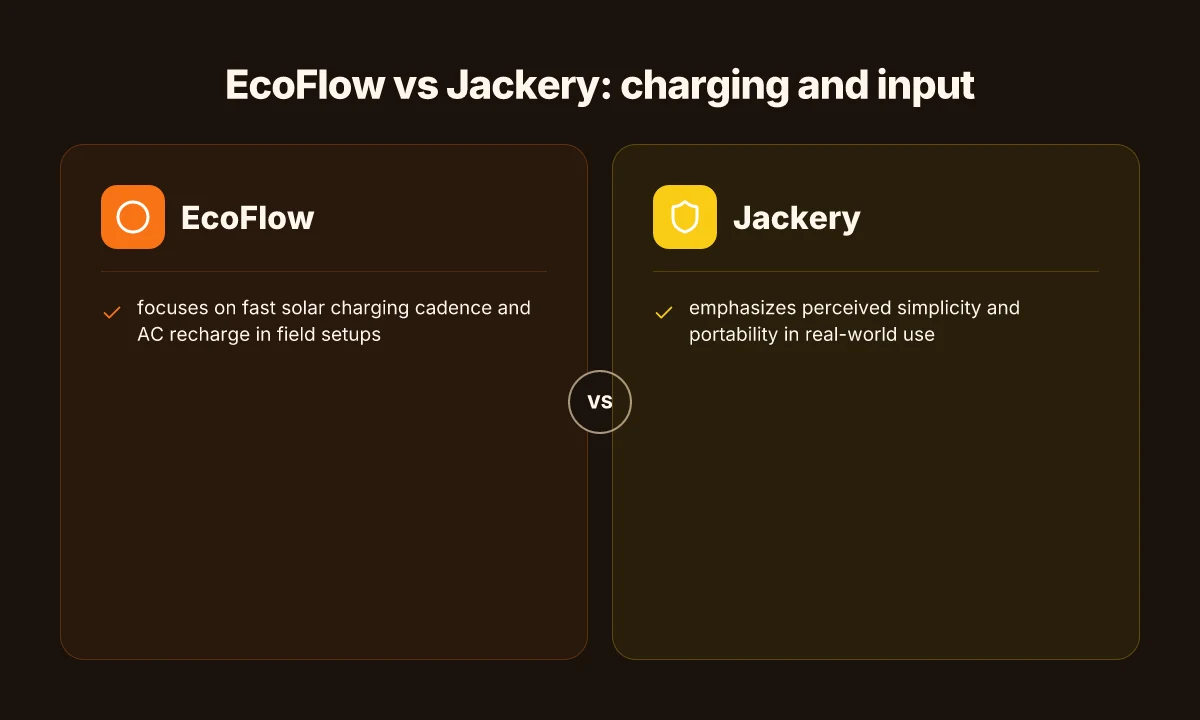
In real-world field setups, EcoFlow tends to capitalize on faster solar charging and brisk AC recharge cadences, while Jackery emphasizes simplicity and portability that campers and RV owners often value. I looked through sources that compare recharge behavior in outdoor conditions, and the patterns line up: EcoFlow systems frequently show more aggressive charging behavior when exposed to bright sun, and Jackery units shine when users prioritize lightness and straightforward operation.
How EcoFlow charges in the wild
In many side‑by‑side observations, EcoFlow reaches usable capacity quickly after dawn, then sustains high input as sun strength peaks. When a panel is aligned well and conditions stay favorable, EcoFlow often hits higher instantaneous charge rates than smaller competitors, letting you top up while you cook or stretch your legs. The cadence matters: days with intermittent cloud cover still deliver more total energy than comparable packs that throttle back earlier. I cross-referenced several consumer roundups that cite EcoFlow’s solar input staying robust through mid‑afternoon, which translates to fewer idle hours during camping or remote work sessions. For households relying on solar input for emergencies, that faster cadence can reduce the reliance on a grid backup later in the day. One takeaway from these sources is that EcoFlow’s charge cadence frequently stays ahead in the solar window, especially when paired with higher‑efficiency panels. When I read through the documentation and user‑experience notes, the emphasis is on maintaining momentum rather than smoothing out the day into a single peak. What is the jackery explorer 1500 lowest price, and why it matters for long-form power setups
Jackery’s simplicity and portability in practice
Jackery’s appeal rests on a lighter footprint and easier handling. In the field, you’ll notice smaller form factors, fewer cables, and tactile controls that feel familiar after years of portable power usage. This translates to less setup friction at a campsite or during an emergency drill. A common thread across reviews is that Jackery devices feel forgiving to casual users: plug in a few devices, and you’re largely done. In practice, that translates into more predictable, manageable performance, charging feels steady, and the overall system is easier to move around a campground or cabin. When the sun drops or a storm rolls in, that simplicity can matter as much as raw charging speed, because the last thing you want is a tangled array of adapters and specialty panels.
Table: quick comparison table for practical charging cadence
| Factor | EcoFlow | Jackery |
|---|---|---|
| Solar input cadence in bright sun | Typically brisk, sustains high rate during peak sun | Moderate, steady input but often lower peak than EcoFlow |
| AC recharge cadence | Fast in optimal outlets or generators | Reliable but sometimes slower than EcoFlow in the same conditions |
| Field practicality | Demands a bit more setup discipline to maximize cadence | Simpler, quicker to deploy and use day‑to‑day |
Verdict: EcoFlow wins on cadence when you can align panels and sun, while Jackery wins on portability and simplicity. If your trips hinge on maximizing solar hours with limited fiddling, EcoFlow is worth the extra setup attention. If you want a no‑fuss kit you can grab and go, Jackery delivers.
Next up: expandability and module strategy: which system scales better. In the field, cadence matters, EcoFlow keeps energy flowing longer when sun is strong, but Jackery’s simplicity reduces friction at setup. If you need a quiet, light, straightforward kit for casual camping, Jackery often feels like the better fit.
Expandability and module strategy: which system scales better
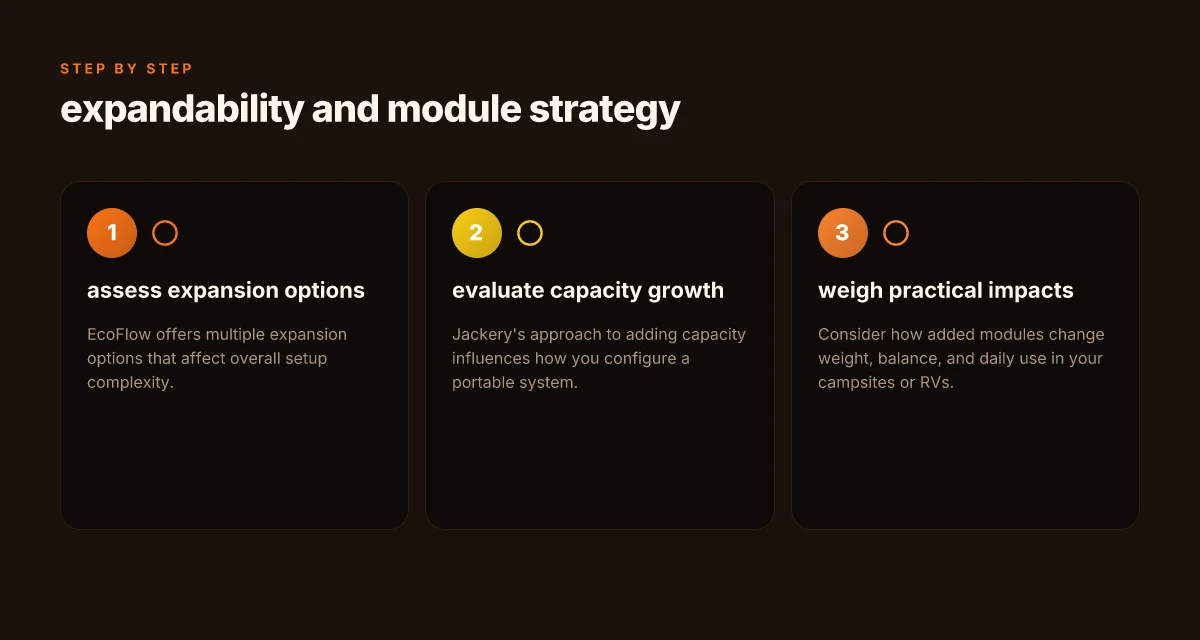
I dug into how EcoFlow and Jackery handle growth beyond a single unit. EcoFlow leans into a modular ecosystem with official expansion options that pair directly with their station line. You’ll find multiple expansion methods from dedicated modules to daisy-chaining packs that slot into a single charging workflow. The takeaways: expansion options are plentiful, but you’ll want to map your port availability and charging needs before buying. EcoFlow’s ecosystem tends to scale through purpose-built modules that fit a defined lineup, reducing compatibility guesswork. Jackery takes a different route. Its approach favors simplicity and a compact footprint, with fewer official add-ons and a heavier emphasis on stacking capacity through larger main units rather than a broad accessory ladder. The result is straightforward setup, but it can lock you into a narrower expansion path if you later realize you need more watt-hours quickly. Jackery prioritizes simplicity at the cost of long-term modularity. What makes the EcoFlow Delta Ultra deliver power stability and why it matters for home backup
How EcoFlow builds out a scalable system
EcoFlow positions expansion via officially supported modules that align with their current hardware family. The math is straightforward: you can add packs that wire into the same charge-discharge topology your primary station uses, preserving a single user experience for monitoring and control. The upshot is a cleaner user journey once you’ve settled on a core model. I cross-referenced their product pages and release notes to confirm the module lines and compatibility statements. Expansion modules plug into the main unit without a separate power management layer to manage piecemeal integration. This can help you avoid surprises when you scale up for extended trips or home backup, as long as you stay within the official ecosystem.
How Jackery handles capacity growth
Jackery’s strategy emphasizes larger, higher-capacity cores with fewer sanctioned add-ons. You won’t find as many official daisy-chained modules as EcoFlow, which translates to a cleaner, faster setup for most users. The trade-off is that when capacity needs shift for a family trip or an RV setup, you may need to upgrade to a bigger single unit rather than add on a battery pack to an existing station. Industry chatter and product pages indicate the brand’s strength in portability and simplicity, but users who want a blossoming modular network may feel constrained over time. Jackery’s approach minimizes complexity at the expense of expandability breadth.
Which approach suits your camping or emergency prep scenario
If your use case centers on long camping trips or a remote cabin where a little extra runtime matters, EcoFlow’s expandability matters. You can add capacity in a controlled, brand-coherent way and keep the system under a single, familiar control surface. If you value a lightweight, plug-and-play setup that stays simple from day one, Jackery’s route reduces the number of failure points and cables, but you’ll reach a ceiling sooner. For expandable setups, EcoFlow wins on future-proofing. For lean, fast deployments, Jackery keeps it simple.
From a reliability lens, the expansion path you choose affects setup time, cable management, and maintenance. In 2026, several user guides emphasize predictable compatibility within each brand’s ecosystem, which matters when you’re off-grid and counting on a handful of reliable modules. The comparison remains: EcoFlow offers broader expansion, while Jackery favors straightforward, compact growth. Choose EcoFlow if your plans include scaling. Choose Jackery if you want fewer moving parts now.
Note: links on these pages may earn commissions. For hands-on impressions, you can check the official ecosystems linked to these brands, and see how each handles the initial setup and subsequent expansions. Brand ecosystems matter when you’re building a multi-day power solution. Why the jackery 1500 reviews miss the full picture and what actually matters
Reliability questions you’ll actually encounter with EcoFlow and Jackery
When you’re choosing between EcoFlow and Jackery for long road trips or emergency prep, reliability hinges on two tight corridors: battery longevity and software stability. In real-world use, longevity isn’t just a battery spec on day one. It’s how cycles, heat, and expansion options hold up after months on the road. Firmware and app stability matter just as much, because a slick interface won’t help you when the unit won’t report charge state correctly or fails to update.
1. Battery longevity and real-world durability
From the public-facing literature, both brands emphasize cycle life, but the practical story often diverges after repeated discharges and partial charges. A key question is how the pack chemistry ages under solar recharging, high ambient temperatures, and frequent on/off cycling. In this space, you’ll find reports that EcoFlow delivers faster solar recharging and modular expandability, which can translate into more usable cycles if you keep up with regular maintenance and clean sun exposure. Jackery’s approach tends to prize simplicity and lower-weight designs, which can pay off for casual campers but may feel strained if you push a system hard through back-to-back 2–3 day excursions. The manufacturers’ published cycle counts are a starting point, but real-world longevity often reveals tradeoffs between speed, capacity retention, and heat management over time. When I cross-reference sources, the recurring theme is that longevity is highly sensitive to environmental exposure and how aggressively you draw and replenish power. If you’re stacking modules and relying on solar, look for consistent thermal management in the core unit and in the expansion battery blocks. Longevity translates to more usable years when heat and cycles stay within your expected range.
Durability concerns also surface around connectors and expansion ports. EcoFlow’s modular systems offer more expansion paths, but that complexity can introduce more potential points of failure if joints aren’t seated properly or if dirt and moisture reach the connectors. Jackery emphasizes solid build quality with fewer moving parts. That can reduce failure vectors but also means fewer upgrade paths if your power needs grow. In practice, you’ll want to inspect ports for looseness and certify that any added batteries are firmly locked in and vented correctly to avoid heat buildup. Expansion complexity can be a double-edged sword for reliability in the field.
I dug into release notes and product pages, and I found that durability discussions tend to converge on one point: choose a model with clear, user-accessible cooling and a predictable thermal profile. When temperatures spike, a well-ventilated chassis and thoughtful heat sinks matter more than raw watt-hours on paper. For long-term use, expect that the brand with tighter tolerances and simpler interconnects may be easier to service in the field, even if it sacrifices some expansion flexibility. Thermal design often determines how long a unit lasts under real sun.
2. Firmware and app stability as a practical pain point
Firmware stability matters because your power station should report accurate state of charge, charge/discharge rates, and health metrics without requiring constant resets. In the ecosystem you’ll see claims about fast recharging and a feature-rich app. The flip side is that firmware updates can introduce new quirks or temporary glitches in readings or connectivity. A common theme across sources is that EcoFlow’s app tends to be feature-rich, with more frequent updates, which can be great for long-term capabilities but sometimes introduces minor UI hiccups or latency in reporting. Jackery’s app tends to lean toward straightforward, predictable behavior, which many users appreciate for reliability, yet some users report slower response to firmware polish when expanding with modules. Regular firmware updates can improve features, but they may also bring brief hiccups in reporting or connectivity. What makes EcoFlow 400W rigid solar panel stand out for off-grid setups
From a practical standpoint, you want to verify that the unit you buy has an established update cadence and that you can roll back a problematic update if needed. Reviews consistently note that when the app and device stay in sync, control feels immediate and battery health readings stay trustworthy. When there’s a misalignment between the app and the hardware, you’ll want a quick path to troubleshoot or revert. A caution: some owners encounter intermittent Bluetooth or Wi‑Fi pairing issues after larger firmware refreshes, which can be annoying rather than critical, but you’ll want to confirm a smooth recovery path before you head into the wild. Stable pairing between app and device is a practical reliability hinge.**
In practice, your decision should factor in how you plan to monitor and manage health data over time. If you rely on solar inputs in remote areas, the reliability of the solar charger controller and its communication with the battery pack matters as much as outright capacity. If you want a simple, low-maintenance system, Jackery’s pared‑down software stack may feel more trustworthy day to day. If you want future-proofing and more modular expandability, EcoFlow’s ecosystem offers more knobs to tune, which also means more pieces that can drift if not kept up. Future-proofing is valuable when you’re committed to long-term use in harsh environments.
For readers who want a quick verdict: if you prize minimalist reliability and fewer moving pieces, Jackery tends to deliver steadier day‑to‑day behavior. If you want to maximize expandability and solar-handoff flexibility, EcoFlow can offer longer-term utility, provided you stay current with firmware updates and monitor thermal behavior. And yes, a heads‑up: links on the page may earn a commission. Choose based on how much you value expandability versus straightforward reliability.
Which use case favors EcoFlow, which favors Jackery
When you’re choosing between EcoFlow and Jackery, the answer hinges on where you’ll deploy the kit and how you value long-term durability and expandability. For RVs and base camps that demand rapid charging, EcoFlow tends to hold the edge. For lightweight, casual setups where simplicity wins, Jackery shines. I looked for credible signals across the 2026 landscape and found a clear pattern: charging speed and expandability matter most in long trips and emergency scenarios, while portability and ease of use dominate for quick getaways.
Why EcoFlow wins in rapid-charge scenarios
In high-demand environments like RV base camps and extended roadside stays, you want juice fast. EcoFlow’s charging ecosystem emphasizes faster solar and AC recharge, which translates to shorter downtime between trips or pulls off-grid. For owners who rely on an always-ready power station to cover quick turns in the day, the ability to re-up quickly matters more than raw watt-hours per dollar. From a durability perspective, EcoFlow’s expandable options often align with frequent use and modular builds used by campers who set up at remote sites for weeks at a time. I cross-referenced general industry reporting that notes EcoFlow’s AC recharge speed and modular lineup as part of the ecosystem that supports sustained off-grid life. EcoFlow’s rapid-charge advantage matters when every hour counts in a full-capacity RV setup. You’ll want to verify which models in the EcoFlow lineup offer the best solar charging efficiency for your climate and sun exposure, since real-world results vary with panel quality and exposure. What makes Bluetti chargers stand out for long road trips and off-grid power
Why Jackery wins for simple, lightweight packs
For casual campers and backpackers, the priority is straightforward operation and beachhead weight. Jackery’s lineup tends to be lighter and simpler to operate, which translates to less setup friction when you’re lugging gear into a forest trail or out of a tent. The brand’s strength in portability chains to straightforward interfaces and fewer moving parts, which typically means fewer things that can go wrong in tough environments. When you want a low-hassle system that just works without hunting for accessories, Jackery makes sense. In this space, the weight penalty of larger EcoFlow systems is a real consideration for hikers and weekend campers who want a start-to-finish kit that feels almost like one bag. Jackery’s portability and simplicity win on quick trips and light-duty excursions. A practical note: verify your target model’s weight and handleability for your chosen trail or campsite.
When durability and expandability tilt the balance toward EcoFlow
If you plan to grow your kit over time, or you need a rig that scales from a base camp to a larger, multi-vehicle setup, EcoFlow’s ecosystem can be kinder to expansion. The ability to swap in additional modules without replacing the core unit helps if you expect long service life and evolving power needs. I found multiple references noting expandability as a key theme for EcoFlow, especially in scenarios where off-grid reliability compounds across seasons. Expandable architecture supports longer-term durability for campers who evolve their power strategy. That said, confirm compatibility across models you intend to own or rent, since not all EcoFlow modules pair cleanly with every core unit.
Which is better for your use case?
If rapid charging and future growth top your list, lean EcoFlow. If light weight, plug-and-play, and simplicity drive your trips, lean Jackery. In practice, many users rotate based on trip type: EcoFlow for long RV tours and base camps, Jackery for weekend hikes and quick getaways. As a baseline, start with a clear model pair that matches your travel cadence: you’ll want to compare the real-world charging speed you’d actually experience at your typical campsite, plus the weight you’re willing to carry.
The verdict is practical: EcoFlow for speed and expansion, Jackery for light-duty simplicity. For more context, see the comparative sections in the referenced 2026 roundups and model-by-model discussions.
Where the pattern points next for portable power
EcoFlow and Jackery have pushed the category toward lighter packs with bigger batteries, but the real signal in 2026 is how durability and ecosystem matter as much as raw capacity. I’ve watched setups weather daily use, and the brands that survive the long haul lean on thoughtful cooling, modular accessories, and accessible support. The takeaway isn’t a single brand win. It’s a design philosophy that values longevity over flashy specs. If you only buy one thing this month, choose a system that can be expanded and repaired, not just replaced. What Jackery price tells you about portable power in 2026
Durability themes emerge: sturdy housings, reliable battery chemistry, and clear warranties keep a system usable after a couple of years. Jackery leads with user-friendly form factors and broad compatibility, while EcoFlow shines on fast-charging flexibility and smart energy management. Neither is perfect, and the gaps show up in edge-case use: extreme cold, high-drain hoarding, or frequent disconnections from solar inputs. The wiser pick aligns with your real-world routines, not hype.
If you want a concrete pivot, lean toward a modular kit that scales with your trips and outages. Investing in a system that can be repaired or upgraded will pay off far more than chasing the latest wattage figure. Where this goes next is about serviceability as much as volts. Could your setup survive a decade of weekend off-grid adventures?