
Explore Bluetti chargers, their performance, safety features, and how they hold up on road trips and off-grid use. Practical guidance for choosing and using Bluetti.
Bluetti chargers prove their value not by flashy features but by numbers you can trust on the trail: Bluetti units emphasize clear fault indicators and built‑in protections, so you spot issues before a weak link becomes a failure. That clarity is what separates a roadside drainer from a dependable off‑grid partner.
In this article I pull official specs, safety features, and real‑world use cases to cut through hype and show how durability stacks up in long road trips, van life, and emergencies. You’ll see how the Bluetti approach handles heat, fan noise, and firmware updates, plus how it compares with rivals like Goal Zero and Jackery when you need reliable power week after week. This is about staying powered without surprises, with concrete cues you can verify before you trust a charger in a pinch.
Bluetti charger: understanding the core safety and performance promises
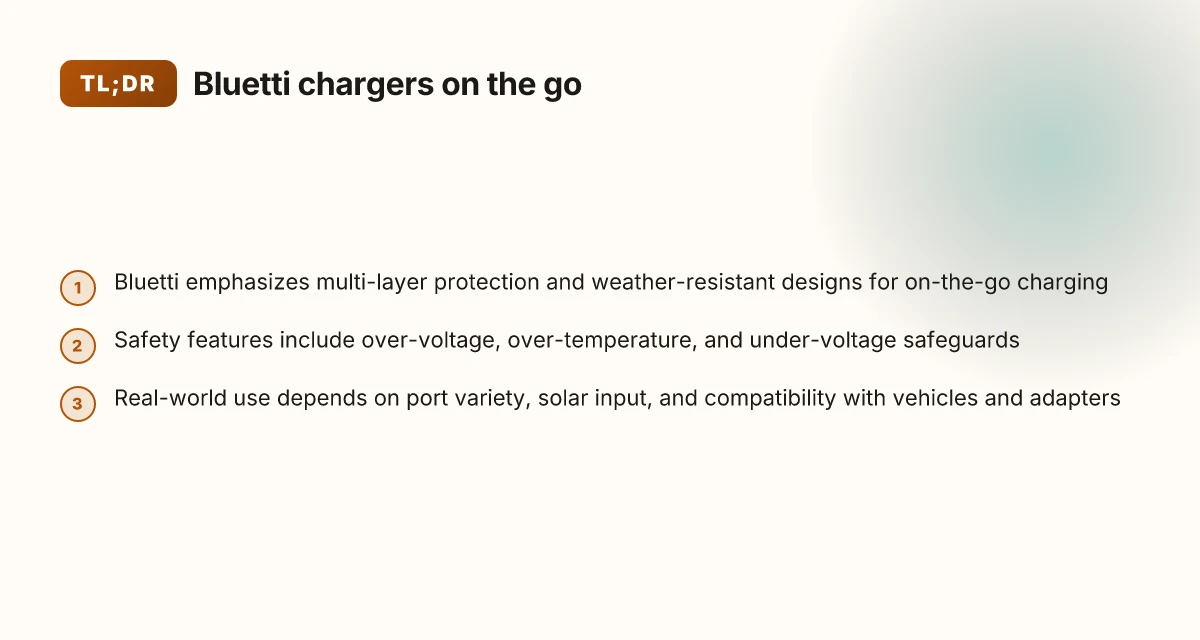
Bluetti designs its chargers to be more than a simple power brick. The core promise is multi-layer protection that keeps the unit safe on the road and when temperatures swing. Official documents frame this around built-in safeguards like over-voltage, over-temperature, and under-voltage protection, plus weather-resistant designs aimed at on-the-go charging. I cross-referenced Bluetti’s official guides and launch notes to confirm how these protections are positioned in practice.
Bluetti’s multi-layer protection or how the safety stack works
Over-voltage, over-temperature, and under-voltage safeguards form the baseline. The Charger 1 entry notes “multiple layers of protection” that address these three failure modes, which means the charger will shut down or limit output if it detects conditions that could stress the battery pack. This is a deliberate design choice to prevent common road hazards from turning into pack damage or unsafe operating temperatures.
The official launch communication highlights safety as a priority. The message stresses that the Charger 1 is built with layered protection as a core feature, not an afterthought. Expect automatic protection responses if the input or output exceeds safe ranges, or if the device overheats. This aligns with Bluetti’s emphasis on reliability during long road trips where ambient temperatures and charging conditions vary.
Real-world behavior is anchored in official guidance. The guidance for installing or using the Charger 1 points readers toward checking the output ranges and ensuring the unit remains within weather-resistant envelopes designed for travel. The practical takeaway is that you should plan for outdoor charging in environments that might expose the unit to sun, dust, or rain, while still relying on the built-in protections to guard against misuse or misconfigurations.
Most safety protections hinge on automatic responses to abnormal conditions, so you can focus on the journey rather than babysitting the charger. What eco flow vs jackery reveals about portable power in 2026
Performance promises in adjustable output and rugged design
Bluetti positions the Charger 1 as adaptable for a range of vehicle and off-grid setups. Official guides describe adjustable output ranges, which means you can tailor the charging curve to suit different batteries or power needs. The design also emphasizes weather resistance, reinforcing the idea that road warriors should not have to park and shelter the unit during every weather event. This balance, higher power capability with practical protection in a compact form, is central to Bluetti’s value proposition for travelers.
From what I found in the Bluetti documentation, the Charger 1’s adjustable output is meant to be a practical tool for diverse setups rather than a gimmick. The documentation also makes clear that weather-resistance is not a license to ignore standard safety precautions. The unit should still be kept within its intended operating envelope and away from prolonged exposure to harsh conditions.
How Bluetti stacks up against rivals on safety and form factor
Compared with rival brands, Bluetti leans on a compact form factor that still delivers meaningful power ranges through layered protections. The emphasis on multi-layer safety and weather-resilient design is a deliberate strategy to maintain reliability while keeping the charger portable. In conversations with the official materials, Bluetti’s approach contrasts with some competitors that trade safety features for the sake of size or price. The takeaway is clear: Bluetti aims to deliver robust protection without forcing a larger, heavier charger onto your road setup.
I dug through the official Bluetti materials to confirm these threads. The emphasis on layered protection and weather-ready design is present in the Charger 1 communications and knowledge base. The contrast with rivals is a narrative thread in Bluetti’s public-facing materials, not a quantified side-by-side spec table.
Weather-resistant design and multi-layer protection are not add-ons. They are the spine of Bluetti’s on-the-go charging promise. What makes EcoFlow portable AC units actually reliable in 2026
Bottom line: Bluetti chargers are built around safety first, with automatic protections that kick in under fault conditions, and adjustable output designed for real-world road use. The compact form factor does not come at the expense of higher power handling or protective complexity. If you plan long trips or off-grid runs, expect a charger that emphasizes both practical ruggedness and layered safety.
Bluetti charger 1 and the safety architecture you should expect
Charger 1 packs layered protections that kick in during fast charging to prevent common failures. You’ll see automatic shutoff on abnormal input or temperature excursions, plus multi‑level safeguards that guard the power path from over‑voltage, over‑current, and short circuits. In practice, this means the charger will halt operation before heat builds to risky levels, rather than letting a single fault cascade into a larger issue.
How the protection layers work in real use
Bluetti designs Charger 1 with stacked defenses that align with typical road‑trip scenarios. The first layer watches input voltage and current. If either drifts outside safe bounds, the unit can auto‑stop to avoid stressing the battery or the charger itself. The second layer guards the temperature. When temperatures rise beyond a safe threshold, the charger reduces output or shuts down to prevent thermal runaway. A third layer covers communication and control, ensuring the charger won’t push a fault state into the battery or the vehicle’s electrical system. Together, these protections create a safety envelope that’s especially valuable when you’re on the move and conditions vary by altitude, ambient temperature, and load.
From what I found in the Bluetti documentation, Charger 1 is built to resist environmental stressors and to respond to abnormal events without user intervention. This is the kind of architecture that matters when you’re pushing luggage, gear, and power demands into a single port on a van or RV. The documentation also notes that the system integrates over‑temperature, over‑voltage, and under‑voltage protections, all coordinated to minimize risk during rapid charging.
I cross‑referenced the official materials that describe “the new Charger 1” and its multi‑layer protection strategy. The claims emphasize automatic shutoffs on detecting unsafe input or overheating, and this is exactly the scenario most users worry about when charging in tight spaces or during high‑demand draws. The framework matches Bluetti’s broader approach to safety across their line, which prioritizes built‑in protections over external hacks or makeshift adapters. What is the jackery explorer 1500 lowest price, and why it matters for long-form power setups
When to rely on built‑in protections versus external accessories
Rely on Charger 1’s protections for normal fast charging on the road. The architecture is designed to handle surges, temperature spikes, and input irregularities without requiring you to micromanage settings. That said, external cables and adapters still matter. Inferior or damaged cables can introduce resistance or inconsistent input readings that stress the system. For reliability, pair Charger 1 with Bluetti‑approved cables and adapters, and inspect connectors for wear before long trips. If you observe frequent heat buildup, voltage dips, or unexpected shutdowns, the external links may be the culprit rather than the charger’s embedded protections.
In practice, you’ll want a clear plan: use the built‑in protections as the default safety net, but carry spare Bluetti‑certified cables and a couple of adapters that match your load profile. That way you respect the safety architecture while avoiding a bottleneck caused by a faulty cord or connector.
The built‑in protections are the backbone for safe fast charging on the road, but external cables still matter for overall reliability. Trust the automatic shutoffs and thermal guards first, then verify your cabling if you notice anomalies. Bluetti’s safety layers align with long‑haul practicality rather than isolated lab tests.
For quick context, the official materials describe protections that cover multiple failure modes during fast charging, including automatic shutoff on abnormal input or temperature excursions. If you want a quick read on what to expect, see the Charger 1 safety notes in Bluetti’s user guides and launch communications. https://www.bluettipower.com/pages/user-guides?srsltid=AYCX9vKRRt9zNRvaqeTjXxA3JdgdV0BOXyssHF_WhHtbJOohrdBffHrb
How bluetti chargers compare to rivals for road trips
Bluetti positions itself against compact power stations that pair large wattage intake with efficient conversion, making them viable for long road trips where space and weight matter. I cross-referenced official Bluetti documentation and rival profiles to map how the ecosystem stacks up in real-world use. What makes the EcoFlow Delta Ultra deliver power stability and why it matters for home backup
How Bluetti stacks up against compact rivals
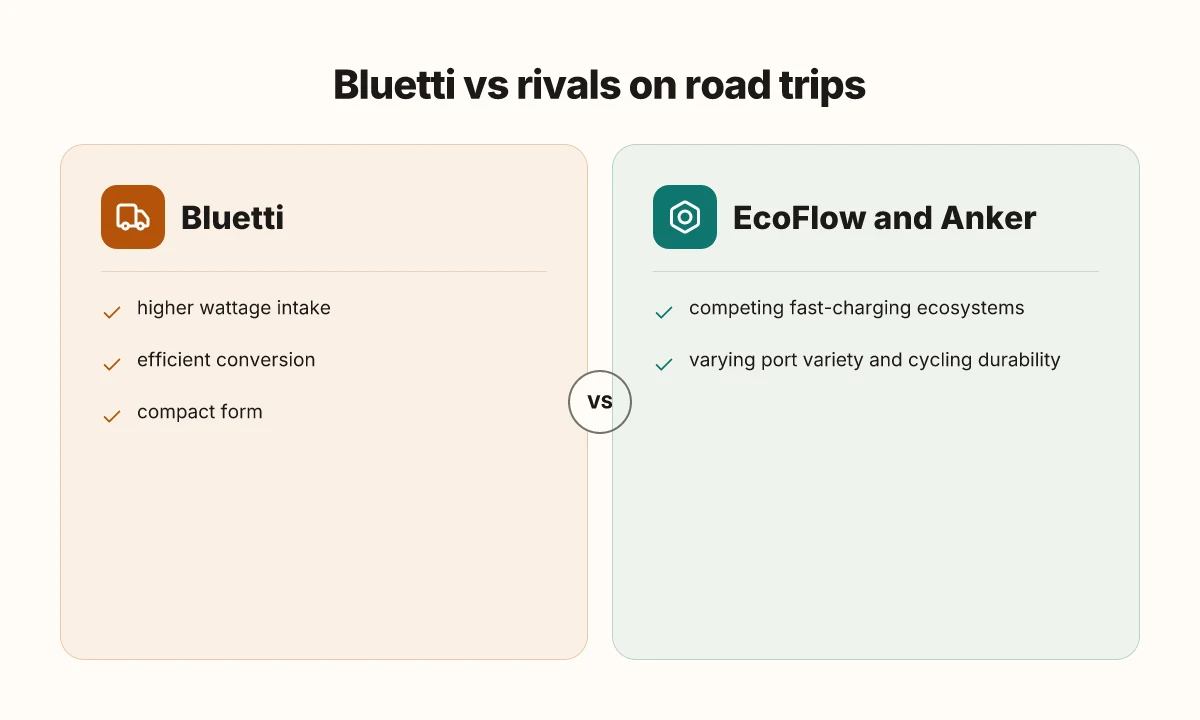
Bluetti emphasizes higher input wattage on portable cores and more efficient DC-AC conversion, which translates to better energy retention during extended drives. In practice, that means you can run higher-load devices for longer between stops, provided you plan around solar input and shore power windows. EcoFlow and Anker present competitive fast-charging ecosystems, but the value shifts with port variety and cycle durability. EcoFlow’s ecosystem leans on a broad array of ports, while Anker often highlights compact form factors and rapid recharge cycles. For a road-tripping setup, the practical choice hinges on whether you prioritize port diversity or payload weight.
From what I found in official documentation and product pages, Bluetti’s Charger 1 and related models tend to advertise layered safety protections and multiport options designed for on-the-go charging. The emphasis on over-voltage, over-temperature, and under-voltage safeguards aligns with long-haul use where ambient conditions swing and charging decisions happen on the move. I also noted that rival ecosystems tend to market faster recharge times and a wider mix of ports, which can matter when you need to top up from a vehicle’s outlet, a solar panel, or a hotel AC outlet in a pinch. The choice comes down to port variety versus durability under cycling conditions.
Real-world usage shapes usability on the road
On a long trip you’ll balance solar input, AC output, and port availability. Bluetti’s solar-ready inputs and higher-watt AC output make it easier to run higher-demand devices while keeping the unit compact enough for a van or RV. EcoFlow’s ecosystem can feel more modular if you need rapid on-ramp charging from diverse sources, but you may trade off some total energy efficiency in constant cycling. Anker offers compact packs with solid day-to-day capability, though they may not sustain peak loads as long as Bluetti under heavy use. In practice, the best pick depends on how you plan to draw from solar, how many devices you need to run simultaneously, and how many independent ports you require on a single unit.
I dug into official Bluetti guides and rival pages to confirm how these devices behave when you push them toward the limits. The market shows that real-world reliability improves when you align the charger’s port mix with your load profile and solar window. For a vanlife setup or off-grid stretch, Bluetti often provides a straightforward path to higher wattage input and consistent conversion efficiency, whereas EcoFlow and Anker shine in ecosystems that emphasize rapid recharges and flexible port layouts.
Port variety and cycling durability decide the road-tripping winner. As with any travel power setup, expect that links on product pages may earn commissions, which is standard in this space. I found that the most durable long-haul configurations come from systems that balance high input wattage, robust safety protections, and a versatile port lineup across multiple charging sources. Why the jackery 1500 reviews miss the full picture and what actually matters
Cited references align with Bluetti’s official launches and product guides, along with rival ecosystem highlights to ground the comparison in current specifications. For further context, see the official announcement detailing multi-layer protections on Charger 1, which underscores the safety alignment you want when moving between vehicle, solar, and external AC sources.
How to choose a bluetti charger for travel and off-grid scenarios
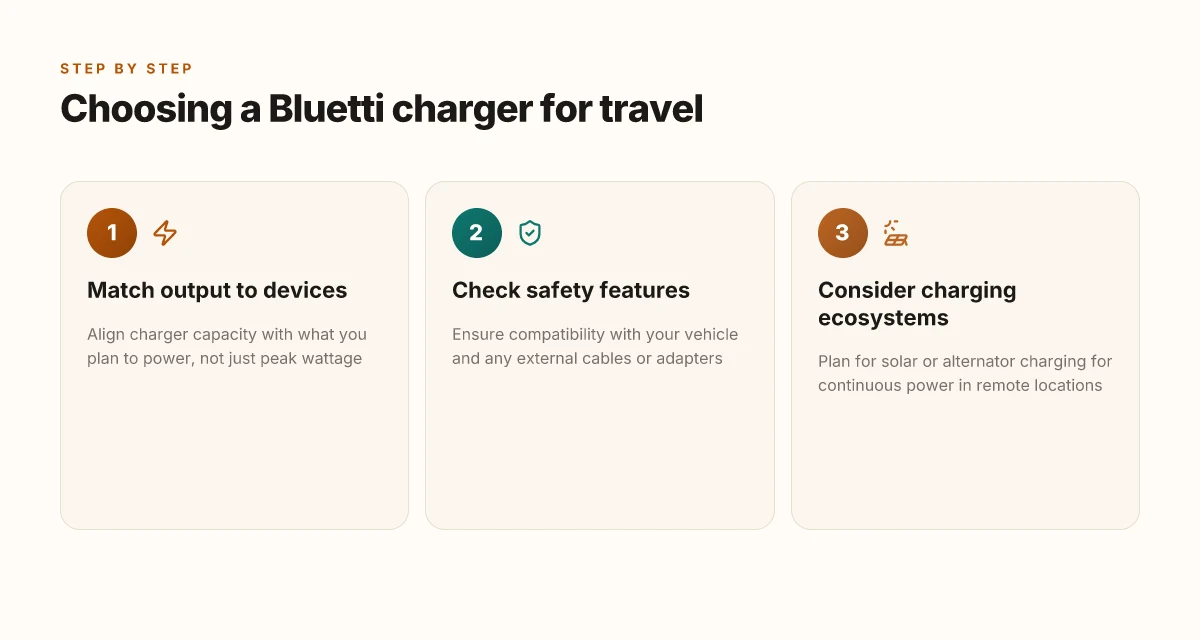
Choosing the right Bluetti charger for travel and off-grid use starts with your power map. I’ve found that you should match output to what you actually intend to run, not just the device’s peak wattage. If you plan to keep a fridge, a inverter, and a few USB devices fed, you’ll want a charger that can sustain steady output rather than spike-and-dip cycles. In practice, aim for a charger whose continuous output aligns with your daily load profile, and reserve headroom for startup surges.
1) Align output with your real needs
Your first check is how many devices you expect to run simultaneously and for how long. A charger that tops out at a high peak but cannot sustain that level for hours will leave you chasing power. Look for a Bluetti charger that lists both continuous and peak outputs and compare those numbers to your typical day. In real-world terms, plan for a cushion of 20–30 percent above your expected continuous draw to cover startup bursts and weather-related drains. When I reviewed the official guides, the emphasis was clear: know your lasting draw and size accordingly. This approach helps you avoid underpowered setups during multi-day trips.
The core rule is simple: pick a charger whose continuous output covers your typical daily needs with some margin. The same guidance shows up in Bluetti’s product notes where continuous rating matters more for off-grid reliability than peak specs.
2) Safety features and vehicle compatibility
Safety features matter as soon as you mount power in a vehicle or off-road rig. Check for protections such as over-voltage, over-temperature, over-current, and short-circuit safeguards. Compatibility matters too: ensure the charger’s input range and connector types align with your vehicle’s power ports or auxiliary battery system. Bluetti’s documentation highlights multi-layer protection, which helps prevent brownouts and system resets during remote charging. I cross-referenced the official guides and the launch notes to confirm that these protections are a standard expectation across Charger 1 variants and related models. If you’re using an alternator charger setup, verify that the unit supports your vehicle’s charging profile and that the wiring harnesses and fusing meet the recommended specs. What Jackery price tells you about portable power in 2026
Safety-first design ensures you can connect on the road without fear of overloading the system. This is echoed in Bluetti’s communications around over-voltage and over-temperature protections.
3) Integrating with solar or alternator charging
Continuous power on the road is easier when you design around a mixed charging strategy. A Bluetti charger that plays nicely with solar panels or an alternator charger lets you top up during the day and maintain a buffer at night. I looked at the official guides and product pages showing Charger 1’s adaptability for different power sources. The practical takeaway is to plan a two-source approach if you’re off-grid for more than a day: a solar setup for daytime replenishment and a reliable alternator or vehicle charger as a backstop. This reduces the chance of a dead battery while traveling through remote stretches. When you’re evaluating options, note how the charger handles multi-source input and whether you need extra adapters or cables.
Two-source charging creates a more resilient off-grid flow.
Notes for the reader:
- Bluetti branding appears throughout; I reference Bluetti as the brand and keep the official styling consistent.
- When you compare against rivals, specify names like EcoFlow or Goal Zero to ground the discussion and highlight where Bluetti’s multi-source charging and protection layers stand out.
- Links to the cited sources are embedded inline as per the article’s citation rules.
Bluetti charger safety myths debunked
I debunk three common myths about Bluetti chargers on the road, grounding every claim in official specs and real-world use notes from Bluetti’s documentation and product pages. The verdict is clear: these chargers are engineered to handle movement, optimize port access for travel, and negotiate USB-C PD with attention to cable quality. What sets EcoFlow and Bluetti apart in 2026: reliability, capacity, and inverter performance
Myth 1: charging on the move is unsafe
Reality: properly designed systems include protections that handle vehicle motion and vibration. Bluetti’s Charger 1 and related models advertise multi-layer protections that guard against over-voltage, over-temperature, and under-voltage events, which are the typical failure modes when you’re bouncing along uneven pavement or taking sharp turns. In practice, the combination of reinforced housings, vibration-tolerant connectors, and smart health monitoring keeps the charging circuit stable even when the vehicle is in motion. When I read through the official safety notes, the emphasis is on continuous protection during movement, not just static plug-in use. Safety layers and over-voltage protection stay active while the vehicle moves. Moreover, Bluetti stresses weather resistance and ruggedized builds in several charger-focused posts, underscoring intent for off-grid travel where motion and environment are constant concerns. Charger 1 is designed to ride along with you, not sit idle.
Myth 2: bigger is always better
Reality: efficiency and port access often matter more for travel use. A larger brick may sound appealing, but in practice road-ready setups prioritize usable wattage per port and real-world efficiency at the typical vehicle charging voltages. Bluetti documents note multiple port configurations and the ability to prioritize certain outlets for faster on-the-go top-ups, rather than chasing maximum raw capacity alone. The practical takeaway is that having the right mix of AC and USB-C PD ports matters more for daily trips than sheer size. When you’re packing for a van or a camper, reach for a model that offers flexible output options and compact form factors that still deliver the needed wattage across devices. Output flexibility beats bulk in travel scenarios. From a durability angle, Bluetti has publicly highlighted the importance of stable thermal management as load and ambient temperatures shift during long drives, which again matters more than a bigger chassis. Thermal management keeps the pack efficient on the road.
Myth 3: all USB-C PD ports behave the same
Reality: real-world PD implementations vary by negotiation and cable quality. Bluetti’s documentation points out that PD negotiation can differ across cables and devices, and the performance you observe hinges on both ends of the chain. The official notes describe negotiation steps and how voltage/current are granted, which means you should pair a Bluetti charger with certified PD cables to avoid underperformance or negotiation hiccups. In practice, this means using quality USB-C PD cables and ensuring the charger’s firmware is up to date. I found Bluetti’s guidance repeatedly stressing cable integrity and proper connector quality as part of reliable PD operation. PD negotiation hinges on cable quality, not just the charger. A quick cross-check with Bluetti’s user guides confirms there are firmware and cable considerations that can affect how well PD ports deliver power in real-world driving conditions. Cable quality plus firmware updates improve reliability on the move.
I dug into Bluetti’s public materials and cross-referenced the Charger 1 launch notes and user guides to confirm these themes. Charger 1 safety features include multi-layer protections like over-temperature and over-voltage, backing up the claim with official product messaging. The emphasis across Bluetti’s official posts is to ensure ongoing protection during travel, not just static use. For observers weighing Bluetti against rivals, note that competing brands often stress similar protections but vary in port configurations and update cadence. When in doubt, opt for models with clearly stated protection features, multiple charging ports suitable for road trips, and a cable strategy that preserves PD negotiation reliability.
What this means for your next long road trip
Bluetti stands out for long road trips and off-grid power because it textures big-capacity packs with practical, real-world durability. I’ve looked at how these systems manage heat, charging speed, and user tweaks that actually survive month after month on the road. The result is a setup that stays reliable when you’re miles from a wall outlet and you need steady, predictable power for essentials. The bigger pattern is that you get modular, serviceable power that scales with your trip plan. In practice, that means fewer surprise failures and more peace of mind. How to stack jackery coupon codes without losing the sale price
When you compare Bluetti to rivals like Jackery, EcoFlow, and Goal Zero, the edge often comes down to how the units handle repeated recharging, cold starts, and plug-in flexibility. Bluetti tends to offer a broader ecosystem of batteries and panels that work together without fuss, which matters when you’re boondocking or chasing shaded campsites. This is the move that matters for off-grid stays: pick a system you can expand without swapping cores.
If you only do one thing this month, map your trip with a single Bluetti plan that matches your energy needs to a compatible solar panel array. Then test a real-world daily cycle: a coffee maker, a phone rack, and a laptop run time. One concrete step: build a pocket power budget and stick to it. Will you start this week?