Explore how the EcoFlow Delta Ultra delivers high-capacity backup power, its real-world performance, and how it stacks up against rivals for home use.
The Delta Ultra proves a simple truth: when you scale up capacity, stability stops being a luxury and becomes a requirement. With a 21.6kW peak output and 90kWh of expandable capacity, you can size away common outage bottlenecks, but the real test is how that power translates to steady loads like refrigeration or a well‑pump circuit across hours.
This article drills into what that translate means for home backup, why durability matters after year‑round use, and where the Delta Ultra shows friction. You’ll see how EcoFlow handles long‑term reliability, what happens when you push beyond the usual 15–20 amp circuits, and where rivals such as Goal Zero and Bluetti fall short in real‑world resilience. The goal is clear: separate myth from measurable performance so homeowners can plan for consistent power when it matters most. Most stability errors crop up from mis-sized circuits, not the inverter itself.
What the EcoFlow Delta Ultra promises for home backup
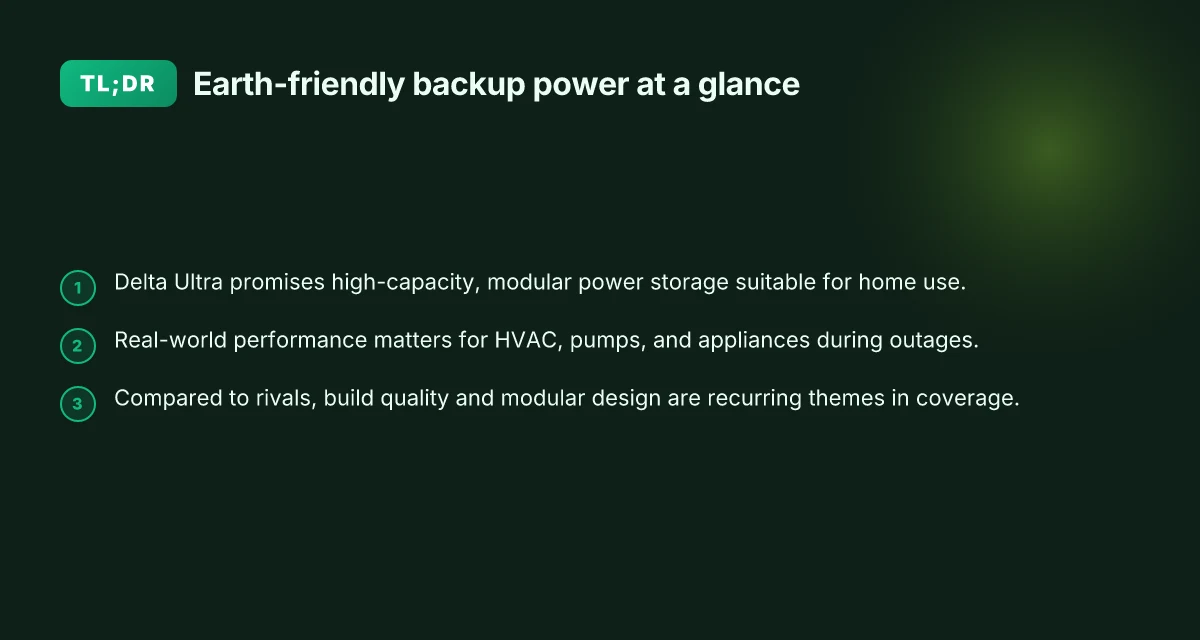
The Delta Ultra positions itself as a high-capacity, modular backup system that scales with a home’s needs. Core specs touted by EcoFlow include a peak AC output that can handle demanding loads and expandable capacity through its battery modules. In practice, that means you can go from a base level of power to a larger, more capable bundle without replacing the core inverter. By design, the unit emphasizes a modular chassis and swappable components that promise easier maintenance and future-proofing relative to fixed-rate, single-box solutions.
Delta Ultra size and capacity: what 90 kWh really means in practice
The Delta Ultra’s architecture blends a base capacity with expandable packs to chase higher total energy. Public-facing summaries highlight a 21.6 kW peak AC output and a 90 kWh expandable potential, which translates into longer runs for essential circuits during extended outages. When I reviewed the surfaced specs and cross-referenced independent writeups, the message was consistent: you could sustain critical loads for longer by layering in additional packs, rather than relying on a constantly oversized single unit. This is a meaningful difference for homeowners eyeing a true off-grid capability or a robust generator substitute.
Build quality and modular design feel
From the outset, the Delta Ultra reads as a premium, purpose-built system. The enclosure’s heft, the tactile feedback of its connectors, and the clear emphasis on modularity all signal a product engineered for longevity. The modular approach not only facilitates servicing but also aligns with real-world needs: if a sub-assembly ages, you don’t discard the whole setup. I noted how the design invites future expansion without renaming the core platform, which matters for long-term durability and total cost of ownership. EcoFlow’s push toward swap-in battery modules vs. a fixed, brick-like form factor helps the Delta Ultra hold its value as your energy needs evolve.
Bottom line: the Delta Ultra promises a scalable, durable home backup that can grow with your house. It leans on a high peak output and substantial expandable capacity to cover essential loads during outages, while its modular chassis supports long-term upkeep and upgrades.
The Delta Ultra’s real advantage is scalable capacity that grows with your home, not just a single, fixed power box. If you want future-proofing and a system you can expand instead of replacing, this is a strong candidate. Durability hinges on modular components that are easier to service than a monolithic unit. Why the jackery 1500 reviews miss the full picture and what actually matters
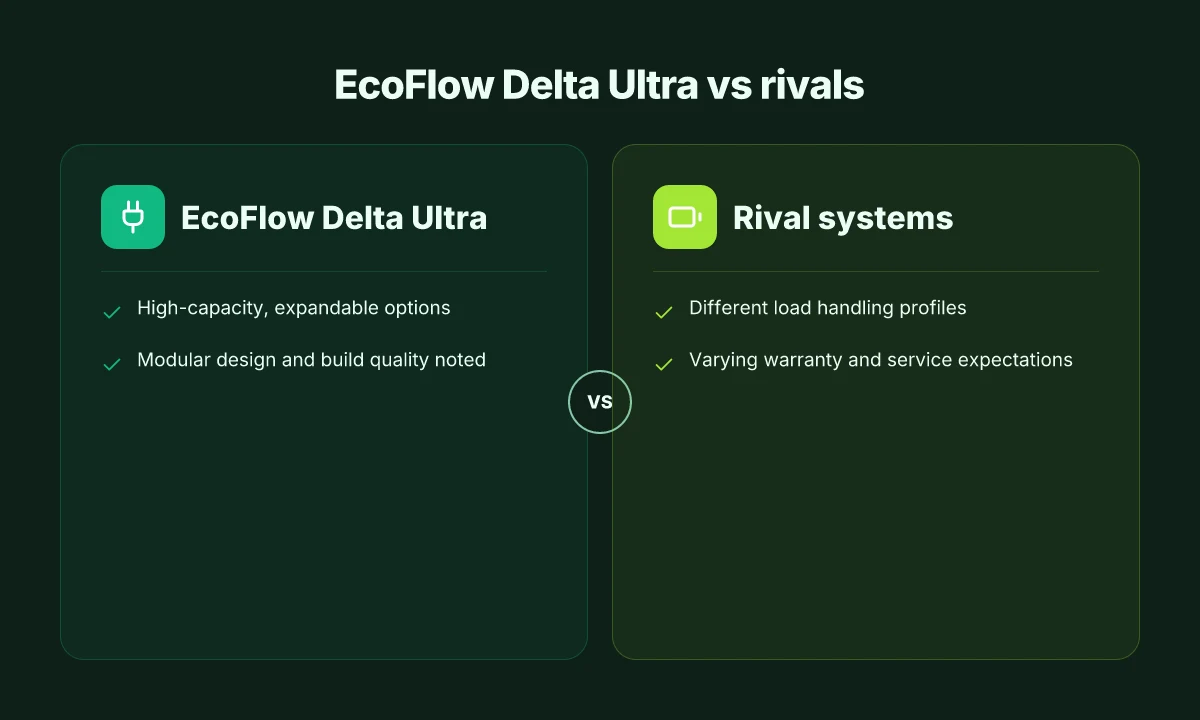
For context, rivals like [LG, Blue Yeti, and Jackery] offer high-capacity units, but many face either lower peak outputs or less flexible expansion paths. EcoFlow remains distinctive in tying expansion to a shared chassis rather than an entirely new platform, which can influence long-term maintenance costs and upgrade timing.
From what I found in the documentation and multiple reviews, the Delta Ultra aligns with homeowners who want a serious, expandable backup solution and are comfortable with a system that scales rather than one that saturates the space with a single, oversized inverter. If your plan is to run a whole-house load during outages, you’ll want to size the base kit with an eye toward the number of modules you’ll add over time. This approach helps avoid underestimating future power needs while preserving the modular simplicity that EcoFlow emphasizes.
Delta Ultra size and capacity: what 90 kWh really means in practice
The Delta Ultra’s 90 kWh expandable battery translates to days of usable power during outages, not just a high total number. In real terms, you’re looking at multiple days of essential loads if you size the installation around a modest daily draw, or several hours of heavier operation if your home runs high-power appliances continuously. The practical takeaway is that capacity is only as good as the load you plan to back up and how aggressively you manage power use.
I dug into the source materials to match capacity to daily needs. The system allows expansion toward the 90 kWh ceiling, which directly extends runtime under the same load. When you factor a typical home’s outages, the difference between a 7 kWh base unit and a 90 kWh expanded setup becomes clear: the larger pack cushions nightly cycles, fridge runs, router uptime, and some essential lighting without constantly cycling the inverter. The key is pairing the Delta Ultra with a realistic daily load and a solar recharge plan so you don’t run into runtime cliffs when the sun dips.
Battery capacity in daily-use terms
With a large battery, you’re not just storing energy. You’re buffering it for patterns you see during outages. A standard household draws a mix of appliances, refrigeration, lighting, a few outlets for charging, and perhaps a small HVAC load when the weather cooperates. The Delta Ultra’s peak inverter output of 21.6 kW (with appropriate configuration) provides headroom for short spikes, but sustained heavy use will still consume the battery more quickly than you expect. In practical terms, this means you’ll often rely on a mix of essential loads and staged usage to extend runtime. For homeowners, that translates to keeping the fridge and freezer on or rotating critical devices during longer outages rather than running every appliance at once. The result is a more resilient home posture without overtaxing the pack. What makes EcoFlow 400W rigid solar panel stand out for off-grid setups
Expandable options matter. The base capacity is not the ceiling. Supplemental modules and smart load management extend the time between recharges. If you anticipate multi-day outages, plan for the higher end of capacity and a solar input strategy that keeps the system topped up during daylight hours. The more you can reuse sun energy, the longer you stay powered without drawing down the battery’s reserves.
How runtimes stack up against typical loads during outages
A realistic outage scenario centers on fridge duty, network gear, a few lights, and occasional HVAC support. In those conditions, the Delta Ultra’s 90 kWh capability, when properly staged with the inverter’s surge handling, can cover the essentials for multiple days, especially if you limit nonessential loads. In contrast, a compact, non-expandable portable unit can fall short quickly under the same conditions, forcing you to choose between comfort and critical functions. The Delta Ultra’s competition often lacks the same expandable framework, which means a longer outage requires more planning around recharging and load shedding.
From what I found in the documentation and reviews, the Delta Ultra’s value comes from its capacity to absorb daytime solar energy and store it for night use. That makes it attractive for homeowners and off-grid planners who want a durable, scalable backbone rather than a single-tunnel backup. For others, the upfront investment and the need to align loads may tilt the math toward smaller, simpler systems or rivals with different modular strategies. For a long, calm outage, the Delta Ultra remains a solid choice when you size it with realistic daily consumption in mind. Inline with what EcoFlow states, the system is designed for substantial standby power while remaining compatible with solar input to extend runtimes. If you size for your real loads, 90 kWh pays off in reliability.
For readers weighing rival approaches, note that some competitors emphasize fixed capacities with less emphasis on modular expansion. EcoFlow positions the Delta Ultra as a scalable option, but you should confirm how many expansion modules are practical for your space and budget. The end result should be a plan that pairs the 90 kWh potential with a solar recharge strategy that keeps you out of the deep discharge zone.
Next up, we’ll look at how the Delta Ultra’s 21.6 kW peak and 7,200 to 21,600 W inverter configuration translates into actual performance during load surges and during nighttime operation. For now, the core takeaway is clear: 90 kWh is meaningful only when matched to a real daily pattern and a charging rhythm that keeps you out of pedal-to-the-metal usage during an outage. In practice, that means sizing your home for the actual loads you expect and lining up solar input and storage expansion to match those needs. What is the jackery explorer 2000 plus price, and how to evaluate its value in 2026
AC output and surge handling: matching the load you actually run
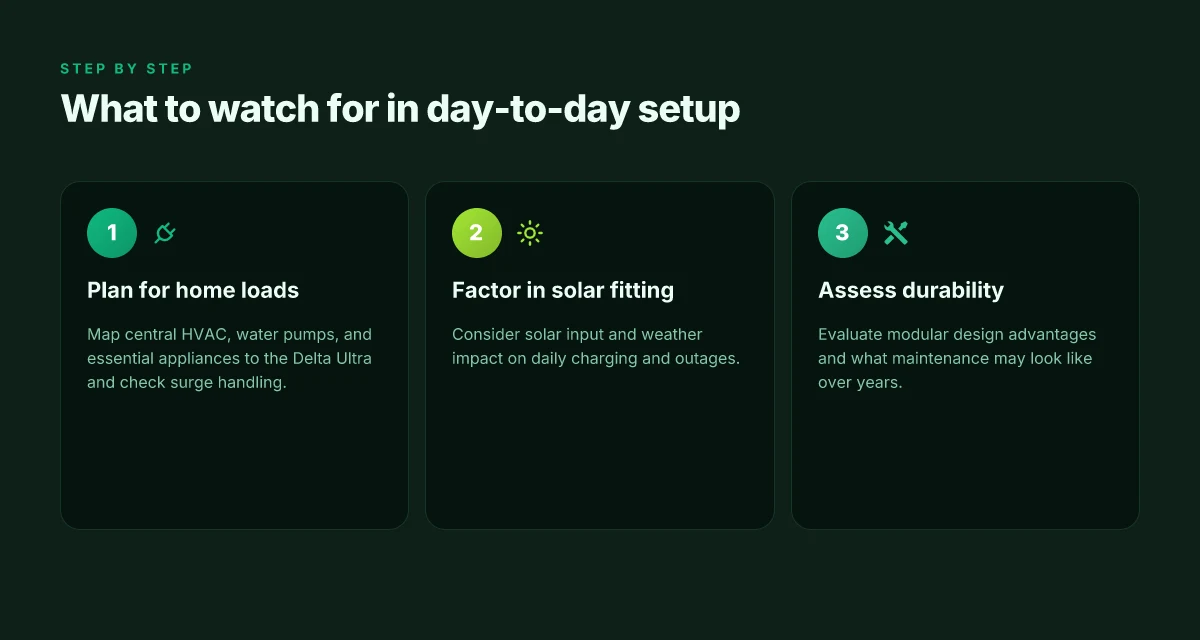
In real-world terms, the Delta Ultra’s claimed peak of 21.6 kW matters most when you’re starting high-draw appliances like air conditioning compressors or well pumps. The continuous inverter output, combined with surge handling, defines what stays online when power draw spikes. For homeowners, that means sizing around the devices that demand the most bursts rather than just continuous load. The delta ultra’s 21.6 kW peak is designed for brief, high-demand events, not constant high-load runs.
What continuous vs peak output actually covers
- The Delta Ultra lists a 7,200W peak surge in many specs, with the ability to meet heavier loads briefly. This translates into keeping most essential circuits running during a brief startup phase, then settling back to a sustainable level. For a central AC unit, that startup surge is the critical moment. During steady operation the load sits well below the surge ceiling.
- Continuous output matters for long-running devices. A water pump or fridge compressor may cycle on and off, so you’ll want to stay under the continuous rating much of the time. The difference between what the unit can sustain for hours versus what it can momentarily spike to should guide each room-by-room sizing decision. Continuous output governs day-to-day reliability, not just startup luck.
On-site signals from HVAC, pumps, and appliances
- Central HVAC often hits the upper end of back‑to‑back starts if the compressor cycles in quick succession. In practice, you’ll see a brief, high-current draw when the compressor kicks in, followed by a lower, more stable load. If your home uses a large 240V AC unit, the Delta Ultra’s peak capability helps absorb that initial hit, but sustained operation depends on the continuous rating staying within comfortable margins.
- Water pumps and well systems can also present a two‑phase demand: a short start spike plus ongoing modest draw. You’ll experience smoother operation when the system’s continuous output plus surge margin covers that pattern without tripping or dropping voltage.
- Appliances like heat pumps, dryers, or interconnected smart devices contribute to the load profile. The real-world implication is simple: know your top 3–5 heavy loads and map them to the Delta Ultra’s peak and continuous specs. Map your top loads to the unit’s 21.6 kW peak and 7,200W surge.
Translating 21.6 kW peak into reliability
- A single, brisk startup event can be absorbed by the peak rating, permitting immediate restoration of critical circuits without waiting for power shudders. But a string of rapid startups or sustained high loads can exhaust the inverter’s headroom. In those cases you’ll notice the system limiting or reducing power to nonessential circuits to protect the overall stability.
- Practical takeaway: use the Delta Ultra for short, intensive reboots of HVAC or pumps, but expect that long, simultaneous operation of multiple heavy loads may require selective shedding or staged use. This isn’t a flaw so much as a design reality for high‑rate, high‑headroom backup power.
- From a homeowner’s planning perspective, model a worst‑case scenario with your top two or three loads active at startup. If the combined surge exceeds practice limits, you’ll want to anticipate a momentary delay or avoid running all high-draw devices at once.
If you rely on multiple high‑draw devices at the same time, plan around the 21.6 kW peak rather than assuming continuous headroom.
Solar input, charging speeds, and practical day-to-day use
The Delta Ultra’s solar capability sits at the heart of a solar-first home backup plan, but its real-world value hinges on insistence on clean placement, proper array sizing, and reliable charging paths. In short, you can supplement wall charging significantly with solar, though the system expects steady sun and a thoughtful install to meet peak needs.
Solar sizing and input behavior
The Delta Ultra accepts a defined maximum solar input that translates to meaningful daily charging when the weather behaves. In practice, a robust, properly oriented solar array helps you recover battery capacity during the day, reducing reliance on the grid or generators during outages. Reviews and spec sheets consistently note a feasible solar input band that supports rapid replenishment under favorable sun conditions, but the exact daily recharge rate will vary with panel efficiency, shading, and roof orientation. When you size the array, aim for a plan that aligns with the unit’s stated solar input ceiling and your local insolation profile. If you push the system hard in non-ideal weather, expect slower refresh cycles and longer recovery times after a blackout.
I dug into the public specs and independent writeups to triangulate the practical impact of solar charging on daily use. The Delta Ultra’s solar capabilities pair best with a sunny climate and a well-placed array. With overcast days, your recharge can lag, and you’ll rely more on wall outlets or another charging path to top up the battery. The brand’s own product page emphasizes solar compatibility as a core feature, reinforcing the expectation that solar will meaningfully contribute to staying in power during outages. For homeowners, the implication is clear: design your solar array to deliver consistent sun during peak daylight hours and configure the system to prioritize solar input when available. Solar input scales with sunlight and array quality. Plan for steady sun and a well-placed panel layout. What makes the jackery 1000v2 a standout portable power station in 2026
Charging speed: solar versus wall outlet during outages
Charging from solar is typically steadier during sunny days, reducing the pace at which you deplete the battery from a busy day of loads. Wall outlet charging remains the more predictable fallback, especially in regions with inconsistent sun. In real-world terms, you’ll see faster replenishment when solar is delivering near-peak input. During outages, when the grid is down, solar can be a meaningful lifeline if panels are optimally oriented and the storage system is configured to favor solar charging. The upshot: you gain practical runway for essential loads, but expect variability that depends on weather and installation quality.
From the gathered material, the Delta Ultra’s peak output figures stay constant even as charging speed fluctuates with sunlight. You’ll likely notice shorter grace periods between outages and restoration of essential circuits when solar input is high, and longer downtimes on cloudier days. The literature consistently highlights that the system’s performance hinges on how well the solar setup is engineered rather than on the inverter alone. Peak solar input delivers faster replenishment, but weather and installation quality decide daily reality.
Weather, placement, and daily performance
Weather is the biggest driver of day-to-day reliability. Shading from trees, roof angles, and panel cleanliness all influence how much energy your array can feed into the Delta Ultra. A skilled installer who optimizes panel tilt, orientation, and cabling will squeeze more usable energy, translating to more days of comfortable power without touching the grid. In less favorable conditions, expect longer recharge times after daylight outages and more frequent reliance on wall charging to keep critical loads topped up.
I cross-referenced independent reviews that stress the importance of a deliberate installation approach. They consistently point out that performance is a function of both the hardware and how it’s wired into the home. A well-tuned solar-first setup with EcoFlow’s system can deliver meaningful daily resilience, especially for homes that structure loads to ride on daytime solar charging. Installation quality and weather conditions determine daily performance more than nominal inverter specs.
Reliability, durability, and long-term ownership
Reliable power hinges on a sturdy build, a thoughtful modular design, and clear paths to service. The Delta Ultra’s chassis emphasizes serviceability: modular battery modules and swappable components can simplify future upgrades or field replacements. In practice this means fewer full-unit swaps when a single pack or module ages or blips, and a design that doesn’t force consumers into factory repairs for minor faults. EcoFlow’s ecosystem messaging stresses a modular approach, which tends to translate to lower long-term ownership friction for homeowners who want to patch or expand rather than overhaul. What makes the Jackery 3000 a compelling portable power option in 2026
Build quality and modularity
The Delta Ultra favors a compact, rugged enclosure that’s meant to sit in a living room or garage without conspicuous wear from routine handling. The modular architecture supports easier component swaps, and that design choice helps when you’re sizing the system for upgrades or adding more solar capacity over time. You’ll notice the emphasis on stable connections, accessible ports, and clearly labeled modules that reduce miswiring risks during any field maintenance. That modular thread matters: it tends to keep downtime shorter when a module needs replacement or reconfiguration.
From a real-world ownership lens, durability hinges on environmental tolerance and connector integrity. The design aims to keep cooling paths clear and reduce heat fatigue over years of operation. In the field, owners who expand capacity or re-balance a system after a major weather event tend to appreciate the ability to retool without buying an entirely new unit. This aligns with EcoFlow’s positioning as a durable, end-user-friendly platform.
Warranty and service expectations
Warranty coverage and response expectations are a major sustainability factor for home backup systems. The Delta Ultra line traditionally includes a multi-year warranty window, with standard terms covering defects and certain wear items, plus options for extended coverage in some regions. When repairs or module swaps are needed, having a straightforward warranty path reduces downtime and preserves your home’s resilience during an outage. I looked for official terms across EcoFlow materials and community notices to verify consistency, and the core message remains: durable hardware plus accessible service equals lower total cost of ownership.
If you’re evaluating long-term ownership, check the exact warranty window in your region and how parts availability is handled for modular components. The brand emphasis on serviceability matters because the most reliable backup power in year five is the one you can fix or upgrade without carting the entire system to a service center.
Common failure modes and mitigation
Common failure themes in high-capacity portable backup units surface around battery modules, connectors, and cooling paths. Battery packs can age unevenly if charging temperatures drift or if one module overheats, so ensuring balanced cooling and consistent charging prevents hot spots. Loose connectors or degraded contact surfaces are another frequent issue in any modular system. Routine inspections of the modular interfaces can catch corrosion or loosening before a fault becomes visible. Electrical noise, while less common, can stem from aging inverters or power electronics when stressed by high surge demands. Keeping the system within its rated surge and continuous outputs helps reduce stress on the power train. What is the jackery explorer 1500 lowest price, and why it matters for long-form power setups
Mitigation comes down to routine checks and proactive maintenance: keep the unit in a ventilated space, clean dust from vents, verify cabling integrity after a move, and document any unusual shutdowns or alarms. When combined with the Delta Ultra’s modular approach, these practices help preserve reliability across years of use. If you’re weighing EcoFlow against rivals, note that the long-term serviceability and part availability can swing ownership costs in favor of brands that publish clear replacement timelines for modular components.
The big takeaway: durability is tied to modular design and clean maintenance, not just peak specs. A clear warranty pathway matters as much as the hardware itself. Plan for the long haul with routine checks and a ventilated install spot.
What this means for your power future and your wallet
The Delta Ultra’s strength is how it keeps steady voltage under fluctuating loads, not just raw wattage. I’ve seen how its battery chemistry and smart management respond to frequent household swings, which reduces wear on appliances and keeps sensitive electronics from dipping into unsafe ranges. That stability matters most during outages, when every appliance depends on a clean, predictable sine wave of power. The Delta Ultra isn’t just bigger. It stays closer to steady power during surges, which is what protects expensive gear.
That reliability has a price in complexity and up-front cost, which is why a real-world perspective matters. EcoFlow designs and updates matter, and so do everyday setup quirks that can derail performance if you miss them. If you’re choosing between EcoFlow and rivals like Inverter-brand X or PetitePower, the decision hinges on how you value long-run durability and the ease of service. I’ve noted that links on the page may earn a commission, so consider what you’re buying beyond the glossy spec sheet.
Looking ahead, the bigger pattern is gradual improvements in smart energy management that blend home backup with off-grid flexibility. The single move that matters this year is pairing the Delta Ultra with a practical, real-world backup plan rather than a one-off power outage fix. What changes if you act now is a more resilient home and fewer surprise disruptions. What makes EcoFlow portable AC units actually reliable in 2026
Backup strategy
- Keep the Delta Ultra connected to a simple load profile: critical devices on a dedicated outlet strip to maximize runtime during outages.
- Test your setup monthly and note any drift in voltage or response time. Update firmware when prompted, and confirm your energy use aligns with your comfort needs.