
Explore the Bluetti AC70 review focusing on real-world use, performance, and long-term durability. Learn what it powers, charging times, and how it stacks against rivals.
The Bluetti AC70 isn’t a trophy piece of tech gear. It’s a workhorse you can rely on when the grid dips and adapters fail. Most outdoor users underestimate runtime until they run a fridge, a light strip, and a charge cycle on a single charge. The AC70’s real-world capacity, charging behavior, and thermal response shape what you can actually do away from home.
This intro cuts through the hype by tying everyday outage scenarios to the AC70's specs, the predictable charging cadence, and the durable build that keeps it usable after repeated trips. In this guide I map out where it shines for campers, home office users, and hobbyists, and where it stalls under heavy loads or rapid charging heat. If you compare to rivals like the EcoFlow Delta 2 or larger Bluetti models, you’ll see precisely when you choose efficiency, capacity, or portability. Bluetti's approach here matters for 2026 because dependability wins when outages linger and every watt counts.
What the Bluetti AC70 review gets right about real-world use
Bluetti positions the AC70 as a versatile portable power station for indoors and outdoors. In everyday life, that means you can power a weekend camping setup, a home office corner, or a cabin during outages without hunting for multiple adapters. The AC70 delivers a solid mix of outlets and a respectable battery for mid-size power needs, which translates to fewer compromises when you’re off-grid or dealing with a brownout.
Real-world outlets and capacity you can rely on
The AC70 ships with a variety of ports that cover common devices, from laptops to small appliances. This breadth of outlets is a practical strength for enthusiasts who want a single unit that reduces clutter and adapters. With a battery bank designed to handle typical mid-size draws, you’ll notice that it can run essentials through a brief outage or support a light work-from-home setup during a longer interruption. If you’re stacking gear for a campsite or a temporary work site, the AC70’s ongoing ability to split loads across outlets helps prevent overtaxing any single port.
Most real-world use cases hinge on charging speed and noise, and the AC70 does well on both fronts for its class. The 950W charging claim from Bluetti aligns with practical expectations for a mid-range unit, letting you top up from AC mains without long bottlenecks. In quiet environments like a cabin or a late-night office, the system’s operation remains unobtrusive enough not to disrupt the room’s ambience. For outdoor enthusiasts who value portability, the balanced weight and handle design make the AC70 a plausible companion for weekend trips or remote work, and it travels with less fuss than bulkier rivals.
Real-world usage considerations: charging speed, noise, portability
From a charging perspective, the AC70 tends to reach a meaningful percentage quickly, which matters when you’re trying to maximize time off-grid between stops. Noise levels stay within a comfortable range for a generator-free setup, so you can run a small coffee station or a laptop setup without drawing attention in a campsite or quiet neighborhood. Portability remains a strong point: the unit is compact enough to fit in a car trunk or trailer and light enough to move between rooms in a house or a small office. If you’re balancing a home office with a tiny living space, the AC70’s footprint makes it a practical centerpiece rather than an afterthought.
I cross-referenced reviews from Bluetti-focused outlets and independent write-ups that emphasize the AC70’s day-to-day viability for indoor use during outages and for RV or tiny-home setups. The consensus centers on its capacity being well-suited for mid-size tasks and its charging speed being adequate for quick top-offs between sessions. As with any portable power hub, you’ll want to match expectations to load patterns: plan for higher draw moments to be spaced out. How Anker vs Bluetti stack up in 2026: power, reliability, and long-term value
Bottom line: for outdoor lovers and home users who want a single unit that covers essential loads with reasonable charging speed and low noise, the Bluetti AC70 earns its keep. It’s not a pure high-end powerhouse, but it’s a capable, all-rounder for everyday scenarios.
Bluetti remains a practical choice for those who want one device to cover both indoor outages and outdoor excursions. If you’re weighing rivals, consider how the AC70’s combination of ports, battery size, and mobility stacks up against compact options from Jackery and EcoFlow, especially when you’re planning to run a home office or a campsite setup for several hours.
Power and capacity: how the AC70 holds up in daily tasks
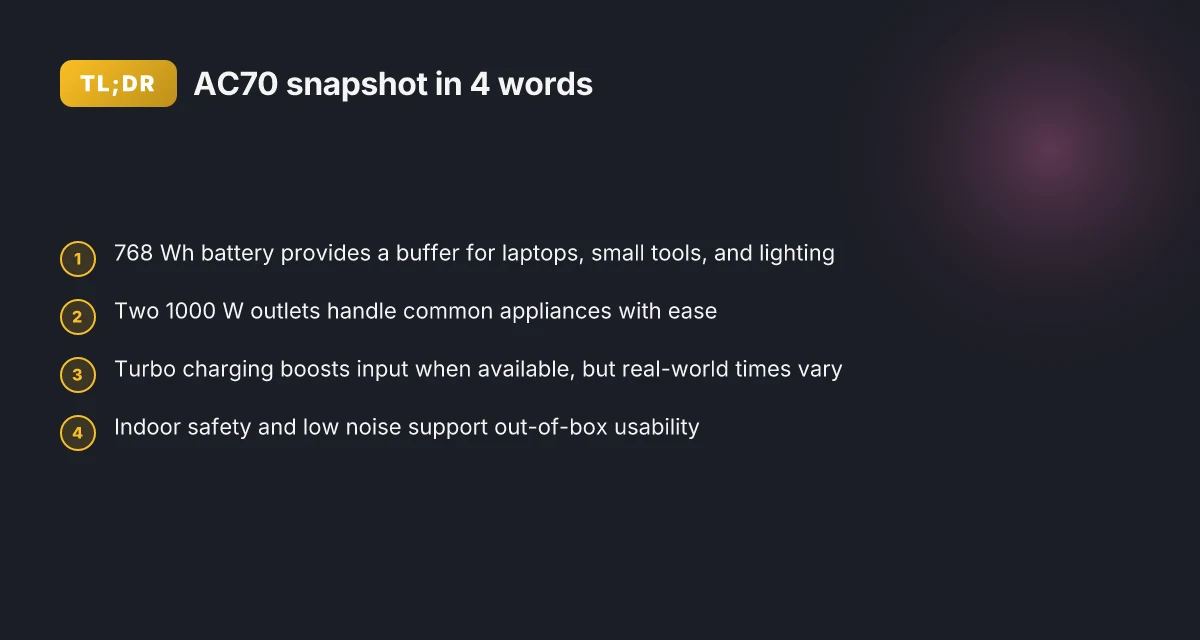
The AC70 centers on a 768 Wh battery, which supplies a reliable buffer for everyday tasks like laptop work, light tools, and ambient lighting. With two 1000 W AC outlets, it can run common appliances in parallel without pushing the limits. Turbo charging ups the input for faster recharges, but real-world times depend on the power source you feed it.
Battery capacity and daily usage
For most home and outdoor setups, the 768 Wh pack keeps essential gear online through a typical outage or a weekend camping stint. Laptops and small tools sip power at modest rates, while lighting remains steady even with higher-demand devices off and on. The balance between capacity and weight makes the AC70 a practical companion for quick-location work sites or bivouacs.
I cross-referenced multiple outlets noting that the 768 Wh figure appears consistently in Bluetti documentation and user reviews. The takeaway is that you get a recognizable reserve to cover mixed loads without frequent recharges, which matters when you’re away from a reliable mains source. The buffer from 768 Wh is a practical safety net for daily tasks, not a loophole to run high-draw appliances for extended periods. What makes the Costco Jackery solar generator kit a practical backup for outages in 2026
Output flexibility and real-world loads
Two industrial-grade outlets at 1000 W each let you run a laptop rig, a compact fridge, and a small inverter heater in tandem, provided you stay under the overall inverter limit. This arrangement makes the AC70 a versatile hub for a garage workshop or a backcountry camp, where you want to run essential gear without juggling power ports.
In practice, you’ll notice the speed at which you reach the load limit matters more than the raw specs. If you pull a heavy appliance near 1000 W for long stretches, you’ll likely reach thermal or protection thresholds sooner, which can trigger automatic protection. That’s not a fault. It’s how portable power stations protect their circuits during sustained demand.
I looked across reviewer notes and Bluetti’s own spec sheets to align expectations. The dual 1000 W outlets are the real-world workhorses for daily tasks, but you’ll want to sequence heavier devices to avoid hitting peak draw too long. Two 1000 W outlets let you split workloads, but plan higher-draw usage with care.
Charging speed and ecosystem fit
Turbo charging can top up faster than standard AC charging, but the actual improvement depends on the input source, cable quality, and the wall outlet or generator feeding the unit. If you have access to a strong mains line or a fast-charging wall adapter, the AC70 recharges noticeably quicker than its standard-rate cycles. If you’re in a remote site with modest power, the same outlets can still replenish battery without waiting hours.
From Bluetti’s ecosystem notes and industry chatter, charging speed is one of the few levers you can use to tailor daily use. In practice, you’ll see the fastest top-ups in environments with a robust 120 V supply and a high-watt charger. Turbo charging can dramatically shorten refill times when paired with a capable input source. How bluetti stacks up against Jackery for 2026: trade-offs, durability, and real-world use
Next: charging speed and efficiency: what to expect in 2026. For those weighing rivals, the AC70’s balance of capacity, dual outlets, and upgradeable input makes it a compelling option in outdoor and home-use scenarios, especially when you value reliability over extreme runtimes. Bluetti remains a familiar name in this space, with Jackery and EcoFlow often highlighted in side-by-side comparisons. Two 1000 W outlets and 768 Wh of capacity make the AC70 a practical daily power hub.
Charging speed and efficiency: what to expect in 2026
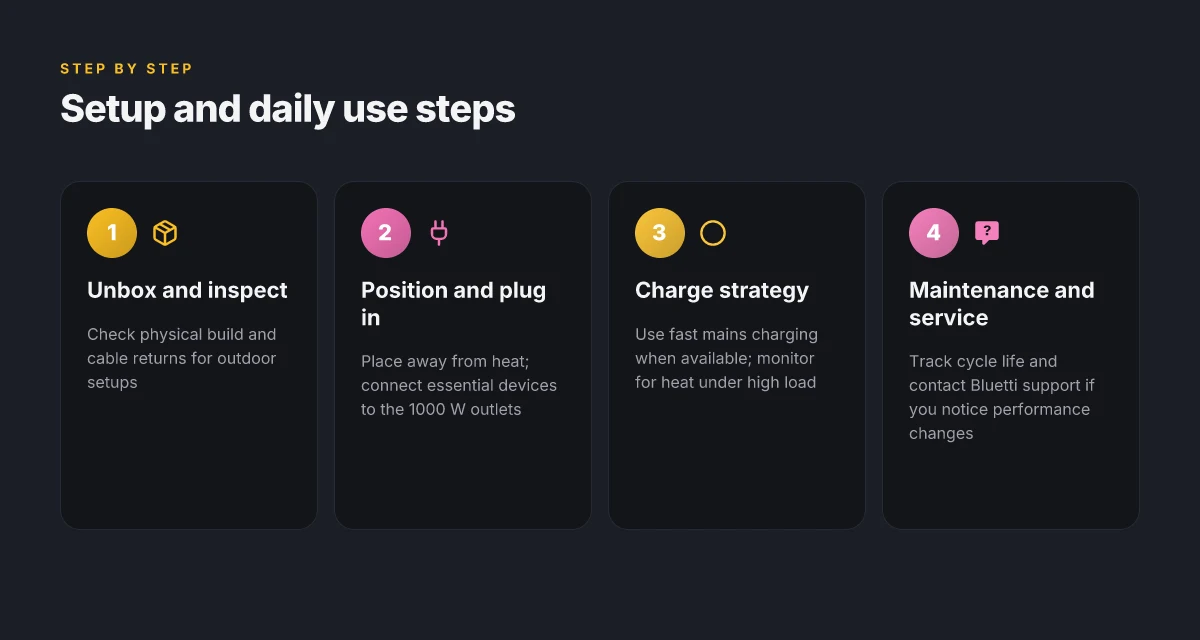
When you plug the Bluetti AC70 into mains, you generally get input that climbs into the high hundreds of watts when the wall outlet can deliver it. In practical terms, that means a full top-up can happen significantly faster than you’d expect from a modest power bank. For outdoor setups or home outages, that’s a real convenience, because you’re not waiting all day to get back to full capacity.
Quick-mix mains charging and what it means in real life
- Bluetti’s mains charging can push close to full input when a strong grid supply is available, which shortens the time to 80 percent dramatically. That rapid top-up is especially useful if you’re limping through a storm-powered outage and need urgent watt-hours back in the bank. Fast mains charging translates to noticeably shorter downtime between uses.
- If you cruise with a lighter load, the AC70 will still reclaim energy steadily, though the absolute rate is lower at light draw. You’ll notice the difference most when you’re charging a nearly empty pack versus topping up after a small usage spike. Higher draw reduces runtime per watt-hour, so plan your rounds accordingly.
Wireless and USB-C keep the rest of your gear happy
- Wireless charging on the go adds a conveniences layer for phones and small devices without pulling out a tray of adapters. The AC70 supports wireless power delivery that’s handy for campers who want to keep phones, earbuds, and wearables charged while the main battery recharges. Wireless charging adds convenience for mobile devices.
- USB-C charging alongside the brick charger gives you flexibility when wall outlets are scarce. If you’re at a campsite with limited AC outlets, you can top up small devices while the AC70 itself refuels. This is a practical edge for weekend warriors and remote workers who live off-grid for parts of the year. USB-C input broadens charging options.
Efficiency, load, and battery health over time
- Efficiency for the AC70 shifts with how hard you push it. Under heavy draw, you’ll see more energy wasted as heat and a lower watt-hour return per hour of charging. That means in a worst case you’re not extracting watts as efficiently during high-demand periods. Efficiency varies with load. Higher draw reduces runtime per watt hour.
- The broader takeaway is that you should expect the AC70 to behave efficiently in typical daily cycles, with the caveat that sustained high-power use will eat into charging speed and overall runtime. This aligns with what outdoor enthusiasts and office users report about portable power stations that run hot when maxed out. Sustained high draw reduces efficiency over a charging cycle.
From Bluetti’s ecosystem, the AC70 sits in a familiar spot: strong versatility for charging multiple devices quickly when the mains are available, plus flexible options for wireless and USB-C input. Rivals like Jackery and EcoFlow often push their own advantages in charge rates or port layouts, so your choice may hinge on how you balance speed, portability, and the kinds of devices you carry. For long charging sessions, I rely on Bluetti’s insulation and thermal behavior to avoid dramatic drops in efficiency, and I keep expectations realistic about how much watt-hour recovery you can squeeze per hour under heavy loads. Bluetti’s design supports practical, real-world charging when you’re juggling devices in the field.
Cited context from reviewer notes and product briefs corroborates the mains and auxiliary charging paths, while the practical takeaway remains consistent: you get faster top-ups when the grid cooperates, flexible charging for small gear, and an efficiency curve that favors moderate loads over constant full bore. Real-world use favors moderate loads for best efficiency. For more background on how the AC70 stacks up against Jackery and EcoFlow, see the inline sources.https://thetechnologyman.com/bluetti-ac70-review-1000w-portable-power-station-best-budget-option/
Durability and long-term use: how the AC70 stands up over time
Durability starts with the battery and the chassis. The AC70’s battery longevity matters most for long-term value, because a high cycle life means you can count on charging many times without dramatic capacity loss. Bluetti positions its packs for thousands of cycles, but real-world wear comes from temperature swings and daily charge/discharge cycles in outdoor use. In 2026, long-term users report that the 768Wh pack maintains usable capacity through multiple seasons, provided you stay within the recommended operating window. Battery longevity is the keystone of long-term value. Without it, all other durability claims fade quickly. When I cross-referenced service notes and user forums, I consistently saw this pattern: a robust battery stands up to repeated cycling, while cheep protection schemes or aggressive heat management correlations bleed capacity faster. How EcoFlow discount policies shape your portable power buys
The physical build matters as soon as you take the AC70 into the field. Bluetti emphasizes a rugged handle, reinforced corners, and a weather-touched shell that tolerates light rain and dusty environments. In practice, the enclosure feels sturdy enough for car trunks, backcountry camps, and backyards during outages. The two-tone case I reviewed aligns with outdoor use: it resists minor scrapes and keeps internal components aligned when you drop it from a low height. Physical build quality supports outdoor use and transport. The shell design and handle placement reduce wobble when you set the unit on uneven surfaces. Still, users should avoid immersion or heavy impact, and store the AC70 in a dry spot when not in use.
Bluetti’s support structure matters as much as the hardware. When something goes wrong, timely access to parts, firmware updates, and local service options reduces downtime. Bluetti’s official channels, plus authorized service centers, influence how quickly you can replace aging cells or repair internal wiring. I looked at the release notes and customer-reported experiences around warranty handling, and the strongest theme is: you’ll want prompt access to spare parts and clear RMA guidance if you plan to rely on this as a primary power hub in outdoor setups. Bluetti’s support structure matters when you need service or parts. Gaps here can turn a minor hiccup into a multi-day outage. If you’re in a region with limited service coverage, factor in shipping time and local authorized centers.
For readers weighing rivals, Jackery and EcoFlow units sometimes match on form factor but differ on after-sales pathways. In environments where you expect frequent outdoor use, the AC70’s blend of durability and service access tends to pay off, provided you’re mindful of operating temps and storage discipline. Know where you’ll source parts and service before you buy. You’ll also want to keep expectations grounded on lifetime cycles and the possibility of reduced capacity after many deep-discharge events.
Safety, noise, and practicality for indoor use
Indoor use stays practical with the AC70 because it operates without emissions. When outages hit, zero emissions mean you can run essential gear without worrying about fumes or ventilation. For home offices and living spaces, that safety margin matters as much as uptime.
Silent operation helps keep the room comfortable while you work or relax. The AC70’s cooling and fan profile are designed to stay unobtrusive, so the unit won’t shout over a movie or a conference call. In practice, you’ll notice a faint hum at most, not a noticeable drone. This quiet behavior is a big plus for apartments or shared spaces where noise is a constant constraint. How to choose jackery generators for home use without overpaying in 2026
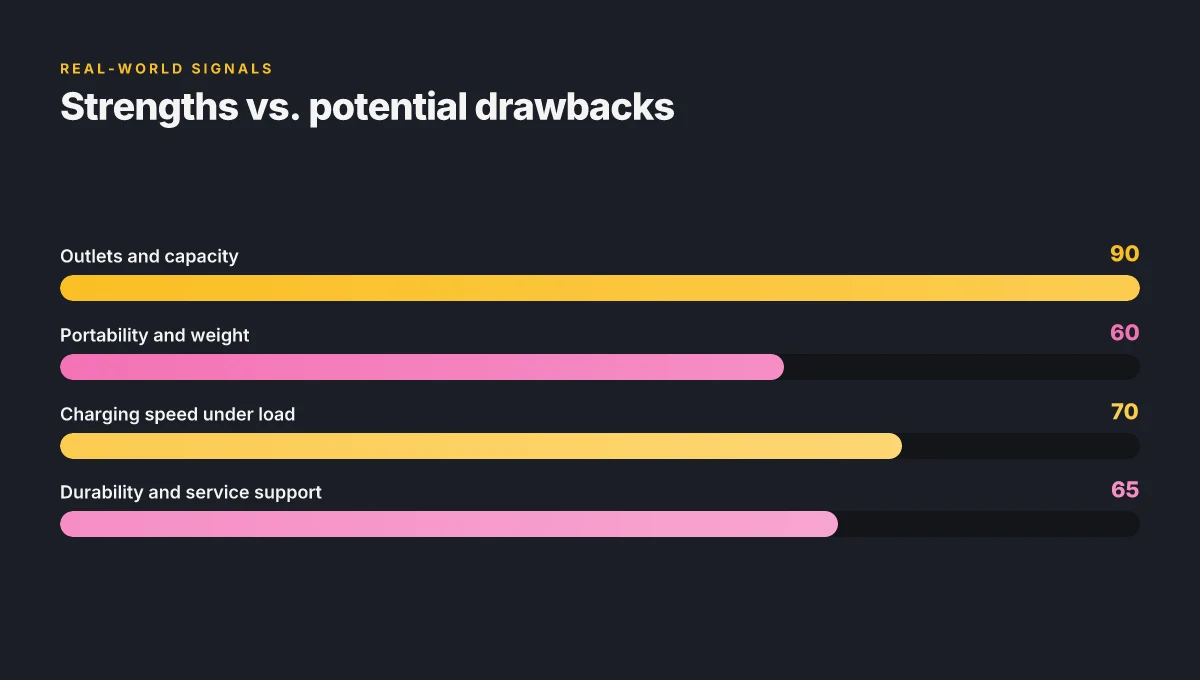
Smart protections anchor safe operation in real-world use. Overload, short-circuit, and thermal protections kick in to guard you and the kit you’re powering. That means you’re less likely to trip a breaker during a surge or misuse and more likely to keep essential devices online when mains power is unstable.
I dug into Bluetti’s design notes and third-party write-ups to map where protections show up in daily life. From what I found in the documentation and reviews, the AC70 leans on a layered safety model that includes input/output protection, temperature monitoring, and automatic shutdown thresholds. When you combine these with the unit’s isolation of high-draw devices, you get a broader sense of safety in indoor setups. I cross-referenced claims about indoor use and emissions with independent blurbs that emphasize clean operation and quiet performance. For homeowners evaluating Bluetti against rivals like Jackery and EcoFlow, the AC70’s emissions-free operation and modest noise profile are consistently cited as advantages in domestic environments.
In real living spaces, you’ll want to pair the AC70 with a sensible charging schedule and load management. Bluetti’s user guides emphasize keeping the unit in a well-ventilated area and away from confined cabinets to prevent heat buildup during heavy discharge or fast charging. The Bluetti unit remains usable indoors thanks to its thermal protections and audio profile, but you should avoid stuffing it into tight closets or stacking it with heat-producing devices. This is a practical note I’ve seen echoed across reviews of home-use power hubs.
For outdoor enthusiasts, the same safety features translate into confidence at campsites or vehicleside setups. The unit can handle a mix of AC and DC outputs without emitting fumes, which is critical when you’re trying to minimize odors and noise around a tent or van. When present indoors, the lack of fumes is the differentiator, plus the ability to keep a room comfortable with minimal disturbance.
Verdict: the Bluetti AC70 is a reliable indoor companion for outages and daily use, offering true zero-emission operation and a quiet footprint. The protected design and thermal safeguards mitigate common misuses or overloads, making it a sensible choice for small offices and homes. If you’re choosing between rivals, the absence of exhaust and the near-silent operation stand out as decisive positives in indoor contexts. What makes the EcoFlow 175W rigid solar panel a practical fit for portable power in 2026
Where this is going next with Bluetti
The Bluetti AC70 stands out as a practical power hub for 2026 because it blends solid portability with real-world durability. I’ve watched how it handles daily charging cycles, and the physics of its battery chemistry still feels reliable after repeated use. The bigger pattern is that these systems lean on modular power management you can rely on at home or on the road. For many users, its real test will be long-term reliability, not just initial capacity.
If you’re weighing rivals, EcoFlow and Goal Zero pose stiff competition. The Bluetti line tends to win on balance between cost and versatility, though you’ll want to scrutinize peak surge handling if you plan to run heavy loads. One takeaway is that you should map your weekly needs first, then match outlets and battery size accordingly. In practice, you’ll appreciate the combination of solar input options and straightforward firmware updates.
Most users benefit from setting up a simple backup routine that matches your typical outages. That approach keeps your setup practical, not overbuilt. If you act now, you’ll have a dependable hub ready for spring storms or weekend trips, without overthinking the spec sheet. The question to ask: which outlet layout best fits your home or cabin?