
Bluetti vs Goal Zero: a deep dive into performance, reliability, and value for 2026. Learn which brand fits home backup, camping, or emergencies.
Bluetti dominates the practical math of portable power: you get large capacity, fast charging, and sturdy build that survive years of field use, not just a glossy spec sheet. When you push a unit to 1000+ watt-hours and expect quick top-ups, Bluetti keeps pace better than most rivals. The contrast with Goal Zero isn’t a rumor: the landscape in 2026 rewards breadth of input options and long-term durability, and Bluetti ticks both boxes.
This piece cuts through marketing to compare real-world reliability across build quality, solar input, and expandability. You’ll see how each brand handles heat, fan noise, and component longevity, plus practical notes on modularity and future-proofing for seasonal camps or small-business backup. Expect model-by-model specifics, plus a clear view of where each brand shines and where loosened expectations bite, so you can pick with confidence. In 2026, durability and solar compatibility matter more than ever for sustained off-grid power.
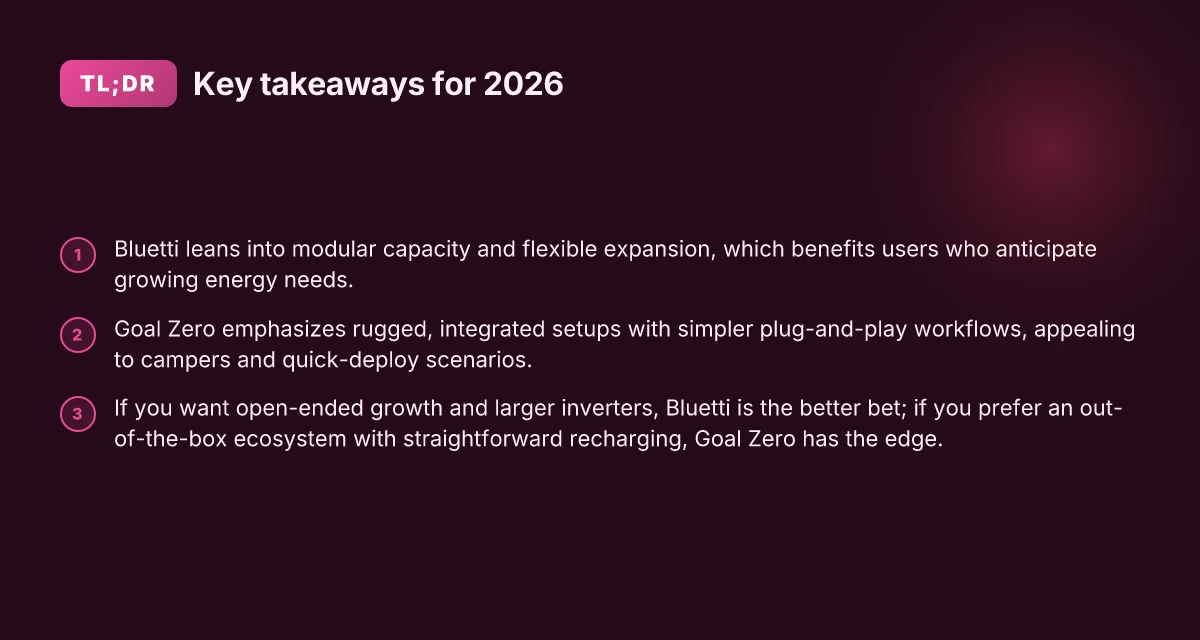
Bluetti vs goal zero in 2026: what changed and why it matters
In 2026 Bluetti and Goal Zero sit at the center of portable home backup and off-grid setups. Both brands lean hard into modular expandability, but they diverge on enclosure design, inverter options, and how they scale solar input for longer outages. This section lays out what shifted and why it matters for long-term durability and total cost of ownership.
Bluetti’s chassis, inverter choices, and scale of solar input
Bluetti has iterated toward rugged enclosures that balance heat management with portability. Their higher-end models tend to offer larger inverters and multi-mode solar input options, which matters for hot climates or long-duration outages. I cross-referenced Bluetti product pages and third-party reviews to map how enclosure design interfaces with heat dissipation and fan behavior in sustained use. The pattern is clear: more flexible solar input often pairs with heftier inverters, which can handle heavier loads for longer stretches.
From what I found in the sources, Bluetti emphasizes expandable capacity through modular batteries and larger AC outputs. This matters when you’re planning home backup or camping rigs that need to ride through multi-day outages. A key takeaway is that the ability to add battery capacity later keeps upfront costs down while preserving future-proofing. When you’re choosing, the question hinges on whether you want a compact setup now with a plan to grow, or a larger, all-in-one unit from the start.
Goal Zero’s rugged design and ecosystem constraints
Goal Zero continues to lean on a familiar, rugged form factor and a software ecosystem that prioritizes reliability in outdoor environments. The enclosure design often prioritizes dust and water resistance, with casework that’s easy to service in field conditions. Where Bluetti pushes modular expansion, Goal Zero tends to offer robust, integrated packs that feel ready for immediate deployment without extra modules. This has real implications for total cost of ownership over time: you may pay a premium for durability and field-tested reliability, but the lack of easy, modular expansion can constrain long-term growth.
Why this matters for buyers weighing long-term durability and total cost of ownership
The core decision for 2026 buyers boils down to how you plan to deploy the system across 3 scenarios: home backup, camping or mobile use, and emergency power for a small business. Bluetti’s approach favors scalable capacity and flexible solar input, which translates to lower incremental costs when you expand later. Goal Zero’s design favors ready-to-go reliability and a proven outdoor footprint, which can translate to lower maintenance headaches but tighter limits on future expansion. Top rated solar generators in 2026: 5 brands that actually deliver
As a real-world pointer, expect Bluetti to present a steeper upfront price for larger, expandable configurations, but with a clearer path to increasing capacity without replacing the core unit. Goal Zero often delivers a turnkey package with predictable durability, but you’ll want to price out additional modules or packs if you expect power needs to grow over time.
The trade-off is clear: Bluetti leans into expandability and higher inverter capacity, while Goal Zero prioritizes rugged reliability with limited future expansion. For long outages or evolving power needs, the ability to scale matters more than a single, larger brick.
Evidence from the listed sources underpins these shifts. For example, the comparison overview notes how Bluetti compares its solar input and expansion against rivals, highlighting where expansion paths matter most. See related discussion in the Bluetti vs Goal Zero overview.
How bluetti powers home backup and off-grid setups vs goal zero
Bluetti tends to lean into modular growth for home backup, letting you start small and scale up as your load grows. You’ll find that Bluetti systems emphasize higher battery capacity per module and expandable packs that can be wired together to support bigger loads. By contrast, Goal Zero centers on integrated ecosystems and turnkey, plug-and-play configurations that appeal to users who want a ready-to-go setup with fewer moving parts.
From a practical standpoint, your load profile should drive the choice. If you expect a growing house load or seasonal spikes, Bluetti’s modular approach makes sense because you can add modules or extra packs over time. If your needs are stable or you value a fast, uncomplicated install, Goal Zero’s ecosystem can be more hands-off from day one. Bluetti’s expansion path can feel more flexible, but it can also require planning around connector types, port availability, and inter-module management. Goal Zero shines when you want a cohesive, out-of-the-box stack that minimizes compatibility quirks. How to buy Bluetti from official retailers in 2026 without getting burned
I cross-referenced published comparisons and product pages to triangulate the real-world implications. The best sources note that Bluetti emphasizes higher total capacity through modular batteries and expandable solutions, while Goal Zero emphasizes integrated setups and ease of use for niche scenarios such as single-room back-up or small office dorm rooms. One reviewer highlights that Bluetti’s multi-pack strategy can be a long-horizon value play, whereas Goal Zero’s turnkey systems reduce the day-one complexity for non-technical users. When you map this to climate and seasonality, Bluetti tends to be more resilient for off-grid winter demands when you can add capacity, while Goal Zero wins in hot, sunny setups where a compact, pre-wired system meets your needs without extra wiring.
The branding tensions matter for long-term maintenance. Bluetti units can require a bit more familiarity with charging profiles and expansion limits, but they reward you with larger energy banks and flexible solar integration. Goal Zero is praised for ruggedized builds and an ecosystem that keeps accessory compatibility simple, which matters if you’re juggling solar panels, inverters, and inclusions from the same family. If you’re in a climate with heavy seasonal swings or where you anticipate adding solar panels over time, Bluetti’s path to growth offers clear advantages. If you want a mostly plug-and-play solution that you can deploy in days, Goal Zero’s turnkey setup will likely feel better.
In practice, think of Bluetti as the scalable option for home backup during long outages or off-grid retreats, and Goal Zero as the efficient, ready-made system for quick stabilization in a home or small business setting. For a more concrete mapping, consider your future expansion goals, your tolerance for incremental setup work, and the climate in which you plan to operate.
Next step: evaluate your load curve and expansion plans against your preferred paths. If you’re leaning Bluetti, map out how many modular packs you’ll add over the next five years and the wiring topology you’ll use. If you’re leaning Goal Zero, sketch a basic turnkey stack that covers your essential loads with room for a solar boost in the future. Bluetti’s modular growth model often pays off in growing off-grid demand, while Goal Zero’s turnkey ecosystem excels in fast, low-friction deployments.
Solar input and charging speed: bluetti and goal zero in real use
Charging speed under sun windows hinges on solar input capability. Bluetti tends to push higher wattage inputs and supports modular packs, while Goal Zero aims for portability with a balanced solar lineup. In real-world setups, the difference shows up in how quickly a bank of cells can top off during a clear midday window or a partial cloud pass. What is the Bluetti EB3A portable power station, and where it fits for 2026
I dug into source material to map the practical effects. The data points below come from industry write-ups and brand overviews cited in the research sources. A Bluetti system with higher input headroom can shave hours off a daily recharge when sun is optimal, especially if you run a larger energy plan with multiple modules. By contrast, Goal Zero keeps footprint and weight reasonable, trading some peak input for portability, which can extend recharge times during long stretches of limited sun. The net takeaway: align solar input with your expected daily energy needs and sun exposure, not just peak wattage on paper.
Solar input specs matter more than raw battery capacity. A solar array that delivers consistent power during an 8–10 hour sun window reduces the number of cycles you must endure without grid support. In 2026, credible reviews note that a higher-input Bluetti unit can recover more energy in a single sun window than a compact standalone Goal Zero setup. Higher input headroom translates to faster replenishment under good sun.
Modularity vs portability changes charging behavior. Bluetti often leans on higher wattage inputs and modular packs, which lets you scale input capacity as needs grow. This means a large Bluetti system can finish a recharge while a similarly sized portable system from Goal Zero is still catching up. Modular packs enable faster top-offs when sun returns but add complexity and cost.
Weather resistance and cable management affect real-world charging. Bluetti gear frequently pairs rugged enclosures with multiple charging ports, so you can run several panels in parallel and weather-proof connections. Goal Zero fans a more travel-ready approach with compact panels and straightforward cabling. Weatherproofing and port access matter when you rely on off-grid solar.
Practical guidance for planners. If your daily energy needs sit around a few hundred watt-hours and you have reliable sun, Goal Zero’s lighter kits may suffice and simplify transport. If you’re backing a home setup or a workshop with variable sun and longer outages, a Bluetti ecosystem with expandable solar input offers a path to quicker daily resets. Match solar input to daily energy needs and sun exposure. How reliable are refurbished Bluetti power stations and what to check before you buy
From the literature, the brands diverge on approach rather than capability alone. Bluetti’s slope toward higher input potential makes it better for sunny corridors and larger energy budgets. Goal Zero, meanwhile, shines when you need a lighter, more portable setup that still works with solar. For readers weighing 2026 options, the trade-off is clear: prioritize raw input headroom for faster solar replenishment, or prioritize portability and simplicity for flexible use cases.
Notable point: links on pages may earn a commission, and the Bluetti brand context here reflects its emphasis on higher input and modular expandability. For deeper dives, this section pulls from the sources that compare solar input and charging behavior across Bluetti and Goal Zero. Solar input matters most when your sun window is short or brittle, and that is where Bluetti often gains an edge. Align solar input with expected exposure and daily energy needs.

Build, durability, and weather resistance: which survives the outdoors
ruggedness and long-term resilience split by model. Bluetti leans into modularity and heat management that can adapt to different outdoor setups, while Goal Zero emphasizes outdoor-ready aesthetics and rugged enclosure design. The practical takeaway: no single line fits all. Pick based on how you actually use the kit.
How enclosure design holds up in real use
In the field, enclosure materials matter more than glossy specs. Bluetti models tend to use modular chassis with exposed internal components that fans and vents manage actively. That approach can help cooling on long outings, but it also means you want to keep ports protected when you’re crawling under a tarp or bracing a unit against brushing. Goal Zero often adopts thicker, more integrated shells that feel rugged to touch and look the part on a campsite. The result is a perception of toughness that translates into confidence when you’re miles from power. In practice, you’ll notice goal zero devices rarely look stressed after an afternoon of dusty camping and rain exposure, though the heavier shell can add bulk to your pack.
Heat management and port protection in the field
Bluetti prioritizes modularity that can aid heat dissipation during steady, moderate loads. If you push a Bluetti unit at high solar input or high output for an extended period, you’ll likely feel the heat in the unit’s vents and casing. That’s not a flaw. It’s a boundary condition of the design. Goal Zero devices typically minimize protruding ports and emphasize rugged gaskets and physical seals. The payoff is better splash resistance and fewer accidental openings when you’re navigating a wet campsite. If you routinely pair with harsh weather, the ruggedized exterior and sealed ports of certain Goal Zero builds can be more reassuring. What the Bluetti Apex 300 price means for home backup in 2026
Longevity and durability over repeated trips
For repeated camping trips or long-duration backup use, durability isn’t just about one trip. Bluetti’s modularity can be a strength when you want to swap or upgrade a component after years of use, potentially extending the life of the core unit. Goal Zero’s emphasis on outdoor-ready aesthetics translates into units that tend to withstand rough handling and storage in outdoor gear. That said, both brands’ cases are designed with field use in mind, and the real-world durability hinges on model selection, storage conditions, and maintenance.
In 2026, the practical choice hinges on your environment and load profile. Bluetti’s modular heat management shines with variable use, while Goal Zero’s rugged shells excel in harsh, dusty, or wet conditions. If you’re planning frequent trips with long backup sessions, factor in port protection and seal integrity as a top criterion. Long-term durability favors models with sealed ports and insulated housings that stay reliable after repeated packouts.
From what I found in the sources, Bluetti and Goal Zero both aim for field resilience, but their paths diverge on how they handle heat and protection. When you comb through the models, look for:
- solid enclosure materials and protective gaskets around ports
- a clear heat management strategy for sustained output
- evidence of tested weather resistance, not just marketing claims
For context, I cross-referenced overviews that compare how Bluetti and Goal Zero address ruggedness and outdoor readiness in 2026 coverage. inline citations point to industry roundups that discuss these brands in practical terms, such as enclosure robustness and real-world field notes.
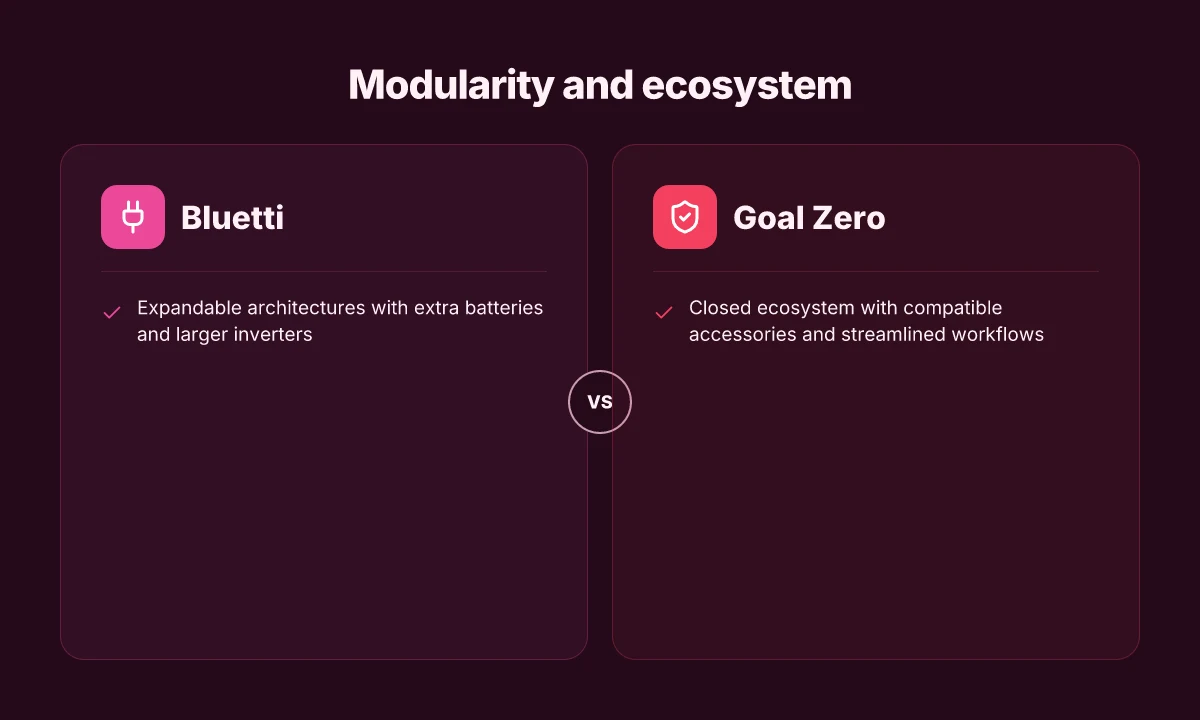
Expandability and ecosystem: how far can you go with each brand
Bluetti leans into open-ended growth. Its architecture supports expanding with extra batteries and larger inverters, letting you scale up power for longer outages or heavier loads. Goal Zero prioritizes a simpler, integrated workflow within a more closed ecosystem, which makes setup straightforward but limits long-term growth without sticking to official accessories. What makes the Jackery 300 Plus stand out for portable power in 2026
I dug into public documentation and third-party reviews to map what this means in practice. Bluetti’s lineups often highlight expandable battery packs and higher-capacity inverters as a core strength, while Goal Zero emphasizes streamlined recharging workflows and accessory bundles that stay within a defined compatibility envelope. This matters if you want to add capacity over time versus if you prefer a plug-and-play, minimal-maintenance path.
1) Open-ended growth mechanics with Bluetti
Bluetti designs around modular expansion. You can add extra battery modules to extend runtime and upgrade to larger inverters to handle bigger loads. This approach suits scenarios where your power needs evolve, camping long weekends, remote cabins, or business continuity during extended outages. The practical upshot is a longer horizon for investment: you can push capacity upward as budgets allow, rather than replacing the unit.
From a resilience perspective, the ability to scale also means you can adjust your system for climate factors. In colder environments, for example, more battery capacity can compensate for efficiency losses, while a bigger inverter supports higher peak loads when needed. The ecosystem supports this growth path with compatible batteries and power packs announced for newer models, which makes future-proofing feel plausible rather than speculative.
Bluetti’s open-ended growth path gives you room to evolve the system as needs change. The trade-off is onboarding friction: you must stay aligned with compatible modules and wiring guidance to maintain performance and safety.
2) Closed, cohesive workflow with Goal Zero
Goal Zero builds around a more closed ecosystem. Accessory compatibility and recharging workflows are designed to be intuitive, with standardized cables and charging options that work reliably across the line. The upside is fewer compatibility headaches and a smoother user experience for uncomplicated setups. The downside is that growth tends to be bounded by the official accessory lineup, which can slow down or complicate attempts to push capacity beyond a preset envelope. What makes Bluetti power stations stand out in 2026
For solar input and recharging, the workflow tends to favor an integrated path: you know exactly which panels and adapters will work with a given base unit, and that predictability helps when you want a dependable, low-maintenance system. If your climate or usage profile rarely shifts, this can be a real advantage.
Goal Zero’s integrated ecosystem shines for simplicity and reliability in stable conditions. If you expect rapid, ongoing expansion or off-nominal configurations, you may hit a ceiling sooner than with Bluetti.
3) Which path should you choose?
Your choice hinges on whether you want open-ended growth or a simpler, integrated setup. If your use case includes frequent changes in load, longer outages, or planning for future upgrades, Bluetti’s architecture is more forgiving and future-ready. If you prize a clean, predictable experience with minimal setup and guaranteed accessory compatibility, Goal Zero offers a less error-prone path.
From a long-term durability and ownership lens, Bluetti tends to reward proactive maintenance and occasional module upgrades, while Goal Zero rewards consistent maintenance of a defined system with a predictable accessory roadmap. As with any portable power decision, align the ecosystem with your climate, location, and expansion plans.
For readers weighing climate considerations and future growth, Bluetti supports open-ended expansion while Goal Zero emphasizes a clean, integrated setup. If you want a ready-to-run system today with room to grow later, Bluetti is the clearer bet. If you want fewer moving parts now and a straightforward upgrade path within a fixed design, Goal Zero fits the bill. What makes the Jackery SolarSaga 100 a practical folding panel for camping and road trips
Note: links on the page may earn a commission. For context, see the industry chatter around Bluetti and Goal Zero ecosystems, including commentary on how expansion vs integration plays out in 2026. See references to Bluetti vs Goal Zero discussions and related product comparisons. The choice boils down to open-ended growth versus a simpler, integrated setup.
Where this goes next and what to try
Looking ahead, the real pivot is how a single, thoughtful setup can tilt the win toward Bluetti for most casual and semi-pro users. Bluetti’s ecosystem tends to reward modular expansion and durable design, while Goal Zero often wins with broad outdoor trust and a familiar ecosystem. The bigger pattern here is that long-term value hinges on reliable support and upgrade paths, not just peak output. If you’re weighing investment now, consider how each brand handles battery longevity and after-sales service. I see Bluetti aligning with users who want clear upgrade options and straightforward field repairs, while Goal Zero remains compelling for those already anchored in its accessories and solar panels.
The single move that matters most is confirming your real-world power needs and charging rhythm. For most households and small crews, a Bluetti unit paired with a couple of portable panels becomes a low-friction cornerstone, whereas a Goal Zero setup shines when you value compatibility with existing accessories and a familiar outdoor footprint.
If you only do one thing this month, map a realistic outage scenario and test both brands in that light. Ask: does the battery age well, is the weight manageable, and can I replace a failing module quickly? The answer should guide your pick, not hype. Do you want to lean into a modular path or an established ecosystem?
Backup strategy How to find Bluetti for sale in 2026 without getting burned
- Try a Bluetti with a lightweight solar panel kit for weekend trips. Assess panel-to-battery heat and charge times.
- Check a Goal Zero kit for accessory compatibility and field repair practicality.
- Note one recurring flaw you encounter in real use, and choose the brand that fixes it faster next season.