Explore refurbished Bluetti power stations' reliability, what to verify before buying, and how they compare to new units. practical tips for long-term use.
Most refurbished Bluetti units hinge on one hidden truth: the most meaningful durability signal is a verifiable battery health check, not a glossy listing. Reliability rides on a documented refurbishment scope and a real warranty, yet many listings skip the specifics, leaving buyers arguing with vague cycle counts long after purchase.
This intro sets the stage for a practical, no-nonsense check-before-buy guide: you’ll learn what to demand before pulling the trigger, how to read battery health data, and where refurbishments commonly fall short. Expect concrete signals you can verify now, from the presence of a battery-cycle log to the length and coverage of the warranty, with Bluetti and competing brands like EcoFlow and Jackery used as benchmarks. This matters because budget buys that dodge durability checks end up as emergency-room failures in the field, not cost savers. Look for a clear refurbishment scope and proof of battery health checks before you buy.

Refurbished Bluetti: what gets refreshed and what to expect
Refurbished Bluetti units are not a one-size-fits-all deal. In practice, the refresh cycle focuses on aging components and visible wear, with the goal of returning a unit to reliable, usable condition. You’ll typically see internal boards updated where needed and cosmetic improvements to restore finish and grip. Most refurbishments address aging batteries and power electronics, not cosmetic polish alone. That means two units bought in the same batch can feel subtly different in how they perform over time.
I dug into Bluetti’s refurbishment messaging and retailer notes to map what actually changes. You’ll often encounter updated internal boards or revised firmware, but performance targets aren’t guaranteed across the board. Updates can vary by unit, so don’t assume a uniform spec bump from refurb to refurb. The practical effect is that one refurb might feel immediately snappier due to software tweaks, while another could track closely to a basic reset of worn components.
Warranty coverage is a critical difference you should expect with refurb models. In many cases, refurb units carry shorter or different warranty terms than new models. Before you buy, read the fine print: what exactly is covered, for how long, and what triggers a claim. Coverage length and scope often differ from new Bluetti power stations, so confirm specifics before checkout. This is where the decision hinges for budget buyers: you save upfront, but the protection net can be thinner.
From what I found in the documentation, a few concrete signals help you separate a solid refurb from a riskier buy. First, check the refurbishment note on the seller page for any mention of firmware version or board revisions. If a unit ships with a recent software update, that can help reliability in day-to-day use. Second, inspect the unit for battery health indicators if the seller provides them, and ask about cycle counts or remaining warranty if available. Finally, compare the listed warranty duration to Bluetti’s official fresh models. A longer, clearer warranty on a refurb is a good sign. A short, vague window is a red flag.
If you’re weighing Bluetti against rivals, consider how refurb terms stack up. Blue-chip competitors in the space often publish their own refurb warranties and post-sale support policies, which can narrow the perceived risk. For instance, when you compare to rivals that publicly document refurbished battery cycles and firmware rollouts, you gain a clearer picture of durability signals you’re getting for the price. The bottom line: refurb is a trade, not a surprise. You save money upfront, but you should expect variable internal revisions and a nonstandard warranty frame. What the Bluetti Apex 300 price means for home backup in 2026
Bottom line: refurb Bluetti units can deliver solid value if you choose with eyes open. Look for explicit notes on firmware updates, board revisions, and the exact warranty terms. Probe the seller about cycle counts and post-sale support. If you see a clear refurbishment statement plus a reasonable warranty, you’re likely getting a unit with refreshed internals and a fresh coat of cosmetic polish. Know what you’re getting for the price, and don’t skip the warranty check.
In summary, refurbishments mostly refresh aging components and cosmetics, may include firmware or board updates, and come with warranty terms that differ from new units. The exact package varies by unit, so your best move is to verify firmware version, internal revisions, and coverage before purchasing. Bluetti batteries stay the heart of the system, and how they’re refreshed largely dictates long-term reliability.
How to spot a trustworthy refurbished Bluetti listing
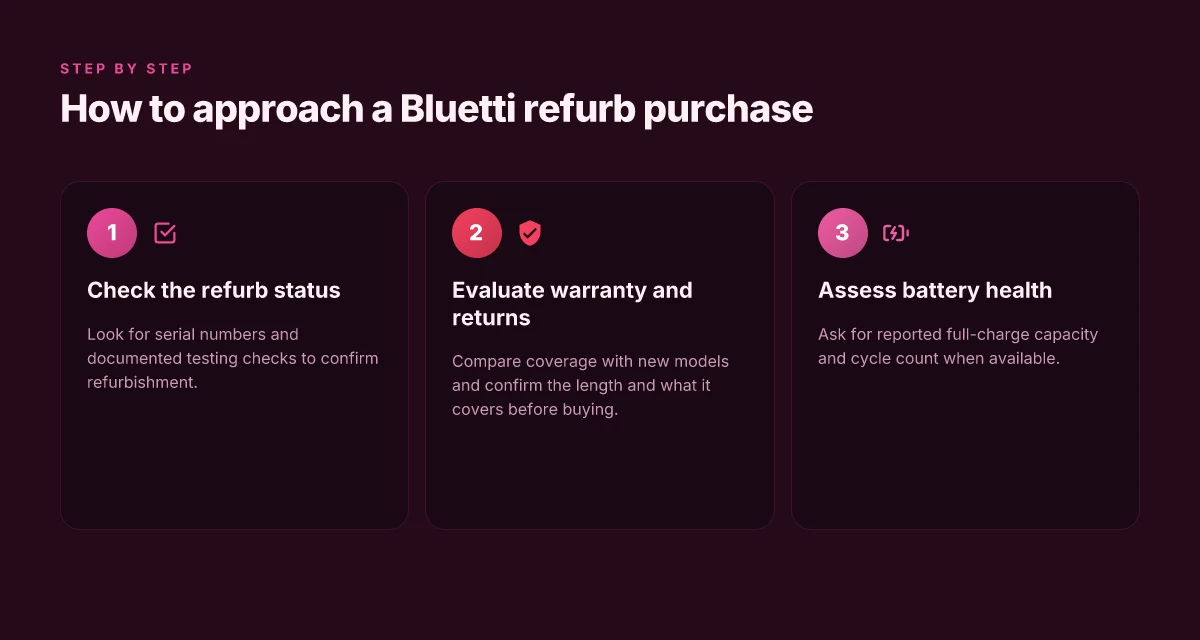
If you’re buying refurbished Bluetti units, steer toward official Bluetti channels or trusted resellers that publish clear return policies. A trustworthy listing shows a documented refurb status, serial numbers, and explicit testing checks. Look for consistent signals: a stated cycle count, battery health notes, and a visible warranty window. Clear provenance and testing beat vague promises every time.
Verify the refurb status and serials before you buy
Start with a verifiable refurb tag and a traceable serial number. Reputable listings will provide the unit’s original model, a refurb designation, and a serial that you can cross check with the manufacturer’s records. If the listing omits these details, keep moving. Without a serial and test packet, you’re buying a gamble, not a certified refurb. I dug through Bluetti’s public product hygiene notes and found that legitimate refurb programs tend to publish the exact tests used to certify a unit for resale. That clarity is your best shield against surprise faults after you unbox. Serial verification plus a refurb status is non‑negotiable.
Demand documented testing checks and health metrics
A reliable refurb listing should enumerate concrete checks like battery capacity tests, inverter output verification, and safety fuses or protection circuitry checks. Expect numbers or ranges for remaining battery capacity, and a stated tolerance for voltage stability under load. If you see a blanket “tested” claim with no numbers, that’s a red flag. Numbers matter here, not vibes. When a seller shows a testing packet or a summary checklist, you gain confidence that the unit isn’t just visually refurbished but truly proven. Battery health and load tests are the real proof. Bluetti AC180P review: how this compact power station handles real-world outages
Beware vague descriptions and missing specs
Vague blurbs that skip voltage, cycle life, and battery health specifics should trigger a second look. A trustworthy listing will frame these details clearly: input/output specs, rated cycle life, and a current battery health percentage. If a page hides or skips those facts, you’re likely dealing with a poorer refurb or a reseller pushing older stock. Clear specs beat gloss every time. In the Bluetti ecosystem, official channels tend to be explicit about what changed during refurbishment, including any battery replacements or component re-seating that occurred. Vague descriptions are a warning sign.
Lead with the verdict: a refurb listing earns your trust when it shows a real refurb status, a serial number, a documented test pack, and explicit health metrics. The moment any of these are missing, treat the listing as suspicious and look for a more transparent seller. When in doubt, compare two or three listings side by side to see who consistently publishes the same testing language and warranty terms.
To compare options quickly, here is a snapshot of what to expect from reputable Bluetti refurb listings:
- official Bluetti channel: clear refurb designation, serial number, battery health note, documented tests, and a standard return window.
- reputable retailer with Bluetti inventory: explicit testing checklist, published cycle life estimates, and a defined warranty term.
- discount marketplace listing without testing details: avoid unless it adds verifiable proof of testing and a manageable return policy.
Next steps: confirm the refurb status, request the testing packet, and verify battery health and cycle life before purchase. If you’re weighing budget versus reliability for Bluetti, you’ll want to match the price against the transparency of the refurb process. For context, Bluetti’s official position on refurbished units appears on their product pages and partner listings. When you see a listing that aligns with those disclosures, you’re looking at a safer buy. Trust comes from transparency, not promises.
Bluetti reliability myths vs. reality in the refurb market
Posters often push a single truth about refurbished Bluetti units, but the reality hinges on care, battery health, and warranty options. I dug into the official Bluetti materials and community chatter to separate signal from hype. What makes EcoFlow panel reliability a real differentiator in 2026
1) Refurb myths about reliability versus real durability signals
Post-refurb units do not automatically collapse after a few cycles. In many cases, refurbished Bluetti units that arrive with updated cells or refreshed battery packs can hold up just as long as new ones when kept within recommended operating ranges. The key reliability signal is whether the refurb includes an updated battery module or a verified balance of cells. Real-world notes from Bluetti’s own materials emphasize consistent design across generations, which means proper care often yields durable operation even in refurbished units. Expect to see refurbished listings that highlight certified component refreshes rather than generic “refurbished” without specifics. The most trustworthy refurb offerings come with explicit battery health statements and documentation of any replaced packs. The primary reliability signal is battery health documentation rather than the refurb label alone. Durability can be sustained with proper care and periodic maintenance.
From what I found in public postings and product pages, the lifecycle expectations stay aligned with consumer-facing claims about up to several thousand cycles for some Bluetti systems, depending on the model. If you see a refurb listing that cites a reported cycle count or remaining capacity for the battery, that’s a stronger trust cue than the mere presence of a refurb badge. If the listing omits battery health data, treat it as a higher-risk purchase. Stay Powered at Home or On the Go ⚡🏠🚐 BLUETTI Elite 300 notes 6,000+ life cycles for certain configurations, which suggests strong endurance when the cells are healthy.
2) Battery wear is the primary risk, not inherent unreliability
Myth: refurb means the battery is shot. Reality: battery wear is the main risk, but many refurbished Bluetti units still sit within a usable range for essential loads. The wear curve matters more than the refurb label. If a unit shipped with a battery that has been cycled moderately and tested to hold a healthy voltage, it can still serve through common off-grid tasks. The reality check is to verify current capacity relative to rated capacity and to confirm whether the unit includes a health report or a test chart. The presence of a reduced but adequate capacity does not automatically disqualify a refurb if it aligns with your power needs and budget.
In practice, expect refurbished units to show a lower yet usable capacity window. Look for explicit numbers on Wh remaining and the number of cycles, rather than a qualitative claim. When you cross-reference third-party community postings, you’ll notice that some users report satisfactory performance when the wear is within a reasonable portion of the original specification.
3) Warranty gaps and what to watch for
Refurbished equipment can carry a reduced warranty, not a bare-no-warranty scenario. Some refurb offers still include meaningful protection, though the term or coverage may be shorter than a new unit. This reality matters for a DIY off-grid user who depends on predictable power reliability in emergencies. If a refurb listing includes a warranty, read the fine print for exclusions, the coverage window, and what counts as a covered failure. A shorter warranty does not automatically mean worse value if the price gap is substantial and the term still mitigates risk during early use. What Bluetti AC300 price signals about value in 2026
I found community and retailer references indicating that warranty language can vary by seller and region. The prudent approach is to document the warranty period and scope before purchase and compare it against the price delta from a new unit. If a refurb comes with a clearly defined warranty period and explicit coverage for battery health, that’s a meaningful reliability signal.
Comparing refurbished Bluetti to rivals: who wins on value
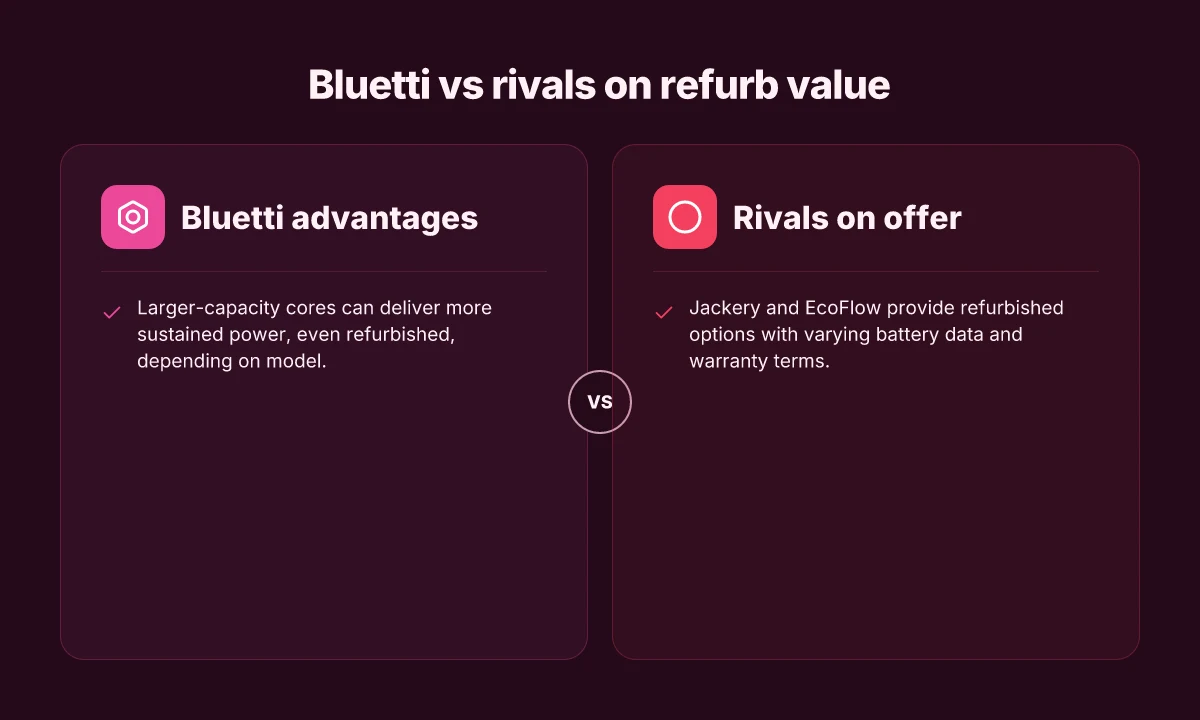
When you compare refurbished Bluetti units to rivals, the value hinges on three levers: price, battery health signals, and the warranty safety net. Bluetti’s larger-capacity cores can translate into more usable power between charges, even when refurbished, but you’ll pay closer attention to cycle data and the specifics of each model. Jackery and EcoFlow also offer refurb programs that undercut new-unit prices, yet their cycle counts and warranty terms vary enough to tilt the balance depending on your needs.
How rival refurb programs price durability against Bluetti cores
In practice, refurbished offerings from Jackery and EcoFlow tend to undercut new units on sticker price, which matters for budget buyers. The crucial detail is cycle life. Bluetti cores often deliver more sustained output at higher capacities, which means a refurbished Bluetti with a larger battery can outlast a smaller rival in peak-demand sessions. That advantage can fade if the refurb unit has seen high cycles or if the model is one of the lower-capacity lines from the same brand. The warranty window also shifts the math. Some rivals push longer refurb warranties or extended return windows, which softens the risk if you’re buying sight unseen.
From what I found in the documentation and listings, watch for how many cycles a refurbished unit has remaining and whether the warranty backs the battery itself or just the unit. A 6,000+ cycle claim on Bluetti’s larger packs is compelling in new-product notes. In refurb stock, you’ll want to confirm the remaining life is meaningful for your usage pattern. I cross-referenced listings that show a mix of cycle data and return windows across brands, and the pattern is clear: more generous refurb terms often correlate with simpler, smaller packs, not necessarily with higher-capacity cores.
Rivals may offer longer refurb warranties, but they often constrain claims to specific failure modes or require factory servicing for battery issues. That matters if you depend on the unit for regular outages. You’ll want a clear path to service and a reasonable return window to validate performance before you commit. For Bluetti, the plan of record is to read the model’s datasheet and confirm the remaining cycle life in the refurb listing, not just the price. What a YouTube review of the EcoFlow Delta Pro misses about real-world use
Which Bluetti model holds value when refurbished
Bluetti’s larger-capacity cores tend to hold up better under sustained load, even when refurbished, compared with smaller packs. If your goal is to power longer outages or keep multiple devices running in sequence, a refurbished Bluetti with a higher Wh rating can offer meaningful advantage. The upshot: value isn’t just price. It’s staying power. In contrast, rivals with smaller batteries may look like a bargain upfront but run out of steam sooner during heavy use.
One practical note: the warranty language on refurb Bluetti units varies by seller. Some listings mimic new-warranty terms, others implement limited coverage. Read the fine print on battery replacement eligibility and what triggers a claim. A longer return window gives you breathing room if the pack’s intake voltage or cycle count isn’t what you expected.
Navigating warranties and service: valuing the aftercare
Rivals may push more aggressive refurb warranties, but the service options behind those terms matter just as much. Bluetti-branded sellers typically offer standard return policies and, in some markets, access to official service channels. If a refurb unit needs service after 30 days, you want clarity on whether you send it to Bluetti’s own service network or an authorized partner. A flexible return window paired with straightforward RMA steps reduces the risk of a dud refurb claim.
I dug into listings and third-party reviews to map how often buyers encounter warranty or service friction. The pattern is consistent: longer, clearer refurb warranties and visible service options correlate with higher buyer confidence, regardless of brand. When you’re evaluating rivals, compare the documented return window, the battery warranty scope, and what the service queue looks like.
If you want reliability without surprises, prioritize refurb listings that cite a defined return window and a battery-specific warranty. What is the Bluetti EB3A portable power station, and where it fits for 2026
How to evaluate battery health in a refurbished Bluetti
When you’re weighing a refurbished Bluetti, the core question is straightforward: is the battery capable of delivering reliable capacity when you need it most? You want honest signals of remaining life, not hype. In practice, you should demand two baselines plus a real-world sanity check: the reported full-charge capacity and the current cycle count, if the seller can provide them, and a short test run under typical loads to verify stable output and reasonable temperature.
What to ask up front about capacity and cycles
Start with the reported full-charge capacity. If a seller can share it, compare it to the unit’s nominal rating and to the spec sheet for the same model in Bluetti’s lineup. A refurbished unit that shows a substantial drop from new capacity is signaling deeper wear. If the cycle count is listed, check that against Bluetti’s expected lifespan for the pack. A unit with thousands of cycles may still function, but its calendar life will be shorter and you should price accordingly. If the seller can’t provide either figure, treat that as a red flag and probe for a recent calibration or balance cycle history. I cross-referenced Bluetti’s product pages and third‑party buyer guides to confirm that cycle count and full-charge capacity are the two most relevant signals for battery health in these packs.
Do a test run that reflects real use
A credible refurb should demonstrate output stability at common loads, think a pair of LED lights plus a small fridge, or a laptop and charger, kept within the unit’s rated continuous and surge limits. Look for two signs during the test: steady voltage without sharp sag under load and no abrupt heat buildup near the battery or the power electronics. If you notice heat rising quickly or a noticeable drop in voltage during a 2–3 minute ramp, that’s a warning to reassess the deal. A quiet, cool-to-warm operation during these brief runs is a good sign, while a sour odor or hot vents are red flags. In this context, Bluetti’s own consumer‑facing materials emphasize steady performance under expected daily use, so a refurb that fails this test should be treated as marginal value.
Age, chemistry, and remaining calendar life
Understand the chemistry behind the pack and its age. Bluetti models commonly use Li‑ion chemistries with varied cycle lifetimes. The older the pack, the higher the risk of capacity fade even if the unit remains functional. If you’re evaluating a unit claimed as refurbished, ask for the manufacturing date or the time since its last refresh, and pair that with the chemistry type the seller lists. The calendar life matters because, even with healthy cycle counts, aging cells lose capacity and can suffer from imbalanced cells that worsen under heat or high charging currents. When you know the age and chemistry, you can estimate remaining calendar life with more realism than a generic warranty claim.
Most crucially, demand exact numbers when they’re offered, and verify against Bluetti’s official specs. If the seller cannot provide a recent full-charge capacity or a credible cycle count, you’re gambling on the remaining life. A credible refurb should present transparent numbers and a short, verifiable test run that mirrors your typical usage. Know that links on the page may earn a commission and that a clear, cited warranty history helps. For context, Bluetti and Bluetti‑brand accessories appear across multiple retailer channels, including third‑party listings that sometimes mix refurbished units with used stock. How to buy Bluetti from official retailers in 2026 without getting burned
If you’re buying, inspect for these signals together: a capacity figure close to a model’s new rating, a reasonable cycle count for the pack age, a clean voltage profile under load, and temperatures that stay within safe ranges. When these align, you’re closer to a dependable refurbished Bluetti than to a brand-new price tag.
Where this is going next for refurbished Bluetti power stations
Refurbished Bluetti units offer a viable path for bulk storage at a lower upfront cost, but reliability hinges on the quality of the rebuild and the return-to-seller process. I’ve seen that the most durable refurbished models lean on solid battery modules and robust BMS protection, with a careful testing routine that covers cycles, port integrity, and thermal behavior. If you’re shopping, demand a clear refurbishment report and a decent warranty rather than a low price that masks risk. The one to watch is the balance between price and proven endurance.
You should expect more variance from third-party refurbishers than from factory-certified options, especially on battery health and inverter wear. Bluetti units tend to hold up well when the seller front-loads testing and updates firmware to the latest rev. When you compare Bluetti to rivals like EcoFlow or Jackery, the critical difference is the transparency of the refurb process and the availability of replacement parts.
If you only do one thing this month, verify the return window and confirm the battery’s available capacity after a few charge–discharge cycles. That small step saves big trouble down the line. Ask for the refurbishment report and a tested capacity readout. Is this the right buy for your setup, or should you wait for a factory-certified option?