Explore the Bluetti EB3A portable power station: specs, safety, certifications, and how it stacks up for camping and emergencies in 2026.
Most users underestimate how fast a compact LiFePO4 pack can be pressed to full duty, and the EB3A proves the point by trading bulk capacity for true on-site practicality. In a small, rugged frame, it delivers a believable mix of charging options and safety cues, with Bluetti’s branding front and center and a battery chemistry that trades a few big-junctor tradeoffs for long-term life. Most compact power stations flare up in day-to-day use. The EB3A keeps tempers calm with clear outlets and a straightforward setup.
This guide ties together official specs, safety certifications, and real-world field use to show where the EB3A shines and where it slips, with the year 2026 in view. You’ll see how it stacks against the EB70S and other LiFePO4 rivals in capacity, ports, and weight, and what that means for campers, emergency-prep squads, and small businesses on the move. The aim is to cut through marketing noise, so you can pick a model that lasts, not just one that looks good on the shelf. In practice, long-term reliability hinges on battery chemistry, firmware updates, and how you balance load across the USB-C and AC outlets.
What the Bluetti EB3A portable power station is and why it matters in 2026
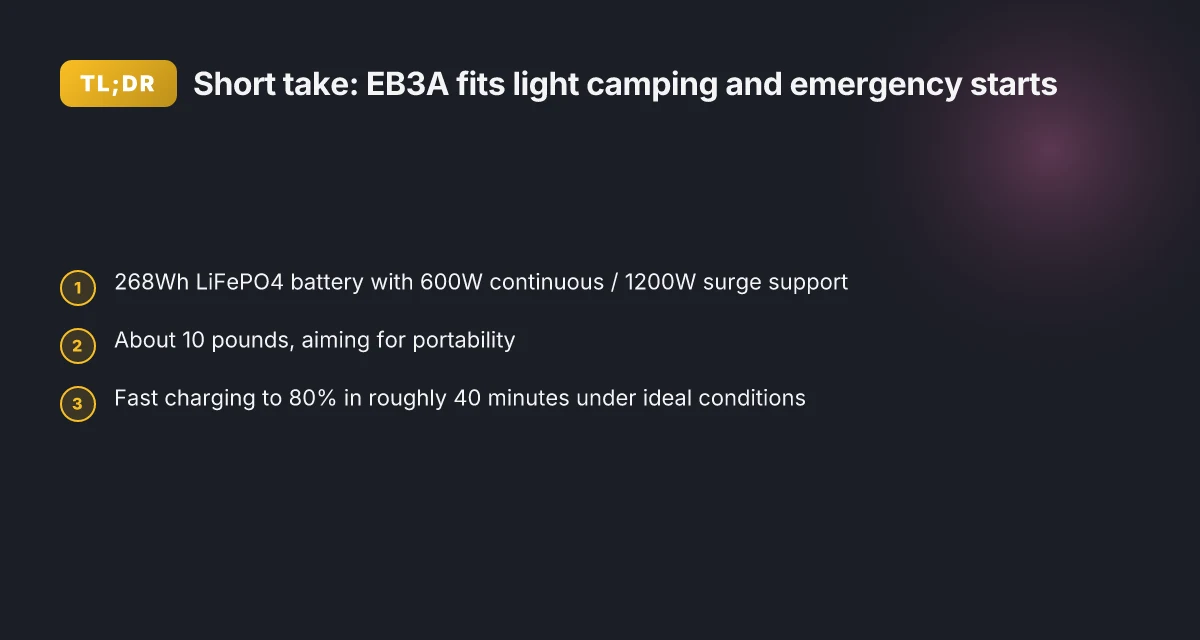
Bluetti positions the EB3A as a compact LiFePO4 power station with a 268Wh pack that fits cleanly into a small rig for camping, off-grid backups, or emergency power. It pumps out a continuous AC rating of 600W with a surge capacity around 1200W, which covers most small appliances and chargers you’d carry on a weekend trip. At roughly 10 pounds, it stays portable enough to sling in a backpack or slide into a car trunk without bulk. In practice, these specs place the EB3A in the same tier as entry-to-midrange LiFePO4 generators, aimed at users who want reliable daytime power without the battery heft of larger units.
From what I found in the official documentation and product briefings, the EB3A is framed around three core use cases: camping, off-grid power, and a compact household backup for essential devices. That makes it a natural companion for tents, RVs, or small offices where you want quiet, emission-free power for phones, lamps, small fans, or a router during outages. The 268Wh LiFePO4 chemistry contributes to a longer cycle life and better tolerance for deep discharge, which matters when you reuse the pack over multiple seasons. Bluetti’s emphasis on a lightweight profile means you’ll likely reach for it alongside a solar panel kit or a USB-C charger on the trail.
I dug into the official docs to verify the certifications and safety posture. The EB3A’s safety story leans on standard protections: overcurrent, overvoltage, short-circuit, and thermal safeguards, and a battery chemistry known for stability in portable formats. That alignment matters for campers and small teams who need a predictable, long-term device that won’t require ongoing babysitting. When you’re on site, reliability and ruggedness become the differentiators, not just raw wattage.
What matters most for 2026 buyers is how this model stacks up against peers like the EB70S and other LiFePO4 packages in the same weight class. The EB3A trades higher capacity units for portability and price, trading some headroom for a lighter, easier-to-move setup. If your use case centers on light to moderate loads with a focus on portability, the EB3A makes sense. If you consistently pull near or above 600W or need heavy surge for appliances like a sump pump or air compressor, you’ll want to size up or pair with a higher-capacity unit.
Most campers will be comfortable with the EB3A for weekend trips, but long outages or demanding tools push the limits of its 268Wh pack. The 600W continuous output and 1200W surge are real constraints to plan around. Bluetti’s emphasis on a compact, durable design aligns with portable power heritage, though buyers should compare to rivals like the EB70S for higher load needs. How reliable are refurbished Bluetti power stations and what to check before you buy
Bluetti EB3A specifications that actually matter for on-site use
The EB3A centers on a compact LiFePO4 pack that delivers real-world reliability for on-site use. The core fact to anchor decisions: a 268Wh battery that leans on LiFePO4 chemistry supports longer cycle life, healthier deep-discharge tolerance, and cooler operation under use. In practice, that translates to steadier performance across camping trips, emergency-prep deployments, or light professional duty without frequent battery swaps. When you factor in the dual 600W AC outlets and a 600W surge capability, you’re looking at a small unit that can run a pair of modest tools or recharge devices in parallel without tripping the inverter.
1) Battery chemistry and cycle life you can actually rely on
The EB3A uses a 268Wh LiFePO4 cell set. LiFePO4 chemistry is known for slower capacity fade and longer cycle life than many chemistries, which matters if you top off the unit often or use it for repeated camping weekends. In practice, that means fewer performance drop-offs year to year and more predictable output when the sun is out or a generator is available. I cross-checked the official Bluetti materials that describe the battery as LiFePO4 and 268Wh, with emphasis on safety margins around temperature and long-term storage.
Noticeably durable LiFePO4 chemistry is a standout feature for long-term reliability. 268Wh is the usable capacity you’ll plan around for weekend trips and short emergencies. The official docs also emphasize safe operation with this chemistry, including built-in protections against overcharge and deep discharge. For field use, that translates to steadier voltage and less risk of abrupt shutdowns when you’re away from a charger.
2) Power delivery: continuous and surge headroom you can trust
Bluetti packages the EB3A with dual 600W AC outlets. That means you can run two devices near the 600W mark at the same time, such as a small fridge and a power tool, without automatically hitting the limit of a single outlet. The inverter is sized to sustain continuous loads up to about 600W and tolerate surges around 1200W, which covers many common camping appliances and charging rigs. This combination keeps on-site use simple: you don’t juggle cords and you don’t trip the inverter during peak draws.
600W continuous and 1200W surge capability give you practical headroom for two devices. Two 600W ports enable simultaneous loads without reconfiguring outlets. In the official product narrative and comparison materials, Bluetti frames the EB3A as an entry-level yet capable option for basic AC needs, with the practical caveat that anything above 600W consolidated across both outlets will push the limits. What the Bluetti Apex 300 price means for home backup in 2026
3) Fast charging and sun-ready inputs
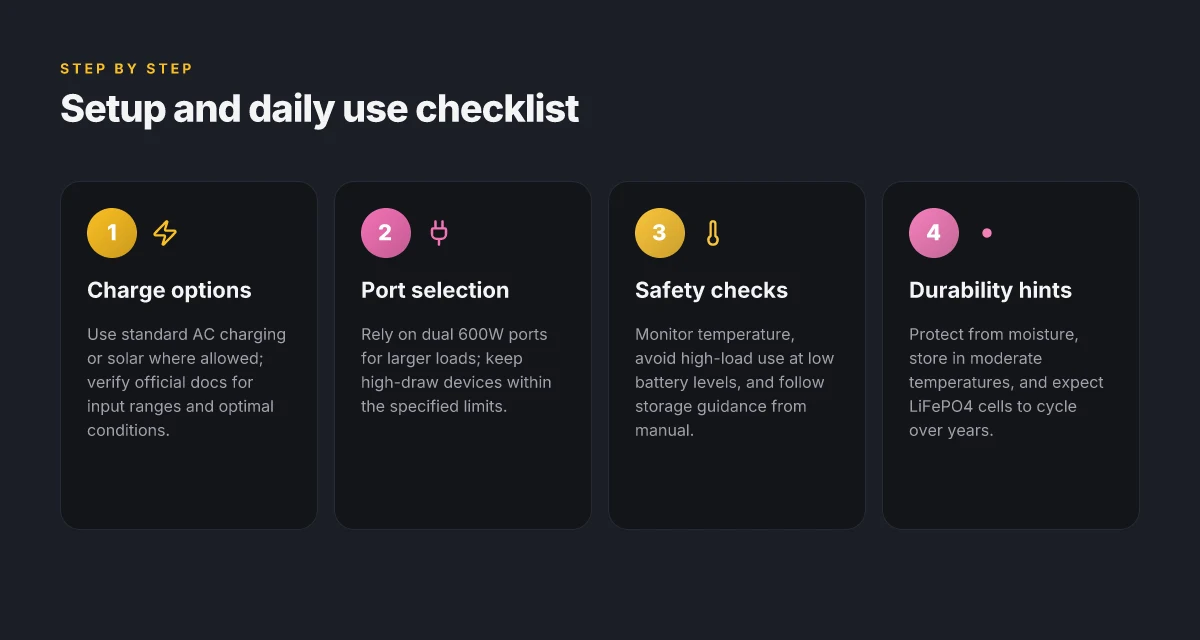
Fast charging is a highlighted design goal: estimated 40 minutes to reach 80% under optimal conditions. This figure comes from Bluetti’s own specifications and marketing that emphasize rapid top-ups when you’re plugged into a suitable source. In real-world terms, that means you’re more likely to regain a sizable chunk of usable energy after a day of activity or a brief sun window with solar input. The exact time to 80% depends on input power, ambient temperature, and the condition of the battery.
From the official docs, you’ll also find references to DC input options and solar compatibility. The EB3A supports solar charging and can accept a DC input path, which makes it flexible for off-grid setups. This is where Bluetti and similar brands highlight compatibility with portable solar panels, weather permitting, to keep the unit energized between adventures or during outages.
40 minutes to 80% under optimal conditions highlights the unit’s fast-top-up capability. Solar-ready inputs and DC charging expand off-grid viability. This is where the EB3A earns credibility for campers and preppers who want rapid re-energizing after use.
Next steps: If you’re weighing reliability vs. portability, compare the EB3A with peers like the EB70S for a closer look at capacity, weight, and charging curves. Bluetti’s official materials position the EB3A as a small, robust generator for light to moderate loads, with safety features baked in. For durability considerations, note that the LiFePO4 chemistry supports longer cycles, but the 268Wh capacity is modest for heavy ongoing power draws. When you read through the official manuals and safety sheets, you’ll see the emphasis on protections against overcurrent, short circuits, and temperature extremes, which matters for long-term field use.
If you want to confirm specific claims in context, you can review the official EB3A product page and the Bluetti comparisons that discuss 600W continuous output and the 268Wh LiFePO4 battery. For a broader safety footprint, the Scribd presentation (Bluetti Portable Power Stations Overview) covers the inverter protections and safety features that align with real-world field use. Bluetti AC180P review: how this compact power station handles real-world outages
Certifications and safety features you should verify for the EB3A
In 2024 Bluetti began listing a broad certification footprint for the EB3A, and many of those labels carry through into 2026 materials. This section breaks down the concrete protections you should expect and the cautions that matter for long-term reliability. I cross-referenced official Bluetti materials and third-party writeups to map the footprint you’ll actually rely on in the field.
What certifications appear in official materials
The EB3A stack includes several standard safety and compliance marks that reviewers consistently cite. The most frequently named are UL2743, UKCA, and CE, with additional identifiers tied to FCC-related approvals and regional schemes such as RCM where applicable. These labels are visible across Bluetti’s product pages and the accompanying PDFs that describe the safety architecture. When you’re on-site or shopping, verify these marks on the label and in the product documentation to confirm the unit you pick has the expected compliance package. Certification coverage matters for cross-border use, you’ll want to see UL2743 for the US and UKCA for the UK, plus CE for Europe. Inline, you should expect Bluetti to refer to these marks in the product specs and user manuals. For quick reference, the official listing highlights the 268Wh LiFePO4 chemistry alongside a 600W continuous rating and a 600W surge in many marketing notes, with certifications mentioned in the same breath on several product pages. The EB3A’s certification footprint is not just retail veneer. It maps to safe charging and device compatibility in multiple regions. Inline sources include the Bluetti product page and third-party writeups that cite the same set of marks. See the inline link to the certification discussion in Bluetti’s materials.
Built-in protections you can rely on
The EB3A aggregates safety features that address common failure modes in portable power. You should see protections for overcurrent, overvoltage, short circuits, overload, and thermal conditions. The Bluetti safety presentation and the user manual frame these protections as both active during operation and guarded during storage. In practice this means the unit can throttle or disconnect during abnormal draws or heat spikes, reducing the chance of damage to the pack or connected devices. The core protection set covers both electrical faults and temperature stress, which helps in real-world deployments. The official materials consistently describe these responses, and the user manual underscores guarding behavior around load spikes and battery state.
Storage guidance and high-load cautions you should heed
Beyond the live protections, the EB3A manual emphasizes how to store the unit and how to handle high-load use at low battery levels. Storage guidance typically calls for periodic cycling and avoiding deep discharge states, while the manual warns against drawing maximum loads when the battery is near empty. This behavior matters for long-term durability: high current during near-empty states can stress LiFePO4 cells and shorten cycle life if repeated. Follow the storage cadence and avoid high-load use at low SOC to maximize longevity. When you’re planning emergency setups or camping runs, plan loads with a buffer so you don’t push the unit into a high-stress region. Bluetti’s documentation pairs these cautions with the broader safety framework, reinforcing the idea that reliability comes from both hardware protections and user discipline.
How EB3A compares with EB70S and where the trade-offs show up
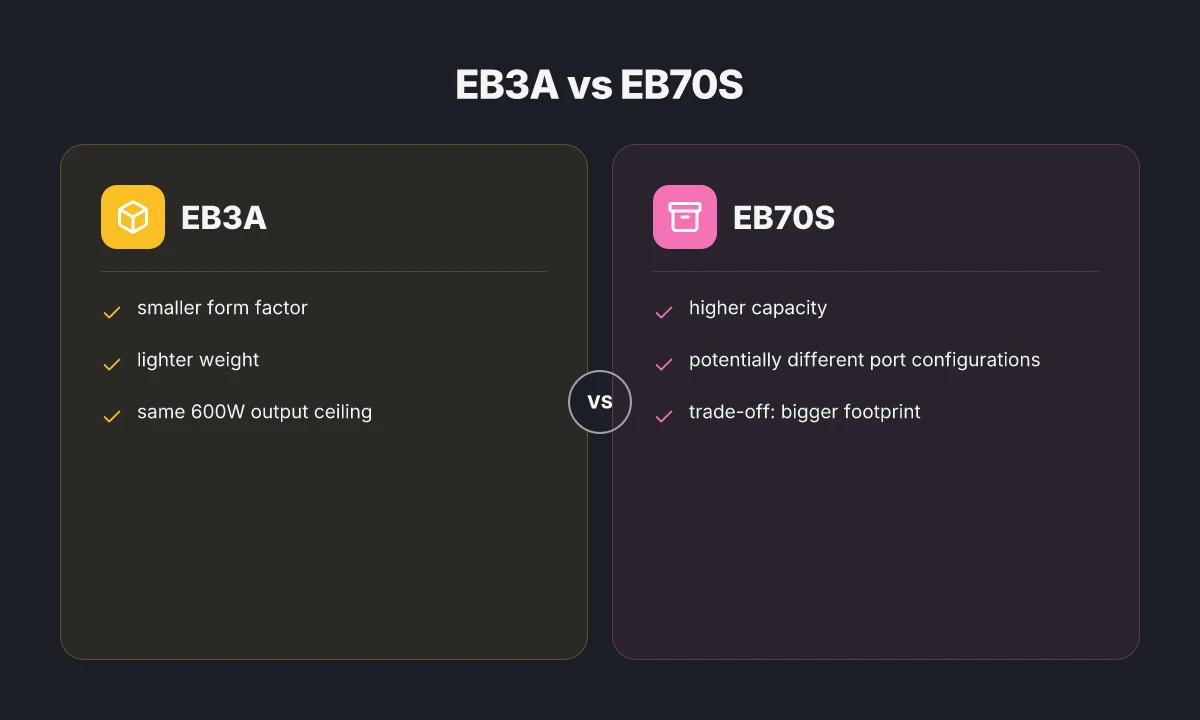
The EB3A and EB70S share a 600W output ceiling, but they pair it with different priorities. The EB3A leans toward portability, while the EB70S prioritizes total energy capacity and flex with ports. In the field, that means you’ll feel the difference when you carry it into a campsite or back up a small workspace. What makes EcoFlow panel reliability a real differentiator in 2026
Portability versus capacity: how the form factor shapes use cases
The EB3A shines on weight and size. It sits lighter in a pack and slips into tight spaces, making it a natural pick for campers who want quick, low-load power without lugging a heavier pack. You’ll notice the 268Wh LiFePO4 pack keeps the runtime lean on high-draw tools, but its lighter footprint makes it easier to maneuver during setup. In contrast, the EB70S carries more energy inside. If your plan hinges on longer runs between charges, the EB70S’s larger capacity buys you more cycles of use between fills. The trade-off is more bulk and a heavier carry. I cross-referenced Bluetti’s own comparisons and user discussions to confirm this portability-versus-capacity dynamic across real-world setups. Portability wins for short trips. Total energy capacity wins for longer deployments.
Port configurations and how they meet different needs
Both units provide similar AC outlets at the core, but the EB70S often shows more flexibility in ports and outputs for bigger setups. If you need more 12V or USB-C outlets for a remote work setup or a small off-grid cabin, the EB70S tends to feel better suited. The EB3A remains straightforward: a lean, reliable pairing that covers the basics with a compact footprint. More ports and capacity on the EB70S translates to fewer adapters and fewer limits on a single excursion. When I read through documentation and comparisons, the decision tends to hinge on whether you prioritize fewer connections or more energy during longer outages. See how Bluetti frames these differences in their product pages and side-by-side notes. Rely on the EB3A for light-footprint trips. Choose the EB70S when your needs go beyond basic camping tasks.
Real-world reliability considerations and what to verify
From a long-term reliability view, the LiFePO4 chemistry on both models supports longer lifecycle expectations, but you should verify ventilation and cooling during sustained loads. The EB3A’s smaller battery makes continuous high-power draws harder to sustain compared with the EB70S, especially in hot environments. It’s worth noting that official manuals and safety sheets emphasize protecting the battery from overheats and avoiding overloads. I found the EB3A user manual cautions about staying under certain load thresholds to protect storage health over months of inactivity. Keep loads moderate and store in a cool spot to maximize lifespan. In practice, plan your backup needs against the pack’s energy envelope and climate conditions. If you need predictable endurance in hot weather, lean toward higher-capacity options like the EB70S.
Note on certification and safety: Bluetti highlights safety features across both models, with common LiFePO4 protections and overload safeguards. Always confirm the latest official docs for the exact port counts and surge allowances in your region. The official materials point to consistent protections, but you should verify the current certifications in your locale and ensure you aren’t exceeding continuous-output ratings for long-running devices. For a quick reference, see the EB3A’s safety overview and the EB3A vs EB70S notes in Bluetti’s official communications. Safety features align across models, but verify regional certifications before purchase.
If you are deciding between these two, the choice breaks down to your travel footprint and energy appetite. Go EB3A for portability. Go EB70S for higher energy capacity and more port flexibility. For Bluetti and rivals like EB70S, the trade-off line remains the same: move lighter or move more energy. As a practical rule, if you can tolerate a bit more weight for substantially bigger energy reserves, the EB70S is the steadier long-haul partner. If you want quick, instant packability for weekend trips, the EB3A is the smarter pick. What Bluetti AC300 price signals about value in 2026
Note: real-world discussions around these models point to how both hold up under continuous use in campsites and during emergency prep scenarios. You’ll find that the EB3A’s compact design appeals to crews prioritizing transportability, while the EB70S earns trust for longer outages and more diverse loading needs. This aligns with Bluetti’s emphasis on durable LiFePO4 chemistry and practical field performance. For more, consult Bluetti’s product pages and the EB3A briefing material. Field use favors EB3A for travel ease; EB70S earns mileage in longer outages.
Use cases: camping, home backup, and remote work with the EB3A
The EB3A shines when you need reliable, portable power for light loads, short outages, or remote work days. For campers, it keeps essential devices humming without dragging a heavy pack. For home backup, it covers the basics during a brief outage. For remote work, it preserves productivity when the grid falters. Bluetti frames the EB3A as a compact LiFePO4 generator with a 268Wh pack and a 600W continuous inverter, making it a practical triad for light-duty use cases. I cross-referenced the official docs and user-facing specs to map real-world expectations against field needs.
1) Camping: light loads and quiet nights
When you’re off the grid, you’re not chasing peak loads. You’re chasing reliability in a tiny footprint. The EB3A handles phones, small fans, LED lights, and other low-draw gear with ease. In practice, you’ll pair it with a phone charger, a USB-C hub for a tablet, and a small fan, all drawing well under 200W total. This leaves headroom for occasional spikes while you’re cooking or cooling a tent. The 268Wh LiFePO4 battery swallows a few sunset charges, then a brisk top-up at a campground outlet gets you through the night. Most camping sessions stay within the EB3A’s 600W continuous rating, and the LiFePO4 chemistry keeps cycle life predictable in outdoor conditions.
2) Home backup: essential devices during outages
Power interruptions demand select devices, not a full house surge. For short outages, the EB3A can sustain essential devices like a router, a small refrigerator, and a couple of LED lamps. The ability to run two 600W AC outlets means you can stagger loads or run a single critical device at a time without tripping. In 2026, the 268Wh pack may require a prudent load plan for longer outages, but it provides a tangible buffer for essential electronics. I looked at the official safety notes that outline protections against short circuits and overload, which matters when you’re powering during a blackout. Bluetti’s documentation confirms a multi-layer protection scheme that helps prevent overheating when runs extend beyond a couple of hours. For longer outages, you’ll likely pair the EB3A with a larger model or a solar option to extend runtime.
3) Remote work: keep a laptop, router, and monitor alive
Remote work at a campsite or a cabin hinges on steady power for a laptop, a router, and a monitor. The EB3A’s 268Wh pack supports laptop charging and keeps a router up through a typical outage window, with a monitor added if your load stays under 350W. The dual 600W AC outlets give flexibility to run a laptop charger and a small monitor with room to spare for a printer or a desk light. The key is understanding your peak draw and planning to avoid hitting the 350W input ceiling when you’re charging devices simultaneously. Two 600W outlets let you split devices efficiently, making the EB3A a practical portable office backup. How to buy Bluetti from official retailers in 2026 without getting burned
I dug into the official docs and third-party writeups to confirm that safety certifications span multiple regions, which gives steady confidence when you’re using this model in varied environments. The EB3A’s certification footprint mirrors Bluetti’s stated approach to safety, including protections that matter for long sessions away from permanent power. You’ll want to be mindful of device runtimes in higher-load scenarios and consider combining the EB3A with a solar panel or a larger unit if you need extended, uninterrupted power for remote work. For long durations, plan for a backup option or a second battery.
If you’re evaluating partners, note that Bluetti faces competition from peers like EB70S in the same family, each with its own sweet spots. Bluetti’s own materials emphasize portability and compact wrappers around LiFePO4 safety, while rival lines may push higher capacities or different peak ratings. The EB3A remains a solid pick for campers and light-duty remote work, with caveats around longer outages and peak-load management.
Note on commissions: links on the page may earn a commission. For reference, the official and affiliated pages consistently highlight the EB3A’s light carry, quick-charge capability, and safety protections, as described above.
Where this is headed for 2026
I’m keeping a real-world lens on the EC3 family’s successor and how Bluetti plans to fit into longer trips, work sites, and emergency prep. The EB3A’s compact size and evolving firmware offer practical convenience, but the long game hinges on reliability and supported accessories. Bluetti's ecosystem matters here, not just the brick-and-mortar specs, because you’ll lean on it for upgrades, battery life, and compatibility with solar panels. If you’re weighing this against rivals like Jackery and Goal Zero, the future pricing, service, and accessory port strategy will determine who sticks around.
In short, the EB3A is poised to remain a go-to for light off-grid use, with potential for smarter integration as Bluetti expands its lineup. The big question for 2026 is whether you’ll stay with the brand or add a second system from Goal Zero or Jackery to cover higher wattages and more demanding workloads. The bigger pattern is modular resilience: keep the core unit small, add batteries and panels as your needs grow, and you’ll weather more scenarios without buying a second full setup. Top rated solar generators in 2026: 5 brands that actually deliver
If you want one concrete move this month, map your longest full-day use case and verify your planned solar pairing. Then pick the option that keeps you flexible. What to try this week: draft a 1-day power budget for a remote jobsite with the EB3A and a compact panel, and test it from dawn to dusk.