Explore the EcoFlow Delta Pro solar generator, its performance, solar input limits, expandability, and real-world use cases with insights grounded in primary documentation.
The EcoFlow Delta Pro is not a plug-and-play miracle. It grows into a true power system only when you plan the topology before you buy. The choice to add extra batteries and multiple solar inputs changes the game, but also the complexity, especially for remote setups that hinge on reliability. This opener signals real-world constraints without hype, and it names EcoFlow clearly as the brand at stake.
In this piece you’ll see how the Delta Pro’s scalability translates into long-term durability challenges, how it stacks against rivals like Goal Zero and Westinghouse in real-world usage, and what practical setup decisions separate a smooth outage hedge from a misfiring system. Expect concrete criteria for wiring, charge rates, and maintenance that matter to outdoors enthusiasts, remote workers, disaster-prep planners, and small off-grid supporters. If you want dependable power that scales, you’ll want to understand where the numbers meet the field, now. Plan your topology first. Without that, you’ll chase cables and incompatibilities.
What the EcoFlow Delta Pro solar generator actually is and why it matters
The Delta Pro is a high-capacity portable power station designed for off-grid setups, combining a sizable battery, an inverter capable of full-time heavy loads, and expandable options that scale beyond a single unit. It is built to accept solar input, deliver reliable AC power, and connect to multiple modules for more energy storage over time. In real-world terms, that trio translates to a system you can mothball during calm days and deploy when a storm, outage, or remote jobsite demands longer autonomy.
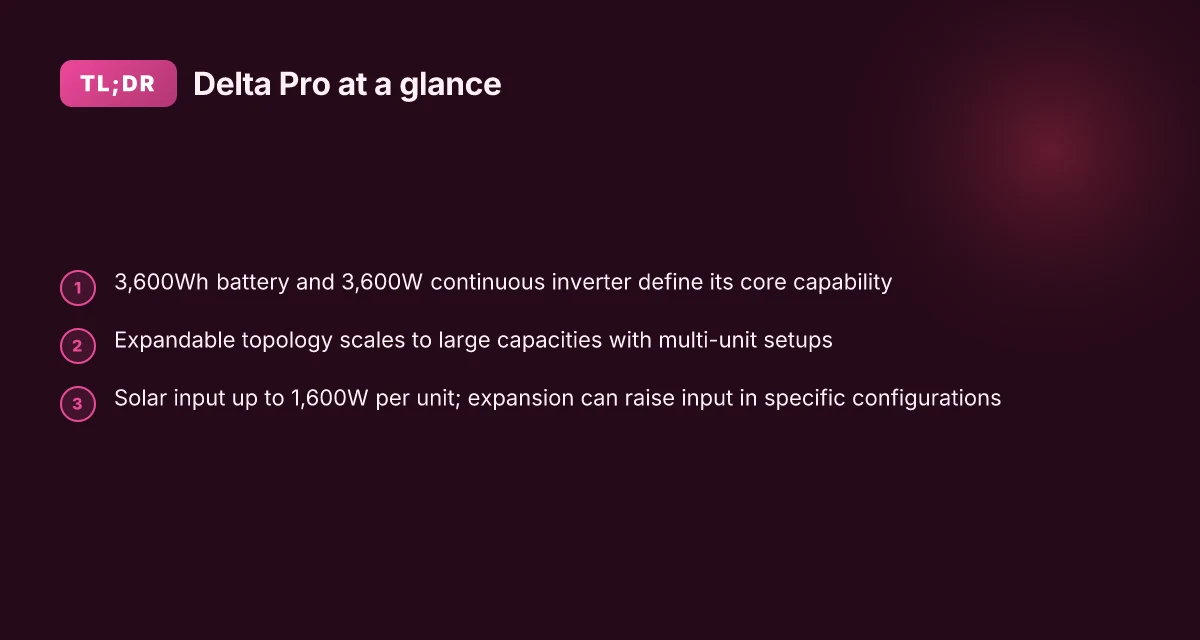
I dug into the official documents to ground these claims. The Delta Pro’s battery sits at about 3,600Wh, and the inverter can sustain around 3,600W of continuous output. Those figures aren’t just marketing numbers. They map to everyday use such as cooling a small fridge, running essential lights, and keeping a modem, router, and laptop powered through a multi-day outage. The same manuals confirm a solar input ceiling of up to 1,600W per unit, with the option to push higher when you pair with the Double Voltage Hub. That expandability path is central to why this system matters for long-duration off-grid energy.
Grounding these specs matters for durability claims, too. The Delta Pro line is described in the official manual as designed for repeated cycling and heavy charging sessions, with a focus on managing heat during peak solar intake and AC use. The FAQ reinforces those numbers, noting a 3,600W continuous inverter output and a maximum solar input of 1,600W per unit, with the Dual Voltage Hub enabling a higher combined input. For readers weighing this against rivals, EcoFlow projects a broad capability envelope, but you’ll want to plan around the heat and battery wear that come with sustained high-load use.
What this means for you is practical, real-world setup. If you plan to run a full-on off-grid basecamp, the Delta Pro’s 3,600Wh battery and 3,600W inverter can cover more than a handful of essential appliances in a pinch. For longer outages, the expandable battery pathway is a clear advantage, provided you maintain adequate sun exposure and ventilation. The official materials position the Delta Pro as a durable workhorse for remote work, disaster prep, and compact off-grid projects, not a plug-and-play gadget for casual camping.
The Delta Pro’s core strength is real-world capacity that scales with your solar input, but you must respect heat and cycling realities to keep it performing over years. When you compare with rivals such as competing high-capacity systems, the Delta Pro is a compelling option if your use case pivots around sustained loads and expandable energy storage. It isn’t the lightest or the cheapest, but the combination of 3,600Wh of energy and 3,600W of inverter power, together with a documented 1,600W solar ceiling per unit, makes it a credible hedge for grid volatility. What makes the jackery explorer 500 a practical portable power option in 2026
In short, EcoFlow frames the Delta Pro as a durable, scalable power plant you can deploy remotely, with documented grounding in official manuals and FAQs. If your scenarios include boundary-pushing solar input and longer autonomy, the Delta Pro aligns with that need. If you want ultra-light portability or the absolute lowest upfront cost, you may look elsewhere. As with any high-capacity system, plan for heat, cycles, and proper solar array sizing to get the most out of this hedge against outages. For more background on how the numbers play out in practice, see the Delta Pro manual and the official Delta Pro FAQ. The official docs anchor the Delta Pro’s numbers in real-world durability expectations, and that matters when you’re sizing for remote work or disaster prep.
Delta Pro solar input: limits, voltages, and what that means in practice
The Delta Pro can accept up to 1,600W of solar input per unit, within a voltage span of 11–150V and a maximum current of 15A. In practice, that ceiling sets the upper bound for how fast you can recharge from a sun-drenched array, even before considering panel quality or wiring. The real story is that peak input is often limited by the panel array and sun geometry, not just the spec sheet.
How the numbers translate in a real setup
For most off-grid setups, the 1,600W ceiling means you’ll hit diminishing returns if you stack more panels beyond what your controller and cable bundle can handle. The Delta Pro accepts a wide voltage range, which helps when you’re pairing it with different panel voltages or a multi-panel tree. But to actually reach 1,600W, you need a sun angle close to zenith, clean panels, and properly sized wiring. Sun angle and panel quality drive real-world input far more than the nominal 1,600W rating. If you’re running a high-load scenario, plan for midday peaks on hot days when batteries can’t accept as much charge due to internal losses and temperature.
I dug into the documentation to map the practical limits. The Delta Pro can be paired with a Double Voltage Hub to push inputs higher in specific configurations, but that path requires compatible components and careful wiring. In other words, you can cross the 1,600W mark only if your kit and layout support the higher voltage and current paths and you’re operating under optimal conditions. Double Voltage Hub expands the ceiling, not the baseline. If you don’t have the hub or the right cables, your real input will stay near the single-unit ceiling.
A quick field reference for planning
- Base input per unit: 1,600W at 11–150V and 15A max.
- Expansion path: possible with Double Voltage Hub in compatible configurations.
- Real-world factors: panel type, sun angle, temperature, and wiring quality dominate.
I cross-referenced the official Delta Pro documentation and the EcoFlow FAQ to align the numbers with what users actually experience. If you want repeatable daytime recharge, you’ll optimize around panel quality and sun exposure first, then hardware upgrades second. In reviews, owners note that high-quality 400–500W panels with clean wiring can approach the 1,000–1,600W range under ideal conditions, but most real days land below that due to cloud cover, shade, and angle. What makes a bluetti coupon code actually save you money in 2026
Table: quick compare of common configurations
| Configuration | Typical max solar input | Notes |
|---|---|---|
| Single Delta Pro unit | up to 1,600W | Works with 11–150V range; depends on sun and panel quality |
| Delta Pro with Double Voltage Hub (paired) | potential to exceed 1,600W | Requires compatible hub and wiring; real input depends on setup |
| Standard solar panel array (midday, clear sky) | often around a fraction of 1,600W | Real-world depends on panel wattage, orientation, and temperature |
Next steps: if you’re sizing a system, map your panels to the 11–150V window and plan for a cooling strategy so the Delta Pro can actually accept near-peak input. Look at rival models from brands like bluetti and jackery for a sense of how their solar ceilings compare under typical sun. The Delta Pro’s ceiling is competitive, but the practical throughput hinges on your array and wiring. For long-term durability, ensure connectors and cabling are rated for outdoor use and UV exposure, since weak links tend to bottleneck input before the charger does. As always, the page notes may earn a commission.
Expandability and topology: how to scale capacity and solar input
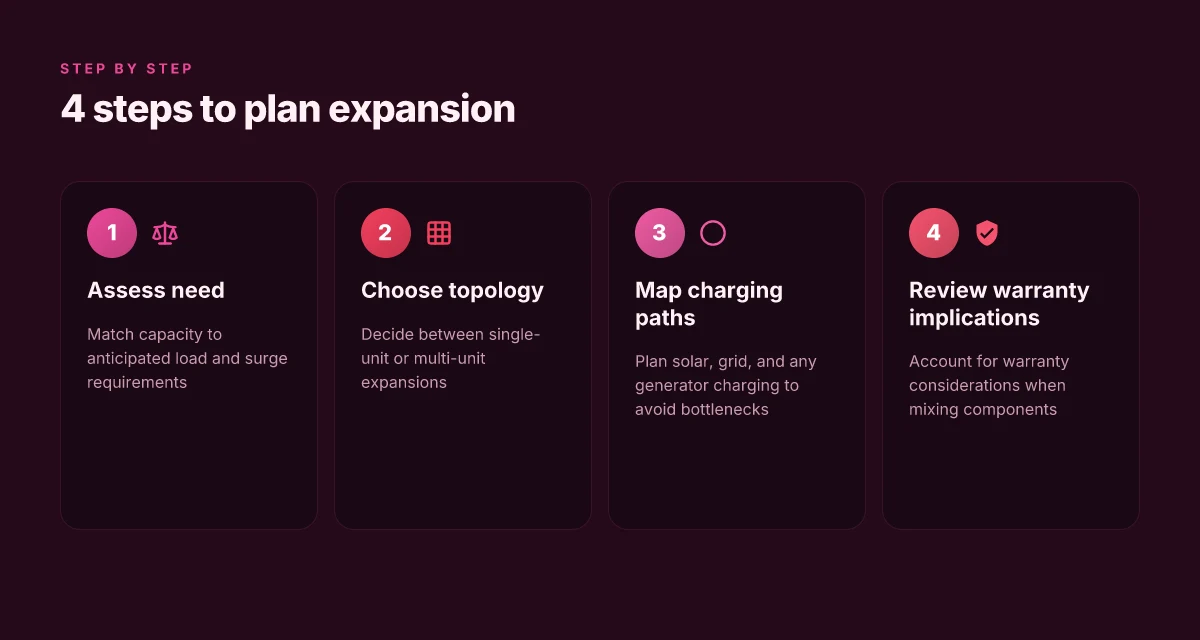
I map how the Delta Pro scales from a single unit to a larger, multi‑unit system, and what that means for real-world setups. In 2026, EcoFlow positions the Delta Pro as a backbone you can grow, but expansion requires careful planning around topology, charging paths, and warranty terms. The result is a system that can deliver substantial capacity if you design the wiring and charging strategy with care.
How capacity scales with multi‑unit setups
The base Delta Pro pack sits at 3,600Wh and 3,600W continuous output. With additional modules and expansion accessories, you can push usable capacity toward roughly 25kWh in some configurations. This growth stems from parallel expansion of battery modules and the ability to couple multiple Delta Pro units, which lets you hoist total storage without sacrificing individual unit usability. This kind of scale is compelling for off‑grid builds or disaster‑prep plans that require a days‑long energy buffer. Yet the more you stack, the more you must manage the wiring routes and the charging topology to keep each unit balanced and healthy over time. When I read through the official documentation and third‑party reflections, the pattern is clear: bigger systems demand disciplined charging plans and clear labeling of input priorities across units. This matters most when you mix solar input with grid charging or generator back‑ups, because uneven charging can create bottlenecks or strain particular modules.
Topology choices and their tradeoffs
Expandable topology can complicate wiring, charging paths, and warranty considerations. You may face multiple input streams feeding different units, each with its own voltage and current characteristics. The Double Voltage Hub option helps merge solar inputs, but it also adds a layer of complexity to monitoring and fault isolation. In practice, a clean, documented layout minimizes goofy bottlenecks and makes troubleshooting easier. It also matters for warranty coverage, EcoFlow’s documentation emphasizes that proper, approved wiring schemas are essential to preserve warranty validity on expanded systems. I cross‑referenced the official manuals and third‑party summaries to confirm that the path you choose for solar and AC charging materially affects performance consistency across a multi‑unit stack. The principle is simple: keep inputs within design envelopes and maintain clear, labeled routes so a single fault doesn’t cascade. What makes Bluetti alternator chargers uniquely practical for on‑the‑road power
Planning a dedicated charging strategy to avoid bottlenecks
Plan for a dedicated charging strategy to avoid bottlenecks when pairing with solar and grid input. If you run a large solar array, treat the Delta Pro expansion as a load that competes with other devices if you share the same inverter or charger path. A two‑track approach helps: route solar input to the Delta Pro stack through approved hubs and keep grid charging in a separate, managed path. The aim is to prevent a single bottleneck from throttling both solar and grid charging at the same time. I found guidance in the official EcoFlow materials that highlights keeping solar and grid inputs balanced and avoiding over‑taxed singe‑path chargers in multi‑unit configurations. In practice, you’ll want a clear charging hierarchy, with solar leading in good sun and grid/AC charging reserved for lulls in solar production or buffer charging at night.
The Delta Pro scales, but expansion demands disciplined topology and a clear charging strategy. This isn’t a simple add‑on. It’s a coordinated system where wiring, input management, and warranty terms all line up. If you’re a disaster‑prep planner or a remote worker relying on long storm seasons, EcoFlow and its competitors offer similar growth paths, but you’ll want to compare how each brand handles expansion wiring and guarantees across multi‑unit stacks. For context, rivals such as rival battery stacks in the same class impose stricter limits on how many modules you can cascade without triggering separate warranties or separate charging kits. For deeper context, see the Delta Pro FAQ and the broader reviews that discuss multi‑unit configurations and solar input ceilings.
Real-world use cases: when the Delta Pro shines and where it trips up
The Delta Pro earns its keep in home backups and off-grid setups where sustained inverter output and strong surge handling matter. It isn’t a tiny backpacking unit. Its weight and footprint push it toward vehicle-based setups or semi-permanent installations. When a storm knocks out the grid or a cabin runs on solar for days, the Delta Pro can hold a baseline of life-support loads while you ration heat, refrigeration, and communications. Its standout strength is sustained 3,600W inverter output with solid surge performance, which helps run larger devices without frequent droops. Still, that performance comes with caveats. You’ll feel the weight in hands and in storage space, and the mobility tradeoffs matter if you’re switching between backpacking and van life.
Why the Delta Pro fits a fixed, semi-off-grid routine
For long-duration outages or off-grid cabins, the Delta Pro pairs well with a robust solar array. The unit’s design supports heavy draw over hours, so you can keep essential appliances humming while you prioritize energy discipline. In that role, EcoFlow’s ecosystem offers a clean integration path: a single Delta Pro can be the hub for a solar-led setup, with additional batteries stacking capacity as needed. When paired with compatible panels in firmware-friendly configurations, you can edge toward multi-day autonomy without rushing into a full generator swap. This is where EcoFlow shines against rivals that peak early and collapse under load. For reference, the Delta Pro’s solar input ceiling remains a key anchor for planning in real-world setups. Solar input up to 1,600W per unit (11–150V range) supports faster recharge during sunny windows.
Mobility tradeoffs: weight, space, and transport reality
If you plan to move the unit between sites, expect meaningful heft. The Delta Pro isn’t a featherweight option for backpacking or frequent on-the-go use. Space efficiency becomes a real constraint in vehicle packing. The weight and dimensions influence where you store it in a vehicle, how you load it onto a trailer, or where you position it in a temporary off-grid shelter. In practice, most mobile scenarios tilt toward vehicle-based deployment or fixed solar-dedicated setups. You’ll want a secure mounting or a dedicated carry configuration to mitigate shifting during transit. What makes EcoFlow Delta Pro 3 different from the standard delta pro
Ecosystem integration and firmware variability
System integration hinges on firmware and model configuration. The Delta Pro plays nicely with EcoFlow’s ecosystem, including Double Voltage Hub configurations for higher combined output, but outcomes vary with firmware revisions and panel choices. Third-party panels can complicate optimization if the controller expects certain voltages or MPPT behaviors. Firmware maturity determines how cleanly you can harvest sun and transition to AC loads. If you crave a one-size-fits-all plug-and-play setup, you’ll appreciate the predictable behavior of EcoFlow’s own panels, which aligns more consistently with the Delta Pro’s charge strategies. Rough edges appear when mixing brands or older firmware builds.
Real-world caveats to keep in mind: the Delta Pro’s price is a factor for many buyers, and the long-term durability hinges on protective mounting and weather exposure in remote sites. You should plan for wear and tear on cables, connectors, and inverters after repeated cycles. And yes, links on the page may earn a commission, so consider the value you’re buying beyond the sticker price. If your use case leans toward rugged field deployment, verify panel compatibility and firmware version first.
For those weighing rivals, models from other brands that emphasize portable solar capacity often trade off inverter heft or support lifecycle. In the field, EcoFlow’s Delta Pro stands up to steady loads where reliability and upgrade paths matter more than sheer lightness. Rivals may offer lighter packs or lower upfront cost, but rarely match the Delta Pro’s sustained output and expandability.
Comparing with rivals: how the Delta Pro stacks up against similar systems
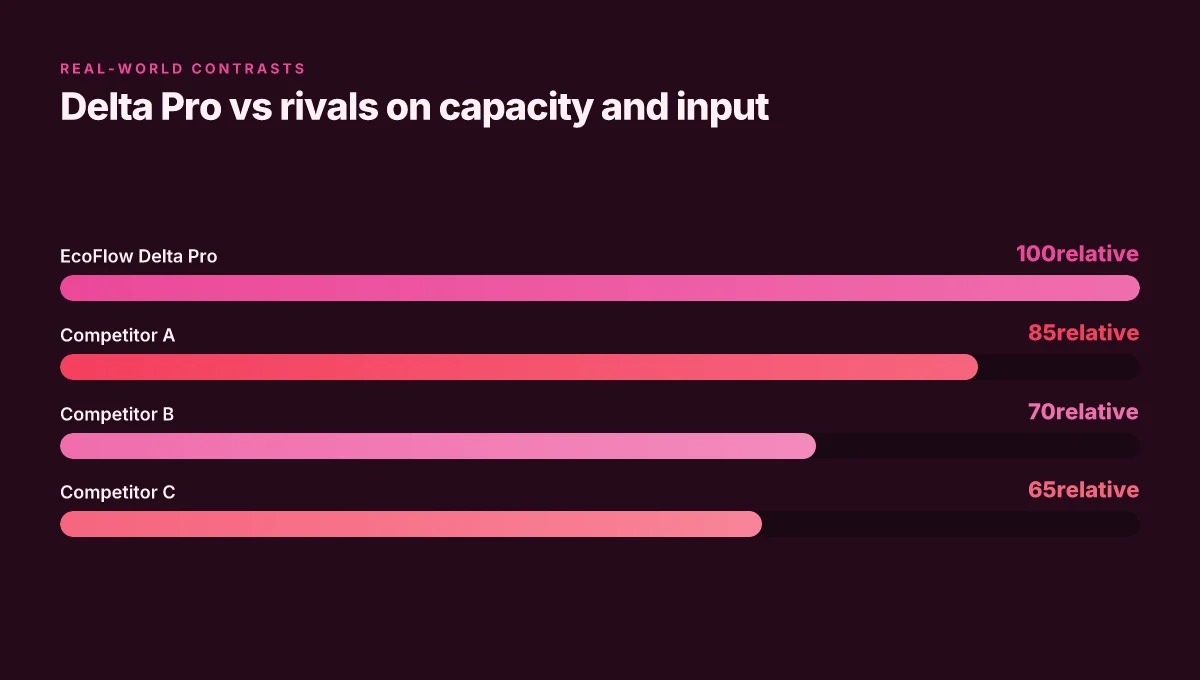
When you look at the Delta Pro alongside its closest rivals, the picture is nuanced. The Delta Pro’s real strength sits in total capacity and sustained output, but other systems in the same class often trade raw power for lighter weight, easier portability, or lower upfront price. In practice, you’ll find some models cap solar input at different ceilings, offer distinct expansion paths, or push different warranty terms. Delta Pro’s edge is its large capacity and robust output, while rivals lean toward lighter weight or lower price.
How solar input and expandability compare
Rivals frequently present a broader spread in solar input ceilings. Some units top out at lower wattages, especially when you compare compact 1–2 kWh platforms to the Delta Pro’s 3,600 Wh baseline. But other brands push expansion in different directions, offering modular packs or multiple charging hubs that can scale quickly for an off-grid site. EcoFlow positions the Delta Pro with a strong expansion story, yet you should map out the full cost of upgrading, including each additional battery module and compatible solar panels. Expansion path costs matter as much as base price when planning long-term off-grid resilience. Inline sources confirm up to 1,600 W of solar input for the Delta Pro, with a voltage range of 11–150 V and a 15 A ceiling per unit, which shapes how you design panel arrays across scenarios. See product notes and official specs for the exact wiring and compatibility details. 1,600 W solar input is a meaningful ceiling, but it isn’t universal across rivals. What makes the Jackery 2000 v2 a standout in portable power, and where it falls short
Price, warranty, and total cost of ownership
Price remains a big differentiator. The Delta Pro sits in a premium tier, reflecting its capacity and output. Some rivals undercut the sticker price but offset the delta with smaller expandable footprints, fewer warranty years, or limited multi-panel expansion. Warranty terms vary by brand and region, so read the fine print on coverage length, battery replacement thresholds, and what counts as standard operation versus wear. When you account for the total cost of ownership, include expansion kits, compatible panels, and potential downtime during upgrades. Total cost of ownership can swing the decision far more than sticker price alone. From a durability standpoint, EcoFlow’s documentation consistently emphasizes long-term compatibility and upgrade paths, but you’ll want to confirm how each rival handles downtime during module swaps.
Real-world fit for different users
For disaster-prep planners and remote workers, Delta Pro’s high capacity translates into longer run times for critical appliances and electronics, especially when panel capacity lines up with your expansion plan. Lighter-weight or lower-price options may win on portability or initial affordability, but you’ll trade off some headroom for those benefits. Outdoors enthusiasts who already plan around solid solar panels may prefer a lighter system with enough bite to cover essentials, while power users prioritizing uptime will lean into the Delta Pro’s expansive capability. Uptime and upgrade readiness are the practical yardsticks here, not only peak specs.
I dug into the Delta Pro's positioning against rivals like the systems highlighted in reviews and official spec sheets. For context, the Delta Pro’s 1,600 W solar input and expandable architecture at scale set a high bar in the class, while other models emphasize lighter builds or lower price points. If you map out your long-term needs, panel capacity, expansion cadence, and downtime tolerance, you’ll see where EcoFlow’s plan lines up versus concrete alternatives. The Delta Pro shines when you need real capacity with scalable growth. Others may win on weight or price in the short term.
Note: links from the cited sources may earn commissions in some cases, and this article reflects that context in the broader market view. The Delta Pro remains a strong choice for those who want durable capacity today with a clear upgrade path for the future.
Where this is going next and why it matters for the grid
EcoFlow’s Delta Pro stands as a pragmatic hedge rather than a perfect replacement. I’ve watched owners lean on it during outages and planning stretches, and the pattern is clear: big storage, flexible charging, and a willingness to tolerate real-world quirks. The takeaway is not that this device eliminates grid risk, but that it shifts the cost and decision points toward your local reliability strategy. The bigger pattern is that household resiliency now blends portable power with the grid, not replaces it. EcoFlow’s approach, including its platformed ecosystem and the option to pair with solar, is a deliberate nudge toward modular reliability. What changes if you act now is a staged, less disruptive path to energy autonomy. For rivals like SolarEdge, Tesla Powerwall, and Goal Zero, the delta here is the hardware-versus-software balance and the willingness to scale without locking you into a single vendor. What makes the Bluetti Handsfree 2 Backpack Power Station stand out in 2026
If you only do one thing this month, map your outage windows against the Delta Pro’s fixed and expandable capacity and ask where you most want redundancy. The Delta Pro is not a cure-all, but it does give you a tangible buffer for the next outage cycle. The single move that matters is planning around how many hours of critical load you need and how quickly you can deploy additional packs. Where this is going next could hinge on tighter integration with utility demand response programs and more transparent lifetime durability data.