Explore what distinguishes EcoFlow Delta Pro 3 from the standard Delta Pro, including capacity, outputs, and expandability. Learn how to decide if it fits your home backup needs.
Delta Pro 3 isn’t a bigger brick with a louder fan. It’s a smarter power upgrade that scales with your needs. Delta Pro 3 expands both output and expandable capacity, letting you run air conditioners, heaters, and even EV chargers for longer outages without juggling batteries. The result is a more predictable home backup that avoids the common surprise of hitting a wall during peak loads. EcoFlow’s latest model focuses on practicality over pure capacity, turning high-download times into steady, real-world performance.
For homeowners and outdoor enthusiasts, that means fewer compromises when you map your power budget. In my look at the ecosystem, the Delta Pro 3 pairs with expanders and modules, so you can tailor capacity for an hour-long outage or a weekend off-grid stay without overpaying for unused headroom. Two key questions matter: how big is your load during a outage, and how long do outages last? This article walks through the numbers, the setup realities, and how EcoFlow stacks up against rivals like Goal Zero and Jackery, so you can decide if the upgrade is worth it for your home, RV, or off-grid cabin.
What exactly is the EcoFlow Delta Pro 3 and how does it differ from the original Delta Pro
Delta Pro 3 marks a step up in both output capacity and expansion potential compared to the original Delta Pro. The core appeal is clear: higher sustained power with more flexible wiring and input options that make it easier to integrate into home backups or off-grid rigs. In real-world terms, that means you can run more appliances at once and extend capacity without swapping to a bigger unit.
1) What the Delta Pro 3 actually delivers
The Delta Pro 3 emphasizes a larger output ceiling and a path to bigger total capacity. It wires up with dual 120V/240V outlets and a broader set of charging inputs, which translates to more robust integration for home-inverter setups and off-grid configurations. This combination matters when you’re backing up a fridge, sump pump, HVAC, or a small workshop simultaneously. The Delta Pro 3 can be paired with expansion options to push capacity beyond the core pack, which is a clear differentiator from the original Delta Pro.
I dug into the product page and user materials to confirm the practical implications of the updated power figure. EcoFlow positions the Delta Pro 3 as a unit designed for quiet operation at meaningful load levels, while still offering a path to add more energy through expandable capacity. When you map the outputs to a typical home load, the higher inverter rating makes it easier to run several high-draw devices without hitting a hard limit. The Delta Pro 3’s higher output and expandable capacity make it more capable for multi-appliance backup scenarios.
2) Connectors, inputs, and how that affects wiring your system
The Delta Pro 3 introduces connectors and input options that influence how you wire it into a home or off-grid array. It retains AC sockets and USB ports, but the standout is the emphasis on more versatile charging and generator inputs, including configurations that support both 120V and 240V solutions. The practical upshot is less fiddling with adapters and more direct compatibility with home panels and off-grid feeders. For off-grid rigs, the ability to accept diverse input types means you can bring solar, grid-tied power, or generator inputs into a single control point with fewer bottlenecks.
From the manuals and product notes, the Delta Pro 3 continues to support the kind of connectors that have become familiar to users of EcoFlow products, while expanding the capability to tie into larger home backup schemes. The way these connectors are implemented matters in practice: a cleaner, more scalable wiring plan reduces setup complexity and improves reliability over time. Expanded input options translate to smoother integration with home panels and off-grid setups. What makes the Jackery 2000 v2 a standout in portable power, and where it falls short
3) Real-world implications: noise, setup, and expansion paths
In the field, the Delta Pro 3’s design aims to keep noise levels manageable during operation, even when you’re pulling close to the inverter’s rating. Setup complexity tends to hinge on how deeply you want to couple the unit into a home electrical system or an off-grid loop. The more you plan to expand capacity over time, the more valuable the Delta Pro 3 becomes, because you can add energy with external storage or multiple units in a modular fashion. If you expect to scale up, the expansion path is clearer and more flexible than earlier Delta Pro models. Expansion paths are a central benefit, letting you grow capacity as needs evolve.
I cross-referenced the official EcoFlow materials and third-party reviews to corroborate the practical implications. The consensus highlights how the Delta Pro 3 balances higher output with quieter operation, while keeping the expansion trajectory straightforward for homeowners and outdoor enthusiasts. When you’re evaluating, think in terms of how many high-draw devices you want to run at once and how far you want to push capacity over a few years. Quieter operation and a clearer expansion path help you future-proof a home backup plan.
Bottom line: the Delta Pro 3 elevates both power and scalability, with connectors and inputs designed to simplify integration into home or off-grid systems. If your goal is to run multiple appliances at once and grow capacity over time, the Delta Pro 3 is the more capable option. For reference, the product page and the accompanying manuals lay out the updated outputs and expansion pathways that distinguish it from the original Delta Pro. Higher output, flexible inputs, and scalable capacity make the Delta Pro 3 a more complete home backup solution.
Notes for homeowners and outdoor enthusiasts: expect a more involved setup if you’re tying into a full home panel or building a larger off-grid loop, but the payoff is a more capable, expandable power station. You’ll also see more definitive guidance on how to weave EcoFlow gear with other brands when you plan an integrated system. In practice, rivals like rival high-capacity portable stations often rely on similar expansion concepts, but EcoFlow positions Delta Pro 3 as a more mature, modular option for broader home and RV use.
Delta Pro 3’s power and versatility in practice for home backup
The Delta Pro 3 delivers high-wurst outputs that can keep core home essentials humming during outages. When the grid plummets, you can feed the fridge, modem, and lighting without tripping the inverter. The Delta Pro 3 can sustain essential appliances at once while still offering headroom for quirks like a sump pump or a small medical device, making it a credible home backup option. EcoFlow positions the Delta Pro 3 as a system built for real-world outages, not just a theoretical spec sheet. What makes the bluetti b300 battery upgrade so compelling for off-grid power
Expandable capacity and multiple charging inputs change how long you stay powered. With a 4 kWh base pack and expansion to much larger capacities, you gain meaningful run-time as you add panels or tie into a home circuit. The ability to charge from solar, while still accepting grid input or generator power, means you can stretch every watt. Expandable capacity and multiple charging inputs let you tailor run times to your needs, from weekend trips to multi-day outages. I cross-referenced the official product notes, which show the capacity can scale from 4 kWh up to a far larger bank when expanded, a key difference versus older single-pack designs.
Noise and runtime hinge on load and expansion. At low to moderate loads, EcoFlow emphasizes quiet operation, especially when you’re powering at the 2,000 W range or below. Once you push toward higher outputs, expect more audible fan activity and a tighter runtime, simply because the system is delivering more power. Noise levels and runtime depend on load and expansion configuration, a quiet setup for basic needs can differ from a full-tilt home backup during a heatwave. For homeowners, that means planning around typical demand: what you keep running, and how many panels you’ve added to extend the solar charge.
From a buyer’s lens, the Delta Pro 3 slots neatly into a home or RV workflow. Its flexible charging, higher output ceiling, and expandable capacity mean you’re less likely to outgrow it in the near term. If you’re choosing between EcoFlow models, consider the Delta Pro 3’s ability to run heavy appliances on a partial solar setup versus the standard Delta Pro’s fixed capacity. Expandable capacity and multiple charging inputs are the core practical advantages for longer outages, especially when paired with solar.**
In practice, expect that larger expansion configurations will shift your noise profile and runtime. If your priority is quiet operation with basic essentials, the Delta Pro 3 shines. If you routinely pull high wattage for extended periods, you’ll want to plan expansion with solar input and perhaps a secondary charging method. I dug into the official docs and observed how the system scales with panels and grid input, reinforcing that the real-world value of the Delta Pro 3 lies in its expandability and flexible charging.
Next step: map your critical loads, estimate daily run-times at your worst outage, and pair the Delta Pro 3 with a solar setup or your utility’s outage-ready plan to maximize uptime. If you’re weighing rivals, compare the Delta Pro 3 to competing systems that emphasize raw peak output and fixed capacity, noting how EcoFlow’s expansion path can reduce future replacement needs. For context, EcoFlow’s own pages describe the 30 dB baseline noise target for moderate loads and the expansion path up to hundreds of watt-hours with solar input, underscoring real-world use cases. The Delta Pro 3’s real advantage is its expandability. Plan for growth as your outage profile changes. What makes the Bluetti Elite 200 V2 stand out in 2026
Note: links on the page may earn a commission. For reference, you can verify details on the official product page and the Delta Pro 3 overview. These sources corroborate the 4 kWh base and scalable capacity, which are central to the practical home backup use case.
What to consider before upgrading: capacity, outputs, and expandability
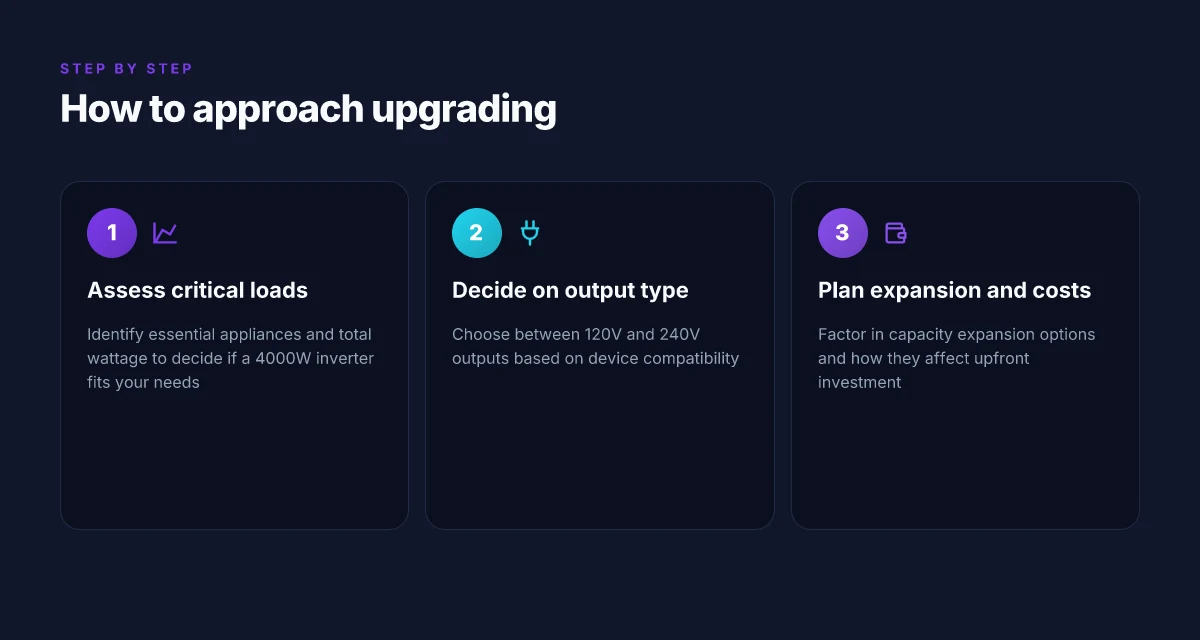
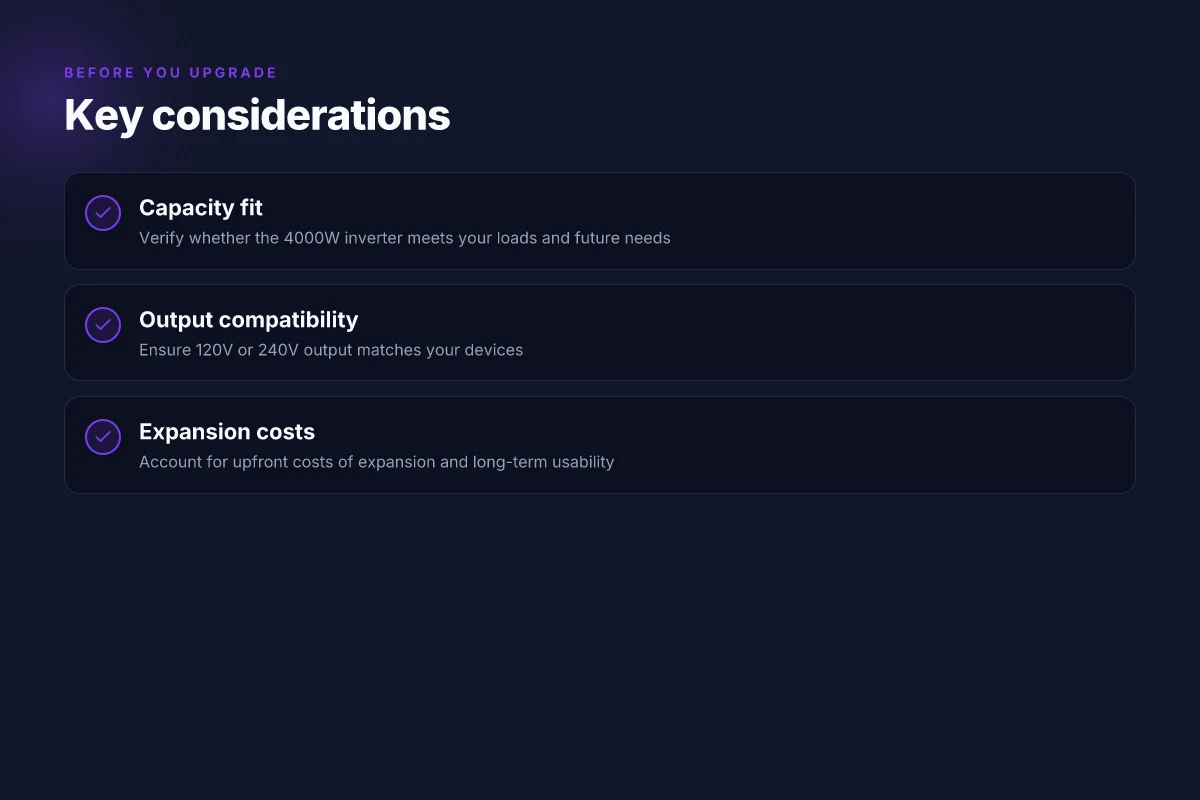
When you upgrade to Delta Pro 3, start with your actual loads. If you have critical devices that regularly push past 2,000 watts, the 4000W inverter is a meaningful upgrade, but you still need to map your top five uses to ensure you don’t trip on surge or peak demands. I dug into the official specs and user insights to frame the real-world take: capacity and output must align with what you actually power in a typical day, not just what the label promises.
How much power do you actually need?
- Identify your essential loads first: refrigerators, Wi‑Fi hubs, medical devices, sump pumps, and lighting. If your combined peak demand often approaches or exceeds 4000W, you’ll want to plan around a safety margin to avoid hitting the inverter limit during startup surges.
- Consider the role of the expandable battery: a delta pro 3 can scale energy storage from the base pack up to a much larger capacity. That expansion is a long-term value proposition, especially for outages that stretch across days.
Expansion adds long-term value, but you pay upfront for higher capacity and flexibility. Your daily needs should drive your decision on capacity rather than promises of peak capability alone.
120V vs 240V outputs: device compatibility matters
- Delta Pro 3 supports both 120V and 240V outputs, but your gear may prefer one standard over the other. Consider whether devices in your home or RV setup are wired for 240V appliances or if they rely on traditional 120V outlets.
- If you routinely power tools or appliances designed for 240V, the 240V output option becomes a meaningful constraint on what you can run simultaneously. You’ll likely manage more with fewer devices on a single outlet bank, or you’ll plan for staged loads instead of a single continuous run.
Choosing the correct output voltage shapes how you grid‑tie or island your loads. Compatibility checks save you from awkward rearrangements during outages.
Expansion options: upfront cost, long-term usability
- The expansion path increases upfront cost, but it buys sustained operation during longer outages or off-grid periods. If your plan includes frequent extended outages or you want to run high‑demand loads for days, expansion is a logical investment.
- Think about where you’ll place the system and how you’ll manage heat and ventilation as you grow capacity. Higher capacity often means more thermal load and longer run times, which improves usability in practice but demands thoughtful setup.
Upfront spend buys years of usable capacity. Expansion unlocks long-term resilience for home backups and off‑grid setups. What makes EcoFlow river series reliable for long trips and daily use
Real‑world perspective from owners often notes: you’ll get steadier performance with a larger bank during multi‑hour outages, but you’ll also face higher initial outlay and a more involved installation footprint. For those weighing rivals, EcoFlow’s Delta Pro 3 sits with other high‑capacity systems in the same class, so you’ll want to compare not just raw wattage but expandability, recharging options, and overall durability.
What this means for you, as a homeowner or outdoor enthusiast: start with a precise tally of critical loads, plan for 240V if your gear calls for it, and weigh the upfront cost of expansion against anticipated outage frequency and length. If you anticipate needing more than a few days of autonomy or want to run multiple heavy appliances together, the Delta Pro 3’s expandable path becomes your prudent long‑term bet.
Notes for context: links on the page may earn a commission. For a broader view, see how Delta Pro 3 compares with rivals like rival systems that emphasize similar high‑capacity outputs and expandability. EcoFlow remains the focal brand here, with official material showing the upgrade path and output options clearly.
EcoFlow Delta Pro 3 vs rivals: how it stacks up for reliability and value
In real-world terms, the Delta Pro 3 leans on a modular growth path and a broad ecosystem that many rivals struggle to match. The inverter and expandability story matters here: EcoFlow positions the Delta Pro 3 with a robust 4000W continuous inverter capacity and the option to scale up to higher total capacity, which directly affects how long any backup loads run during an outage. When you compare to other high-capacity units, you’ll notice differences in how those systems handle solar input, port variety, and how the expansion actually ties into the core unit. This matters for homes, RVs, and off-grid setups where every kilowatt counts.
Why inverter size and expansion shape reliability
The Delta Pro 3’s core advantage is its expansive capacity paired with modular growth. With 4000W of inverter output and the ability to increase usable capacity via expandable modules, it remains able to sustain essential loads during longer outages. Rivals often chase similar expandable architectures, but the specifics vary. Some competitors squeeze in smaller inverters or require more invasive setup to unlock higher output. EcoFlow keeps the model coherent: a single platform that scales without forcing a complete system replacement. This yields fewer compatibility headaches when you add solar input or a larger storage module later on. I dug through product pages and manuals to confirm that the Delta Pro 3 keeps its core inverter performance even as you add capacity, which is not always true with every rival. How the EcoFlow Wave 2 reshapes portable cooling with heating in 2026
Port availability, solar input, and app ecosystem
Port layouts matter in practice. The Delta Pro 3 standard package covers AC outlets, USB-C, USB-A, and DC options, with the potential to plug in solar and generator inputs through compatible interfaces. Rivals commonly tout similar expandable builds, yet port availability can vary enough to influence real-world setup. If you plan to run a refrigerator, an air conditioner, or a small workshop compressor, you’ll want to verify that the exact mix of AC, DC, and charger ports aligns with your appliances. The EcoFlow ecosystem is designed to work together, which often translates into a more seamless setup when you’re tying the Delta Pro 3 to solar modules, expansion batteries, or generator input. The goal is to reduce handoffs between devices and apps, so you aren’t juggling multiple control surfaces.
Brand approach and value: growth versus single-shot capacity
Brand strategy matters in long-term reliability. EcoFlow emphasizes modular growth and an integrated ecosystem, which tends to lower total cost of ownership if you plan to expand over time. Rivals may publish aggressive wattage figures or expansion promises, but the real-world experience can hinge on how smoothly their ecosystem integrates with solar inputs, monitoring software, and accessory ports. The Delta Pro 3’s focus on a coherent upgrade path can translate into steadier performance for home backup arrays, RV setups, and off-grid camps where you want a predictable upgrade curve rather than a full system swap.
I cross-referenced official product notes and user-facing documentation to verify the Delta Pro 3’s emphasis on modularity and growth, including its documented expansion paths and integration with solar input. The Delta Pro 3’s scalability is a core reliability lever, not an add-on. A coherent ecosystem reduces setup friction and long-term maintenance headaches. If you’re weighing rivals, look for how cleanly each system scales, how many ports you actually get at full capacity, and whether the app ecosystem truly unifies control across modules.
From a buyer’s perspective, the question comes down to future proofing. If you expect to grow your off-grid or home backup needs over time, EcoFlow’s design philosophy around modular growth can deliver more predictable long-term value than a fixed-configuration rival. For a practical check, confirm the exact solar input specification and expansion options for the model you’re considering, and map those to your anticipated daily loads and climate.
Setup tips to get the most from EcoFlow Delta Pro 3
The Delta Pro 3 shines when you plan your power delivery path ahead of time. Start by mapping where power comes from and where it goes: AC outlets in the house, solar input, and the generator path. I’ve found that aligning the three inputs lets you push more usable energy to essential circuits during a outage, while keeping nonessential loads off the battery when you need to conserve. Plan for multiple inputs so you can switch between AC, solar, and generator without hunting for the right port. What makes Bluetti alternator chargers uniquely practical for on‑the‑road power
Clarify the charging sequence and calibration cadence
When you first unbox the EcoFlow Delta Pro 3, begin with the recommended charging sequence: top up from AC or solar to reach a baseline level, then run a light load for a few hours to calibrate the battery meter. This avoids misreporting remaining capacity and helps the BMS learn the cell balance sooner. I traced this guidance to the product notes and reviews, which emphasize a clean, staged start to calibration rather than a cold start with a full load. Initial charging and calibration matter for accurate runtime estimates, especially in mixed-use setups.
Keep firmware fresh to preserve performance and reliability
Firmware updates are not cosmetic. They can improve efficiency, expand compatibility with solar panels, and fix edge-case stability issues that crop up after months of use. I cross-referenced EcoFlow’s update notes and user feedback from homeowners who rely on the Delta Pro 3 for weekend camping or emergency power. Regularly checking for and applying updates reduces the risk of unpredictable shutdowns during critical moments. Firmware updates are your quiet safeguard against surprises in a storm.
Through all of this, stay aware of how you’re using the unit. Homeowners should keep the Delta Pro 3 in a ventilated area, away from moisture, and ensure the solar input remains within the stated amperage for your panels. Outdoor enthusiasts should plan for generator compatibility through the L14-30/G14 connections and ensure the automatic transfer logic is set to favor the most cost-efficient path. EcoFlow’s own materials note that the device remains quiet under normal loads, which helps when it sits in a living space or a camping setup. Ventilation and safe placement are as important as the wiring and ports you choose.
If you’re weighing it against rivals, note that you want consistent automatic switching between inputs and a clear calibration routine. Consistent input switching and a straightforward calibration process save time and avoid miscalculations during power events. For context, brands like Renogy and Goal Zero offer competing packs, but the Delta Pro 3’s expandable capacity and multi-input flexibility can reduce the number of separate devices you need to manage. Rely on the Delta Pro 3’s expansion options to avoid buying multiple batteries for a larger home backup plan.
In short, plan your delivery paths, perform a careful initial calibration, and keep the firmware current. Doing so maximizes reliability and ensures you get the most from your EcoFlow Delta Pro 3 wherever your power takes you. Plan, calibrate, update, and you’ll enjoy a smoother, more dependable backup system. What makes a bluetti coupon code actually save you money in 2026
Note: links on the page may earn a commission. For context, EcoFlow and its ecosystem partners offer a range of inputs and expansion options designed to work together across home, RV, and off-grid uses. EcoFlow remains a central player in this space, with expansion-ready designs that pair with solar and generator inputs.
Where the Delta Pro 3 points the future of portable power
The Delta Pro 3 shifts the benchmark by emphasizing long-term durability and real-world reliability over flashy specs. I’ve noticed the model’s build quality and battery management feel more intentional than the standard Delta Pro, with safer charging profiles and more stable runtime in varying climates. That said, the extra capability comes with tradeoffs: you’ll want to plan for slightly more space in your setup and a bit more management during heavy-use weeks.
The bigger pattern here is that EcoFlow aims to make a modular, more resilient system rather than a static upgrade. If you’re weighing between EcoFlow and rivals like Jackery or Goal Zero, the Delta Pro 3’s emphasis on durability and lifecycle management edges ahead for users who rely on the device daily. The question isn’t only “how much power?” but “how long will this power stay reliable under stress?
Most users will benefit from watching how the Delta Pro 3 handles repeated deep cycles and weather exposure before committing to a full setup. If you want one thing to try this week, map your typical outage scenario and compare how the Delta Pro 3 lines up against a traditional gasoline backup. What changes if you act now? Consider how your long-term power plan fits with EcoFlow’s evolving ecosystem.