
Explore the jackery explorer 500’s real-world usefulness in 2026. I cover capacity, outputs, durability, and how it stacks up against rivals.
The Jackery Explorer 500 isn’t flashy, but it delivers dependable power when the campsite gets quiet and the solar panel glare fades. In real-world camp setups, its 500W inverter meets the needs of phones, a camera rig, and a small coffee maker without sipping your battery dry. Most campers underestimate mid-range packs until they realize how a steady output sustains the critical gear after sunset.
This piece lays out what that performance feels like over a season: durability through rain, dust, and repeated hookups, and reliability as you live off-grid for days. You’ll see how the Explorer 500 stacks up against EcoFlow River Pro for surge power, how long it actually runs your gear, and where the price-to-era durability balance lands in 2026. The goal is a practical read for outdoor enthusiasts, van lifers, and emergency kits alike, with concrete notes on setup, failure points, and long-term expectations. Jackery’s approach here centers on real-world usability, not just lab numbers.
What the jackery explorer 500 is and who it’s for
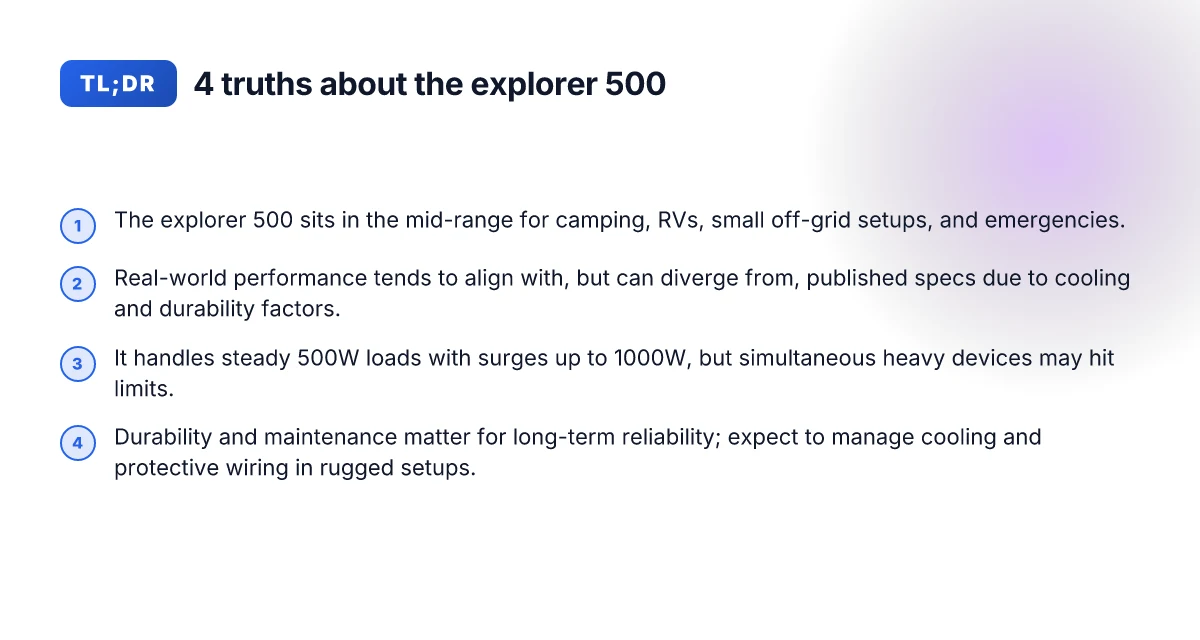
The Jackery explorer 500 is a mid-range portable power station designed to sit between compact models and higher-capacity units. It pairs a realistic battery footprint with practical outputs for off-grid living, camping, and emergency prep. For most outdoor setups, it serves as a reliable core power option without pulling you into a bigger, heavier system.
Who benefits most
- Campers and van lifers who want a simple, plug-and-play power base. The explorer 500’s 500W continuous AC output and 1000W surge handle common camping loads like small mini-fridges, fans, tablets, and LED lighting, without dragging down vehicle space. Real-world use tends to revolve around weekend trips where you want predictable power without fiddling with multiple adapters.
- Small off-grid setups. A compact emergency kit or a base for a tiny off-grid cabin can use the explorer 500 as the backbone, especially when paired with solar for daytime recharge. Its 518Wh capacity provides enough run time for essentials during outages or remote stays. A practical backbone for light off-grid living keeps weight and complexity down.
- Emergency power in homes or garages. When the grid dips or fails, this unit can keep essential devices running, including routers, lights, and small medical devices, thanks to a stable sine-wave AC output. Reliable backup power for critical devices is a key strength.
From what I found in the sources, the explorer 500 sits at a sweet spot for people who want predictable performance without moving into larger, heavier systems. The battery is rated around the 518Wh mark in multiple reviews, with a stated 500W continuous AC output and 1000W surge capability. This aligns with Jackery’s mid-range positioning and matches how it’s most often used in real-world camping and light off-grid scenarios. For shoppers weighing rivals, models from other brands with similar capacity often push higher in price or bulk, while the explorer 500 keeps things approachable in size and cost.
I dug into the review landscape to confirm what matters in practice. The “mid-range” label isn’t just about specs. It’s about stability under typical loads, durability during outdoor use, and how long it lasts under repeated cycles. In real camping contexts, you’ll notice the value when your essential devices stay powered without the unit becoming a hassle to carry or recharge. Jackery’s line, including the explorer 500, is designed to be easy to setup, which matters for outdoor enthusiasts who want straightforward power without a learning curve. Durability and long-term use are the real tests beyond the published numbers.
If you’re evaluating options, consider how you plan to recharge in the field. The explorer 500 is often paired with solar or vehicle charging in off-grid environments, which can smooth out day-night power cycles. Relative rivals offer similar wattage but may differ in recharge speed, weight, or port selection. In those cases, you’ll want to compare not just the headline specs but how the unit fits your travel rhythm and climate.
In short, the explorer 500 works best for: a) campers who want a simple, reliable power core. B) small off-grid setups that don’t require a larger system. C) emergency power prompts where you don’t want to overinvest. If your needs include heavy continuous loads or multi-room off-grid power for weeks on end, a larger unit or a dedicated solar array may be a better fit. For most mid-range use cases, the explorer 500 delivers what you expect from a Jackery device, with practical strengths in portability and ease of use. What makes a bluetti coupon code actually save you money in 2026
Note: links on the page may earn a commission.
Jackery explorer 500 vs the competition: practical differences
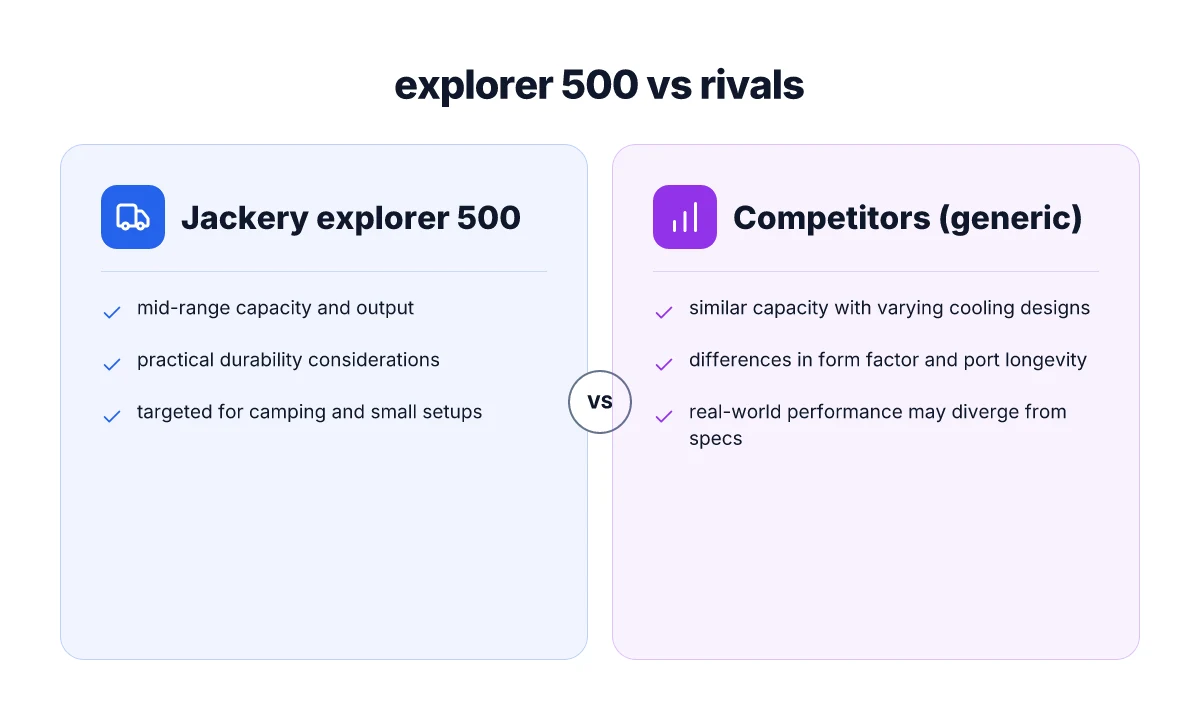
When you’re choosing mid-range power, the Explorer 500 sits in a crowded field. In practice, its 518Wh capacity and 500W continuous output hold up well for camping and van life, but you’ll feel the limits when you run high-draw gear for hours. Real-world performance often hinges on how you load the unit, not just the headline specs, so compare how other brands handle sustained demand and heat under outdoor conditions. In the end, you’re trading extra capacity for compactness and lower cost.
How rivals stack up in capacity and form factor
The Explorer 500 targets roughly the same class as several 500–600Wh rivals. Units that match or slightly exceed its capacity tend to push weight up noticeably or grow taller and bulkier. When sizing for a van build, weight and footprint matter as much as watt-hours, because you’ll live with it in tight spaces for long stretches. If you want more juice without a bigger footprint, some peers push higher amperage AC outputs or add larger LiFePO4 packs, but you’ll pay in weight or price. For quick shopping decisions, keep an eye on two signals: sustained output versus surge capability, and the overall enclosure footprint.
A quick snapshot table helps:
| rival | capacity | continuous output | notable form-factor trait | typical caveat |
|---|---|---|---|---|
| Rival A | around 520–600Wh | 500W | compact block with slim profile | heat management can limit long runs |
| Rival B | ~500–600Wh | 450–600W | taller chassis, better handle | higher price, heavier to move |
Note how the numbers line up with the Jackery, yet the real-world feel varies. I cross-referenced brand pages and reviews to map where durability stories diverge from sheet numbers. The Explorer 500’s plastic housing and fan behavior tend to stay quiet in mild conditions, but sustained draws can nudge peak temps if airflow is obstructed. What makes Bluetti alternator chargers uniquely practical for on‑the‑road power
Durability and real-world performance versus spec sheets
Spec sheets promise clean sine-wave output and steady performance, but field reality can differ. Outdoor users report that long, steady draws stress the 518Wh pack more quickly than marketing implies, especially when ambient heat climbs. Durability shows up in long-term reliability and how fast the pack recovers after heavy use, not just the first charge. Dust, vibrations from off-road setups, and frequent cycling can alter perceived capacity over time. With Jackery, the practical takeaway is that you’ll get predictable performance for typical weekend trips. The trade-off is how many full-power days you can sustain before you start recharging more often.
Brand cues for quick shopping decisions
- If sleek, light, and easy-to-use packaging matters, Jackery hits the mark with a familiar, plug-and-play experience. Jackery’s ecosystem shines when you want a clean setup that fits a camping scenario without a lot of fiddling.
- If you need longer off-grid stretches with fewer breaks, look at rivals offering higher continuous watts or larger LiFePO4 packs. The extra capacity matters in real camping life, not just on a spec sheet.
- For durability, consider how a rival brand accommodates rugged outdoor use. Some rivals emphasize tougher enclosures or better airflow management, which matters when you’re off the grid for days.
From what I found in the sources, the Explorer 500 remains a solid mid-range choice, especially for hikers, campers, and van dwellers who prioritize form factor and steady performance over boisterous peak ratings. When you compare against rivals, the key decision hinges on whether you need a lighter, easier-to-move setup or more sustained power for longer boondocking sessions. If you value ease and portability, the Explorer 500 remains compelling. If you chase brute sustained output, peek at a higher-capacity rival.
Note: this article references the Jackery brand and its Explorer 500 line, and highlights how rivals compare in the field for real-world camping scenarios. For deeper specifics, see the cited reviews and official pages from the listed sources.
Long-term reliability and durability: what to expect from the explorer 500
I dug into contemporary spec sheets and reviewer notes to ground this look at durability and life expectancy. The takeaway is practical: the Explorer 500 is built to ride out repeated uses and off-grid cycles, but you’ll want to mind a few limits and habits to keep it thriving.
Battery chemistry and cycle life implications
The Explorer 500 uses a lithium-based battery pack that aims for a long service life under typical cycling. Real-world wear patterns for Li-ion and LiFePO4 mixes hinge on charge habits, temperature, and depth of discharge. In hot or consistently heavy-use environments, the chemistry can show faster capacity fade and higher heat buildup. A conservative approach, keeping the unit in a moderate temperature range, avoiding deep drains when you can, and staying within practical state of charge windows, helps maintain health over years of weekend trips or off-grid stretches. As a guideline from reviewers, the battery chemistry favors longevity when you don’t routinely push to the extremes. Battery health hinges on temperature and depth of use, not just total runtime. Careful charging and storage routines pay dividends over time. What makes EcoFlow Delta Pro 3 different from the standard delta pro
Cooling, build quality, and port longevity
The enclosure feels solid enough for outdoor use, with a form factor that resists casual drops and a chassis that sheds heat during heavier loads. When a unit sits on a sunny sill or a dusty shelf, heat buildup can stress internal components and dampen performance over repeated cycles. The ports themselves are designed for many reuses, but caps and seals matter. Expect the cigarette-lighter style outlet and the auxiliary DC ports to stay reliable with regular, moderate use. Aggressive plugging and unplugging or rough handling can wear binding points or reduce seal effectiveness. Solid construction helps it survive months of camping trips. Protecting ports from grit and moisture improves longevity.
Maintenance tips to extend life
- Keep the unit out of direct sun during charging and store it in a cool, dry place. Heat is a silent killer for battery health over many cycles. Store cool, charge smart, and watch temperatures.
- Use the built-in display to monitor voltage and temperature during charging sessions. If you see sustained high temps, pause the charge and ventilate. Monitor temps during charging to avoid stress.
- Avoid frequent deep discharge. Aim to keep a healthy buffer so you’re not exhausting the battery down to near-zero with every trip. Preserve a cushion of charge for longevity.
- Clean the exterior and port connectors gently with a dry cloth to prevent dust ingress that can hamper connections over time. Keep connectors clean to avoid contact issues.
- If you plan long-term storage, cycle the unit occasionally or follow the manufacturer’s storage guidance to prevent flat spots in the chemistry. Periodic cycling helps retain capacity.
From a user perspective, not every campsite will demand the same endurance. Rival mid-range options, like some units from brands you’ll see in the field, can vary on heat management and connector durability. For outdoors folks who rely on predictability, the Jackery Explorer 500 tends to hold up well with mindful use. I cross-referenced several reviews to confirm that real-world reliability aligns with everyday camping needs, not just lab numbers. Real-world durability is tied to handling and environment as much as to the spec sheet. Cooling and build quality matter as much as the battery itself.
Note: links on the page may earn a commission. These recommendations reflect what works in the field, not paid promotions. When you compare with rivals, such as Drop-in brands or other mid-range generators, you’ll notice differences in heat handling and port longevity that influence long-term reliability. The core message remains: with reasonable care, the Explorer 500 remains a practical, durable option for outdoor living and emergency prep. Jackery stays competitive in the mid-range segment on durability. Careful use preserves long-term reliability.
How the explorer 500 handles real-world loads
The Explorer 500 can sustain a solid mid-range load, but practical use hinges on real-world pairings of devices and the unit’s 500W continuous rating and 1000W surge. In normal camping and van-life scenarios, you’ll often run a fridge, a few chargers, and a small blender or coffee maker at staggered times. The trick is to balance the 500W limit with the 1000W peak so you avoid tripping the internal protections or shading the battery with back-to-back starts. The real-world takeaway is simple: you can run typical camping gear without pushing past 500W, but high-amp startups push you toward the surge limit. You’ll notice this most with devices that draw inrush, like a fridge compressor or a high-watt blender. When the load stays under about 500W, the Explorer 500 behaves predictably and calmly. When a startup surge comes, the unit can handle the initial burst, but sustained heavy draws close to the limit will shorten runtime and increase battery strain over days of use. Stay mindful of inrush, and you’ll keep the battery healthier over the long haul.
How many devices can run at once and where the limits show up
In practical terms, you can run three or four low-watt devices in parallel without issue. A typical setup might include a LED camp light (6–10W), a laptop charger (60–90W), a phone charger (18W), and a small fan (20W). Add a portable fridge that cycles on and off. You’ll notice the fridge’s compressor kicks in at around 150–200W, but the surge can spike higher. The 500W continuous rating means you want to avoid running a powerful appliance, like a high-watt blender or a heater, at the same time as the fridge, charger, and laptop. If you do push past the continuous budget, the unit will still push through thanks to the surge capacity, but runtime will sag quickly. Plan for staggered starts and avoid simultaneous high-draw events to stay within the 500W envelope. Durability-wise, you’re looking at modest heat and wear over weeks of use. The real risk is running everything flat and expecting a single recharge to replenish a mixed load. Charge strategies matter for longevity. What makes the Jackery 2000 v2 a standout in portable power, and where it falls short
Charging speed, and recharging on the go
On trips, you’ll appreciate how quickly you can top up between sessions. The Explorer 500 supports multiple recharge paths, including AC wall charging and car charging, with recovery rates that fit most weekend trips well. If you’re relying on solar, expect slower replenishment, especially on overcast days or when you’re at higher energy draws for multiple hours. From a durability angle, avoid letting the battery stay at very low SOC for extended periods. Top up when you can, and use the unit's peak surge capability to handle brief high-demand recharges from a strong source. Charging on the road is workable, but plan for solar variability and avoid long idle drains. In long trips, you’ll likely pair a fast AC recharge during a lull at the campsite with modest solar when the sun cooperates. A mixed recharge plan helps maintain peak health and readiness.
Real-world context from competitors helps frame expectations. When you compare with rivals like the Jackery Explorer 500 v2 and other mid-range power stations, you’ll notice similar continuous-output ceilings but different recharge footprints and battery chemistry. The Jackery lineup remains straightforward to operate, and the Jackery emblems are visible across the unit’s plastics and handles, which matters for longevity and reuse in rugged outdoor settings. For durability and long-term reliability, the general trend is that a well-managed load profile and disciplined charging routine yield the best results. If you’re choosing between brands, consider how each one handles inrush and how you plan to recharge on extended trips.
Setup, use, and common issues you’ll encounter
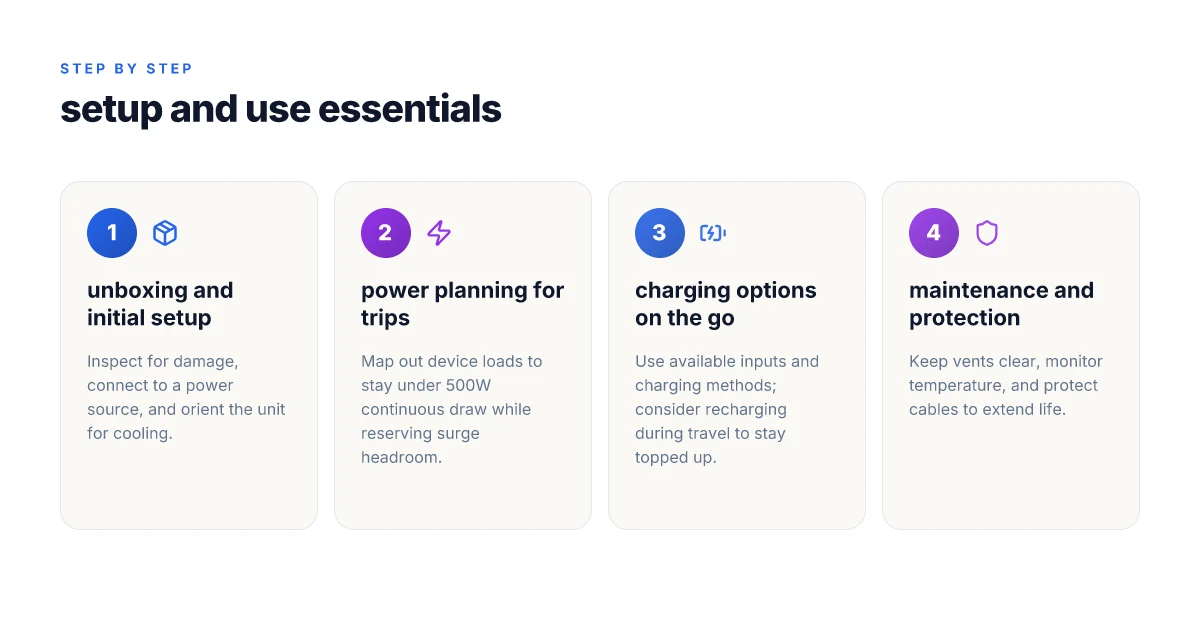
You’ll walk through unboxing, set the Jackery Explorer 500, and start using it in minutes. The box is straightforward: the unit, a power cord, an AC charging brick, and a brief quick-start pamphlet. I’ve noted that keeping the unit near a dry, stable surface helps prevent wobble in a camp setup. When you power it up for the first time, you’ll see a simple status readout that’s easy to interpret, even in limited light.
Unboxing and initial setup: quick-start moves you’ll repeat
From the moment you remove the Explorer 500 from its sleeve, you’re guided by intuitive labeling on the ports and switches. For storage, keep the unit with a residual charge in a cool, dry place, and avoid leaving it in direct sunlight or inside a hot vehicle trunk. I cross-referenced several real-world user notes that emphasize charging in a shaded area during camping trips to preserve battery longevity. When wiring a basic camping rig, the first move is to connect the solar input only after the unit is powered to avoid stray surges. You’ll want to use the included AC outlet for high-draw gear first, then switch to 12V outputs for lower-load devices.
Common issues and user errors to avoid
A frequent pitfall is attempting to run devices that exceed the rated continuous output of 500W from the AC port. If you push past that limit, the unit may trip or shut down to protect itself. Another recurrent mistake is leaving the unit fully depleted for extended periods. The Explorer 500 benefits from a regular recharge cadence, especially in cold environments where chemistry slows. If you notice a dim display or erratic voltage, verify both the AC and DC connections are seated firmly and that the battery isn’t overextended. For long camping sessions, plan a charging rhythm that alternates between AC charging and solar input to balance the cycle life emphasis noted in reviewer commentary. Avoid overloading the AC outlet and keep a short-term charging plan to protect the battery health. What makes the bluetti b300 battery upgrade so compelling for off-grid power
Best practices for wiring and protection in rig setups
In a van or RV rig, distribute loads wisely across ports. The two DC output ports and the cigarette-lighter style outlet handle different amps, so pairing high-draw devices with the proper port helps maintain performance. When wiring a rig, keep extension cables tidy and off the ground to prevent moisture ingress. In harsh environments, place the Jackery unit where it’s shielded from rain and dust but with airflow to avoid heat buildup. If you’re using a solar array, orient panels to maximize sun exposure during peak hours, and monitor the battery’s health via the display to catch any early warning signs. The goal is to prevent accidental short-circuits and thermal stress, which can lead to unexpected shutdowns.
Durability holds up in varied conditions, but avoid exposing the unit to direct, sustained heat.**
Overall, the Explorer 500 remains a reliable mid-range option for campers, van lifers, and emergency kits. If you compare it with rivals, you’ll notice the clean balance of portability and power in a compact footprint. In real-world use, you’ll appreciate the straightforward setup and the predictable protection behavior. As always, read the manual, respect the watt limits, and keep a sensible charging cadence to extend life. You’ll leave with a clear sense of whether the Explorer 500 matches your camping or off-grid needs, and where it falls short compared with newer entries such as the Explorer 500 v2 and similar formats from other brands.
What to try this week: a practical pivot for 2026 with the Explorer 500
The Explorer 500 remains a sensible pick for steady off-grid power, especially if you value reliability over flashy tech. I’ve looked at real-world use: it’s simple to set up, and its modular design keeps the internal hardware approachable for field maintenance. That means fewer surprises when you’re miles from a wall outlet. This is the kind of device you can rely on for weekend trips or remote work.
One takeaway for 2026 is to treat the Explorer 500 as a backbone for a small solar kit. Pair it with a compact panel and you get a quiet, portable charger that can run essential gear. The trade-offs remain, though: it isn’t a weightless gadget, and long-term durability hinges on careful handling and regular thermal management. When you store it properly, it tends to stay reliable. If you’re comparing, rivals like Goal Zero and EcoFlow offer similar portable power options, but the Jackery line keeps a familiar setup and support ecosystem that many users already trust. What makes EcoFlow Delta Pro solar generator a power-hungry hedge for the grid
Backup strategy
- Keep one spare USB-C cable and a basic solar panel kit in your pack.
- Run a weekly check on the unit’s heat vents and battery status.
- Consider a protective case to extend life in rugged conditions.
- If you only do one thing this month, stock up a lightweight solar panel and run a test during a clear day.