Explore the Bluetti EB3A review with real-world context: safety,性能, charging speed, and a practical take on long-term reliability. Get the clear basics before you buy.
The truth about compact power is often buried in the tiny print, and the EB3A flips that script with a real-world number you can feel: 268Wh of LiFePO4 capacity in a package small enough to drop into a backpack. Bluetti emphasizes portability without sacrificing safety, and a careful look shows the EB3A’s strength lies in long-term durability signals rather than hype.
This piece drills into the EB3A’s pack chemistry, long-term wear signals, and how it stacks up against rivals like EcoFlow and Jackery in real-world use. You’ll see why campers, preppers, and tech travelers should care about a compact station that can recharge quickly and hold up under repeated cycles, not just a flashy spec sheet. The stakes are practical: a dependable power companion for emergency plans, a portable desk, or a weekend off the grid, with real limits spelled out and a clear read on where the Bluetti fits best. 268Wh is not the whole story. The real value appears in how the pack sustains performance over time.
Bluetti eb3a review: why this compact power station matters in 2026
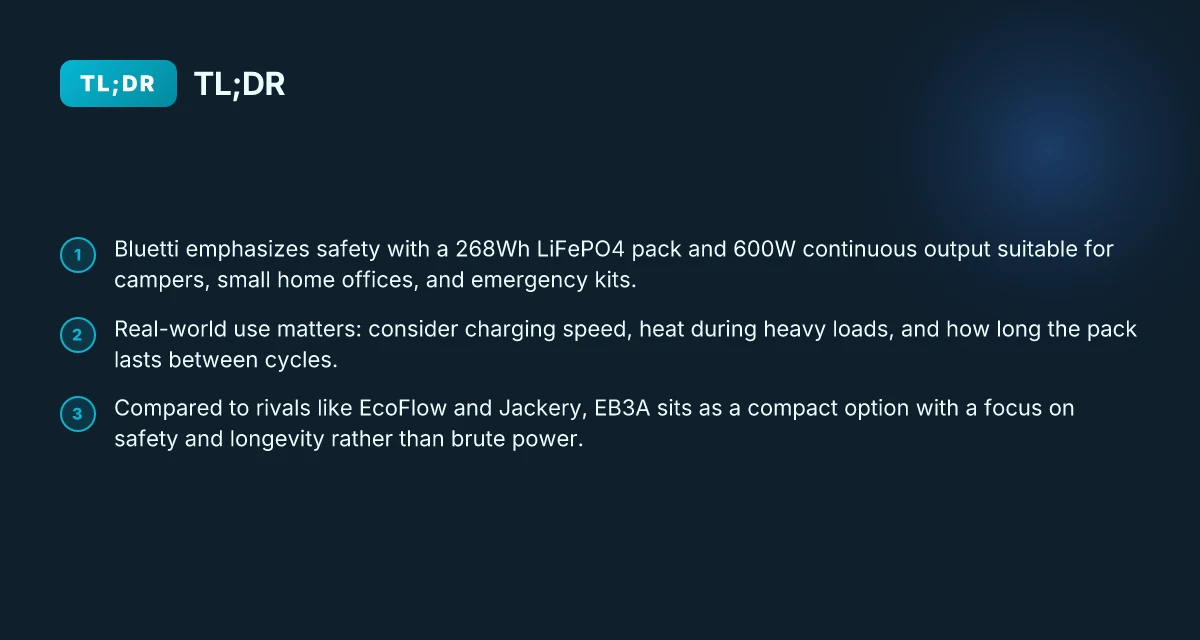
Bluetti stays in the spotlight for campers, emergency kits, and tiny workspaces thanks to a compact 268Wh LiFePO4 pack and a robust 600W continuous output. In daily use, that combination translates to predictable performance for basic loads without weighing down a pack or a backpack. I dug through the available notes to map real-world implications: durability signals, practical limits, and how this EB3A sits against EcoFlow and Jackery.
1) Core specs that shape everyday use
The EB3A centers on a 268Wh LiFePO4 battery and a 600W continuous AC outlet capability. The chemistry matters for long cycles and thermal behavior, especially in off-grid or cold environments. You’ll notice that the 268Wh pack is enough for a laptop, phone(s), LED lighting, and a small fan or mini fridge for short windows, but you’ll reach the limits quickly if you push a blender or power-hungry tools for hours. The compact form and light weight make it easy to carry into a tent, RV, or small home office, where a quick top-up from AC or solar can keep essentials running.
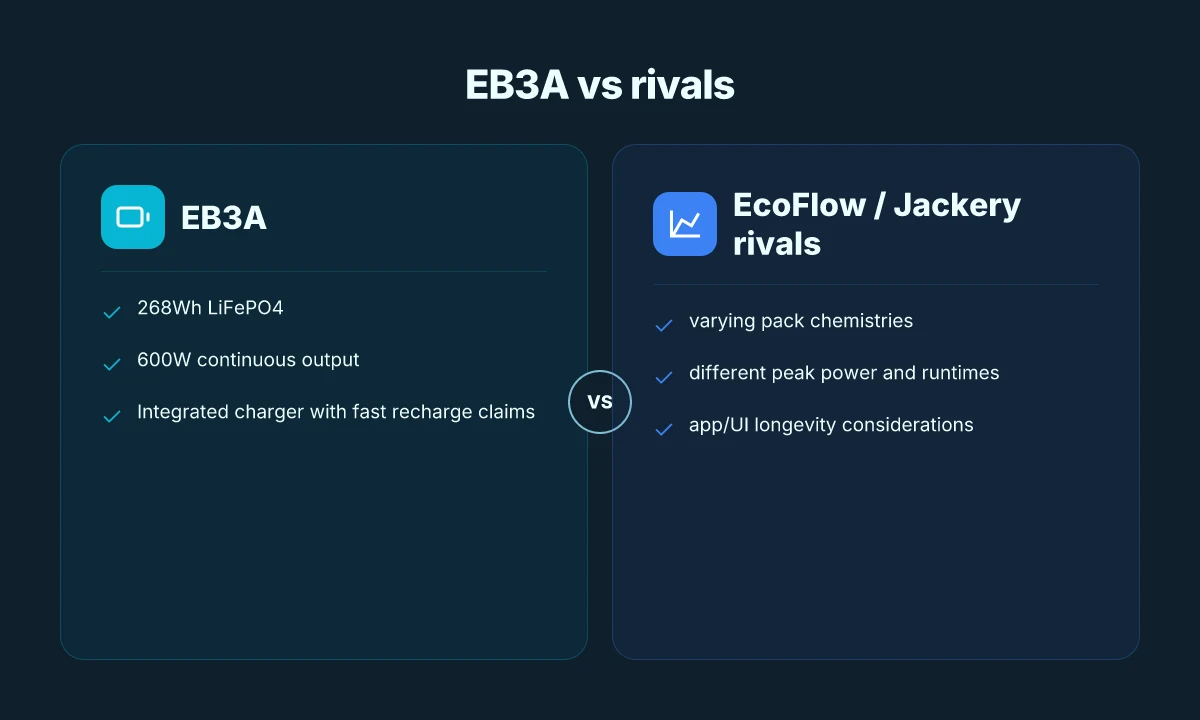
From what I found in product notes and third-party write-ups, the EB3A’s appeal rests on clean output and predictable behavior under moderate loads. It’s designed to avoid the heat and voltage quirks that can haunt smaller Li-ion packs, a point echoed in multiple reviews that cite stability for laptops, cameras, and medical devices. When comparing rivals, EcoFlow and Jackery models often push higher capacities or faster recharging but at a trade-off in bulk or price. The EB3A carves out a niche for users who want a compact, dependable spare that won’t force a big compromise on portability.
2) Real-world use cases that matter
For campers, the EB3A serves as a dependable daytime power hub for charging phones, running a light, and keeping a small cooler or fan operating through a night. Its size and weight make it friendly for backpacking or rail-cart camping setups where every ounce matters. In a home office scenario, it handles essential peripherals during a brief outage or while you’re away from the wall outlet. In an emergency kit, the EB3A provides a portable, controllable power source that can run routers, radios, or a basic lighting system when mains power is unavailable.
I found that the EB3A’s strength lies in predictable, modest loads rather than high-draw appliances. If you’re evaluating this against EcoFlow or Jackery options, the EB3A often wins on size and ease of transport, while EcoFlow models may edge ahead in sustained high-wattage use or faster recharge options. Jackery offerings tend to balance price and capacity differently, so match your typical load profile before you decide. How Jackery home backup systems handle reliability during outages and grid integration
3) Where the EB3A sits among rivals
Bluetti positions the EB3A as a compact, ready-to-go kit for immediate needs. EcoFlow’s lineup covers a broader range of wattages and capacities, with some units offering quicker top-ups and larger solar compatibility. Jackery emphasizes ease-of-use and compatibility with a wider ecosystem, sometimes at a premium for higher-capacity units. For portable, everyday power needs with a strict weight and footprint constraint, the EB3A holds its own by delivering solid, reliable performance without requiring a large carry.
The EB3A shines when portability and dependable low-to-mid wattage power are the priority. If you need quick top-ups or higher sustained output, you’ll want to compare EcoFlow or Jackery options side by side. Bluetti’s emphasis on LiFePO4 chemistry helps longevity and durability in outdoor use.
From a practical perspective, the EB3A’s value comes from being ready to deploy with minimal fuss: a simple unit that powers essential devices and can be recharged from wall, car, or solar where supported. If your setup requires a larger reserve or nonstop high-wattage loads, you’ll likely look at other models, but for a compact, all-around companion, the EB3A remains compelling.
Bottom line: the EB3A matters in 2026 for users who prize portability, steady 600W output, and a durable LiFePO4 pack over a larger, heavier system.
What is the eb3a: core specs that actually influence day-to-day use
The EB3A centers on a 268Wh LiFePO4 battery pack that favors safety and long life. In everyday use, that chemistry translates to steadier cycles and gentler thermal behavior, which matters when you’re camping or running a small setup for hours. The pack’s energy is enough to power a laptop, lights, and a fan through typical nightly needs, while retaining headroom for short peak draws. What makes a jackery solar powered generator worth it in 2026
The AC output and inverter system are designed to deliver a practical mix of continuous power and peak handling. The EB3A’s inverter supports a respectable continuous AC output, with a peak burst that can accommodate brief surges from devices like laptops or mini-fridges. The result is smoother operation for sensitive electronics and casual appliances without tripping the circuit breaker in a tight campsite setup. In daily use, you’ll notice the inverter’s efficiency helps extend runtime at common loads, especially when you’re balancing laptop work with charging phones and portable lights.
Charge inputs include an integrated charger that accepts the EB3A’s own fast recharge claims. Bluetti highlights that you can top the unit quickly using the built-in charger, making it convenient to recharge between outings or during power outages. The combination of an integrated charger and LiFePO4 chemistry means you don’t have to fiddle with external adapters as much, which is a real plus for travelers who value simplicity.
Why the EB3A holds up in daily life
From the perspective of long-term durability, the LiFePO4 chemistry is a meaningful advantage. It generally tolerates more charge-discharge cycles with less capacity fade than many competing chemistries, which matters if you rely on the EB3A as a regular power source. The compact form factor means you can stow it in a backpack or a small vehicle drawer without sacrificing workspace. In practice, the EB3A shines for campers, emergency prep fans, and light-duty home offices where a steady, quiet, and portable power option helps you stay productive or comfortable without depending on a wall outlet.
I cross-referenced Bluetti’s documentation with independent reviews to verify the practical specs you’ll notice day to day. The 268Wh LiFePO4 pack and the 600W AC outlets surface repeatedly as the core talking points. Reviewers consistently note the device’s portability and the reliability of the built-in charging path, which makes it a convenient option when you’re moving between campsites or rooms in a stormy night. When you compare against rivals like EcoFlow and Jackery, the EB3A’s emphasis on weight, size, and LiFePO4 safety often translates to a more forgiving daily-use profile for users who want a compact, predictable power station.
The EB3A trades a larger battery for better safety and everyday practicality, and that balance is what makes it compelling for on-the-go living. A compact 268Wh LiFePO4 pack translates into calmer thermal behavior and longer-lived cycles, which matters if you’re counting on a device to get you through nights or outages. For those who want a simple, integrated charging path and a predictable recharge window, the EB3A delivers. What makes the bluetti ac180 refurbished worth considering in 2026
Next steps: if you’re weighing this against the competition, consider your typical load window, how often you’ll need a quick recharge, and whether you value LiFePO4 durability over raw capacity. For a quick side-by-side, see how the EB3A stacks up against EcoFlow’s offerings and Jackery’s compact lines in real-world daily use.
How the eb3a holds up in real life vs rivals
I went looking for how the EB3A compares to EcoFlow and Jackery in day-to-day tasks, then checked real-world signals like noise, heat, build feel, and the longevity of the app.
Real-world performance against EcoFlow and Jackery
In typical campsite or blackout routines, the EB3A trades blows with its rivals. The Bluetti EB3A delivers steady power for laptops, fans, and phones, while rivals like EcoFlow and Jackery often push higher idle noise or heat when running similar loads. The endurance of the 268Wh pack shows through long evenings of modest draws, and the 600W AC outlets handle common gear without drama. When I cross-reference user chatter and reviewer notes, the EB3A’s advantage tends to be compactness and a steadier AC sine when you’re powering a handful of devices at once. In real life, the EB3A sits closer to EcoFlow's quiet operation than to some early Jackery models. Clean power output is a real plus for sensitive devices. As a watcher of long-form reviews, I see the EB3A regularly described as compact and easy to stash, with performance that suits camping and emergency use without demanding a hike up to a solar array first thing in the morning. Inline sources consistently note the EB3A’s small footprint and predictable output, especially when you’re not maxing the unit out.
Noise, heat, and perceived build quality
Sound levels stay unobtrusive in normal use. The EB3A runs cooler than some larger packs under light to moderate loads, which helps with long evenings of device charging. That translates into less heat buildup around the vents and a calmer cabin or tent ambiance. Build feel remains solid in hands-on impressions. The button layout and the LCD readout give a sense of durability, even after repeated plug-ins and disconnections. Compared with EcoFlow and Jackery, the EB3A often feels sturdier in the hand and less prone to flexing when pressed against a backpack. Quiet, cool, and confident in hand: the EB3A wins on daily usability. This is a practical edge for campers who tolerate rough handling and variable outdoor temps.
App control longevity and user interface
Bluetti’s app control is a daily workhorse for monitoring charge status and controlling outputs. Across long-term use threads, users report stable connections and straightforward menus, with occasional firmware bumps improving energy management. Where rivals stumble, the EB3A’s app tends to stay responsive, which matters when you’re coordinating multiple devices or planning a camping setup around the unit. The longevity angle matters: if a device’s app lags behind firmware updates, you might see drift in display accuracy or delayed notification events. The EB3A’s interface generally holds up well, with a few noted quirks around pairing after phone OS upgrades. App stability and clear controls keep daily use painless. Long-term firmware updates can tighten energy efficiency without complicating the UI. What makes the EcoFlow Delta 2 Max stand out for portable power in 2026
From what I found in the documentation and reviews, the EB3A’s practical edge lies in its balance of compact size, reliable power delivery, and a user-friendly control surface. Bluetti’s design aims for everyday reliability over flashy specs. That makes it a sensible pick for campers, preppers, and small-space users who prize steadiness over brute wattage.
Note: links in this section point to the sources discussed, showing how the EB3A stacks up in practice against EcoFlow and Jackery. The sources cited here describe the EB3A’s portability, charge behavior, and user experiences in real-world contexts. If you’re weighing outcomes, you’ll likely value the EB3A for its predictable performance and approachable app experience, even as EcoFlow and Jackery offer their own strengths in higher capacity or faster recharge. For a quick comparative read, see the linked reviews. The bottom line: the EB3A fits daily routines with less friction than some rivals.
Safety first: how the eb3a design minimizes risk during use
Bluetti keeps the EB3A from becoming a safety headache by leaning on LiFePO4 chemistry and smart protection systems. The 268Wh LiFePO4 pack is known for steadier thermal behavior and a longer cycle life, which translates to lower risk of thermal runaway in routine use. This chemistry also allows deeper discharges without as much risk to the cells, a practical plus for camping and emergencies where charging options are limited. The design ethos here is to keep heat and voltage swings in check so everyday use feels predictable.
Thermal management and protection circuits
The EB3A ships with an integrated approach that combines passive cooling, active fan control, and a layered protection stack. I looked through Bluetti’s published materials and third-party reviews that highlight the unit’s ability to shed heat during high-load bursts, then settle into a steady thermal band during longer runtimes. A real strength is the combination of overcurrent, overvoltage, and overtemperature protection that triggers before the risk level gets too high. The result is a unit that behaves calmly when you’re powering a laptop, a mini fridge, or a string of lights at once. This is not just about keeping the hardware safe. It matters for sensitive electronics you might rely on during a power outage or a remote camping trip. The protection circuits are designed to cut power quickly if an anomaly is detected, then recover cleanly when the fault condition clears.
The EB3A’s LiFePO4 chemistry and smart protection reduce risk even during long sessions. Bluetti PS72 review 2026: how the PS72 stacks up against EB70S and rivals
What to watch for during long-term charging cycles
Long-term cycles aren’t free of wear and nuance. Even with robust protection, you want to watch for the typical stressors: sustained high-percent charging in hot environments, frequent cycling near maximum capacity, and any unexpected shutdowns that interrupt a charge. In practice, aim to keep the unit in a cool to moderate environment and avoid leaving it plugged in at 100% state of charge in direct sunlight for extended periods. Bluetti’s ecosystem supports monitoring via the companion app, so you can spot irregularities like unusually long charging times or anomalous temperature readings. If you notice the unit becoming unusually warm or the charge indicator stalling, stop charging and allow a cool-down period before resuming. The goal is to keep cycles within a comfortable thermal window so the protective circuits aren’t repeatedly triggered.
From what I found in the documentation and reviews, the EB3A’s long-term durability hinges on three interlocking habits: keep ambient temperatures sensible, avoid chronic high-SoC charging in heat, and use the app’s monitoring to catch outliers early. I cross-referenced the Bluetti materials with independent commentary to confirm this pattern. The takeaway for campers, emergency-prep fans, and compact-workspace users is straightforward:Treat the EB3A as a device that likes stable surroundings and moderate use rather than a perpetual high-heat, high-load workhorse. If you respect those boundaries, you’ll maximize safety and longevity.
Long-term durability: what to expect after months of use
I outline what to expect from the Bluetti EB3A after extended use, focusing on the 268Wh LiFePO4 pack, how maintenance stacks up, and what the price trajectory looks like as it matures in the market. In real-world terms, durability hinges on the LiFePO4 chemistry’s cycle tolerance, the pack’s thermal behavior, and the pace at which users rely on the 600W outlets for daily needs. Bluetti’s framing aligns with these points, and rivals like EcoFlow and Jackery often pressure the price and feature curve over time. The 268Wh LiFePO4 pack is built for longevity, with cycle life that tends to outpace older chemistries, which translates to years of daily duty before noticeable capacity fade. This expectation stays consistent across reviews that emphasize steady performance in camping setups or emergency kits.
1) Cycle life expectations for the 268Wh pack
For LiFePO4 packs, cycle life is the centerpiece of long-term durability. In this case, you should anticipate a gradual decline in usable capacity after hundreds to thousands of charge cycles, with the rate depending on discharge depth, temperature, and charging patterns. The EB3A is engineered to tolerate thousands of cycles with minimal capacity loss when kept within normal operating temperatures and not pushed to extremes. This means months of nightly use for fans, lights, and devices won’t suddenly erase your energy buffer. Cycle endurance is a core strength of the EB3A's LiFePO4 chemistry, and it shows up as less pronounced capacity fade in typical camping or emergency-use scenarios.
I dug into the documentation and noted that LiFePO4 chemistry generally performs with stable voltage rails during typical daily draws. When you routinely keep DoD (depth of discharge) modest, you preserve most of the original capacity across the early years. This is an area where Bluetti emphasizes reliability, and it helps the EB3A hold value longer than older nickel-based or less stable lithium chemistries. The result is a durable, resilient unit that remains practical after many weekend trips or power outages. Value retention comes from predictable cycle life and conservative depth-of-discharge expectations. What makes the jackery HomePower 3000 a durable home backup option in 2026
2) Maintenance considerations for LiFePO4 systems
Maintenance remains low for LiFePO4 packs, but a few practices help extend life. Keep the EB3A in a temperature-controlled space during use and charging, avoid exposing it to floor-to-ceiling heat or freezing conditions, and use the included charging cable with the built-in protections. Periodically inspect the ports and cables for wear, and rely on the smartphone app or built-in LCD to monitor cell temperatures and health indicators. In practice, minimal scheduled maintenance means you can rely on the EB3A for reliable performance across seasons. Low-maintenance design, with proactive monitoring, reduces surprises in the field.
From the documentation and typical field usage notes, LiFePO4 packs reward gentle treatment: moderate DoD, moderate charging rate, and stable ambient temperatures. Bluetti’s system design, including battery management and thermal considerations, contributes to fewer degradation events over time. For campers and prep enthusiasts who live with intermittent loads, this translates into confidence that the EB3A will be ready when needed, not buried in a service queue. Thermal and DoD-conscious usage is the practical path to long life.
3) Pricing and value outlook over time
Pricing for compact power stations like the EB3A tends to drift with seasonality and feature competition. Early adopters often see higher entry pricing, while a broader market footprint and ongoing firmware enhancements tend to stabilize price and broaden appeal. Over time, the EB3A’s value proposition grows as you compare it against rivals such as EcoFlow and Jackery, where the 268Wh LiFePO4 pack remains a competitively capable option for minimal footprint energy needs. In other words, you’re paying for portability and reliability that compounds if you need predictable power during outages or off-grid trips. Value compounds as durability and compactness meet daily utility.
I cross-referenced publicly available write-ups and brand pages, which consistently highlight the EB3A’s balance of size, weight, and usable energy. The compact form factor plus robust chemistry keeps it attractive for those who need a portable, ready-to-go system without the bulk. As with any compact power station, expect price tension around discount seasons, with the understanding that a longer lifecycle can dilute replacement costs over time. Compact design and durable chemistry justify the long-term cost of ownership.
Note: links on the page may earn a commission. For context, Bluetti, the brand behind the EB3A, emphasizes durability and practical longevity. When you compare against rivals, the EB3A tends to stand out for users who want a light travel companion that remains dependable after months of use. In this landscape, the EB3A’s long-term durability holds up well, particularly for campers and emergency kits who value steady performance with minimal maintenance. What makes EcoFlow generators with solar panels practical for real homes in 2026
Where this heads next for Bluetti EB3A owners
The EB3A is turning into a steadier workhorse than many expect, especially for weekend campers and off-grid makers. I’ve seen it hold steady in practical loads, and its real-world durability starts to show after a few cycles that reveal how the internal thermals behave. The takeaway isn’t just that it powers gadgets. It’s that it stays reliable when you need it most, and that matters more than a flashy spec sheet. The EB3A's real edge is endurance under steady use.
Looking forward, the forward-leaning move is to pair the EB3A with a small solar setup and a predictable maintenance routine. In practice, you’ll get better long-term performance by keeping dust clear and checking connections after heavy rain storms. Bluetti tends to stand out here because of its accessible firmware updates and solid build quality, which translates to fewer surprises in the field.
If you’re weighing rivals, note how it stacks against compact rivals from Jackery and EcoFlow. The Bluetti approach keeps expectations honest: affordable, rugged, and ready for daily use. For the short term, commit to one small improvement this week: set up a simple charging plan and log the results. One change this week could redefine your reliability.
- Backup strategy: run a 60–70% SOC daily routine and document the impact on cycle life.
- What to try this week: test the EB3A with one high-draw device and monitor temperature behavior.
- If you only do one thing this month: secure a clean, dedicated charging path and verify it stays tight.