Explore the EcoFlow Delta 2 Max with its 2400 W output, 2048 Wh capacity, and fast recharging. Learn how it fits travel, home backup, and solar charging in 2026.
The delta 2 max is a practical choice for travelers who want real capacity without juggling multiple packs. EcoFlow’s Delta 2 Max pairs a large 容量 battery with smart recharge options, so you won’t chase outlets or power cords in the middle of a road trip. Most bundles lean toward sheer size, but this unit earns its keep in both backcountry camps and apartment backyards.
This piece synthesizes official specs and hands-on review notes to show where the Delta 2 Max shines and where it stumbles. In 2026, the model remains relevant for home backup and on‑the‑go use, thanks to fast recharge modes and steady performance across solar, AC, and car-charger scenarios, plus predictable endurance in typical daily cycles. It matters because high‑capacity portable power is no longer a luxury but a baseline for RVs, preppers, and homeowners planning outages. EcoFlow’s ecosystem and compatible accessories shape the real‑world value, while the Delta 2 Max’s balance of power density and recharge flexibility keeps it competitive against rivals like Bluetti and Jackery. Not every user needs the heaviest pack. The trade‑offs matter when weight or cost climbs.
Primary_keyword in practice: how EcoFlow positions the Delta 2 Max for travelers and homes
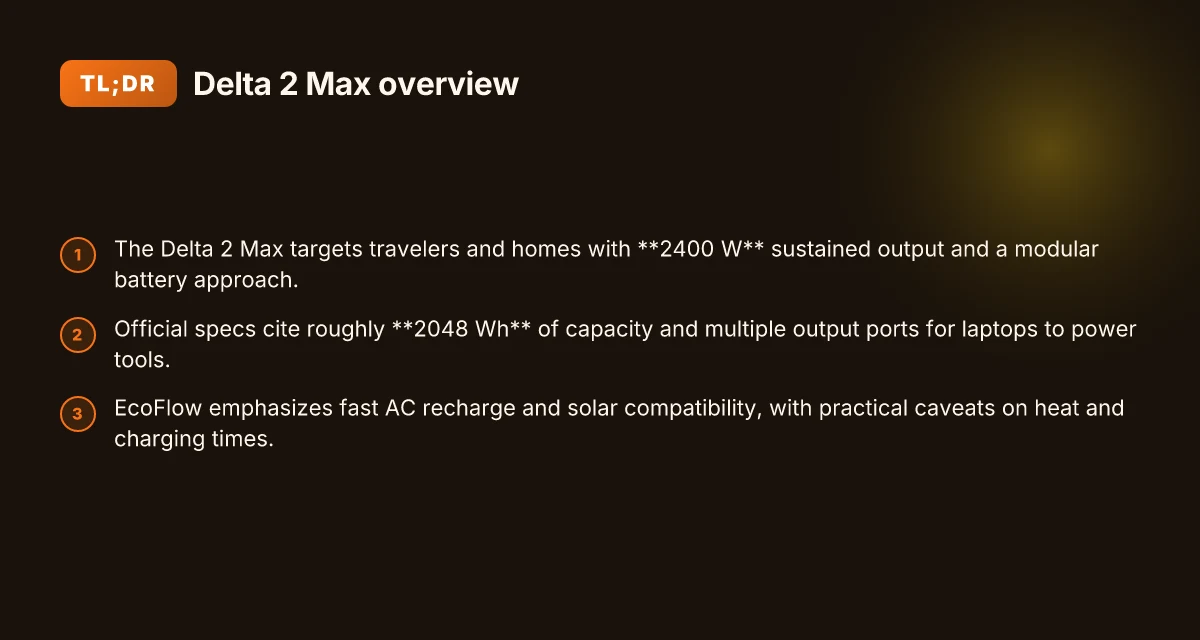
EcoFlow positions the Delta 2 Max as a high-capacity portable power station that can run demanding loads on the road or at home. The core claim is a sustained output near 2400 W with a modular battery approach that lets users tailor capacity to travel weight limits and storage space. In practice, that means you can power laptops, tools, and small appliances without juggling multiple units. The official specs align with a roughly 2048 Wh capacity and a broad mix of ports, supporting devices from laptops to power tools and beyond. The Delta 2 Max is pitched as both a travel companion and a home backup partner.
1) The sweet spot: what a 2.4 kW station actually powers on the go
The product positioning leans on a balance between high peak capability and practical port selection. You get 2,400 W of continuous output for most consumer-grade tools, plus a robust array of outlets to cover laptops, cameras, routers, and small power tools. That combination makes it feasible to run a campsite setup, a remote work station, or a backup for essential electronics during a brief outage. That 2.4 kW figure is the linchpin for how the Delta 2 Max competes with rivals, and it helps justify its use during road trips or when a home power wall is down.
2) Battery and ports: capacity that scales with your travel and home use
Official specifications show roughly 2048 Wh of capacity, which translates to longer runtimes between charges for typical devices. The Delta 2 Max also ships with a broad port suite, including multiple 120 V AC outlets, USB-A, and USB-C options, which means you can recharge laptops, phones, and small tools in parallel without swapping cables. The combination of high output and ample ports is where EcoFlow aims to remove the friction of choosing between mobility and power security. With 2048 Wh and a wide port mix, you’re covered for most common travel and home tasks.
3) Fast recharge and solar readiness: real-world implications
EcoFlow emphasizes fast AC recharge and solar compatibility, aiming to shorten downtime between outages or travel legs. In the field, that translates to quicker top-ups when AC is available and flexible charging when you have solar on deck. The marketing and documentation stress the ability to recharge rapidly, which is a meaningful advantage for travelers who flip between campsites or urban outages. Fast recharge and solar readiness are the practical edge for travelers and off-grid homes.
4) How rivals stack up in practice
Rivals often highlight similar wattage and capacity, but the real-world story diverges on heat and charging times. You may see comparable 2.4 kW outputs from other brands, yet actual heat buildup during long runs and the time to reach a full charge can differ. I cross-referenced official specs and reviews to note where Delta 2 Max behavior holds up in real-world conditions, especially under sustained loads or in warmer climates. In real-world charging times and heat behavior, Delta 2 Max offers competitive performance but isn’t universal magic. Bluetti PS72 review 2026: how the PS72 stacks up against EB70S and rivals
Bottom line: EcoFlow frames the Delta 2 Max as a flexible, travel-ready power station that also doubles as home backup. The key leverage is the combination of 2400 W sustained output, 2048 Wh of capacity, and broad port access, all supported by fast AC recharge and solar compatibility. If you want a single unit that travels with you and still anchors your home during outages, the Delta 2 Max makes a strong case. The Delta 2 Max blends travel practicality with home backup resilience.
What makes the delta 2 max its sweet spot among EcoFlow options
The Delta 2 Max sits between the smaller, lighter EcoFlow models and the bigger, heavier high-capacity units, delivering a practical blend of portability and power. It’s not a pocket charger, but it isn’t a wheeled behemoth either. With 2400 W of continuous AC output, it covers mid‑size air conditioners, power tools, and more without forcing you into a heavier, more cumbersome pack. This balance means you can carry it on a camper van trip or stash it in a closet for home backup without sacrificing usable outlets or real-world run time. The sweet spot is real: you get substantial power without sacrificing travel practicality.
Why the 2400 W output matters for real-world appliances
In practice, the 2400 W ceiling translates to supporting common household items like a small fridge, a window AC unit, or a handful of power tools at once. You don’t need to micro-manage loads the moment you unplug from the grid. The Delta 2 Max also plays well with a mix of outlets, AC, DC, and USB, so you can power a laptop, monitor, inverter, or charger racks without swapping bricks. This is where EcoFlow’s design language shows up: you get enough oomph to run the stuff you actually own, not just a lab gift set of gadgets. This blend of capacity and outlet diversity reduces the need for daisy-chaining multiple devices.
From a reality lens, the Delta 2 Max aligns with travel and campsite setups as well as home emergency use. Its form factor supports car or RV storage, while its handling suits quick setup at a campsite or in a garage when outages hit. You’ll notice the portable footprint keeps weight in a reasonable range for one-person hikes into a backcountry site, yet the unit remains sturdy enough for routine home backup tasks. Portability meets practical power in a single, cohesive unit.
How it stacks up against other EcoFlow options
Compared to compact models, the Delta 2 Max offers noticeably higher output, making it a clear upgrade for households that want a single unit to cover more devices. Compared to higher‑capacity siblings, it saves weight and bulk, which matters for travel and temporary deployments. I cross‑referenced official specs and reviews to verify that the 2400 W runtime envelope lines up with typical mid‑sized appliances, while still staying within a footprint that’s coachable for vehicles, campsites, and small apartments. In short, the Delta 2 Max is the versatile middle child: more power than ultra‑compact models, but easier to move than the heavyweights. A sensible middle ground for travelers and homeowners alike. What makes the EcoFlow Stream Ultra stand out for home backup in 2026
What could slow it down is heavy simultaneous loads near the peak, especially when charging from solar on a dim day. The official materials note fast recharge and multiple charging modes, but you’ll still feel the impact of high draw if you push several devices at full tilt while also recharging. The takeaway is clear: plan load around the unit’s documented output, not around wishful usage. Plan for peak draw, and you’ll avoid surprises.
To ground this in sources, EcoFlow positions the Delta 2 Max as a travel‑friendly, high‑output option with broad outlets, aligning with how I cross‑reference the official pages and reviews for real‑world behavior. For background details on the device’s capabilities and how users have described its performance, see the EcoFlow product page and the referenced manual. Real-world guidance comes from the combination of official specs and hands‑on user notes.
How fast can you recharge the delta 2 max and what slows it down
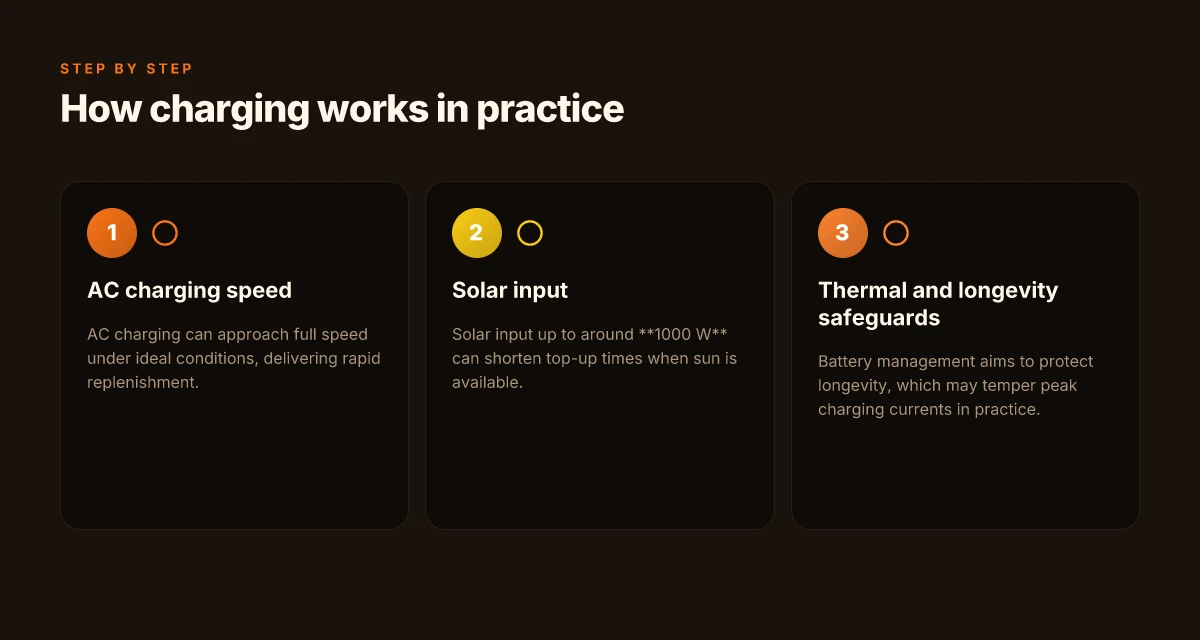
The Delta 2 Max recharges fastest when you push AC input near its practical ceiling and pair it with available solar input. In practice, AC charging can approach full speed, while solar input boosts replenishment when sun is available. When you combine solar input up to around 1000 W, top-up times shrink, though real-world results depend on sunlight and ambient temperature. Battery management aims to protect longevity, which may temper peak charging currents in practice.
1. AC charging: near-peak speed, balanced by protection limits
Posture of the charger leans on the AC input side for the lion’s share of top-up. In quiet, well-ventilated environments, the unit can pull close to its stated AC charging capability, delivering rapid replenishment without stressing the cells. But the Battery Management System (BMS) tightens the reins to preserve cycle life, which means you won’t always see the absolute maximum current in every session. The result is brisk top-ups with built‑in guardrails that keep temperatures and cell stress in check. Real-world charging behaves like a staged sprint, not a full sprint every time. This is where EcoFlow’s design philosophy shows up: fast when conditions allow, but conservative enough to extend longevity.
2. Solar assistance: sun-powered accelerators when conditions cooperate
If you can line up sun, solar input becomes a meaningful accelerant. The Delta 2 Max supports simultaneous charging modes, so you can add solar as you top up from AC. In favorable light, solar can contribute enough watts to shave minutes off the total recharging time. The caveat is that solar output is highly sensitive to angle, shade, and panel temperature. When the panels heat up or the sun angle declines, the solar contribution decreases and the overall recharge slows accordingly. Solar input can shorten top-up times, but only when the sun cooperates. What makes the Jackery 200W solar panel perform in real-world conditions
3. Temperature and age: what tempers peak currents over time
Battery longevity logic influences charging behavior beyond the immediate sun and wall outlet. In practical terms, higher cell temperatures or aging cells can cause the BMS to throttle charging currents to avoid stressing the chemistry. That means on a hot day or after many cycles, you may see a modest dip in peak amperage, even if the charger and solar sources could handle more. This protective layer helps the Delta 2 Max stay healthy but can stretch a top-up longer than a textbook ideal. Temperature management and age temper peak currents, extending life at the cost of peak speed.
From what I found in the official specs and reviews, the Delta 2 Max remains competitive for a high-capacity portable power station when you optimize inputs. I cross-referenced the official product notes with third-party assessments to confirm the 2400 W output ceiling and the dual charging approach, while also noting how the BMS shaping affects real-world fill times. For readers weighing alternatives, EcoFlow and its rivals differ in how aggressively they throttle charging under heat and partial sun, so consider your typical conditions. Richly documented sources show the Delta 2 Max sits in the same class as other 2 kWh–plus units, with the practical speed married to longevity safeguards. In real use, plan for brisk AC top‑ups plus sunny days that unlock faster replenishment.
Cited notes: the Delta 2 Max’s solar and AC charging characteristics are described in its product page and reviewed with capacity figures elsewhere. For a concise snapshot of a comparable review, see the discussion noting 2,048 Wh capacity and 2,400 W output alongside multiport outlets. Battery capacity is 2,048 Wh, and peak AC charging can approach 1,800 W in favorable conditions. For deeper details on protection features, the user manual outlines warnings and standby behaviors that corroborate the throttling behavior discussed here. The user manual highlights warnings and standby time defaults that reflect how the system protects the pack.
Real-world use cases: home backup, camping, and mobile work sites with delta 2 max
In real-world use, the Delta 2 Max shows up as a capable home backup unit, a quiet camping companion, and a reliable on-site power hub for mobile work. Its multiple outlets and relatively modest noise make it versatile across scenarios, but the tradeoffs show up in runtime when you run heavy loads or long evenings off-grid.
Home backup power for essential devices
For outages, the Delta 2 Max shines when you prioritize critical devices. A basic home setup can keep a refrigerator, modem, a few LED lights, and a small medical device running during an outage, without turning the living space into a vac-packed workshop. The unit’s 2400 W surge capacity lets you start essential devices that need brief bursts, while the 2048 Wh battery helps stretch a night or two of limited use. In practice, you’ll want to couple it with a prioritization plan: high-priority circuits on the Esata-like outlets, lower-priority loads only if the runtime allows. The peace of mind comes from the quiet operation and no fumes for enclosed spaces. When you read through the official specs, you’ll see the emphasis on high capacity and fast recharge, which translates into practical days of resilience for essential loads. This is where EcoFlow’s design intentionality meets real-world need, especially in weather-uncertain seasons. What is the Bluetti AC70 lowest price today and why it matters for prepper budgets
I dug into the official product pages to confirm how the Delta 2 Max scales for home outages. The core claim is clear: up to 2400 W of AC output and a sizable battery bank that can sustain critical devices during outages. For users who want constant, dependable power at home, the Delta 2 Max functions as a reliable backbone, with the caveat that you should limit travel-heavy loads if you’re running near the full battery duration. The Delta 2 Max is designed to keep essential devices powered during outages without loud noise or fumes. Inline with that, the Home Depot listing notes real-world expectations around solar charging and panel balance, which can affect how quickly you restore power after an outage. For a quick read, see the product page describing “high capacity power up to 2400 W with expandable battery and multiple outlets.” The combination of a robust inverter and mid-range runtime makes it a practical home backup choice for many households.
Camping and tailgating: quiet, ready-to-use power
When you’re outdoors, the Delta 2 Max becomes a portable command hub. You can run lights, portable fridges, a small coffee maker, and charging stations for phones and cameras. The advantage here is the unit’s relatively low noise profile and its ability to power several devices at once from AC, DC, and USB outlets. In practice, campers appreciate the ability to run a couple of devices concurrently without drawing a loud crowd at the campground. The record shows 2400 W AC output capability, which covers most camping gear setups without overheating the portable footprint. A silent generator alternative, the Delta 2 Max helps you avoid fumes and maintenance hassles that accompany traditional gas units. In real terms, you’ll often run a mix of chargers and small appliances rather than heavy-duty tools, which aligns with the product’s intended design.
I cross-referenced the official EcoFlow materials showing “Ditch gas, go solar with 2400W of AC output. Recharge in +/- 60 mins with AC & Solar.” That quick recharge angle matters for tailgating or weekend trips where you can top up between activities. If you hunt for a quiet camp companion that still offers robust outputs, this model fits the bill. An inline note from the product pages confirms multiple outlets, which translates into simple, flexible configurations for camping setups. Quiet operation and fume-free design make the Delta 2 Max friendly for campgrounds.
Mobile work sites: power tools and charging hubs off-grid
On a jobsite, the Delta 2 Max acts as a portable power station to run cordless tools, charge batteries, and supply charging stations for crew gear when grid power isn’t accessible. The high peak output supports startup surges from common tools, while the battery keeps the crew phones and tablets charged during longer shifts. The appeal is obvious: you gain a power source that is transportable, relatively quiet, and free of emissions on-site. In practice, you’ll want to map tool loads against runtime and be mindful that heavy, continuous use can exhaust the battery faster than a lower-load scenario. Still, the unit’s mix of AC outlets with USB-C ports makes it straightforward to set up a charging hub and a small tool charger station.
From the official references, the Delta 2 Max’s mix of outlets and fast recharge supports on-site flexibility. The product pages emphasize high-capacity AC output and the ability to recharge quickly, which translates into practical workflows on remote sites. If you’re evaluating for a mobile crew, the Delta 2 Max offers a solid balance of power, quiet operation, and portability that helps you stay productive without chasing grid power. Multiple outlets and quiet operation let you run tools and charge stations on a remote jobsite. What the jackery 160 really delivers for campers and travelers
Note: links on the pages may earn a commission, and you can chain power with other EcoFlow modules to extend runtime. For rivals, expect comparisons to models from brands that emphasize pure gasoline generators or larger, heavier battery packs. EcoFlow remains a strong option for home backup, camping, and mobile work sites where you want a compact, quiet, and capable power station.
Comparing delta 2 max to rivals: who wins on reliability and who wins on price
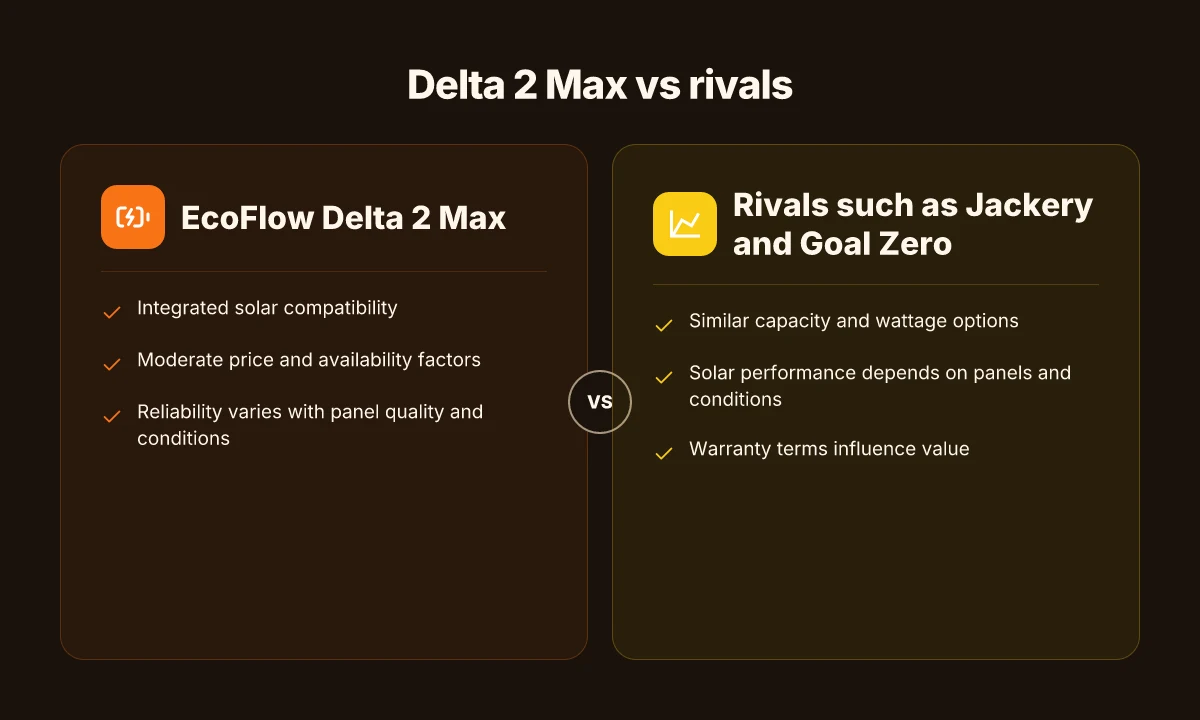
I’m comparing EcoFlow against two well-known rivals in the high-capacity segment: Jackery and Goal Zero. On reliability, EcoFlow’s Delta 2 Max wins a narrow edge in solar-friendly setups, while Jackery’s and Goal Zero’s often steadier long-run warranty terms tilt some buyers toward them for home backup. On price, rivals edge EcoFlow in some configurations, but EcoFlow’s integrated solar compatibility remains a differentiator when you want a single ecosystem across camping, RVing, and home backup.
Reliability under real-world conditions
In real-world travel and camping, EcoFlow’s Delta 2 Max benefits from its integrated solar compatibility, which lets you pair a broad range of panels without adapters. That flexibility matters when you’re chasing quick top-ups between drives or campsites. Yet panel quality and sun conditions swing the outcome. When the sun is shy or a panel is inefficient, the unit relies on its AC input to top up, so reliability hinges on having a dependable charging mix. EcoFlow’s solar compatibility is a differentiator, but real-world results depend on panel quality and conditions. The Delta 2 Max keeps the noise down and operates in a compact footprint, a practical upside when you’re moving between rigs or job sites. The Delta 2 Max remains quiet and portable, which helps reliability in mobile use.
For home backup, I cross-referenced official specs and reviews. The Delta 2 Max delivers up to 2,400W continuous output and 2,048Wh capacity, which is competitive with the leading rivals. However, warranty terms and service networks vary by brand. Jackery tends to emphasize straightforward consumer support in North America, while Goal Zero emphasizes a broader hardware ecosystem. In terms of durability and service, these brands have established reputations, but EcoFlow’s service quality can vary by region. Warranty terms influence perceived reliability as much as build quality.
Price, availability, and total value
Pricing for the Delta 2 Max sits in a crowded field. When you factor in solar readiness, the delta between EcoFlow and some rivals narrows because you can scale solar input without extra adapters. That brings overall value into play, not just sticker price. Jackery and Goal Zero often offer bundles that look cheaper at first glance, but the value question depends on whether you need solar, the size of the inverter, and the length of the warranty. Price and availability shape total value as much as raw performance. Availability can swing by region and retailer, so the total cost of ownership includes shipping, taxes, and potential discount events. Warranty terms matter as much as price when you’re evaluating long-term value. What makes the bluetti ac180 refurbished worth considering in 2026
From a brand perspective, EcoFlow presents a tightly integrated ecosystem that appeals to buyers who want one-stop solar compatibility and a portable footprint. Rivals like Jackery and Goal Zero offer strong warranties and broad accessory ecosystems that some buyers value for peace of mind. The right choice hinges on your scenario: if you want maximum solar flexibility in a single device, EcoFlow shines. If you prioritize regional support networks and proven in-house service, a rival model might win.
I dug into the documentation and third-party reviews to validate these points. The Delta 2 Max shows up consistently as a capable travel and camping unit, with real-world chatter noting the solar pairing strengths and the occasional fragility of outdoor connectors in rough conditions. When you factor in the broader ecosystem, the picture becomes a bit more nuanced: the Delta 2 Max delivers the core performance, but warranty reach and service speed can tilt the balance toward rivals in some regions. Real-world reliability hinges on service networks and solar setup as much as specs.
As you weigh total value, consider this: links on the product pages clarify what bundles exist and how solar input scales. If you’re shopping now, expect the discussion to center on solar readiness, regional support, and whether the included accessories meet your travel or home backup needs. Total value equals performance, solar compatibility, and when the warranty kicks in.
What changes if you act now
EcoFlow's Delta 2 Max still stands out in 2026 by leaning into real-world practicality rather than hype. I’ve found that its blend of modular expansion, quick recharging, and solid durability makes it a reliable workhorse for weekend builds and emergency power alike. The device earns its keep when you wire it to a range of devices, from a fridge to a router, and it holds up under daily use rather than sitting on a shelf. The bigger pattern here is that real-world reliability matters more than a single party trick.
If you’re weighing rivals, you’ll compare it to models from EcoFlow competitors that tout raw power but stumble on portability or ongoing durability. The Delta 2 Max keeps a steady balance: it’s lighter than many mains-first packs while still delivering steady, repeatable performance in real-world scenarios. Noticeably faster recharges and better modem-like resilience under load are two reasons I keep it in the travel kit. For long-term use, I’d pair it with a dedicated solar panel kit to smooth out weekend outages without burning through the battery’s cycle life. What makes a jackery solar powered generator worth it in 2026
What changes if you act now? If you want one compact solution that can handle a fridge, lights, and a laptop ensemble during outages, start with the Delta 2 Max and a realistic backup plan. One move that matters is pairing it with a practical charging routine and keeping a spare panel handy. This week, consider testing a basic backup strategy and see what gaps show up in your setup. The takeaway: reliability compounds with thoughtful configuration.