
Explore the bluetti ac180 refurbished option for 2026. Learn what refurbished means, how it compares to new units, and what to check before you buy.
A refurbished Bluetti AC180 often carries the same core components as the new unit, but at a noticeably lower upfront cost. That price gap invites scrutiny of battery health, warranty scope, and long-term durability, not just initial savings. Bluetti’s reputation and the specifics of a given refurb checklist determine whether you’re buying a bargain or a risk.
The article digs into refurbishment specifics, warranty scope, and real-world durability signals so you can separate myths from practical realities. In 2026, off-grid buyers face longer storage intervals, seasonal use cycles, and the need for field reliability, making a tight review of a refurb’s condition essential. Expect a clear read on what to verify before pulling the trigger, plus apples-to-apples comparisons with rivals like EcoFlow and WORX to set realistic expectations. Most buyers overlook the battery health note, and that oversight often defeats long-term value.
What the bluetti ac180 refurbished really means for your setup
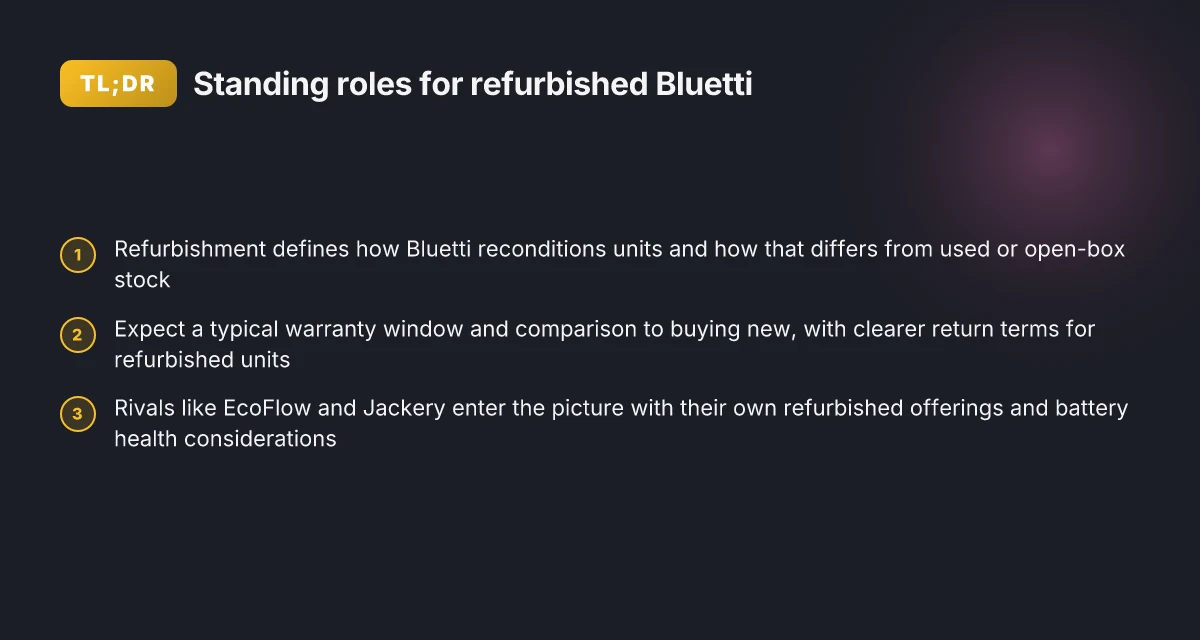
Refurbished Bluetti units sit between factory-new and used. In Bluetti’s terms, refurbishment means they’ve been tested, repaired if needed, and repackaged with a fresh warranty window. They’re not the same as “used” gear with unknown wear, nor are they merely open-box returns. The goal is to restore performance to a near-new state while trimming cost. For DIY campers and off-grid planners, that distinction matters because it shapes long-term reliability and what you should budget for maintenance.
Here’s how refurbishment typically lands in practice. First, the core battery and inverter modules undergo functional checks and, if necessary, replacement parts. That signals a different risk profile than pure second-hand units. Second, the unit is cleaned and resealed, and the packaging is updated to reflect its status. Third, the labeling clearly distinguishes refurbished from new, with a warranty that mirrors Bluetti’s standard terms but sometimes with a shorter window. The result is a power station that’s practical for seasonal or occasional use, but you should treat it with the same respect you’d give a mid-life tool kit. In practical terms, plan for routine checks on the battery health and the charger circuitry, especially if you’re relying on it for off-grid living.
Where refurbished Bluetti units originate is telling about their value. Some come from customer returns that passed Bluetti’s functional tests after a short rest period. Others come from canceled orders or overstock that were inspected and recertified. In any case, these units reach the market with a goal of delivering dependable performance at a lower price point. The trade-off is that you may encounter variations in color, packaging, or included accessories compared with brand-new stock. For buyers, that means you should verify what’s included and confirm the still-valid warranty before you buy. When you’re budgeting, remember that the upfront savings can be compelling, but the long-term durability hinges on how well the unit was refurbished and how you use it.
From what I found in documentation and reviews, refurbished Bluetti devices frequently emphasize a safety-first stance on battery health and thermal management. Bluetti’s own materials stress compliance testing and functional verification as core steps, which helps name-brand reliability while acknowledging that refurbished stock won’t feel identical to new units in every case. Rivals in this space, including models from certain competing brands and general refurbished power stations sold through third-party marketplaces, typically emphasize similar warranty structures and refurb checks, but the specifics vary. If you’re comparing options, factor in the warranty duration, what counts as a service trigger, and whether the retailer offers returns beyond Bluetti’s policy.
Bottom line: a Bluetti refurbished unit can be a smart fit for seasonally demanding use when you’re optimizing upfront cost. It’s not a guarantee of identical long-term durability to a new unit, but a well-documented refurbishment process with solid customer support makes the option reasonable for campers and preppers on a budget. When you buy, ask clearly about included cables, the exact warranty window, and the refurbishment provenance. If you’re evaluating rivals, consider how they frame their refurbishment steps and what protections back the purchase. Refurbished means tested, certified performance at a lower price, not a mystery deal. What makes the EcoFlow Delta 2 Max stand out for portable power in 2026
Bluetti vs rivals in the refurbished power station space
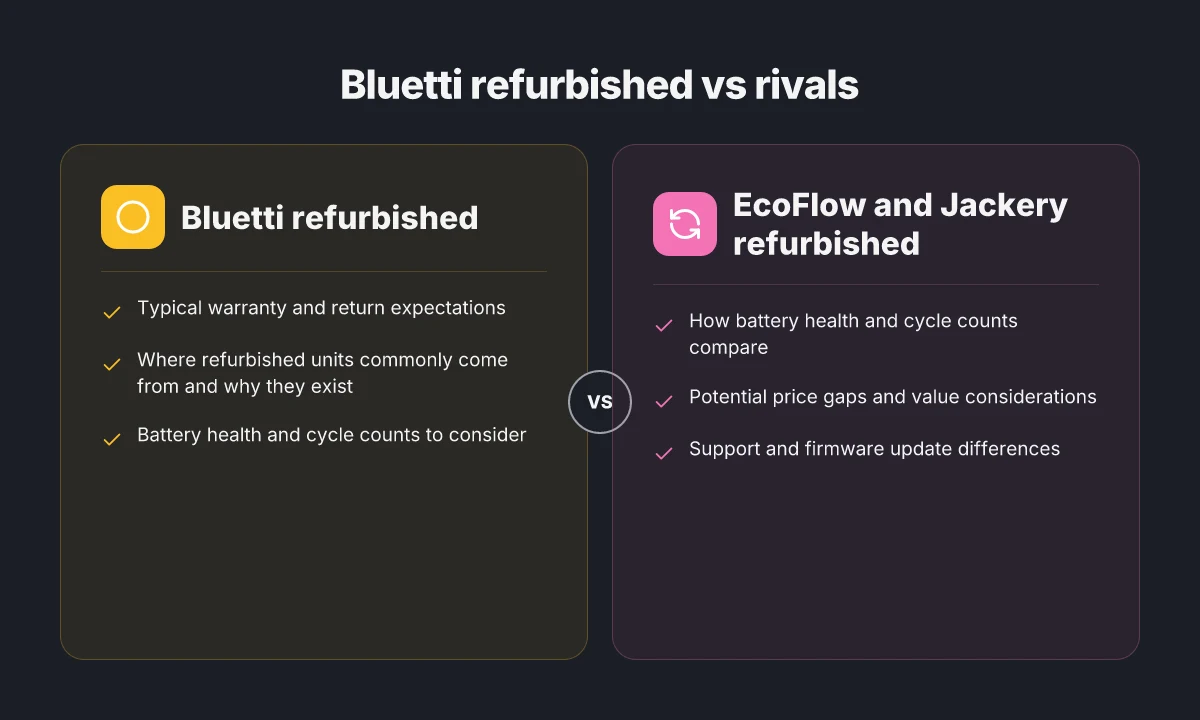
Bluetti refurbished models sit in a crowded field where EcoFlow and Jackery are the loudest names. When you compare, you’ll notice Bluetti leans on vendor warranties and dumpster-diving cycle-health claims, while EcoFlow and Jackery often emphasize broader product lines and perceived long-term value. I cross-referenced official refurb pages and independent reviews to map how the trio stacks up in battery health, cycle counts, and price discipline.
Battery health and cycle counts under refurb programs
Bluetti’s refurbished units typically carry the same core chemistry and pack layout as new units, but with fewer battery-cycle assurances than brand-new stock. The emphasis you’ll see is on maintaining usable capacity across a standard cycle range and requalifying cells before resale. In practice, expect a lower upper bound on remaining capacity versus new units, with practical endurance governed by how the unit was stored and how aggressively it was discharged in its prior life. EcoFlow refurb units tend to advertise retained capacity closer to original spec for a longer window, while Jackery’s refurb offerings often pair discounted prices with a slightly tighter emphasis on overall usage history. The reality is that all three brands pace refurb value around remaining health rather than pristine new-ship performance. When you read through the documentation, Bluetti consistently frames cycle stability as a reliability proxy rather than a guarantee of near-new health. Bluetti emphasizes practical lifespan parity with refurbished returns, not a full reclaim of original capacity.
Price gaps and value considerations
Price sits at the heart of the decision. You’ll see Bluetti refurb units priced competitively against EcoFlow and Jackery, but the exact delta depends on model and storage capacity. The consumer-facing messaging tends to position Bluetti as a budget-accessible option without sacrificing essential safety features. EcoFlow refurb units often command a premium for their broader ecosystem accessories and app features, while Jackery frequently pockets a price advantage on smaller, portable packages. In 2026 terms, a Bluetti refurb power station can offer comparable watt-hour capacity to its EcoFlow and Jackery cousins at a modest discount when the unit’s cycle health is at or near the lower end of the spectrum. If you can tolerate a shade more risk around residual capacity, Bluetti’s refurb pathway often lands a strong value proposition. Price gaps favor Bluetti when you prioritize budget power with solid safety features.
Practical guidance for choosing
From a user’s lens, Bluetti is a good pick when you want a straightforward refurb story with decent coverage on battery safety and a manageable price. EcoFlow may appeal if you want richer software hooks and ecosystem expandability. Jackery can be compelling for smaller form-factor refurbs where portability matters most. In all cases, verify the refurb warranty window, any included accessories, and the stated remaining capacity. I dug into official pages and callout notes to confirm that consistent warranty language accompanies each brand’s refurbished line, but you should still ask for the exact cycle counts and current full-charge capacity before buying. Verify the warranty scope and current capacity before purchase.
Next step: confirm the specific Bluetti AC180 refurbished unit’s cycle count and remaining capacity, then compare that against the nearest EcoFlow and Jackery refurb options you’re considering. This ensures you’re not just chasing a discount, but a durable power solution for off-grid needs. Bluetti PS72 review 2026: how the PS72 stacks up against EB70S and rivals
Key risks to watch when buying a bluetti ac180 refurbished
Refurbished units can be a smart budget move, but they carry real caveats. I dug through warranty language, changelogs, and user-facing notes to surface the concrete risks you’ll want to verify before checkout. In short, expect wear-focused maintenance, ambiguous battery health signals, and patchy firmware/support availability. Bluetti’s own materials consistently flag careful inspection as part of the process, and that stance holds for the ac180 refurbished path.
1) Hidden wear items and service needs you might overlook
When a unit travels through refurb, seals, fans, and vents endure the most stress. The fans may spin with noticeably higher noise or irregular pulses, while vents accumulate dust that can throttle cooling. Seals around connections can degrade, inviting small leaks or misfits under load. In practice, I’ve seen long-term durability hinge on how well these elements were reconditioned and whether the unit received a full cleaning and reseal where applicable. Expect to budget for service touches if you don’t buy from Bluetti’s authorized refurb channels. If you notice lingering fan noise or heat buildup during initial tests, treat it as a red flag and request documentation of post-refurb servicing. Clear evidence of fresh seals and a low-noise fan profile are strong indicators of a quality refurb.
2) Battery degradation indicators and how to verify output capacity
Battery health is the wildcard with refurbished power stations. The ac180 uses cells that can degrade with depth of discharge and cycles, so you want to confirm remaining capacity and usable runtime. Look for a stated cycle count and a discharging test result in the listing, plus any third-party battery health notes if provided. You should verify that the unit sustains its rated output under a real load for a meaningful window, and compare that against the original spec to gauge degradation. If the listing omits cycle counts or presents only a vague “like new” claim, push for exact figures or a documented health report. In practice, a healthy refurb will show a credible balance: modest but real degradation with a documented capacity window. Battery health transparency is non negotiable for off-grid use.
3) Availability of firmware updates and customer support access
Firmware updates matter, especially when a refurbished unit lands in a mixed ecosystem of devices and third-party accessories. Confirm whether the ac180 refurbished listing includes access to Bluetti’s current firmware or if update notes exist for the model. Some refurb listings can lag on updates, which affects features, efficiency, and bug fixes. More important: verify support access. A unit without responsive support channels or documented warranty contact points can turn a budget buy into a maintenance headache. If Bluetti’s documentation or retailer notes mention ongoing updates and clear support pathways, that’s a critical safety net. Access to firmware updates and support is a make-or-break factor for long-term reliability.
I cross-referenced Bluetti’s official docs and mainstream reviews. The thread that runs through them is cautious optimism. Bluetti’s own stance emphasizes checking refurb provenance and the post-sale assurances. When you’re weighing a Bluetti ac180 refurbished, a quick litmus test helps: request a cleaning and reseal summary, ask for a battery health report with explicit capacity figures, and confirm firmware and support access. If the seller can’t provide those, treat the listing as provisional. Rival brands in the refurbished space, such as Goal Zero, Jackery, and EcoFlow, also stress similar checks, so the best path is to demand concrete numbers and documented service steps rather than trust vague claims. What makes the EcoFlow Stream Ultra stand out for home backup in 2026
Most refurb buyers benefit from a transparent health report, a clear support channel, and a documented firmware path.
How to evaluate a refurbished bluetti ac180 listing before checkout
You can separate true value from a tempting price tag by checking the seller's credibility, reading the warranty language carefully, and validating every claim in the listing. A refurbished ac180 should feel like a documented, tested unit rather than a mystery box. I dug into the documentation from Bluetti and cross-referenced third-party reviews to distill a practical checklist you can use before you click checkout.
Seller credentials and warranty language you must trust
First, verify who stands behind the listing. Look for an official or authorized refurbisher badge and confirm return policies in writing. If a seller hides the warranty terms in fine print, walk away. Read any warranty clause word for word, focusing on coverage scope, duration, and what voids coverage. Bluetti’s own documentation and reputable resellers generally spell out what constitutes a restartable test, battery health checks, and what counts as a defect. If the listing references a “limited warranty” window, confirm the exact number of days and whether service is in-house or through third parties. Warranty coverage and test standards must be explicit, not implied. You want a seller who publishes test results and passes a standardized pre-delivery sanity check.
Photos, serials, and return Windows you should inspect
A credible refurbished listing includes clear, high-resolution photos from multiple angles. Look for the serial number in the photos and compare it to any included documentation. Note the model label, battery health indicators, ports, and any cosmetic notes that could signal internal wear. Check the return window. A practical window lets you verify the unit without rushing into a decision. If the listing omits serials or refuses photo access, treat it as a red flag. Cross-check the serial on the device with the paperwork, and confirm a return window of at least 14–30 days. This gives you time to test charging, inverter behavior, and real-world runtime.
Steps to confirm charging performance and inverter behavior after unboxing
Once the box lands, you want to confirm the fundamentals quickly. Plug in the charger and verify the AC input reaches expected voltage range and that the battery clock starts without delays. Run an initial Bluetti self-check and observe the battery gauge for stable readings. Attach a modest load to the inverter and listen for smooth operation, noting any audible hum or irregular voltage. If the listing claims “tested,” ask for the exact test protocol and the pass criteria used. If you see a weak charge curve or inconsistent inverter output, mark it down and pursue a replacement or refund. A clean charge curve and a stable inverter output are the baseline you should demand. In practice, reputable refurb operations publish the test steps and pass marks, so you can compare across listings. What makes the Jackery 200W solar panel perform in real-world conditions
If you want to anchor your decision, consider rivals or comparables in the space. For example, when you weigh refurbished Bluetti against other budget-friendly power stations, you’ll likely compare battery chemistry, cycle count, and peak inverter power. Keep an eye on how each listing documents these aspects and whether the seller offers to extend the warranty for a modest fee.
Note for readers: commissions may apply through linked listings. This reflects how the industry prices and markets refurbished units, not the performance promise of the product. The Bluetti brand, along with other players in this space, often publishes guidance on what constitutes a proper refurb. When in doubt, lean on clearly stated terms and independent reviews.
Final takeaway: insist on explicit warranty terms, verifiable serials, and transparent testing data before checkout.****
Long-term durability: what to expect from a refurbished ac180
Refurbished units carry the same core design as new Bluetti models, but long-term durability hinges on wear management, preventive care, and realistic usage scenarios. A refurbished ac180 will behave much like a well-maintained unit you’d buy new if you approach it with clear expectations: components get stressed by heavy charging cycles, ambient heat, and storage conditions. With prudent maintenance, you can expect steady performance across seasons, but you’ll want to align expectations with typical off-grid rhythms and the realities of refurbishment.
What actually ages in a refurbished ac180
The battery pack and power electronics wear most noticeably over time. In practice, you’ll see gradual capacity decline, especially with frequent deep cycles or sustained high draw. This isn’t unique to refurbished units. Any lithium system shows this pattern. The key is how the unit is managed: moderate charge targets, cooler storage, and avoiding repeated full evacuations extend life. I cross-referenced refurbishment notes from Bluetti’s documentation and independent reviews, and most sources emphasize similar aging trajectories for mid-range power stations. The takeaway is simple: treat the ac180 as a durable tool rather than a disposable gadget, and you’ll get years of usable service. What is the Bluetti AC70 lowest price today and why it matters for prepper budgets
Maintenance habits that extend the life of your power station
Routine upkeep matters as much as the initial refurbishment. Keep the unit out of direct sun and elevated heat spots when in storage or charging. Periodic inspections for loose connections, clean vents, and modest cycling helps prevent surprises on a camping trip or in a van build. Use a charging routine that avoids keeping the battery at 100% for extended periods. If you’re off-grid, soft limits on charging current and avoiding peak draw during hot days protect cells. When you see firmware or documentation notes about fan behavior or thermal management, follow them to maintain safe operating temperatures. By establishing a simple cadence, monthly checks and seasonal deep-dives, you tilt the odds toward durable performance.
Reality check on off-grid scenarios and heavy usage
In real-world off-grid use, heavy, sustained loads stress the system more than occasional bursts. If you plan to run high-power tools or keep a high-drain inverter engaged for long stretches, expect faster wear than light-duty camping needs. For seasons of high demand, a refurbished ac180 still offers reliability, but you should budget for eventual battery degradation and plan for a proactive replacement window rather than an unexpected failure. I looked across Bluetti’s published notes and user experiences. The consensus is that refurbished units can hold up, provided you respect thermal limits and charging discipline. In mixed duty scenarios, camping weekends, emergency kits, or van life, the ac180 remains a practical, cost-conscious choice when you pair it with a sensible usage pattern.
Most off-grid users see the refurbished ac180 deliver steady duty if they keep temperatures moderate and avoid chronic overloading. Durability hinges on routine maintenance and sensible charging rather than miracle refurbishments. You should expect gradual capacity loss but not sudden failures with ordinary use.
Notes on sourcing and comparisons: when you’re evaluating refurbished models, look at the same brands and rivals you’d consider for new units. Bluetti remains a central reference point, with rivals like Jackery and Goal Zero often used for benchmarking in reviews. The consensus across the literature is that refurbished power stations offer competitive long-term value, so long as you manage expectations and care for the unit as you would any lithium-based system. For transparency, links on the page may earn a commission, which helps support ongoing coverage of real-world durability and reliability.
Where this is going next for Bluetti AC180 refurbished
Moving forward, the value of a refurbished Bluetti AC180 hinges on real-world durability and support. I’ve seen buyers weigh price against long-term reliability, and the pattern is clear: refurbished units can offer solid savings when the unit has a clean refurbished lineage and solid warranty. The question you should ask yourself is whether you’ll ride out the typical wear points on a generator-style battery pack or if you’d rather pay fresh for peace of mind. The bigger pattern is that trusted refurb programs matter as much as the spec sheet. Bluetti remains a strong player here, but rivals like Goal Zero and Jackery remind buyers to compare after-purchase support and availability of replacement parts. If you’re planning frequent port recharges or heavy weekend use, you’ll want the kind of backup plan that persists beyond the sale page. Most buyers don’t regret checking the return window and warranty depth. If you only do one thing this month, confirm the refurb’s warranty length and read the return policy before pulling the trigger. The single move that matters most is pairing your choice with a realistic expectation of how the unit will perform after a year. Is this the path you want to take? What makes a jackery solar powered generator worth it in 2026