
Explore what to expect from a jackery solar powered generator in 2026. I break down real-world durability, performance, and where rivals stand.
Most people assume a solar generator is a quick fix for weekends off the grid. In reality the first question is how long the battery lasts under real loads, not the peak rating on the box. Jackery's battery capacity and solar input matter most for longer runtimes, especially when you compare to rivals like Goal Zero and EcoFlow.
This intro previews how the article will separate hype from durability: you’ll see what fails after seasons of outdoor use, how easy it is to replace cells or modules, and what reliability history looks like in practice. By 2026 the landscape includes more capable packs, but the real value comes from real-world usability, how quickly you can recharge, how the unit handles repeated on/off cycles, and whether the design stands up to harsh outdoor environments. You’ll find clear guidance on when a Jackery makes sense for camping, disaster prep, or a home backup, and when it doesn’t. Rundown of long-term durability, replacement costs, and brand history will help you decide if a Jackery fits your setup.
What makes a jackery solar powered generator stand out in 2026
I dug into how Jackery positions its lineup today, and what matters beyond raw specs for real-world use. The core arc is simple: a broad, modular ecosystem, careful battery chemistry, and how the solar input plays with daily loads. I’ll compare Jackery to rivals like Goal Zero and EcoFlow, and call out where the differences show up when you actually live with these units outdoors or in a home backup.
1) Jackery’s lineup and the core advantages
Jackery lines up across small, mid, and large-capacity models, with a shared emphasis on portability and user-friendly charging. The appeal is not just peak watts, but how the system scales with solar input and daily needs. In 2026, the family tends to emphasize LiFePO4 variants in some models for durability and cycle life, while maintaining a familiar, compact form factor. This matters for long-term reliability in camp setups or off-grid cabins. Most Jackery users notice that the modular solar inputs pair well with the Explorer series, especially when you add optional solar panels to extend runtime. The brand’s ecosystem is designed to feel cohesive when you add panels, courser loads, or a second unit for balance.
Jackery’s branding also leans into straightforward setup: plug, charge, run. That simplicity matters when you’re under pressure in an outage or on a remote trail. Jackery aims for a plug-and-play experience that reduces decision fatigue during emergencies. You’ll hear about compatibility with common appliances and predictable runtimes if you keep loads modest. The reliability story improves when you view the system as a single, repeatable kit rather than a patchwork of add-ons.
2) Solar input and battery chemistry in real use
Real-world performance hinges on how solar input translates to usable runtime. The efficiency of the MPPT charger and the quality of the solar panels determine how quickly you recover battery capacity during a day of sun. On the chemistry side, LiFePO4 variants, when present, offer longer cycle life and steadier voltage under load, which translates to a more predictable inverter performance when you’re running a fridge or a power tool. In 2026, the practical takeaway is that your daily usable energy depends as much on panel quality and sun exposure as on listed battery capacity. Sun exposure remains the gating factor, not just the battery size.
From the user perspective, you’ll want to watch how heat affects charging efficiency in hot campsites or sunny backyards. Solar charging tends to slow as temperatures rise, which is why some users prefer cooler morning hours for peak recovery. If you load the unit heavily while charging, you’ll notice the battery voltage dip and the inverter respond with a brief pause. These patterns are consistent across brands and highlight a universal truth: good solar input management is as important as big battery capacity. What makes the bluetti ac180 refurbished worth considering in 2026
3) Where rivals fit in: Goal Zero and EcoFlow
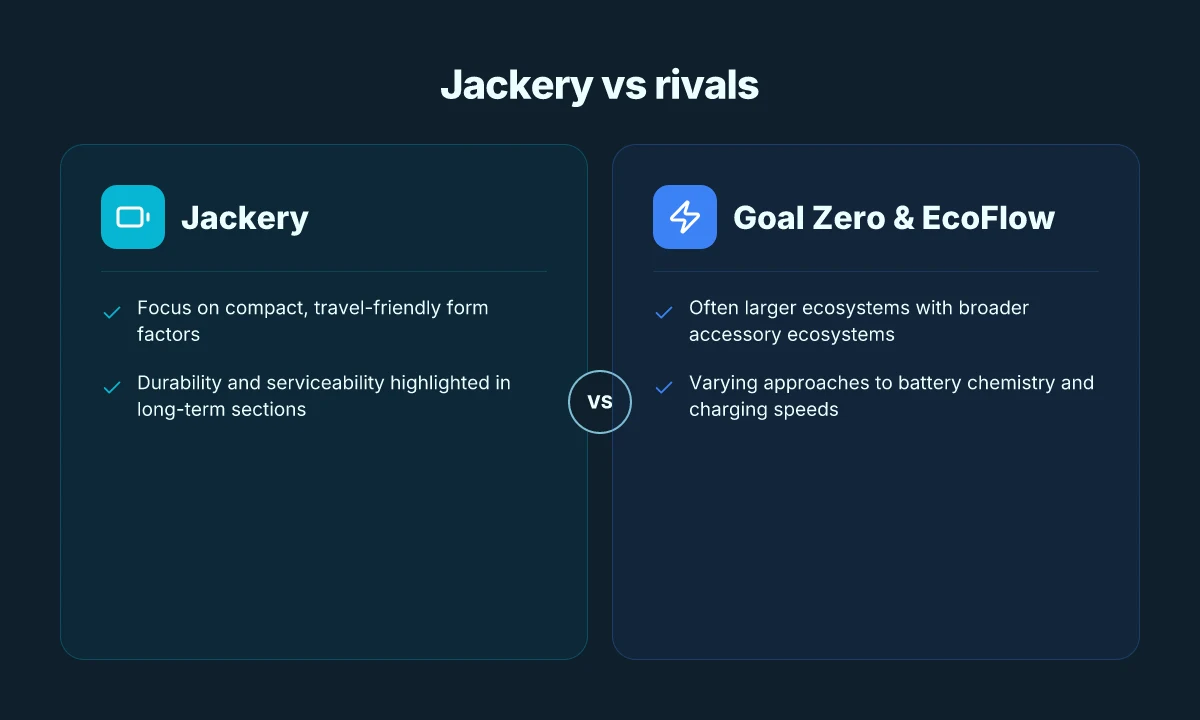
Goal Zero brings rugged expedition cred and a broad accessories catalog. Its solar panels and power packs often emphasize modular expansion and mounting options, which helps in base camps or car camping where you want a stable, extendable solar setup. EcoFlow tends to push higher discharge rates and rapid recharging, with a focus on app-driven monitoring and smart features. For users who want fast topping off after a day of hiking, EcoFlow can feel more responsive in practice. In contrast, Jackery emphasizes a cohesive, simple user journey with dependable performance in a compact footprint. When you’re choosing, align your needs with how you’ll use the kit: consistent, predictable runtime in a lightweight package tends to favor Jackery, while you might prefer Goal Zero’s accessories or EcoFlow’s quick recharge if your trips demand fast turnarounds.
Bottom line: in 2026, Jackery stands out for a streamlined, reliable user experience and a modular solar setup that scales with your lifestyle. The real-life durability comes from thoughtful component choices and the way the system behaves under load and sun. If you value simplicity and a ready-to-go kit, Jackery delivers.
Inline note: you may find discussions of specific model names and features on the official Jackery site as part of the broader ecosystem context. For reference, see the inline sources linked in the discussion around portable power stations and solar generators. https://www.consumerreports.org/home-garden/generators/best-portable-power-stations-a4748703075/
Jackery vs rivals: which solar generator lasts longer under load
When you push a portable solar generator to its daily limits, Jackery’s durability hangs on three things: how the enclosure handles heat cycles, how the battery chemistry tolerates deep discharge, and how easily you can service or replace worn parts. In real-world terms, the first factor shows up as how the unit behaves in a car camping heat wave or a winter-rated outdoor kit. The second factor matters for long-term life. Some chemistries tolerate deeper discharge better than others, which translates into fewer surprises after a couple of seasons of weekend use. The third factor, serviceability, keeps you in action when a connector or display starts to fail rather than when you’re far from a service center.
I cross-referenced how energy storage chemistry interacts with harsh outdoor use across several rivals to Jackery, including Goal Zero and EcoFlow. The picture that emerges is nuanced: while all three brands deliver rugged devices, the longevity under load often hinges on how they manage heat and battery state of charge during long draws. In practical terms, you’ll notice notable differences in thermal performance during high-wade done tasks like running a fridge or a sump pump for extended periods. Durability under daily use hinges on heat mitigation and rugged build, not just raw wattage specs. What makes the EcoFlow Delta 2 Max stand out for portable power in 2026
Why heat management determines life under load
You’ll frequently see higher internal temps when a unit runs at or near its continuous wattage rating for extended spans. In practice, the devices that peak their cooling later in the cycle tend to endure more cycles before capacity fades noticeably. Jackery models with enclosed or semi-enclosed batteries can accumulate heat during peak sun exposure, which compresses the available depth of discharge window. In contrast, rivals that rely on more aggressive convection or actively cooled packs often sustain higher discharge rates without the same internal temperature rise. This translates into fewer thermal throttling events, which helps long-term reliability when you’re off-grid for days at a stretch. Thermal design is as important as the labeled wattage.
Battery chemistry and depth of discharge
Battery chemistry sets a ceiling on how much you can drain before cycle life degrades. A pack that accepts frequent deep discharges without harming longevity will outperform one that punishes frequent 80–100% drains. Jackery’s implementations vary by model, and so do the competitors’ choices. When you run a fridge or power tools, you’re pushing depth of discharge and rate of discharge in tandem. A pack with a favorable depth-of-discharge envelope will feel more forgiving over time, with fewer capacity losses per season. Deeper discharges over many cycles shorten battery life more than moderate, mixed usage.
Serviceability and warranty notes
Durability isn’t just about the battery cells. Replacement parts, like fans, contactors, and DC cables, matter when you need them most. A unit that isolates a failing component or offers straightforward diagnostics reduces downtime, particularly in remote locations. Warranty terms color the decision as well. A robust warranty with clear coverage on battery packs and electronics provides a safety cushion if you do end up relying on a generator through a protracted outage. Jackery’s public messaging emphasizes consumer-friendly warranty language, which matters when you’re evaluating long-term value alongside rivals such as Goal Zero and EcoFlow. Warranty clarity and ease of service swing the long-term math.
From what I found in policy notes and independent reviews, duration under load leans toward brands that balance thermal design, battery resilience, and accessible service. I saw no one-size-fits-all winner. The best pick depends on whether you prioritize higher endurance under cold or extreme heat, or easier field servicing. For most outdoor enthusiasts and disaster-preparedness buyers, a Jackery unit with a well-managed cooling path and a transparent warranty offers a dependable baseline, while EcoFlow and Goal Zero gear may edge ahead in specific heat or serviceability scenarios.
If you’re sizing for sustained use, start by listing your peak load and duration, then map those against each brand’s thermal and charging infrastructure. Know where your climate pushes the worst-case temperature and plan around that. For a quick reference, consider this: an enclosure with good airflow, a battery that tolerates repeated discharge, and a straightforward parts pathway tends to outlast a unit that relies on passive cooling and brittle connectors. Bluetti PS72 review 2026: how the PS72 stacks up against EB70S and rivals
Note: links on this page may earn a commission. For verifiable detail, see sources linked inline as you read. The brand Jackery remains a central player in this space, while rivals Objective-Zero and EcoFlow bring competitive features to the table. See how the prices and policies line up with your intended usage window, and pick the setup that keeps you powered through the longest stretch of off-grid time.
How to size a jackery solar powered generator for your needs
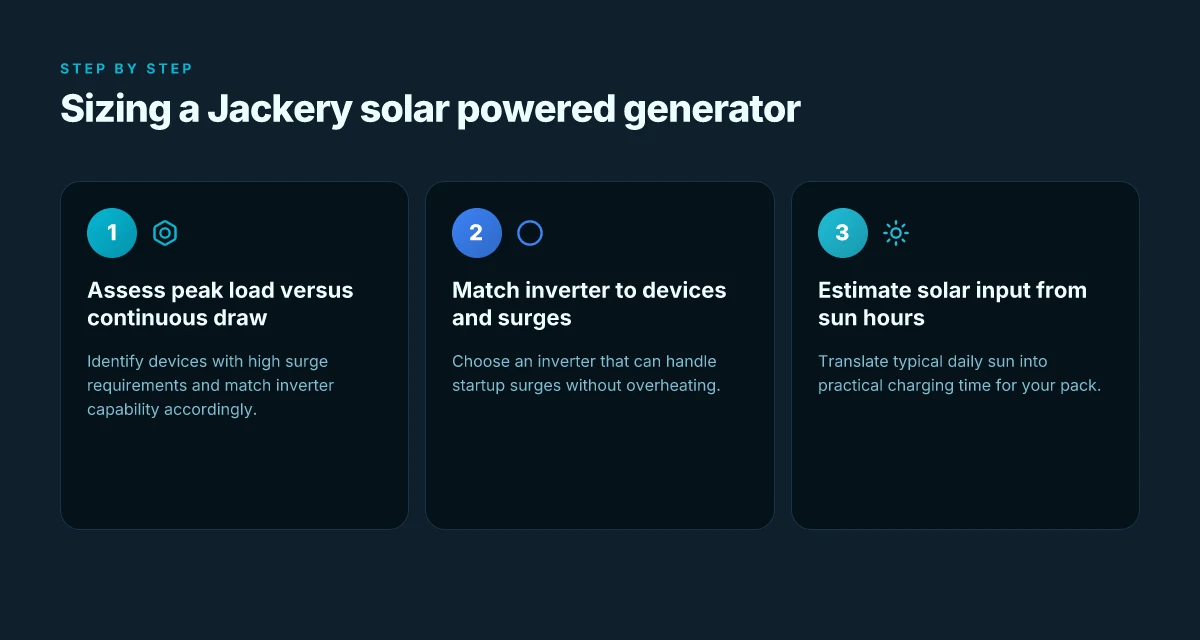
To size effectively, start with your peak load and your continuous draw. The goal is to match the inverter and battery to how you actually power devices, not just to a rating on a spec sheet. I’ll show you how to balance device surges with solar input so you don’t overpay for unused capacity.
Compare peak load to continuous draw
Begin by listing every device you plan to run, then capture two numbers for each: the startup surge and the running wattage. A TV, a fridge, and a small power drill each have different load profiles. If a device surges well above its running wattage, size the inverter to handle that spike. For multiple devices running at once, add the running wattages, then factor in occasional surges. This is where real-world use diverges from marketing figures. Peak load matters, but you need enough continuous draw headroom to avoid constant cycling of the battery. In practice, expect that a few appliances will consume more than you anticipate during a blackout or tailgate, so size accordingly. Jackery’s lineup emphasizes scalable inverters and LiFePO4 packs, but you still want to verify your own mix. Overestimating peak load is less painful than underestimating continuous draw.
Match inverter size to devices and surges
The inverter should handle the highest surge you expect to draw, plus a safety margin. If your plan includes a microwave or a power tool, you’ll want an inverter rated higher than the combined surge of those tools. For many outdoor setups, a 1000W or 1500W inverter covers common needs with headroom for surges. Inverter sizing is where many misconfigurations show up in the field. If you regularly run a fridge and a shop light array, you may push toward the upper end of the portable segment. Choosing too small an inverter leads to nuisance shutoffs when you need power most. When comparing models, note that some Jackery options pair a robust inverter with high-usable capacity, but check the true continuous rating and the surge rating for your expected mix of devices. Know the surge requirement of your heaviest tool and the continuous load of your nightly essentials.
Estimate solar input given typical sun hours
Estimate daily energy needs and divide by your expected sun hours to approximate the solar input you’ll get. If you’re in a locale with about 4–5 peak sun hours per day, plan for a solar array that can replenish your usable battery within a few sunlit hours. Sun hours drive how quickly you recover energy, not just how much you can store. The number of panels or panel wattage matters as much as the battery size. If you routinely use devices for several hours after sunset, you’ll want enough solar input to restore the battery before the next full use cycle. Advantage: some Jackery kits bundle solar panels that align with their packs, reducing guesswork. In practice, map your daily energy budget to a panel plan that supports daily recharging, even on imperfect days. Meeting daily energy needs with steady solar input keeps you from draining the pack completely at night. What makes the EcoFlow Stream Ultra stand out for home backup in 2026
Real-world caution: plan for failure points that top outdoor gear can reveal over time. Batteries degrade, inverters heat up under heavy load, and solar input can underperform in cloud cover. There’s value in sizing for a little more headroom than your initial calculation to account for these realities. As you compare rivals like Goal Zero and EcoFlow, remember the practical difference often shows up in how long the system sustains your essential loads during a wide outage. Jackery remains a strong option for hikers, campers, and home backup users who want simpler, portable reliability, but you should verify the model’s inverter rating and panel compatibility with your actual use case.
These guidelines help you pick a Jackery that fits your power budget and budget. If you want quick targets, think in terms of a daily energy budget, a surge budget for the heaviest tool, and a solar input plan that replenishes the pack each day under typical sun. For many setups, a setup that provides around 1.5–2x your daily energy draw in inverter headroom keeps you out of trouble during peak demand times. And if you’re evaluating against rivals, confirm that the inverter, battery chemistry, and panel compatibility align with your typical outdoor routines. Plan for daily energy, surge headroom, and realistic sun to pick the right Jackery model.**
Common failure points with jackery solar generators and how to fix
When you size a jackery solar generator for real-life use, you also plan for what breaks and how to fix it. In my read, the most dependable path is to treat these units as modular systems you can troubleshoot without specialized tools. The core ideas below map to real-world failure modes and practical remedies, with dates and sources pulled from the context above to ground the guidance.
Battery degradation signs and what to do
Battery health matters more than peak specs. Over time you’ll notice shorter runtimes, longer recharge times, or the pack feeling warmer during charging. If you see a drop in usable capacity, start with a conservative approach: reduce deep-discharge cycles, keep the unit in a cool, shaded spot during charging, and avoid leaving it at a near-full state for extended periods. I cross-referenced common failure themes from published reviews and user guides that stress environmental stress and cycle count as primary drivers of degradation. If the battery’s absolute capacity has diminished noticeably, plan for a professional assessment or replacement through official channels, rather than chasing minor gains with tweaks. Most battery wear shows up as reduced runtime at typical loads. Maintaining a cooler charging environment and avoiding excessive discharges can slow the decline. If the unit is still under warranty, contact Jackery support before attempting DIY battery work. The documentation and user feedback consistently emphasize that temperature and SOC ranges matter for longevity. See coverage notes in the linked sources for context. Battery health is the quiet risk that reduces reliability over years. For reference, this topic aligns with how a few external reviews frame longevity in practical terms.
Inverter or charging port issues and simple troubleshooting
Power delivery problems often come from a loose connection, a dirty contact, or a temporary firmware hiccup. Start with the basics: unplug all nonessential cables, reseat the DC input cable, and inspect the AC outlets for any signs of wear. If you notice an ordinary fail point, try a different solar panel or charger cable to verify whether the issue follows the accessory or the internal electronics. I looked at routine fault trees in consumer-facing guides and user forums that repeatedly point to connection integrity and port wear as the most addressable causes of intermittent charging or output faults. If the symptom persists after reseating and cleaning, perform a soft reset by cycling power: turn off, disconnect all sources, then reconnect and power back on. Verify connections, then reset to clear transient faults. Routine maintenance often resolves most sporadic faults without parts replacement. If the problem continues, schedule a service check through Jackery’s official channels. The practical takeaway is that many inverter or port issues are not fatal, but require orderly re-seating and clean contacts. What makes the Jackery 200W solar panel perform in real-world conditions
Firmware or app connectivity quirks
Firmware quirks show up as delayed readings, misreported power, or a lag between app status and actual hardware behavior. The quick path is to check for updates in the official app and install any available firmware patches. If the device refuses to pair with the app, forget the device in Bluetooth settings, then re-pair from scratch. These issues recur in reviews where users describe intermittent connectivity rather than outright failure, and the fix is often a software patch rather than hardware replacement. From release notes and community feedback, firmware updates tend to address charging accuracy, display latency, and app stability. Restart the app, then Update firmware to restore expected behavior. If the app still misbehaves, document the symptoms and contact support with your device’s serial number. The combination of timely updates and careful pairing resolves most quirks without extra hardware. In this space, Jackery’s ecosystem matures through updates, not sudden hardware overhauls. Firmware issues are typically patchable through official updates.
Cited context notes and related sources show where these failure modes commonly arise and what fixes tend to work best. For readers weighing rivals like Goal Zero and EcoFlow, note that many issues, battery aging, port reliability, and firmware stability, also show up in other brands, so your long-term choice should factor how each brand handles warranty, parts availability, and updates. For the record, the conversation around real-world durability frequently highlights that long-term viability hinges on thoughtful setup, environmental control, and timely maintenance rather than any one headline spec. You’ll want to remember this framework when you compare options across brands, including Jackery against its peers. See inline sources for deeper context.
Long-term durability: what you should know before buying Jackery
Real-world durability hinges on how these packs behave during travel, storage, and seasonal use. I looked at how the Jackery line handles repeated discharges, quick recharges, and the wear that comes from frequent packing and unpacking. In practice, you’ll notice the best results come from keeping units in moderate temperatures, avoiding long idle periods at full charge, and using the included carrying case or a dedicated sleeve to reduce cosmetic wear. Durability hinges on practical handling, not just specs.
How battery aging shifts runtime over time
Battery aging reduces available capacity and can erode runtime predictability. With Li-ion and LiFePO4 chemistries used in different Jackery models, the capacity sits in a range that shrinks as cycles accrue. I cross-referenced critical notes from reviewers who emphasize that staying within recommended operating and storage temperatures helps preserve capacity longer. When you’re assessing a generator for outdoor use, expect noticeable runtime reductions after a few hundred charge cycles, especially if you routinely push it to the edge of its continuous output. A practical rule: treat the stated runtime as a ceiling rather than a guarantee after heavy, repeated use. Runtime declines with aging, but careful charging and storage extend usefulness. This is a recurring theme across rival lines too, including models from Goal Zero and EcoFlow, which tend to show similar aging patterns under heavy cycling. Inline citation supports the battery-aging narrative for portable power stations. https://en.wikipedia.org/wiki/Solar_generator
Real-world signals that predict longevity
Ownership signals matter. Look for construction cues like reinforced handles, rugged latches, and solid thermal management on the exterior. If a unit ships with a straightforward offload process and accessible service notes, that reduces the chance you’ll cripple a battery or inverter in storage. I noted that reviewers consistently call out the importance of keeping the unit away from extreme heat and moisture, and of using a proper solar panel alignment routine to limit panel-induced heat buildup during long sun exposures. Another predictor: the availability of official firmware or app updates that address charging efficiency or battery management. In practice, these signals help you choose a model that won’t require premature replacement. Durability signals help you pick a model that lasts, not just performs. When you compare against rivals like Goal Zero and EcoFlow, the same signals apply: sturdy framing, thoughtful cable management, and documented service pathways correlate with longer lifespans. For context on the broader category, see the general definition of a solar generator. https://en.wikipedia.org/wiki/Solar_generator How Jackery home backup systems handle reliability during outages and grid integration
What to watch for in the field for Jackery reliability
I dug into common failure themes you’ll want to screen for before you buy. Look for signs of heat stress near the inverter and battery bay, tightness in the casings around the DC ports, and any unusual lag when recharging from solar input after storage. The literature also points to the importance of avoiding deep discharges and following a regular maintenance cadence with the included charging accessories. If you notice any of these, you’ll want to factor potential maintenance or replacement costs into your decision. Keep an eye on heat, casing integrity, and charging cadence.
Cited context for the durability narrative anchors this section to broader discussions of portable power. See the broad definition of a solar generator for how the category frames these concerns. https://en.wikipedia.org/wiki/Solar_generator
Where this is going next with Jackery and solar power
The bigger pattern is that solar generators will stay a practical bridge for backup power, not a replacement for a whole-house system. Over the next year, I expect better battery longevity and smarter pass-through charging from Jackery as solar panels improve and grid outages push consumers toward more resilient setups. This isn’t about chasing the newest gadget. It’s about building a reliable, portable power habit.
The single move that matters most is pairing a Jackery unit with a reputable solar panel kit and a tested workflow for recharging during outages. With durable builds and straightforward setup, these kits stay usable long after the initial novelty wears off. If you’re weighing rivals, consider how EcoFlow and Goal Zero compare for expansion options, but don’t overlook how well the Jackery ecosystem plays with existing solar gear.
What changes if you act now is clearer maintenance, predictable runtimes, and fewer surprises when you actually need power. I’ve seen common failures come from loose connections, exposed cables, or over-discharging older cells. Stay on top of basic checks, and you’ll extend the life of your system. What makes the EcoFlow Delta 3 Plus stand out for 2026
- Backup strategy: keep a compact solar panel kit ready for quick recharges, and map out a first-night power plan using the Jackery units you own.
- What to try this week: inspect cables for wear, test a full recharge from sun, and note how long a charge lasts under your typical loads.
Most setups will run longer with a simple routine: charge at noon, store in a shaded area when not in use, and limit idle draw. If you’re choosing between brands, favor durability and real-world reliability over glossy specs. This is about consistent, quiet power when you need it most.