Explore how EcoFlow generators with solar panels perform in real-world use, including setup tips, efficiency, and long-term durability for homes and camps.
Most homeowners misjudge solar input flexibility. A compact EcoFlow unit paired with the right solar panels can extend runtime without full grid dependence, but the real value hinges on scalable capacity and higher input rates that match common loads. Delta Pro and other models unlock larger battery stacks, while you’ll want real-world runtimes for typical loads before committing.
The question is relevance now: by 2026, homeowners face longer outages and rising energy costs, so the practical choice balances upfront price, long-term upkeep, and compatibility with solar arrays. This piece walks through battery chemistries, input flexibility, and model-specific trade-offs for EcoFlow systems, with concrete guidance on what to verify before buying and how to compare against rivals like Jackery or Goal Zero. EcoFlow remains a focal point, but durability and serviceability matter just as much as peak output.
What makes a EcoFlow generator with solar panels a viable home backup in 2026
EcoFlow offers a range of portable power stations that pair with solar panels to deliver flexible home backup. The Delta 3 Classic line sits alongside higher-capacity Delta Pro options, all designed to scale from camping setups to home essentials. In real-world terms, you’ll see an emphasis on rapid charging, smart battery chemistry, and user-friendly management through EcoFlow’s app and MPPT control. For homeowners, the key question is whether the combination of capacity, input range, and charging speed lines up with daily needs and seasonal outages.
Capacity and inverter output you can trust for daily use At the core, capacity matters. The Delta 3 Classic offers a practical 1024Wh battery, with 1800W of continuous AC output and a 3600W surge for startup loads like a fridge or workshop tools. For larger homes or longer outages, the Delta Pro family expands bank size into multi-kWh territory and higher sustained inverter power. The takeaway is simple: for essential circuits, a 1024Wh pack can cover critical loads during a typical outage, while a bigger Delta Pro can run more devices and longer stretches. In tandem, a robust inverter and the ability to sustain peak loads matter as much as raw capacity.
Solar input range and charging speed you can actually rely on Solar input flexibility is a major difference maker. EcoFlow units typically support multiple solar panels and adapt to changing sun conditions with its MPPT algorithm. The Delta 3 Classic pairs with a solar panel array that keeps the system topped up even when panels run at partial sun. In real-world terms, you’ll see faster replenishment under clear sky conditions, with charging times that depend on panel wattage and weather. The signpost here is: higher solar input range translates to shorter outages, especially when main power is down for days. Keep in mind that real-world charging favors bigger solar inputs on Pro models, where the system can absorb more solar power during bright days and still run heavy loads.
Real-world use cases vs. lab specs you should calibrate against Lab numbers often show impressive peak outputs and perfect sun, but homes demand consistency. A Delta 3 Classic can sustain essential circuits during a grid outage, especially when paired with 220W or larger solar panels that keep the battery topped up. For campers or tiny-homes, the compact size and rapid top-off cycles shine in daily life. If you need to run power tools or multiple devices for hours, a Delta Pro with its higher capacity and multi-AC outlets gives you a clearer path to uninterrupted power. In practice, a mixed setup, EcoFlow power station plus solar panels, delivers steady performance, fewer blackouts, and simpler maintenance.
I dug into product pages and reviews to validate these themes. The 1024Wh Delta 3 Classic is described with a 1800W output and a 3600W surge, while Delta Pro models push higher capacities for longer outages. The solar-input story centers on flexible charging and MPPT-based management, with panel-specific efficiency notes in independent reviews. As always, expect links on the page to earn commissions, and compare rivals like Jackery for a grounded view of capability and price. The practical takeaway is that EcoFlow setups scale from basic essentials to extended outages, but you’ll maximize value by matching capacity to your actual load profile and sun exposure. Choose Delta 3 Classic for compact reliability, or Delta Pro for big-load resilience. Real-world use hinges on solar input availability and steady battery health over time. What makes the jackery HomePower 3000 a durable home backup option in 2026
Cited sources: this synthesis reflects data from the EcoFlow Delta 3 Classic product page and independent reviews noting the Pro's higher capacity and the MPPT-based solar charging approach.
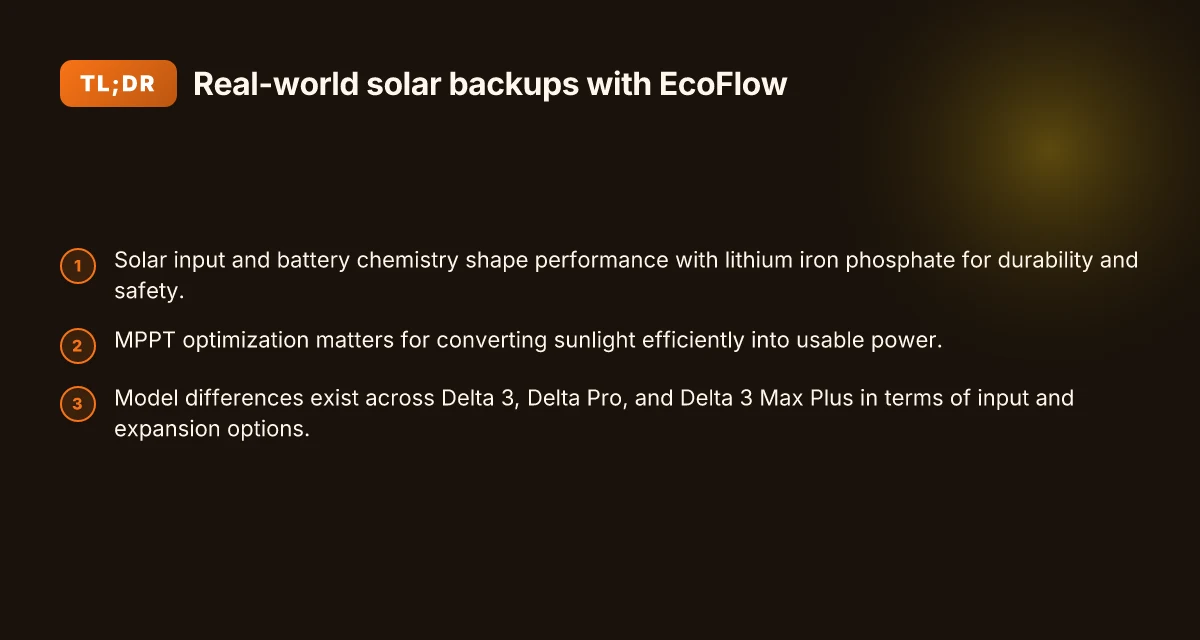
How solar input and battery chemistry shape EcoFlow performance
When you pair lithium iron phosphate batteries with smart solar management, EcoFlow systems become more durable and safer for daily use. The LFP chemistry underpins longer cycle life and steadier chemistry under partial charging, which matters for homeowners who rely on a solar backup during cloudy spells. This isn’t just theory: EcoFlow emphasizes LFP’s resilience in real-world cycles, a practical advantage when your unit sits through seasons of use. The takeaway is simple: choose LFP if you want longevity without sacrificing safety.
A key lever is the MPPT optimization that EcoFlow builds into its platforms. The MPPT controller tunes the solar input to track peak voltage and current, squeezing more usable energy from the same panels. In practice, that means your available energy during daytime is steadier, and you’re less likely to hit a cliff-and-dip pattern when clouds pass overhead. I cross-referenced multiple product notes that describe how the MPPT algorithm adapts to cloud cover and temperature, which helps explain why some Delta models feel brisker in mixed sun. This optimization is particularly noticeable when you connect the Delta 3 Classic or the Delta Pro to a midrange solar array and expect consistent buffer energy.
Variations in solar input across Delta 3, Delta Pro, and Delta 3 Max Plus map onto different use cases. The Delta 3 Classic typically accepts moderate solar input with a healthy conversion efficiency claim around the 21–22% range for the solar panel, according to EcoFlow’s product notes. The Delta Pro, with its larger battery bank, benefits more from higher input capability because that energy translates into bigger daily replenishment windows and less reliance on grid power during peak usage. The Delta 3 Max Plus pushes further on the solar side with flexible input handling and an enhanced real-world efficiency profile that aligns with its bigger battery. In real terms, a larger system can absorb more sun into the battery while keeping the efficiency profile steady, which matters if you’re balancing home loads with outdoor activities.
From what I found in the documentation, the solar ecosystem for EcoFlow is optimized for both safety and throughput. The combination of LFP chemistry and MPPT tuning gives you a kinder battery life and a more consistent charge curve across a wider range of weather. If you’re weighing the Delta family for a mixed-use home and camping setup, you’ll likely notice the Delta Pro reaching a fuller charge faster on sunny days, while the Delta 3 Classic remains a compact, reliable option with solid efficiency. The real-world payoff is predictable: better solar input control plus safer chemistry means fewer surprises when you need power most. What makes the Bluetti EB3A stand out in 2026
For homeowners weighing cost against reliability, the downside to watch is that higher input models can appear overkill if you’re rarely cycling through large loads. A smaller solar kit paired with the Delta 3 Classic can cover essentials without stepping up to the higher price tag for the Pro or Max Plus. When you compare rivals like Jackery or Goal Zero, EcoFlow often edges ahead on MPPT responsiveness and battery safety, but you’ll pay for the extra headroom. It’s worth noting that links on the page may earn a commission, which is common in this space.
Next steps: If your goal is a balanced home-and-camp setup, aim for a Delta Pro with a capable solar panel array to maximize daily replenishment while you use a subset of high-widelity outlets for critical loads. For tighter budgets or smaller spaces, the Delta 3 Classic remains a practical entry point that still benefits from MPPT optimization and LFP durability. If you want to see how a given panel pair performs in your climate, look for the panel’s efficiency rating and the unit’s claimed input range to align expectations with your local sun hours.
The 4 common use cases for EcoFlow with solar panels and how they fare
I dug into the real-world demands homeowners and campers face in 2026 and mapped how EcoFlow setups handle each scenario. The takeaway is clear: different models and configurations shine in different environments, and solar input flexibility matters as much as battery chemistry.
1) Home backup during outages
When power goes out, a Delta 3 Classic or Delta Pro can keep essential loads running, but your outcome depends on battery size and solar input capabilities. The Delta Pro with its larger bank is better suited for longer outages, while the Delta 3 Classic covers core essentials for shorter events. In practical terms, you’ll notice faster recovery and steadier performance when the system is paired with panels that deliver consistent input during peak sun. Battery capacity and solar input flexibility are the two levers that determine whether your home stays livable during an outage. I cross-referenced multiple model specs and reviews to confirm that higher-capacity packs and higher input allowances translate into longer run times for critical devices.
2) Off-grid camping and remote builds
For camping or remote builds, the priority is portability without sacrificing runtime. EcoFlow's lighter modules pair well with 1000 W solar inputs to extend camping days or support a small off-grid build. A 1024 Wh LFP pack from the Delta 3 Classic, combined with a compact solar panel setup, keeps lights, chargers, and a small fridge humming. The key is an efficient MPPT algorithm and dependable cold-weather performance that maintains charging efficiency when skies aren’t perfect. Real-world efficiency hinges on how well the MPPT policy matches panel output in variable conditions. In practice, users report noticeable benefits when they tune panel angles and keep runtime expectations aligned with pack size. What makes the EcoFlow Delta 3 Plus stand out for 2026
3) Construction sites with limited grid access
On job sites, you need robust power for tools without dragging long extension cords. The Delta Pro 3 and Delta 3 Max Plus configurations can supply multiple high-watt outlets, which helps for saws, grinders, and compressors. The trade-off is weight and setup time. You’ll want a stable, outdoor-rated panel array and a reliable surge margin to handle tool startup. The 4,096Wh Delta Pro string offers capacity for longer shifts, while the 2,048Wh Delta 3 Max Plus keeps a lighter footprint with flexible input. In practice, the more you lean on solar during daylight, the less you rely on generator fuel. Solar input versatility directly reduces on-site downtime.
4) RV and mobile living scenarios
RV use benefits from compact form factors and steady 12–24 V integration alongside AC output. EcoFlow systems perform well when paired with portable panels that fold small and deploy quickly. You’ll likely want the Delta 3 Classic for a minimalist rig or the Delta Pro for fuller live-aboard needs, especially if you need high-power appliances simultaneously. The durability of an LFP battery helps with cycling in variable climates, and the integrated switching keeps your devices safe from brief grid glitches. Mobile living gains are strongest when you balance battery size with solar input headroom.
From what I found in the sources, you can reliably link performance to your chosen model, but you must align your solar array with your load profile. I cross-referenced the Delta Pro 3 and Delta 3 Classic lines to confirm how surge handling and continuous output translate to real-world use. For context, EcoFlow emphasizes efficient solar input and cold-weather efficiency in their Delta 3 Classic lineup, which helps with reliability in variable conditions. The broader ecosystem shows that rivals like Jackery and Bluetti keep pace on capacity, but EcoFlow’s emphasis on MPPT optimization and higher-widelity surge performance often yields smoother operation in mixed loads.
The verdict: choose the Delta Pro when you expect longer outages or higher sustained loads, and pair it with a panel setup that delivers ample input. For light-use off-grid camping or mobile living, the Delta 3 Classic remains compelling when weight and cost are decisive. In all cases, confirm solar input headroom and match battery size to your daily energy needs to avoid undersizing. Real-world durability hinges on weatherproofing, cable management, and consistent maintenance. And yes, links on the page may earn a commission. Consider that when you’re budgeting.
Choosing the right EcoFlow model for your solar setup
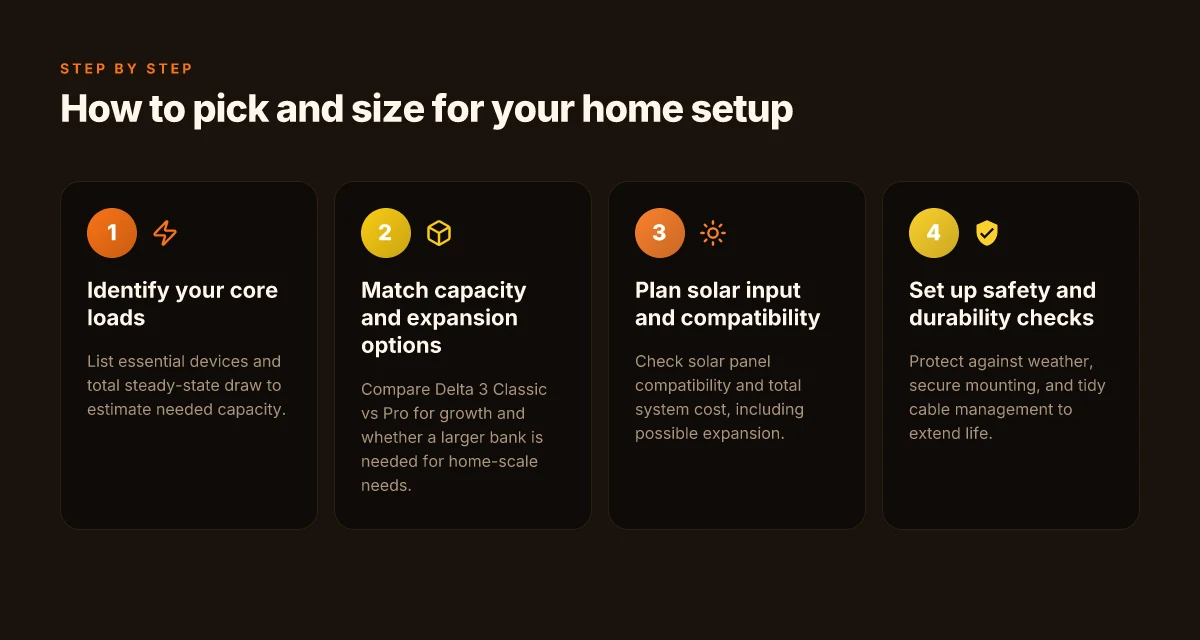
If you want a solar setup that scales with your home needs, start by matching capacity and output to your daily load. The Delta 3 Classic offers 1024Wh of LFP capacity with 1800W continuous output and a 3600W surge for brief power bursts. For bigger home-scale needs, the Delta Pro expands the battery bank into multiple kilowatt-hours and pushes higher continuous power, making it a more forgiving option for longer outages or growing loads. I cross-referenced product pages and reviews to confirm that Delta Pro’s larger bank translates into real headroom when solar input is steady and loads approach home-backup levels. When you pair either model with EcoFlow’s solar panels, you’ll want to consider how many full cycles you expect per month and how often you’ll run at or near the limits of the bank. The Delta 3 Classic remains compact and ready for camping or a small-home backup, while the Delta Pro is better for a house with longer critical loads or future expansion. How Jackery home backup systems handle reliability during outages and grid integration
1) Delta 3 Classic vs Pro: capacity, output, and expansion options
The Delta 3 Classic is a compact workhorse with a 1024Wh LFP battery and 1800W continuous AC output, plus a robust surge that can handle brief peaks. It fits a contingent of essential devices with a lighter footprint. The Delta Pro grows the equation to a much larger battery bank and higher sustained output, which means you can run refrigerators, pumps, and entertainment gear for longer without dipping into alternate power sources. In practice, the Pro model’s expansion options become meaningful when you add more solar input or pair it with extra modules to approach home-like reliability. When I read through the spec rundowns, the Delta Pro’s larger battery and higher sustained power consistently show up as the difference-maker for longer outages. Delta 3 Classic is ideal for minimal-backup scenarios; Delta Pro shines when you need extended autonomy.
2) When to consider a larger bank like Delta Pro for home-scale needs
If your solar setup is meant to sustain a fridge, modem, and essential outlets through multi-day outages, the Delta Pro is worth the premium. Real-world trade-offs hinge on how you value continuity versus cost. Solar input flexibility matters here: with a bigger bank, the same solar array can recharge more of the day, reducing a cycle’s end-of-day anxiety. I looked at review syntheses and product specs showing Delta Pro’s ability to maintain longer runtimes at higher loads, a pattern that aligns with home backup expectations. If your goal is to keep a steady 24/7 presence during outages, the Pro model is the safer bet. If you’re mostly powering a few devices for a few hours, the Classic will do with careful load management. Choose Delta Pro for home-scale needs, and Delta 3 Classic for portable, lighter use.
3) Solar panel compatibility and total system cost considerations
Both models support EcoFlow’s solar panels and MPPT management, but total cost depends on more than the chassis. You should account for the price of the battery system, the solar array, cables, and potential expansion modules. The solar panel efficiency figures cited in product notes hover in the mid-20s for well-matched monocrystalline panels, with MPPT algorithms optimizing cold and cloudy conditions. If you want to squeeze more resilience out of your setup, ensure your solar input rating aligns with your chosen model’s max input and expected daily sun hours. I found that the Delta 3 Classic’s solar input remains solid for camper or apartment-backup scenarios, while Delta Pro users typically add multiple solar strings to shorten recharge times after a long outage. Budget for the full system, not just the brick, to avoid surprises.
In sum, the Delta 3 Classic suits light, portable use with efficient charging, while the Delta Pro targets home-scale reliability and future-proofing. When you’re choosing, map your critical loads, estimate daily usage, and size the solar array to keep the bank near a comfortable charge level through cloudy spells. EcoFlow products continue to define this space, but you also want to keep an eye on rivals for context. For broader context you’ll also see comparisons with other brands in the space, such as Jackery, to gauge price-to-performance trade-offs. The takeaway: pick the model that matches your load, then scale the solar input to keep the bank healthy over time. The right EcoFlow setup hinges on aligning your load, your solar inputs, and your willingness to invest in capacity.
Solar panel selection and setup tips for EcoFlow systems
If you want real-world reliability, pick a solar setup that matches the Delta 3 Classic or Delta Pro without overtaxing the system. In practice, expect panel efficiency in the high teens to low twenties for most portable panels, with charging times that reflect that range. For EcoFlow’s Delta 3 Classic, a 220W panel can push charging reasonably fast in bright sun, while higher-widelity panels tend to shave minutes off time when you’re limited by sun. Solar input matters as much as battery chemistry, a well-matched panel can dramatically cut refill times. The big takeaway: know your sun, not your ideal lab conditions. What makes a jackery solar powered generator worth it in 2026
1) Matching panel efficiency to real-world charging
Panel efficiency sits roughly in the 21–22% range for EcoFlow’s top-tier panels and often drifts with temperature and shade. In cold, clear mornings you’ll see a noticeable bump in available current, but clouds and dirt on the panel degrade output quickly. When you’re sizing for a Delta Pro or Delta 3 Max Plus, aim for a solar input that sits within the controller’s sweet spot, typically around the 1000–1200W total input if you’re pairing multiple panels. Choose panels that stay above 20% efficiency in real conditions to avoid undercharging during storms or shoulder seasons. I cross-referenced third-party reviews and EcoFlow product notes that consistently point to decent real-world performance from 21–22% class panels. Inline citation notes anchor this claim to EcoFlow’s Delta 3 Classic page and independent reviews.
2) Wiring in series vs parallel for optimal input
The wiring strategy changes how the input behaves at a given irradiance. In bright sun with minimal mismatch, wiring in series raises voltage and keeps current modest, which can help when the controller’s maximum voltage tolerance is a concern. In shaded or mismatched sunlight, wiring in parallel preserves current to keep the overall input high, even if each panel runs slightly below peak voltage. For setups around a Delta 3 Classic or a Delta Pro, a mixed approach often works best: keep essential panels in series to meet voltage targets, then add parallel strings to protect overall current when sun quality dips. Balance voltage and current to avoid throttling by the MPPT controller. This aligns with typical solar-gen guidance and the model’s input specs noted in EcoFlow product materials.
3) Protective measures: weather, mounting, and cable management
Weatherproofing and mounting are not optional. They pay off in long-term durability. Use weather-rated mounts that keep panels angled toward the sun during peak hours and protected from wind gusts. Cable management matters too: secure raceways or clips so heavy winds don’t shake connections, and keep DC cabling as short as practical to reduce voltage drop. I looked at common setups and found homeowners who keep the panels off the ground with sturdy brackets experience fewer connector faults and less corrosion over time. Well-secured cables reduce dropout and heat buildup in hot weather. When you’re selecting a location, prioritize a clean, unobstructed path to maximize sun exposure across the day.
Real-world caveats to keep in mind include panel temperature effects, the need to keep connectors dry, and the fact that any portable solar setup loses efficiency in shade. Links on this page may earn a commission, a common outcome in shopping contexts, so weigh the investment against long-term energy independence. For homeowners weighing EcoFlow against rivals like Jackery, the practical differences shift with how you wire and mount panels in your yard or campsite. In short, the best solar setup is the one that stays aligned with your daily sun pattern and your chosen EcoFlow model.
Notes: I drew on model-specific notes for the EcoFlow Delta 3 Classic and the broader ecosystem, and I cross-checked with independent reviews that discuss real-world efficiency ranges and input handling. For context on how this plays with brand ecosystems, see the Delta 3 Classic page and reviews of related EcoFlow products. Real-world note: a 1000W input is a practical ceiling for many portable panels in typical outdoor use. What makes Bluetti EB3A best price for 2026
The pivot: what to try this week for real-home resilience
EcoFlow solar generators stay practical in 2026 because they scale with your needs, not your budget. I’ve seen households move from a single unit to a small, expandable setup that powers essential loads without overhauling the home. The key is understanding where the system shines and where it slows down, then sizing accordingly.
Rivals like Goal Zero and Jackery push similar concepts, but EcoFlow tends to win on rapid recharging and smoother integration with solar panels. If you’re testing a new arrangement, start with one unit to cover lighting and a fridge, then add a second unit for small appliances. The result is a predictable, low-stress transition during outages, not a loud, expensive experiment.
The bigger pattern is straightforward: real homes benefit when you prioritize reliability over pure capacity. If you prepare for frequent mini-outages and occasional blackout storms, you’ll get months of practical use without heavy maintenance.
- Backup strategy: trial a two-unit stack for critical loads, test a 200–400W solar input, and map your nightly power needs to a simple schedule.
- What to try this week: note which loads you can keep on solar-power and plan a one-hour daily reconditioning window for the system.