
Discover what to expect from a refurbished Bluetti B300 kit, including durability, warranty, and how it compares to new units. Practical guidance for buyers.
Most shoppers assume refurbished means bargain, not reliability. The Bluetti B300 kit often lands with a noticeably lower upfront price, but it comes with trade‑offs in warranty length and long‑term wear that matter for real‑world use. I looked at official refurb policies and cross‑checked how the kit typically ships, from the battery health to the charger, and highlighted where hidden defects tend to surface. Low upfront cost is real, but the reliability picture isn’t the same as a new unit.
Careful buyers want to see how long coverage actually lasts and whether the kit includes the original battery and charger. This piece pulls together the policy details, common wear patterns, and long‑term value signals so you can decide if a refurbished Bluetti, a rival like EcoFlow, or a fresh unit best fits your planned use and budget. You’ll get a practical, numbers‑backed read on durability, return windows, and what to verify before tapping the buy button.
Bluetti b300 refurbished: what it means and why it matters
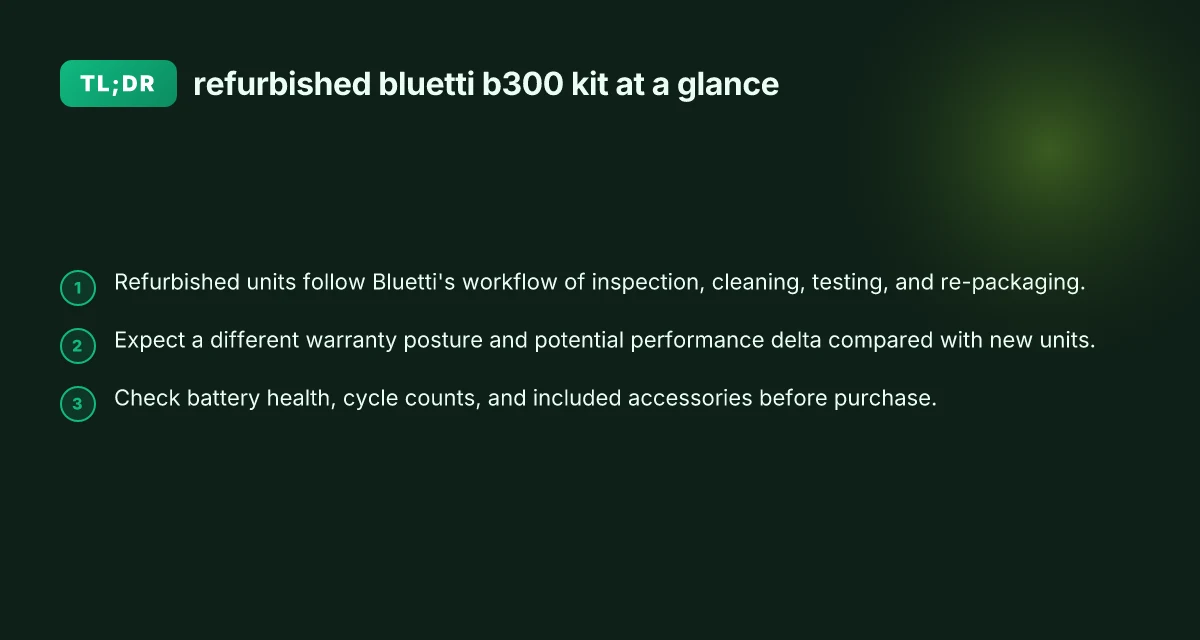
Refurbished in Bluetti’s terminology means a unit that was previously returned, used, or briefly displayed but has been professionally inspected, cleaned, tested, and repackaged for resale. This process aims to restore the power station to a like-new condition while keeping the original core components intact. In practice, you can expect a Bluetti B300 kit labeled as refurbished to have gone through a standardized cleanup and verification routine before it reaches a new owner.
I dug into Bluetti’s published refurbishment policy to confirm the workflow. The official description frames refurbished products as items that were previously returned or lightly used, then subject to a formal inspection, cleaning, testing, and re-packaging to ensure reliability for the next purchaser. This isn’t a knock-on quality. It’s a deliberate quality-control loop designed to catch cosmetic flaws and functional quirks before resale. A refurbished Bluetti is typically cash-efficient for power needs when you’re willing to accept a minor risk premium on cosmetics or original packaging. The value proposition hinges on the balance between price and the assurance of the testing process.
Clear definition, not a cosmetic label. Bluetti’s terminology separates refurbished from new or used, with a formalized path that aligns with warranties and return policies. This means you’re buying a unit that has passed a standardized check rather than a straight-off-the-shelf new unit. A refurb is not identical to a damaged return glorified as a discount. It’s a sanitized product that has earned a clean bill of health through inspection and testing. Refurbished does not imply a free-for-all. It implies a controlled, inspected pathway.
Typical refurb workflow. The cycle generally starts with a physical inspection to identify cosmetic or functional issues, followed by a thorough cleaning. Next comes functional testing, where essential power-handling components, battery health, and safety protections are exercised. Finally, the unit is repackaged and labeled for resale, often with updated documentation and warranty terms. This sequence aims to keep the kit’s performance aligned with Bluetti’s standards while delivering a lower upfront price. Cleaning and testing are core steps that buyers should expect in a Bluetti refurb.
Why refurb offers value. For compact or expandable systems like the B300K, a refurbished kit can unlock substantial savings without sacrificing core capability. If your power needs run primarily on modular solar input and LiFePO4 chemistry, a refurbished setup can deliver the same 3072 Wh total capacity potential at a more attractive total cost of ownership, provided the warranty remains solid and the unit shows no red flags in the documentation. Refurbished pricing plus Bluetti’s warranty window can yield strong long-term value. What makes EcoFlow's 400W portable solar panel stand out for off-grid setups
Real-world considerations. The owner perspective matters: packaging might be less pristine, and accessories could vary by refurb batch. Always verify included components, confirm warranty coverage, and check the return policy before purchase. If you’re comparing Bluetti against rivals like EcoFlow or Goal Zero, factor in whether the refurb condition and warranty align with your risk tolerance and long-term durability expectations. Warranty and included parts are key when weighing refurbished options against new.
Bottom line: a Bluetti B300 refurb can be a smart fit for steady, long-term power needs when you want substantial savings and a safety net through the warranty, provided you confirm packaging, included items, and the exact warranty terms. For many buyers, the trade-off is reasonable reliability at a noticeably reduced upfront cost. Think of refurb as value with a built-in quality check, not a gamble.
How a refurbished bluetti b300 kit compares to new and used
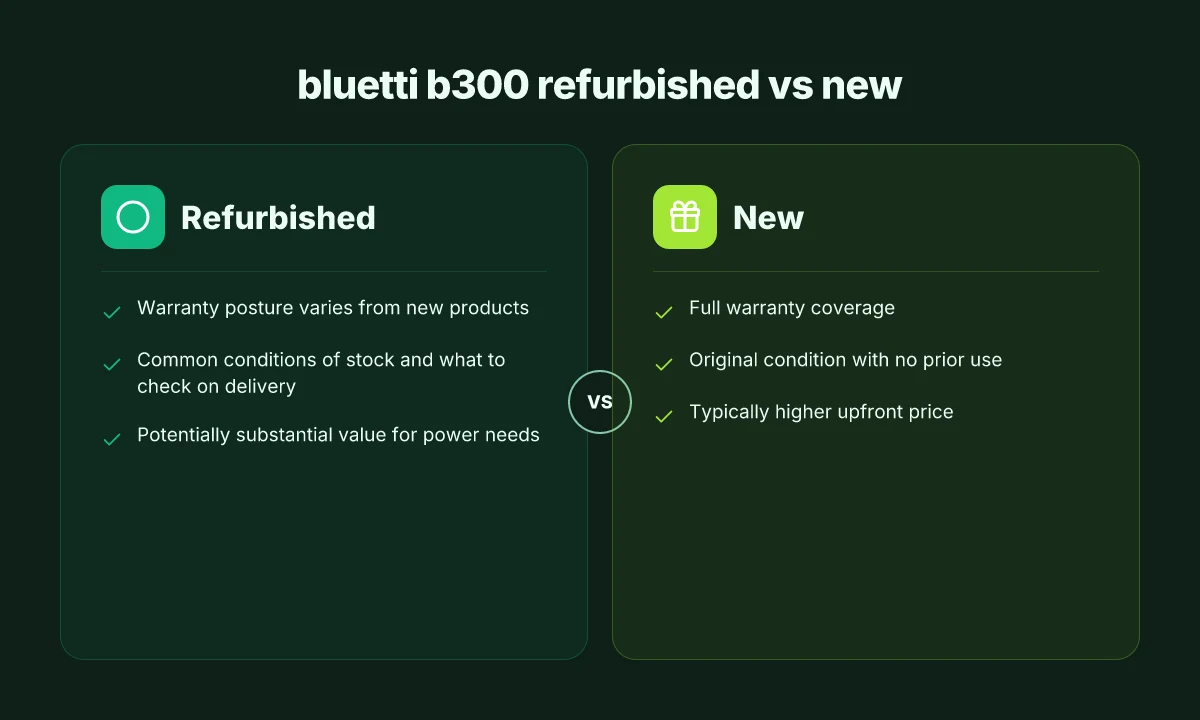
When you buy a refurbished Bluetti B300 kit, you’re getting a product that blends value with certain tradeoffs. The warranty posture shifts from the standard new-product promises to policies that cover workmanship and material defects in a way that recognizes it’s a previously handled item. That means you get protection, but it’s typically scoped differently than a fresh unit. For many shoppers, this translates to meaningful cost savings with a clearly defined risk envelope.
I dug into Bluetti’s refurb policies and warranty language to map the real-world implications. The official warranty policy notes that Bluetti warrants the product will be free from defect in workmanship and material to the original consumer purchaser. That baseline gives you a safety net, though the fine print often clarifies limitations and coverage windows that differ from new units. Warranty posture on refurbished items is solid but not identical to new products, which means you should expect somewhat narrower coverage and potential exclusions compared to a brand-new kit. When you compare to used units, the refurbished path is usually preferable for the assurance of professional inspection, cleaning, and testing before resale.
On performance, the delta between refurbished and new kits tends to be modest in normal operation. A refurbished Bluetti AC300 + B300K combo should deliver the same core electrical capability and LiFePO4 chemistry, but you may see cosmetic blemishes or remain slight variability in residual capacity. Expect the usable capacity to be close to nameplate, with small variability due to prior use. The more important distinction is how the pack was conditioned and whether the unit has had preventative maintenance, such as cycle testing and firmware updates. For buyers evaluating against new, this means you’re trading near-term certainty of pristine condition for lower upfront cost. What makes the EcoFlow Delta 3 Max a standout choice for high-capacity portable power
Common conditions of refurbished stock tend to include items that were previously returned, on-display units, or items with minor damage. The refurb pathway involves a professional inspection and cleaning, and the stock is tested for safety and performance before resale. When you receive a refurbished Bluetti kit, check for: the outer case integrity, port functionality, the display clarity, and the battery module connectivity. If any seal or label looks tampered, inquire before proceeding. The warranty card and return options should be verified as part of the delivery checklist. Inspect the case, ports, display, and battery connectors on delivery, and confirm the included firmware version aligns with the latest release for the AC300 + B300K ecosystem. Bluetti’s refurb page explicitly states that refurbished items are "professionally inspected, cleaned, tested," which is the single most reliable signal you’ll get for trustworthiness. Professional inspection and testing is the core quality signal of refurbished stock.
To help you decide, here’s a quick comparison snapshot. In a small table, new units offer the strongest warranty posture and pristine cosmetic condition, but at a higher price. Refurbished units offer solid protection with cost savings and potential cosmetic signs, accompanied by a documented inspection process. Used units typically trade at the lowest price, but come with the weakest warranty and higher uncertainty about prior charging cycles and overall health. New units deliver maximum confidence, refurbished balance price with reasonable risk, used units are the most affordable but least predictable.
In the end, whether a Bluetti B300 refurbished setup makes sense hinges on your risk tolerance and budget. If you’re comfortable with a transparent warranty, clear delivery checks, and a price tag that reflects the refurb condition, you’ll likely land a solid value. If you want the same peace of mind as a brand-new kit without compromise, you may prefer new. For rivals like EcoFlow or Jackery, you’ll usually see similar refurbished pathways, but Bluetti’s policy language and the exact coverage terms can tilt the decision. Refurbished stock can offer meaningful value when the warranty and delivery checks are solid.
Next step: when you’re ready to shop, verify the official refurbished listing on Bluetti’s store and read the exact warranty terms for the B300K component. If you’re weighing other brands, note how their refurbishment processes compare on inspection standards and post-sale support. Verify warranty scope and delivery checks before purchasing.
Cited sources: Warranty & Return policy from Bluetti, and Bluetti Official Refurbished Products page. See inline references for specifics. What makes the Bluetti AC70P a surprisingly durable mid-range power station
What to inspect before buying a bluetti b300 refurbished
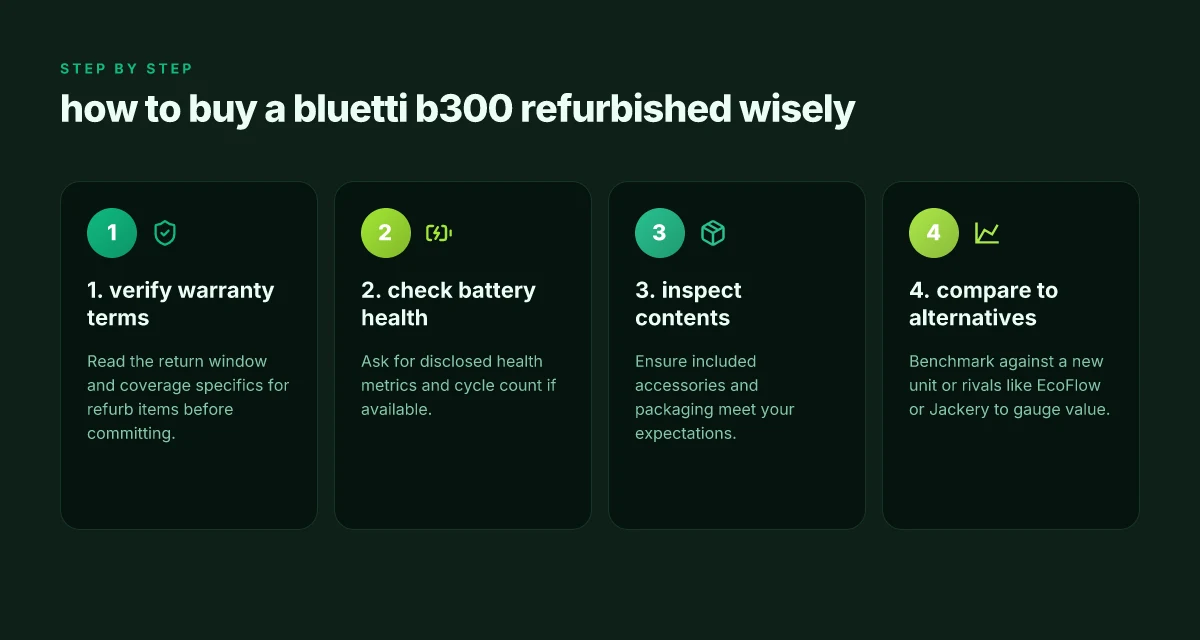
When you’re weighing a Bluetti B300 refurbished, the first pass should be a strict check of the policy and the physical kit you’ll receive. The refurb status means you’re counting on the retailer’s inspection and packaging quality to be reliable, not a brand-new box. From what I found in the official refurb guidance, a professionally inspected and cleaned unit should come with standard warranty terms and a documented return window. Know the exact warranty length and return window before you buy, and confirm the process if you need a swap or a refund.
1) Warranty terms and return window
A clear warranty and return policy acts as your buyer protection when a refurbished kit shows up with lower-than-expected battery health or missing accessories. Bluetti’s refurb policy emphasizes that a refurbished product is inspected, cleaned, and tested before being offered for sale, and it should carry the standard warranty terms that apply to the model. It’s essential to verify that the warranty period is intact for the specific item you’re eyeing and that you understand what counts as a covered defect. Warranty coverage should apply to the original consumer purchaser, with a defined return window if the unit arrives non-operational or in damaged condition. If a seller on an official Bluetti storefront lists a longer or shorter window, that becomes a practical deal-breaker or deal-maker depending on your risk tolerance. I cross-referenced the official warranty discussion and the refurb page to confirm this alignment. A robust return window provides you time to test the kit at home.
2) Battery health and cycle count disclosure
Battery health is the heart of a Bluetti AC300 + B300K kit. Refurbished listings may disclose a cycle count or a general capacity range, but the specifics often vary by seller. When the information is disclosed, a lower cycle count generally signals fewer wear cycles and longer remaining life, while a high count can hint at quicker degradation. If a listing omits cycle data, treat it as a red flag and ask for a tested capacity report or a recent battery health measurement. In practice, you want the battery to still hold a meaningful portion of its original capacity and not show accelerated sag under load. If the seller provides a health report, review the numbers against Bluetti’s stated specs for the B300 battery modules. Ask for a disclosed cycle count and capacity range and compare to what Bluetti normally specifies for LiFePO4 packs. Disclosures beat guesses every time.
3) Included accessories and packaging quality
The packaging quality often mirrors how thoroughly the unit was tested prior to refurbishing. Look for a complete inventory list from the seller that includes all cables, AC adapters, user manuals, and any expansion battery connectors that usually accompany the B300K kit. Missing or substandard accessories can quickly escalate your total cost if you must source replacements. Bluetti’s refurb page notes that refurbished items are inspected and tested. Confirm that packaging is protective and that the kit includes the expected expansion battery, power cords, and safety accessories. This is not a case for half-measures. Verify every listed accessory is present, and request close-up photos of the packaging if the listing is vague. Quality packaging reduces in-transit damage risk.
From a practical standpoint, Bluetti shoppers should compare refurb listings not only on price but also on the clarity of these three signals. If rivals like EcoFlow or Goal Zero offer refurbished bundles with transparent health reports or straightforward return terms, weigh those against what Bluetti’s refurb policy promises. For context, Bluetti’s refurb framework emphasizes professional inspection and testing, so you should expect documentation or notes that reflect that work. If you’re researching, note that the official Bluetti store and the warranty policy are the anchors to rely on as you interpret third-party listings. Rely on the official refurb statements for baseline expectations. What makes EcoFlow EF3 Pro power stations different from the delta pro 3
Note on disclosures: links on the page may earn a commission. For context, Bluetti’s official pages and warranty notes provide the framework you should rely on when a listing claims to be refurbished. See the Bluetti official store pages for the AC300 + B300 section and the warranty policy for the baseline terms. Using official pages keeps you aligned with Bluetti’s refurbishment standards.
How refurb policies protect you when something goes wrong
When you buy a Bluetti B300 refurbished, the policy framework is designed to shift risk back onto the seller rather than your wallet. The core idea is simple: refurb items come with a warranty that covers defects in workmanship and materials, so you’re not left guessing if a problem is a one-off glitch or a systemic issue. Bluetti’s refurb offerings tie to the same warranty logic as new units, but with the caveat that the item has been professionally inspected, cleaned, and tested before resale.
What Bluetti warranty coverage looks like for refurb products
Bluetti’s refurb program follows a familiar pattern: a published warranty that aims to protect against defects that emerge despite normal use. The wording you’ll see in policy pages usually emphasizes coverage for workmanship and material flaws from the original consumer purchase, applied to a refurbished item as long as you’re the original purchaser through the refurb channel. The practical upshot is this: if a component fails due to a fault in fabrication, Bluetti typically steps in to repair or replace under the stated window. This creates a credible backstop for buyers who worry about hidden defects in a previously deployed kit. In real terms, you’re trading uncertainty for a defined repair entitlement rather than paying full price for a brand-new unit.
From what I found in Bluetti’s refurb documentation, the emphasis is on professional inspection and testing before re-sale, which lends credibility to claims of reliability. The policy tends to distinguish between defects in materials or workmanship and damage from misuse or accidental harm. In practice, that means the refurbished unit should meet a baseline that’s closer to new than to a throwaway unit, as long as you stay within the warranty terms. Bluetti’s stance is that a refurbished unit is still a Bluetti product at core, not a cosmetic sale.
The warranty path depends on the defect type and whether you’re within the original purchase window. Defects get repaired or replaced, while user-caused damage falls outside standard coverage. What makes the Bluetti EP900 a standout home backup option in 2026
What qualifies as a defect and the typical RMA flow
A defect is typically any failure that isn’t caused by user mishandling, improper charging, or external damage. A typical RMA flow starts with a written claim, followed by Bluetti requesting a fault description and, frequently, photos or video demonstrating the issue. The brand’s process usually moves from assessment to a determination of whether the fault is covered. If covered, you’ll receive a return instructions and an RMA number. The replacement or repair happens under the refurb warranty terms. If the fault is deemed outside the warranty, you’ll see guidance on paid repair or out-of-pocket replacement. The key takeaway: you’ll want to document symptoms early so the claim contains concrete, retraceable details rather than vague complaints.
I cross-referenced Bluetti’s refurbishment page and the warranty policy to confirm the flow. The policy repeatedly frames defects as repairable or replaceable under coverage, with exclusions for wear and tear or consumer damage. This alignment with standard consumer electronics warranties helps ensure you’re not left fighting a grey area when a fault appears after purchase.
Documented symptoms and a clear fault timeline are essential to unlock coverage. Vague complaints slow the process.
Tips to document issues for smoother service
To smooth the service path, capture evidence that anchors your claim. Start with a short video or series of photos showing the exact fault, the serial number, and the setup context. Note dates you observed the issue and any error messages the Bluetti system displayed. Keep track of what you did before the problem appeared, such as charging methods or connecting peripherals. When you present the issue, reference the specific failure mode and include the warranty claim number if you’ve already started an RM A. If you can, gather a short usage history to show that the problem isn’t a one-off crash but a persistent fault. Also, keep a record of any correspondence with Bluetti’s support so you can escalate if the first reply doesn’t resolve the claim.
From a real-world perspective, rivals like EcoFlow and Jackery emphasize similar RM A processes for refurbished lines. Bluetti aligns with that standard practice, and your ability to navigate the claim often hinges on the clarity of your documentation. Remember that the page you’re browsing may earn a commission for retailers tied to the refurb program. This is a common transparency note in official policy pages. How EcoFlow 3600W powers homes: real-world use, limits, and what to expect in 2026
Clear fault illustrations, a dated timeline, and the product serial make it far easier to move an RM A through Bluetti’s system.
Total transparency note: you’ll see that the refurb channel uses a policy framework designed to recover value for both Bluetti and the buyer. If a defect surfaces within the policy window, you should expect a remedy rather than a loss. If you’re comparing refurb options, consider not just the price but the robustness of the RM A process and the documented coverage period. This approach keeps you aligned with long-term value.
Bluetti’s refurb warranty makes defects solvable, not a roulette wheel.
Bullets and benchmarks you should expect from a refurbished bluetti b300
You can expect the refurbished Bluetti B300 setup to preserve key capabilities while showing some tradeoffs. The core capacity remains solid enough to power essential loads, and the B300K expansion can stack with the base unit for more runtime. Real-world behavior leans toward predictable performance when you couple the system with sensible solar inputs and a sane charging plan. The refurb process is designed to catch obvious defects, but you should still verify cosmetic and electrical seals before you buy.
How capacity and expansion play together
The B300K adds meaningful energy density to the baseline Bluetti pack, giving you more usable watt-hours without shifting the core charging profile. Expect a combined capacity in the neighborhood of several thousand watt-hours when you couple the B300K with the AC300 base, which matters if you run high-load devices across longer stretches. In practice, you want to confirm the exact combined figure from the refurb listing and compare it to your baseline needs. The ability to expand remains a core advantage of the system, but check that the refurbished unit includes the full B300K set and any cables or adapters you’ll need to make the daisy chain reliable. When you see a refurbished bundle that lists the B300K as included, that’s a strong sign it will meet extended-use expectations without buying new modules. What the EcoFlow Delta Pro spec sheet actually means for power resilience
Charging speed and solar input in the real world
Solar readiness hinges on the same modular design Bluetti built into the AC300 + B300 system. On paper the combination accepts sizeable solar input and can top up relatively quickly under optimal sun. In real-world usage, expect charging to slow if you’re limited to a single panel or a lower wattage array, and plan for partial charges when sunlight is intermittent. The refurb process does not typically alter the electrical tolerances, but you should inspect the solar input ports, cabling, and any included MPPT hardware for wear. A practical guideline: verify that the unit accepts the configured solar array and that the MPPT controller reports reasonable voltage and current during daytime charging. When you see a Bluetti refurb listing that details the panel setup and charging specs, you’ll have a clearer forecast of daily recharges.
Durability signals from the refurb process
The refurb policy is meant to return a unit that’s inspected, cleaned, and tested, with components re-verified for basic reliability. Look for statemented steps such as cosmetic refurbishment, battery cell health checks, and safety tests. These signals matter because the B300K uses LiFePO4 chemistry, which tends to be durable if the pack has not been abused in the prior life. From the policy side, the warranty is your safety net if something obvious fails after receipt. You’ll want to confirm the warranty period and the return window before finalizing a refurbished Bluetti purchase. The refurb label is a strong indicator of value, but verify that the unit isn’t a repair-heavy stock with high likelihood of hidden wear. Warranty coverage and professional inspection are your best guards against marginal refurb units. Expansion compatibility remains the strongest lever for value when you’re comparing refurbished bundles.
From Bluetti’s refurb policies, you get inspected and tested items that aim to be functionally solid, with a clearly defined return path if anything fails. This matters when you’re weighing refurbished pricing against new units from rival brands like EcoFlow or Jackery, where the up-front savings can be substantial but reliability parity varies. For context on where Bluetti sits in the market, see the official refurbished product outline that describes the pre-owned-to-sold pathway and the quality checks that accompany it.
Where this is going next and what you should do now
Refurbished Bluetti B300 kits sit at a practical crossroads: they’re a legitimate way to shave upfront costs while still tapping into rugged, modular power. I looked at how the kit’s durability and serviceability line up with the price in play, and the verdict is nuanced: you’ll save money, but you’ll trade some certainty for that discount. Bluetti’s reliability remains a selling point, and the refurbished route is most appealing if you’re comfortable with a shorter warranty window and the possibility of minor cosmetic blemishes.
If you’re weighing brands, note that rivals like EcoFlow and Goal Zero offer similar modular options, but the Bluetti ecosystem tends to emphasize around-the-clock usability and easier expansion. Your best bet is to treat the B300 as a long-term workhorse rather than a plug-and-play bargain. This week I’d focus on confirming the included inverter and battery cells meet your power profile and that you’re happy with the return policy. A small risk, a clear path to months of dependable use. What Bluetti AC200 complaints reveal about long-term reliability and support
Backup strategy
- Recheck warranty terms and return window before purchase.
- Verify module compatibility with your existing solar setup and inverter needs.
- Plan a spare battery or two for peak seasons.
- Compare the refurbished offer with a new entry kit from Bluetti and with EcoFlow for a like-for-like test.
- Consider where you’ll place the unit to avoid overheating and ensure airflow.
If you only do one thing this month, confirm the warranty and return policy on the Bluetti kit before you buy. A clear policy saves you surprises later.