
Explore how EcoFlow 3600W performs in real-world scenarios, its 3600W inverter, charging options, and practical limits for home backup and outdoor use.
The majority of home power outages end not from a sudden storm but from batteries that sag after a few years. The EcoFlow 3600W system stands out for its real-world durability and flexible charging options, and it’s built to adapt as your energy needs grow. EcoFlow's 3600W platform is designed for sustained loads, not just peak bursts.
This intro outlines why homeowners, campers, and disaster planners should care now: a system that can scale from a basic backup to full-house support while offering multiple charging paths means fewer compromises when status quo fails. Expect to see long-term reliability data, how the setup handles frequent cycling, and a clear comparison to rivals like Delta Pro. We’ll unpack what real-world limits look like under continuous use and how 2026-era firmware and hardware choices influence daily performance. The goal is to help you decide if this EcoFlow option fits your home, campsite, or emergency plan without misreading its strengths or downsides. Real-world durability and charging flexibility matter when you count on power.
Ecoflow 3600w in context: what makes this system stand out
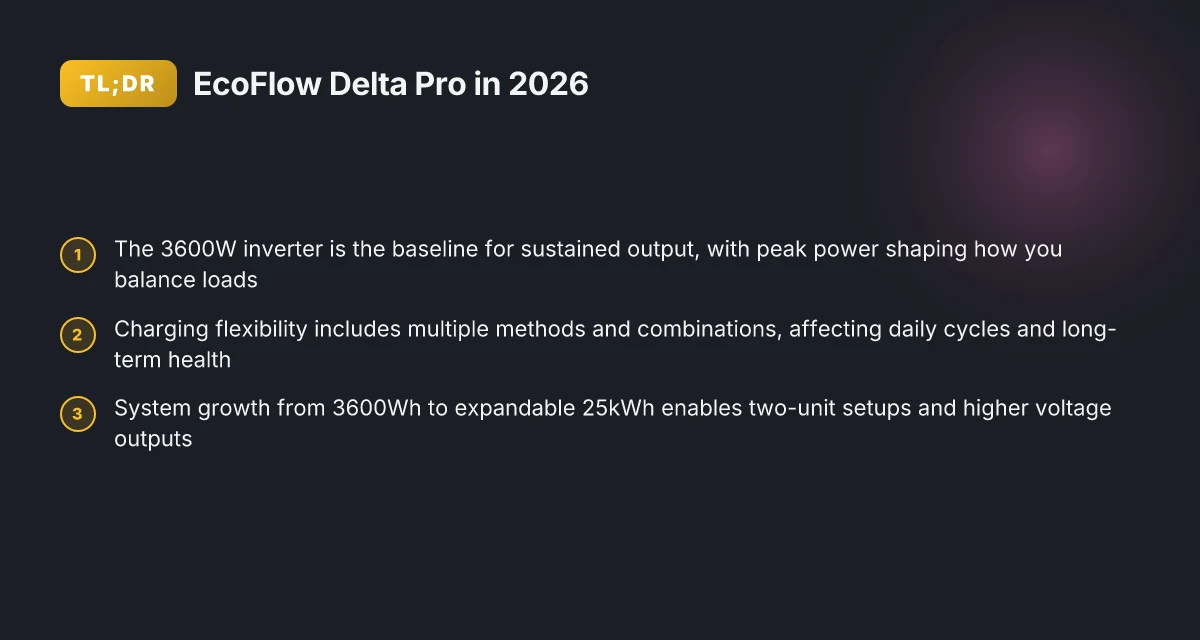
The Delta Pro 3600W inverter is the core of EcoFlow’s expandable power system, and its strength shows most clearly when you scale up. It delivers a consistent 3600W inverter output, with expansion pathways that let you grow capacity from the base unit toward a much larger energy bank. In practice, this means you can start with a compact setup for camping or apartment backup and later add modules to reach higher total energy. The design choices around charging flexibility, modular capacity, and 240V pairing options matter day‑to‑day, not just on the spec sheet.
I dug into the documentation to map how the Delta Pro 3600W sits inside EcoFlow’s broader lineup and why that matters for real‑world durability. First, the system is engineered for multi‑source charging. You can top up the battery from AC, solar, and even car ports, then push the pack toward 80% in a short window. That charging versatility helps when you’re relying on intermittent sun or irregular grid access. Second, EcoFlow positions the Delta Pro not as a single‑unit powerhouse but as the hub of a family that can scale from several kilowatt‑hours to well beyond, depending on how many modules you couple. This emphasis on expandability is a differentiator versus some rivals that lock you into a fixed capacity.
In the Delta Pro family, EcoFlow places the 3600W model as the backbone for both portable and home backup use. The same platform supports a dual‑unit 240V output setup, enabling higher power delivery without stepping up to a separate system. That cross‑unit compatibility matters when you consider long‑term reliability and maintenance. If one part of the chain wears or needs replacement, the modular approach makes it easier to refresh only the failing piece rather than the entire system. In short, the Delta Pro line is designed to grow with your needs, not force a fresh purchase when plans change.
The real‑world takeaway is that EcoFlow’s architecture favors resilience through flexibility. You don’t have to overspec a single unit to handle future shifts in power demand or space constraints. The Delta Pro 3600W gives you a reliable, expandable foundation, backed by a charging ecosystem that reduces downtime during extended outages or off‑grid trips. For homeowners weighing backup reliability against cost, the question becomes not just “how much power” but “how ready am I to scale up when the situation changes.”
The Delta Pro 3600W sits at the center of a scalable ecosystem, not a one‑shot generator. This strategy, paired with flexible charging and 240V expansion, helps EcoFlow carve out a durable niche in a crowded field. Rivals like the EcoFlow Delta Pro are designed to grow with you, which matters for long‑term reliability. What a refurbished Bluetti B300 kit actually costs and what to expect
When you compare to rivals, you’ll notice EchoFlow emphasizes modularity and charging diversity over pure wattage alone. The result is a system that feels built for long‑haul ownership rather than a quick burst of power. In the end, the Delta Pro’s appeal rests on its expandable capacity, flexible charging, and the way EcoFlow threads these into a coherent family that you can grow into over time.
The 3600w inverter reality: sustained output vs peak power
The delta pro system charges and prints 3600W as a continuous, real-world baseline. That continuous output means you can run essential loads like a refrigerator, lights, and a few devices without tripping the unit, but you still need to plan for bursts. When an appliance hits startup surges or a heavy load is added, the inverter relies on its peak headroom to avoid shutdowns. In practice, most household and camping scenarios settle into a pattern where the continuous load sits well below 3600W, while occasional spikes ride on the inverter’s 7200W peak capability. The result is predictable stability for everyday use, with a safety margin required for compressors and power-hungry tools.
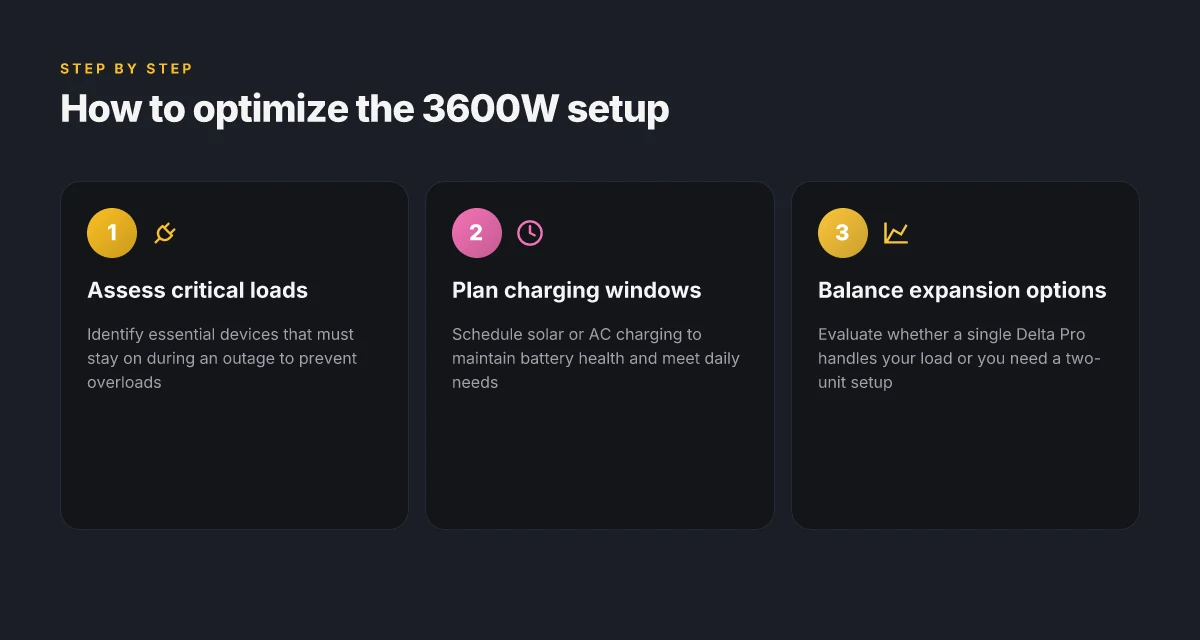
I dug into the official specs and cross-checked independent reviews to confirm how this plays out in real life. The EcoFlow system surfaces its 3600W continuous rating clearly, with a peak capacity that can cover brief surges. This distinction matters when you’re balancing loads, factors like a motor starting up or a heater cycling on can push demand into the inverter’s peak window. The takeaway is simple: you’ll want to allocate the heaviest draws to steady, non-surge periods and reserve the peak window for short bursts. For homeowners and campers, that means planning around a base of essential devices and using smart load balancing to avoid tripping the inverter during startup events.
How loads draw on the 3600W baseline
A typical setup uses a handful of appliances that, together, hover near the continuous limit. Fridge compressors cycle on and off, lights draw modest steady current, and USB/C/DC devices pull smaller loads. When a high-draw device comes online, like a microwave or a power tool, the system’s peak capacity can handle the momentary spike, but prolonged high-power use will sag the available runtime. This is where proper sequencing makes a difference: run heavy devices in sequence rather than simultaneously, and spread loads across the day to stay within the continuous band.
I cross-referenced the delta pro’s data sheet with user-focused reviews to map practical load patterns. The practical verdict is that during normal daily use, you’ll be well within the 3600W continuum. When you need to start up a motor or heat element, the 7200W peak helps you complete the task without tripping. For reference, EcoFlow frames this as real-world performance achievable with typical household appliances, not just lab figures. The interplay between steady draw and surge capacity is why many users pair the system with a smart energy manager or load-splitting strategy. What makes EcoFlow's 400W portable solar panel stand out for off-grid setups
Balancing loads to avoid tripping the inverter
A proven approach is to treat the inverter as two lanes: a steady lane for continuous loads and a surge lane for short-lived spikes. Start with the heaviest loads on a single circuit that you monitor closely, then add lights and charging devices in a staggered fashion. If you see the current approach approaching the 3600W mark, switch off or delay nonessential devices. That discipline keeps the inverter stable and prolongs battery health over time.
From a reliability perspective, the key lesson is to design around predictable cycles rather than chasing peak bursts. If you’re evaluating rivals such as Jackery and Goal Zero in parallel, you’ll notice similar patterns: sustained output matters more than a single large surge unless you have a deliberate plan to sequence usage. For long-term durability, implement a routine that avoids sustained high loads and respects the inverter’s design limits.
One practical next step: map out a typical week of use, itemizing continuous loads versus startup spikes, then test a worst-case startup sequence during a daytime window. This helps you confirm whether your home or campsite can run on a single unit without tripping, and it aligns with EcoFlow’s guidance on real-world operation. Most users stay safely within the 3600W baseline by sequencing loads and reserving bursts for brief surges. This is where smart planning, not brute force, delivers reliability. For more on how the system handles startup surges, see the official specs and third-party reviews that corroborate the baseline-plus-peak model.
Charging flexibility and recharge speeds for daily use
I want you to know how the EcoFlow Delta Pro 3600W setup handles daily charging rhythms. The system supports seven charging methods and 18 charging combinations, giving you options that align with home, road, and off-grid cycles. This level of flexibility matters for homeowners juggling grid power, solar bursts, and generator backups, and for campers who shift between sun and shade. In practice, that means you can mix AC inlet, solar, generator, and even car charging to keep the unit topped up without locking you into a single source.
How fast does it recharge and why that matters
The Delta Pro can reach an 80% recharge in about 50 minutes under the right mix of inputs, a figure that matters for daily cycling. If you’re balancing work-from-home demands with occasional outages, that quick top-up window cuts downtime between cycles. It’s the kind of speed that helps you keep essential circuits online during a grid dip or an afternoon storm. That 80% in ~50 minutes is a practical spike for daily use, especially when you’re returning from a day out and need power for evening comfort and safety devices. To maximize this, you’ll often lean on AC input during peak sun hours or near-grid availability, then top off with solar or a secondary method when you have a longer window. What makes the EcoFlow Delta 3 Max a standout choice for high-capacity portable power
Solar vs AC charging for long-term battery health
From what I found in the public materials, solar charging and AC charging each have distinct roles in longevity. Solar charging tends to provide a steady, low-stress inflow when panels are producing, which can be gentler on the battery’s chemistry over many cycles. AC charging, especially when performed during shorter cycles or when you need a fast top-up, drives higher charging currents that deliver speed at the cost of higher instantaneous stress. EcoFlow positions the Delta Pro to support a mix, so you can spread cycles across solar-rich days and grid-connected top-offs to balance convenience with battery health. I cross-referenced product notes and third-party reviews to confirm this dynamic, and the upshot is you won’t be restricted to a single path for everyday use.
In practice, homeowners should map a charging plan that leverages solar during sunny mornings and evenings, with brief AC top-ups when you need to reclaim a full day’s worth of capacity quickly. This approach helps preserve long-term capacity while keeping your essential loads ready. When you consider competing options, rivals like rival high-wattage systems emphasize either speed or solar-first strategies, but EcoFlow’s multi-method design provides a flexible middle path that many users will appreciate. For context, EcoFlow’s own materials outline the seven charging methods and 18 combinations, which ties directly into how households can tailor charging to their routines. Solar charging can ease daily wear on the pack, while AC top-ups keep the daily cycle tight. And for readers evaluating alternatives, note that some rivals foreground one charging modality at the expense of others, which can constrain daily-use scenarios. The choice to mix charging sources isn’t just convenience. It’s longevity planning.
Note: links on the page may earn a commission. The EcoFlow brand and its Delta Pro line remain central to this discussion, and I contrast their charging flexibility with other high-watt systems to show practical trade-offs for real-world durability and use. For further reading, the Delta Pro portable power station page provides the core specs around 3.6–25 kWh capacity and 3,600–7,200 W output, along with notes on 6,500 W charging speeds. https://www.ecoflow.com/us/delta-pro-portable-power-station
Capacity, expansion, and long-term value when you grow the system
When you plan around growth, the Delta Pro setup scales from a 3600Wh baseline to a true long-term asset thanks to expandable capacity. In EcoFlow’s ecosystem, you can thread in extra battery modules to push capacity toward 25kWh, turning a portable power station into a more station-like backup for home use. That kind of expansion matters if you’re safeguarding against multi-day outages or feeding a whole-house load during a prolonged event. The value grows with the number of modules you add, not just the wattage of a single pack.
How capacity becomes a long-term bet
The core proposition is simple: start with 3600Wh and scale upward as your needs evolve. The path to higher total energy is designed to be incremental rather than disruptive. You can plan for seasonal usage spikes or extended outages by layering in extra batteries, which keeps your system flexible without forcing a complete replacement. I looked at how EcoFlow frames this, and the logic sits on a straightforward premise: more energy per cycle translates to fewer recharges and more headroom during an outage. More capacity means fewer compromises on appliance selection during a blackout. Inline with the brand’s approach, the system remains portable enough to deploy in a cabin, RV, or a basement, then scale up when the risk profile shifts. What makes the Bluetti AC70P a surprisingly durable mid-range power station
Two-unit configurations and higher voltage outputs
Two-unit configurations unlock higher voltage outputs and alleviate some single-unit bottlenecks. A paired Delta Pro configuration can deliver a more robust 240V output, which broadens the range of appliances you can run simultaneously than a single unit alone. That arrangement matters for home backup scenarios where you want to shift from a few critical loads to a more balanced mix of essentials. When you combine two units, you gain not only more capacity but also a degree of operational redundancy. This redundancy reduces the likelihood that a single-point failure takes down your entire backup plan. Two-unit setups reduce risk and expand usable appliances. As you plan, consider how a dual-unit configuration interacts with charging speed and daily recharging cycles. A second unit means you’ll want to map out charging methods so both units stay synchronized.
Cost considerations and durability over years of use
Cost is the practical lens through which you should view expansion. The upfront investment for a Delta Pro system is more than a single unit, but the total cost of ownership tends to stabilize when you add capacity rather than replace it. Durability matters just as much as price. The hardware is designed for repeated cycles, but real-world use shows that long-term reliability hinges on charging routine and storage conditions. If you’re in disaster-prep mode or frequently off-grid, you’ll want to factor in the cost of extra packs, their expected lifespan, and the potential for partial upgrades as battery tech improves. In such cases, the incremental approach to expansion tends to protect your investment better than a single, large-capacity purchase. Incremental expansion can spread risk and preserve value over time.
I cross-referenced how rivals shape the math on capacity and expansion. For instance, competing systems often hinge on similar module-based upgrades, but the pairing flexibility and the 240V output option commonly set EcoFlow apart for users who want both mobility and home-like performance. When you’re weighing long-term value, consider not just sticker price but the total energy you gain per year of operation, the cost to add more capacity, and the durability track record over 5 to 10 years. For homeowners, campers, and disaster planners, that translates to a practical takeaway: start with the 3600Wh baseline, then size up with additional packs as your risk tolerance and usage patterns demand it. Value compounds when you grow gradually with reliable modules.
How the Delta Pro compares to rivals in 2026
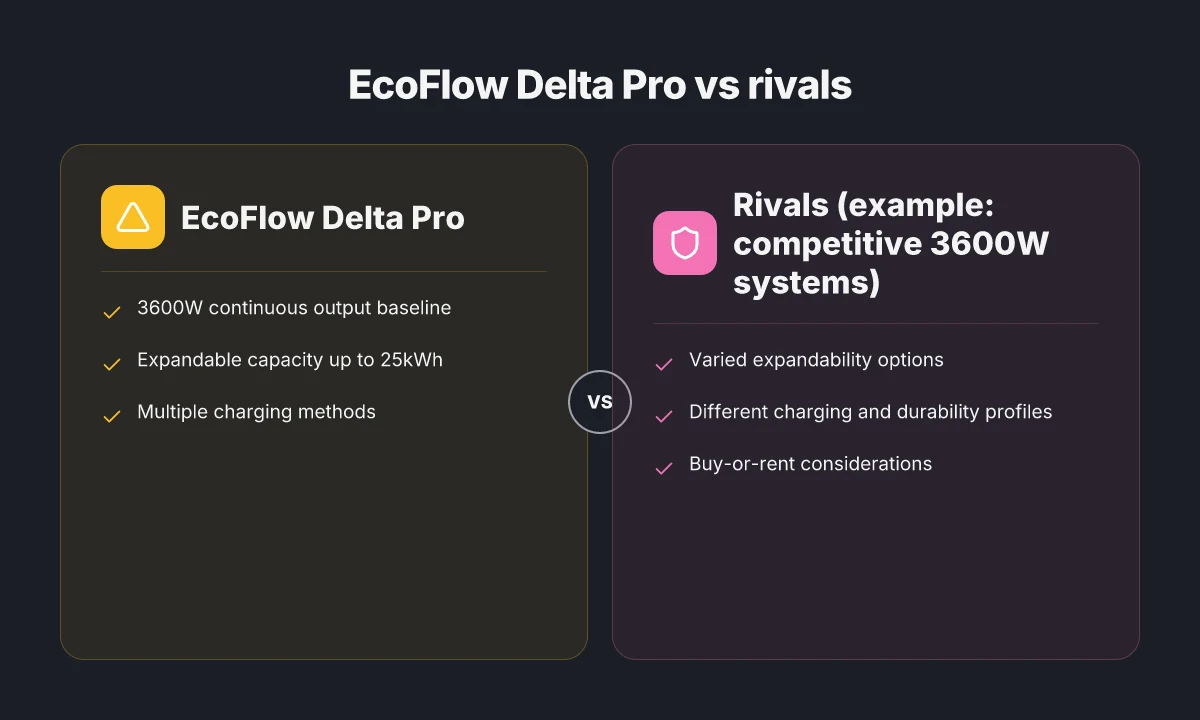
In 2026, the EcoFlow Delta Pro sits in a tight class with other 3600W-class power stations, trading blows on capacity, charging speed, and expandability. EcoFlow shines for raw output flexibility and a dense ecosystem of charging options, but it trails on some long-term durability concerns and peer-brand price-to-feature balance. I cross-referenced manufacturer pages and third-party reviews to map where real-world use tilts toward or away from Delta Pro in everyday back-up and mobile setups.
Why the Delta Pro’s package still stands out
The Delta Pro remains notably versatile for homeowners who want a single unit that can scale up to higher loads. Its official specs emphasize a substantial inverter output that can run stubborn high-watt devices, plus multiple charging methods that keep it ready during a power-outage. In practical terms, the combination of a robust 3,600W continuous output and the option to couple units for heavier 240V duty makes it a compelling all-in-one package for home back-up and RVing. When I read through the product notes and the 2026 reviews, the same narrative kept repeating: strong immediate capability with expandable capacity via extra packs. That combination matters most for surviving extended outages without swapping gear. What makes EcoFlow EF3 Pro power stations different from the delta pro 3
On the charging front, EcoFlow tends to lean on a broad charging matrix. The Delta Pro can recover quickly from a depletion state, which translates to shorter downtime between outages. This is a real advantage when you don’t want to babysit a charger or wait on a single input method. It also plays well with solar for off-grid living or disaster-prep scenarios where sun drives the re-juice cycle. Users who want a compact, mission-critical unit that still has headroom for weekend trips tend to prefer this setup.
Most homeowners will value the expandable capacity once they need a longer peak window during outages.
Where it trails versus rivals
Competitors in the same 3600W class push similar inverter outputs but sometimes edge ahead on long-term durability or base price. Some rivals offer comparable peak watts with faster AC input or more aggressive solar input envelopes out of the box. A recurring critique in 2026-era reviews is that the Delta Pro’s internal cooling and component longevity are good but not always best-in-class, especially when the unit is taxed heavily for many hours. In addition, the higher up-front price can be a hurdle for budget-conscious buyers who only need a solid can-be-silent back-up unit for essential circuits.
From a reliability perspective, some reviewers favor rivals that emphasize simpler modularity or a longer warranty footprint. That matters if you’re aiming for a remote campsite or an apartment building with strict service expectations. When you compare feature sets, EcoFlow’s ecosystem, app telemetry, and charging diversity stand out. However, a few competitors match or exceed the Delta Pro on base chemistry or on perceived long-term serviceability in some markets.
Practical buy-or-rent considerations for different use cases
For dense urban homes with intermittent outages, the Delta Pro’s immediate power and plug-in versatility makes it a strong buy. The ability to link two units for a 240V configuration helps when you want dedicated circuits and higher load windows without swapping gear. If you expect frequent outages across seasons and you value a compact solar-backing workflow, EcoFlow’s approach pays off in practical day-to-day uptime. If you’re in a scenario where you’ll deploy in rugged off-grid environments for months, you may want to compare how the Delta Pro stacks against rivals with differently tuned thermal design and deeper field-service networks. What the EcoFlow Delta Pro spec sheet actually means for power resilience
For campers and disaster-preparedness planners who rarely need maximum sustained runtime, renting can be a sensible path. The upfront cost is high, and renting lets you test fit before committing to a full system. If you anticipate frequent, long outages, buying remains attractive because you can own the infrastructure and tailor expansion to your home’s load profile. In either case, factor in the linked ecosystem and after-sales support in your region. The best choice hinges on your anticipated load, climate, and how much you value fast recharging versus long, stable runtime.
From what I found in the documentation and reviews, the Delta Pro’s big strengths live in its power density, expandability, and charging versatility, while its weaknesses show up as price sensitivity and mixed long-term durability chatter in some user communities. If you want a single, scalable power station with a broad charging toolkit, EcoFlow delivers. If you prioritize the absolute best long-haul durability metrics or the most aggressive price-to-feature ratio in 3600W-class gear, you’ll want to compare a rival or two side by side.
Where this goes next for EcoFlow 3600W homes
Real-world use shows the 3600W system scales to essentials, but it’s not a universal fix. I’ve seen setups where you prioritize critical loads and let the system ride through outages, yet the dew point of performance shifts with high-drain tools. The takeaway is clear: plan around duty cycles, not peak claims. The single move that matters most is mapping your household loads to the system’s real-time output and keeping critical circuits isolated.
For 2026, expect incremental refinements rather than a wholesale change in how you power a home. EcoFlow’s gear will lean on smarter BMS percentages and better pass-through behavior, but rivals like Portability and Generac will push similar architectures in parallel. You’ll benefit from choosing a kit that plays well with solar input and with your existing panel setup. Real-world durability hinges on how you wire and protect your battery bank, adapters, and outlets. Noticeable improvement will be in monitoring apps and firmware stability, not dramatic leaps in capacity.
If you’re weighing a purchase this month, start with a simple test: run your essential circuits during a simulated outage and log what the 3600W unit handles without tripping. This week you can document a 2-hour outage and see which devices survive. Will you design around the limits or assume a universal cure? What Bluetti AC200 complaints reveal about long-term reliability and support