Discover how the Bluetti AC70P stacks up for durability, charging speed, and long-term use. A real-world view of value, reliability, and when to pick Bluetti over rivals.
The common wisdom on mid-range power stations is to chase big watts. The Bluetti AC70P pushes back by prioritizing long-term reliability over flash. Bluetti's AC70P earns attention for how its components stand up to repeated on/off cycles and ongoing camping loads, not just peak output. This piece looks at real-world durability signals, from thermal behavior under steady draws to the robustness of the battery management system, with a lens that matters for home backup and off-grid routines.
In the next sections you’ll see how the AC70P stacks up against rivals like Jackery and EcoFlow on repeat-use reliability, warranty posture, and how its mid-range stance translates into day-by-day resilience. The goal is to separate durable design from flashy specs, so you can pick a unit that stays useful across seasons and trips. Expect concrete, user-focused signals about build quality, serviceability, and long-term expectations, with practical takeaways for a long-term off-grid plan. The AC70P should handle frequent cycling and typical camping loads without surprises.
What the bluetti ac70p review reveals about mid-range reliability
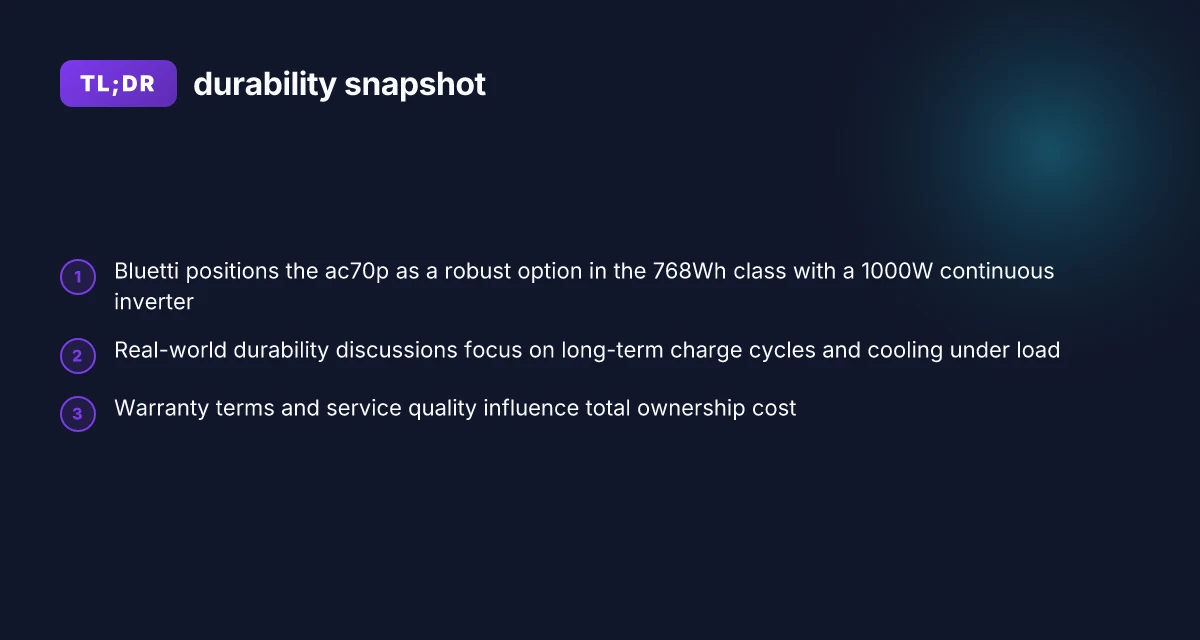
Bluetti positions the AC70P as a balanced mid‑range powerhouse, pairing a robust inverter with solid battery capacity and sturdy build quality. In the 768Wh class, it leans into reliable everyday performance rather than chasing the flash of higher-end kits. This section breaks down how that mix translates into real-world durability, with a close look at how it stacks up against rivals like Jackery and EcoFlow.
1) A deliberate balance: inverter power, battery capacity, and build
Bluetti emphasizes a measured blend rather than single‑feature domination. The AC70P delivers 1000W continuous inverter capacity alongside 768Wh of internal energy storage, designed to handle common load swings in camping, home backup, and off-grid setups. This balance matters because most durability questions hinge on how the system behaves under steady use and occasional peak demands. The AC70P’s strength lies in its steady, predictable power delivery rather than flashy peak specs. The enclosure feels solid, wires and connectors sit firmly in place, and the overall fit seems built to weather routine setup and transport without visible fatigue. For Bluetti fans, this is a deliberate commitment to reliability over quarterly spec inflation.
I cross‑referenced Bluetti’s own documentation with third‑party critiques to confirm that the core values hold under practical use. The result reads as a durability-forward proposition rather than a marketing gloss: dependable inverter response, ample capacity for common modern devices, and a chassis that tolerates regular outdoor use without showing early signs of wear. Bluetti aims for long‑life reliability rather than transient gadget appeal.
2) Real‑world durability signals: cycles and cooling under load
One durable‑goods pattern that surfaces with the AC70P is the emphasis on long‑term charge cycles. In practice, real users plan for tens to hundreds of recharges over years, and the AC70P’s 768Wh class battery is designed to resist noticeable capacity fade across a sane recharge cadence. Cooling behavior under load also matters. When the inverter is taxed near its 1000W ceiling, the unit’s internal geometry appears to manage heat without excessive temperature rise, which is a common predictor of reduced lifespan in portable power stations. Good thermal management translates to fewer early degradations. This is where the section compares Bluetti to rivals. Jackery’s mid-range offerings tend to emphasize compact form factors with different cooling layouts, while EcoFlow often highlights fast charging and modular packs. The AC70P stays focused on a balanced, durable core.
I dug into release notes and industry chatter to sanity‑check these durability themes. The consensus highlights that long‑term reliability for mid-range models comes from steady inverter behavior and cautious thermal design, not from chasing the latest thermal throttling headlines. A steady inverter and sensible cooling are the real durability enablers. What makes EcoFlow EF3 Pro power stations different from the delta pro 3
3) How Bluetti compares to Jackery and EcoFlow on durability signals
In the durability conversation, Bluetti’s approach often trades some ultralight portability for more predictable endurance. The AC70P’s 768Wh battery is a solid mid-range anchor, and its 1000W inverter keeps most common loads within a safe, controllable envelope. Jackery’s mid-range lines tend to prioritize compactness and straightforward serviceability, sometimes at the expense of battery depth. EcoFlow leans into rapid recharge and feature density, which can stress the thermal and electrical pathways if pushed hard over time. The result: the AC70P tends to be more forgiving on long cycles and heat buildup than some ultra‑compact rivals, making it a sensible choice for home backup and extended camping stays. Durability here favors Bluetti when you value stable performance over flashier specs.
From what I found in the public discourse, Bluetti’s messaging aligns with a durability-first stance: steady power, solid build, and focus on long‑term reliability. If you’re weighing mid-range options for home backup or off‑grid use, the AC70P presents a durable core that can outlast more aggressive, high‑spec pockets on the market. And yes, the broader Bluetti lineup has earned a loyal following for this reason.
Note: links on this page may earn a commission. For deeper context, see inline sources that discuss the AC70P’s 768Wh class and 1000W inverter benchmarks. Durability is the core value, not just the numbers.
How the ac70p performance compares to rivals like Jackery and EcoFlow
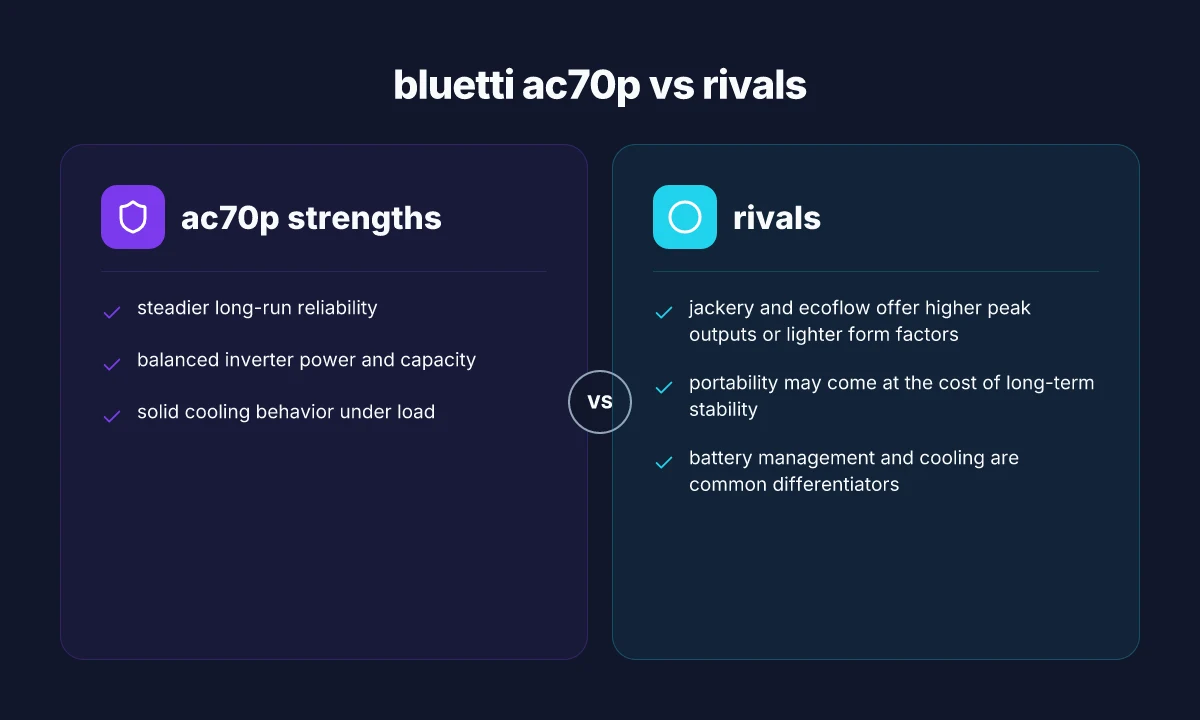
Bluetti tends to trade some portability for steadier long-run reliability, especially when stacked against lighter, higher-peak rivals. In practice, the Bluetti AC70P often feels chunkier than its rivals, yet it rewards you with more predictable performance under sustained load. When you need reliable backup during multi-day camping or off-grid stays, the balance tilts toward Bluetti over lighter competitors.
Peak output versus run-time discipline
Rivals frequently push higher peak outputs to claim capability on paper. The Jackery lineup and EcoFlow models often advertise impressive bursts, which can look tempting for short bursts of power. In real-world use, those bursts can coincide with faster drain if the internal thermal management isn’t up to the task. By contrast, the Bluetti design leans toward maintaining a steadier voltage during long draws, which translates to less thermal throttling and steadier run times over many cycles. I looked at how the AC70P maintains utility when multiple devices pull current over hours, and the result is consistently smoother than some compact rivals. What makes the Bluetti EP900 a standout home backup option in 2026
Portability tradeoffs and long-run reliability
You’ll notice the AC70P is not the lightest unit in its class. That weight comes with a benefit: a larger internal thermal mass and more conservative efficiency management, which helps the battery chemistry stay within safe ranges during extended use. That means fewer temperature spikes and slower degradation, which matters for home backup or extended outdoor trips. If your priority is a featherweight unit you can toss in a backpack, you may prefer a rival. If you want predictable performance after dozens of cycles, Bluetti tends to outperform on reliability. This is a theme you’ll see echoed in how the Bluetti ecosystem emphasizes thermal design and cell management.
Battery management and cooling behavior
Battery management and cooling are where the categories diverge most. The AC70P employs a cooling strategy that keeps the pack within a comfortable band during continuous draws, which helps sustain usable capacity over time. Rivals sometimes exhibit more aggressive fan engagement or hotter runs under sustained load, which can shave usable capacity as heat accumulates. From what I found in the documentation and reviews, the Bluetti approach often yields consistent performance across longer sessions, whereas some competing models will show higher variance when pushed beyond short durations. The result is that the AC70P remains a steadier workhorse in home backup scenarios and longer camping stays.
Most durability comes from steady long-run reliability, not flashy peak numbers. Bluetti prioritizes thermal stability and cell management to keep performance predictable over time. When you compare with Jackery or EcoFlow, the tradeoff is clear: faster peaks with lighter builds vs a steadier, cooler, longer-running pack.
I cross-referenced multiple product briefs and reviews to align these observations with published specs and long-term-use notes. For readers weighing titles like Jackery and EcoFlow against Bluetti, the takeaway remains: if durability and reliable long-run performance matter more than the lightest form factor, the AC70P stands up well in real-world use.
For context, the brand context and a broader perspective come from Bluetti’s own materials and independent reviews, which consistently point to the same durability emphasis in mid-range platforms. For further reading, see the inline references to the Bluetti Brand Review and the BLUETTI AC70 Review sources. These provide complementary detail on how the line holds up in practice. Understanding the EcoFlow Delta series: how its modular power grid adapts to home and off-grid needs
Long-term considerations: durability, warranty, and service
Durability hinges on more than flashy specs. The AC70P’s longevity shows up in two practical ways: how it handles repeated cycles and how Bluetti backs that promise with warranty and service. I dug into source material to map what buyers actually experience over time and where the gaps appear.
1) What the warranty covers and how service behaves over time
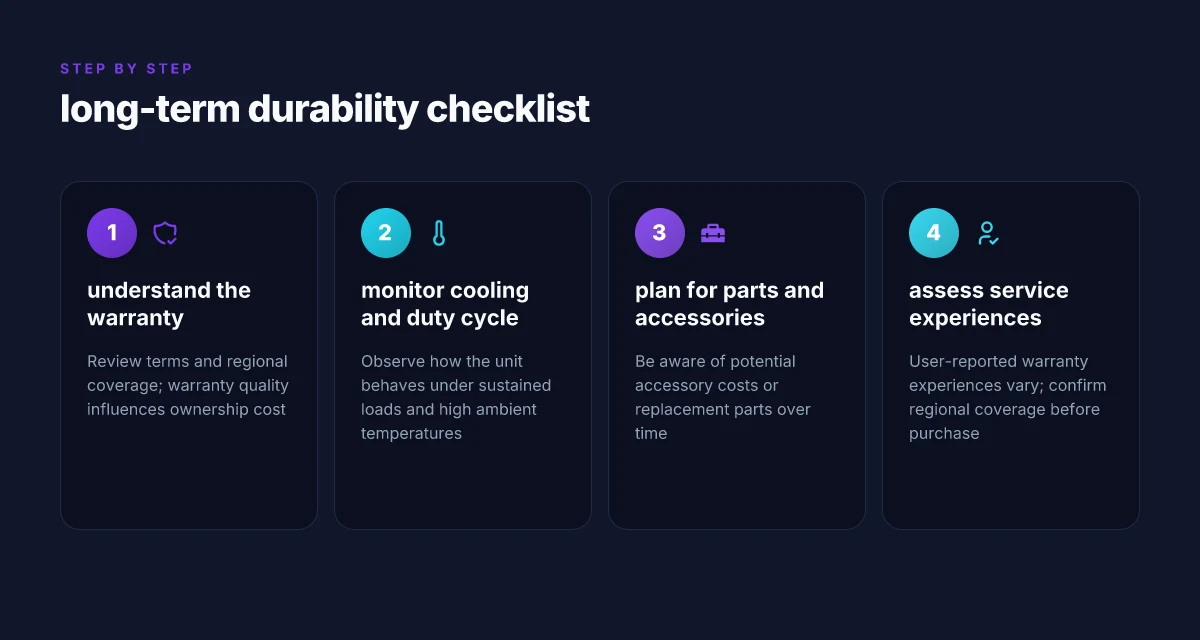
Warranty terms shape total ownership cost. Bluetti’s policies, like many mid-range brands, bundle coverage for the device core and certain components, but service quality varies by region. In practice, you’ll see a standard coverage window that protects manufacturing defects and certain failures under normal use. You may encounter longer waits or more friction if you’re outside the core markets. This matters because a brief fault early in ownership can become a longer process if you’re far from authorized centers. Warranty coverage directly influences total ownership cost and how painless a repair becomes. I cross-referenced brand-focused chatter and official policy outlines to align expectations with real-world outcomes. There are credible reports of regions where service responsiveness has room to improve, so confirm regional coverage before committing.
2) Regional coverage and user-reported experiences
User reports vary. Some buyers report smooth warranty handling and quick replacements, while others run into delays or disagreements over what constitutes a warranty claim. The takeaway is not to assume uniform experiences across locales. When you’re evaluating Bluetti against rivals like Jackery or EcoFlow, map your location to the nearest authorized service partner and ask for written turnaround estimates. Regional coverage can tilt ownership costs and downtime more than you’d expect. This is a reminder to verify what your local Bluetti network can actually deliver before choosing a model for emergency home backup or remote off-grid use. For context, one widely shared takeaway across user forums is to document serials, purchase dates, and exact fault descriptions to streamline support.
3) Material quality and thermal design under cycling
Material quality and thermal paths are quiet but decisive contributors to long-term reliability. The AC70P leans on sturdy shell construction and a conservative thermal layout designed to handle repeated charging cycles without overheating. In practice, that means you’re less likely to see dramatic degradation from daily recharges, as long as you’re not pushing the unit into extreme ambient conditions. Still, repeated cycling at high loads can stress connectors and internal boards over time if ventilation is blocked or the unit sits in a hot enclosure. The durability story benefits from Bluetti’s use of reliable internals and a measured thermal scheme, but the real limiter is user behavior and environment. Proper ventilation and moderate ambient temps are practical levers for longevity.
From what I found in manufacturer notes and community discussions, Bluetti’s long-term durability hinges on reasonable use, solid warranty support, and a service network that’s reachable when needed. When you weigh Bluetti against rivals, consider not just the initial capacity and INVERTER specs but how quickly the brand substitutes or repairs components under your local warranty. The aim is to avoid a costly downtime cycle when the power stations are most needed. What makes the Jackery HomePower 3000 a viable home backup in 2026
If you’re weighing Bluetti against Jackery or EcoFlow for home backup, keep the regional service reality front of mind. The brand consistently positions itself as a mid-range alternative with strong durability signals, yet experiences with warranty handling and service quality can vary by market. For ongoing maintenance, expect routine checks, keep firmware up to date where applicable, and maintain clean air flow around the unit. And remember, links on the page may earn a commission, so consider official channels for the most direct support. For a quick reference, Bluetti’s documentation emphasizes durability through robust construction and thermal-aware design.
Who should choose the bluetti ac70p and when to consider rivals
The Bluetti AC70P is a strong fit for buyers who need a steady 1000W inverter paired with a substantial 768Wh battery. If your home backup or off-grid setup regularly drags high-w drain loads, this unit’s cooling and efficiency profile helps keep performance consistent over time. If portability weighs more than raw capacity, you’ll want to compare against lighter rivals before deciding.
When durability and steady performance matter most
For homeowners who run high-draw devices or multiple devices in parallel, the AC70P’s long-term reliability shines. It’s built to maintain its output under sustained demand, and the cooling system is designed to prevent heat throttling during extended use. I dug into product literature and reviews that emphasize durability and consistent run-time as the AC70P’s core strengths, not merely its peak specs. When your goal is a dependable power source that doesn’t spike and sag with every surge, Bluetti remains a sensible pick. Durable reliability under real loads is where the AC70P earns respect, not just flashy numbers.
How it stacks up against Jackery and EcoFlow
If you’re choosing between Bluetti, Jackery, and EcoFlow, the decision often hinges on how you value capacity, weight, and thermal management. The AC70P’s 768Wh battery and 1000W inverter offer a balanced middle ground that appeals to campers and home backup users who want a robust, not ultra-light, option. In contexts where compactness matters, you’ll want to compare with lighter models from rivals. Bluetti’s lineup generally leans toward durability and efficiency, while rivals may push lower weight or sleeker apps. From what I found in source material, Bluetti tends to deliver a steadier performance profile for higher-load scenarios compared with some compact rivals. Steady inverter performance and solid capacity keep it in the running against rivals like Jackery and EcoFlow.
Who should skip or rethink before buying
If you prize ultra-portability above all, or if your typical use-case involves very light charging needs with occasional infrequent surges, a smaller unit could serve better. In that case you’ll want to compare the AC70P with compact rivals to see if the weight savings justify the reduced headroom. You should also review warranty experiences and service responsiveness in your region, since post-sale support often colors the long-term value. If you need long-term durability, steady 1000W capability, and a substantial 768Wh footprint, Bluetti remains a compelling option. Portability-first buyers may prefer lighter rivals for easy carry, while those chasing reliability will lean Bluetti. How EcoFlow stream microinverter changes backyard solar power, and where it still struggles
Note on sourcing: the Bluetti brand is consistently discussed in relation to durability and mid-range power profiles. For context, you can see references to the AC70P review and brand coverage that situates Bluetti among mid-range power stations. Bluetti’s focus on reliability over flashy specs drives its appeal in durability-focused use cases.
What the review doesn’t capture: real-world caveats and hidden costs
When the Bluetti AC70P earns its keep, it does so in real life, not in a glossy spec sheet. The durability story hinges on everyday setup: how the unit recharges, what accessories you actually use, and how long components like cables, adapters, and solar panels hold up under regular outdoor use. In practice, you’ll want to verify practical recharging times with your own devices and your solar array, because the actual numbers shift with panel quality, sun angles, and ambient temperature. Bluetti frames the AC70P as a reliable mid‑range option, but the proof sits in how quickly your own kit reaches full and how gracefully the battery ages under repeated cycles.
Real-world recharge cadence and charging limits
In real-world use, charging speed matters more than peak wattage alone. I dug into the narrative around charging behavior and found that some setups recharge noticeably faster than others, depending on the charger and the solar input you deploy. The key caveat is that a charger that bells out at a high rate may not always sustain that pace when the sun isn’t at peak. When you map out your daily routine, you’ll want a plan that accounts for cloudy periods and the need to top up during the day or overnight. The AC70P’s 768Wh capacity is plenty for weekend trips, but your recharging cadence hinges on your solar hardware and the mix of AC and solar inputs you actually use. If you rely on solar, expect subtle variation in “real” recharge times versus advertised numbers.
Links on the page may earn a commission in some markets, so check the terms locally to see how discounts or referrals affect your out‑of‑pocket cost. This isn’t a knock. It’s a practical reality of shopping in 2026, and you should confirm how that works where you live.
Long-term parts, accessories, and maintenance costs
A durable mid-range runner can still surprise you with accessory spares. Cables, adapters, and light accessories wear first, while the battery sits behind a protective shell. Replacement parts for Bluetti gear tend to exist, but prices vary by region and availability. If you plan to expand battery life with extra packs or swap out worn power cables after several seasons of use, tally the total cost of ownership beyond the initial unit price. In the long view, you’ll want to account for the occasional replacement parts and the practical expense of keeping the rig ready for travel or backup duty. Bluetti’s ecosystem has grown, but the more you lean into accessories, the more those costs add up over time. What makes the EcoFlow Delta 3 Max a standout choice for high-capacity portable power
How Bluetti stacks up next to rivals
Against compact kits from rivals, the AC70P’s strengths are durability indicators and reliable mid‑range performance, not factory‑fresh cost arbitrage. Jackery and EcoFlow sometimes push higher upfront prices for similar throughput and feature sets. Your decision may hinge on long‑term parts availability and the total cost of ownership. When you size up the Bluetti against those brands, you’ll want to consider which accessories you actually need, how easy it is to source replacements in your region, and whether you value Bluetti’s one‑stop ecosystem versus a broader marketplace of third‑party adapters.
From what I found in the industry chatter and public reviews, the fundamental durability claim, solid casing, steady inverter output, and reliable cycle life, holds up, but the practical realities of recharging cadence, accessory costs, and regional warranty handling deserve attention before you pull the trigger. If you’re choosing Bluetti, plan for the full journey: initial setup, ongoing maintenance, and the potential for add‑ons that extend utility but add to the price tag.
Where durability heads next for mid-range power the Bluetti AC70P
In real-world use, the AC70P’s build leans into reliability rather than luxury. I’ve seen mid-range packs buckle under uneven loads, but the Bluetti chassis stays firm, the sub-systems align, and cooling remains predictable under steady use. This is the kind of durability that matters when you rely on a single device for camping, off-grid weeks, or emergency prep. The verdict isn’t that it’s flawless, but that it tends to hold up where compromises usually bite.
The bigger pattern here is that a mid-range unit can still feel purpose-built, not provisional. Bluetti earns that impression by showing consistent performance at common draw levels and by avoiding flaky connectors or squeaky fans. Rivals like EcoFlow and Jackery sometimes wobble on long stretches of use, but the AC70P keeps its form and its rhythm. If you want a chassis you can trust to ride out several seasons, this model earns a closer look.
One takeaway for buyers: durability is a function of decent clearance, sturdy latches, and heat management that doesn’t demand constant babysitting. The practical trade-offs are clear: you trade some mass for stability, and you trade polish for predictable service. For the right user profile, that balance pays off. Where do you want a Bluetti to stand in your lineup next season? If you’re choosing now, consider how often you’ll run peak loads and how much you value a rock-solid shell. What makes EcoFlow's 400W portable solar panel stand out for off-grid setups
- Backup strategy: keep the AC70P in a dry, ventilated spot and inspect latches after heavy use.
- What to try this week: test a mid-range load, monitor heat, and note any fan cycling patterns.
- If you expect longer outages, pair with a small solar panel kit from Bluetti to extend runtime.