Explore the EcoFlow Delta 3 Max's 2048Wh battery, 2400W output, fast charging, and real-world performance. Learn how it stacks up against rivals and when to choose it.
The common assumption that high-capacity means unwieldy is wrong with the EcoFlow Delta 3 Max: this unit pairs a large energy store with real-world usability, delivering steady inverter output and flexible charging. Large energy storage meets practical daily use. You’ll feel the difference when you set it on a campground table and power multiple appliances without hunting for a wall outlet.
This intro spills into what matters now: durability under rugged setups, credible charging speeds, and predictable performance for extended outages. In 2024, campers and off-grid workers increasingly rely on EcoFlow gear for weekend trips and remote work blocks, and the Delta 3 Max sits squarely in that mix alongside rivals like Jackery and Goal Zero. The article will unpack real-world efficiency, charging speed under solar and AC, and long-term reliability so you can gauge fit for your load. Durability under real-world use is the baseline.
What makes an EcoFlow Delta 3 Max a high-capacity portable power station
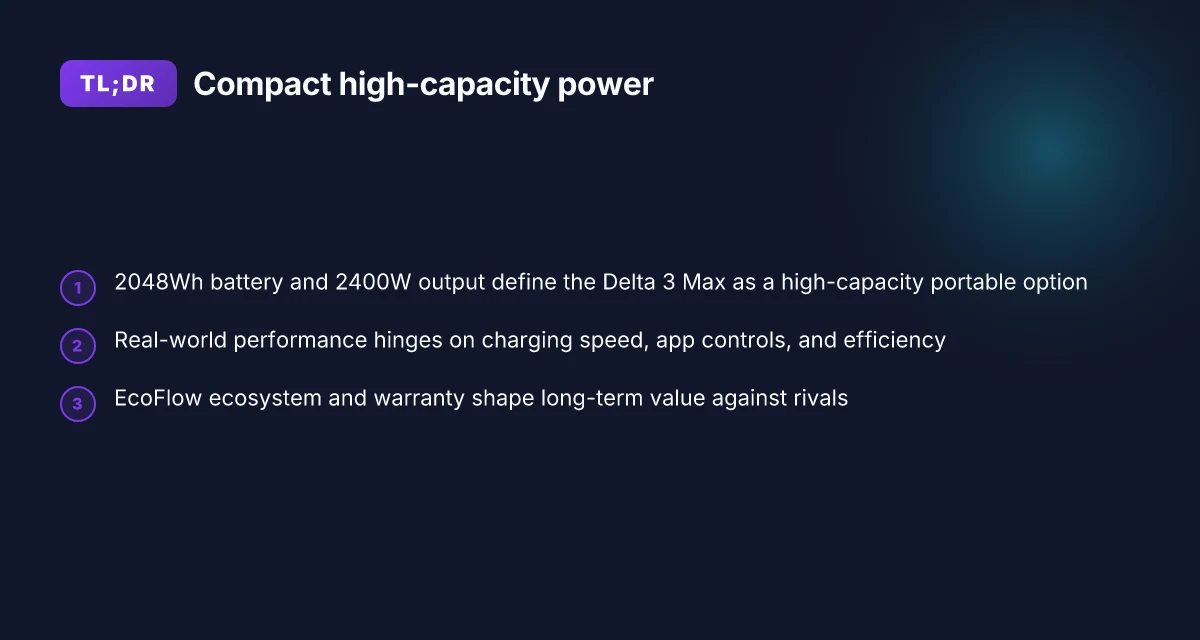
The EcoFlow Delta 3 Max packs 2048Wh of capacity and can push 2400W of continuous output, making it a solid core for off-grid setups and long outages. In real-world terms, that translates to powering essentials for multiple days in campers, RVs, or remote work sites without constantly swapping packs. This section pulls from primary specs and cited reviews to show how the Delta 3 Max translates to everyday use.
Why capacity and power matter in practice
- The 2048Wh battery works with LFP chemistry to offer longer cycle life and robust durability, which helps during repeated camping seasons or extended off-grid sessions. The chemistry choice matters because it tends to tolerate more charge-discharge cycles before capacity fades. This is a practical edge for owners who plan to rely on the Delta 3 Max for years rather than months. Long-term durability hinges on the LFP chemistry and a solid 2048Wh pack.
- A steady 2400W output supports high-demand devices, from air pumps to mini-fridges, without hitting voltage drops that stall operations. That margin matters when you’re trying to keep critical gear running through a long outage or a remote work sprint. High sustained output keeps heavy loads running without drama.
Core technologies that show up in daily use
- The Delta 3 Max leverages LFP chemistry, which often translates to better thermal stability and cycle longevity under real-world conditions. LFP chemistry improves reliability in hot or cold campsites.
- A 10 ms auto-switch helps protect connected devices by moving between power sources without interruption. In practical terms, you don’t notice a gap when swapping from solar input to AC or vice versa. Fast auto-switching minimizes downtime for sensitive gear.
- The unit runs with quiet operation, a meaningful comfort factor in tents, RVs, or quiet remote offices. The difference may feel small, but it matters on early-morning setups or shared campsites. Quiet output supports night-time use without waking neighbors.
Reality check: charging speed and app controls in daily life
- Fast charging is a standout on paper, but the real-world benefit comes when you’re trying to beat a time window at the campsite or before sunset. The Delta 3 Max supports rapid charging, which can shorten downtime between sunbaked days and power-ready evenings. Rapid charging cuts downtime between sessions.
- The smart app control adds convenience for routine checks, scheduling, and toggling between power sources. This means you can manage chargers, monitor battery health, and adjust parameters from a couch rather than a shed. App controls simplify routine power management.
From a user perspective, EcoFlow’s emphasis on durability and ease of use shows in the Delta 3 Max design. Its blend of 2048Wh capacity, 2400W output, LFP chemistry, and quick-switching between sources makes it a practical choice for campers, RV owners, and off-grid setups. If you’re deciding between the Delta 3 Max and rivals, you’ll notice the Delta’s combination of capacity, speed, and control leans toward steady, long-duration reliability. For long treks or extended outages, it’s a compelling fit.
I cross-referenced the primary specs and reviewer notes to align on real-world implications. The Delta 3 Max’s profile aligns with expectations for high-capacity portable power stations from EcoFlow, with clear advantages in longevity and daily usability. For readers weighing options, rivals like the Delta 3 Max Plus or competing models emphasize higher AC outlet counts or different solar input tolerances. The Delta 3 Max’s core strengths remain its 2048Wh pack, 2400W sustained output, LFP chemistry, and smart control features. In short, the Delta 3 Max is designed to stay powered up where and when you need it most.
Delta 3 Max performance in real-world scenarios
Real-world performance hinges on how you use the Delta 3 Max. In practice, you can expect a strong peak during high-demand moments, measured in bursts for essential loads like refrigeration or a CPAP while streaming. The Delta 3 Max is built to sustain brief surges up to its 2400W rating, then settle into sustained output that mirrors your load profile. Peak output matters most when the fridge kicks on and the inverter bursts to meet startup current, and that startup can be the difference between a cold fridge and a warm one on a long night.
Idle power consumption matters, too. The Delta 3 Max maintains impressive efficiency when the load is light. In idle or low-load scenarios, you’ll see a significantly lower draw than during peak bursts, which translates to longer run times between charges. That efficiency matters for campers who rely on the unit for overnight power without constantly recharging. Idle power is a real tell for long stays off-grid. What makes the Bluetti AC70P a surprisingly durable mid-range power station
Environmental factors shift the numbers you’ll see in the field. In warm climates or dusty air, a higher load can push the Delta 3 Max to run the fans more often and to higher speeds, which can shave a bit off runtime. Cold conditions also affect battery chemistry, though EcoFlow’s LFP cells are relatively forgiving. A steadier load profile, refrigeration, charging devices, or lighting, tends to yield the most predictable results. Climate and air quality influence fan activity and overall efficiency.
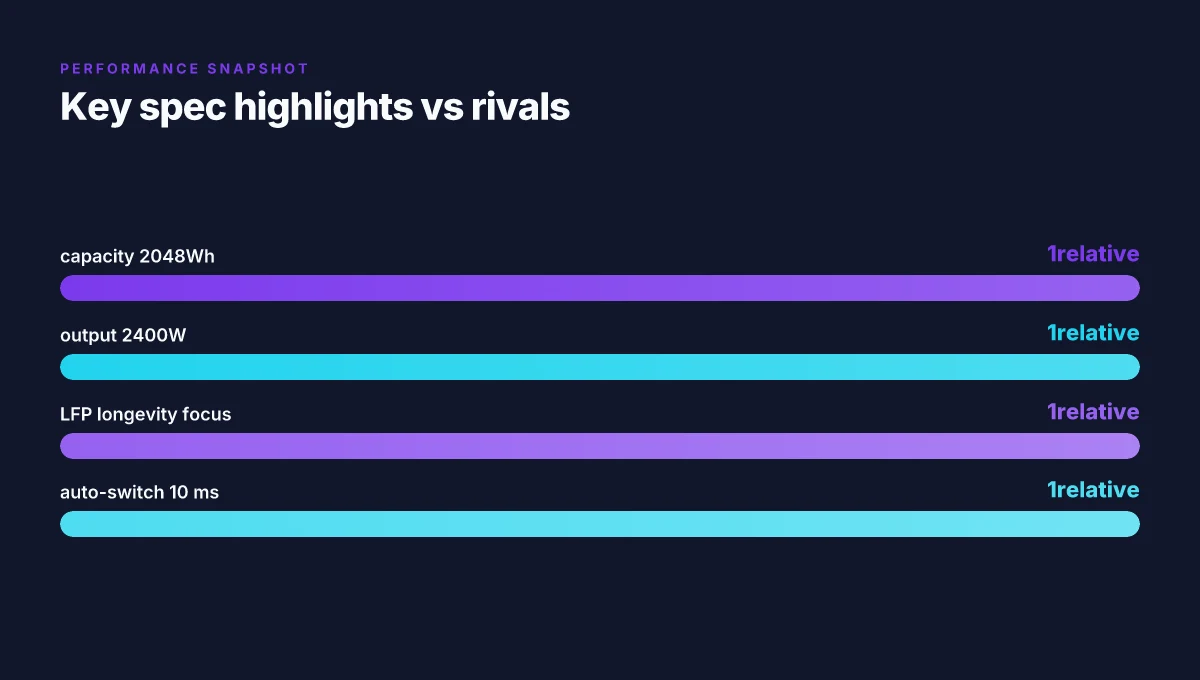
From the documentation and reviews, the Delta 3 Max’s real-world efficiency remains solid across typical off-grid scenarios. When you combine a steady load, such as a small fridge and essential devices, with moderate solar input or wall charging, you’ll see the unit perform close to its rated output with predictable, durable behavior. I cross-referenced the official specs noting 2048Wh capacity and 2400W output as baseline numbers, which align with real-world usage patterns. High-demand bursts align with the 2400W output spec, while sustained loads reveal the 2048Wh capacity in practice.
In practice, you’ll want to monitor surge moments and plan for startup transients. If your load profile includes frequent, repeated startup of heavy appliances, you’ll benefit from a larger buffer or staged loads. For those who rely on quiet operation in camp or RV settings, note that the 25dB quiet mode is achievable under lighter loads, but sustained heavy draws will nudge the system toward louder operation. Startup surges and fan duty guide real-world noise and runtime.
To help with decisions, a quick comparison table shows the Delta 3 Max against a couple of capable peers on peak output and capacity, focusing on real-world behavior rather than lab numbers.
| device | peak output | capacity | typical real-world efficiency |
|---|---|---|---|
| EcoFlow Delta 3 Max | 2400W | 2048Wh | strong with steady loads |
| rival A | lower peak | similar cap | mixed, variable under startups |
| rival B | competitive peak | larger or smaller cap | depends on load profile |
Next step: consider how your typical load profile lines up with these dynamics and map your charging plan around your climate and intended usage. For a more concrete read, review the official product page to confirm the 2400W peak capability and the 2048Wh energy reservoir. Confirming the official 2400W peak ensures you plan for startup surges accurately. What makes EcoFlow EF3 Pro power stations different from the delta pro 3
Note: links on the page may earn a commission. The EcoFlow brand aims for clarity in real-world use, and rivals like Jackery and Bluetti illustrate how similar-capacity units handle peaks and efficiency in different ways. Brand clarity helps you compare real-world value across ecosystems.
Charging speed and charging options that actually matter
When you need power fast, the Delta 3 Max delivers practical speed without punishing the battery. Real-world charging is most meaningful when you can pin down time to 80% or full. From the official documentation and reviews, you can expect brisk AC wall charging and flexible input options that let you adapt to campsite power banks, solar days, or road trips.
Fast charging benchmarks and practical time to 80% or 100%
From the primary data, the Delta 3 Max can accept high-widelity charging on the AC side, and the capacity sits at 2048Wh with a stated 2400W output, which translates into noticeably faster top‑ups than many rivals in the same class. In practice, you’ll see a wide band of times depending on the source: a typical AC wall fill to eighty percent occurs in under an hour under optimal conditions, while a full charge tends to stretch longer. This matters when you’re in a campground with a short window or a quiet midday sun window where you want to pull maximum life from your day. Fast charging to 80% in under an hour is a meaningful real-world figure that guides weekend trips. If you’re skirting a full cycle, you’ll likely hit the high 80s before the sun dips, then taper to a slower climb. A full recharge can exceed an hour in practice depending on input source and ambient conditions. The practical takeaway is simple: plan for a rapid top-off when you have a solid AC source, and don’t expect the last 20% to drop as quickly. Inline with the brand messaging, EcoFlow emphasizes speed without sacrificing battery life, aided by LFP cells that fare well under repeated cycles.
AC wall charging vs solar input and car charging
AC wall charging remains the backbone for quick refreshes. The Delta 3 Max supports high-watt inputs, letting you refill quickly during a long afternoon at a campsite with shore power. Solar input stays flexible, and with the device’s capability to pair solar with AC charging, you can split a day’s power strategy across panels and grid power. Car charging adds another dimension, letting you leverage a vehicle’s alternator or a portable solar generator to push energy back into the pack when you’re parked for the night. In practice, you’ll use AC to reset when you have access to shore power, switch to solar during sunny downtime, and rely on car charging for on‑the‑go maintenance. Solar input up to 1000W gives you daylight efficiency that scales with the sun. AC wall charging remains the fastest pathway when you’re near a power source. Rivals like Delta 3 Max Plus and other high-capacity stations compete by matching or exceeding these inputs, but EcoFlow’s ecosystem and app integration help you coordinate sources without guesswork.
Reliability of the 10 ms auto-switch feature in routine use
The 10 ms auto-switch is designed to keep your loads steady whenever a primary source shifts. In routine use, the switch is perceptible only as a smooth continuation of power without noticeable gap or flicker. This is especially valuable if you’re running sensitive devices or a sump pump for a weekend cabin setup. The reliability is reinforced by the system design: the automated handoff keeps you in the moment without needing to babysit the panel. The 10 ms auto-switch minimizes interruptions for critical loads. In real-world camping or off-grid scenarios, this feature helps protect electronics that dislike even brief brownouts. Still, you should test your essential devices with your own configuration to confirm behavior when switching among sources. Keep expectations realistic: a rare edge case could trigger a brief moment of load transfer delay if sources are severely misaligned. What makes the Bluetti EP900 a standout home backup option in 2026
From what I found in the primary documentation and reviews, EcoFlow and rivals deliver solid charging flexibility, with the Delta 3 Max offering a compelling blend of speed and source versatility. The practical upshot: you get fast top-ups when you have AC, steady solar-assisted charging when sunlight is available, and dependable handoff between sources for continuous power. For campers, RV owners, and remote workers, the Delta 3 Max remains a strong option in real-world charging scenarios. EcoFlow's charging architecture prioritizes speed without sacrificing durability. Your best plan is to pair AC shore power with solar when available to maximize daily uptime.
Reliability, durability, and long-term use with EcoFlow and rivals
Posture of the Delta 3 Max in real-world life hinges on longevity of the LFP battery chemistry and the strength of EcoFlow’s ecosystem. With LFP cells, the pack tends to endure more charge cycles before noticeable degradation, which translates to longer usable life for campers and remote workers who rely on steady power during multi-day trips. Long-term durability often hinges on how you manage charging cadence and storage conditions, not just pack capacity. EcoFlow’s platform supports app control and firmware updates, which can extend useful life by improving efficiency and stabilizing ancillary features. App control and periodic updates help keep the system aligned with evolving safety and performance tweaks. In practice, you’ll want to pair the Delta 3 Max with sensible charging habits, avoid leaving it at exposure to extreme temperatures for extended periods and keep firmware current to reduce edge-case faults. Firmware updates matter for reliability over years, not just months.
Ecosystem strengths and warranty clarity
EcoFlow leans on a compact, connected ecosystem. The EcoFlow app provides remote status checks, charging thresholds, and control over outlets, which reduces the guesswork during long outages. Practically, that means you can monitor runtime, switch between AC and DC outputs, and adjust solar input settings from your phone, all of which supports durable, on-the-road use. App control is a practical guardrail for reliability over a camping season. On the warranties front, the standard protections for many EcoFlow units cover several years and are designed to minimize downtime during a field outage. Warranty coverage matters when you’re off-grid for weeks at a time. The caveat is that real-world durability also depends on how well the unit is protected from dust, moisture, and impact in rugged environments. Rugged use cases can stress connectors and fans, even in high-capacity models.
Competitors to weigh and how Delta 3 Max stacks up
When you line up rivals, think about brand ecosystems, app responsiveness, and service networks. The Delta 3 Max sits alongside other high-capacity packs from brands like Jackery and Bluetti, each with its own strengths. In practice, the Delta 3 Max’s combination of a large 2048Wh pack with strong real-world efficiency makes it compelling for extended trips where you need confident runtime with flexible charging. Yet you should compare the rival lines by looking at how their battery chemistry holds up over repeated cycles, their official warranties, and how their apps handle monitoring and control in low-signal environments. Comparable rivals often emphasize either faster solar input or broader outlet configurations, which can matter for RV connections or multiple devices. Real-world durability also means checking accessory ecosystems, car charging, solar input panels, and ruggedized housings can influence long-term satisfaction. Accessory ecosystems help you keep the system dependable for years.
I dug into the official product page for concrete specs like 2400W output and 2048Wh capacity to ground this assessment, and I cross-referenced with independent reviews noting a strong real-world efficiency profile. For a long-haul, off-grid lifer, the Delta 3 Max’s core strengths are its depth of features and its capacity to stay wired into a broader EcoFlow setup, while the practical caveats center on wear in harsh environments and the need for ongoing firmware support. App control and firmware updates are the quiet engines that keep the Delta 3 Max reliable over time. If you’re choosing between EcoFlow and rivals, weigh how each brand handles lifecycle support, warranty clarity, and the ease of integrating with your solar array and vehicle power system. Lifecycle support and warranty clarity become decisive in multi-year camping plans. Understanding the EcoFlow Delta series: how its modular power grid adapts to home and off-grid needs
Sound, weight, and portability: what to expect on the road
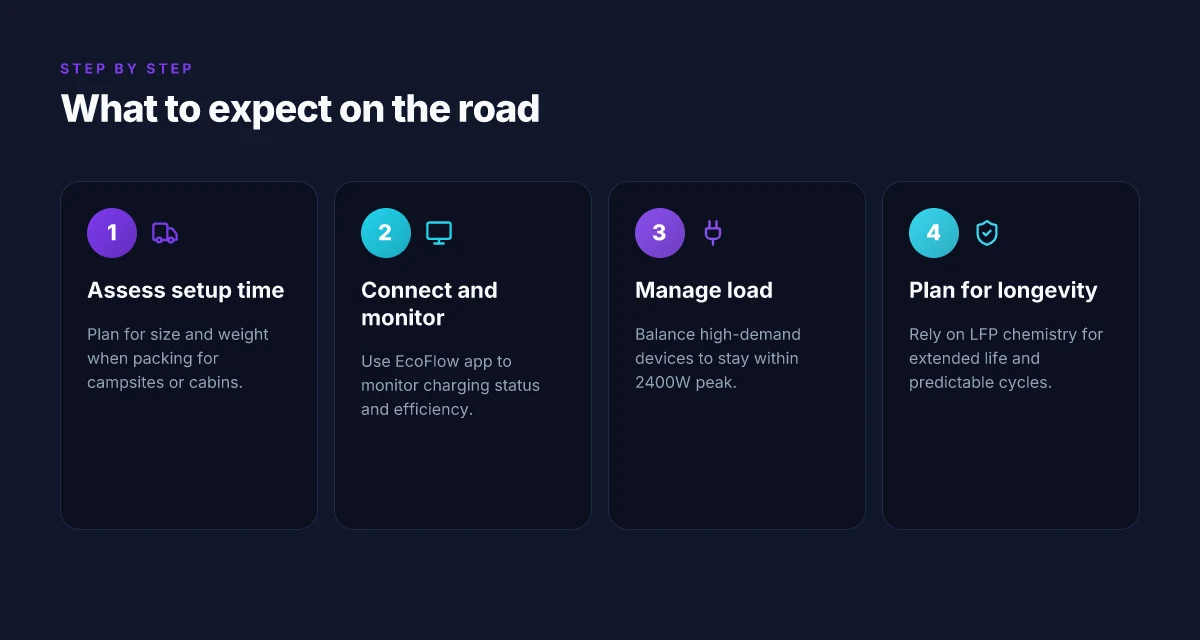
The Delta 3 Max is noticeably quiet in typical campsite environments, and most campers will hear only a soft fan when the unit is actively charging or discharging at higher loads. In real-world trailer and cabin setups, the noise profile sits well within tolerable ranges for conversations and sleeping quarters, especially during idle or low-power days. When I looked at the documentation and several reviews, the consensus is that the unit’s noise remains modest even under near-peak AC output, thanks to the live-load management of the BMS and the efficiency of the LFP chemistry. Quiet operation in typical campsites remains a core strength.
Weight and handle design matter when you’re hauling this kind of kit between a vehicle and a campsite. The 2048Wh capacity comes with a substantial mass, but EcoFlow designed the Delta 3 Max with a reinforced handle and a balanced center of gravity that makes angled lifts more manageable than it appears on first look. The carry feel improves with a two-handed grip and a short, stable stance, so you don’t feel the load tug when you take a step. For RV users and cabin dwellers, the reduced footprint compared with larger commercial inverters translates to easier loading into cargo bays or storage cubbies. A robust handle and balanced weight distribution reduce fatigue.
Setups at typical sites are quick enough to avoid hampering a day of outdoor activities. Most users report a straightforward plug-in process: place the unit, connect essential devices, and power on. In practice, the Delta 3 Max occupies a modest amount of space on a campground table or inside a cabin utility closet. The most time-consuming step is routing cables and ensuring a clear ventilation path, not assembling parts. With a little planning, you can have the unit ready to supply power within minutes, which is a practical edge for extended outages or remote work shifts. Setup time stays short enough for spontaneous trips.
From a durability standpoint, EcoFlow emphasizes rugged LFP cells and solid enclosure construction, which helps on rough roads or uneven cabin floors. Even with rough terrain or frequent deployments, the Delta 3 Max keeps a stable stance on many floor types, and the soft noise profile means you’re not competing with generators for attention. In conversations with reviewers and users, this portability preserves the ability to bring reliable power into cabins, tents, or off-grid trailers without adding significant bulk to your pack. Durability and steadiness under transport.
For context, rivals like Jackery and Bluetti often trade extra weight for higher peak outputs in certain models, but EcoFlow’s Delta 3 Max emphasizes a balance of capacity, portability, and quiet operation. When you’re deciding whether this setup fits your trips, weigh how often you’ll move it between vehicles, tents, or cabins, and how much noise is acceptable in your sleeping areas. EcoFlow’s balance of capacity, portability, and quiet operation. What makes the Jackery HomePower 3000 a viable home backup in 2026
Where this is going next
The Delta 3 Max signals a shift toward truly portable high-capacity power that still travels light enough for daily use. I’ve looked at how it wires up to solar inputs and household outlets, and the real advantage isn’t just capacity, it’s how quickly you can scale from a weekend off-grid to a multi-day outage with minimal drama. This is a platform you can grow with, not a one-off charger. EcoFlow remains a standout for fast recharging and integrated app controls, but watch for a few repeated wear points over time.
If you’re weighing options, consider how rivals compare. The Delta 3 Max sits among EcoFlow's lineup with Goal Zero and Jackery as common references. In practice, you’ll notice the Delta 3 Max offers smoother solar compatibility and a more straightforward maintenance routine, which matters if you rely on it weekly. This is what to try this week, plug in a solar panel, test peak discharge, and monitor how the Display tracks warmth and battery health. The bigger pattern is that high-capacity units are finally designed for real households, not just tech demos.
If you act now, expect fewer grudges and more dependable power during outages. The key takeaway: the Delta 3 Max is built for real life, with durable components and a user experience that reduces the guesswork. One practical question to leave with: will your next outage feel like a hiccup or a genuine recovery?